Future of Blockchain
Global Technology Outlook
Srinath Perera, Ph.D.
VP Research WSO2, Apache Member,
srinath@wso2.com | @srinath_perera
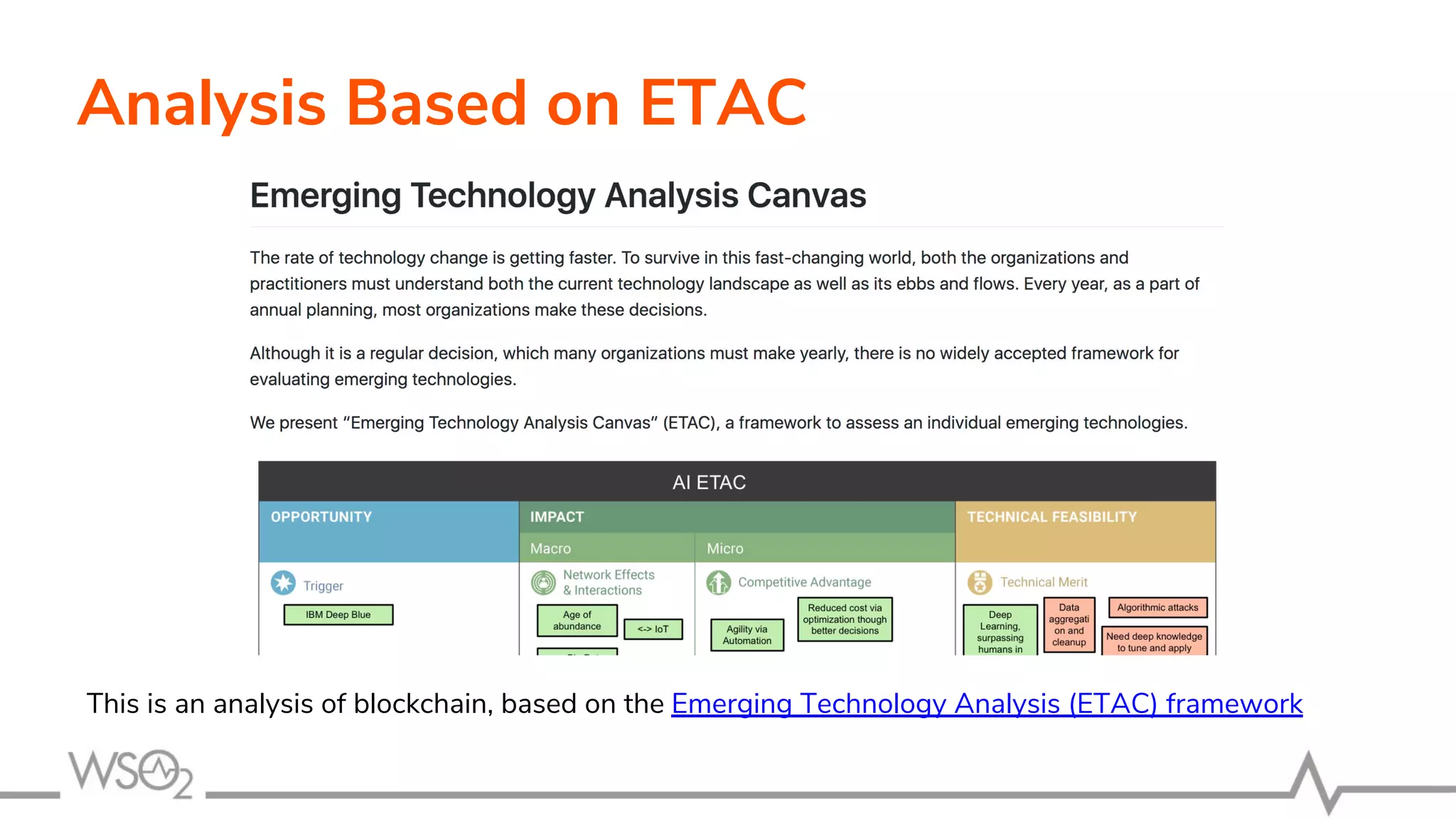
Analysis Based on ETAC
This is an analysis of blockchain, based on the Emerging Technology Analysis (ETAC) framework
Impact?
● Replace current alternatives to trust that are time-consuming,
expensive, and weaker (e.g. intermediaries and government
inspections.)
● It is faster, often establishing trust within a second
● It is much more secure, guarded by cryptography algorithms
and census data
● The resulting system is cheaper and more agile
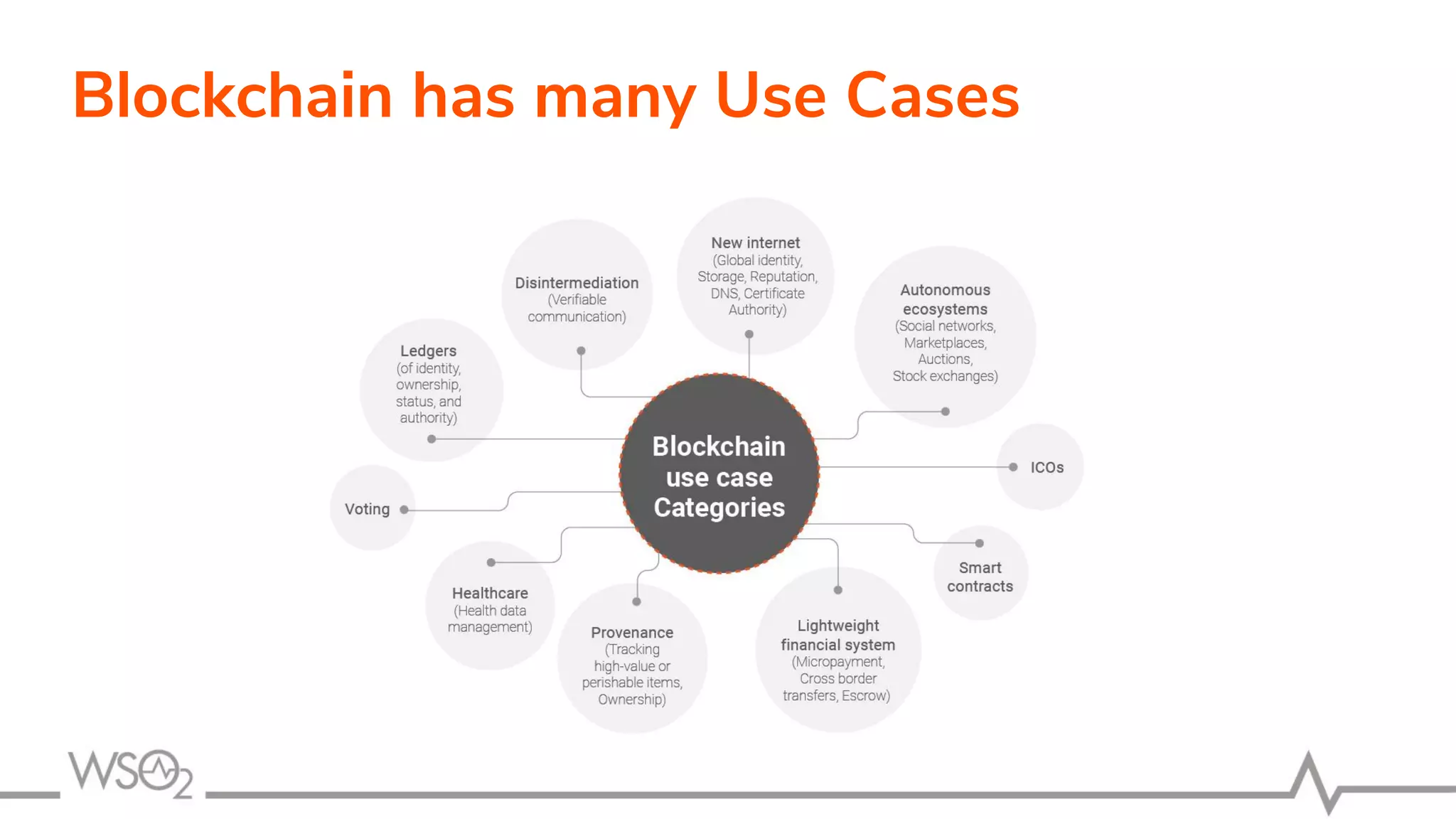
Blockchain has many Use Cases
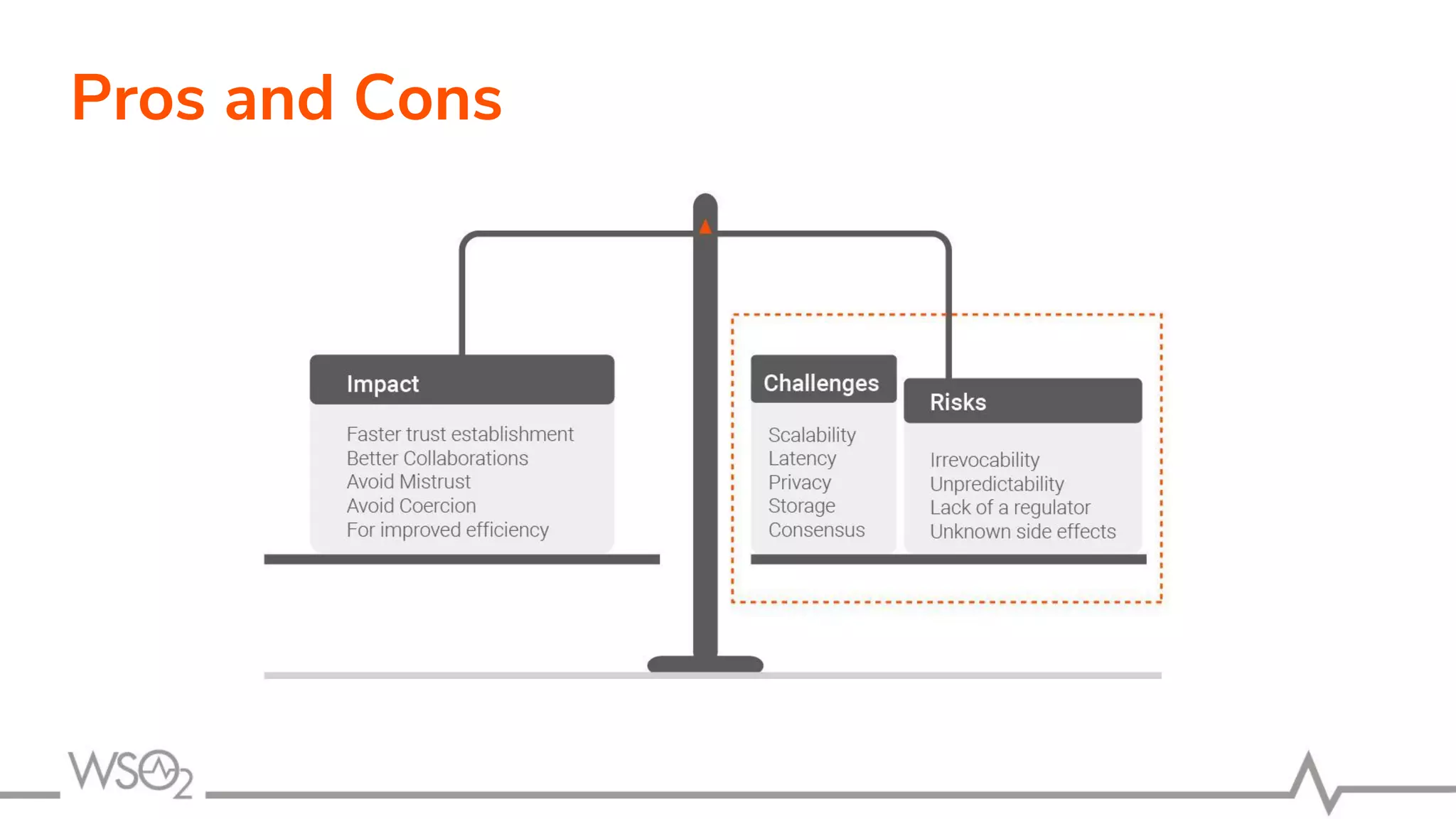
Pros and Cons
Challenges
● Limited scalability and latency
○ about 8 minutes and about 2 to 3 transactions per second.
○ Most use cases are not feasible under these limits.
○ Private blockchain have faster algorithms although they provide lesser guarantees.
● Limited privacy
○ Blockchain only provides pseudo anonymizations.
○ However, by analyzing the transaction graph and other related information, it is often possible to link
users to transactions.
○ Once one transaction is linked to a user, all his transactions become known.
● Storage constraints
○ each node must store the full history of the blockchain. This forestalls lightweight nodes, such as IoT
devices
○ As time passes, the history becomes larger aggravating the problem.
● Unsustainable consensus
○ The current consensus method is cumbersome and consumes a significant amount of energy.
○ Bitcoin uses more energy than Australia.
Risks
• Irrevocability
– Appeal is not possible
– Some use cases, this can be handled with undo transaction, but some others (e.g. land registry) mistake
is not reversible without the current owner complying
• Regulator Absence
– A regulator plays a key role in some use cases
– Although not popular, regulators play a crucial role in many systems (e.g. avoid fraud and pyramid
schemes
– With Blockchain-based systems it is impossible or expensive to fill the missing regulator’s role
• Misunderstood Side Effects
– Impact beyond CS
• Unclear Regulatory Responses
– Potential future regulations and laws governing blockchains and their use
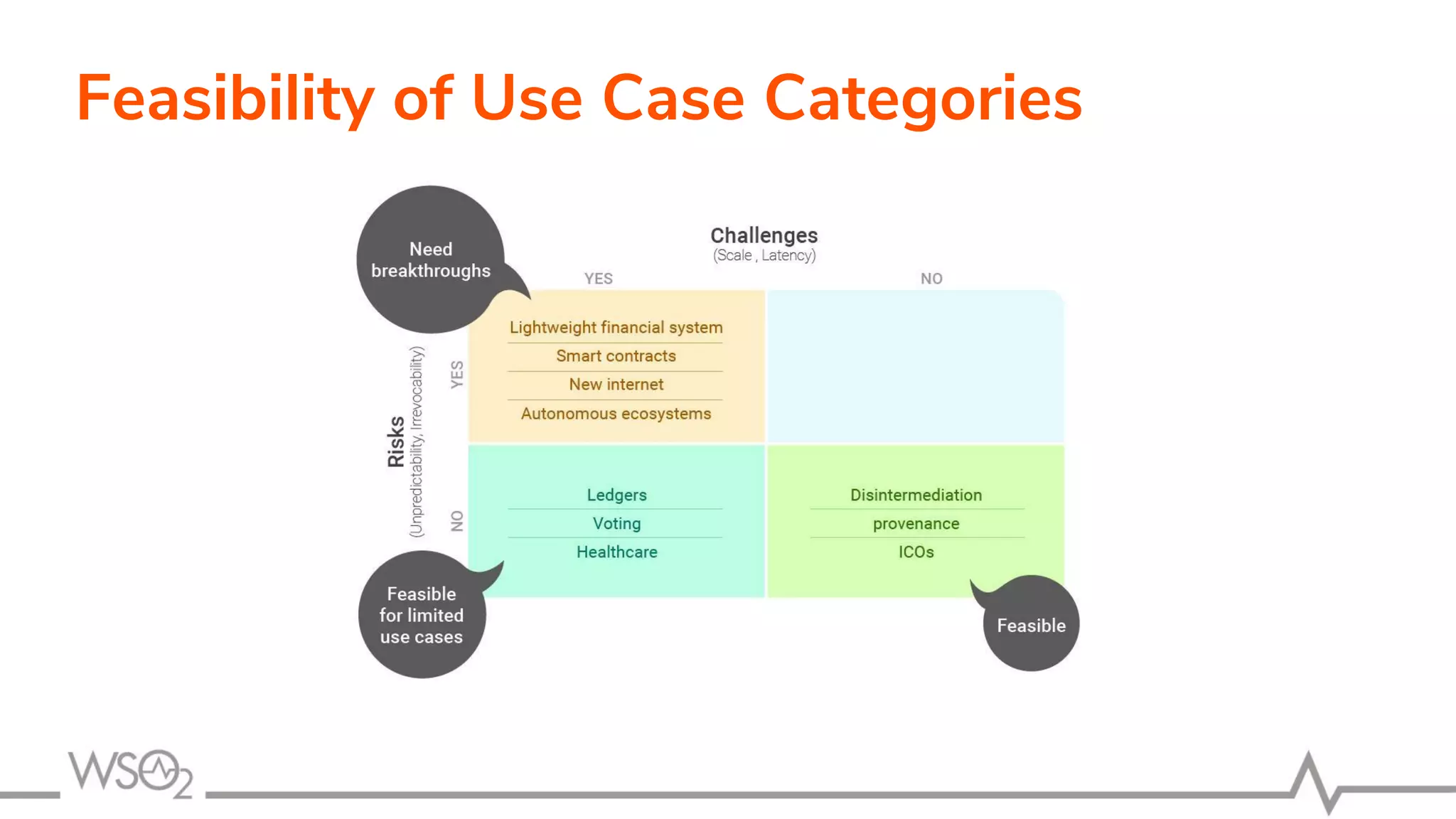
Feasibility of Use Case Categories
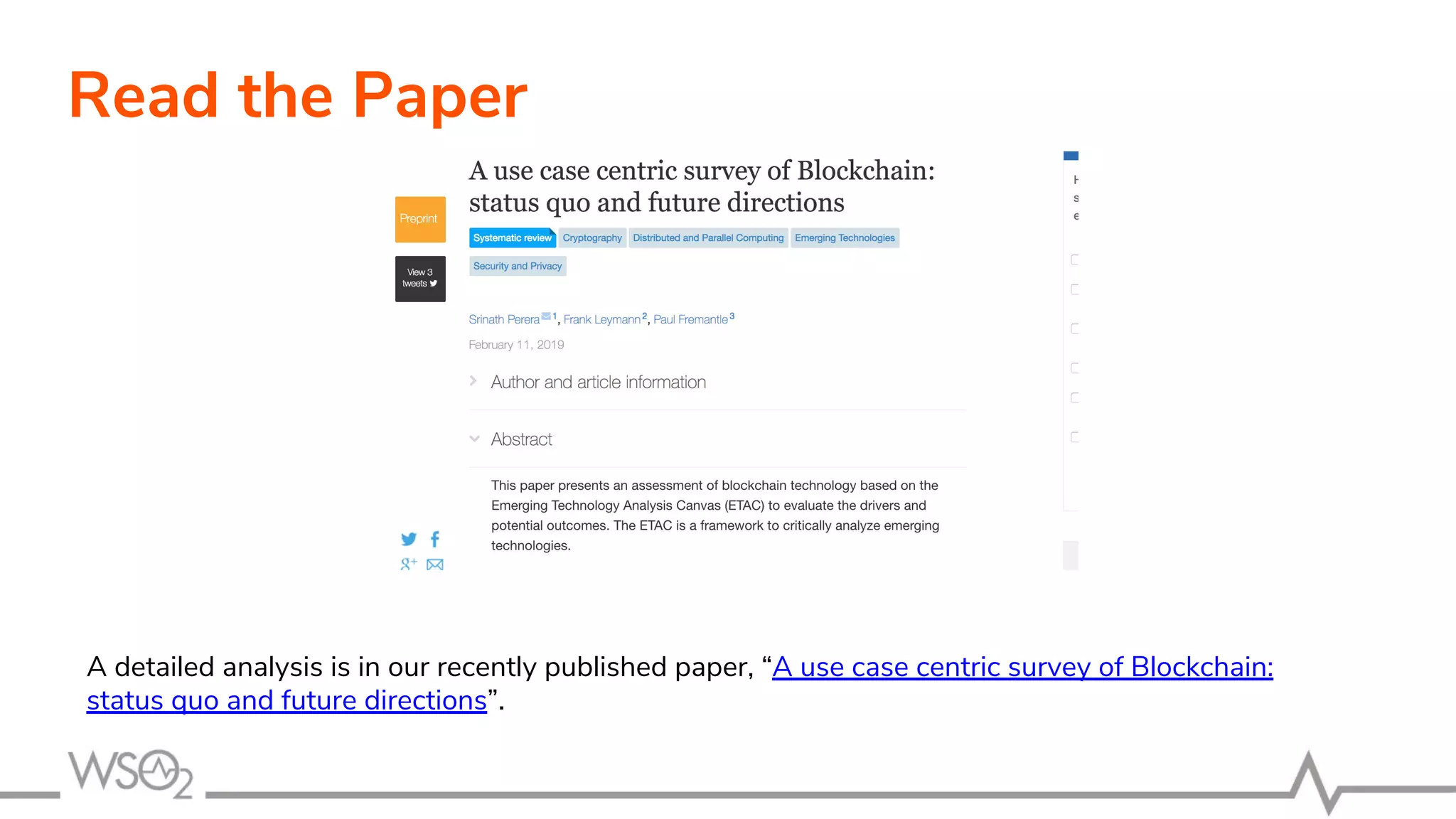
Read the Paper
A detailed analysis is in our recently published paper, “A use case centric survey of Blockchain:
status quo and future directions”.
To receive updates on ETAC and ETAC-based
emerging technology analysis, subscribe to our
newsletter at
https://wso2.com/subscribe/gto
THANK YOU
wso2.com

Global Technology Outlook - Future of Blockchain

  • 1.
    Future of Blockchain GlobalTechnology Outlook Srinath Perera, Ph.D. VP Research WSO2, Apache Member, srinath@wso2.com | @srinath_perera
  • 2.
    Analysis Based onETAC This is an analysis of blockchain, based on the Emerging Technology Analysis (ETAC) framework
  • 3.
    Impact? ● Replace currentalternatives to trust that are time-consuming, expensive, and weaker (e.g. intermediaries and government inspections.) ● It is faster, often establishing trust within a second ● It is much more secure, guarded by cryptography algorithms and census data ● The resulting system is cheaper and more agile
  • 4.
  • 5.
  • 6.
    Challenges ● Limited scalabilityand latency ○ about 8 minutes and about 2 to 3 transactions per second. ○ Most use cases are not feasible under these limits. ○ Private blockchain have faster algorithms although they provide lesser guarantees. ● Limited privacy ○ Blockchain only provides pseudo anonymizations. ○ However, by analyzing the transaction graph and other related information, it is often possible to link users to transactions. ○ Once one transaction is linked to a user, all his transactions become known. ● Storage constraints ○ each node must store the full history of the blockchain. This forestalls lightweight nodes, such as IoT devices ○ As time passes, the history becomes larger aggravating the problem. ● Unsustainable consensus ○ The current consensus method is cumbersome and consumes a significant amount of energy. ○ Bitcoin uses more energy than Australia.
  • 7.
    Risks • Irrevocability – Appealis not possible – Some use cases, this can be handled with undo transaction, but some others (e.g. land registry) mistake is not reversible without the current owner complying • Regulator Absence – A regulator plays a key role in some use cases – Although not popular, regulators play a crucial role in many systems (e.g. avoid fraud and pyramid schemes – With Blockchain-based systems it is impossible or expensive to fill the missing regulator’s role • Misunderstood Side Effects – Impact beyond CS • Unclear Regulatory Responses – Potential future regulations and laws governing blockchains and their use
  • 8.
    Feasibility of UseCase Categories
  • 9.
    Read the Paper Adetailed analysis is in our recently published paper, “A use case centric survey of Blockchain: status quo and future directions”.
  • 10.
    To receive updateson ETAC and ETAC-based emerging technology analysis, subscribe to our newsletter at https://wso2.com/subscribe/gto
  • 11.