POVERTY REDUCTION &
HUMAN DEVELOPMENT
Scanning and Global Supply
Chain Design
               Arsala Khan
Globalization of Markets
Factors of Globalization
•   Technology has overcome much of the
    distance created by geography and culture.
•   The pace of globalization depends on:
    1. Advances in information and communication
       technology
    2. Availability of reliable transportation
    3. Reduction of protectionist trade policies
Globalization’s Implications

1. Intensifying competition
  e.g. Nokia and unilever possess capital and technology needed
      to challenge rivals around the globe.
Importance of Global Markets
 95% the world’s population lives outside the U.S.
 80% of the world’s gross domestic product is
  produced outside the U.S.
 50%+ of the population is under 20 years old in
  many countries
 Educational background and disposable income
  are prime factors motivating consumption
  decisions
 US companies earned $315 billion profits
  overseas in 2004, up 78% over the past decade.
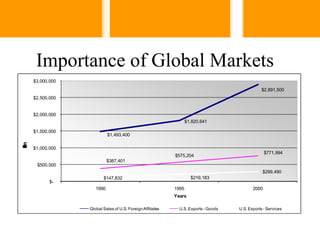
Importance of Global Markets
    $3,000,000
                                                                                                $2,891,500
    $2,500,000


    $2,000,000
                                                                  $1,820,641

    $1,500,000
                           $1,493,400
m
o
n
s
$


    $1,000,000
l
i


                                                                                                  $771,994
                                                           $575,204
                           $387,401
     $500,000
                                                                                                $299,490
                        $147,832                                    $219,183
           $-
                    1990                                   1995                            2000
                                                           Years

                 Global Sales of U.S. Foreign Affiliates     U.S. Exports - Goods   U.S. Exports - Services
Global Business is Different
Managers must consider four differences between
Global and domestic operations.
    1.   Politics –political stability and undercurrents that
         might jeopardize global business strategies.
    2.   Legalities – requires competent legal counsel
    3.   Finance – exchange rate risk and hedging; taxation
         issues
    4.   Culture –must adapt to local views on time, personal
         space, worker/manager relations, individual
         accountability, etc.
Six Globalization Imperatives
•     EMPLOYMENT GENERATION &
      EMPLOYMENT GENERATION & CREATION OF PHSICAL
      ASSETS
        CREATION OF PHSICAL ASSETS


Six imperatives are shaping the global competitive
    landscape:
2. Establish a Triadic Presence – companies need to
    operate in the three major world markets – U.S., E.U.
    and Asia
3. Utilized Beachheads – use operations in industrialized
    countries as bridges into emerging markets
Six Globalization Imperatives

3. Achieve Seamless Performance Across Markets –
   deliver the same high quality product with the same
   excellent service everywhere
4. Extend Reach Through Alliances – alliance partners
   can provide market knowledge, technological
   expertise, operational know-how, and/or financial
   resources.
Six Globalization Imperatives

1. Compete in Competitors Home Market –
   competition prevents cross profit subsidization
2. Coordinate Global Activities – cross-
   pollination of ideas creates synergy while
   reducing redundancy
Designing a Global Network
To insure access to customers and worldwide resources,
companies are increasingly creating worldwide supply chain
networks.

Resources within the supply chain need not be owned by a
single entity.
Designing a Global Network

To insure supply chains are properly designed four
  criteria should be considered:
4.Compatibility – need to align network design
  decisions with company’s overall strategy
5.Configuration – need to identify and consider
  issues that will affect network performance
  when deciding where to locate value added
  activities
Designing a Global Network

3.Coordination – need to direct and integrate
   geographically dispersed activities
4.Control – need for consistent and proper day-to-
   day decision-making at local value added
   facilities
THANK YOU!
QUESTIONS?

Global Supply chain

  • 1.
    POVERTY REDUCTION & HUMANDEVELOPMENT Scanning and Global Supply Chain Design Arsala Khan
  • 2.
  • 3.
    Factors of Globalization • Technology has overcome much of the distance created by geography and culture. • The pace of globalization depends on: 1. Advances in information and communication technology 2. Availability of reliable transportation 3. Reduction of protectionist trade policies
  • 4.
    Globalization’s Implications 1. Intensifyingcompetition e.g. Nokia and unilever possess capital and technology needed to challenge rivals around the globe.
  • 5.
    Importance of GlobalMarkets  95% the world’s population lives outside the U.S.  80% of the world’s gross domestic product is produced outside the U.S.  50%+ of the population is under 20 years old in many countries  Educational background and disposable income are prime factors motivating consumption decisions  US companies earned $315 billion profits overseas in 2004, up 78% over the past decade.
  • 6.
    Importance of GlobalMarkets $3,000,000 $2,891,500 $2,500,000 $2,000,000 $1,820,641 $1,500,000 $1,493,400 m o n s $ $1,000,000 l i $771,994 $575,204 $387,401 $500,000 $299,490 $147,832 $219,183 $- 1990 1995 2000 Years Global Sales of U.S. Foreign Affiliates U.S. Exports - Goods U.S. Exports - Services
  • 7.
    Global Business isDifferent Managers must consider four differences between Global and domestic operations. 1. Politics –political stability and undercurrents that might jeopardize global business strategies. 2. Legalities – requires competent legal counsel 3. Finance – exchange rate risk and hedging; taxation issues 4. Culture –must adapt to local views on time, personal space, worker/manager relations, individual accountability, etc.
  • 8.
  • 9.
    EMPLOYMENT GENERATION & EMPLOYMENT GENERATION & CREATION OF PHSICAL ASSETS CREATION OF PHSICAL ASSETS Six imperatives are shaping the global competitive landscape: 2. Establish a Triadic Presence – companies need to operate in the three major world markets – U.S., E.U. and Asia 3. Utilized Beachheads – use operations in industrialized countries as bridges into emerging markets
  • 10.
    Six Globalization Imperatives 3.Achieve Seamless Performance Across Markets – deliver the same high quality product with the same excellent service everywhere 4. Extend Reach Through Alliances – alliance partners can provide market knowledge, technological expertise, operational know-how, and/or financial resources.
  • 11.
    Six Globalization Imperatives 1.Compete in Competitors Home Market – competition prevents cross profit subsidization 2. Coordinate Global Activities – cross- pollination of ideas creates synergy while reducing redundancy
  • 12.
    Designing a GlobalNetwork To insure access to customers and worldwide resources, companies are increasingly creating worldwide supply chain networks. Resources within the supply chain need not be owned by a single entity.
  • 13.
    Designing a GlobalNetwork To insure supply chains are properly designed four criteria should be considered: 4.Compatibility – need to align network design decisions with company’s overall strategy 5.Configuration – need to identify and consider issues that will affect network performance when deciding where to locate value added activities
  • 14.
    Designing a GlobalNetwork 3.Coordination – need to direct and integrate geographically dispersed activities 4.Control – need for consistent and proper day-to- day decision-making at local value added facilities
  • 15.
  • 16.