The Global Economic Outlook:   More Bad News Ahead   Pam Woodall Asia Economics Editor,  The Economist June 2008
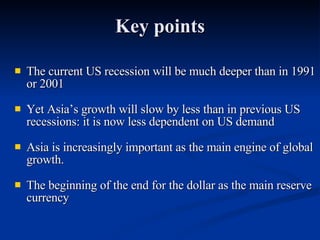
Key points The current US recession will be much deeper than in 1991 or 2001  Yet Asia’s growth will slow by less than in previous US recessions: it is now less dependent on US demand Asia is increasingly important as the main engine of global growth.  The beginning of the end for the dollar as the main reserve currency
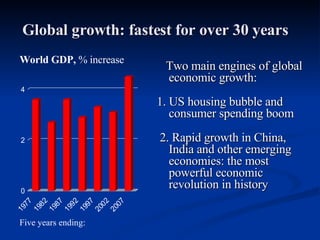
Global growth: fastest for over 30 years Two main engines of global economic growth: 1. US housing bubble and consumer spending boom 2. Rapid growth in China, India and other emerging economies: the most powerful economic revolution in history World GDP,  % increase Five years ending:
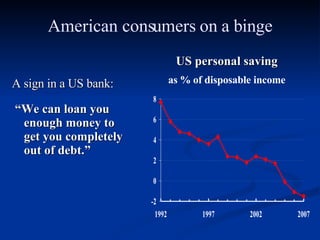
US personal saving A sign in a US bank:  “ We can loan you enough money to get you completely out of debt.” as % of disposable income American consumers on a binge
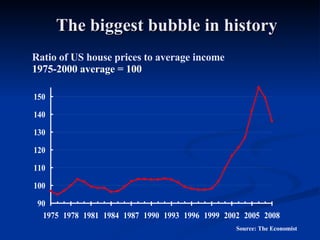
The biggest bubble in history Ratio of US house prices to average income  1975-2000 average = 100 Source: The Economist
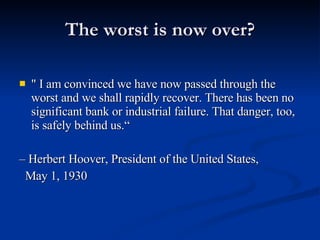
The worst is now over? " I am convinced we have now passed through the worst and we shall rapidly recover. There has been no significant bank or industrial failure. That danger, too, is safely behind us.“ –  Herbert Hoover, President of the United States,  May 1, 1930
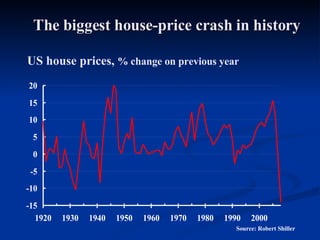
The biggest house-price crash in history Source: Robert Shiller US house prices,  % change on previous year
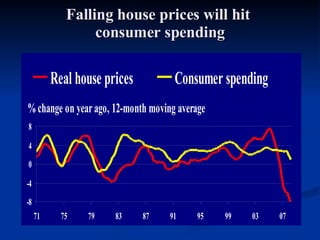
Falling house prices will hit  consumer spending
Comparison of financial crises Total financial losses  Source: IMF
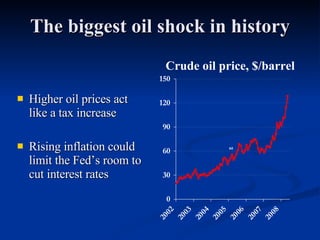
The biggest oil shock in history Higher oil prices act like a tax increase Rising inflation could limit the Fed’s room to cut interest rates   Crude oil price, $/barrel
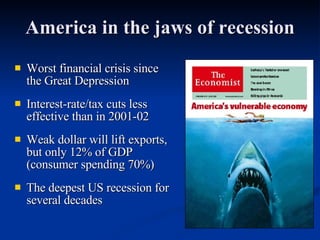
America in the jaws of recession Worst financial crisis since the Great Depression  Interest-rate/tax cuts less effective than in 2001-02  Weak dollar will lift exports, but only 12% of GDP (consumer spending 70%) The deepest US recession for several decades
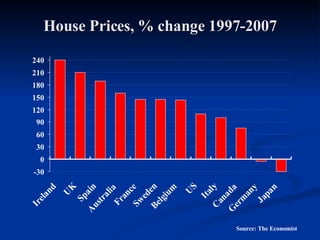
House Prices, % change 1997-2007 Source: The Economist
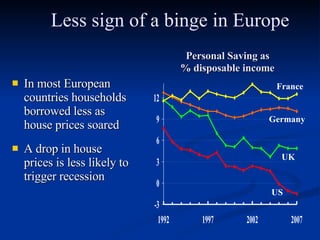
Personal Saving as  % disposable income In most European countries households borrowed less as  house prices soared A drop in house prices is less likely to trigger recession France US Less sign of a binge in Europe UK Germany
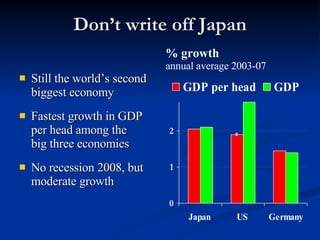
Don’t write off Japan Still the world’s second biggest economy Fastest growth in GDP per head among the  big three economies No recession 2008, but moderate growth % growth   annual average 2003-07
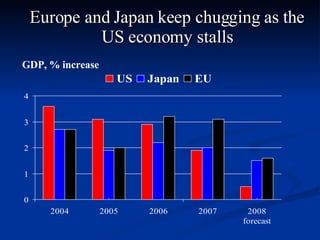
Europe and Japan keep chugging as the US economy stalls GDP, % increase
If America sneezes will Asia catch a cold? As US demand has slowed, Asia continues to boom Asia’s exports to rest of world remain robust Stronger domestic demand in Asia Emerging Asia’s GDP US domestic demand
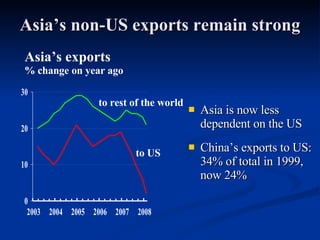
Asia’s non-US exports remain strong Asia is now less dependent on the US China’s exports to US: 34% of total in 1999, now 24% Asia’s exports % change on year ago to rest of the world to US
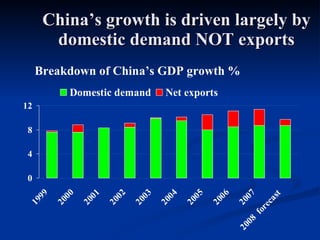
China’s growth is driven largely by domestic demand NOT exports Breakdown of China’s GDP growth %
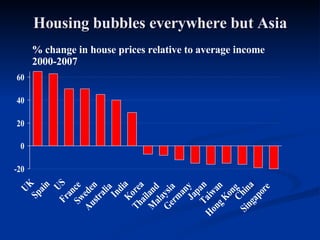
Housing bubbles everywhere but Asia % change in house prices relative to average income 2000-2007
Asian economies’ exposure to  a US recession Smaller Asian economies are more dependent on US But all in better economic shape than in past. Room for fiscal stimulus to boost spending
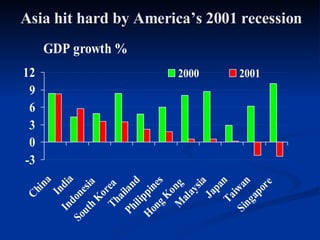
Asia hit hard by America’s 2001 recession
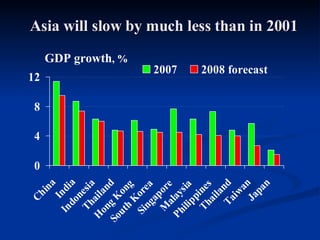
Asia will slow by much less than in 2001 GDP growth , %
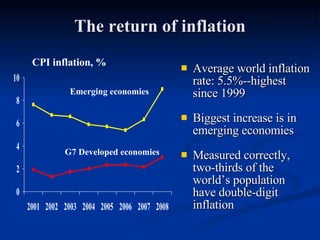
The return of inflation Average world inflation rate: 5.5%--highest since 1999 Biggest increase is in emerging economies Measured correctly, two-thirds of the world’s population have double-digit inflation CPI inflation, % G7 Developed economies Emerging economies
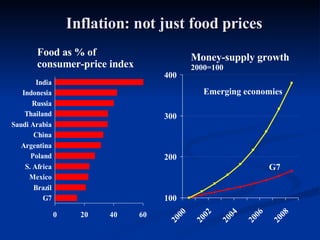
Inflation: not just food prices Money-supply growth  2000=100 Food as % of  consumer-price index Emerging economies G7
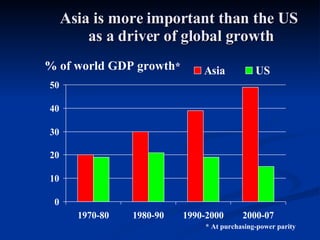
Asia is more important than the US  as a driver of global growth % of world GDP growth * * At purchasing-power parity
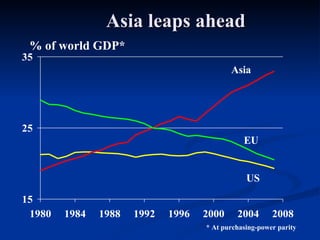
Asia leaps ahead % of world GDP* Asia * At purchasing-power parity EU US
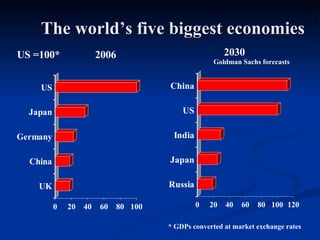
The world’s five biggest economies 2006 2030   Goldman Sachs forecasts US =100* * GDPs converted at market exchange rates
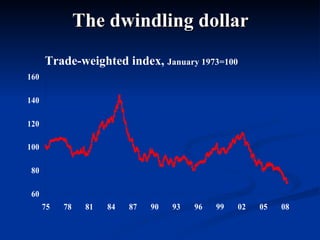
The dwindling dollar Trade-weighted index,  January 1973=100
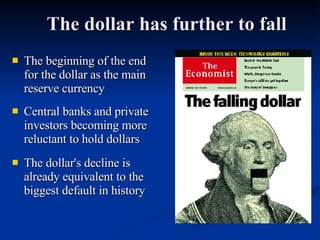
The dollar has further to fall The beginning of the end for the dollar as the main reserve currency Central banks and private investors becoming more reluctant to hold dollars The dollar's decline is already equivalent to the biggest default in history
The new world order Thanks to the vigour of Asia and other emerging economies, a US recession need not drag the whole world into recession   A  prolonged downturn in the US, while emerging economies continue to grow rapidly will reinforce the shift in global power from the old industrial world to the new emerging markets In future the world economy will be steered not by the US and Europe, but increasingly by Asia

Global Economic Outlook

  • 1.
    The Global EconomicOutlook: More Bad News Ahead Pam Woodall Asia Economics Editor, The Economist June 2008
  • 2.
    Key points Thecurrent US recession will be much deeper than in 1991 or 2001 Yet Asia’s growth will slow by less than in previous US recessions: it is now less dependent on US demand Asia is increasingly important as the main engine of global growth. The beginning of the end for the dollar as the main reserve currency
  • 3.
    Global growth: fastestfor over 30 years Two main engines of global economic growth: 1. US housing bubble and consumer spending boom 2. Rapid growth in China, India and other emerging economies: the most powerful economic revolution in history World GDP, % increase Five years ending:
  • 4.
    US personal savingA sign in a US bank: “ We can loan you enough money to get you completely out of debt.” as % of disposable income American consumers on a binge
  • 5.
    The biggest bubblein history Ratio of US house prices to average income 1975-2000 average = 100 Source: The Economist
  • 6.
    The worst isnow over? " I am convinced we have now passed through the worst and we shall rapidly recover. There has been no significant bank or industrial failure. That danger, too, is safely behind us.“ – Herbert Hoover, President of the United States, May 1, 1930
  • 7.
    The biggest house-pricecrash in history Source: Robert Shiller US house prices, % change on previous year
  • 8.
    Falling house priceswill hit consumer spending
  • 9.
    Comparison of financialcrises Total financial losses Source: IMF
  • 10.
    The biggest oilshock in history Higher oil prices act like a tax increase Rising inflation could limit the Fed’s room to cut interest rates Crude oil price, $/barrel
  • 11.
    America in thejaws of recession Worst financial crisis since the Great Depression Interest-rate/tax cuts less effective than in 2001-02 Weak dollar will lift exports, but only 12% of GDP (consumer spending 70%) The deepest US recession for several decades
  • 12.
    House Prices, %change 1997-2007 Source: The Economist
  • 13.
    Personal Saving as % disposable income In most European countries households borrowed less as house prices soared A drop in house prices is less likely to trigger recession France US Less sign of a binge in Europe UK Germany
  • 14.
    Don’t write offJapan Still the world’s second biggest economy Fastest growth in GDP per head among the big three economies No recession 2008, but moderate growth % growth annual average 2003-07
  • 15.
    Europe and Japankeep chugging as the US economy stalls GDP, % increase
  • 16.
    If America sneezeswill Asia catch a cold? As US demand has slowed, Asia continues to boom Asia’s exports to rest of world remain robust Stronger domestic demand in Asia Emerging Asia’s GDP US domestic demand
  • 17.
    Asia’s non-US exportsremain strong Asia is now less dependent on the US China’s exports to US: 34% of total in 1999, now 24% Asia’s exports % change on year ago to rest of the world to US
  • 18.
    China’s growth isdriven largely by domestic demand NOT exports Breakdown of China’s GDP growth %
  • 19.
    Housing bubbles everywherebut Asia % change in house prices relative to average income 2000-2007
  • 20.
    Asian economies’ exposureto a US recession Smaller Asian economies are more dependent on US But all in better economic shape than in past. Room for fiscal stimulus to boost spending
  • 21.
    Asia hit hardby America’s 2001 recession
  • 22.
    Asia will slowby much less than in 2001 GDP growth , %
  • 23.
    The return ofinflation Average world inflation rate: 5.5%--highest since 1999 Biggest increase is in emerging economies Measured correctly, two-thirds of the world’s population have double-digit inflation CPI inflation, % G7 Developed economies Emerging economies
  • 24.
    Inflation: not justfood prices Money-supply growth 2000=100 Food as % of consumer-price index Emerging economies G7
  • 25.
    Asia is moreimportant than the US as a driver of global growth % of world GDP growth * * At purchasing-power parity
  • 26.
    Asia leaps ahead% of world GDP* Asia * At purchasing-power parity EU US
  • 27.
    The world’s fivebiggest economies 2006 2030 Goldman Sachs forecasts US =100* * GDPs converted at market exchange rates
  • 28.
    The dwindling dollarTrade-weighted index, January 1973=100
  • 29.
    The dollar hasfurther to fall The beginning of the end for the dollar as the main reserve currency Central banks and private investors becoming more reluctant to hold dollars The dollar's decline is already equivalent to the biggest default in history
  • 30.
    The new worldorder Thanks to the vigour of Asia and other emerging economies, a US recession need not drag the whole world into recession A prolonged downturn in the US, while emerging economies continue to grow rapidly will reinforce the shift in global power from the old industrial world to the new emerging markets In future the world economy will be steered not by the US and Europe, but increasingly by Asia

Editor's Notes