Global Technology Services
IBM Confidential © 2003 IBM Corporation
Global Delivery Framework
Overview document
January 2009
Global Technology Services
© 2003 IBM Corporation
2 IBM Confidential
FOR INTERNAL USE ONLY
What is Global Delivery Framework?
The GDF is a set of delivery practices based on our Lean
principles that enables consistent global delivery excellence.
These delivery practices, referred to as components, are
designed to support the GTS strategy to “be the world’s premier
IT services provider by delivering the highest quality solutions at
the most competitive prices.”
Global Technology Services
© 2003 IBM Corporation
3 IBM Confidential
FOR INTERNAL USE ONLY
This year, we continue to build upon the solid foundation to take quality to the
next level by implementing key elements of Global Delivery Framework (GDF)
Former Approach 2008-2009 Incremental Activities
Standard work definitions enable
standard, yet configurable solutions
Assigning workload to most efficient
and skilled pools optimizes delivery
Peer-to-peer collaboration and
teaming that is enabled by co-
location
Ability to see patterns across
accounts enables greater defect
prevention
Global
Delivery
Centers
with
consistent
approaches
and
processes
around the
world
(Global
Delivery
Framework)
2008-2009
Inconsistent work definition;
practices
Remote, fragmented workforce not
enabled to continuously collaborate
and problem solve
Delivery resources in separate
pockets
Narrow, reactive account-specific
insights that are not quickly
replicated
Sharing resources across accounts
creates more effective work pools,
but retains account knowledge
Processes, tools and practices are
account-specific, hard to scale
Global Technology Services
© 2003 IBM Corporation
4 IBM Confidential
FOR INTERNAL USE ONLY
Key Incremental Activities Supporting Higher Levels of Quality and Competitiveness
“Global Delivery Framework”
 Creating physically co-located working teams that serve specific number of
accounts
– Designing working space to enhance and accelerate knowledge sharing, coaching, skill
development and real-time learning
– Creating dynamic team environments that enable rapid response time and change
– Building relationships among team members that are based on trust and peer-to-peer
collaboration
 Launching defect prevention methodology across pools to enable culture of
continual improvement
 Investing in new cross-account roles for problem resolution (Quality Assurance)
 Building a service product catalog of base services, custom options, tool options
and service levels
Specifically in the US, we are investing in new quality elements to
strengthen our position in the market
Global Technology Services
© 2003 IBM Corporation
5 IBM Confidential
FOR INTERNAL USE ONLY
This model is expected to yield new levels of quality and performance
that ultimately lead to higher client value
More effective work pools that
retain account knowledge
Global Delivery Framework Expected Outcomes for IBM
Standard work components
Optimized global delivery model
Peer-to-peer collaboration and
teaming
Defect prevention
More efficient and flexible workforce
management practices & ability to leverage the
scale curve and support growth
Solutions designed around standard delivery
components; customer solutions consist of
configurations of (mostly) standard components
Common work practices & delivery-wide global
and account view performance dashboard that
allow easy tracking of key quality and service
level metrics
Rigorous, real-time problem solving through
dynamic team environment
High performance standards and quality
improvements
Global Technology Services
© 2003 IBM Corporation
6 IBM Confidential
FOR INTERNAL USE ONLY
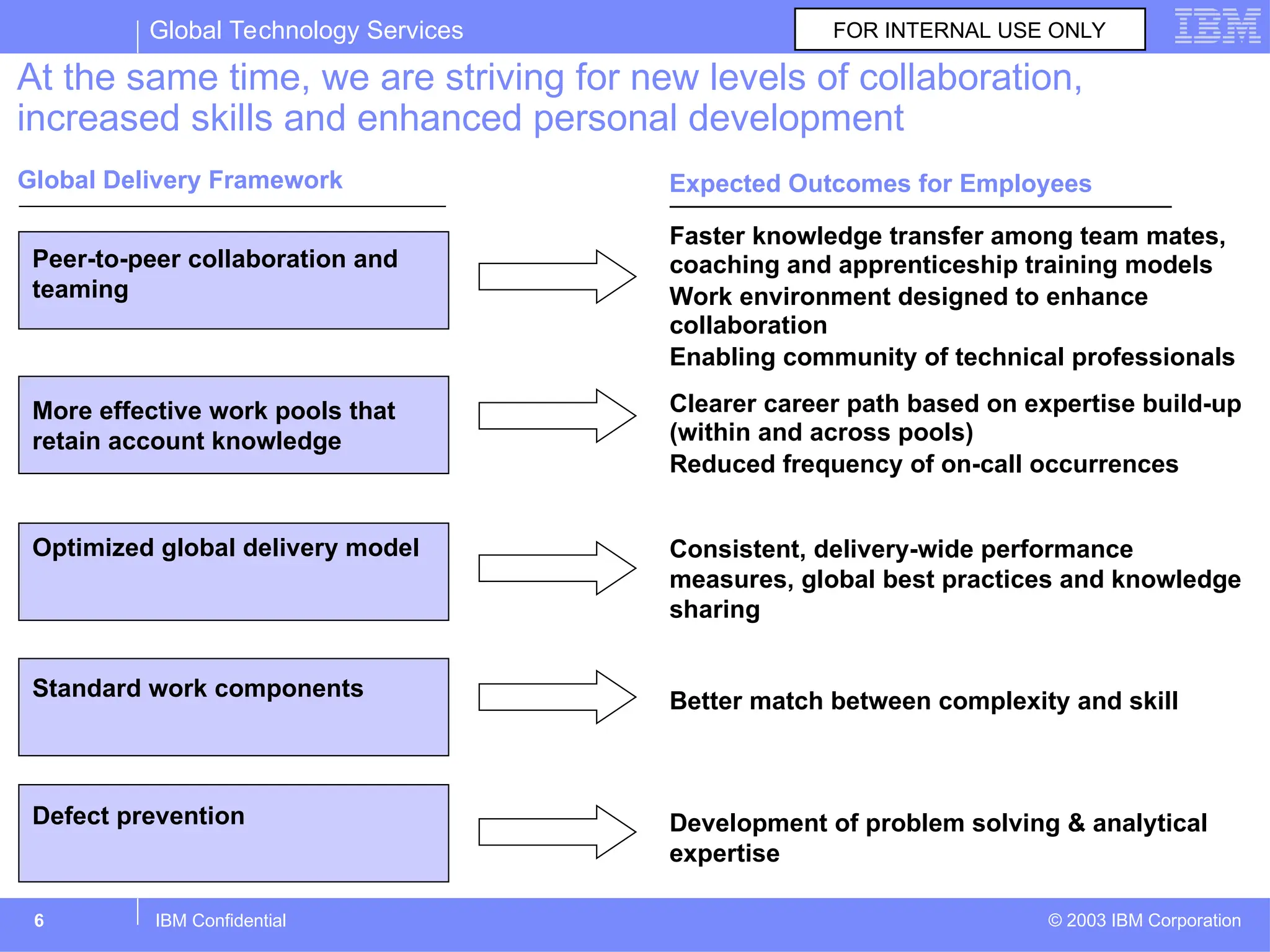
At the same time, we are striving for new levels of collaboration,
increased skills and enhanced personal development
More effective work pools that
retain account knowledge
Global Delivery Framework Expected Outcomes for Employees
Standard work components
Optimized global delivery model
Peer-to-peer collaboration and
teaming
Defect prevention
Clearer career path based on expertise build-up
(within and across pools)
Reduced frequency of on-call occurrences
Faster knowledge transfer among team mates,
coaching and apprenticeship training models
Work environment designed to enhance
collaboration
Enabling community of technical professionals
Consistent, delivery-wide performance
measures, global best practices and knowledge
sharing
Better match between complexity and skill
Development of problem solving & analytical
expertise
Global Technology Services
© 2003 IBM Corporation
7 IBM Confidential
FOR INTERNAL USE ONLY
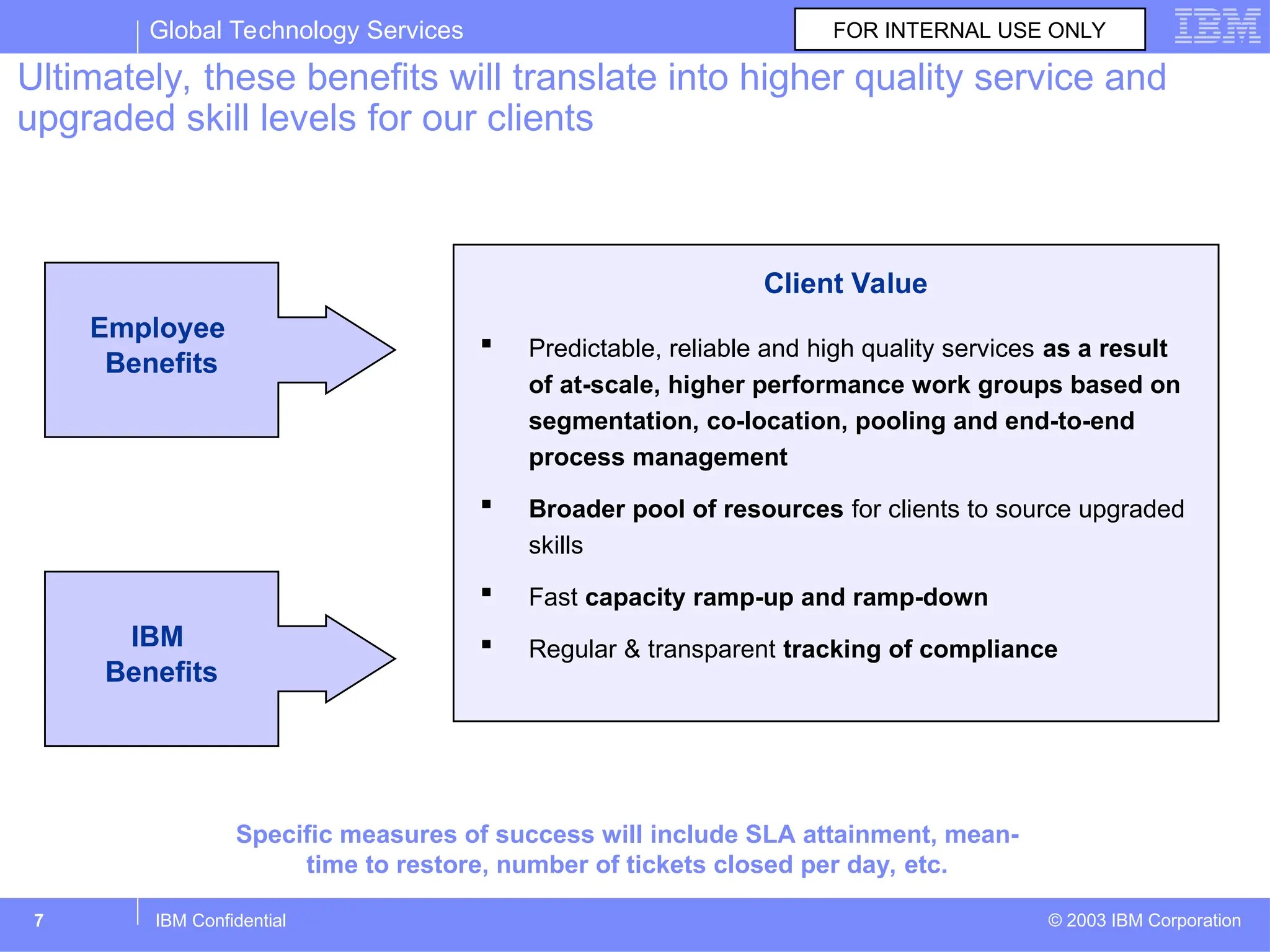
Ultimately, these benefits will translate into higher quality service and
upgraded skill levels for our clients
 Predictable, reliable and high quality services as a result
of at-scale, higher performance work groups based on
segmentation, co-location, pooling and end-to-end
process management
 Broader pool of resources for clients to source upgraded
skills
 Fast capacity ramp-up and ramp-down
 Regular & transparent tracking of compliance
Employee
Benefits
IBM
Benefits
Client Value
Specific measures of success will include SLA attainment, mean-
time to restore, number of tickets closed per day, etc.

Global Delivery Framework - IBM Global Services

  • 1.
    Global Technology Services IBMConfidential © 2003 IBM Corporation Global Delivery Framework Overview document January 2009
  • 2.
    Global Technology Services ©2003 IBM Corporation 2 IBM Confidential FOR INTERNAL USE ONLY What is Global Delivery Framework? The GDF is a set of delivery practices based on our Lean principles that enables consistent global delivery excellence. These delivery practices, referred to as components, are designed to support the GTS strategy to “be the world’s premier IT services provider by delivering the highest quality solutions at the most competitive prices.”
  • 3.
    Global Technology Services ©2003 IBM Corporation 3 IBM Confidential FOR INTERNAL USE ONLY This year, we continue to build upon the solid foundation to take quality to the next level by implementing key elements of Global Delivery Framework (GDF) Former Approach 2008-2009 Incremental Activities Standard work definitions enable standard, yet configurable solutions Assigning workload to most efficient and skilled pools optimizes delivery Peer-to-peer collaboration and teaming that is enabled by co- location Ability to see patterns across accounts enables greater defect prevention Global Delivery Centers with consistent approaches and processes around the world (Global Delivery Framework) 2008-2009 Inconsistent work definition; practices Remote, fragmented workforce not enabled to continuously collaborate and problem solve Delivery resources in separate pockets Narrow, reactive account-specific insights that are not quickly replicated Sharing resources across accounts creates more effective work pools, but retains account knowledge Processes, tools and practices are account-specific, hard to scale
  • 4.
    Global Technology Services ©2003 IBM Corporation 4 IBM Confidential FOR INTERNAL USE ONLY Key Incremental Activities Supporting Higher Levels of Quality and Competitiveness “Global Delivery Framework”  Creating physically co-located working teams that serve specific number of accounts – Designing working space to enhance and accelerate knowledge sharing, coaching, skill development and real-time learning – Creating dynamic team environments that enable rapid response time and change – Building relationships among team members that are based on trust and peer-to-peer collaboration  Launching defect prevention methodology across pools to enable culture of continual improvement  Investing in new cross-account roles for problem resolution (Quality Assurance)  Building a service product catalog of base services, custom options, tool options and service levels Specifically in the US, we are investing in new quality elements to strengthen our position in the market
  • 5.
    Global Technology Services ©2003 IBM Corporation 5 IBM Confidential FOR INTERNAL USE ONLY This model is expected to yield new levels of quality and performance that ultimately lead to higher client value More effective work pools that retain account knowledge Global Delivery Framework Expected Outcomes for IBM Standard work components Optimized global delivery model Peer-to-peer collaboration and teaming Defect prevention More efficient and flexible workforce management practices & ability to leverage the scale curve and support growth Solutions designed around standard delivery components; customer solutions consist of configurations of (mostly) standard components Common work practices & delivery-wide global and account view performance dashboard that allow easy tracking of key quality and service level metrics Rigorous, real-time problem solving through dynamic team environment High performance standards and quality improvements
  • 6.
    Global Technology Services ©2003 IBM Corporation 6 IBM Confidential FOR INTERNAL USE ONLY At the same time, we are striving for new levels of collaboration, increased skills and enhanced personal development More effective work pools that retain account knowledge Global Delivery Framework Expected Outcomes for Employees Standard work components Optimized global delivery model Peer-to-peer collaboration and teaming Defect prevention Clearer career path based on expertise build-up (within and across pools) Reduced frequency of on-call occurrences Faster knowledge transfer among team mates, coaching and apprenticeship training models Work environment designed to enhance collaboration Enabling community of technical professionals Consistent, delivery-wide performance measures, global best practices and knowledge sharing Better match between complexity and skill Development of problem solving & analytical expertise
  • 7.
    Global Technology Services ©2003 IBM Corporation 7 IBM Confidential FOR INTERNAL USE ONLY Ultimately, these benefits will translate into higher quality service and upgraded skill levels for our clients  Predictable, reliable and high quality services as a result of at-scale, higher performance work groups based on segmentation, co-location, pooling and end-to-end process management  Broader pool of resources for clients to source upgraded skills  Fast capacity ramp-up and ramp-down  Regular & transparent tracking of compliance Employee Benefits IBM Benefits Client Value Specific measures of success will include SLA attainment, mean- time to restore, number of tickets closed per day, etc.

Editor's Notes

  • #2 GDF is a set of delivery practices based on our Lean principles that enables consistent global delivery excellence. These delivery practices, referred to as components, are designed to support the GTS strategy to “be the world’s premier IT services provider by delivering the highest quality solutions at the most competitive prices.” To this end, the GDF has the following objectives: Deliver best-in-class Quality IT services Standardize delivery processes globally Execute with industry leading efficiency Implement defect prevention processes The GDF is based on five fundamental concepts: Segmentation – Separating delivery of recurring work from transformation [project] work and account management, thereby enabling identification of workload demand patterns that can then be addressed through standardized operations. Pooling – Creating skill-based teams, and breaking the traditional “ownership model” (one system, one technical owner) to enable better utilization of skills and overall resources while simultaneously reducing average service times and response times. Additionally, under the old delivery model, work was usually organized by account, resulting in further inefficiencies. In the GDF, work is organized along workload characteristic lines while still maintaining necessary account knowledge and skills. Co-location – Locating all of the members of a skill-based pool in the same physical location to improve sharing, real-time problem solving, and foster an apprenticeship approach to training and skill building. Continual Improvement – Formalizing the review, analysis, and interpretation of operational data to identify recurring issues and opportunities for improvement. The results of these efforts are shared across pools and GDCs. Standardization – Incorporating all the insights from continual improvement into standard operating procedures to create well-defined service components to insure clients realize best-in-class performance across the board.
  • #3 Our execution on the GTS and delivery strategy requires us to make changes in our management systems, the way we sell and how we deliver. In other words we will need to address some fundamental cultural changes in the upcoming year. So, how will we do this? We will start by introducing new methods and approaches that leverage the basic quality improvement principles and apply them consistently to cross-account demand. We have recently combined these quality methods with our global delivery model and created dramatic results with truly strategic potential. Our emerging “Global Delivery Framework” allows us to use our advantages of scale and breadth of technical experience as never before. We will continue expanding the following elements of the Global Delivery Framework throughout our delivery centers: Share resources across accounts by creating skill-based teams, combined with segmentation and dispatching of ticket flows across multiple accounts. At the same time, the team will retain specific account knowledge through SMEs and higher-level skills. Co-locate the skill-based pools and their managers to maximize collaboration, real-time problem solving and peer-to-peer communication. Effective and efficient performance requires clear goals, immediate feedback, coaching, peer support, and an appropriate work environment. Face-to-face “huddles” between shift teams allows effective hand-offs between shifts and enables faster understanding of issues. Front-line management walks the floor, providing encouragement, coaching, and innovation in real time, based on the observed performance of operators. Managers conduct problem-solving meetings during each shift, based on opportunities identified and insights gathered every day. Peer coaching and instruction, or “apprenticeship”, is a powerful complement to formal training. Teams build their own morale through shared accomplishments and are available for motivation by higher-level managers or face-to-face interactions with visiting clients. Community of technical professionals can be created and personal development is encouraged through apprenticeship models. Matching workload and problem complexity with the right skill within the pool and across the pools optimizes delivery. Experiences will be combined to identify breakdowns and prevent defects. Harvesting data across the organization will enable us to apply analytics to our delivery processes, turning ticket flows from day-to-day tasks into a source of greater operational insight. We will introduce dedicated quality analysts within each pool and Green teams, pool-agnostic teams. The Green team will work across pools to improve quality and process, capture and codify this knowledge through an investigation record, and share the knowledge across the pools.
  • #4  So, let’s talk specifics. Which of these will we implement in the US and how. The most noticeable change for many of our employees is the creation of physically co-located work teams that serve a specific set of accounts. The ability of a team in the form of a pool to scale across and share learnings, knowledge and training is strengthened by the ability to drive thinking together, sit team members next to each other, learn and listen to each other in a disciplined manner. However, we recognize that not all IBM space is conducive to team learning – so we will be designing the team spaces to encourage coaching, teaming and peer-to-peer collaboration. We consider this to be a key element of the quality program and are investing in making this the right environment for collaboration (this means a team conference room, place to congregate, etc.) (2) We are launching a defect prevention methodology across pools to enable the scale of insight across accounts. This is absolutely key for continual improvement. While we will have teams that focus on defect prevention, we will also drive the problem-solving (kaizen) from bottom up. Everyone will be expected to stop and redo/reshape the service delivery model to inject quality in their everyday work and deliver incremental value to our clients. Managers will conduct problem-solving sessions during each shift, based on opportunities identified and insights gathered throughout the day. (3) In this spirit, we invest in Quality Assurance roles within each team and across pools (Green team). And finally, (4) We have begun building a productized catalogue of base services, custom options, tool options and service levels. This will allow us to break away from the large amounts of custom processes, tools and practices. (We will still perform custom work but will shift our focus to standardized services that make us more competitive and allow us to deliver high quality) So, now you know what we plan to do, let’s spend some time discussing why?
  • #5 Our goal is to create an environment of continuous improvement at every level and in every role, with a focus on getting quality right the first time. The benefits and outcomes of the approach listed on this page directly relate to the ITDelivery strategy around standardization, automation and globalization. But more importantly, what will this mean for our employees and their personal development….
  • #6  One of the key elements of a true high-performance quality culture is the focus on people development and enabling problem-solving at every level of IBM – at the management level and at every individual’s level. This is a new way of thinking, new attitude and something that needs to become part of everyone’s DNA. We will achieve this through enhanced skill development (ability to work on and learn about multiple accounts; work on different types of issues; problem-solve/share knowledge with colleagues); and clear career development (greater variety within roles, including work with advanced quality approaches and multiple clients; more opportunities for role rotation and apprenticeships, and more career paths and advancement opportunities will be available). We will build communities of technical professionals and design workspace around team building and peer-to-peer collaboration. It is important to understand that building high-performance quality culture is about investment, not cost savings. We are heavily investing in new quality roles/teams, training programs and the workspace design and we will be investing in all of you.
  • #7 But ultimately, the ones who will benefit the most are our clients. This new approach integrates GTS and ITDelivery as quality is not just a function of delivery. Our clients should experience predictable, reliable and high quality services as a result of these at-scale, higher performance work groups. They should have access to broader pool of resources and to upgraded skills. We will also be addressing all of the relationship lifecycle stages (including Engagement and Solutioning, Transition and Transformation) in order to ensure that our clients receive the highest quality service. We recognize the need to develop a comprehensive, structured approach to transforming all aspects of our business. This will be a phased implementation and a journey, not a quick fix. Throughout this journey, we need to keep in mind the final outcome – client value and delivery of higher quality services.