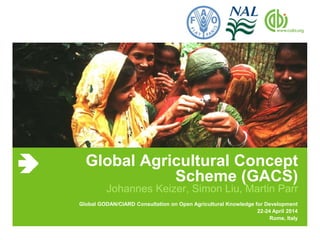
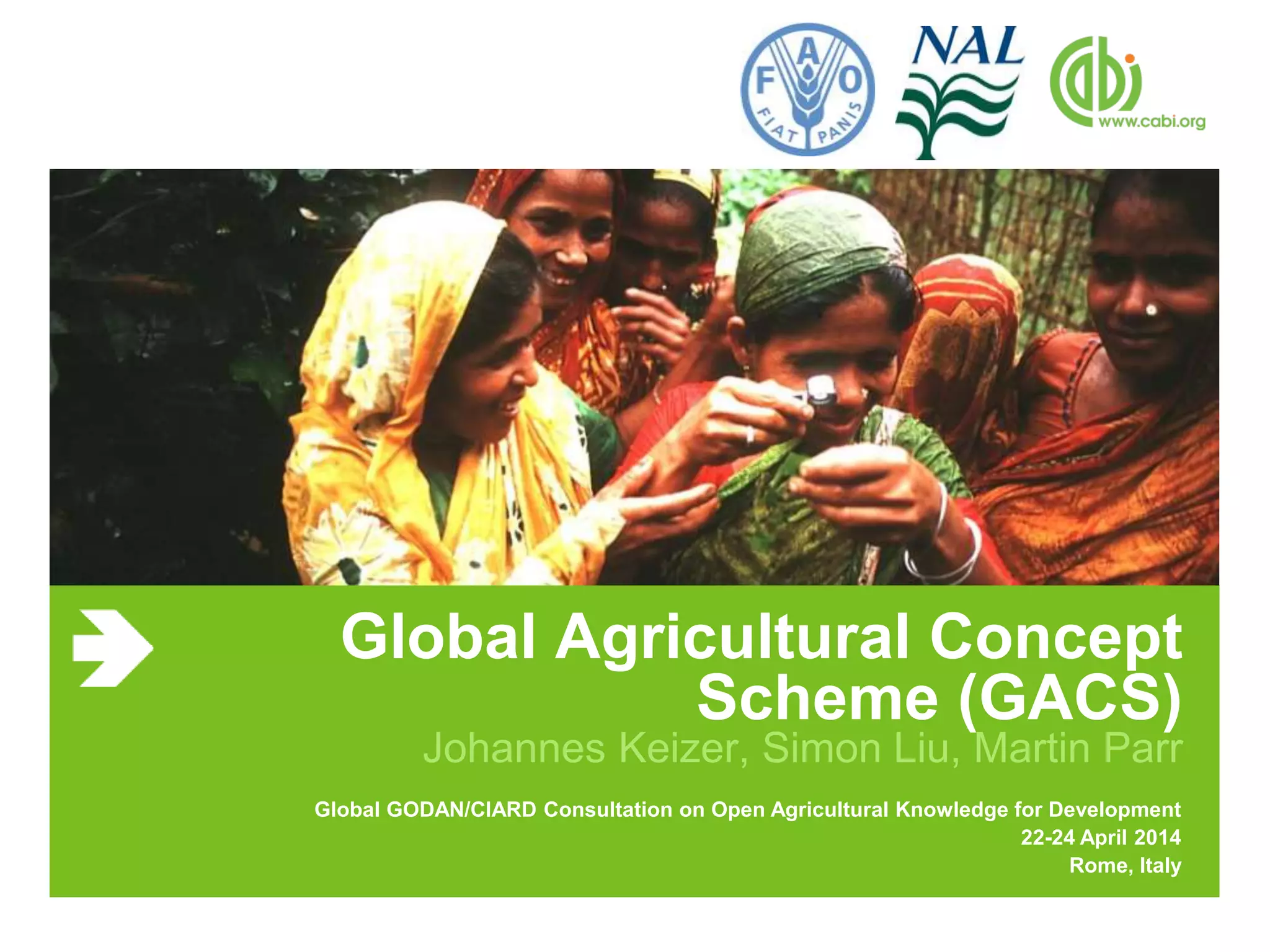
Global Agricultural Concept 
Scheme (GACS) 
Johannes Keizer, Simon Liu, Martin Parr 
Global GODAN/CIARD Consultation on Open Agricultural Knowledge for Development 
22-24 April 2014 
Rome, Italy
Global Agricultural Content Scheme 
(GACS) 
• Who? 
• Why? 
• What? 
• How?
• Johannes Keizer 
• Simon Liu 
• Martin Parr 
Who?
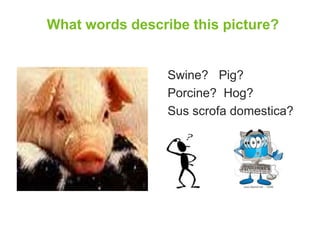
What words describe this picture? 
Swine? Pig? 
Porcine? Hog? 
Sus scrofa domestica?
• Acronyms 
Synonyms 
- ABA vs. abscisic acid 
- DHBV vs. Duck hepatitis B virus 
- WHO vs. World Health Organization 
• Plural / Singular 
- pigs vs. pig 
- renal calculi vs. renal calculus 
• Spelling variants 
- Sugar beet vs. Sugarbeet 
- Buddleja vs. Buddleia 
• Usage variants 
- Aubergines vs. Eggplants 
- Palta vs. Aguacate vs. Avocado 
• Quasi-synonyms…
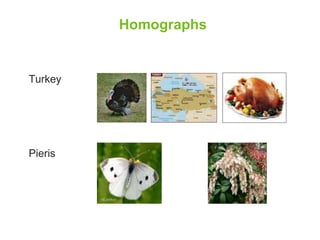
Turkey 
Pieris 
Homographs
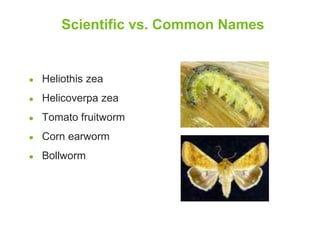
Scientific vs. Common Names 
● Heliothis zea 
● Helicoverpa zea 
● Tomato fruitworm 
● Corn earworm 
● Bollworm
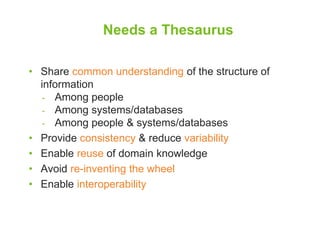
Needs a Thesaurus 
• Share common understanding of the structure of 
information 
- Among people 
- Among systems/databases 
- Among people & systems/databases 
• Provide consistency & reduce variability 
• Enable reuse of domain knowledge 
• Avoid re-inventing the wheel 
• Enable interoperability
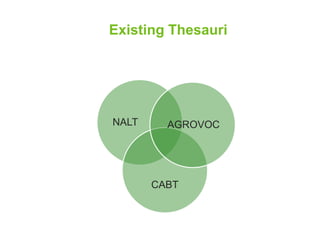
Existing Thesauri 
NALT 
AGROVOC 
CABT
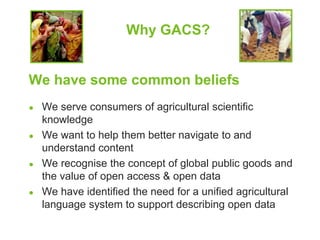
Why GACS? 
We have some common beliefs 
● We serve consumers of agricultural scientific 
knowledge 
● We want to help them better navigate to and 
understand content 
● We recognise the concept of global public goods and 
the value of open access & open data 
● We have identified the need for a unified agricultural 
language system to support describing open data
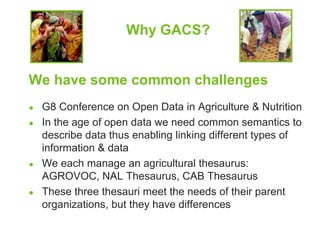
Why GACS? 
We have some common challenges 
● G8 Conference on Open Data in Agriculture & Nutrition 
● In the age of open data we need common semantics to 
describe data thus enabling linking different types of 
information & data 
● We each manage an agricultural thesaurus: 
AGROVOC, NAL Thesaurus, CAB Thesaurus 
● These three thesauri meet the needs of their parent 
organizations, but they have differences
Why GACS? 
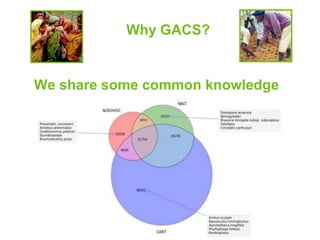
We share some common knowledge
GACS Uses 
• Information description & structuring 
• Spelling aid 
• Natural language processing 
• Information retrieval 
• Information mapping & integration 
• Automated indexing
What? 
Global Agriculture Concept Scheme 
GACS … 
● A global unified agricultural language system 
● Address the differences and builds alignments between 
AGROVOC, CABT and NALT 
● Public 
● Open (and moving to Open Data) 
● Collaborative (CABI, NAL, FAO) 
● Extensible (scope and partners) 
● An integrated offering 
● A working model (a bit more than a Proof of Concept?)
What? 
GACS aspires to … 
● Be owned and maintained by a consortium? 
● Bring economies of scale to partners and users 
● Avoid duplication of effort in new organisations moving 
to open data environments 
● Improve efficiency of information and data management 
in the long term 
● Improve the discoverability of information and data to 
the benefit of farmers, researchers and policy makers
How? 
● Signed agreement between CABI, FAO, NAL to work 
together to develop GACS, covering 
● Options for alignment 
● Technical Approach 
● Governance 
● Resources & Milestones 
● Commission independent consultants to review existing 
thesauri and host organisation workflows and business 
needs 
● Host and participate in workshops, working closely with 
policy makers 
● This is what we hope to help start to answer here
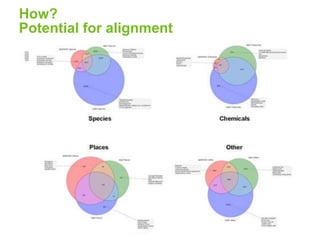
How? 
Potential for alignment
Meeting 
Outcomes 
. 
Building common understanding 
Fact finding for consultants Part 1 report 
Communicate the need for GACS in an open 
data environment? 
Support for GACS
Thank You
Questions? 
● We are proposing an approach to address a need for a unified agricultural language 
system. 
Is this a real need? Will this workshop validate the need? 
Is this a useful approach? Is this an important development? 
● At the moment there are three organisations involved and three thesauri. Which 
organisations are missing? Which vocabularies/thesauri are missing? Is it 
important that they are included in this ‘proof of concept’ stage. What would the 
nature of their participation be? 
● Who would be the main users of GACS? Do we have enough ‘use cases’ to help 
people understand the utility of GACS? 
● We will need to address the governance of GACS. What sort of models would 
work? What innovative solutions for governance would be possible? 
● Have we missed anything? Are there alternatives?
Conclusions of the meeting? 
● There is a need for GACS, this approach is important/essential, and although there 
may be other partners at this moment we want to scope out and implement a first 
phase.

Global agricultural Concept Scheme (GACS)

  • 1.
    Global Agricultural Concept Scheme (GACS) Johannes Keizer, Simon Liu, Martin Parr Global GODAN/CIARD Consultation on Open Agricultural Knowledge for Development 22-24 April 2014 Rome, Italy
  • 2.
    Global Agricultural ContentScheme (GACS) • Who? • Why? • What? • How?
  • 3.
    • Johannes Keizer • Simon Liu • Martin Parr Who?
  • 4.
    What words describethis picture? Swine? Pig? Porcine? Hog? Sus scrofa domestica?
  • 5.
    • Acronyms Synonyms - ABA vs. abscisic acid - DHBV vs. Duck hepatitis B virus - WHO vs. World Health Organization • Plural / Singular - pigs vs. pig - renal calculi vs. renal calculus • Spelling variants - Sugar beet vs. Sugarbeet - Buddleja vs. Buddleia • Usage variants - Aubergines vs. Eggplants - Palta vs. Aguacate vs. Avocado • Quasi-synonyms…
  • 6.
  • 7.
    Scientific vs. CommonNames ● Heliothis zea ● Helicoverpa zea ● Tomato fruitworm ● Corn earworm ● Bollworm
  • 8.
    Needs a Thesaurus • Share common understanding of the structure of information - Among people - Among systems/databases - Among people & systems/databases • Provide consistency & reduce variability • Enable reuse of domain knowledge • Avoid re-inventing the wheel • Enable interoperability
  • 9.
  • 10.
    Why GACS? Wehave some common beliefs ● We serve consumers of agricultural scientific knowledge ● We want to help them better navigate to and understand content ● We recognise the concept of global public goods and the value of open access & open data ● We have identified the need for a unified agricultural language system to support describing open data
  • 11.
    Why GACS? Wehave some common challenges ● G8 Conference on Open Data in Agriculture & Nutrition ● In the age of open data we need common semantics to describe data thus enabling linking different types of information & data ● We each manage an agricultural thesaurus: AGROVOC, NAL Thesaurus, CAB Thesaurus ● These three thesauri meet the needs of their parent organizations, but they have differences
  • 12.
    Why GACS? Weshare some common knowledge
  • 13.
    GACS Uses •Information description & structuring • Spelling aid • Natural language processing • Information retrieval • Information mapping & integration • Automated indexing
  • 14.
    What? Global AgricultureConcept Scheme GACS … ● A global unified agricultural language system ● Address the differences and builds alignments between AGROVOC, CABT and NALT ● Public ● Open (and moving to Open Data) ● Collaborative (CABI, NAL, FAO) ● Extensible (scope and partners) ● An integrated offering ● A working model (a bit more than a Proof of Concept?)
  • 15.
    What? GACS aspiresto … ● Be owned and maintained by a consortium? ● Bring economies of scale to partners and users ● Avoid duplication of effort in new organisations moving to open data environments ● Improve efficiency of information and data management in the long term ● Improve the discoverability of information and data to the benefit of farmers, researchers and policy makers
  • 16.
    How? ● Signedagreement between CABI, FAO, NAL to work together to develop GACS, covering ● Options for alignment ● Technical Approach ● Governance ● Resources & Milestones ● Commission independent consultants to review existing thesauri and host organisation workflows and business needs ● Host and participate in workshops, working closely with policy makers ● This is what we hope to help start to answer here
  • 17.
  • 18.
    Meeting Outcomes . Building common understanding Fact finding for consultants Part 1 report Communicate the need for GACS in an open data environment? Support for GACS
  • 19.
  • 20.
    Questions? ● Weare proposing an approach to address a need for a unified agricultural language system. Is this a real need? Will this workshop validate the need? Is this a useful approach? Is this an important development? ● At the moment there are three organisations involved and three thesauri. Which organisations are missing? Which vocabularies/thesauri are missing? Is it important that they are included in this ‘proof of concept’ stage. What would the nature of their participation be? ● Who would be the main users of GACS? Do we have enough ‘use cases’ to help people understand the utility of GACS? ● We will need to address the governance of GACS. What sort of models would work? What innovative solutions for governance would be possible? ● Have we missed anything? Are there alternatives?
  • 21.
    Conclusions of themeeting? ● There is a need for GACS, this approach is important/essential, and although there may be other partners at this moment we want to scope out and implement a first phase.

Editor's Notes

  • #3 These three orgnisations have signed agreement to work together to develop
  • #4 These three organisations have signed agreement to work together to develop the concept and implement a pilot, because …..
  • #12 Bullet 1: Commitment to make data accessible in open formats, in formats usable by automated agents, is growing. Bullet 2: The three agricultural thesauri are used globally, but at the moment they are not aligned with each other and they are costly to maintain and difficult to access and to use. Bullet 3, as organizations move to open data they will need tools for enriching the data with metadata derived from tools that they may end up developing such as creating new vocabularies /schemes for specific purposes – this is a duplication of effort and not cost effective in an open data environment where these knowledge management costs may become prohibitive. Addresses a problem Increasing amount of content leads to much confusion Data is everywhere But….what does it all mean? We need improved tools to help us understand the data Semantics – the framework for describing meaning Several tools exist which could usefully be aligned to promote coherence What happens if we don’t
  • #13 Shows the common concepts and terms , but shows the differences – how to move these to a unified agricultural language system
  • #18 This slide is one that Osma prepared to look at this provides us with data on where we focus for quick wins for the first stage or ‘proof of concept’ enabling GACS to move to a bigger vision. No conclusions yet – as you know but these data will be presented in their presentation