Chapter Four
Globalization and Regionalism
4.1. Defining Globalization
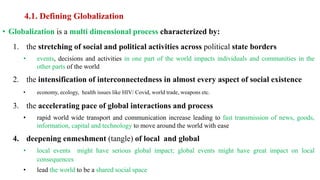
• Globalization is a multi dimensional process characterized by:
1. the stretching of social and political activities across political state borders
• events, decisions and activities in one part of the world impacts individuals and communities in the
other parts of the world
2. the intensification of interconnectedness in almost every aspect of social existence
• economy, ecology, health issues like HIV/ Covid, world trade, weapons etc.
3. the accelerating pace of global interactions and process
• rapid world wide transport and communication increase leading to fast transmission of news, goods,
information, capital and technology to move around the world with ease
4. deepening enmeshment (tangle) of local and global
• local events might have serious global impact; global events might have great impact on local
consequences
• lead the world to be a shared social space
Con’t…
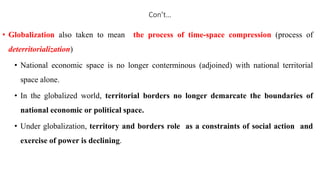
• Globalization also taken to mean the process of time-space compression (process of
deterritorialization)
• National economic space is no longer conterminous (adjoined) with national territorial
space alone.
• In the globalized world, territorial borders no longer demarcate the boundaries of
national economic or political space.
• Under globalization, territory and borders role as a constraints of social action and
exercise of power is declining.
4.2. The Globalization Debates
Globalization is a contentious issue in international relations.
There has been intense debate as to the direction, nature and effect of globalization on states.
There are three perspectives:
The hyper-globalists,
The skeptics
Transformationalists
Each perspective delivers a distinct response to the questions of:
 What is new about globalization; and what are its political consequences for
sovereign statehood?
The Hyper-globalists
• nation states become obsolete
• privileges the economic over the political, the market over the state, and prefigures the decline
of states
• de-nationalization/ de-territorialization is due to economic globalization
• claim that economic globalization is generating a new pattern of losers as well as winners in
the international economy
• globalization is imparting new liberal ideas and culture of modernization replacing the
traditional culture
The skeptics
 Rejects the view of super globalist as a myth, flawed and politically naïve
• Considers globalization as internationalization which is dependent on the regulatory power
of states
 States are central actors and agents of globalization playing central role in shaping and
regulating the economic activities including the transboundary flows of ideas, goods and
peoples
 Undermine the view that the world is interconnected and moving in to a village.
• Globalization is not more than regionalization that is being manifested in the emergence
of financial and trading blocs in Western countries, north America, in Asia and to some
extent in Africa.
• Argue that the world has seen more interconnectedness at regional level than at the
global level.
 There is no free flow of goods, resources, technology and finance at the global
level, instead there is just a regional based globalization
Con’t…
 The Western region (Global North) is more integrated and globalized than Africa and
Asia (Global South).
 There does exist a trade relation b/n the developing nations and the Western markets
(agricultural commodities); this trade is not beneficial to the developing nations as the
West sells technology and financial capital to the developing world where the developing
world sells its relatively much cheaper agricultural commodities.
 Doesn’t agree that globalization would help to narrow the economic and technological
gap b/n the Global North and the Global South
Con’t…
• Globalization brings nothing new;
• it is just the crystallization of the already existing realities of the world which has been
marked by the Global North-Global South gap reflected in terms of the deeply rooted
patters of inequality and hierarchy
• For them, the so called globalization is not more than regionalization that is being manifested
in the emergence of financial and trading blocs in
 Western countries, North America, in Asia and to some extent in Africa.
 Europe, EU as site and expression of globalization;
 North America, a trading bloc, NAFTA(North American Free Trade Agreement),
 Asia, ASEAN (Association of Southeast Asian Nations).
Transformationalists
• globalization is driving force behind the rapid social, political and economic changes which
are reshaping societies and international politics
• globalization is reconstituting or reengineering/transforming the power, function and the
authority of the state
• they assert that a new sovereignty regime is displacing traditional conception of state power
as an absolute, indivisible, territorially exclusive power.
• sovereignty today is the best understood as “….less a territorially defined barrier than a
bargaining resource for a politics characterized by complex transnational network
4.3. Globalization and Its Impacts on Africa
• Americanization
- homogenization of the world in American standards
- Africa is poor performer due to conflicts and political instabilities
- In the political sphere, the erosion of sovereignty is there
- Artificial democracy and good governance
- the development of anti-developmentalism by declaring the state irrelevant or marginal to the
developmental effort
- Disintegrated economic competition to win outside interest
- Opened economies to foreign goods and services
- Severe loose of African identity
- Discouraged entrepreneurialism, economy is marginalized
- Not technological innovations, etc
4.4. Ethiopia in a Globalized World
• Positive impacts
- Access to new technologies and knowledge transfer
- Increased foreign aid due to attempts to liberalize
• Negative Impacts
- Ethnic and religious extremism
- Loss of identity
- Economic and pol.l dependency due to incompetency
4.5. Pros and Cons of Globalization
Pros of Globalization
- expansion of democratic culture, human
right and the protection of marginalized
- Innovation in science, medicine, and
technology
- strengthened international interdependence
- rapid economic growth in some countries
of the south
Cons of Globalization
- A growing gap between rich and poor
- Western imperialism of ideas and beliefs
- Increased consumption increased
environmental pollution
- Transboundary crimes
- Glocalization (contributed to the rise of
radical nationalism and ethnicity)
4.6. Defining Regionalism and Regional Integration
• Regionalism refers to intensifying political and/or economic processes of cooperation among states
and other actors in particular geographic regions
• It also refers to the proneness of the governments and peoples of two or more states to establish
voluntary associations and to pool together resources (material and nonmaterial) in order to create
common functional and institutional arrangements.
• Best described as a process occurring in a given geographical region by which different types of
actors come to share certain fundamental values and norms.
• These actors also participate in a growing network of economic, cultural, scientific, diplomatic, political and
military interactions
• Regionalism is happening in all parts of the world
• First started in Europe, then in Latin America
• But the style of Western
• The prevailing theories are also Western based
4.6.1. The Old Regionalism
Regionalism is predominantly a post-World War II phenomenon. 1940s in Western Europe
• Regional Integration in Europe and Beyond
- The current EU has a root in earlier regional arrangements
- European Coal and Steel Community (ECSC) in 1951 European Economic Community
(EEC) in 1958 + European Atomic Energy Community (EAEC)ECEU
- European experience as a base for the others elsewhere is being used since then
- This resulted in difficulties in identifying comparable cases
Regional Integration in Latin America and Africa
- The development of regionalism closely related to anti-colonialism and the quest to facilitate
economic dev’t
- Structuralist perspectives ruled the developing states’ regionalism, not integration, but
development, state-promoted industrialization and nation-building, first and foremost through
protectionism and import-substitution.
- the attempt in Latin America was to enhance import substitution regionally when it became
exhausted at the national level
- The structuralist school thus shifted its focus away from economic integration as means for
peace and political unification, to one of regional economic cooperation /integration as means
for economic development and state-formation in developing countries i.e Structural
transformation
- This type of regionalism resulted in the creation of the Latin American Free Trade Association
(LAFTA) in Montevideo in 1960.
Con’t…
- In Africa, the development of regional cooperation is influenced by the 1960s and 70s
debates b/n Casablanca and Monrovia group and laid in the founding documents of OAU
and latter AU, such as Lagos Plan of Action (1980) and the Abuja treaty (1991)
- The major purpose of regionalization was to resist colonial and post-colonial influence,
protectionism and realizing import substitution
- CFA (Community of French Africa), East African Community (EAC) and SACU (Southern
African Community Union), The SADCC (The Southern Africa Development Coordination
Conference, a predecessor of the SADC)
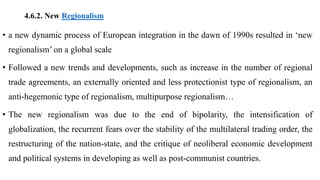
4.6.2. New Regionalism
• a new dynamic process of European integration in the dawn of 1990s resulted in ‘new
regionalism’ on a global scale
• Followed a new trends and developments, such as increase in the number of regional
trade agreements, an externally oriented and less protectionist type of regionalism, an
anti-hegemonic type of regionalism, multipurpose regionalism…
• The new regionalism was due to the end of bipolarity, the intensification of
globalization, the recurrent fears over the stability of the multilateral trading order, the
restructuring of the nation-state, and the critique of neoliberal economic development
and political systems in developing as well as post-communist countries.
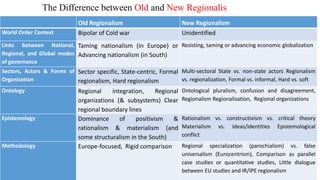
The Difference between Old and New Regionalis
Old Regionalism New Regionalism
World Order Context Bipolar of Cold war Unidentified
Links between National,
Regional, and Global modes
of governance
Taming nationalism (in Europe) or
Advancing nationalism (in South)
Resisting, taming or advancing economic globalization
Sectors, Actors & Forms of
Organization
Sector specific, State-centric, Formal
regionalism, Hard regionalism
Multi-sectoral State vs. non-state actors Regionalism
vs. regionalization, Formal vs. informal, Hard vs. soft
Ontology Regional integration, Regional
organizations (& subsystems) Clear
regional boundary lines
Ontological pluralism, confusion and disagreement,
Regionalism Regionalization, Regional organizations
Epistemology Dominance of positivism &
rationalism & materialism (and
some structuralism in the South)
Rationalism vs. constructivism vs. critical theory
Materialism vs. ideas/identities Epistemological
conflict
Methodology Europe-focused, Rigid comparison Regional specialization (parochialism) vs. false
universalism (Eurocentrism), Comparison as parallel
case studies or quantitative studies, Little dialogue
between EU studies and IR/IPE regionalism
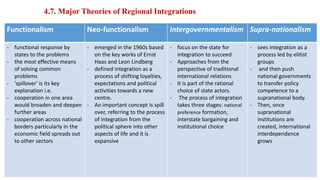
4.7. Major Theories of Regional Integrations
Functionalism Neo-functionalism Intergovernmentalism Supra-nationalism
- functional response by
states to the problems
- the most effective means
of solving common
problems
- 'spillover' is its key
explanation i.e.
- cooperation in one area
would broaden and deepen
further areas
- cooperation across national
borders particularly in the
economic field spreads out
to other sectors
- emerged in the 1960s based
on the key works of Ernst
Haas and Leon Lindberg
- defined integration as a
process of shifting loyalties,
expectations and political
activities towards a new
centre.
- An important concept is spill
over, referring to the process
of integration from the
political sphere into other
aspects of life and it is
expansive
- focus on the state for
integration to succeed
- Approaches from the
perspective of traditional
international relations
- It is part of the rational
choice of state actors.
- The process of integration
takes three stages: national
preference formation,
interstate bargaining and
institutional choice
- sees integration as a
process led by elitist
groups
- and then push
national governments
to transfer policy
competence to a
supranational body.
- Then, once
supranational
institutions are
created, international
interdependence
grows
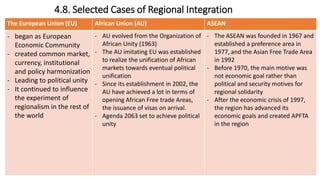
4.8. Selected Cases of Regional Integration
The European Union (EU) African Union (AU) ASEAN
- began as European
Economic Community
- created common market,
currency, institutional
and policy harmonization
- Leading to political unity
- It continued to influence
the experiment of
regionalism in the rest of
the world
- AU evolved from the Organization of
African Unity (1963)
- The AU imitating EU was established
to realize the unification of African
markets towards eventual political
unification
- Since its establishment in 2002, the
AU have achieved a lot in terms of
opening African Free trade Areas,
the issuance of visas on arrival.
- Agenda 2063 set to achieve political
unity
- The ASEAN was founded in 1967 and
established a preference area in
1977, and the Asian Free Trade Area
in 1992
- Before 1970, the main motive was
not economic goal rather than
political and security motives for
regional solidarity
- After the economic crisis of 1997,
the region has advanced its
economic goals and created APFTA
in the region
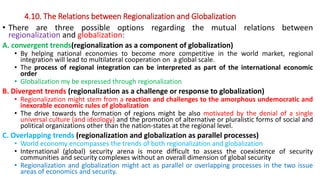
4.10. The Relations between Regionalization and Globalization
• There are three possible options regarding the mutual relations between
regionalization and globalization:
A. convergent trends(regionalization as a component of globalization)
• By helping national economies to become more competitive in the world market, regional
integration will lead to multilateral cooperation on a global scale.
• The process of regional integration can be interpreted as part of the international economic
order
• Globalization my be expressed through regionalization
B. Divergent trends (regionalization as a challenge or response to globalization)
• Regionalization might stem from a reaction and challenges to the amorphous undemocratic and
inexorable economic rules of globalization
• The drive towards the formation of regions might be also motivated by the denial of a single
universal culture (and ideology) and the promotion of alternative or pluralistic forms of social and
political organizations other than the nation-states at the regional level.
C. Overlapping trends (regionalization and globalization as parallel processes)
• World economy encompasses the trends of both regionalization and globalization
• International (global) security arena is more difficult to assess the coexistence of security
communities and security complexes without an overall dimension of global security
• Regionalization and globalization might act as parallel or overlapping processes in the two issue
areas of economics and security.
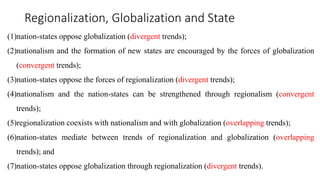
Regionalization, Globalization and State
(1)nation-states oppose globalization (divergent trends);
(2)nationalism and the formation of new states are encouraged by the forces of globalization
(convergent trends);
(3)nation-states oppose the forces of regionalization (divergent trends);
(4)nationalism and the nation-states can be strengthened through regionalism (convergent
trends);
(5)regionalization coexists with nationalism and with globalization (overlapping trends);
(6)nation-states mediate between trends of regionalization and globalization (overlapping
trends); and
(7)nation-states oppose globalization through regionalization (divergent trends).
Global Affairs - PP 4 2024 teaching.pptx

Global Affairs - PP 4 2024 teaching.pptx

  • 1.
  • 2.
    4.1. Defining Globalization •Globalization is a multi dimensional process characterized by: 1. the stretching of social and political activities across political state borders • events, decisions and activities in one part of the world impacts individuals and communities in the other parts of the world 2. the intensification of interconnectedness in almost every aspect of social existence • economy, ecology, health issues like HIV/ Covid, world trade, weapons etc. 3. the accelerating pace of global interactions and process • rapid world wide transport and communication increase leading to fast transmission of news, goods, information, capital and technology to move around the world with ease 4. deepening enmeshment (tangle) of local and global • local events might have serious global impact; global events might have great impact on local consequences • lead the world to be a shared social space
  • 3.
    Con’t… • Globalization alsotaken to mean the process of time-space compression (process of deterritorialization) • National economic space is no longer conterminous (adjoined) with national territorial space alone. • In the globalized world, territorial borders no longer demarcate the boundaries of national economic or political space. • Under globalization, territory and borders role as a constraints of social action and exercise of power is declining.
  • 4.
    4.2. The GlobalizationDebates Globalization is a contentious issue in international relations. There has been intense debate as to the direction, nature and effect of globalization on states. There are three perspectives: The hyper-globalists, The skeptics Transformationalists Each perspective delivers a distinct response to the questions of:  What is new about globalization; and what are its political consequences for sovereign statehood?
  • 5.
    The Hyper-globalists • nationstates become obsolete • privileges the economic over the political, the market over the state, and prefigures the decline of states • de-nationalization/ de-territorialization is due to economic globalization • claim that economic globalization is generating a new pattern of losers as well as winners in the international economy • globalization is imparting new liberal ideas and culture of modernization replacing the traditional culture
  • 6.
    The skeptics  Rejectsthe view of super globalist as a myth, flawed and politically naïve • Considers globalization as internationalization which is dependent on the regulatory power of states  States are central actors and agents of globalization playing central role in shaping and regulating the economic activities including the transboundary flows of ideas, goods and peoples  Undermine the view that the world is interconnected and moving in to a village. • Globalization is not more than regionalization that is being manifested in the emergence of financial and trading blocs in Western countries, north America, in Asia and to some extent in Africa. • Argue that the world has seen more interconnectedness at regional level than at the global level.  There is no free flow of goods, resources, technology and finance at the global level, instead there is just a regional based globalization
  • 7.
    Con’t…  The Westernregion (Global North) is more integrated and globalized than Africa and Asia (Global South).  There does exist a trade relation b/n the developing nations and the Western markets (agricultural commodities); this trade is not beneficial to the developing nations as the West sells technology and financial capital to the developing world where the developing world sells its relatively much cheaper agricultural commodities.  Doesn’t agree that globalization would help to narrow the economic and technological gap b/n the Global North and the Global South
  • 8.
    Con’t… • Globalization bringsnothing new; • it is just the crystallization of the already existing realities of the world which has been marked by the Global North-Global South gap reflected in terms of the deeply rooted patters of inequality and hierarchy • For them, the so called globalization is not more than regionalization that is being manifested in the emergence of financial and trading blocs in  Western countries, North America, in Asia and to some extent in Africa.  Europe, EU as site and expression of globalization;  North America, a trading bloc, NAFTA(North American Free Trade Agreement),  Asia, ASEAN (Association of Southeast Asian Nations).
  • 9.
    Transformationalists • globalization isdriving force behind the rapid social, political and economic changes which are reshaping societies and international politics • globalization is reconstituting or reengineering/transforming the power, function and the authority of the state • they assert that a new sovereignty regime is displacing traditional conception of state power as an absolute, indivisible, territorially exclusive power. • sovereignty today is the best understood as “….less a territorially defined barrier than a bargaining resource for a politics characterized by complex transnational network
  • 10.
    4.3. Globalization andIts Impacts on Africa • Americanization - homogenization of the world in American standards - Africa is poor performer due to conflicts and political instabilities - In the political sphere, the erosion of sovereignty is there - Artificial democracy and good governance - the development of anti-developmentalism by declaring the state irrelevant or marginal to the developmental effort - Disintegrated economic competition to win outside interest - Opened economies to foreign goods and services - Severe loose of African identity - Discouraged entrepreneurialism, economy is marginalized - Not technological innovations, etc
  • 11.
    4.4. Ethiopia ina Globalized World • Positive impacts - Access to new technologies and knowledge transfer - Increased foreign aid due to attempts to liberalize • Negative Impacts - Ethnic and religious extremism - Loss of identity - Economic and pol.l dependency due to incompetency
  • 12.
    4.5. Pros andCons of Globalization Pros of Globalization - expansion of democratic culture, human right and the protection of marginalized - Innovation in science, medicine, and technology - strengthened international interdependence - rapid economic growth in some countries of the south Cons of Globalization - A growing gap between rich and poor - Western imperialism of ideas and beliefs - Increased consumption increased environmental pollution - Transboundary crimes - Glocalization (contributed to the rise of radical nationalism and ethnicity)
  • 13.
    4.6. Defining Regionalismand Regional Integration • Regionalism refers to intensifying political and/or economic processes of cooperation among states and other actors in particular geographic regions • It also refers to the proneness of the governments and peoples of two or more states to establish voluntary associations and to pool together resources (material and nonmaterial) in order to create common functional and institutional arrangements. • Best described as a process occurring in a given geographical region by which different types of actors come to share certain fundamental values and norms. • These actors also participate in a growing network of economic, cultural, scientific, diplomatic, political and military interactions • Regionalism is happening in all parts of the world • First started in Europe, then in Latin America • But the style of Western • The prevailing theories are also Western based
  • 14.
    4.6.1. The OldRegionalism Regionalism is predominantly a post-World War II phenomenon. 1940s in Western Europe • Regional Integration in Europe and Beyond - The current EU has a root in earlier regional arrangements - European Coal and Steel Community (ECSC) in 1951 European Economic Community (EEC) in 1958 + European Atomic Energy Community (EAEC)ECEU - European experience as a base for the others elsewhere is being used since then - This resulted in difficulties in identifying comparable cases
  • 15.
    Regional Integration inLatin America and Africa - The development of regionalism closely related to anti-colonialism and the quest to facilitate economic dev’t - Structuralist perspectives ruled the developing states’ regionalism, not integration, but development, state-promoted industrialization and nation-building, first and foremost through protectionism and import-substitution. - the attempt in Latin America was to enhance import substitution regionally when it became exhausted at the national level - The structuralist school thus shifted its focus away from economic integration as means for peace and political unification, to one of regional economic cooperation /integration as means for economic development and state-formation in developing countries i.e Structural transformation - This type of regionalism resulted in the creation of the Latin American Free Trade Association (LAFTA) in Montevideo in 1960.
  • 16.
    Con’t… - In Africa,the development of regional cooperation is influenced by the 1960s and 70s debates b/n Casablanca and Monrovia group and laid in the founding documents of OAU and latter AU, such as Lagos Plan of Action (1980) and the Abuja treaty (1991) - The major purpose of regionalization was to resist colonial and post-colonial influence, protectionism and realizing import substitution - CFA (Community of French Africa), East African Community (EAC) and SACU (Southern African Community Union), The SADCC (The Southern Africa Development Coordination Conference, a predecessor of the SADC)
  • 17.
    4.6.2. New Regionalism •a new dynamic process of European integration in the dawn of 1990s resulted in ‘new regionalism’ on a global scale • Followed a new trends and developments, such as increase in the number of regional trade agreements, an externally oriented and less protectionist type of regionalism, an anti-hegemonic type of regionalism, multipurpose regionalism… • The new regionalism was due to the end of bipolarity, the intensification of globalization, the recurrent fears over the stability of the multilateral trading order, the restructuring of the nation-state, and the critique of neoliberal economic development and political systems in developing as well as post-communist countries.
  • 18.
    The Difference betweenOld and New Regionalis Old Regionalism New Regionalism World Order Context Bipolar of Cold war Unidentified Links between National, Regional, and Global modes of governance Taming nationalism (in Europe) or Advancing nationalism (in South) Resisting, taming or advancing economic globalization Sectors, Actors & Forms of Organization Sector specific, State-centric, Formal regionalism, Hard regionalism Multi-sectoral State vs. non-state actors Regionalism vs. regionalization, Formal vs. informal, Hard vs. soft Ontology Regional integration, Regional organizations (& subsystems) Clear regional boundary lines Ontological pluralism, confusion and disagreement, Regionalism Regionalization, Regional organizations Epistemology Dominance of positivism & rationalism & materialism (and some structuralism in the South) Rationalism vs. constructivism vs. critical theory Materialism vs. ideas/identities Epistemological conflict Methodology Europe-focused, Rigid comparison Regional specialization (parochialism) vs. false universalism (Eurocentrism), Comparison as parallel case studies or quantitative studies, Little dialogue between EU studies and IR/IPE regionalism
  • 19.
    4.7. Major Theoriesof Regional Integrations Functionalism Neo-functionalism Intergovernmentalism Supra-nationalism - functional response by states to the problems - the most effective means of solving common problems - 'spillover' is its key explanation i.e. - cooperation in one area would broaden and deepen further areas - cooperation across national borders particularly in the economic field spreads out to other sectors - emerged in the 1960s based on the key works of Ernst Haas and Leon Lindberg - defined integration as a process of shifting loyalties, expectations and political activities towards a new centre. - An important concept is spill over, referring to the process of integration from the political sphere into other aspects of life and it is expansive - focus on the state for integration to succeed - Approaches from the perspective of traditional international relations - It is part of the rational choice of state actors. - The process of integration takes three stages: national preference formation, interstate bargaining and institutional choice - sees integration as a process led by elitist groups - and then push national governments to transfer policy competence to a supranational body. - Then, once supranational institutions are created, international interdependence grows
  • 20.
    4.8. Selected Casesof Regional Integration The European Union (EU) African Union (AU) ASEAN - began as European Economic Community - created common market, currency, institutional and policy harmonization - Leading to political unity - It continued to influence the experiment of regionalism in the rest of the world - AU evolved from the Organization of African Unity (1963) - The AU imitating EU was established to realize the unification of African markets towards eventual political unification - Since its establishment in 2002, the AU have achieved a lot in terms of opening African Free trade Areas, the issuance of visas on arrival. - Agenda 2063 set to achieve political unity - The ASEAN was founded in 1967 and established a preference area in 1977, and the Asian Free Trade Area in 1992 - Before 1970, the main motive was not economic goal rather than political and security motives for regional solidarity - After the economic crisis of 1997, the region has advanced its economic goals and created APFTA in the region
  • 21.
    4.10. The Relationsbetween Regionalization and Globalization • There are three possible options regarding the mutual relations between regionalization and globalization: A. convergent trends(regionalization as a component of globalization) • By helping national economies to become more competitive in the world market, regional integration will lead to multilateral cooperation on a global scale. • The process of regional integration can be interpreted as part of the international economic order • Globalization my be expressed through regionalization B. Divergent trends (regionalization as a challenge or response to globalization) • Regionalization might stem from a reaction and challenges to the amorphous undemocratic and inexorable economic rules of globalization • The drive towards the formation of regions might be also motivated by the denial of a single universal culture (and ideology) and the promotion of alternative or pluralistic forms of social and political organizations other than the nation-states at the regional level. C. Overlapping trends (regionalization and globalization as parallel processes) • World economy encompasses the trends of both regionalization and globalization • International (global) security arena is more difficult to assess the coexistence of security communities and security complexes without an overall dimension of global security • Regionalization and globalization might act as parallel or overlapping processes in the two issue areas of economics and security.
  • 22.
    Regionalization, Globalization andState (1)nation-states oppose globalization (divergent trends); (2)nationalism and the formation of new states are encouraged by the forces of globalization (convergent trends); (3)nation-states oppose the forces of regionalization (divergent trends); (4)nationalism and the nation-states can be strengthened through regionalism (convergent trends); (5)regionalization coexists with nationalism and with globalization (overlapping trends); (6)nation-states mediate between trends of regionalization and globalization (overlapping trends); and (7)nation-states oppose globalization through regionalization (divergent trends).