LEARNING OUTCOME:
1. IDENTIFYSOME PROBLEMATIC FRAMES OF REFERENCE AND
CORRECT THEM
2. TRANSFORM SOME BASIC ASSUMPTIONS YOU LEARN FROM THE
OLD TRADITIONS, CULTURE, AND EVEN FAMILY ORIENTATION.
3. CONTRAST THE KIND OF ASSUMPTION BY CITING CONCRETE
EXAMPLES
DIFFERENT ANSWER
• Byemploying critical thinking, individuals can evaluate information
objectively, consider multiple perspectives, and analyze complex
situations more effectively. It enables them to identify underlying
assumptions, uncover biases, and assess the credibility and
relevance of data and evidence.
• It plays a pivotal role in enhancing decision-making and problem-
solving processes.
6.
•CRITICAL THINKING ISAT THE CORE
OF LEARNING BECAUSE IT ALLOWS
STUDENTS TO REFLECT ON AND
COMPREHEND THEIR PERSPECTIVES.
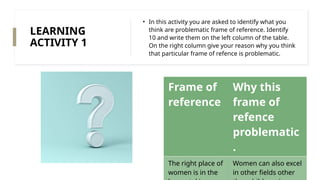
LEARNING
ACTIVITY 1
• Inthis activity you are asked to identify what you
think are problematic frame of reference. Identify
10 and write them on the left column of the table.
On the right column give your reason why you think
that particular frame of refence is problematic.
Frame of
reference
Why this
frame of
refence
problematic
.
The right place of
women is in the
Women can also excel
in other fields other
10.
TRANSFORMATIVE LEARNING
• ITIS A THEORY OF ADULT LEARNING THAT UTILIZES
DISORIENTING DILEMMAS TO CHALLENGE
STUDENTS’ THINKING. STUDENTS ARE THEN
ENCOURAGE TO USE CRITICAL THINKING AND
QUESTIONING TO CONSIDER IF THEIR UNDERLYING
ASSUMPTIONS AND BELIEFS ABOUT THE WORLD ARE
ACCURATE.
11.
EXAMPLE
• Equivocation; -Thisfallacy is committed when a term/ word is used
in an argument to mean different things. -This occurs in premises
and is inferred in the conclusion. e.g.,
• 1) Power corrupts. Knowledge is power. Therefore, knowledge
corrupts.
• 2) God is love. Love is blind. Therefore, God is blind.
12.
KINDS OF ASSUMPTIONS-STEPHEN
BROOKFIELD.
•PARADIGMATIC- A FANCY WORD FOR DESCRIBING SOMETHING THAT
IS AN IDEAL OR STANDARD.
EXAMPLE: GIFT ARE SYMBOL OF GENEROSITY.
LEARNING IS FUN.
ADULT LEARNERS ARE MUCH BETTER TO HANDLE THAN
CHILDREN.
BIRTHDAYS ARE JOYOUS EVENT.
TEACHERS ARE EXEMPLARS OF MORAL EXCELLENCE.
13.
KINDS OF ASSUMPTIONS-STEPHEN
BROOKFIELD.
•PRESCRIPTIVE- ARE WHAT YOU THINK SHOULD HAPPEN IN EACH
SITUATION. ASSUMPTIONS ABOUT WHAT WE THINK OUGHT TO BE
HAPPENING IN A PARTICULAR SITUATION.
EXAMPLE: LEARNERS SHOULD ALWAYS BE SMART.
STUDENTS WHO STUDIED IN A CATHOLIC SCHOOL
SHOULD BE IN THE CHURCH EVERY SUNDAY OR HOLY.
14.
KINDS OF ASSUMPTIONS-STEPHEN
BROOKFIELD.
•CAUSAL- ASSUMPTIONS ARE ASSUMPTIONS ABOUT HOW DIFFERENT PARTS
OF THE WORLD WORK AND ABOUT THE CONDITIONS UNDER WHICH THESE
CAN BE CHANGED. IN LOGIC THIS IS WHAT WE CALL “NON-CAUSA PRO
CAUSA”
EXAMPLE: WHEN THERE IS SMOKE, THERE IS FIRE.
FRIDAY THE 13th
“malas”
NOT WEARING A RED UNDERWARE IS THE CAUSE OF YOUR FAILURE IN
BOARD EXAM.
15.
KINDS OF ASSUMPTIONS
•ONTOLOGICAL-THE OBJECT OF INQUIRY, WHAT
YOU SET TO EXAMINE. ONE OF THE LONGEST
STANDING ONTOLOGICAL QUESTIONS IN
PHILOSOPHY IS THE EXISTENCE OF GOD. THE
PURPOSE OF EXISTENCE, THE MEANING OF
SENSORY EXPERIENCE.
LEARNING ACTIVITY 2
DIRECTION:GIVE YOUR PERSONAL PARADIGMATIC ASSUMPTION OF
THE TOPICS LISTED BELOW. MAKE 2 COLUMN IN YOUR PAPER.
1. MARRIAGE 5. FAMILY 9. POLICE OFFICERS
2. RELIGION 6. FRIENDSHIP 10. POLITICIANS
3. EDUCATION 7. DEATH
4. HONESTY 8. OLD PEOPLE
19.
ASSIGNMENT
DIRECTION: IN THISACTIVITY, YOU NEED THE HELP OF OTHRE PEOPLE. THEY
COULD BE YOUR PARENTS, SIBLINGS, FRIENDS, RELATIVES, OR NEIGHBORS, ASK
THEM ABOUT THEIR PRESCRIPTIVE ASSUMPTION ABOUT THE TOPICS LISTED
BELOW.
1. MARRIAGE 4. HONESTY
2. RELIGION 5. FAMILY
3. EDUCATION 6. FRIENDSHIP
20.
TRANSFORMATIVE
LEARNING: THEORY TO
PRACTICE
•A DEFINING CONDITION OF BEING HUMAN IS THAT
WE HAVE TO UNDERSTAND THE MEANING OF OUR
EXISTENCE.
• IN CONTEMPORARY(MODERN-DAY) SOCIETIES, WE
MUST LEARN TO MAKE OUR OWN INTERPRETATIONS
RATHER THAT ACT ON THE PURPOSES, BELIEFS,
JUDGEMENTS, AND FEELINGS OF OTHERS.
• WHAT ISTHE MEANING OF
OUR EXISTENCE? WHY I AM
HERE, AND WHAT PURPOSE
DO I HAVE TO SERVE
HUMANKIND?
• WHAT GIVES YOUR LIFE
MEANING? WHAT ARE YOU
PASSIONATE ABOUT?
FRAME OF REFERENCEENCOMPASSES
OF THE FOLLOWING:
• COGNITIVE-BEING CONSCIOUS MENTAL ACTIVITY(AS THINKING, REASONING,
REMEMBERING, IMAGINING, LEARNING WORDS, AND USING LANGUAGE).
• CONATIVE- WHEN A PERSON IS ACTING A CERTAIN WAY TOWARDS SOMETHING.
(EXAMPLE: WHEN YOU SEE SPIDERS, COCKROACH, AND THE LIKES)
• EMOTIONAL COMPONENTS-FEELINGS THAT WE EXPERIENCE IN OUR DAILY LIFE.
(POSITIVE OR NEGATIVE).
25.
IDEOLOGY
• A SETOF IDEAS, BELIEFS AND ATTITUDES,
CONSCIOUSLY OR UNCONSCIOUSLY HELD, WHICH
REFLECTS OR SHAPES UNDERSTANDINGS OR
MISCONCEPTIONS OF THE SOCIAL AND POLITICAL
WORLD.
• “IDEA” –IS WHATEVER COMES TO MIND. ANY IDEA IS A
POTENTIALLY A COMPONENT OF IDEOLOGY.
ORIGIN OF “IDEOLOGY”
ANDTRANSFORMATION
OF ITS MEANING.
• JOHN LOCKE (1632-1704)- "IDEA" IS OFTEN
USED BY LOCKE TO MEAN A BELIEF OR A BIT
OF KNOWLEDGE. WHEN HE WRITES THAT
KNOWLEDGE "IS REAL ONLY SO FAR AS THERE
IS A CONFORMITY BETWEEN OUR IDEAS AND
THE REALITY OF THINGS“
• HIS CONCERN IS CLEARLY WHETHER THERE IS
A CORRESPONDENCE BETWEEN WHAT WE
BELIEVE AND WHAT IS ACTUALLY THE CASE.
• IDEAS are MENTAL OBJECTS.
• TABULA RASA- AT BIRTH THE (HUMAN)
MIND IS A “BLANK SLATE” WITHOUT RULES
FOR PROCESSING ARE FORM SOLELY BY
ONE’S SENSORY EXPERIENCE.
28.
• FRANCIS BACON(1561-1626)-BACON
HAS BEEN CALLED THE FATHER OF
EMPIRICISM (THE THEORY THAT ALL
KNOWLEDGE IS DERIVE FROM SENSE-
EXPEREINCE). HE ARGUED FOR THE
POSSIBILITY OF SCIENTIFIC
KNOWLEDGE BASED ONLY UPON
INDUCTIVE REASONING AND CAREFUL
OBSERVATION OF EVENTS IN NATURE.
• “KNOWLEDGE IS POWER” SHARING OF
KNOWLEDGE IS THE CORNERSTONE OF
REFUTATION AND INFLUENCE AND
THEREFORE POWER.
29.
•RENE DESCARTES (1596-1650)– he wrote
“COGITO ERGO SUM” (“I THINK THEREFORE I
AM”) BELIEVED THAT IDEAS WERE THE MOST
BASIC LEVEL OF THOUGHTS. IDEAS
REPRESENT THE THOUGHTS WE HAVE; BUT
SINCE THEY ARE REPRESENTATIONS AND
NOT THE ACTUAL THOUGHTS THEMSELVES,
THEY ARE ONLY BASIC THOUGHTS.
POLITICAL IDEOLOGIES
• LIBERALISM-LIBERALISM IS A POLITICAL AND MORAL PHILOSOPHY
BASED ON THE RIGHTS OF THE INDIVIDUAL, LIBERTY, CONSENT OF
THE GOVERNED, POLITICAL EQUALITY, RIGHT TO PRIVATE PROPERTY
AND EQUALITY BEFORE THE LAW
• JOHN STAURT MILL-“WHEN THE THING TO BE DONE IS LIKELY TO BE
BETTER DONE BY INDIVIDUALS THAN BY THE GOVERNMENT,” NON-
INTERVENTION IS THE BEST POLICY. AS A GENERAL RULE,
INDIVIDUALS UNDERSTAND THEIR OWN SITUATION AND
PREFERENCES BETTER THAN A THIRD PARTY.
33.
POLITICAL IDEOLOGIES
• CONSERVATISM-ISA CULTURAL, SOCIAL, AND POLITICAL PHILOSOPHY THAT
SEEKS TO PROMOTE AND TO PRESERVE TRADITIONAL INSTITUTIONS,
CUSTOMS, AND VALUES. THE CENTRAL TENETS OF CONSERVATISM MAY VARY
IN RELATION TO THE CULTURE AND CIVILIZATION IN WHICH IT APPEARS.
• IN MOST DEMOCRACIES, POLITICAL CONSERVATISM SEEKS TO UPHOLD
TRADITIONAL FAMILY STRUCTURES AND SOCIAL VALUES. RELIGIOUS
CONSERVATIVES TYPICALLY OPPOSE ABORTION, LGBT BEHAVIOR (OR, IN
CERTAIN CASES, IDENTITY), DRUG USE, AND SEXUAL ACTIVITY OUTSIDE OF
MARRIAGE.
34.
POLITICAL IDEOLOGIES
• SOCIALISM-SOCIALISMIS A SOCIAL AND ECONOMIC DOCTRINE THAT
CALLS FOR PUBLIC RATHER THAN PRIVATE OWNERSHIP OR CONTROL OF
PROPERTY AND NATURAL RESOURCES. ACCORDING TO THE SOCIALIST
VIEW, INDIVIDUALS DO NOT LIVE OR WORK IN ISOLATION BUT LIVE IN
COOPERATION WITH ONE ANOTHER. FURTHERMORE, EVERYTHING THAT
PEOPLE PRODUCE IS IN SOME SENSE A SOCIAL PRODUCT, AND EVERYONE
WHO CONTRIBUTES TO THE PRODUCTION OF A GOOD IS ENTITLED TO A
SHARE IN IT. SOCIETY AS A WHOLE, THEREFORE, SHOULD OWN OR AT
LEAST CONTROL PROPERTY FOR THE BENEFIT OF ALL ITS MEMBERS.
35.
POLITICAL IDEOLOGIES
• COMMUNISM-APOLITICAL THEORY DERIVED FROM KARL MARX,
ADVOCATING CLASS WAR AND LEADING TO A SOCIETY IN WHICH
ALL PROPERTY IS PUBLICLY OWNED AND EACH PERSON WORKS
AND IS PAID ACCORDING TO THEIR ABILITIES AND NEEDS.
• SOCIETY HAS NO CLASS DIVISIONS OR GOVERNMENT OR
PERSONAL PROPERTY. THE PRODUCTION AND DISTRIBUTION OF
GOODS IS BASED UPON THE PRINCIPLE “FROM EACH ACCORDING
TO HIS ABILITY, TO EACH ACCORDING TO HIS NEEDS.”
36.
ACTIVITY
•SIGHT ONE EXAMPLEOF IDEOLOGY WITHIN
YOUR FAMILY THAT YOU FOLLOW ALONG
THE YEARS. ELABORATE, HOW THIS
IDEOLOGY WIDENS YOUR IDENTITY, AND
CHARACTER.
37.
FALLACIES
• A FALLACIESIS AN ILLOGICAL
STEP IN THE FORMULATION OF
AN ARGUMENT. AN ARGUMENT
IN ACADEMIC WRITING IS
ESSENTIALLY A CONCLUSION
OR CLAIM, WITH ASSUMPTIONS
OR REASONS TO SUPPORT THAT
CLAIM.
38.
FALLACIES
• ARGUMENTUM ADHOMINEM-(ARGUMENT AGAINST THE PERSON)-
OVERTLY DISTORTS A PERSON’S CHARACTER, DESTROYING THEIR
CREDIBILITY NO MATTER HOW VALID THEIR ARGUMENT IS.
• EXAMPLE: “WHY WE SHOULD BELIEVE IN HIM, REMEMBER HE IS EX-
CONVICT.”
39.
FALLACIES
• ARGUMENTUM ADVERECUNDIAM FALLACY (ARGUMENT FROM
INAPPROPRIATE AUTHORITY): AN APPEAL TO THE TESTIMONY OF AN
AUTHORITY OUTSIDE OF THE AUTHORITY'S SPECIAL FIELD OF
EXPERTISE.
• EXAMPLE: YOU SHOULD TAKE THOSE VITAMINS BECAUSE BRAD PITT
SAID THEY ARE THE BEST.
• MASAKIT ANG NGIPIN KO, KAILANGAN KO PUMUNTA SA GYNECOLOGIST.
• GOD DOES NOT EXIST BECAUSE STEPHEN HAWKING SAID SO.
40.
FALLACIES
• ARGUMENTUM ADPOPULUM (AN APPEAL TO POPULARITY, PUBLIC OPINION
OR TO THE MAJORITY) IS AN ARGUMENT, OFTEN EMOTIVELY LADEN, FOR THE
ACCEPTANCE OF AN UNPROVED CONCLUSION BY ADDUCING IRRELEVANT
EVIDENCE BASED ON THE FEELINGS, PREJUDICES, OR BELIEFS OF A LARGE
GROUP OF PEOPLE.
• EXAMPLE: “Smoking must be safe because millions of people have been doing it for
YEARS.”
• THIS CLAIM COMMITS THE AD POPULUM FALLACY BY SUGGESTING THAT THE
WIDESPREAD POPULARITY AND LASTING PRESENCE OF SMOKING AS A HABIT
IMPLY ITS SAFETY. HOWEVER, THIS ARGUMENT IS FALLACIOUS AND
DISREGARDS THE OVERWHELMING SCIENTIFIC EVIDENCE LINKING SMOKING
TO SEVERE HEALTH RISKS SUCH AS LUNG CANCER AND HEART DISEASE.
41.
FALLACIES
• ARGUMENTUM ADIGNORANTIAM (ARGUMENT FROM
IGNORANCE )- CONCLUDING THAT SOMETHING IS TRUE
SINCE YOU CANNOT PROVE IT FALSE.
• LACK OF CONTRARY EVIDENCE.
• EXAMPLE: “GOD MUST EXIST, SINCE NO ONE CAN
DEMONSTRATE THAT HE DOES NOT EXIST”
• “YOU CAN'T PROVE THAT YOU ARE INNOCENT,
THEREFORE YOU ARE GUILTY”
42.
FALLACIES
• ARGUMENTUM ADMISERICORDIAM (APPEAL TO PITY)-APPEALING TO
PERSON’S UNFORTUNATE CIRCUMSTANCE AS A WAY OF GETTING SOMEONE TO
ACCEPT A CONCLUSION.
• EXAMPLE: “SIR/MA’AM, YOU NEED TO PASS ME IN THIS COURSE, SINCE I’LL
LOSE MY SCHOLARSHIP IF YOU DON’T”.
• “NAY IKKAN NAK MAN BALON KO…MABABAINAKON NGA KANAYON
AGPALIBRE.”
43.
FALLACIES
• NON SEQUITOR-(IT DOES NOT FOLLOW)
• EXAMPLE: ALL TRESS ARE TALL.
ALL TALL THINGS ARE YELLOW.
THEREFORE, ALL TRESS ARE GREEN.
WE SHOULD STOP USING HAIRSPRAY
BECAUSE IT IS SNOWING IN NEW YORK.
44.
FALLACIES
• BEGGING THEQUESTION-(PETITIO PRINCIPII)-CIRCULAR ARGUMENT OR
BEAT AROUND THE BUSH.
• EXAMPLE:
WHAT IS A SUPREME COURT?
SUPREME COURT IS COURT WHICH IS SUPREME.
SCENARIO: WHEN A JOURNALIST ASK AN AUTHOR WHY HE
THINKS HIS BOOK IS BESTSELLER, THE AUTHOR SNIDELY REPLIES; “BECAUSE
IT SOLD THE MOST COPIES”.
45.
FALLACIES
• FALSE DILEMMA(EITHER/OR)- ASSUMES
DILEMMA THAT ONLY TO OPTIONS EXIST. A
SITUATIONS IN WHICH A DIFFICULT CHOICE HAS TO
BE MADE BETWEEN TWO OR MORE ALTERNATIVES.
• EXAMPLE- “EITHER YOU AGREE WITH ME OR YOU
HATE ME.”
THE SONG ENTITLED “THORN BETWEEN TWO
LOVERS” MARY MACGREGOR.
46.
FALLACIES
• EQUIVOCATION- isa fallacy that involves the use of one word
to mean two or more meanings, creating ambiguity. The word
has one meaning in one part of the argument and another
meaning in another part.
• EXAMPLE- All trees have bark.
Every dog barks.
Therefore, a dog is a tree.
Cotton is light. What is light is not dark. So, cotton
cannot be dark.
47.
FALLACIES
• APPEAL TOFORCE-
(ARGUMENTUM AD
BACULUM OR THE "MIGHT-
MAKES-RIGHT"
FALLACY): THIS ARGUMENT
USES FORCE, THE THREAT OF
FORCE, OR SOME OTHER
UNPLEASANT BACKLASH TO
MAKE THE AUDIENCE
ACCEPT A CONCLUSION.
48.
REDUCTIONISM
•Reductionism in psychologyrefers to
understanding complex behaviors and mental
processes by breaking them down into simpler
components or underlying factors, often focusing on
biological or physiological mechanisms. It’s the
belief that complex phenomena can be explained by
examining simpler, foundational elements or causes.
49.
• Reductionists saythat the best way to understand why
we behave as we do is to look closely at the very
simplest parts that make up our systems and use the
simplest explanations to understand how they work.
• Neurotransmitters are reductionist in that they simplify
complex behaviors and mental processes to chemical
messengers in the brain. By attributing psychological
experiences solely to neurotransmitter activity, one
might overlook the multifaceted interplay of biological,
cognitive, and environmental factors that contribute to
human behavior and cognition.
50.
•What Is Reductionism?
•Reductionismoperates on the principle of
parsimony in science, suggesting that complex
phenomena should be distilled down to their
simplest foundational principles.
51.
•Reductionism manifests ona spectrum.
At its most fundamental level, it
provides physiological explanations,
linking behaviors to neurochemicals,
genes, and brain structures.
52.
HOLISM
•The opposition toreductionism is “holism,”
which emphasizes the whole system rather
than its individual components. Example, the
role of culture, environment, context in
shaping behavior and mental process.
53.
EXAMPLE OF REDUCTIONISM
•Behaviorismfocuses on observable behaviors and disregards internal mental
processes, reducing complex human behavior to stimuli and responses often influenced
by environmental factors.
•This approach simplifies behavior to measurable, observable events, overlooking the
potential intricacies of cognition, emotions, and other internal states.
•Behaviorism uses a reductionist vocabulary: stimulus, response, reinforcement, and
punishment. These concepts alone are used to explain all behavior.
•This is called environmental reductionism because it explains behavior in terms of
simple building blocks of S-R (stimulus-response).
54.
•Biopsychology
•Biopsychology, also knownas
biological psychology or psychobiology, is often
considered a reductionist approach as well. It
seeks to explain psychological phenomena in
terms of biological processes, such as brain
activity, neurotransmitters, hormones, and
genetic factors.
55.
KEY AREAS FOCUSOF BIOPSYCHOLOGY
• SENSATION AND PERCEPTION
• MOTIVATED BEHAVIOR(SUCH AS HUNGER, THIRST, AND SEX)
• CONTROL OF MOVEMENT
• LEARNING AND MEMORY
• SLEEP AND BIOLOGICAL RHYTHMS
• EMOTIONS
56.
•Explanations for thecause of mental
illnesses are often reductionist. Genetics
and neurochemical imbalances are
frequently highlighted as being the main
cause of these disorders. In the case of
schizophrenia, for example, excess
production of the neurotransmitter
dopamine is seen as a possible cause.
57.
•Structuralism, one ofthe earliest schools of
psychology, is also considered a reductionist
approach.
•Founded by Wilhelm Wundt and further
developed by his student Edward Titchener,
structuralism aimed to understand the structure
of the mind by analyzing its basic components.
58.
•Structuralists believed thatby breaking down mental
processes into their most basic elements, like sensations
and feelings, they could understand the overall structure
of human consciousness. In essence, they aimed to
reduce complex cognitive experiences to simpler
constituent parts.
•Wundt tried to break conscious experiences down into
their constituent (i.e., basic) parts: images, sensations,
and feelings.
59.
•Cognitive psychology
•Cognitive psychology,which focuses on understanding internal mental processes
such as thinking, memory, perception, and problem-solving, is less reductionist
compared to behaviorism or biopsychology. However, it still has elements of
reductionism.
•Cognitive psychology often breaks down complex mental processes into simpler
components for study. For instance, memory can be divided into short-term
(15-30 minutes, just like the Movie 50 first date, loss of short term
memory.), long-term, and sensory storage, and further, into processes
like encoding, storage, and retrieval. Cognitive psychologists aim to grasp the
broader function by understanding these basic components.
•Yet, the cognitive approach generally recognizes the complexity and interactivity of
mental processes. While it simplifies for the sake of study and understanding, it
typically doesn’t reduce behavior or cognition to just one underlying factor or
mechanism.
THEORY OF KNOWLEDGE
•EPISTEMOLOGY- as a branch of philosophy that investigates the
origin, nature and methods and limits of human knowledge.
How did we come to know something?
How certain are we that we know is true?
Did we use reliable instruments to test and determine the
truth and falsity of what we know?
62.
Nature of Knowledge
•OBJECTIVE THEORY- This asserts that there is a world outside of
ourselves which is exists.
• John Locke refers this as “copy theory” or “representative realism” – “there
exist a real and external world which consists merely of material particles in
motions that our ideas of the qualities of matter merely represents these
qualities.
• Plato “allegory of the cave”
63.
continuation…
• Conception andthe Conceivable theory- human being posses two
intellects:
• 1. active- a state of continuous intelligence or insight. Need to act
immediately based on real time data.
• 2. passive-is the psychological concept of knowledge that is not being actively
used
64.
Aristotle Two CertainKnowledge
•1. Scientific Knowledge-it provides facts
•2. intuitive apprehension-having the
ability to know or understand things
without any proof or evidence.
65.
Activity:
•How can wetest the truth and falsity
of what we know?
•How did you come to know many
things? Explain your answer.
66.
BRAIN EXERCISES TOIMPROVE
MEMORY
• 1. MEDITATION-Meditation generally entails directing one’s focus in
a serene and controlled manner. Meditation can offer numerous
advantages for both the mind and the body.
• 2. PLAYING GAMES-Engaging in card games can provide an
enjoyable means of socializing or spending leisure hours.
Furthermore, these pastimes can have potential cognitive benefits
for the brain.
67.
• 3. CROSSWORDS-Solvingcrossword puzzles is a well-liked pastimes
that has the potential to activate the brain. An earlier study
conducted in 2011 observed that crossword puzzles might
postpone the onset of memory decline in individuals with preclinical
dementia.
• 4. JIGSAW PUZZLE-Engaging in jigsaw puzzle can be a satisfying
pastimes and potentially offer brain-related benefits. Studies
suggest that consistent involvement in jigsaw puzzle may serve as a
safeguard against the effects of aging on the brain.
68.
• 5. SUDOKU-Ina study conducted in 2019, involving individuals aged
50 to 93, it was observed that those who regularly engaged in
number puzzles tended to exhibit enhance cognitive function.
• 6. CHESS-A 2016 meta-analysis suggests that activities like chess
can improve memory, executive functioning (goal-directed
behavior), and information processing speed.
69.
• 7. VIDEOGAMES-In a 2015 review, it was observed that certain
video games genres, including action, puzzle, and strategy games,
could potentially enhance attention, problem solving abilities, and
cognitive flexibility.
• 8. SOCIALIZING-Socializing with friends can be mentally
stimulating and may help protect cognitive function. A 2019 study
found that those with more social contact had a lower risk of
cognitive decline and dementia.
70.
• 9. NEWSKILLS-Learning new, mentally challenging skills, like
quilting or photography, can boost a memory function, as per a
2014 study with older adults.
• 10. NEW LANGUAGE- In 2019, a review suggested that bilingualism
might enhance brain connectivity and possibly delay Alzheimer’s
and dementia onset.
71.
• 11. MUSIC-In2018, Brain Science study revealed that when people
listen to music they enjoy, it activates and link various parts of the
brain, leads to improvements in cognitive function and overall well-
being.
• 12. EXERCISING-According to a 2019 review, regular physical
exercise is advantageous for both the brain and the body. The
authors highlight that exercise enhances brain health by positively
affecting memory, cognition, and motor coordination.
72.
• 13. SPORTS-Somesports aren’t only physical demanding but also
mentally challenging. They demand a variety of cognitive skills,
including sustained attention, strategic planning, multi-tasking, and
the capacity to quickly adapt to evolving circumstances.
• 14. SLEEPING-While it is not physical workout, sleep is essential for
both the body and the brain. Most adult should aim 7to 9 hours of
sleep per night, but many don’t meet this target.
73.
Other Source ofKnowledge
1. Custom and Tradition-Custom is a group pattern
of habitual activity usually transmitted from one
generation to another.
Tradition-is the handling down of statements, beliefs,
legends and customs from generation to generation
especially by word of mouth or by practice.
74.
2. Sense Perception-this is the inherent capacity of anu of the faculties,
as sight, hearing, smell, taste or touch by which man perceive stimuli
originating from outside and inside the body.
3. Intuition- this is a direct perception of fact and truth, which is
independent of any reasoning process and considered one possible
source of knowledge. Carl Jung: defines intuition as “thinking which is
done on the level of unconsciousness.” Henry Bergson, renown French
Philosopher, referred to intuition as a “dynamic process of thought
which is penetrated the static limitations of logic.”
75.
4. Authority-testimonies byindividuals who are considered
authorities in their specialized fields and verified facts from
exceptional and extraordinary fields of various sciences found and
attested by qualified bodies are sources of our knowledge.
5. Reason-this is the faculty or power acquiring intellectual
knowledge, either by direct understanding of first principles or by
argument to form conclusions, judgements or inferences from facts
and premises.
76.
The Problem ofKnowledge
1. Skeptic- they claim that people’s “knowledge” only expresses
mere opinions which may be baseless and hence, may not be true.
2. Sophists-one of the oldest positive theories of knowledge was
developed and came into being in ancient Greece. They are group
of wise men. They are extremely doubtful. This theory was
developed by two leading Sophists, Protagoras and Gorgias.
77.
• Protagoras-Protagoras isknown primarily for three claims (1) that
man is the measure of all things (which is often interpreted as a sort of
radical relativism) (2) that he could make the “worse (or weaker)
argument appear the better (or stronger)” and (3) that one could not
tell if the gods existed or not.
• Gorgias- He claims that rhetoric enables a man to persuade judges,
members of the assembly, and others that deal with governmental
issues. He also boasts that a rhetorician can have anyone he wants as
his slave by using his powers of persuasion.
78.
Barriers in attainingKnowledge
1. Blind adherence to authority-blind adherence to
authority without critical and exhaustive examination to
establish the truth is absurd and contrary to all reasons.
The blind acceptance to authority is what is referred to as
Authoritarianism-a belief that knowledge is acquired and
validated by way of complete subjection to authority,
devoid of effort to find out what is true or false.
79.
2. Propaganda-this barrierto attaining knowledge is a deliberate and
systematic strategy of spreading unfounded and misleading
information or ideas to influence and control the minds of the
followers to adhere to certain belief or ideology of a particular
movement or organization. The use of mass communication through
print and broadcast, motion picture and television are propaganda
vehicles used in virtually indoctrinating the followers. The art of
propaganda is accepted by leaders of the world. Adolf Hitler is
particularly skillful in propaganda strategies.
80.
Prejudice-this barrier toattaining knowledge is an unfavorable
opinion or feeling without justifiable grounds or adequate knowledge
or information on the issue or subject. An individual with prejudices
is emotionally charged. He/she thinks and reasons resulting from
judgment and action according to his/her self-interest. A person
possessed with prejudices normally is narrow-minded, parochial, and
does not change his opinion or view even if there are no scientific
proofs to support his allegation.