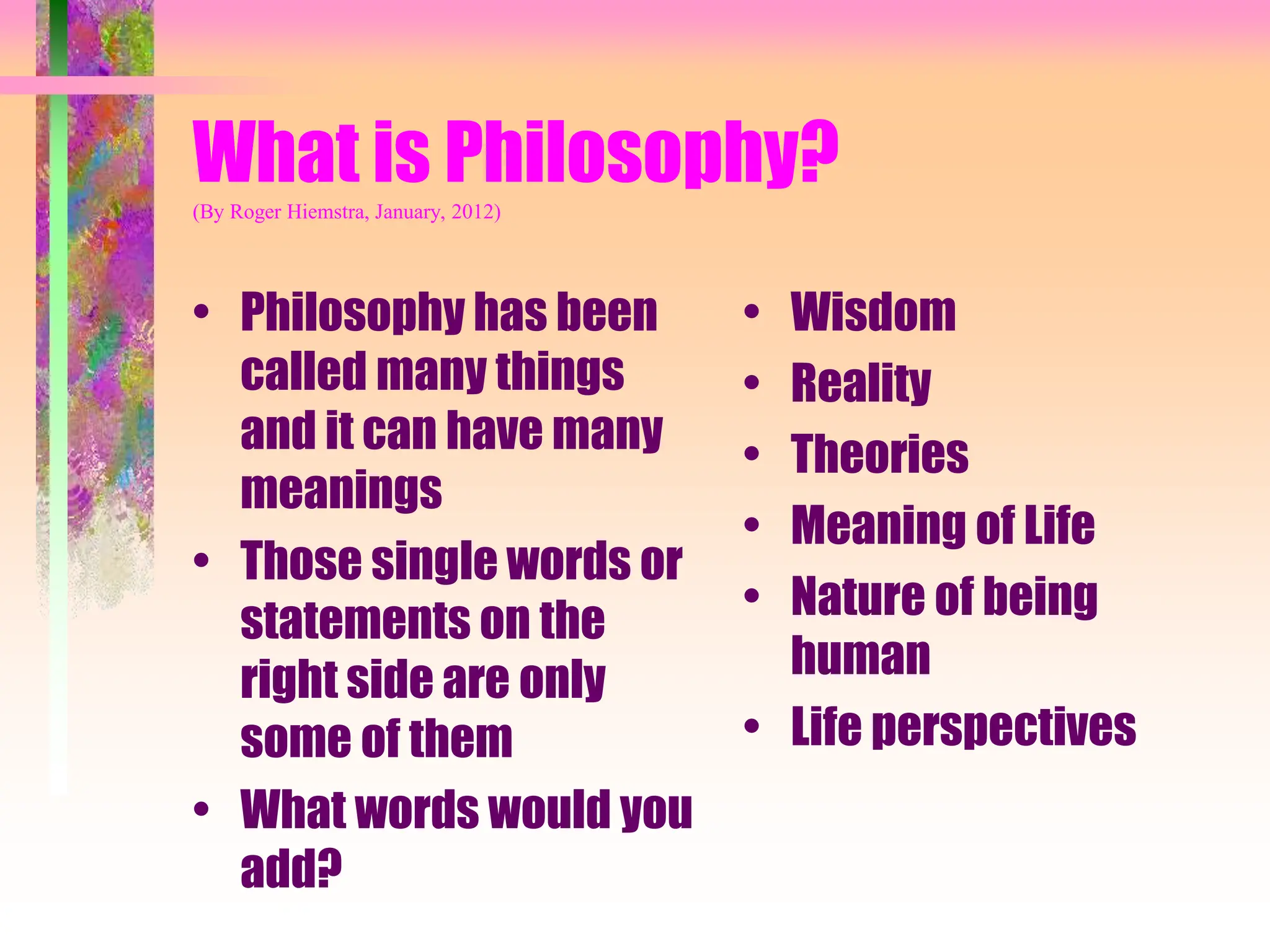
What is Philosophy?
(By Roger Hiemstra, January, 2012)
• Philosophy has been
called many things
and it can have many
meanings
• Those single words or
statements on the
right side are only
some of them
• What words would you
add?
• Wisdom
• Reality
• Theories
• Meaning of Life
• Nature of being
human
• Life perspectives
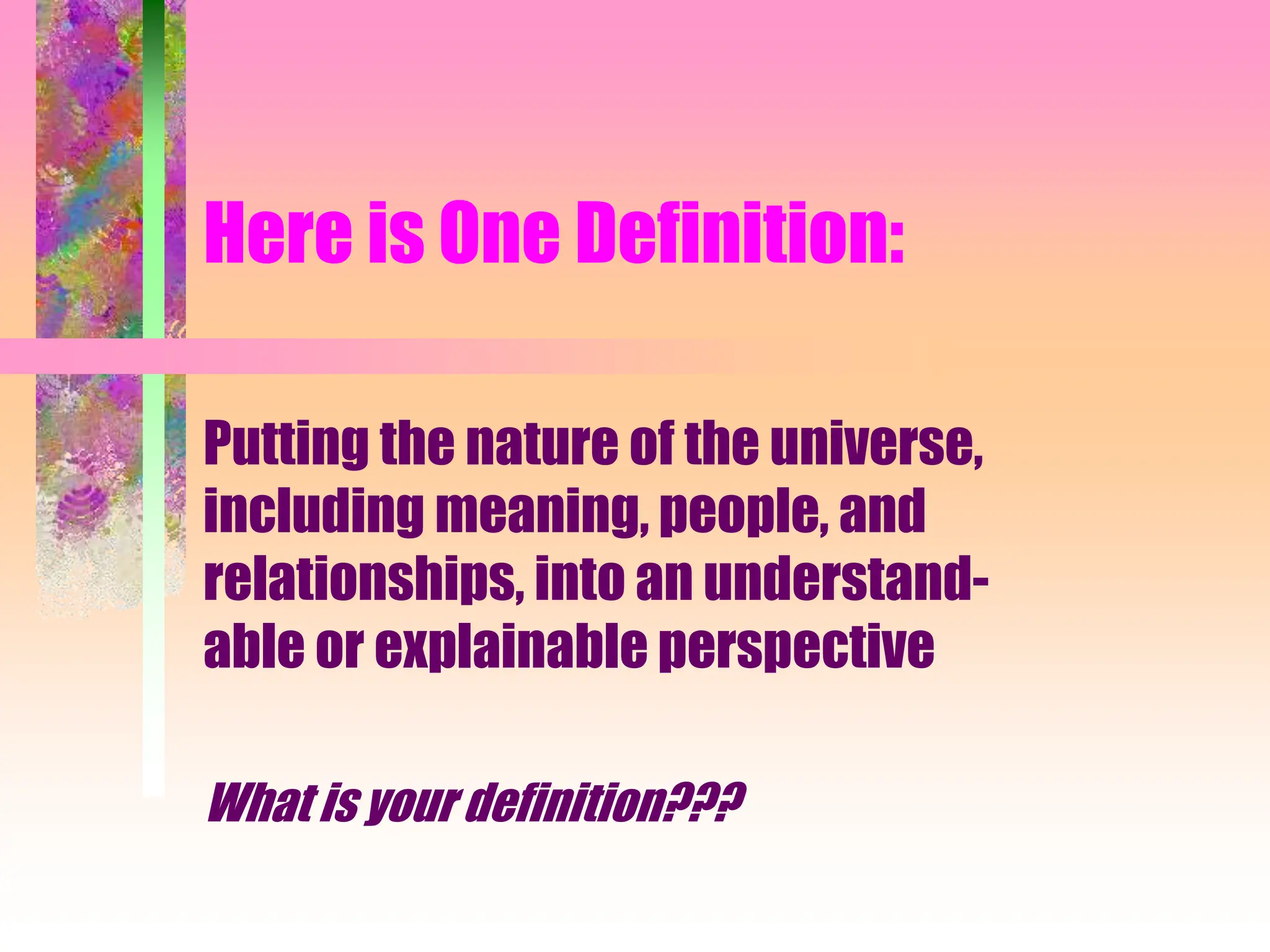
Here is One Definition:
Putting the nature of the universe,
including meaning, people, and
relationships, into an understand-
able or explainable perspective
What is your definition???
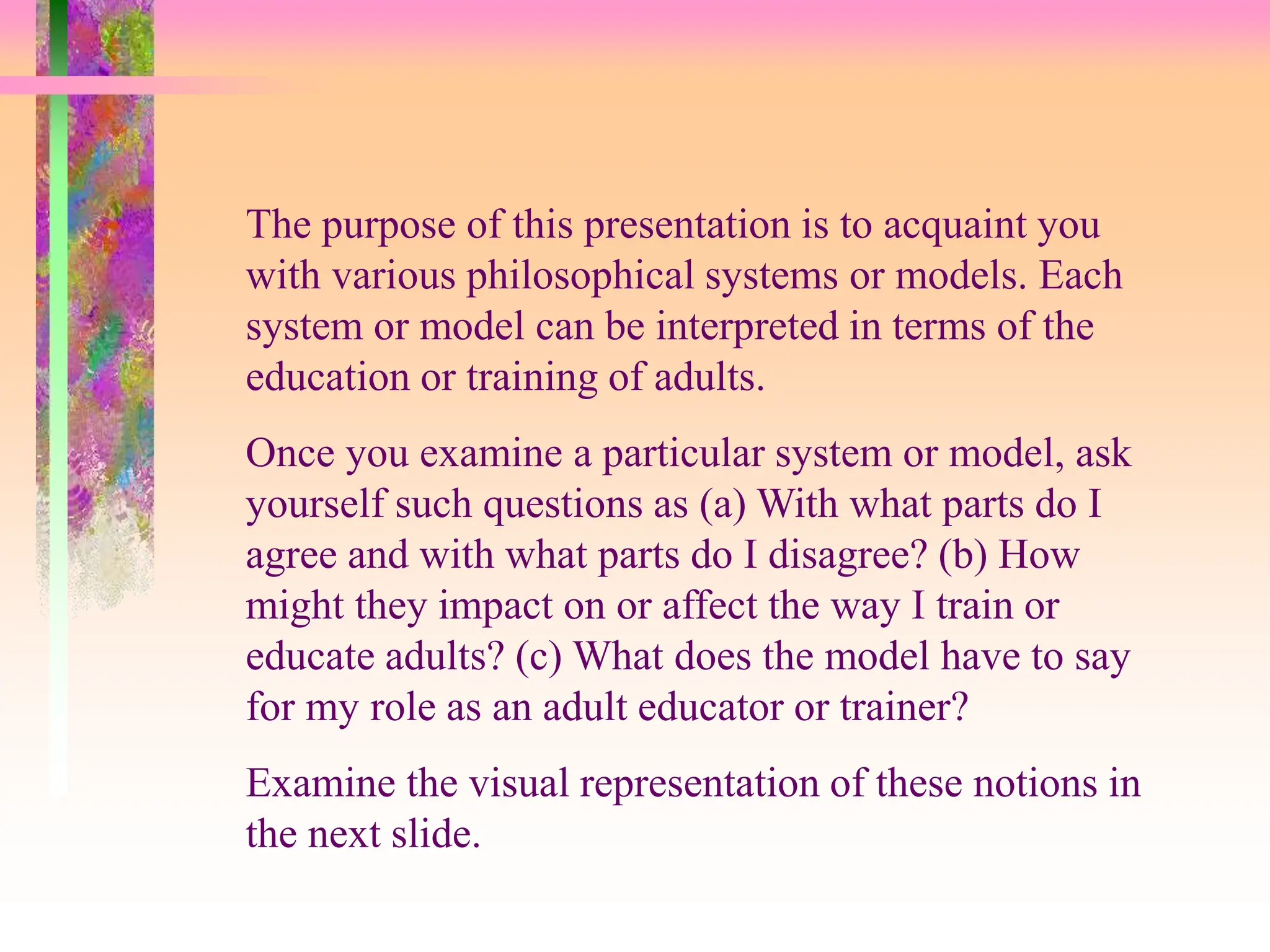
The purpose of this presentation is to acquaint you
with various philosophical systems or models. Each
system or model can be interpreted in terms of the
education or training of adults.
Once you examine a particular system or model, ask
yourself such questions as (a) With what parts do I
agree and with what parts do I disagree? (b) How
might they impact on or affect the way I train or
educate adults? (c) What does the model have to say
for my role as an adult educator or trainer?
Examine the visual representation of these notions in
the next slide.
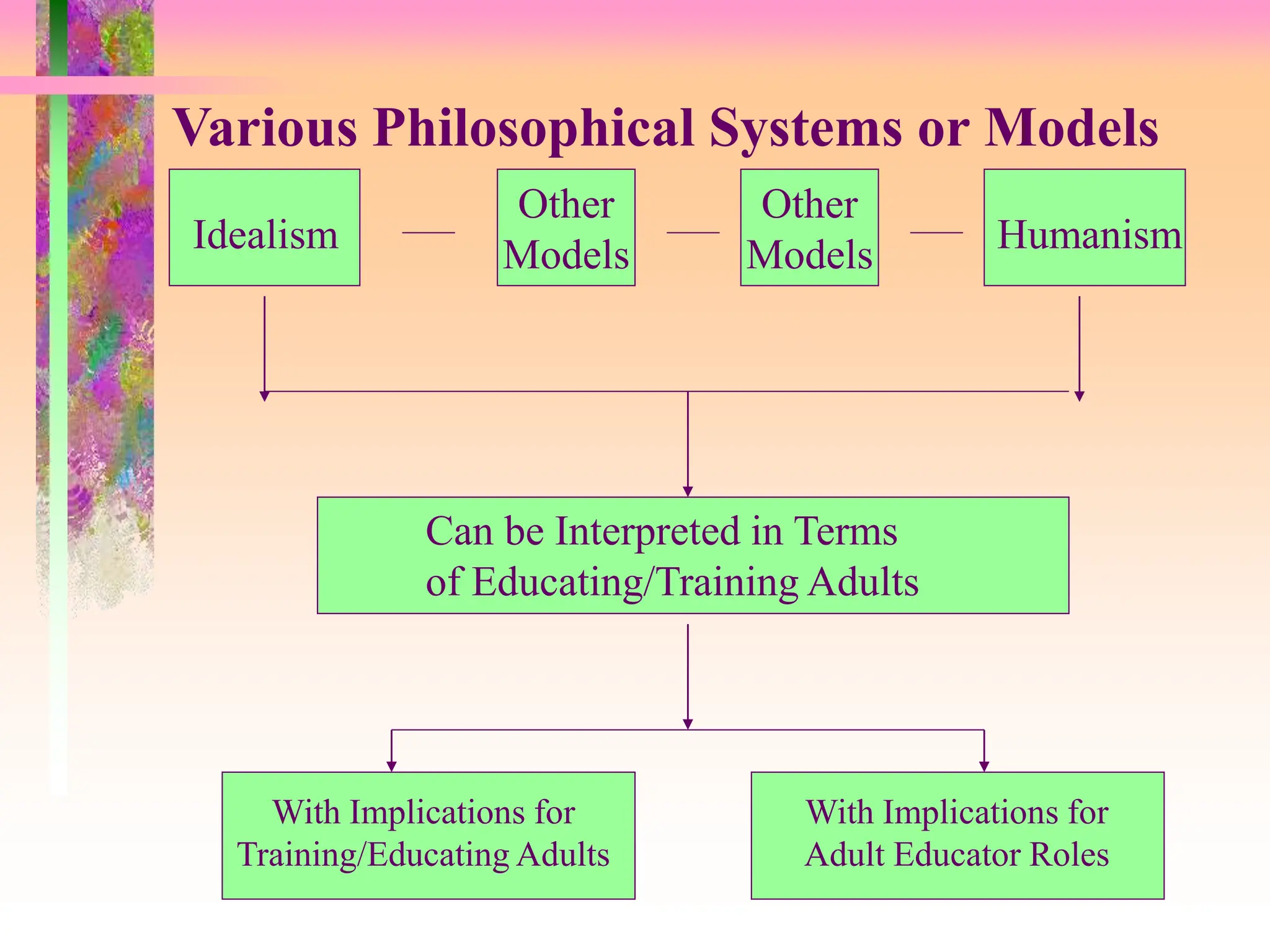
Idealism Humanism
Various Philosophical Systems or Models
Other
Models
Other
Models
Can be Interpreted in Terms
of Educating/Training Adults
With Implications for
Training/Educating Adults
With Implications for
Adult Educator Roles
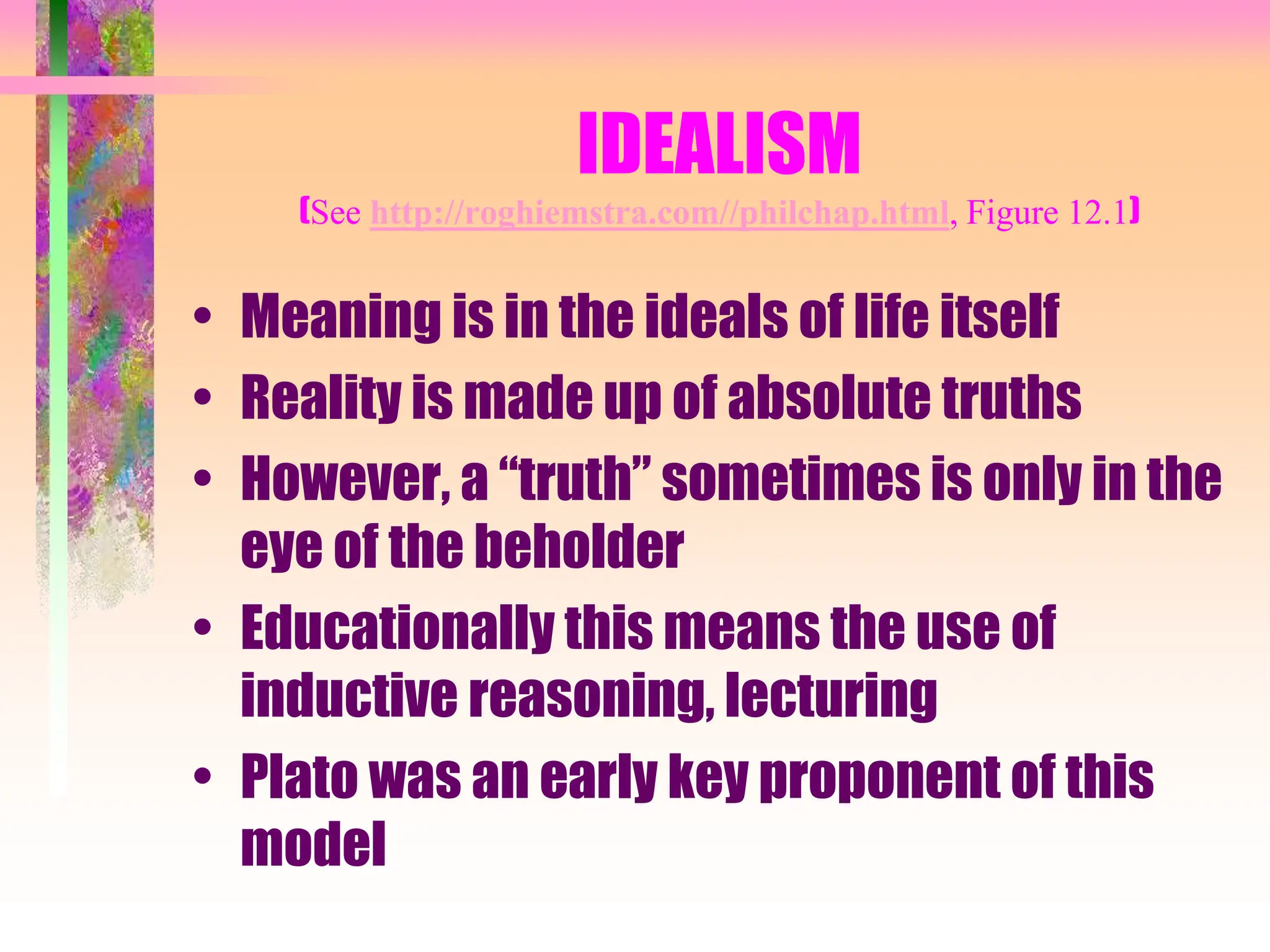
IDEALISM
(See http://roghiemstra.com//philchap.html, Figure 12.1)
• Meaning is in the ideals of life itself
• Reality is made up of absolute truths
• However, a “truth” sometimes is only in the
eye of the beholder
• Educationally this means the use of
inductive reasoning, lecturing
• Plato was an early key proponent of this
model
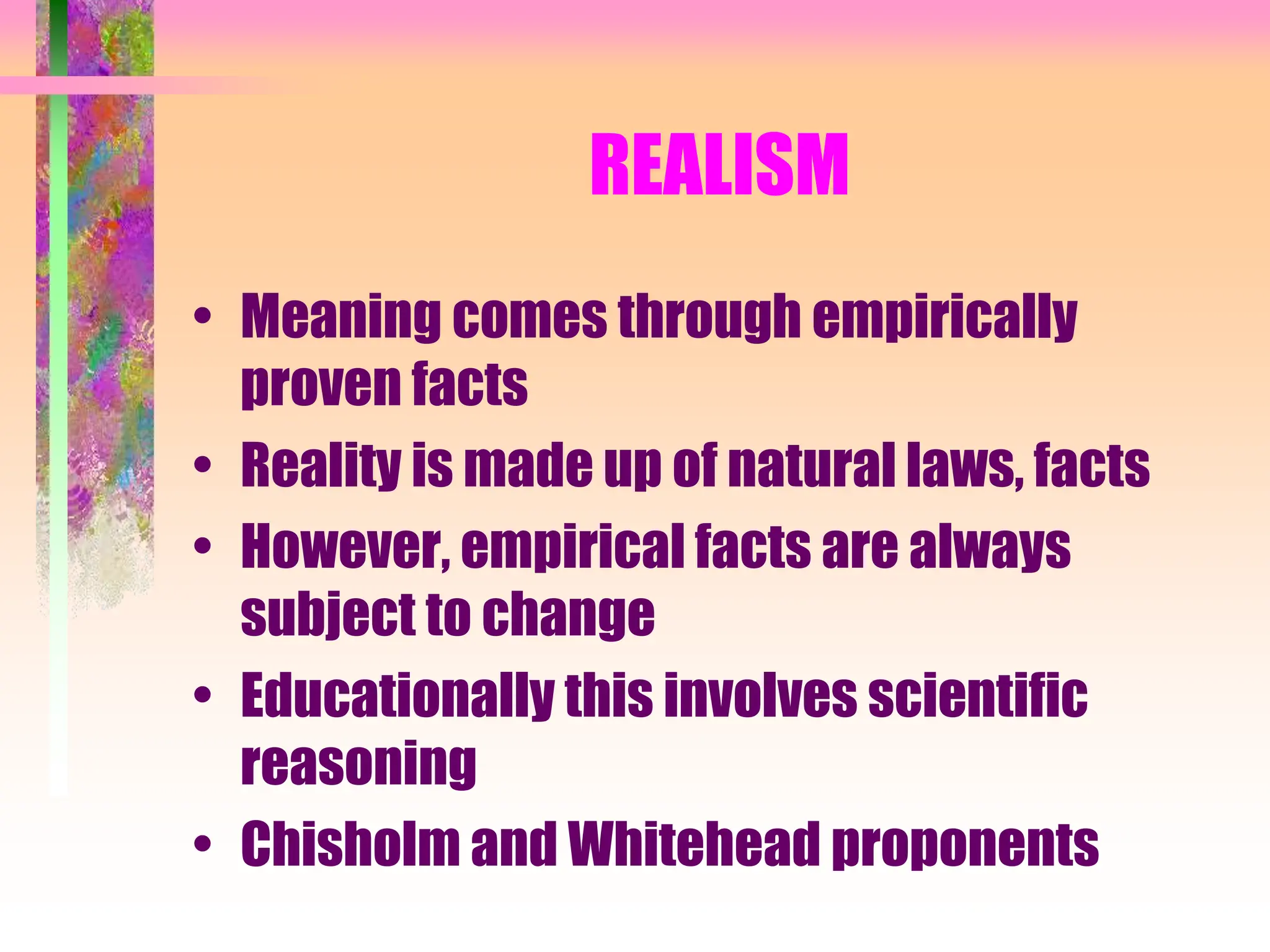
REALISM
• Meaning comes through empirically
proven facts
• Reality is made up of natural laws, facts
• However, empirical facts are always
subject to change
• Educationally this involves scientific
reasoning
• Chisholm and Whitehead proponents
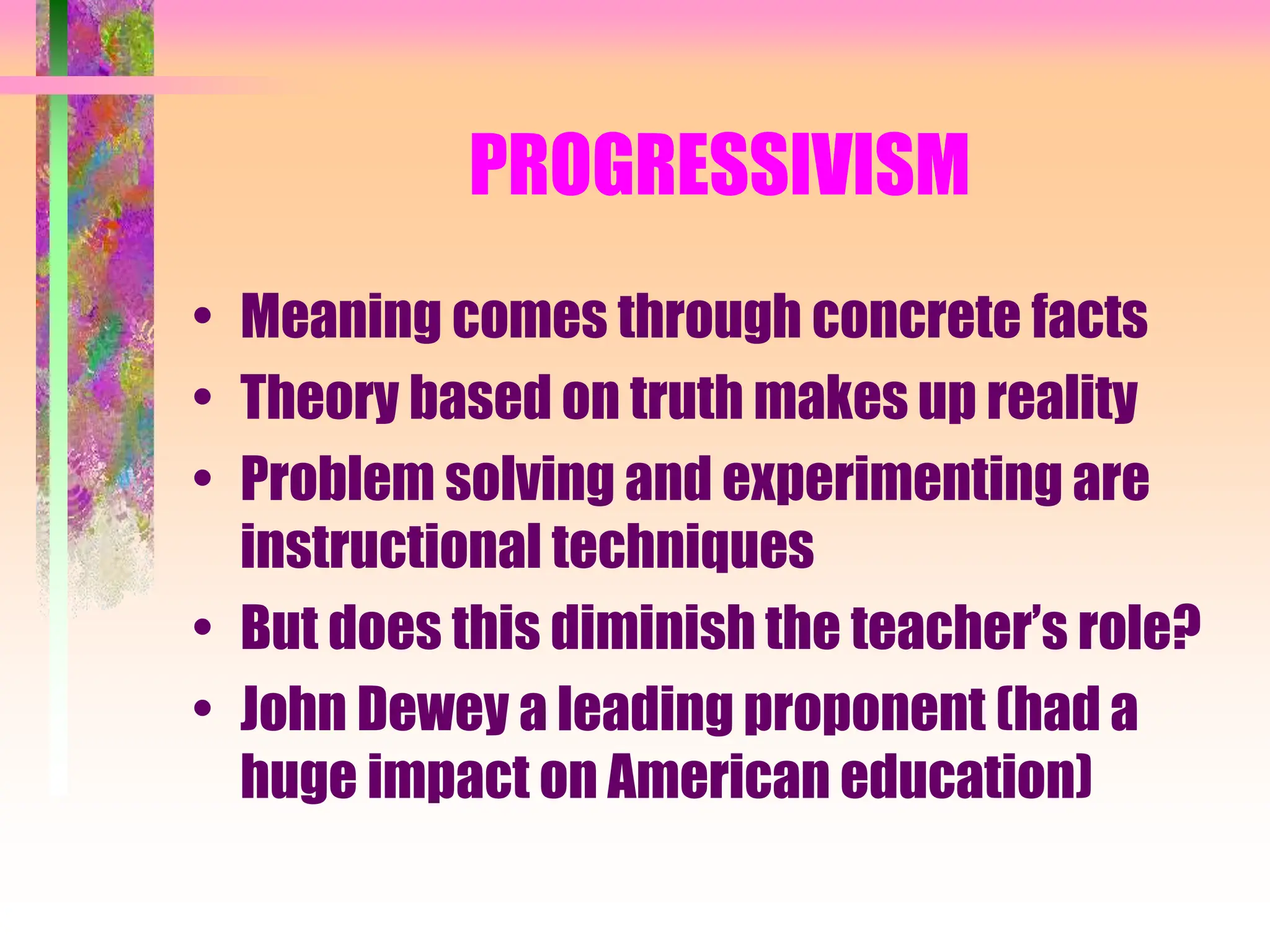
PROGRESSIVISM
• Meaning comes through concrete facts
• Theory based on truth makes up reality
• Problem solving and experimenting are
instructional techniques
• But does this diminish the teacher’s role?
• John Dewey a leading proponent (had a
huge impact on American education)
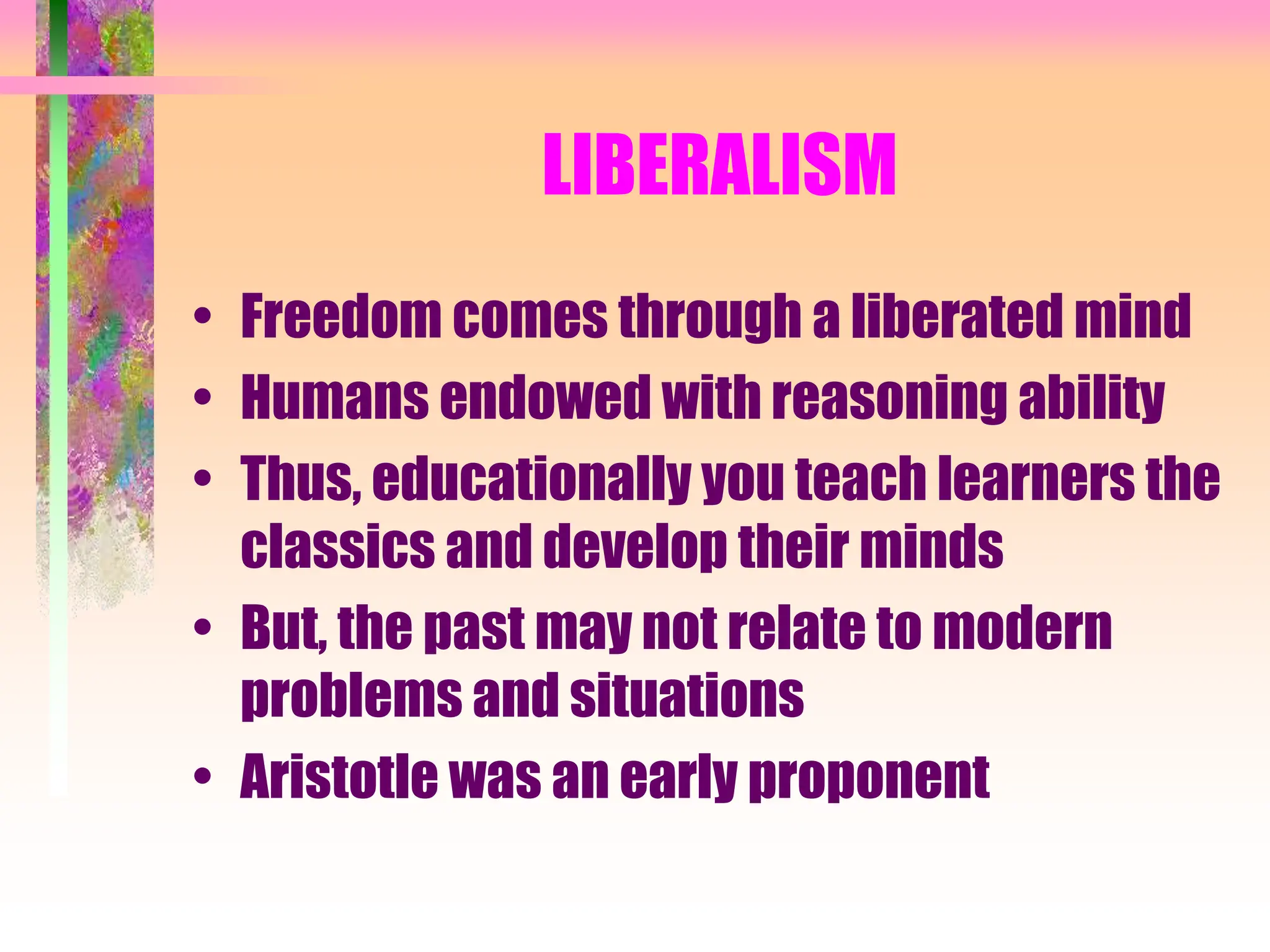
LIBERALISM
• Freedom comes through a liberated mind
• Humans endowed with reasoning ability
• Thus, educationally you teach learners the
classics and develop their minds
• But, the past may not relate to modern
problems and situations
• Aristotle was an early proponent
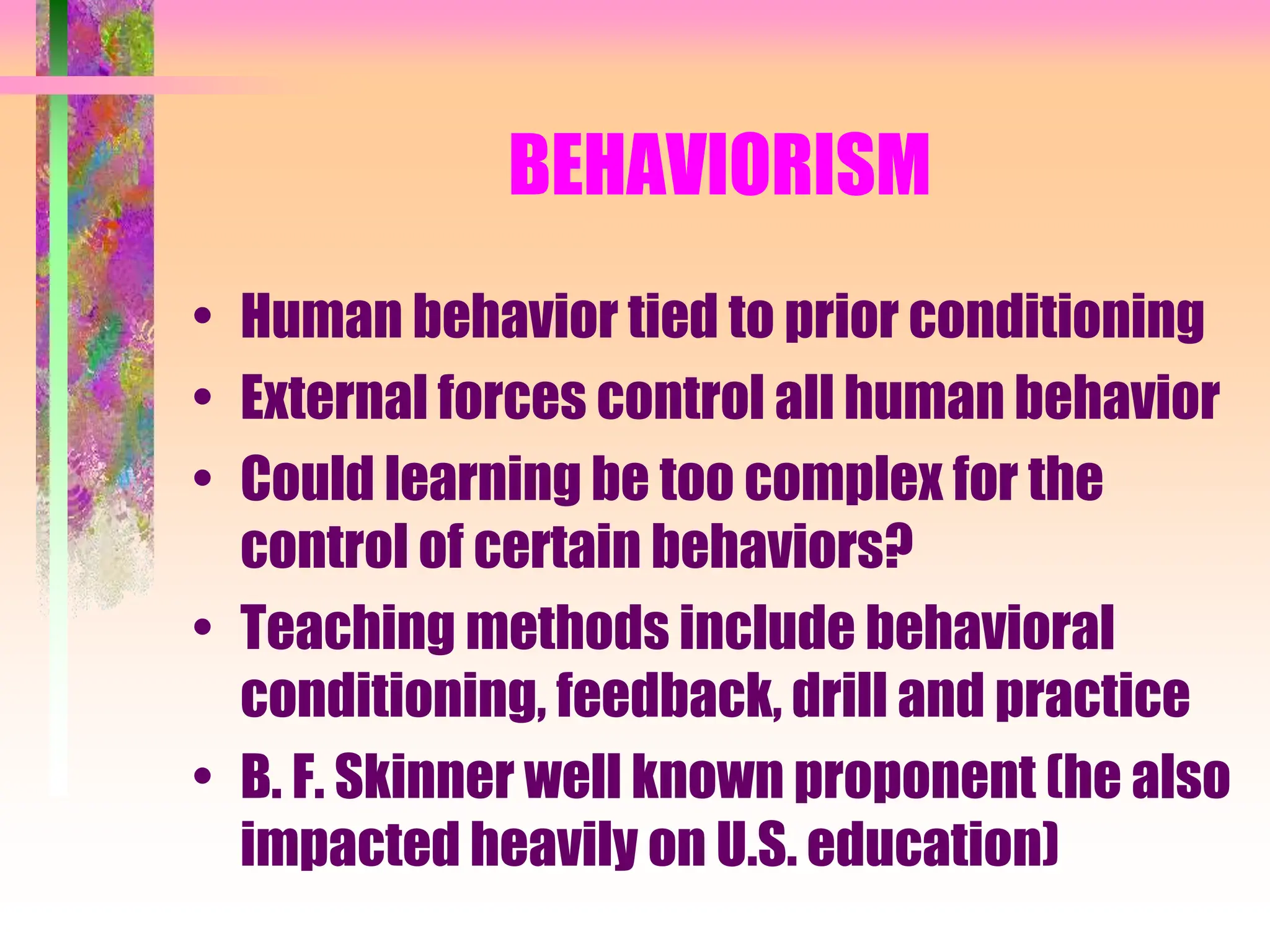
BEHAVIORISM
• Human behavior tied to prior conditioning
• External forces control all human behavior
• Could learning be too complex for the
control of certain behaviors?
• Teaching methods include behavioral
conditioning, feedback, drill and practice
• B. F. Skinner well known proponent (he also
impacted heavily on U.S. education)
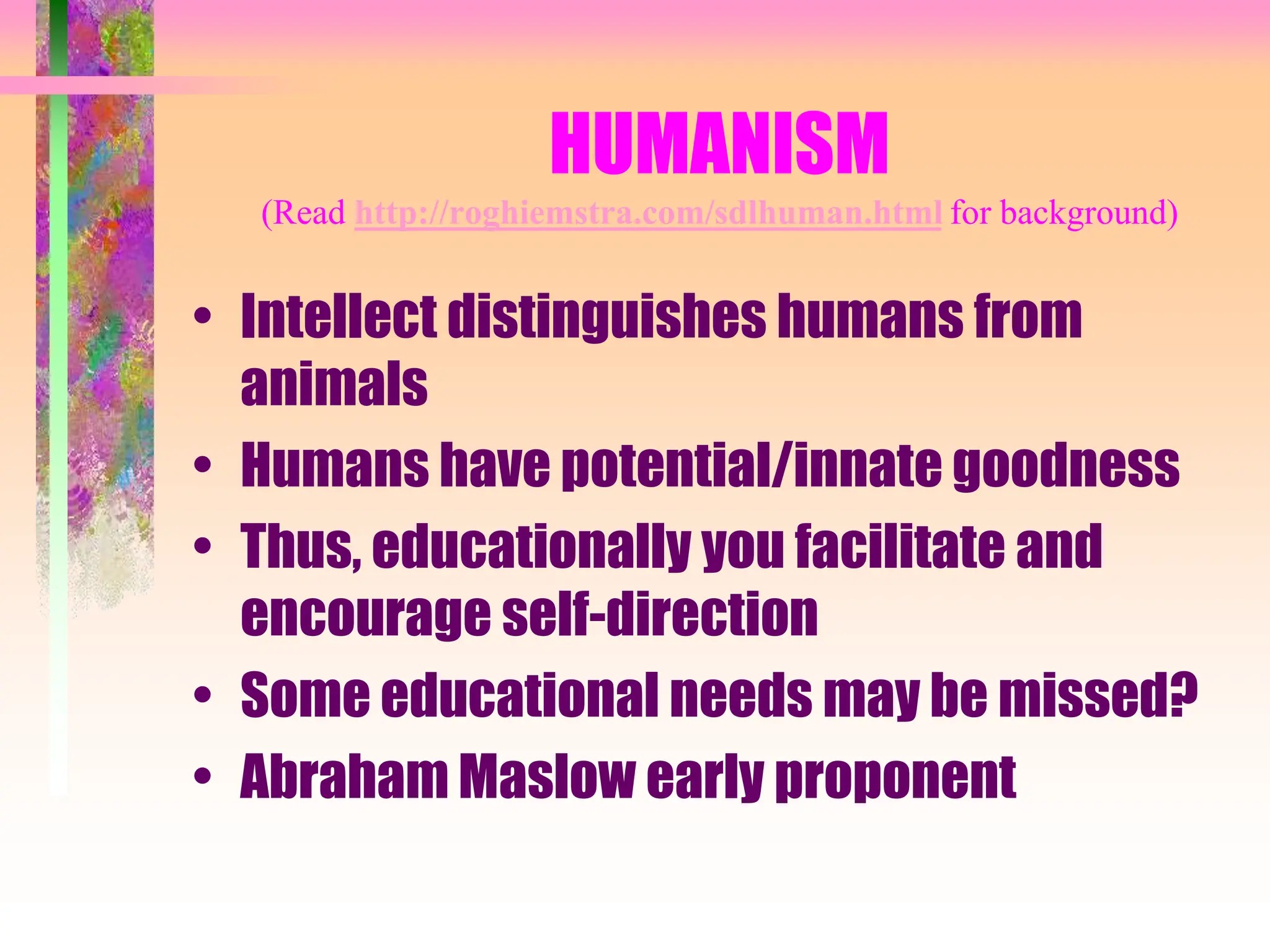
HUMANISM
(Read http://roghiemstra.com/sdlhuman.html for background)
• Intellect distinguishes humans from
animals
• Humans have potential/innate goodness
• Thus, educationally you facilitate and
encourage self-direction
• Some educational needs may be missed?
• Abraham Maslow early proponent
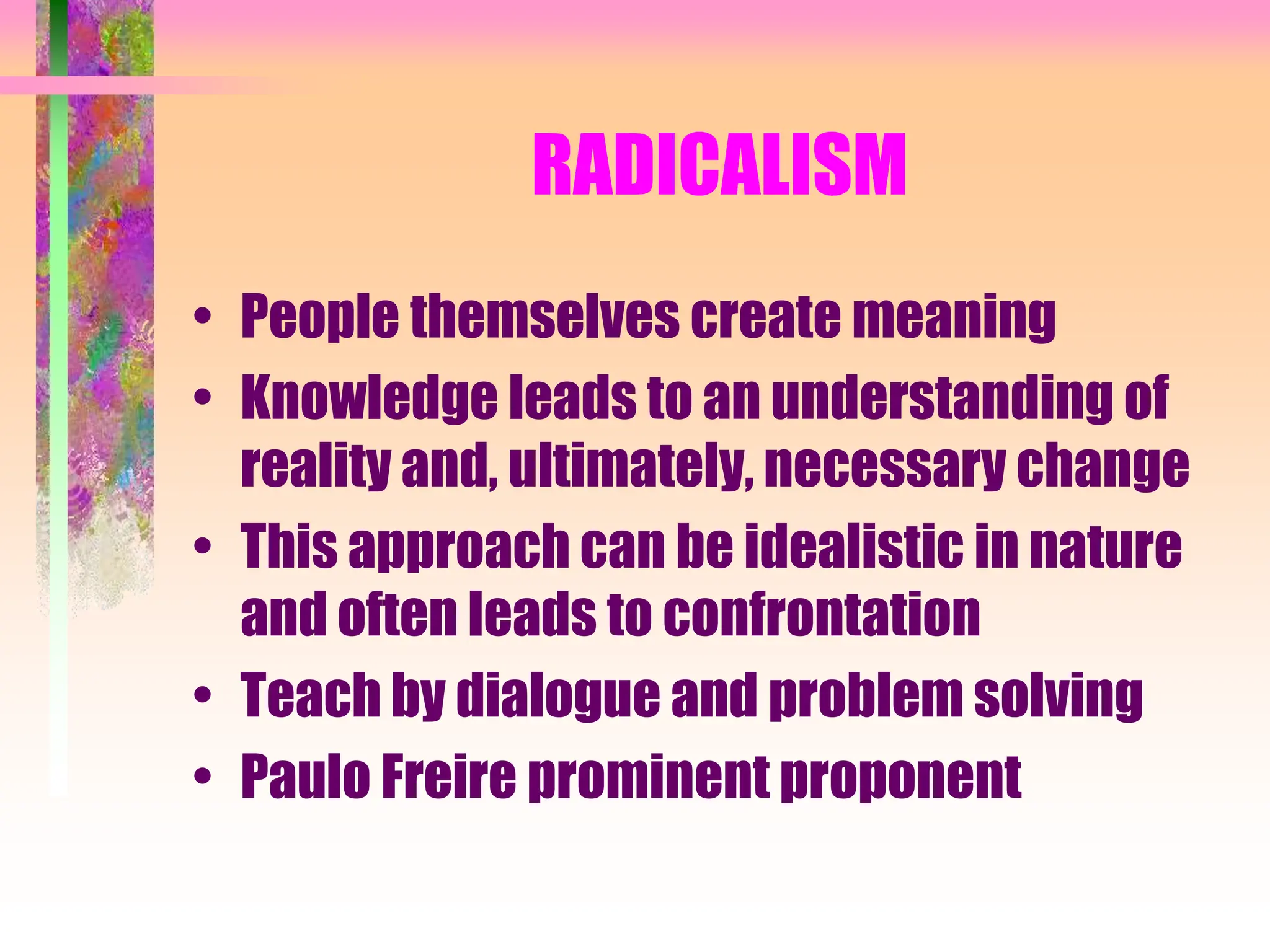
RADICALISM
• People themselves create meaning
• Knowledge leads to an understanding of
reality and, ultimately, necessary change
• This approach can be idealistic in nature
and often leads to confrontation
• Teach by dialogue and problem solving
• Paulo Freire prominent proponent
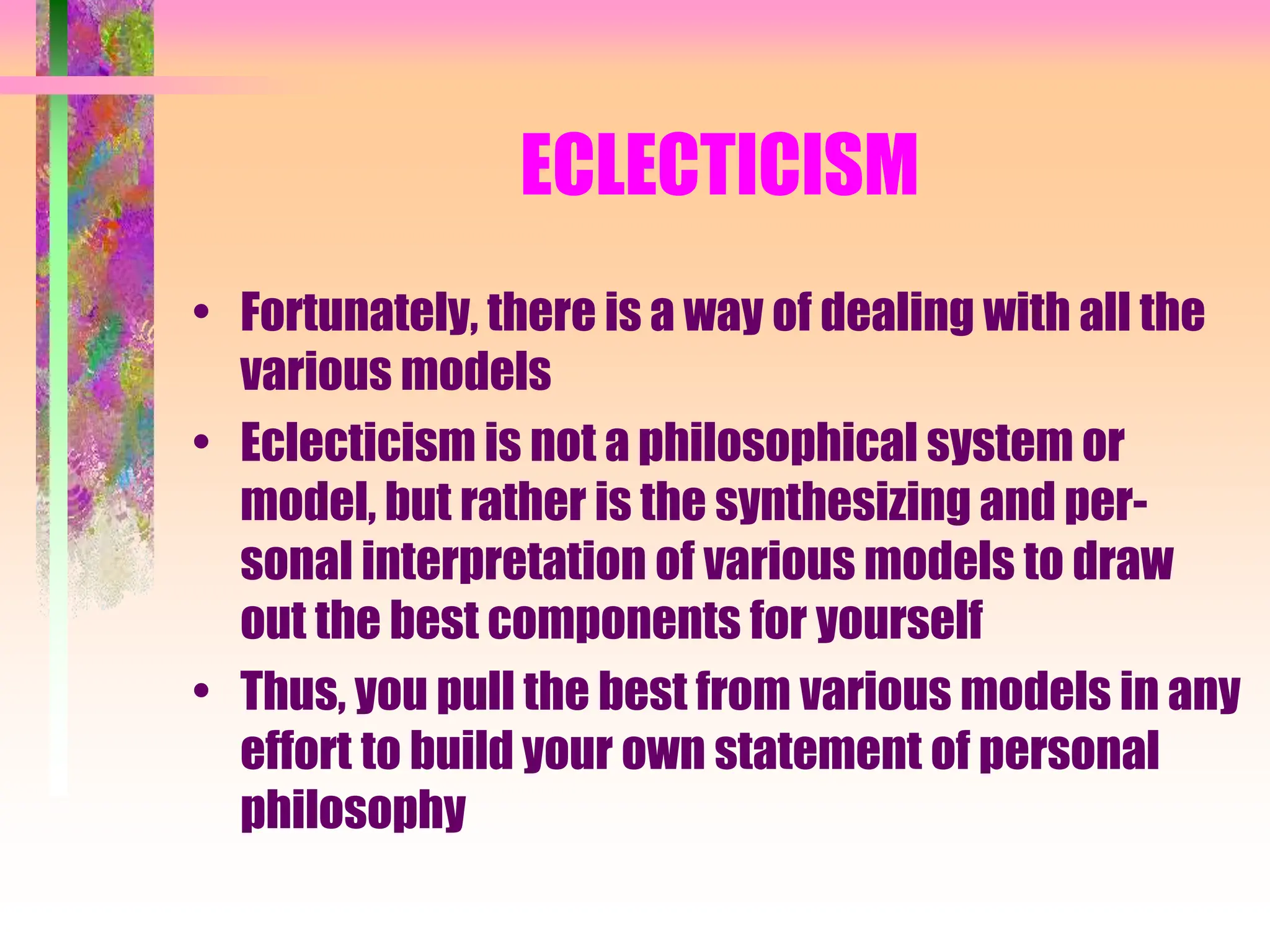
ECLECTICISM
• Fortunately, there is a way of dealing with all the
various models
• Eclecticism is not a philosophical system or
model, but rather is the synthesizing and per-
sonal interpretation of various models to draw
out the best components for yourself
• Thus, you pull the best from various models in any
effort to build your own statement of personal
philosophy
Visit http://roghiemstra.com/ethics1.html for
Roger’s personal statement of philosophy to see how
he drew from various philosophical models to create his
own statement. Go here for other people’s statements.
You can do the same thing and you may want to use
the worksheets shown as Figure 12.2 in
http://roghiemstra.com/philchap.html, as well as
taking the Lorraine Zinn PAEI instrument, and then
scoring it (see learning activity #3: Supplement H of the
PAEI discussion in the Aging Self-Study site) for
information on the instrument and scoring it), as a way
of thinking through the basics of your own statement
The overall point of this exercise is to help you see that
an ability to write a personal statement of philosophy
becomes foundational to an under-standing of ethics
and how you will apply such understanding to what you
do professionally.
Selected References
Archambault, R. D. (1964). John Dewey on education. New York: Modern Library,
Random House.
Bambrough, R. (Ed.). (1963). The philosophy of Aristotle (A. E. Wardman & J. L. Creed,
Trans.). New York: New American Library of World Literature.
Bergevin, P. (1967). A philosophy for adult education. New York: Seabury.
Brubacher, J. S. (1969). Modern philosophies of education. New York: McGraw-Hill.
Chisholm, R. M. (1961). Realism and the background of phenomenology. Glencoe, IL:
Free Press.
Cushman, R. E. (1958). Therapeia: Plato's conception of philosophy. Chapel Hill, NC:
University of North Carolina Press.
Dewey, J. (1916). Democracy and education. New York: Macmillan.
Dewey, J. (1938). Experience and education. New York: Macmillan.
Elias, J. L., & Merriam, S. (1980). Philosophical foundations of adult education. Malabar,
FL: Krieger.
Freire, P. (1970). Pedagogy of the oppressed. New York: Herder and Herder.
Lindeman, E. C. (1928). The meaning of adult education. New York: New Republic.
Maslow, A. (1976). Education and peak experience. In C. D. Schlosser (Ed.), The person in
education: A humanistic approach. New York: Macmillan.
Rogers, C. R. (1969). Freedom to learn. Columbus, OH: Merrill.
Skinner, B. F. (1971). Beyond freedom and dignity. New York: Alfred A. Knopf.
Taylor, A. (1926). Plato: The man and his work. London: Methuen & Co., Ltd.
Whitehead, A. N. (1933). Adventure of ideas. New York: Macmillan.
Zinn, L. M. (1990). Identifying your philosophical orientation. In M. W. Galbraith (Ed.),
Adult learning methods: A guide for effective instruction. Malabar, FL: Krieger.

introduction to philosophy- and overview

  • 1.
    What is Philosophy? (ByRoger Hiemstra, January, 2012) • Philosophy has been called many things and it can have many meanings • Those single words or statements on the right side are only some of them • What words would you add? • Wisdom • Reality • Theories • Meaning of Life • Nature of being human • Life perspectives
  • 2.
    Here is OneDefinition: Putting the nature of the universe, including meaning, people, and relationships, into an understand- able or explainable perspective What is your definition???
  • 3.
    The purpose ofthis presentation is to acquaint you with various philosophical systems or models. Each system or model can be interpreted in terms of the education or training of adults. Once you examine a particular system or model, ask yourself such questions as (a) With what parts do I agree and with what parts do I disagree? (b) How might they impact on or affect the way I train or educate adults? (c) What does the model have to say for my role as an adult educator or trainer? Examine the visual representation of these notions in the next slide.
  • 4.
    Idealism Humanism Various PhilosophicalSystems or Models Other Models Other Models Can be Interpreted in Terms of Educating/Training Adults With Implications for Training/Educating Adults With Implications for Adult Educator Roles
  • 5.
    IDEALISM (See http://roghiemstra.com//philchap.html, Figure12.1) • Meaning is in the ideals of life itself • Reality is made up of absolute truths • However, a “truth” sometimes is only in the eye of the beholder • Educationally this means the use of inductive reasoning, lecturing • Plato was an early key proponent of this model
  • 6.
    REALISM • Meaning comesthrough empirically proven facts • Reality is made up of natural laws, facts • However, empirical facts are always subject to change • Educationally this involves scientific reasoning • Chisholm and Whitehead proponents
  • 7.
    PROGRESSIVISM • Meaning comesthrough concrete facts • Theory based on truth makes up reality • Problem solving and experimenting are instructional techniques • But does this diminish the teacher’s role? • John Dewey a leading proponent (had a huge impact on American education)
  • 8.
    LIBERALISM • Freedom comesthrough a liberated mind • Humans endowed with reasoning ability • Thus, educationally you teach learners the classics and develop their minds • But, the past may not relate to modern problems and situations • Aristotle was an early proponent
  • 9.
    BEHAVIORISM • Human behaviortied to prior conditioning • External forces control all human behavior • Could learning be too complex for the control of certain behaviors? • Teaching methods include behavioral conditioning, feedback, drill and practice • B. F. Skinner well known proponent (he also impacted heavily on U.S. education)
  • 10.
    HUMANISM (Read http://roghiemstra.com/sdlhuman.html forbackground) • Intellect distinguishes humans from animals • Humans have potential/innate goodness • Thus, educationally you facilitate and encourage self-direction • Some educational needs may be missed? • Abraham Maslow early proponent
  • 11.
    RADICALISM • People themselvescreate meaning • Knowledge leads to an understanding of reality and, ultimately, necessary change • This approach can be idealistic in nature and often leads to confrontation • Teach by dialogue and problem solving • Paulo Freire prominent proponent
  • 12.
    ECLECTICISM • Fortunately, thereis a way of dealing with all the various models • Eclecticism is not a philosophical system or model, but rather is the synthesizing and per- sonal interpretation of various models to draw out the best components for yourself • Thus, you pull the best from various models in any effort to build your own statement of personal philosophy
  • 13.
    Visit http://roghiemstra.com/ethics1.html for Roger’spersonal statement of philosophy to see how he drew from various philosophical models to create his own statement. Go here for other people’s statements. You can do the same thing and you may want to use the worksheets shown as Figure 12.2 in http://roghiemstra.com/philchap.html, as well as taking the Lorraine Zinn PAEI instrument, and then scoring it (see learning activity #3: Supplement H of the PAEI discussion in the Aging Self-Study site) for information on the instrument and scoring it), as a way of thinking through the basics of your own statement The overall point of this exercise is to help you see that an ability to write a personal statement of philosophy becomes foundational to an under-standing of ethics and how you will apply such understanding to what you do professionally.
  • 14.
    Selected References Archambault, R.D. (1964). John Dewey on education. New York: Modern Library, Random House. Bambrough, R. (Ed.). (1963). The philosophy of Aristotle (A. E. Wardman & J. L. Creed, Trans.). New York: New American Library of World Literature. Bergevin, P. (1967). A philosophy for adult education. New York: Seabury. Brubacher, J. S. (1969). Modern philosophies of education. New York: McGraw-Hill. Chisholm, R. M. (1961). Realism and the background of phenomenology. Glencoe, IL: Free Press. Cushman, R. E. (1958). Therapeia: Plato's conception of philosophy. Chapel Hill, NC: University of North Carolina Press. Dewey, J. (1916). Democracy and education. New York: Macmillan. Dewey, J. (1938). Experience and education. New York: Macmillan. Elias, J. L., & Merriam, S. (1980). Philosophical foundations of adult education. Malabar, FL: Krieger. Freire, P. (1970). Pedagogy of the oppressed. New York: Herder and Herder. Lindeman, E. C. (1928). The meaning of adult education. New York: New Republic. Maslow, A. (1976). Education and peak experience. In C. D. Schlosser (Ed.), The person in education: A humanistic approach. New York: Macmillan. Rogers, C. R. (1969). Freedom to learn. Columbus, OH: Merrill. Skinner, B. F. (1971). Beyond freedom and dignity. New York: Alfred A. Knopf. Taylor, A. (1926). Plato: The man and his work. London: Methuen & Co., Ltd. Whitehead, A. N. (1933). Adventure of ideas. New York: Macmillan. Zinn, L. M. (1990). Identifying your philosophical orientation. In M. W. Galbraith (Ed.), Adult learning methods: A guide for effective instruction. Malabar, FL: Krieger.