EDUGATE  The Romanian Consortium for the Education of Gifted and Talented Children and Youth   Gifted Education in Romania   Florian Colceag Pre sident 2007
What is <<Gifted Education>>? International Laws to support gifted education The Council of Europe,  Recommendation 1248/2004  on the education of gifted and talented children International Supporters EDUGATE –The Romanian Consortium for the Education of Gifted and Talented Children and Youth  EDUGATE- The Romanian Consortium for the Education of Gifted and Talented Children and Youth IRSCA Gifted Education Bill of law on the Education of Gifted and Capable of High Performance Youth What does gifted mean? Statistical facts Gifted Education in the world Gifted Education   i n  Romania Gifted Education Pilot Project Agenda
Gifted Education – an International Program Why is Gifted Education the answer? The  gifted education  program is an international program i mplemented at an international level and it covers specific education programs on all levels, from a kindergarten to a post-phD level.  North Americans initiated the gifted program in 1984 by   intimately correlating it with regional development objectives: the program is able to form highly competent and motivated human resources with superior intellectual and moral abilities.  An education of excellence Gifted children  with high abilities who don’t integrate into an education system to cover their special educational and counseling needs have a high risk to stay outside the social and economical system and not to integrate. That makes them a distinctive social category that asks for special supporting actions.  3.   The gifted education program is supported by numerous international laws
Gifted Education- Concept Gifted education is not an elitist education because it does not address a small percentage of the scholar population but through its programs of  enrichement, acceleration, tutoring and mentoring all categories of children  are promoted, and supported to develop their natural abilities and potentials.
Concept  (2) An  educational alternative oriented towards  intellectual endowment   and not towards  intellectual imbuement ; emancipation and not manipulation In the context of Romania’s integration to the EU, the Lisabon Declaration respects all the priciples defined and clearly expressed within the Gifted Education system for decades Gifted education does not contradict but enriches and respects the current educational system. However, through its curricula, programs, new teaching methodologies and practices it can  enrich the educational offer of kindergartens, schools, colleges or universities It’s a critical moment for Romania to develop a gifted education program  oriented towards amplifying, diversifying, channeling and using the  abilities  of children with special potential  for the national needs of development
Concept  (3) The education of talented and gifted children  is  a  „ top priority ”   worldwide Started  as a chain reaction after the launching of the first Sputnik, the education of gifted and talented people extend s  from the scientific or technological field to leadership and  the  management  of  social   system s .
International Laws supporting Gifted Education Education Act 1997 (UK) Chapter II (2005) – Labor Party Manifesto for Education (UK) Additional Support for learning Act 2004 (Scotland) No Child Left Behind Act 2001 (US) The School Education Act 1999 (Australia) Education Act 1998 (Republic of Ireland) The Royal Decree 696/1995 (Spain) Recommendation 1248/2004,  Council of Europe  (UE)
Council of Europe  Parliamentary Assembly  RECOMMENDATION 1248   RECOMMENDATION 1248 (1994) on the education for gifted children  *  of the Council of Europe ,  Parliamentary Assembly states clearly that: “ 3. Gifted children should be able to benefit from appropriate educational conditions that would allow them to develop fully their abilities, for their own benefit and for the benefit of society as a whole. No country can indeed afford to waste talents and it would be a waste of human resources not to identify in good time any intellectual or other potentialities. Adequate tools are needed for this purpose. 4. Special educational provision should, however, in no way privilege one group of children to the detriment of the others. 5. The Assembly therefore recommends that the Committee of Ministers ask the competent authorities of the states signatory to the European Cultural Convention to take account of the following considerations in their educational policies:           i. legislation should recognise and respect individual differences. Highly gifted children, as with other categories, need adequate educational opportunities to develop their full potential;           ii. basic research in the fields of &quot;giftedness&quot; and &quot;talent&quot; and applied research, for instance to improve identification procedures, should be developed in parallel. Research on the &quot;mechanisms of success&quot; could help to tackle school failure;           iii. meanwhile, in-service teacher training programmes have to include strategies for identifying children of high ability or special talent. Information on gifted children should be made available to all those who deal with children (teachers, parents, doctors, social workers, ministries of education, etc.);           iv. provision for specially gifted children in a given subject area should preferably be arranged within the ordinary school system, from pre-school education onwards. Flexible curricula, more chances of mobility, enriching supplementary material, audiovisual aids and project-oriented teaching styles are ways and techniques to foster the development of all children, whether highly gifted or not, and enable the identification of special needs at the earliest possible time;           v. the ordinary school system should be made flexible enough to enable the needs of high performers or talented students to be met; vi. any special provision for highly gifted or talented students should be administered with discretion, to avoid the innate danger of labelling, with all its undesired consequences to society. “ Text adopted by the Assembly on 7 October 1994    *Full Text Available at:  http://assembly.coe.int/Documents/AdoptedText/ta94/erec1248.htm
Council of Europe Reply from the Committee of Ministers In 2003, the Committee of Ministers stated in two official replies (September and December) that:  Gifted children form a category of persons with special needs; they face “ certain specific problems in the regular education system for ordinary children ” [1]  and because of that, they require proper provision within a different education system. If proper care is not taken, on one hand, “ the high potential of these children for creativity is lost, and on the other hand, there is the risk of alienation, drop-out and antisocial behaviour ” [2] . [1]  http://assembly.coe.int/documents/workingdocs/doc03/edoc9920.htm [2]  http://assembly.coe.int/documents/workingdocs/doc03/edoc10019.htm
International Supporters for EDUGATE World Council for Gifted and Talented Children   Following the participation to the Biennal conference of World Council for Gifted and Talented Children, August 6-10, 2005, New Orleans, the US, EDUGATE, through  IRSCA Gifted Education  has obtained the partnerships and recognition of its efforts at a national level, which enables the consortium to realize the program with the highest support at a world and european level. Board of Trustees of EDUGATE  is made of the high international personalities involved in the education of gifted and talented children and youth:  Den-Mo Tsai, Taiwan, the current president of WCGTC; Klaus K.Urban, Germany,  former president of WCGTC; Barbara Clarck, the US, former president of WCGTC;  Sandra  Kaplan, the US; Erika Landau, Israel; Joice Van Tasel-Baska, the US;  Johanna Raffan, Anglia, secretary, ECHA; Joseph Renzulli si Sally Reis, the US,  directors of NAGC; Taisir Subhi, The Arab Emirates and Richard A. Boolootian, the US.
International Supporters(2) - Most important international organizations in the field of gifted and talented education  - WCGTC- World Council for Gifted and Talented Children  Asia - Pacific Federation of World Council for Gifted & Talented Children  ECHA - The European Council for High Ability NAGTY - National Academy for Gifted and Talented Youth, UK NAGC - National Association for Gifted Children, the US Support obtained through: Consulting Access to resources Defined programs
IRSCA Gifted Education Motto: Invest in gifted children, invest in the values of society, invest in our national future! “ No nation, no society can allow herslef to neglect gifted  children and youth with highest potential of her people. The  most talented are the nation’s wealth” -  Klaus Urban Prof. Dr., ex president of World Council for Gifted and Talented Children &quot;Gifted education respects and promotes the divine nature of the human being and not a merchandised human being, the human being for consumption. We promote the human being who is a creator, the human being capable to develop her potentials&quot; - Florian Colceag, president, IRSCA Gifted Education.    
IRSCA Gifted Education     Mission To promote and to support the development of all gifted people in all fields: science, arts, managemenbt, leadership, entrepreneurship, and to form human resources capable to solve our complex current matters. Romanian NGO, launched in 2005 Founding members Flori a n   Colceag ,  Com s a Marin, Csinta Thomas ,  Daman a kis Emmanuel ,  Deutsch Elisabeta Iulia ,  Dragot a   Mihai Cristian ,  Jinaru Aron,   Jula Dorin ,  Munteanu Florin ,  Panait Florin ,  Sima- S etraru Alexandra ,  Stoica Cristian ,  S erbulescu Radu The initiator and prime founder of EDUGATE; Initiator of the National Gifted Education Program; the first organizer of a national conference on gifted education; the initiator of programs to discover the potential of every child, and the programs of mentoring, tutoring, curricula enrichment and dissemination of best practices in gifted education to all schools in Romania
IRSCA Gifted Education Affiliations     Since 2006, IRSCA Gifted Education is a full member of  ECHA- European Council  for  High Ability  si  WCGTC- World Council for Gifted and  Talented  Children , the world’s top educational bodies in the field of gifted education
EDUGATE The Romanian Consortium for the Education of  Gifted and Talented Children and Youth   EDUGATE   was developed in 2005 to support the first Gifted Education National Program. It is one of the largest private educational initiatives in Romania today and also, the initiator of the bill of law on the education of gifted children and youth, capable of high performance. Among its founders are more than 40,  most prestigious educational bodies in Romania:   IRSCA Gifted Education  RO-TALENT – The Romanian Association for psycho-pedagogic and social counseling for talented children and youth   Junior Achievement Foundation  Center Education 2000+,   CODECS Foundation for Leadership  CUFR- Conseil Universitaire Formation- Recherche  Francais-Roumain aupres des Grandes Ecoles   Francaises  Cygnus  Foundation The National Institute of Education Sciences CREDIS– Distance Education Department – University of Bucharest   The Harvard Club Romania-Moldavia  SIGMA - The Foundation for European Integration   SIGMA Publishing House  Iulia Hasdeu National College   Mihai Viteazul  National College   Jose MARTI School of Bucharest   Dinu Lipatti  Music High School   George Enescu  Music High School   Floria Capsali  Ballet High Schoo l National Foundation for Youth   Applied sciences and research center- University of Bucharest ProBios - The Romanian Association for Life Sciences The ecologic group of collaboration- University of Bucharest  Altius Academy  Foundation PsihoBest- Psychological Testing & Vocational and Career Orientation Center  The Foundation for Communication Strategies  Global Video Media Television Alpha FDSC- The Foundation for Civic Society Development The Management Department - Polytechnic University  Public Managers Association of Romania  M.A.T.C.A. –2000  Foundation The Students Union from Romania  LEADERS Romania Math and Physics Teachers Association from Bacau (APMFB)  The Pedagogic Alternarnatives Association Creative Media & Art InfoSpeed “ We read” Foundation And more
The Role of EDUGATE The Educational Consortium seeks to realize the following collaborations and activities in order to pursue the  National Gifted Education Program :  Training of professors  Training of psychologists  Training of parents in gifted education  Continuous formation of professors in gifted education and psycho-pedagogic methodologies   Applicative collaboration  Development of abilities  Fundraising  Raising of Venture capital, social and angel capital  Developing financed programs  Developing policies and international programs for schools  Know-how and technology transfer (including teaching methodologies)  Setting-up of a gifted education system with multiple and differentiated offers (private)   Promotion and formation of intellectual values  Intellectual property protection  Promotion on equity and principles of competencies and integrity  Social and professional integration of the graduates of the system   Incentivizing Intelligence and creativity  Training of leaders in all subject matters and all economic domains   Setting up of a market of competencies to put in value and promote intellectual values 
What does « gifted » mean? Gifted or super-normal represents the normal level of the human potential, which is however achieved by a reduced number of people. This normal level comprises all the intellectual, artistic, ethic, communication or creativity qualities which have a lot out of the common. The Romanian term for gifted =  SUPRADOTAT  adj .  (about children) , which means h aving qualities which are out of the common  =  Supra + dotat after the French term  SURDOUE ) , Dictionary of Romanian language  Intelligence is a term currently used but with little understanding on what it represents. Today, there is no conclusive understanding of exactly what the concept of intelligence truly is. Currently there are IQ tests administered, which are ‘normed’ against a population where giftedness is defined as the top five percent of the bell curve. Some modern academic theories recognize that IQ tests are not a true measure of intelligence and have cultural and language biases.  Continuing research into study of intelligence suggests that there are multiple intelligences rather than purely academic intelligence, which is the main item measured in an IQ test. Current educational psychology practices recognize that there are many different types of giftedness as well as many different identification factors, and that an all round approach is best for gifted identification.
The Bill of law on the education of gifted and capable of high performance youth   Passed  by the Romanian parliament in December 2006 and enforced since January 2007 Elaborated by IRSCA Gifted Education in co-operation with The Humanist Foundation ,,Dan Voiculescu&quot;  The Law : Art.1 -  This law regulates the legal operation and organization framework of the National Differentiated Training Center as well as the institutional organization of differentiated education programs for gifted and talented students.   Art.3  - According to the Human Rights Charter, Lisbon case, the Universal Declaration of the Rights of the Child, Recommendation 1248/1994 of the Parliamentary Assembly of the Council of Europe, students with special needs, among whom gifted students can be mentioned, shall be provided with an adequate educational environment which allows them to fully exploit their potential for their own, as well as for the society’s benefit.  Download  the complete text in English
The Bill of law on the education of gifted and capable of high performance youth   The National Differentiated Training Center has the following  o bjectives: E nsuring educational facilities for highly gifted students; according to the specific training methodologies of gifted education psychology; providing conditions and procedures of establishing differentiated training  itineraries, necessary to adjust training to the creative expression capability and the intellectual development to the specific needs of gifted students related to their social and professional integration . Art.26 -  The National Differentiated Training Center shall have the following competences : a)       preparing pilot school programs to introduce the working methodologies specific for gifted students education, adjusted to international levels in this educational system ; b)        establishing a pilot research center and experimental classes, where the specific instruction and curricular technologies for the gifted education system will be put to use ; c) adjusting international education psychology regulations and methodologies to national issues specificity; d) training specialists in teaching methodologies specific to the field of gifted education psychology ; e)   disseminating information and issues concerning the gifted education psychology among teachers and parents’ associations ; f)      preparing and promoting informational support concerning scientific research and assistance in the field of gifted education psychology ; g) distribution through school networks of informational materials on gifted education psychology ; h) organizing within the Teaching Staff Offices and the Children’s Palaces, as well as within schools, high schools, universities joint information activities on specific  gifted education psychology  research; i) integrating gifted students into specific  gifted education psychology  programs.
What does « gifted » mean?  (2) Today giftedness is defined using many factors of such sort as IQ  (intelligence quantum), SQ, (spiritual quantum), EQ (emotional quantum) and others si alti factori.  However, using the IQ as one of the many factors to indicate giftedness, the following bell curve follows : 85-99  Lower normal 100-114  Upper normal 115-129   Bright 130-144   Gifted 145-159  Highly gifted 160-180  Profoundly gifted 180-above  Genius
Statistical Facts According to  recent research data,  only  5-10 % of people on the planet are gifted  ( ref.  Roberta Braverman, the vice president of the New Jersey Association for Gifted Children ). A mong them , at a global level,  a few distinguish themselves by having even greater capacities than the 2%. According to Romanian psychologists, in Romania, the percentage of gifted persons is close to 4% out of the total number of persons. The la st  25 years proved that economic, social and cultural development directly depends on developing the education of gifted and talented persons and on using their capacities nationally as a catalytic factor in development as such.  Gifted people who are not included from an early stage into an educational, subsequently economic, management or politic system emigrate to the countries which offer them chances to assert and develop themselves. The ones who are included in such a system essentially contribute to local development on all levels.
Gifted People- Are they hard to find? History showed us many times that society acknowledged the values of gifted people but this generally happened with great delay, sometimes tens or hundreds of years after the death of the gifted. Such examples are Von Neumen, Gauss, Gauss, Gaulois, Mendel, Mozart, Vivaldi, Van Gogh, Da Vinci or more recently Ramanujan, Sidis and Eminescu.  However, our modern times discovered through gifted education the acknowledgement and promotion of ideas in due time.
But  what happens worldwide? Before starting such an ambitious and worthy project ,  it would be interesting to look closely at the ways other countries worldwide approached giftedness.  How long and in which way have they approached children giftedness and how do they measure the result of the effort made?  Which are the specific differences of approach between highly-developed countries such as USA and countries of the same development level as Romania or of an even lower level?  Last, but not the least, i t is also of great importance to consider the actions taken in Romania...
Gifted Education in the world  (1) The education of overly endowed (gifted) children is a practice in all countries that have developed functional economies and has spread worldwid e  during the past few years. The first science-oriented gifted education centers have been roughly simultaneously developed in the USA, China, Australia, former USSR and in many European countries. There are centers dedicated to this educational system in Austria, Spain, Croatia, France, U.K., and in other European countries Moreover, g ifted children programs have reached and have been implemented in the majority of schools in the world.  There are Gifted Education centers in the USA and in Australia in every state or county, stressing on identifying them and providing specific training for their intellectual profile . . The gifted education units’ network ranges from kindergartens to postgraduate education.
Gifted Education in the world  (2) Worldwide organizations:  WCGTC - World Council for Gifted and Talented Children, The Asia-Pacific Federation of the World Council for Gifted and Talented Children Continental organizations:  Europe -  ECHA- European Council for High Ability  Regional centers:  NAGC- National Association for Gifted Children, the US; NAGTY - National Academy for Gifted and Talented Youth, UK;  Centers of Excellence, magnet schools, charter centers as well as pilot centers to implement new learning technologies, universities and collaborative networks, colleges, schools and kindergartens as well as specialized departments at the levels of ministries of education and governments of numerous countries around the world:  Association Francaise pour les Enfants Precoces (AFEP), France; National Association for Able Children in Education (NACE), the UK; Center for the Study of Giftedness Catholic University of Nijmegan, the Netherlands; Tate-Society to Support Bright Children, Austria; Hollingworth Center for Highly Gifted Children, the US; The National Research Center on the Gifted and Talented, the US; Academic Talent Search, the US; Belin-Blank International Center for Gifted Education and Talent Development, The University of Iowa, Iowa City, IA,  the US; Carnegie Mellon Institute for Talented Elementary Students (C-MITES), the US; Davidson Institute for Talent Development, the US; Program in Mathematics for Young Scientists (PROMYS), Boston University, Boston, MA, the US; Purdue University Gifted Education Resource Institute, the US; Educational Program for Gifted Youth (EPGY), Stanford University, Stanford, C, the US; Accelerated College Entrance Center, California State University, Sacramento, CA, the US; Program for the Exceptionally Gifted, Mary Baldwin College, Staunton, VA, the US; Queensland Association for Gifted and Talented Children, Inc., Australia, etc.
Gifted Education in the world  ( 3 ) Recently, during the past 10 years, Turkey, the Arabian Emirates, Oman, the Republic of South Africa, Brunei and other countries have started developing the system, an aspect positively correlated with their political and economic stability, as well. Such centers are currently being developed in other countries in the Middle East, Africa, South America, which have not been integrated in the first spreading wave. Europe is almost completely integrated in the system.  A significant example in the former communist  block  is the center headed by   Shi Jiannong   from  The Institute of Psychology, Chinese Academy of Sciences   that  dedicat es  its activity to the psychological research of gifted children, who are also trained in special programs.
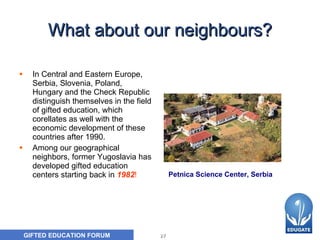
What about our neighbours ? In Central and Eastern Europe, Serbia, Slovenia, Poland, Hungary and the Check Republic distinguish themselves in the field of gifted education, which corellates  as  well with the economic development of these countries after 1990.  Among our geographical neighbors, former Yugoslavia has developed gifted education centers starting back in  1982 !   Petnica Science Center, Serbia
What about our neighbours ?   (2) A representative gifted education center in our geographic area is   Petnica Science Center in Serbia ,   headed by professor Vigor   Majic, the current deputy Minister of Education   S tudents of this center initiated in 1982 have published hundreds of scientific articles in professional magazines, and the center has been kept functional and financed even throughout the harsh period of the war in Yugoslavia.   Its financing raises up to approximately $1,000,000/year and is deemed profitable due to the economic development effect it induces.  These examples are among the hundreds of  other  centers dedicated to this purpose that are spread throughout the whole world.
Gifted Education in Romania The terms “Gifted Children” and “Gifted Education” have circulated in post December 1989 Romania. Governments have always spoken about great projects with miraculously short term results, yet have lacked the human resources specialized in gifted education systems. This phenomenon has also been amplified by the   brain drain   westwards. Yet in fact, authorities have not grasped the actual outreach of the issue and have treated the matter with the shallowness typical to election promises   In short, today there is   critical shortage   of an education system which would provide the necessary learning capabilities to gifted children in Romania
Gifted Education in Romania An education program was launched in Romania in 1982 on Russia’s initiative as a reaction to similar US programs after the first Sputnic was launched.  Most of the former students taking part in these education programs are now professors at universities in economically developed countries or employed by renowned and financially powerful companies.  In 2000, this form of education became official under a new name: Schools for Excellency, by minister’s order, but they maintained the same tendency to concentrate on academic contests. The program is not financed or is underfinanced and it is oriented towards keeping up an image, rather than actually developing the skills of gifted students.
What do we bring new ?  N ew teaching technologies  and testing methods  which are adapted to the personalities and styles of learning of the gifted and talented children   20-year experience in the field of education aimed at achieving results in competitions at an international level   O rganizational experience in the development of the gifted education sector in Australia   Postgraduate studies  in  gifted education  i n SUA  Support  in the  gifted  field from all over the world, including  the largest european and international bodies involved in gifted education such as ECHA,  World Council for Gifted and Talented Children, US; the World  Council for Gifted and Talented Childre n Directions  of education oriented towards a very high professional level, competence and  a  working speed  that would   later  enabl e  graduates to be integrated on a competent national market . This  will essentially contribute to the development  in Romania  of top priority sectors that are highly competitive on the international market.
How do we implement it? A  large number of children who have won awards in international academic competitions, many of them being gifted children. There are also other gifted children who are not among these winners.  P sychologists qualified in evaluating intellectual capacities specific to gifted persons.  A  large number of teachers trained in academic contests.  A  wide range of external collaborators in the field of gifted education and good professional contacts in the field.  K now-how and the specific experience in this field.  The n ecessary competence to develop the system starting from a pilot center and up to setting up a whole active educational network.
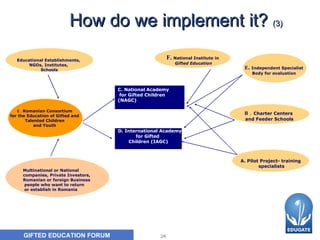
How do we implement it?  (2) T he education of gifted and talented children can only be successfully achieved  if t he   premises   are created  :   Training the  psychologists specialized in discovering endowed children, among whom the gifted and talented children will be selected and then be referred to forms of education that are proper for them .. Second of all, with a view to carrying out the actual educational process, it is necessary to create a body of teachers who master the proper working techniques to be used with each of two  categories  of students   Last, but not the least it is necessary to launch a   pilot center   that will provide all necessary facilities for this type of education
How do we implement it ?  (3) C. National Academy for Gifted Children (NAGC) E .  Romanian Consortium  for the Education of Gifted and  Talented Children  and Youth   A. Pilot Project- training specialists F.   National Institute in Gifted Education D. International Academy  for Gifted  Children (IAGC) Educational Establishments,  NGOs, Institutes,  Schools Multinational or National  companies, Private Investors,  Romanian or foreign Business people who want to return or establish in Romania B.   Charter Centers  and Feeder Schools E .  Independent   Specialist  Body for evaluation   
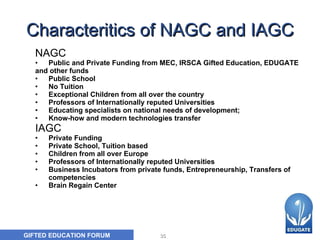
Characteritics of NAGC and IAGC NAGC   Public and Private Funding from MEC, IRSCA Gifted Education, EDUGATE and other funds Public School No Tuition Exceptional Children from all over the country Professors of Internationally reputed Universities Educating specialists on national needs of development;  Know-how and modern technologies transfer IAGC Private Funding Private School, Tuition based Children from all over Europe Professors of Internationally reputed Universities Business Incubators from private funds, Entrepreneurship, Transfers of competencies  Brain Regain Center
Gifted Education Pilot Project Project definition  This complex project needs two stages of implementations:  II. 1. Drafting a Project and an action plan in Gifted Education in Romania starting from the international experience in the gifted field and adopting a functional organizational structure that can be found in all previously mentioned organizations from the global gifted network  II. 2. Implementation of a gifted and talented program that will initiate institutional changes Download  the complete Gifted Education Pilot Project
New Standards N ew educational standards build up on  the  most advanced ps yc ho-educational research in the area as well as our experience resulted from participations in international competitions.  The benefits of these new standards  coming from different practical experience and diverse research areas  consist in reaching highly efficient educational programs in parallel with offering a harmonious  personality  development to those gifted kids who followed the system.  Specifically, these new standards refer to limitating the educational passage or the speed of  passage through the curricula ( tunneling ), to offering boundless access to information and decision, to offering free access and circulation into the international educational system as well as to complete open-mindedness on such cultural criteria as age, sex or pertaining culture.
Benefi ts Suffice it to  cast  a glance  to the  countries that have truly developed such programs to be once more convinced of the immense benefits on all levels.  On a short-term span, this program can identify and develop with accuracy the human resources necessary to develop fields in need of high competitiveness on the global market.  On  a  medium  to  long term  time frame,  the generations of children raised and educated at the height of their capacity will contribute to the birth of a truly advanced society, raising the human mind to the level of nature’s complexity, instead of lowering nature to the level of the human mind.
IRSCA Gifted Education Our current projects  Opportunities to partner The Brain Regain Program The Gifted Education National Program Creating the network of magnet and charter/feeder schools at a national level  Creating the gifted education collaboration network Training of trainers and professionals in gifted education Network of mentors/coaches/tutors in gifted education Enrichment curricula writing  Gifted Education Pilot Project Attracting funding  European Social Fund; Regional Development Fund Private funds Top talent discovering, development and promotion Partnering with corporations and the state Creating the competencies market  Crisis management and policy making Lobbying and Public opinion formation  Promoting equal chances for all
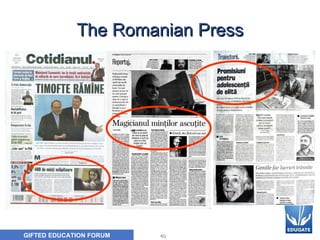
The Romanian Press
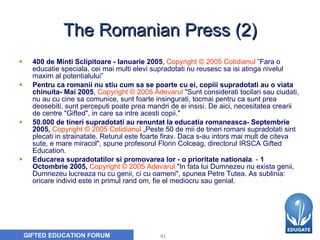
The Romanian Press (2) 400 de Minti Sclipitoare - Ianuarie 2005 ,  Copyright © 2005 Cotidianul  ”Fara o educatie speciala, cei mai multi elevi supradotati nu reusesc sa isi atinga nivelul maxim al potentialului” Pentru ca romanii nu stiu cum sa se poarte cu ei, copiii supradotati au o viata chinuita- Mai 2005 ,   Copyright © 2005 Adevarul   &quot;Sunt considerati tocilari sau ciudati, nu au cu cine sa comunice, sunt foarte insingurati, tocmai pentru ca sunt prea deosebiti, sunt perceputi poate prea mandri de ei insisi. De aici, necesitatea crearii de centre &quot;Gifted&quot;, in care sa intre acesti copii.&quot; 50.000 de tineri supradotati au renuntat la educatia romaneasca- Septembrie 2005,  Copyright © 2005 Cotidianul   „Peste 50 de mii de tineri romani supradotati sint plecati in strainatate. Returul este foarte firav. Daca s-au intors mai mult de citeva sute, e mare miracol&quot;, spune profesorul Florin Colceag, directorul IRSCA Gifted Education.   Educarea supradotatilor si promovarea lor - o prioritate nationala . -  1 Octombrie 2005,  Copyright © 2005 Adevarul   &quot;In fata lui Dumnezeu nu exista genii, Dumnezeu lucreaza nu cu genii, ci cu oameni&quot;, spunea Petre Tutea. As sublinia: oricare individ este in primul rand om, fie el mediocru sau genial.
Key Take-aways Even if t he education of talented and gifted children  has  bec o me a  „ top 1 priority ”   worldwide  with numerous dedicated gifted education  centers around the world, with remarkable results fot these countries’  technical and economical development, Romania faces a critical  brain drain   correlated with an   economic crisis It’s a critical moment. Your support to such an educational system can prove to  be vital in supporting one of the largest private educational initiatives in Romania today. The Advantages of your participation are going to be accordingly important .  Get involved!  Become a member of EDUGATE or the Venture Consortium today!  Find out how you can become: A sponsor A long term partner   Visit  http://www.supradotati.ro/edugate
Thanks! Q&A   Contact info:  [email_address] 0729.029.484

Gifted Education 2007

  • 1.
    EDUGATE TheRomanian Consortium for the Education of Gifted and Talented Children and Youth Gifted Education in Romania Florian Colceag Pre sident 2007
  • 2.
    What is <<GiftedEducation>>? International Laws to support gifted education The Council of Europe, Recommendation 1248/2004 on the education of gifted and talented children International Supporters EDUGATE –The Romanian Consortium for the Education of Gifted and Talented Children and Youth EDUGATE- The Romanian Consortium for the Education of Gifted and Talented Children and Youth IRSCA Gifted Education Bill of law on the Education of Gifted and Capable of High Performance Youth What does gifted mean? Statistical facts Gifted Education in the world Gifted Education i n Romania Gifted Education Pilot Project Agenda
  • 3.
    Gifted Education –an International Program Why is Gifted Education the answer? The gifted education program is an international program i mplemented at an international level and it covers specific education programs on all levels, from a kindergarten to a post-phD level. North Americans initiated the gifted program in 1984 by intimately correlating it with regional development objectives: the program is able to form highly competent and motivated human resources with superior intellectual and moral abilities. An education of excellence Gifted children with high abilities who don’t integrate into an education system to cover their special educational and counseling needs have a high risk to stay outside the social and economical system and not to integrate. That makes them a distinctive social category that asks for special supporting actions. 3. The gifted education program is supported by numerous international laws
  • 4.
    Gifted Education- ConceptGifted education is not an elitist education because it does not address a small percentage of the scholar population but through its programs of enrichement, acceleration, tutoring and mentoring all categories of children are promoted, and supported to develop their natural abilities and potentials.
  • 5.
    Concept (2)An educational alternative oriented towards intellectual endowment and not towards intellectual imbuement ; emancipation and not manipulation In the context of Romania’s integration to the EU, the Lisabon Declaration respects all the priciples defined and clearly expressed within the Gifted Education system for decades Gifted education does not contradict but enriches and respects the current educational system. However, through its curricula, programs, new teaching methodologies and practices it can enrich the educational offer of kindergartens, schools, colleges or universities It’s a critical moment for Romania to develop a gifted education program oriented towards amplifying, diversifying, channeling and using the abilities of children with special potential for the national needs of development
  • 6.
    Concept (3)The education of talented and gifted children is a „ top priority ” worldwide Started as a chain reaction after the launching of the first Sputnik, the education of gifted and talented people extend s from the scientific or technological field to leadership and the management of social system s .
  • 7.
    International Laws supportingGifted Education Education Act 1997 (UK) Chapter II (2005) – Labor Party Manifesto for Education (UK) Additional Support for learning Act 2004 (Scotland) No Child Left Behind Act 2001 (US) The School Education Act 1999 (Australia) Education Act 1998 (Republic of Ireland) The Royal Decree 696/1995 (Spain) Recommendation 1248/2004, Council of Europe (UE)
  • 8.
    Council of Europe Parliamentary Assembly RECOMMENDATION 1248 RECOMMENDATION 1248 (1994) on the education for gifted children *  of the Council of Europe , Parliamentary Assembly states clearly that: “ 3. Gifted children should be able to benefit from appropriate educational conditions that would allow them to develop fully their abilities, for their own benefit and for the benefit of society as a whole. No country can indeed afford to waste talents and it would be a waste of human resources not to identify in good time any intellectual or other potentialities. Adequate tools are needed for this purpose. 4. Special educational provision should, however, in no way privilege one group of children to the detriment of the others. 5. The Assembly therefore recommends that the Committee of Ministers ask the competent authorities of the states signatory to the European Cultural Convention to take account of the following considerations in their educational policies:           i. legislation should recognise and respect individual differences. Highly gifted children, as with other categories, need adequate educational opportunities to develop their full potential;           ii. basic research in the fields of &quot;giftedness&quot; and &quot;talent&quot; and applied research, for instance to improve identification procedures, should be developed in parallel. Research on the &quot;mechanisms of success&quot; could help to tackle school failure;           iii. meanwhile, in-service teacher training programmes have to include strategies for identifying children of high ability or special talent. Information on gifted children should be made available to all those who deal with children (teachers, parents, doctors, social workers, ministries of education, etc.);           iv. provision for specially gifted children in a given subject area should preferably be arranged within the ordinary school system, from pre-school education onwards. Flexible curricula, more chances of mobility, enriching supplementary material, audiovisual aids and project-oriented teaching styles are ways and techniques to foster the development of all children, whether highly gifted or not, and enable the identification of special needs at the earliest possible time;           v. the ordinary school system should be made flexible enough to enable the needs of high performers or talented students to be met; vi. any special provision for highly gifted or talented students should be administered with discretion, to avoid the innate danger of labelling, with all its undesired consequences to society. “ Text adopted by the Assembly on 7 October 1994   *Full Text Available at: http://assembly.coe.int/Documents/AdoptedText/ta94/erec1248.htm
  • 9.
    Council of EuropeReply from the Committee of Ministers In 2003, the Committee of Ministers stated in two official replies (September and December) that: Gifted children form a category of persons with special needs; they face “ certain specific problems in the regular education system for ordinary children ” [1] and because of that, they require proper provision within a different education system. If proper care is not taken, on one hand, “ the high potential of these children for creativity is lost, and on the other hand, there is the risk of alienation, drop-out and antisocial behaviour ” [2] . [1] http://assembly.coe.int/documents/workingdocs/doc03/edoc9920.htm [2] http://assembly.coe.int/documents/workingdocs/doc03/edoc10019.htm
  • 10.
    International Supporters forEDUGATE World Council for Gifted and Talented Children Following the participation to the Biennal conference of World Council for Gifted and Talented Children, August 6-10, 2005, New Orleans, the US, EDUGATE, through IRSCA Gifted Education has obtained the partnerships and recognition of its efforts at a national level, which enables the consortium to realize the program with the highest support at a world and european level. Board of Trustees of EDUGATE is made of the high international personalities involved in the education of gifted and talented children and youth: Den-Mo Tsai, Taiwan, the current president of WCGTC; Klaus K.Urban, Germany, former president of WCGTC; Barbara Clarck, the US, former president of WCGTC; Sandra Kaplan, the US; Erika Landau, Israel; Joice Van Tasel-Baska, the US; Johanna Raffan, Anglia, secretary, ECHA; Joseph Renzulli si Sally Reis, the US, directors of NAGC; Taisir Subhi, The Arab Emirates and Richard A. Boolootian, the US.
  • 11.
    International Supporters(2) -Most important international organizations in the field of gifted and talented education - WCGTC- World Council for Gifted and Talented Children Asia - Pacific Federation of World Council for Gifted & Talented Children ECHA - The European Council for High Ability NAGTY - National Academy for Gifted and Talented Youth, UK NAGC - National Association for Gifted Children, the US Support obtained through: Consulting Access to resources Defined programs
  • 12.
    IRSCA Gifted EducationMotto: Invest in gifted children, invest in the values of society, invest in our national future! “ No nation, no society can allow herslef to neglect gifted children and youth with highest potential of her people. The most talented are the nation’s wealth” - Klaus Urban Prof. Dr., ex president of World Council for Gifted and Talented Children &quot;Gifted education respects and promotes the divine nature of the human being and not a merchandised human being, the human being for consumption. We promote the human being who is a creator, the human being capable to develop her potentials&quot; - Florian Colceag, president, IRSCA Gifted Education.    
  • 13.
    IRSCA Gifted Education    Mission To promote and to support the development of all gifted people in all fields: science, arts, managemenbt, leadership, entrepreneurship, and to form human resources capable to solve our complex current matters. Romanian NGO, launched in 2005 Founding members Flori a n Colceag , Com s a Marin, Csinta Thomas , Daman a kis Emmanuel , Deutsch Elisabeta Iulia , Dragot a Mihai Cristian , Jinaru Aron, Jula Dorin , Munteanu Florin , Panait Florin , Sima- S etraru Alexandra , Stoica Cristian , S erbulescu Radu The initiator and prime founder of EDUGATE; Initiator of the National Gifted Education Program; the first organizer of a national conference on gifted education; the initiator of programs to discover the potential of every child, and the programs of mentoring, tutoring, curricula enrichment and dissemination of best practices in gifted education to all schools in Romania
  • 14.
    IRSCA Gifted EducationAffiliations     Since 2006, IRSCA Gifted Education is a full member of ECHA- European Council for High Ability si WCGTC- World Council for Gifted and Talented Children , the world’s top educational bodies in the field of gifted education
  • 15.
    EDUGATE The RomanianConsortium for the Education of Gifted and Talented Children and Youth EDUGATE was developed in 2005 to support the first Gifted Education National Program. It is one of the largest private educational initiatives in Romania today and also, the initiator of the bill of law on the education of gifted children and youth, capable of high performance. Among its founders are more than 40, most prestigious educational bodies in Romania: IRSCA Gifted Education RO-TALENT – The Romanian Association for psycho-pedagogic and social counseling for talented children and youth Junior Achievement Foundation Center Education 2000+, CODECS Foundation for Leadership CUFR- Conseil Universitaire Formation- Recherche Francais-Roumain aupres des Grandes Ecoles Francaises Cygnus Foundation The National Institute of Education Sciences CREDIS– Distance Education Department – University of Bucharest The Harvard Club Romania-Moldavia SIGMA - The Foundation for European Integration SIGMA Publishing House Iulia Hasdeu National College Mihai Viteazul National College Jose MARTI School of Bucharest Dinu Lipatti Music High School George Enescu Music High School Floria Capsali Ballet High Schoo l National Foundation for Youth Applied sciences and research center- University of Bucharest ProBios - The Romanian Association for Life Sciences The ecologic group of collaboration- University of Bucharest Altius Academy Foundation PsihoBest- Psychological Testing & Vocational and Career Orientation Center The Foundation for Communication Strategies Global Video Media Television Alpha FDSC- The Foundation for Civic Society Development The Management Department - Polytechnic University Public Managers Association of Romania M.A.T.C.A. –2000 Foundation The Students Union from Romania LEADERS Romania Math and Physics Teachers Association from Bacau (APMFB) The Pedagogic Alternarnatives Association Creative Media & Art InfoSpeed “ We read” Foundation And more
  • 16.
    The Role ofEDUGATE The Educational Consortium seeks to realize the following collaborations and activities in order to pursue the National Gifted Education Program :  Training of professors Training of psychologists Training of parents in gifted education Continuous formation of professors in gifted education and psycho-pedagogic methodologies  Applicative collaboration Development of abilities Fundraising Raising of Venture capital, social and angel capital Developing financed programs Developing policies and international programs for schools Know-how and technology transfer (including teaching methodologies) Setting-up of a gifted education system with multiple and differentiated offers (private)  Promotion and formation of intellectual values Intellectual property protection Promotion on equity and principles of competencies and integrity Social and professional integration of the graduates of the system  Incentivizing Intelligence and creativity Training of leaders in all subject matters and all economic domains  Setting up of a market of competencies to put in value and promote intellectual values 
  • 17.
    What does «gifted » mean? Gifted or super-normal represents the normal level of the human potential, which is however achieved by a reduced number of people. This normal level comprises all the intellectual, artistic, ethic, communication or creativity qualities which have a lot out of the common. The Romanian term for gifted = SUPRADOTAT adj . (about children) , which means h aving qualities which are out of the common = Supra + dotat after the French term SURDOUE ) , Dictionary of Romanian language Intelligence is a term currently used but with little understanding on what it represents. Today, there is no conclusive understanding of exactly what the concept of intelligence truly is. Currently there are IQ tests administered, which are ‘normed’ against a population where giftedness is defined as the top five percent of the bell curve. Some modern academic theories recognize that IQ tests are not a true measure of intelligence and have cultural and language biases. Continuing research into study of intelligence suggests that there are multiple intelligences rather than purely academic intelligence, which is the main item measured in an IQ test. Current educational psychology practices recognize that there are many different types of giftedness as well as many different identification factors, and that an all round approach is best for gifted identification.
  • 18.
    The Bill oflaw on the education of gifted and capable of high performance youth Passed by the Romanian parliament in December 2006 and enforced since January 2007 Elaborated by IRSCA Gifted Education in co-operation with The Humanist Foundation ,,Dan Voiculescu&quot; The Law : Art.1 - This law regulates the legal operation and organization framework of the National Differentiated Training Center as well as the institutional organization of differentiated education programs for gifted and talented students. Art.3 - According to the Human Rights Charter, Lisbon case, the Universal Declaration of the Rights of the Child, Recommendation 1248/1994 of the Parliamentary Assembly of the Council of Europe, students with special needs, among whom gifted students can be mentioned, shall be provided with an adequate educational environment which allows them to fully exploit their potential for their own, as well as for the society’s benefit. Download the complete text in English
  • 19.
    The Bill oflaw on the education of gifted and capable of high performance youth The National Differentiated Training Center has the following o bjectives: E nsuring educational facilities for highly gifted students; according to the specific training methodologies of gifted education psychology; providing conditions and procedures of establishing differentiated training itineraries, necessary to adjust training to the creative expression capability and the intellectual development to the specific needs of gifted students related to their social and professional integration . Art.26 - The National Differentiated Training Center shall have the following competences : a)       preparing pilot school programs to introduce the working methodologies specific for gifted students education, adjusted to international levels in this educational system ; b)      establishing a pilot research center and experimental classes, where the specific instruction and curricular technologies for the gifted education system will be put to use ; c) adjusting international education psychology regulations and methodologies to national issues specificity; d) training specialists in teaching methodologies specific to the field of gifted education psychology ; e) disseminating information and issues concerning the gifted education psychology among teachers and parents’ associations ; f)     preparing and promoting informational support concerning scientific research and assistance in the field of gifted education psychology ; g) distribution through school networks of informational materials on gifted education psychology ; h) organizing within the Teaching Staff Offices and the Children’s Palaces, as well as within schools, high schools, universities joint information activities on specific gifted education psychology research; i) integrating gifted students into specific gifted education psychology programs.
  • 20.
    What does «gifted » mean? (2) Today giftedness is defined using many factors of such sort as IQ (intelligence quantum), SQ, (spiritual quantum), EQ (emotional quantum) and others si alti factori. However, using the IQ as one of the many factors to indicate giftedness, the following bell curve follows : 85-99 Lower normal 100-114 Upper normal 115-129 Bright 130-144 Gifted 145-159 Highly gifted 160-180 Profoundly gifted 180-above Genius
  • 21.
    Statistical Facts Accordingto recent research data, only 5-10 % of people on the planet are gifted ( ref. Roberta Braverman, the vice president of the New Jersey Association for Gifted Children ). A mong them , at a global level, a few distinguish themselves by having even greater capacities than the 2%. According to Romanian psychologists, in Romania, the percentage of gifted persons is close to 4% out of the total number of persons. The la st 25 years proved that economic, social and cultural development directly depends on developing the education of gifted and talented persons and on using their capacities nationally as a catalytic factor in development as such. Gifted people who are not included from an early stage into an educational, subsequently economic, management or politic system emigrate to the countries which offer them chances to assert and develop themselves. The ones who are included in such a system essentially contribute to local development on all levels.
  • 22.
    Gifted People- Arethey hard to find? History showed us many times that society acknowledged the values of gifted people but this generally happened with great delay, sometimes tens or hundreds of years after the death of the gifted. Such examples are Von Neumen, Gauss, Gauss, Gaulois, Mendel, Mozart, Vivaldi, Van Gogh, Da Vinci or more recently Ramanujan, Sidis and Eminescu. However, our modern times discovered through gifted education the acknowledgement and promotion of ideas in due time.
  • 23.
    But whathappens worldwide? Before starting such an ambitious and worthy project , it would be interesting to look closely at the ways other countries worldwide approached giftedness. How long and in which way have they approached children giftedness and how do they measure the result of the effort made? Which are the specific differences of approach between highly-developed countries such as USA and countries of the same development level as Romania or of an even lower level? Last, but not the least, i t is also of great importance to consider the actions taken in Romania...
  • 24.
    Gifted Education inthe world (1) The education of overly endowed (gifted) children is a practice in all countries that have developed functional economies and has spread worldwid e during the past few years. The first science-oriented gifted education centers have been roughly simultaneously developed in the USA, China, Australia, former USSR and in many European countries. There are centers dedicated to this educational system in Austria, Spain, Croatia, France, U.K., and in other European countries Moreover, g ifted children programs have reached and have been implemented in the majority of schools in the world. There are Gifted Education centers in the USA and in Australia in every state or county, stressing on identifying them and providing specific training for their intellectual profile . . The gifted education units’ network ranges from kindergartens to postgraduate education.
  • 25.
    Gifted Education inthe world (2) Worldwide organizations: WCGTC - World Council for Gifted and Talented Children, The Asia-Pacific Federation of the World Council for Gifted and Talented Children Continental organizations: Europe - ECHA- European Council for High Ability Regional centers: NAGC- National Association for Gifted Children, the US; NAGTY - National Academy for Gifted and Talented Youth, UK; Centers of Excellence, magnet schools, charter centers as well as pilot centers to implement new learning technologies, universities and collaborative networks, colleges, schools and kindergartens as well as specialized departments at the levels of ministries of education and governments of numerous countries around the world: Association Francaise pour les Enfants Precoces (AFEP), France; National Association for Able Children in Education (NACE), the UK; Center for the Study of Giftedness Catholic University of Nijmegan, the Netherlands; Tate-Society to Support Bright Children, Austria; Hollingworth Center for Highly Gifted Children, the US; The National Research Center on the Gifted and Talented, the US; Academic Talent Search, the US; Belin-Blank International Center for Gifted Education and Talent Development, The University of Iowa, Iowa City, IA, the US; Carnegie Mellon Institute for Talented Elementary Students (C-MITES), the US; Davidson Institute for Talent Development, the US; Program in Mathematics for Young Scientists (PROMYS), Boston University, Boston, MA, the US; Purdue University Gifted Education Resource Institute, the US; Educational Program for Gifted Youth (EPGY), Stanford University, Stanford, C, the US; Accelerated College Entrance Center, California State University, Sacramento, CA, the US; Program for the Exceptionally Gifted, Mary Baldwin College, Staunton, VA, the US; Queensland Association for Gifted and Talented Children, Inc., Australia, etc.
  • 26.
    Gifted Education inthe world ( 3 ) Recently, during the past 10 years, Turkey, the Arabian Emirates, Oman, the Republic of South Africa, Brunei and other countries have started developing the system, an aspect positively correlated with their political and economic stability, as well. Such centers are currently being developed in other countries in the Middle East, Africa, South America, which have not been integrated in the first spreading wave. Europe is almost completely integrated in the system. A significant example in the former communist block is the center headed by Shi Jiannong from The Institute of Psychology, Chinese Academy of Sciences that dedicat es its activity to the psychological research of gifted children, who are also trained in special programs.
  • 27.
    What about ourneighbours ? In Central and Eastern Europe, Serbia, Slovenia, Poland, Hungary and the Check Republic distinguish themselves in the field of gifted education, which corellates as well with the economic development of these countries after 1990. Among our geographical neighbors, former Yugoslavia has developed gifted education centers starting back in 1982 ! Petnica Science Center, Serbia
  • 28.
    What about ourneighbours ? (2) A representative gifted education center in our geographic area is Petnica Science Center in Serbia , headed by professor Vigor Majic, the current deputy Minister of Education S tudents of this center initiated in 1982 have published hundreds of scientific articles in professional magazines, and the center has been kept functional and financed even throughout the harsh period of the war in Yugoslavia. Its financing raises up to approximately $1,000,000/year and is deemed profitable due to the economic development effect it induces. These examples are among the hundreds of other centers dedicated to this purpose that are spread throughout the whole world.
  • 29.
    Gifted Education inRomania The terms “Gifted Children” and “Gifted Education” have circulated in post December 1989 Romania. Governments have always spoken about great projects with miraculously short term results, yet have lacked the human resources specialized in gifted education systems. This phenomenon has also been amplified by the brain drain westwards. Yet in fact, authorities have not grasped the actual outreach of the issue and have treated the matter with the shallowness typical to election promises In short, today there is critical shortage of an education system which would provide the necessary learning capabilities to gifted children in Romania
  • 30.
    Gifted Education inRomania An education program was launched in Romania in 1982 on Russia’s initiative as a reaction to similar US programs after the first Sputnic was launched. Most of the former students taking part in these education programs are now professors at universities in economically developed countries or employed by renowned and financially powerful companies. In 2000, this form of education became official under a new name: Schools for Excellency, by minister’s order, but they maintained the same tendency to concentrate on academic contests. The program is not financed or is underfinanced and it is oriented towards keeping up an image, rather than actually developing the skills of gifted students.
  • 31.
    What do webring new ? N ew teaching technologies and testing methods which are adapted to the personalities and styles of learning of the gifted and talented children 20-year experience in the field of education aimed at achieving results in competitions at an international level O rganizational experience in the development of the gifted education sector in Australia Postgraduate studies in gifted education i n SUA Support in the gifted field from all over the world, including the largest european and international bodies involved in gifted education such as ECHA, World Council for Gifted and Talented Children, US; the World Council for Gifted and Talented Childre n Directions of education oriented towards a very high professional level, competence and a working speed that would later enabl e graduates to be integrated on a competent national market . This will essentially contribute to the development in Romania of top priority sectors that are highly competitive on the international market.
  • 32.
    How do weimplement it? A large number of children who have won awards in international academic competitions, many of them being gifted children. There are also other gifted children who are not among these winners. P sychologists qualified in evaluating intellectual capacities specific to gifted persons. A large number of teachers trained in academic contests. A wide range of external collaborators in the field of gifted education and good professional contacts in the field. K now-how and the specific experience in this field. The n ecessary competence to develop the system starting from a pilot center and up to setting up a whole active educational network.
  • 33.
    How do weimplement it? (2) T he education of gifted and talented children can only be successfully achieved if t he premises are created : Training the psychologists specialized in discovering endowed children, among whom the gifted and talented children will be selected and then be referred to forms of education that are proper for them .. Second of all, with a view to carrying out the actual educational process, it is necessary to create a body of teachers who master the proper working techniques to be used with each of two categories of students Last, but not the least it is necessary to launch a pilot center that will provide all necessary facilities for this type of education
  • 34.
    How do weimplement it ? (3) C. National Academy for Gifted Children (NAGC) E . Romanian Consortium for the Education of Gifted and Talented Children and Youth A. Pilot Project- training specialists F. National Institute in Gifted Education D. International Academy for Gifted Children (IAGC) Educational Establishments, NGOs, Institutes, Schools Multinational or National companies, Private Investors, Romanian or foreign Business people who want to return or establish in Romania B. Charter Centers and Feeder Schools E . Independent Specialist Body for evaluation  
  • 35.
    Characteritics of NAGCand IAGC NAGC Public and Private Funding from MEC, IRSCA Gifted Education, EDUGATE and other funds Public School No Tuition Exceptional Children from all over the country Professors of Internationally reputed Universities Educating specialists on national needs of development; Know-how and modern technologies transfer IAGC Private Funding Private School, Tuition based Children from all over Europe Professors of Internationally reputed Universities Business Incubators from private funds, Entrepreneurship, Transfers of competencies Brain Regain Center
  • 36.
    Gifted Education PilotProject Project definition This complex project needs two stages of implementations: II. 1. Drafting a Project and an action plan in Gifted Education in Romania starting from the international experience in the gifted field and adopting a functional organizational structure that can be found in all previously mentioned organizations from the global gifted network II. 2. Implementation of a gifted and talented program that will initiate institutional changes Download the complete Gifted Education Pilot Project
  • 37.
    New Standards New educational standards build up on the most advanced ps yc ho-educational research in the area as well as our experience resulted from participations in international competitions. The benefits of these new standards coming from different practical experience and diverse research areas consist in reaching highly efficient educational programs in parallel with offering a harmonious personality development to those gifted kids who followed the system. Specifically, these new standards refer to limitating the educational passage or the speed of passage through the curricula ( tunneling ), to offering boundless access to information and decision, to offering free access and circulation into the international educational system as well as to complete open-mindedness on such cultural criteria as age, sex or pertaining culture.
  • 38.
    Benefi ts Sufficeit to cast a glance to the countries that have truly developed such programs to be once more convinced of the immense benefits on all levels. On a short-term span, this program can identify and develop with accuracy the human resources necessary to develop fields in need of high competitiveness on the global market. On a medium to long term time frame, the generations of children raised and educated at the height of their capacity will contribute to the birth of a truly advanced society, raising the human mind to the level of nature’s complexity, instead of lowering nature to the level of the human mind.
  • 39.
    IRSCA Gifted EducationOur current projects Opportunities to partner The Brain Regain Program The Gifted Education National Program Creating the network of magnet and charter/feeder schools at a national level Creating the gifted education collaboration network Training of trainers and professionals in gifted education Network of mentors/coaches/tutors in gifted education Enrichment curricula writing Gifted Education Pilot Project Attracting funding European Social Fund; Regional Development Fund Private funds Top talent discovering, development and promotion Partnering with corporations and the state Creating the competencies market Crisis management and policy making Lobbying and Public opinion formation Promoting equal chances for all
  • 40.
  • 41.
    The Romanian Press(2) 400 de Minti Sclipitoare - Ianuarie 2005 , Copyright © 2005 Cotidianul ”Fara o educatie speciala, cei mai multi elevi supradotati nu reusesc sa isi atinga nivelul maxim al potentialului” Pentru ca romanii nu stiu cum sa se poarte cu ei, copiii supradotati au o viata chinuita- Mai 2005 , Copyright © 2005 Adevarul &quot;Sunt considerati tocilari sau ciudati, nu au cu cine sa comunice, sunt foarte insingurati, tocmai pentru ca sunt prea deosebiti, sunt perceputi poate prea mandri de ei insisi. De aici, necesitatea crearii de centre &quot;Gifted&quot;, in care sa intre acesti copii.&quot; 50.000 de tineri supradotati au renuntat la educatia romaneasca- Septembrie 2005, Copyright © 2005 Cotidianul „Peste 50 de mii de tineri romani supradotati sint plecati in strainatate. Returul este foarte firav. Daca s-au intors mai mult de citeva sute, e mare miracol&quot;, spune profesorul Florin Colceag, directorul IRSCA Gifted Education. Educarea supradotatilor si promovarea lor - o prioritate nationala . - 1 Octombrie 2005, Copyright © 2005 Adevarul &quot;In fata lui Dumnezeu nu exista genii, Dumnezeu lucreaza nu cu genii, ci cu oameni&quot;, spunea Petre Tutea. As sublinia: oricare individ este in primul rand om, fie el mediocru sau genial.
  • 42.
    Key Take-aways Evenif t he education of talented and gifted children has bec o me a „ top 1 priority ” worldwide with numerous dedicated gifted education centers around the world, with remarkable results fot these countries’ technical and economical development, Romania faces a critical brain drain correlated with an economic crisis It’s a critical moment. Your support to such an educational system can prove to be vital in supporting one of the largest private educational initiatives in Romania today. The Advantages of your participation are going to be accordingly important . Get involved! Become a member of EDUGATE or the Venture Consortium today! Find out how you can become: A sponsor A long term partner Visit http://www.supradotati.ro/edugate
  • 43.
    Thanks! Q&A Contact info: [email_address] 0729.029.484

Editor's Notes

  • #23 Ar trebui doar s a ne i nchipuim cum ar ar a ta lumea azi dac a oameni sau super-oameni ca aceştia ar fi i n t ele s i i n timpul viet i i lor s i exploata t i la maximum lor de capacitate Cred c a fiecare dintre noi ar vrea s a aib a unica oportunitate de a putea s a i i pun a azi i ntrebarea “cum ai reu s it s a convingi lumea?” lui Albert Einstein.
  • #33 Ace s tia pot deveni formatori de psihologi specializaţi i n domeniu. Ace s tia au nevoie de un training psihopedagogic pe gifted education pentru a putea fi integra t i i n sistem.
  • #34 Din punct de vedere practic, a s a cum rezultă din experien t a altor ta ri … în vederea desf as ur a rii actului educa t ional propriu-zis Este de remarcat c a supradotarea se reg a se s te pe direc t ii de aptitudini variate s i c a un bagaj pedagogic adecvat acestor direc t ii se poate forma prin studii s i practic i specializate.