AN EXAMINATION OF THE LINK
BETWEEN SCHOOL MANAGEMENT
AND CURRICULUM INNOVATION
Comparative study of public and private primary schools in Greece
By
Marina Stefania Giannakaki
University of Strathclyde
Faculty of Education
Model of school management applied:
THE LEARNING ORGANISATION
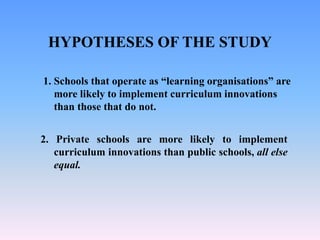
HYPOTHESES OF THE STUDY
2. Private schools are more likely to implement
curriculum innovations than public schools, all else
equal.
1. Schools that operate as “learning organisations” are
more likely to implement curriculum innovations
than those that do not.
WHAT IS A LEARNING
ORGANISATION?
Vision
Shared decision-making
Openness to society
Regular flows of knowledge & information
Rewards / positive reinforcement
WHAT IS CURRICULUM INNOVATION?
Curriculum innovation is the
introduction of:
1. New aims,
2. New content,
3. New instructional approaches, or
4. New methods of assessment
within the school curriculum
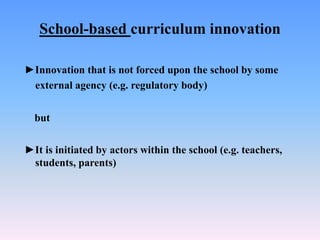
School-based curriculum innovation
►Innovation that is not forced upon the school by some
external agency (e.g. regulatory body)
but
►It is initiated by actors within the school (e.g. teachers,
students, parents)
CONTEXT OF THE STUDY
Greek Primary Schools,
Public and Private
What constitutes curriculum innovation in
the Greek primary school?
The Greek primary school curriculum
Core / compulsory
Centrally developed and uniformly applied in all schools,
both public and private
Non-compulsory
1. Cross-curricular programmes (e.g. environmental education
projects)
2. School events (e.g. art exhibitions, student concerts, etc.)
3. Afternoon classes (e.g. ICT classes, sports classes, etc. )
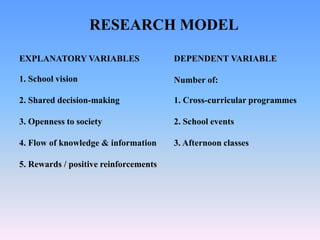
RESEARCH MODEL
EXPLANATORY VARIABLES
1. School vision
2. Shared decision-making
3. Openness to society
4. Flow of knowledge & information
5. Rewards / positive reinforcements
DEPENDENT VARIABLE
Number of:
1. Cross-curricular programmes
2. School events
3. Afternoon classes
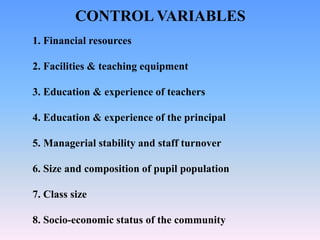
1. Financial resources
2. Facilities & teaching equipment
3. Education & experience of teachers
4. Education & experience of the principal
5. Managerial stability and staff turnover
6. Size and composition of pupil population
7. Class size
8. Socio-economic status of the community
CONTROL VARIABLES
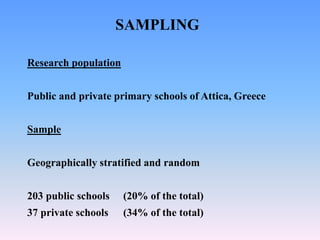
SAMPLING
Research population
Public and private primary schools of Attica, Greece
Sample
Geographically stratified and random
203 public schools (20% of the total)
37 private schools (34% of the total)
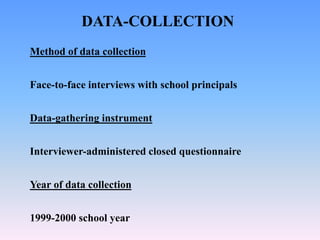
DATA-COLLECTION
Method of data collection
Face-to-face interviews with school principals
Data-gathering instrument
Interviewer-administered closed questionnaire
Year of data collection
1999-2000 school year
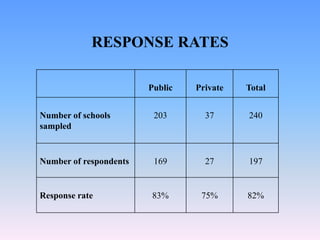
RESPONSE RATES
Public Private Total
Number of schools
sampled
203 37 240
Number of respondents 169 27 197
Response rate 83% 75% 82%
DESCRIPTIVE RESULTS
Private schools scored higher than public schools on the
following explanatory variables:
► Long-term goals (i.e. school vision)
► Collaboration with HE institutions, businesses, and
the voluntary sector (i.e. openness to society)
► Implementation of development programmes for
teachers and parents (i.e. flow of knowledge and
information)
► Use of teacher rewards
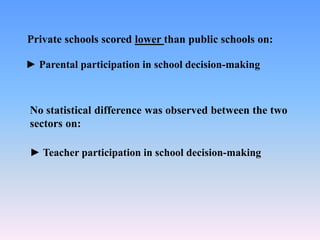
Private schools scored lower than public schools on:
No statistical difference was observed between the two
sectors on:
► Parental participation in school decision-making
► Teacher participation in school decision-making
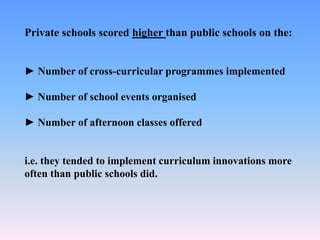
Private schools scored higher than public schools on the:
► Number of cross-curricular programmes implemented
► Number of school events organised
► Number of afternoon classes offered
i.e. they tended to implement curriculum innovations more
often than public schools did.
REGRESSION RESULTS
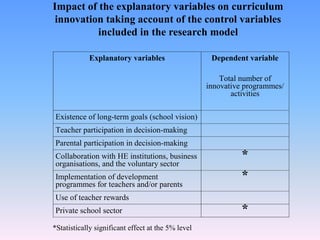
Impact of the explanatory variables on curriculum
innovation taking account of the control variables
included in the research model
Explanatory variables Dependent variable
Total number of
innovative programmes/
activities
Existence of long-term goals (school vision)
Teacher participation in decision-making
Parental participation in decision-making
Collaboration with HE institutions, business
organisations, and the voluntary sector
*
Implementation of development
programmes for teachers and/or parents
*
Use of teacher rewards
Private school sector *
*Statistically significant effect at the 5% level
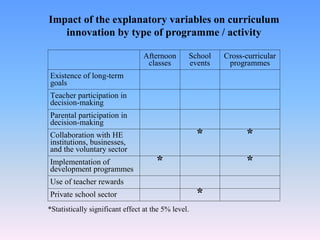
Impact of the explanatory variables on curriculum
innovation by type of programme / activity
Afternoon
classes
School
events
Cross-curricular
programmes
Existence of long-term
goals
Teacher participation in
decision-making
Parental participation in
decision-making
Collaboration with HE
institutions, businesses,
and the voluntary sector
* *
Implementation of
development programmes
* *
Use of teacher rewards
Private school sector *
*Statistically significant effect at the 5% level.
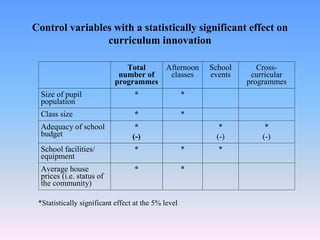
Control variables with a statistically significant effect on
curriculum innovation
Total
number of
programmes
Afternoon
classes
School
events
Cross-
curricular
programmes
Size of pupil
population
* *
Class size * *
Adequacy of school
budget
*
(-)
*
(-)
*
(-)
School facilities/
equipment
* * *
Average house
prices (i.e. status of
the community)
* *
*Statistically significant effect at the 5% level
Control variables that do not affect
curriculum innovation
1. Education & experience of teachers
2. Education & experience of the principal
3. Managerial stability
4. Staff turnover
5. Composition of the pupil population
(% of minority pupils at school)
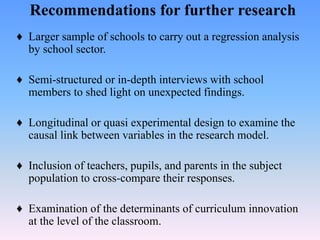
Recommendations for further research
♦ Larger sample of schools to carry out a regression analysis
by school sector.
♦ Semi-structured or in-depth interviews with school
members to shed light on unexpected findings.
♦ Longitudinal or quasi experimental design to examine the
causal link between variables in the research model.
♦ Inclusion of teachers, pupils, and parents in the subject
population to cross-compare their responses.
♦ Examination of the determinants of curriculum innovation
at the level of the classroom.
END

Giannakaki learning conference 2003

  • 1.
    AN EXAMINATION OFTHE LINK BETWEEN SCHOOL MANAGEMENT AND CURRICULUM INNOVATION Comparative study of public and private primary schools in Greece By Marina Stefania Giannakaki University of Strathclyde Faculty of Education
  • 2.
    Model of schoolmanagement applied: THE LEARNING ORGANISATION
  • 3.
    HYPOTHESES OF THESTUDY 2. Private schools are more likely to implement curriculum innovations than public schools, all else equal. 1. Schools that operate as “learning organisations” are more likely to implement curriculum innovations than those that do not.
  • 4.
    WHAT IS ALEARNING ORGANISATION? Vision Shared decision-making Openness to society Regular flows of knowledge & information Rewards / positive reinforcement
  • 5.
    WHAT IS CURRICULUMINNOVATION? Curriculum innovation is the introduction of: 1. New aims, 2. New content, 3. New instructional approaches, or 4. New methods of assessment within the school curriculum
  • 6.
    School-based curriculum innovation ►Innovationthat is not forced upon the school by some external agency (e.g. regulatory body) but ►It is initiated by actors within the school (e.g. teachers, students, parents)
  • 7.
    CONTEXT OF THESTUDY Greek Primary Schools, Public and Private
  • 8.
    What constitutes curriculuminnovation in the Greek primary school?
  • 9.
    The Greek primaryschool curriculum Core / compulsory Centrally developed and uniformly applied in all schools, both public and private Non-compulsory 1. Cross-curricular programmes (e.g. environmental education projects) 2. School events (e.g. art exhibitions, student concerts, etc.) 3. Afternoon classes (e.g. ICT classes, sports classes, etc. )
  • 10.
    RESEARCH MODEL EXPLANATORY VARIABLES 1.School vision 2. Shared decision-making 3. Openness to society 4. Flow of knowledge & information 5. Rewards / positive reinforcements DEPENDENT VARIABLE Number of: 1. Cross-curricular programmes 2. School events 3. Afternoon classes
  • 11.
    1. Financial resources 2.Facilities & teaching equipment 3. Education & experience of teachers 4. Education & experience of the principal 5. Managerial stability and staff turnover 6. Size and composition of pupil population 7. Class size 8. Socio-economic status of the community CONTROL VARIABLES
  • 12.
    SAMPLING Research population Public andprivate primary schools of Attica, Greece Sample Geographically stratified and random 203 public schools (20% of the total) 37 private schools (34% of the total)
  • 13.
    DATA-COLLECTION Method of datacollection Face-to-face interviews with school principals Data-gathering instrument Interviewer-administered closed questionnaire Year of data collection 1999-2000 school year
  • 14.
    RESPONSE RATES Public PrivateTotal Number of schools sampled 203 37 240 Number of respondents 169 27 197 Response rate 83% 75% 82%
  • 15.
  • 16.
    Private schools scoredhigher than public schools on the following explanatory variables: ► Long-term goals (i.e. school vision) ► Collaboration with HE institutions, businesses, and the voluntary sector (i.e. openness to society) ► Implementation of development programmes for teachers and parents (i.e. flow of knowledge and information) ► Use of teacher rewards
  • 17.
    Private schools scoredlower than public schools on: No statistical difference was observed between the two sectors on: ► Parental participation in school decision-making ► Teacher participation in school decision-making
  • 18.
    Private schools scoredhigher than public schools on the: ► Number of cross-curricular programmes implemented ► Number of school events organised ► Number of afternoon classes offered i.e. they tended to implement curriculum innovations more often than public schools did.
  • 19.
  • 20.
    Impact of theexplanatory variables on curriculum innovation taking account of the control variables included in the research model Explanatory variables Dependent variable Total number of innovative programmes/ activities Existence of long-term goals (school vision) Teacher participation in decision-making Parental participation in decision-making Collaboration with HE institutions, business organisations, and the voluntary sector * Implementation of development programmes for teachers and/or parents * Use of teacher rewards Private school sector * *Statistically significant effect at the 5% level
  • 21.
    Impact of theexplanatory variables on curriculum innovation by type of programme / activity Afternoon classes School events Cross-curricular programmes Existence of long-term goals Teacher participation in decision-making Parental participation in decision-making Collaboration with HE institutions, businesses, and the voluntary sector * * Implementation of development programmes * * Use of teacher rewards Private school sector * *Statistically significant effect at the 5% level.
  • 22.
    Control variables witha statistically significant effect on curriculum innovation Total number of programmes Afternoon classes School events Cross- curricular programmes Size of pupil population * * Class size * * Adequacy of school budget * (-) * (-) * (-) School facilities/ equipment * * * Average house prices (i.e. status of the community) * * *Statistically significant effect at the 5% level
  • 23.
    Control variables thatdo not affect curriculum innovation 1. Education & experience of teachers 2. Education & experience of the principal 3. Managerial stability 4. Staff turnover 5. Composition of the pupil population (% of minority pupils at school)
  • 24.
    Recommendations for furtherresearch ♦ Larger sample of schools to carry out a regression analysis by school sector. ♦ Semi-structured or in-depth interviews with school members to shed light on unexpected findings. ♦ Longitudinal or quasi experimental design to examine the causal link between variables in the research model. ♦ Inclusion of teachers, pupils, and parents in the subject population to cross-compare their responses. ♦ Examination of the determinants of curriculum innovation at the level of the classroom.
  • 25.