The New Nuclear Wave:  Perspectives for the 21 st  century  Brussels – 2 nd  July 2008
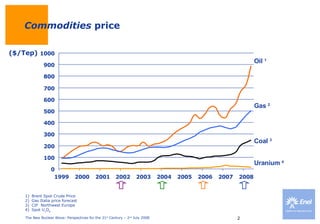
Commodities  price Oil  1 Coal  3 Brent Spot Crude Price Gas Italia price forecast CIF  Northwest Europe Spot U 3 O 8 ($/Tep) Uranium  4 Gas  2
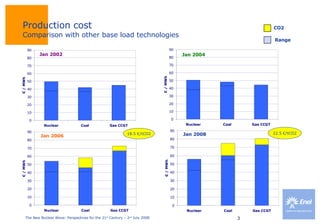
Production cost Comparison with other base load technologies Jan 2002 Jan 2004 Jan 2006 Jan 2008 18.5 €/tCO2 22.5 €/tCO2 CO2 Range
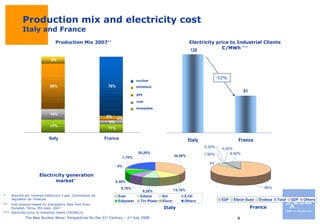
Production mix and electricity cost Italy and France Production Mix 2007 ** Electricity price to Industrial Clients €/MWh  *** *  Autorità per l’energia elettrica e il gas, Commission de régulation de l’énergie **  Enel analysis based on anticipatory data from Enel, Eurostat, Terna, IEA data. 2007 ***  Electricity price to industrial clients  (24GWh/y) Electricity generation market *   Italy France -52% 17% 11% 14% 5% 60% 9% 78% 4% 2% Italy France nuclear oil/others gas coal renewable
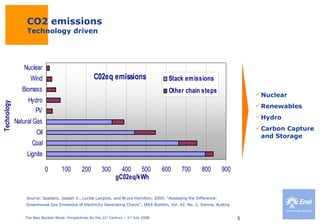
CO2 emissions Technology driven Source: Spadaro, Joseph V., Lucille Langlois, and Bruce Hamilton, 2000: “Assessing the Difference:  Greenhouse Gas Emissions of Electricity Generating Chains”, IAEA Bulletin, Vol. 42, No. 2, Vienna, Austria Nuclear Renewables Hydro Carbon Capture and Storage
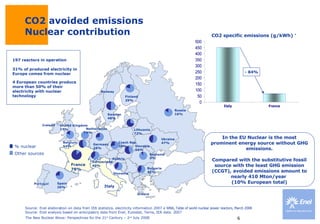
CO2 avoided emissions  Nuclear contribution Portugal Source: Enel elaboration on data from IEA statistics, electricity information 2007 e  WNA, Table of world nuclear power reactors, March 2008 Source: Enel analysis based on anticipatory data from Enel, Eurostat, Terna, IEA data. 2007 CO2 specific emissions (g/kWh)  * - 84% In the EU Nuclear is the most prominent energy source without GHG emissions. Compared with the substitutive fossil source with the least GHG emission (CCGT), avoided emissions amount to nearly 410 Mton/year  (10% European total) 197 reactors in operation 31% of produced electricity in Europe comes from nuclear  4 European countries produce more than 50% of their electricity with nuclear technology % nuclear Other sources Greece France 78% Ireland United Kingdom 19% Spain 26% Sweden 48% Finland 29% Netherlands 4% Germany 28% Russia 16% Norway Slovakia 56% Czech Rep. 30% Bulgaria 42% Romania 9% Slovenia Lithuania 72% Belgium 54% Ukraine 47% Switzerland 40% Austria Italy
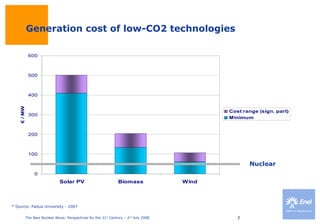
Generation cost of low-CO2 technologies Nuclear * Source: Padua University - 2007
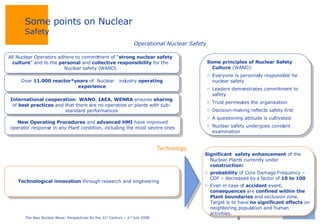
Some points on Nuclear Safety New Operating Procedures  and  advanced HMI  have improved operator response in any Plant condition, including the most severe ones International cooperation :  WANO ,  IAEA ,  WENRA  ensures  sharing  of  best practices  and that there are no operators or plants with sub-standard performances Over  11.000 reactor*years  of  Nuclear  industry  operating experience Operational Nuclear Safety Some principles of Nuclear Safety Culture  (WANO): Everyone is personally responsible for nuclear safety Leaders demonstrates commitment to safety Trust permeates the organization Decision-making reflects safety first A questioning attitude is cultivated Nuclear safety undergoes constant examination All Nuclear Operators adhere to commitment of “ strong nuclear   safety culture ” and to the  personal  and  collective   responsibility  for the Nuclear safety (WANO) Technological innovation  through research and engineering Significant  safety enhancement  of the   Nuclear Plants   currently   under  construction : probability  of Core Damage Frequency – CDF – decreased by a factor of  10 to 100 Even in case of  accident  event,  consequences  are  confined   within the Plant boundaries  and exclusion zone. Target is to have  no significant effects  on neighboring population and human activities. Technology
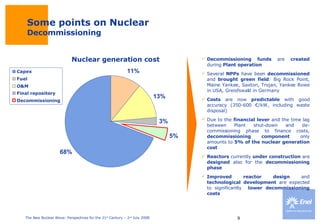
Some points on Nuclear Decommissioning Decommissioning funds  are  created  during  Plant operation   Several  NPPs  have been  decommissioned  and  brought green field : Big Rock Point, Maine Yankee, Saxton, Trojan, Yankee Rowe in USA, Greisfswald in Germany Costs  are now  predictable  with good accuracy (350-600 €/kW, including waste disposal) Due to the  financial lever  and the time lag between Plant shut-down and de-commissioning phase to finance costs,  decommissioning component  only amounts to  5% of the nuclear generation cost  Reactors  currently  under construction  are  designed  also for the  decommissioning phase Improved reactor design  and  technological development  are expected to significantly  lower decommissioning costs
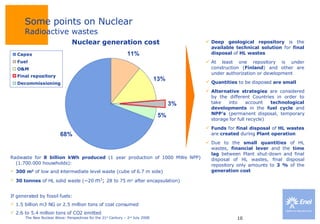
Deep geological repository  is the  available technical solution  for  final disposal  of  HL wastes At least one repository is under construction ( Finland ) and other are under authorization or development Quantities  to be disposed  are small Alternative strategies  are considered by the different Countries in order to take into account  technological developments  in the  fuel cycle  and  NPP’s  (permanent disposal, temporary storage for full recycle) Funds  for  final disposal  of  HL wastes  are  created  during  Plant operation  Due to the  small quantities  of HL wastes,  financial lever  and the  time lag  between Plant shut-down and final disposal of HL wastes, final disposal repository only amounts to  3 %  of the  generation cost Radwaste for  8 billion kWh produced  (1 year production of 1000 MWe NPP) (1.700.000 households): 300 m 3  of low and intermediate level waste (cube of 6.7 m side) 30 tonnes  of HL solid waste (~20  m 3 ;  28 to 75 m 3  after encapsulation) If generated by fossil fuels: 1.5 billion m3 NG or 2.5 million tons of coal consumed 2.6 to 5.4 million tons of CO2 emitted Some points on Nuclear Radioactive wastes
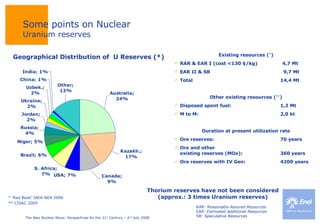
* ‘Red Book’ IAEA-NEA 2006 ** CISAC 2005 Geographical Distribution of  U Reserves (*) Existing resources ( * ) RAR & EAR I (cost <130 $/kg)  4,7 Mt EAR II & SR    9,7 Mt Total   14,4 Mt Other existing resources ( ** ) Disposed spent fuel:     1,2 Mt M to M:   2,0 kt Duration at present utilization rate Ore reserves:   70 years Ore and other  existing reserves (MOx):   360 years Ore reserves with IV Gen:    4200 years Some points on Nuclear Uranium reserves Thorium reserves have not been considered (approx.: 3 times Uranium reserves) RAR: Reasonably Assured Resources EAR: Estimated Additional Resources SR: Speculative Resources

Giancarlo Aquilanti

  • 1.
    The New NuclearWave: Perspectives for the 21 st century Brussels – 2 nd July 2008
  • 2.
    Commodities priceOil 1 Coal 3 Brent Spot Crude Price Gas Italia price forecast CIF Northwest Europe Spot U 3 O 8 ($/Tep) Uranium 4 Gas 2
  • 3.
    Production cost Comparisonwith other base load technologies Jan 2002 Jan 2004 Jan 2006 Jan 2008 18.5 €/tCO2 22.5 €/tCO2 CO2 Range
  • 4.
    Production mix andelectricity cost Italy and France Production Mix 2007 ** Electricity price to Industrial Clients €/MWh *** * Autorità per l’energia elettrica e il gas, Commission de régulation de l’énergie ** Enel analysis based on anticipatory data from Enel, Eurostat, Terna, IEA data. 2007 *** Electricity price to industrial clients (24GWh/y) Electricity generation market * Italy France -52% 17% 11% 14% 5% 60% 9% 78% 4% 2% Italy France nuclear oil/others gas coal renewable
  • 5.
    CO2 emissions Technologydriven Source: Spadaro, Joseph V., Lucille Langlois, and Bruce Hamilton, 2000: “Assessing the Difference: Greenhouse Gas Emissions of Electricity Generating Chains”, IAEA Bulletin, Vol. 42, No. 2, Vienna, Austria Nuclear Renewables Hydro Carbon Capture and Storage
  • 6.
    CO2 avoided emissions Nuclear contribution Portugal Source: Enel elaboration on data from IEA statistics, electricity information 2007 e WNA, Table of world nuclear power reactors, March 2008 Source: Enel analysis based on anticipatory data from Enel, Eurostat, Terna, IEA data. 2007 CO2 specific emissions (g/kWh) * - 84% In the EU Nuclear is the most prominent energy source without GHG emissions. Compared with the substitutive fossil source with the least GHG emission (CCGT), avoided emissions amount to nearly 410 Mton/year (10% European total) 197 reactors in operation 31% of produced electricity in Europe comes from nuclear 4 European countries produce more than 50% of their electricity with nuclear technology % nuclear Other sources Greece France 78% Ireland United Kingdom 19% Spain 26% Sweden 48% Finland 29% Netherlands 4% Germany 28% Russia 16% Norway Slovakia 56% Czech Rep. 30% Bulgaria 42% Romania 9% Slovenia Lithuania 72% Belgium 54% Ukraine 47% Switzerland 40% Austria Italy
  • 7.
    Generation cost oflow-CO2 technologies Nuclear * Source: Padua University - 2007
  • 8.
    Some points onNuclear Safety New Operating Procedures and advanced HMI have improved operator response in any Plant condition, including the most severe ones International cooperation : WANO , IAEA , WENRA ensures sharing of best practices and that there are no operators or plants with sub-standard performances Over 11.000 reactor*years of Nuclear industry operating experience Operational Nuclear Safety Some principles of Nuclear Safety Culture (WANO): Everyone is personally responsible for nuclear safety Leaders demonstrates commitment to safety Trust permeates the organization Decision-making reflects safety first A questioning attitude is cultivated Nuclear safety undergoes constant examination All Nuclear Operators adhere to commitment of “ strong nuclear safety culture ” and to the personal and collective responsibility for the Nuclear safety (WANO) Technological innovation through research and engineering Significant safety enhancement of the Nuclear Plants currently under construction : probability of Core Damage Frequency – CDF – decreased by a factor of 10 to 100 Even in case of accident event, consequences are confined within the Plant boundaries and exclusion zone. Target is to have no significant effects on neighboring population and human activities. Technology
  • 9.
    Some points onNuclear Decommissioning Decommissioning funds are created during Plant operation Several NPPs have been decommissioned and brought green field : Big Rock Point, Maine Yankee, Saxton, Trojan, Yankee Rowe in USA, Greisfswald in Germany Costs are now predictable with good accuracy (350-600 €/kW, including waste disposal) Due to the financial lever and the time lag between Plant shut-down and de-commissioning phase to finance costs, decommissioning component only amounts to 5% of the nuclear generation cost Reactors currently under construction are designed also for the decommissioning phase Improved reactor design and technological development are expected to significantly lower decommissioning costs
  • 10.
    Deep geological repository is the available technical solution for final disposal of HL wastes At least one repository is under construction ( Finland ) and other are under authorization or development Quantities to be disposed are small Alternative strategies are considered by the different Countries in order to take into account technological developments in the fuel cycle and NPP’s (permanent disposal, temporary storage for full recycle) Funds for final disposal of HL wastes are created during Plant operation Due to the small quantities of HL wastes, financial lever and the time lag between Plant shut-down and final disposal of HL wastes, final disposal repository only amounts to 3 % of the generation cost Radwaste for 8 billion kWh produced (1 year production of 1000 MWe NPP) (1.700.000 households): 300 m 3 of low and intermediate level waste (cube of 6.7 m side) 30 tonnes of HL solid waste (~20 m 3 ; 28 to 75 m 3 after encapsulation) If generated by fossil fuels: 1.5 billion m3 NG or 2.5 million tons of coal consumed 2.6 to 5.4 million tons of CO2 emitted Some points on Nuclear Radioactive wastes
  • 11.
    * ‘Red Book’IAEA-NEA 2006 ** CISAC 2005 Geographical Distribution of U Reserves (*) Existing resources ( * ) RAR & EAR I (cost <130 $/kg) 4,7 Mt EAR II & SR 9,7 Mt Total 14,4 Mt Other existing resources ( ** ) Disposed spent fuel: 1,2 Mt M to M: 2,0 kt Duration at present utilization rate Ore reserves: 70 years Ore and other existing reserves (MOx): 360 years Ore reserves with IV Gen: 4200 years Some points on Nuclear Uranium reserves Thorium reserves have not been considered (approx.: 3 times Uranium reserves) RAR: Reasonably Assured Resources EAR: Estimated Additional Resources SR: Speculative Resources