OSHA Recordkeeping
and Reporting Requirements
Johnanewquist@gmail.com
815-354-6853
Draft 1 2 2019
1
2
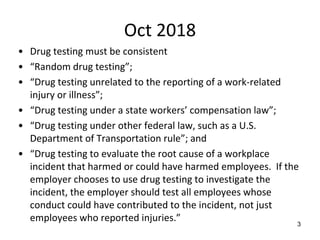
Oct 2018
• Drug testing must be consistent
• “Random drug testing”;
• “Drug testing unrelated to the reporting of a work-related
injury or illness”;
• “Drug testing under a state workers’ compensation law”;
• “Drug testing under other federal law, such as a U.S.
Department of Transportation rule”; and
• “Drug testing to evaluate the root cause of a workplace
incident that harmed or could have harmed employees. If the
employer chooses to use drug testing to investigate the
incident, the employer should test all employees whose
conduct could have contributed to the incident, not just
employees who reported injuries.” 3
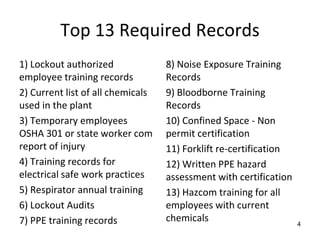
Top 13 Required Records
1) Lockout authorized
employee training records
2) Current list of all chemicals
used in the plant
3) Temporary employees
OSHA 301 or state worker com
report of injury
4) Training records for
electrical safe work practices
5) Respirator annual training
6) Lockout Audits
7) PPE training records
8) Noise Exposure Training
Records
9) Bloodborne Training
Records
10) Confined Space - Non
permit certification
11) Forklift re-certification
12) Written PPE hazard
assessment with certification
13) Hazcom training for all
employees with current
chemicals 4
January 2018
• The date by
which certain
employers are
required to submit to
OSHA the information
from their completed
2017 Form 300A is July
1, 2018.
January 2018
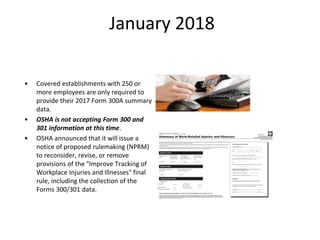
• Covered establishments with 250 or
more employees are only required to
provide their 2017 Form 300A summary
data.
• OSHA is not accepting Form 300 and
301 information at this time.
• OSHA announced that it will issue a
notice of proposed rulemaking (NPRM)
to reconsider, revise, or remove
provisions of the "Improve Tracking of
Workplace Injuries and Illnesses" final
rule, including the collection of the
Forms 300/301 data.
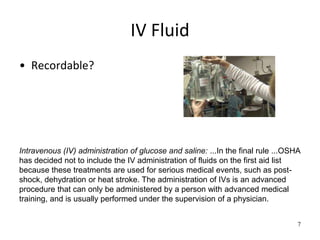
IV Fluid
• Recordable?
7
Intravenous (IV) administration of glucose and saline: ...In the final rule ...OSHA
has decided not to include the IV administration of fluids on the first aid list
because these treatments are used for serious medical events, such as post-
shock, dehydration or heat stroke. The administration of IVs is an advanced
procedure that can only be administered by a person with advanced medical
training, and is usually performed under the supervision of a physician.
Fatality/Catastrophe Reporting
• Report orally within 8
hours any work-related
fatality or incident
involving 3 or more in-
patient hospitalizations
• Do not need to report
highway or public street
motor vehicle accidents
(outside of a construction
work zone)
• Do not need to report
commercial airplane,
train, subway or bus
accidents
• Must report fatal heart
attacks
•1-800-321-OSHA
Reporting Rule
• As of January 1, 2015, all
employers must report:
• You can report to OSHA by:
• Calling OSHA’s free and
confidential number at 1-800-
321-OSHA (6742)
“Jordan Barab We will not
be inspecting all reports,
but we will have some
contact with them.”
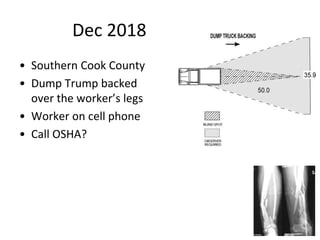
Dec 2018
• Southern Cook County
• Dump Trump backed
over the worker’s legs
• Worker on cell phone
• Call OSHA?
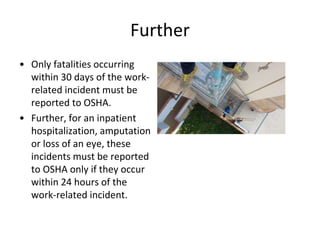
Further
• Only fatalities occurring
within 30 days of the work-
related incident must be
reported to OSHA.
• Further, for an inpatient
hospitalization, amputation
or loss of an eye, these
incidents must be reported
to OSHA only if they occur
within 24 hours of the
work-related incident.
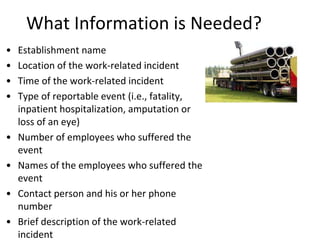
What Information is Needed?
• Establishment name
• Location of the work-related incident
• Time of the work-related incident
• Type of reportable event (i.e., fatality,
inpatient hospitalization, amputation or
loss of an eye)
• Number of employees who suffered the
event
• Names of the employees who suffered the
event
• Contact person and his or her phone
number
• Brief description of the work-related
incident
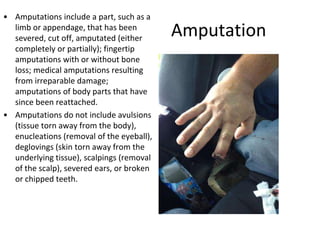
Amputation
• Amputations include a part, such as a
limb or appendage, that has been
severed, cut off, amputated (either
completely or partially); fingertip
amputations with or without bone
loss; medical amputations resulting
from irreparable damage;
amputations of body parts that have
since been reattached.
• Amputations do not include avulsions
(tissue torn away from the body),
enucleations (removal of the eyeball),
deglovings (skin torn away from the
underlying tissue), scalpings (removal
of the scalp), severed ears, or broken
or chipped teeth.
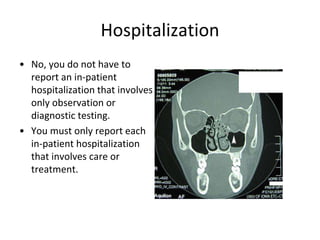
Hospitalization
• No, you do not have to
report an in-patient
hospitalization that involves
only observation or
diagnostic testing.
• You must only report each
in-patient hospitalization
that involves care or
treatment.
Access to Medical Records
• 1910.1020: right to examine & copy medical and exposure
records
• Examples of toxic substances and harmful physical agents are:
– Metals and dusts, such as, lead, cadmium, and silica.
– Biological agents, such as bacteria, viruses, and fungi.
– Physical stress, such as noise, heat, cold, vibration,
repetitive motion, and ionizing and non-ionizing radiation.
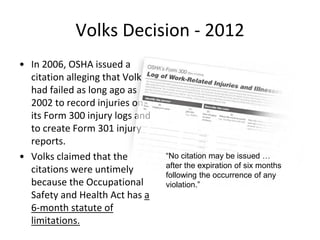
Volks Decision - 2012
• In 2006, OSHA issued a
citation alleging that Volks
had failed as long ago as
2002 to record injuries on
its Form 300 injury logs and
to create Form 301 injury
reports.
• Volks claimed that the
citations were untimely
because the Occupational
Safety and Health Act has a
6-month statute of
limitations.
“No citation may be issued …
after the expiration of six months
following the occurrence of any
violation.”
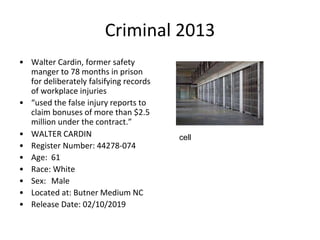
Criminal 2013
• Walter Cardin, former safety
manger to 78 months in prison
for deliberately falsifying records
of workplace injuries
• “used the false injury reports to
claim bonuses of more than $2.5
million under the contract.”
• WALTER CARDIN
• Register Number: 44278-074
• Age: 61
• Race: White
• Sex: Male
• Located at: Butner Medium NC
• Release Date: 02/10/2019
cell
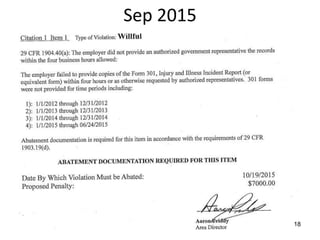
Sep 2015
18
19
Forms
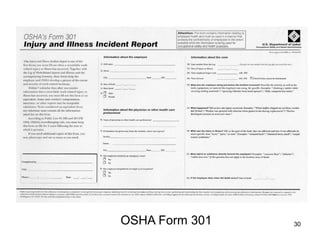
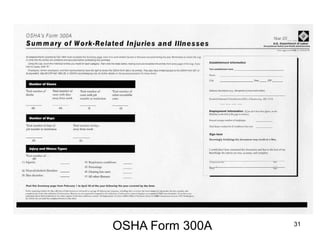
• Three recordkeeping forms
– OSHA Form 300 – Log of
Work-Related Injuries and
Illnesses
– OSHA Form 301 – Injury and
Illness Incident Report
– OSHA Form 300A –
Summary of Work-Related
Injuries and Illnesses
1904.29
Who Keeps Records?
• Employers with only 10
or less employees.
• Low hazard industries.
(See end slides)
20
21
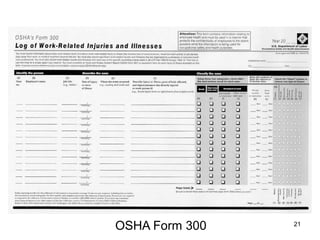
OSHA Form 300
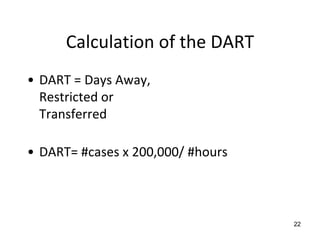
Calculation of the DART
• DART = Days Away,
Restricted or
Transferred
• DART= #cases x 200,000/ #hours
22
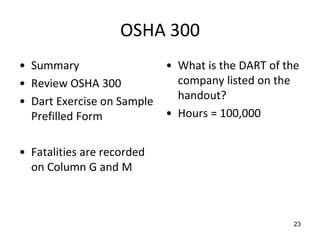
OSHA 300
• Summary
• Review OSHA 300
• Dart Exercise on Sample
Prefilled Form
• Fatalities are recorded
on Column G and M
• What is the DART of the
company listed on the
handout?
• Hours = 100,000
23
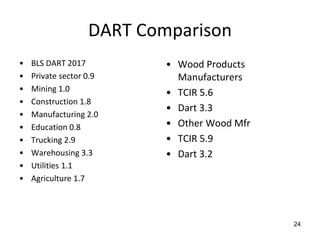
DART Comparison
• BLS DART 2017
• Private sector 0.9
• Mining 1.0
• Construction 1.8
• Manufacturing 2.0
• Education 0.8
• Trucking 2.9
• Warehousing 3.3
• Utilities 1.1
• Agriculture 1.7
24
• Wood Products
Manufacturers
• TCIR 5.6
• Dart 3.3
• Other Wood Mfr
• TCIR 5.9
• Dart 3.2
25
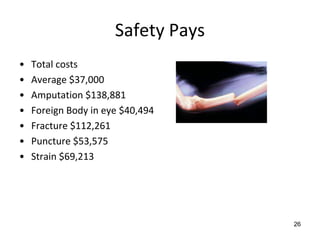
Safety Pays
• Total costs
• Average $37,000
• Amputation $138,881
• Foreign Body in eye $40,494
• Fracture $112,261
• Puncture $53,575
• Strain $69,213
26
Insurance Work Comp
• SIC Code
• 3632 --------------- Machine Shop -------------- $6.00 per $100 of payroll
• 3400 --------------- Metal Stamping ------------ $6.98 per $100 of payroll
• 2881 --------------- Furniture/Cabinet Mfg. --- $4.35 per $100 of payroll
• 3372 --------------- Electro Plating -------------- $5.85 per $100 of payroll
• Price optimization software
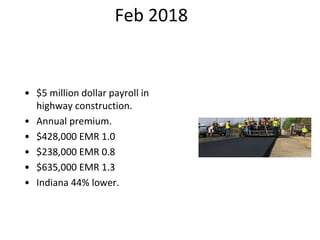
Feb 2018
• $5 million dollar payroll in
highway construction.
• Annual premium.
• $428,000 EMR 1.0
• $238,000 EMR 0.8
• $635,000 EMR 1.3
• Indiana 44% lower.
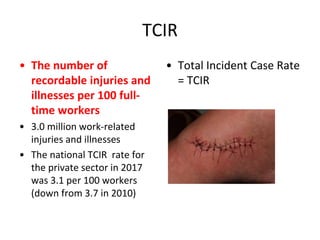
TCIR
• The number of
recordable injuries and
illnesses per 100 full-
time workers
• 3.0 million work-related
injuries and illnesses
• The national TCIR rate for
the private sector in 2017
was 3.1 per 100 workers
(down from 3.7 in 2010)
• Total Incident Case Rate
= TCIR
30OSHA Form 301
31
OSHA Form 300A
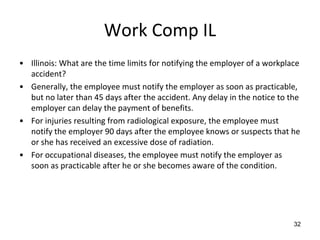
Work Comp IL
• Illinois: What are the time limits for notifying the employer of a workplace
accident?
• Generally, the employee must notify the employer as soon as practicable,
but no later than 45 days after the accident. Any delay in the notice to the
employer can delay the payment of benefits.
• For injuries resulting from radiological exposure, the employee must
notify the employer 90 days after the employee knows or suspects that he
or she has received an excessive dose of radiation.
• For occupational diseases, the employee must notify the employer as
soon as practicable after he or she becomes aware of the condition.
32
33
Recording and Reporting Occupational
Injuries and Illnesses
Overview of the Rule
Employee Definition
• Covered Employees
- Employees on payroll
- Employees not on payroll
who are supervised on
day-to-day basis
- Temporary help agencies
should not record temp
workers when supervised
by the using firm.
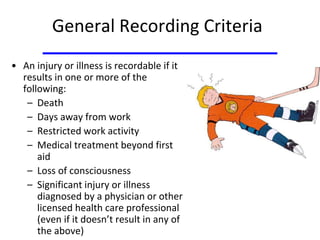
General Recording Criteria
• An injury or illness is recordable if it
results in one or more of the
following:
– Death
– Days away from work
– Restricted work activity
– Medical treatment beyond first
aid
– Loss of consciousness
– Significant injury or illness
diagnosed by a physician or other
licensed health care professional
(even if it doesn’t result in any of
the above)
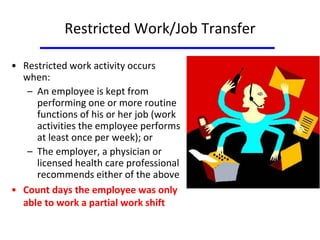
Restricted Work/Job Transfer
• Restricted work activity occurs
when:
– An employee is kept from
performing one or more routine
functions of his or her job (work
activities the employee performs
at least once per week); or
– The employer, a physician or
licensed health care professional
recommends either of the above
• Count days the employee was only
able to work a partial work shift
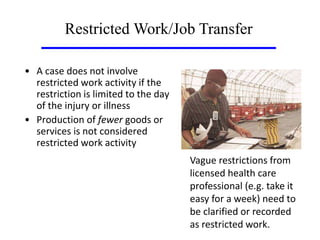
• A case does not involve
restricted work activity if the
restriction is limited to the day
of the injury or illness
• Production of fewer goods or
services is not considered
restricted work activity
Restricted Work/Job Transfer
Vague restrictions from
licensed health care
professional (e.g. take it
easy for a week) need to
be clarified or recorded
as restricted work.
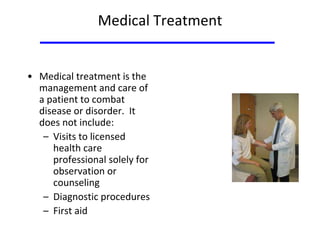
Medical Treatment
• Medical treatment is the
management and care of
a patient to combat
disease or disorder. It
does not include:
– Visits to licensed
health care
professional solely for
observation or
counseling
– Diagnostic procedures
– First aid
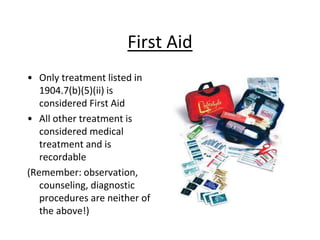
First Aid
• Only treatment listed in
1904.7(b)(5)(ii) is
considered First Aid
• All other treatment is
considered medical
treatment and is
recordable
(Remember: observation,
counseling, diagnostic
procedures are neither of
the above!)
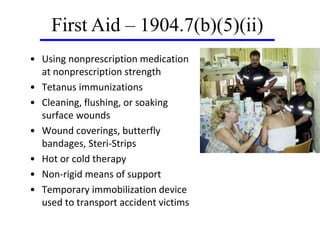
• Using nonprescription medication
at nonprescription strength
• Tetanus immunizations
• Cleaning, flushing, or soaking
surface wounds
• Wound coverings, butterfly
bandages, Steri-Strips
• Hot or cold therapy
• Non-rigid means of support
• Temporary immobilization device
used to transport accident victims
First Aid – 1904.7(b)(5)(ii)
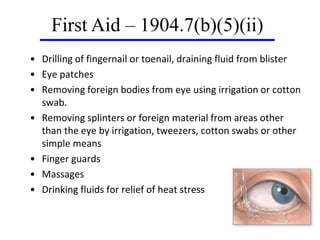
• Drilling of fingernail or toenail, draining fluid from blister
• Eye patches
• Removing foreign bodies from eye using irrigation or cotton
swab.
• Removing splinters or foreign material from areas other
than the eye by irrigation, tweezers, cotton swabs or other
simple means
• Finger guards
• Massages
• Drinking fluids for relief of heat stress
First Aid – 1904.7(b)(5)(ii)
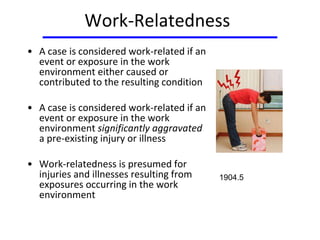
Work-Relatedness
• A case is considered work-related if an
event or exposure in the work
environment either caused or
contributed to the resulting condition
• A case is considered work-related if an
event or exposure in the work
environment significantly aggravated
a pre-existing injury or illness
• Work-relatedness is presumed for
injuries and illnesses resulting from
exposures occurring in the work
environment
1904.5
43
1904.5 – Exceptions
• Present as a member of the general public
• Symptoms arising in work environment that are
solely due to non-work-related event or exposure
(Regardless of where signs or symptoms surface, a
case is work-related only if a work event or
exposure is a discernable cause of the injury or
illness or of a significant aggravation to a pre-
existing condition.)
• Voluntary participation in wellness program,
medical, fitness or recreational activity
• Eating, drinking or preparing food or drink for
personal consumption
44
1904.5 – Exceptions
 Personal tasks outside assigned working hours
 Personal grooming, self medication for non-work-related
condition, or intentionally self-inflicted
 Motor vehicle accident in parking lot/access road during
commute
 Common cold or flu
 Mental illness, unless employee voluntarily provides a
medical opinion from a physician or licensed health care
professional (PLHCP) having appropriate qualifications
and experience that affirms work-relatedness
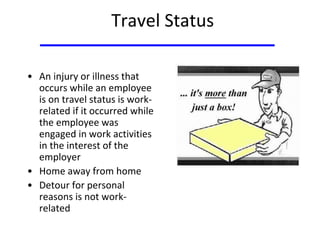
Travel Status
• An injury or illness that
occurs while an employee
is on travel status is work-
related if it occurred while
the employee was
engaged in work activities
in the interest of the
employer
• Home away from home
• Detour for personal
reasons is not work-
related
Jan 2018
• HR stated the employee reported the alleged accident three days after
the event on February 9, 2017.
• Employee reported he was leaving work for the day around 3:30 when he
felt a pull in his upper left arm while putting on his coat.
• He reported bruising on February 7, 2017.
• HR instructed the employee to see his own doctor, as it was not "an actual
injury."
• The employee thereafter presented to Physicians Immediate Care.
• He was returned to work with right-handed duty only restrictions, which
were accommodated.
• According to HR, the employee continued to work, but would leave early
on occasion or call in reporting he was sick
46
Depends
• It depends if it was outside the hours. Otherwise it would be work related.
• "Section 1904.5(b)(2)(v) provides that an injury or illness is not work-
related if it is (1) solely the result of an employee doing personal tasks
(unrelated to their employment) at the establishment, AND (2) outside of
the employee's assigned working hours"
• https://www.osha.gov/pls/oshaweb/owadisp.show_document?p_table=I
NTERPRETATIONS&p_id=30008
• "Rather, the statute shows that Congress knew that employees were
being injured and made ill in a variety of ways and under a variety of
circumstances, and wanted employers to record all cases causally related
to the work environment."
• https://www.osha.gov/pls/oshaweb/owadisp.show_document?p_id=163
12&p_table=FEDERAL_REGISTER
47
48
Questions?

Gi 2019 recordkeeping one hour sl

  • 1.
    OSHA Recordkeeping and ReportingRequirements Johnanewquist@gmail.com 815-354-6853 Draft 1 2 2019 1
  • 2.
  • 3.
    Oct 2018 • Drugtesting must be consistent • “Random drug testing”; • “Drug testing unrelated to the reporting of a work-related injury or illness”; • “Drug testing under a state workers’ compensation law”; • “Drug testing under other federal law, such as a U.S. Department of Transportation rule”; and • “Drug testing to evaluate the root cause of a workplace incident that harmed or could have harmed employees. If the employer chooses to use drug testing to investigate the incident, the employer should test all employees whose conduct could have contributed to the incident, not just employees who reported injuries.” 3
  • 4.
    Top 13 RequiredRecords 1) Lockout authorized employee training records 2) Current list of all chemicals used in the plant 3) Temporary employees OSHA 301 or state worker com report of injury 4) Training records for electrical safe work practices 5) Respirator annual training 6) Lockout Audits 7) PPE training records 8) Noise Exposure Training Records 9) Bloodborne Training Records 10) Confined Space - Non permit certification 11) Forklift re-certification 12) Written PPE hazard assessment with certification 13) Hazcom training for all employees with current chemicals 4
  • 5.
    January 2018 • Thedate by which certain employers are required to submit to OSHA the information from their completed 2017 Form 300A is July 1, 2018.
  • 6.
    January 2018 • Coveredestablishments with 250 or more employees are only required to provide their 2017 Form 300A summary data. • OSHA is not accepting Form 300 and 301 information at this time. • OSHA announced that it will issue a notice of proposed rulemaking (NPRM) to reconsider, revise, or remove provisions of the "Improve Tracking of Workplace Injuries and Illnesses" final rule, including the collection of the Forms 300/301 data.
  • 7.
    IV Fluid • Recordable? 7 Intravenous(IV) administration of glucose and saline: ...In the final rule ...OSHA has decided not to include the IV administration of fluids on the first aid list because these treatments are used for serious medical events, such as post- shock, dehydration or heat stroke. The administration of IVs is an advanced procedure that can only be administered by a person with advanced medical training, and is usually performed under the supervision of a physician.
  • 8.
    Fatality/Catastrophe Reporting • Reportorally within 8 hours any work-related fatality or incident involving 3 or more in- patient hospitalizations • Do not need to report highway or public street motor vehicle accidents (outside of a construction work zone) • Do not need to report commercial airplane, train, subway or bus accidents • Must report fatal heart attacks •1-800-321-OSHA
  • 9.
    Reporting Rule • Asof January 1, 2015, all employers must report: • You can report to OSHA by: • Calling OSHA’s free and confidential number at 1-800- 321-OSHA (6742) “Jordan Barab We will not be inspecting all reports, but we will have some contact with them.”
  • 10.
    Dec 2018 • SouthernCook County • Dump Trump backed over the worker’s legs • Worker on cell phone • Call OSHA?
  • 11.
    Further • Only fatalitiesoccurring within 30 days of the work- related incident must be reported to OSHA. • Further, for an inpatient hospitalization, amputation or loss of an eye, these incidents must be reported to OSHA only if they occur within 24 hours of the work-related incident.
  • 12.
    What Information isNeeded? • Establishment name • Location of the work-related incident • Time of the work-related incident • Type of reportable event (i.e., fatality, inpatient hospitalization, amputation or loss of an eye) • Number of employees who suffered the event • Names of the employees who suffered the event • Contact person and his or her phone number • Brief description of the work-related incident
  • 13.
    Amputation • Amputations includea part, such as a limb or appendage, that has been severed, cut off, amputated (either completely or partially); fingertip amputations with or without bone loss; medical amputations resulting from irreparable damage; amputations of body parts that have since been reattached. • Amputations do not include avulsions (tissue torn away from the body), enucleations (removal of the eyeball), deglovings (skin torn away from the underlying tissue), scalpings (removal of the scalp), severed ears, or broken or chipped teeth.
  • 14.
    Hospitalization • No, youdo not have to report an in-patient hospitalization that involves only observation or diagnostic testing. • You must only report each in-patient hospitalization that involves care or treatment.
  • 15.
    Access to MedicalRecords • 1910.1020: right to examine & copy medical and exposure records • Examples of toxic substances and harmful physical agents are: – Metals and dusts, such as, lead, cadmium, and silica. – Biological agents, such as bacteria, viruses, and fungi. – Physical stress, such as noise, heat, cold, vibration, repetitive motion, and ionizing and non-ionizing radiation.
  • 16.
    Volks Decision -2012 • In 2006, OSHA issued a citation alleging that Volks had failed as long ago as 2002 to record injuries on its Form 300 injury logs and to create Form 301 injury reports. • Volks claimed that the citations were untimely because the Occupational Safety and Health Act has a 6-month statute of limitations. “No citation may be issued … after the expiration of six months following the occurrence of any violation.”
  • 17.
    Criminal 2013 • WalterCardin, former safety manger to 78 months in prison for deliberately falsifying records of workplace injuries • “used the false injury reports to claim bonuses of more than $2.5 million under the contract.” • WALTER CARDIN • Register Number: 44278-074 • Age: 61 • Race: White • Sex: Male • Located at: Butner Medium NC • Release Date: 02/10/2019 cell
  • 18.
  • 19.
    19 Forms • Three recordkeepingforms – OSHA Form 300 – Log of Work-Related Injuries and Illnesses – OSHA Form 301 – Injury and Illness Incident Report – OSHA Form 300A – Summary of Work-Related Injuries and Illnesses 1904.29
  • 20.
    Who Keeps Records? •Employers with only 10 or less employees. • Low hazard industries. (See end slides) 20
  • 21.
  • 22.
    Calculation of theDART • DART = Days Away, Restricted or Transferred • DART= #cases x 200,000/ #hours 22
  • 23.
    OSHA 300 • Summary •Review OSHA 300 • Dart Exercise on Sample Prefilled Form • Fatalities are recorded on Column G and M • What is the DART of the company listed on the handout? • Hours = 100,000 23
  • 24.
    DART Comparison • BLSDART 2017 • Private sector 0.9 • Mining 1.0 • Construction 1.8 • Manufacturing 2.0 • Education 0.8 • Trucking 2.9 • Warehousing 3.3 • Utilities 1.1 • Agriculture 1.7 24 • Wood Products Manufacturers • TCIR 5.6 • Dart 3.3 • Other Wood Mfr • TCIR 5.9 • Dart 3.2
  • 25.
  • 26.
    Safety Pays • Totalcosts • Average $37,000 • Amputation $138,881 • Foreign Body in eye $40,494 • Fracture $112,261 • Puncture $53,575 • Strain $69,213 26
  • 27.
    Insurance Work Comp •SIC Code • 3632 --------------- Machine Shop -------------- $6.00 per $100 of payroll • 3400 --------------- Metal Stamping ------------ $6.98 per $100 of payroll • 2881 --------------- Furniture/Cabinet Mfg. --- $4.35 per $100 of payroll • 3372 --------------- Electro Plating -------------- $5.85 per $100 of payroll • Price optimization software
  • 28.
    Feb 2018 • $5million dollar payroll in highway construction. • Annual premium. • $428,000 EMR 1.0 • $238,000 EMR 0.8 • $635,000 EMR 1.3 • Indiana 44% lower.
  • 29.
    TCIR • The numberof recordable injuries and illnesses per 100 full- time workers • 3.0 million work-related injuries and illnesses • The national TCIR rate for the private sector in 2017 was 3.1 per 100 workers (down from 3.7 in 2010) • Total Incident Case Rate = TCIR
  • 30.
  • 31.
  • 32.
    Work Comp IL •Illinois: What are the time limits for notifying the employer of a workplace accident? • Generally, the employee must notify the employer as soon as practicable, but no later than 45 days after the accident. Any delay in the notice to the employer can delay the payment of benefits. • For injuries resulting from radiological exposure, the employee must notify the employer 90 days after the employee knows or suspects that he or she has received an excessive dose of radiation. • For occupational diseases, the employee must notify the employer as soon as practicable after he or she becomes aware of the condition. 32
  • 33.
    33 Recording and ReportingOccupational Injuries and Illnesses Overview of the Rule
  • 34.
    Employee Definition • CoveredEmployees - Employees on payroll - Employees not on payroll who are supervised on day-to-day basis - Temporary help agencies should not record temp workers when supervised by the using firm.
  • 35.
    General Recording Criteria •An injury or illness is recordable if it results in one or more of the following: – Death – Days away from work – Restricted work activity – Medical treatment beyond first aid – Loss of consciousness – Significant injury or illness diagnosed by a physician or other licensed health care professional (even if it doesn’t result in any of the above)
  • 36.
    Restricted Work/Job Transfer •Restricted work activity occurs when: – An employee is kept from performing one or more routine functions of his or her job (work activities the employee performs at least once per week); or – The employer, a physician or licensed health care professional recommends either of the above • Count days the employee was only able to work a partial work shift
  • 37.
    • A casedoes not involve restricted work activity if the restriction is limited to the day of the injury or illness • Production of fewer goods or services is not considered restricted work activity Restricted Work/Job Transfer Vague restrictions from licensed health care professional (e.g. take it easy for a week) need to be clarified or recorded as restricted work.
  • 38.
    Medical Treatment • Medicaltreatment is the management and care of a patient to combat disease or disorder. It does not include: – Visits to licensed health care professional solely for observation or counseling – Diagnostic procedures – First aid
  • 39.
    First Aid • Onlytreatment listed in 1904.7(b)(5)(ii) is considered First Aid • All other treatment is considered medical treatment and is recordable (Remember: observation, counseling, diagnostic procedures are neither of the above!)
  • 40.
    • Using nonprescriptionmedication at nonprescription strength • Tetanus immunizations • Cleaning, flushing, or soaking surface wounds • Wound coverings, butterfly bandages, Steri-Strips • Hot or cold therapy • Non-rigid means of support • Temporary immobilization device used to transport accident victims First Aid – 1904.7(b)(5)(ii)
  • 41.
    • Drilling offingernail or toenail, draining fluid from blister • Eye patches • Removing foreign bodies from eye using irrigation or cotton swab. • Removing splinters or foreign material from areas other than the eye by irrigation, tweezers, cotton swabs or other simple means • Finger guards • Massages • Drinking fluids for relief of heat stress First Aid – 1904.7(b)(5)(ii)
  • 42.
    Work-Relatedness • A caseis considered work-related if an event or exposure in the work environment either caused or contributed to the resulting condition • A case is considered work-related if an event or exposure in the work environment significantly aggravated a pre-existing injury or illness • Work-relatedness is presumed for injuries and illnesses resulting from exposures occurring in the work environment 1904.5
  • 43.
    43 1904.5 – Exceptions •Present as a member of the general public • Symptoms arising in work environment that are solely due to non-work-related event or exposure (Regardless of where signs or symptoms surface, a case is work-related only if a work event or exposure is a discernable cause of the injury or illness or of a significant aggravation to a pre- existing condition.) • Voluntary participation in wellness program, medical, fitness or recreational activity • Eating, drinking or preparing food or drink for personal consumption
  • 44.
    44 1904.5 – Exceptions Personal tasks outside assigned working hours  Personal grooming, self medication for non-work-related condition, or intentionally self-inflicted  Motor vehicle accident in parking lot/access road during commute  Common cold or flu  Mental illness, unless employee voluntarily provides a medical opinion from a physician or licensed health care professional (PLHCP) having appropriate qualifications and experience that affirms work-relatedness
  • 45.
    Travel Status • Aninjury or illness that occurs while an employee is on travel status is work- related if it occurred while the employee was engaged in work activities in the interest of the employer • Home away from home • Detour for personal reasons is not work- related
  • 46.
    Jan 2018 • HRstated the employee reported the alleged accident three days after the event on February 9, 2017. • Employee reported he was leaving work for the day around 3:30 when he felt a pull in his upper left arm while putting on his coat. • He reported bruising on February 7, 2017. • HR instructed the employee to see his own doctor, as it was not "an actual injury." • The employee thereafter presented to Physicians Immediate Care. • He was returned to work with right-handed duty only restrictions, which were accommodated. • According to HR, the employee continued to work, but would leave early on occasion or call in reporting he was sick 46
  • 47.
    Depends • It dependsif it was outside the hours. Otherwise it would be work related. • "Section 1904.5(b)(2)(v) provides that an injury or illness is not work- related if it is (1) solely the result of an employee doing personal tasks (unrelated to their employment) at the establishment, AND (2) outside of the employee's assigned working hours" • https://www.osha.gov/pls/oshaweb/owadisp.show_document?p_table=I NTERPRETATIONS&p_id=30008 • "Rather, the statute shows that Congress knew that employees were being injured and made ill in a variety of ways and under a variety of circumstances, and wanted employers to record all cases causally related to the work environment." • https://www.osha.gov/pls/oshaweb/owadisp.show_document?p_id=163 12&p_table=FEDERAL_REGISTER 47
  • 48.