Ghana By Sharhukh Jaffer Bashar Al-Ali Dani Aridi
Geography Lies in the center of the western coast of Africa. Boarders with Burkina Faso,  Côte d'Ivoire, and Togo. Area of 238,533 square Kilometers. Warm, humid climate with an average of  6 and 29 °C. Northern area is where most of the cocoa, minerals, and timber are produced.
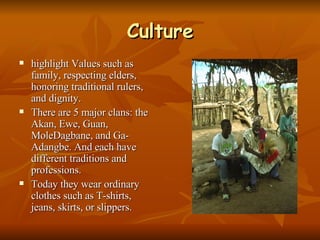
Culture highlight Values such as family, respecting elders, honoring traditional rulers, and dignity. There are 5 major clans: the Akan, Ewe, Guan, MoleDagbane, and Ga-Adangbe. And each have different traditions and professions. Today they wear ordinary clothes such as T-shirts, jeans, skirts, or slippers.
Religion Muslim 16% Christian 63% Traditional African religion: 21% Ghana has the highest percentage of Christians in West Africa.
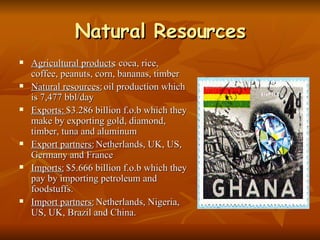
Natural Resources Agricultural products : coca, rice, coffee, peanuts, corn, bananas, timber Natural resources:  oil production which is 7,477 bbl/day Exports:  $3.286 billion f.o.b which they make by exporting gold, diamond, timber, tuna and aluminum Export partners:  Netherlands, UK, US, Germany and France Imports:  $5.666 billion f.o.b which they pay by importing petroleum and foodstuffs. Import partners:  Netherlands, Nigeria, US, UK, Brazil and China.
Rulers The Dinga Cisse was the first King and leader of Ghana. His clan became rulers later on. Queen Amina of Hausaland- ancient Ghana- A fierce and strong leader in Ghana, and one of the 2 conquering leaders in Hausaland, which was made up of Ghana, Mali, Songhay, Kanem Bornu, and Sokoto. Dr. Kwame Nkrumah – The first president of Ghana. He came back from Lincoln University to make Ghana gain independence. On July 1st 1960, Ghana became a Rebulic.
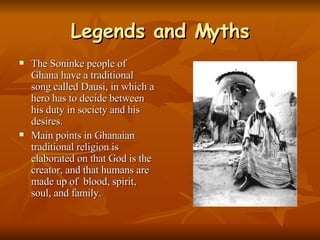
Legends and Myths The Soninke people of Ghana have a traditional song called Dausi, in which a hero has to decide between his duty in society and his desires. Main points in Ghanaian traditional religion is elaborated on that God is the creator, and that humans are made up of  blood, spirit, soul, and family.
Uniqueness It maintains peace and stays away from conflict with other countries. Is one of the highest countries with minerals and food. Is a symbol for freedom and justice in Africa.
Ghana Today People have a good access to education. Akan clan has the highest population (65%).  Tourists are welcome. The people of Ghana are satisfied with their government.

Ghana

  • 1.
    Ghana By SharhukhJaffer Bashar Al-Ali Dani Aridi
  • 2.
    Geography Lies inthe center of the western coast of Africa. Boarders with Burkina Faso, Côte d'Ivoire, and Togo. Area of 238,533 square Kilometers. Warm, humid climate with an average of 6 and 29 °C. Northern area is where most of the cocoa, minerals, and timber are produced.
  • 3.
    Culture highlight Valuessuch as family, respecting elders, honoring traditional rulers, and dignity. There are 5 major clans: the Akan, Ewe, Guan, MoleDagbane, and Ga-Adangbe. And each have different traditions and professions. Today they wear ordinary clothes such as T-shirts, jeans, skirts, or slippers.
  • 4.
    Religion Muslim 16%Christian 63% Traditional African religion: 21% Ghana has the highest percentage of Christians in West Africa.
  • 5.
    Natural Resources Agriculturalproducts : coca, rice, coffee, peanuts, corn, bananas, timber Natural resources: oil production which is 7,477 bbl/day Exports: $3.286 billion f.o.b which they make by exporting gold, diamond, timber, tuna and aluminum Export partners: Netherlands, UK, US, Germany and France Imports: $5.666 billion f.o.b which they pay by importing petroleum and foodstuffs. Import partners: Netherlands, Nigeria, US, UK, Brazil and China.
  • 6.
    Rulers The DingaCisse was the first King and leader of Ghana. His clan became rulers later on. Queen Amina of Hausaland- ancient Ghana- A fierce and strong leader in Ghana, and one of the 2 conquering leaders in Hausaland, which was made up of Ghana, Mali, Songhay, Kanem Bornu, and Sokoto. Dr. Kwame Nkrumah – The first president of Ghana. He came back from Lincoln University to make Ghana gain independence. On July 1st 1960, Ghana became a Rebulic.
  • 7.
    Legends and MythsThe Soninke people of Ghana have a traditional song called Dausi, in which a hero has to decide between his duty in society and his desires. Main points in Ghanaian traditional religion is elaborated on that God is the creator, and that humans are made up of blood, spirit, soul, and family.
  • 8.
    Uniqueness It maintainspeace and stays away from conflict with other countries. Is one of the highest countries with minerals and food. Is a symbol for freedom and justice in Africa.
  • 9.
    Ghana Today Peoplehave a good access to education. Akan clan has the highest population (65%). Tourists are welcome. The people of Ghana are satisfied with their government.