A
Elevate your
enterprise
Chief
Financial
Officer
IBM Institute for
Business Value
Global C-suite Study
19th edition
B
The IBM Institute for Business Value, in cooperation
with Oxford Economics, interviewed 2,102 Chief
Financial Officers. In 184 face-to-face and 1,918
phone interviews, both quantitative and qualitative
responses were collected. The analytical basis for this
CFO report uses 1,996 valid responses from the total
data sample collected.
More than 12,800 CxOs, representing six C-suite
roles, 20 industries and 112 countries, contributed to
our latest research. We used the IBM Watson Natural
Language Classifier to analyze their contextual
responses and ascertain overarching themes. We also
used various statistical methods, including cluster
analysis and discriminant analysis, to scrutinize the
millions of data points we collected.
1
Essential finance
Companies in virtually every industry are
undergoing a secular change to new, platform-
based businesses. To thrive, organizations need
to digitally reinvent their enterprise business
and operating models. CFOs continue to be
instrumental in providing the analytical insights
to help the enterprise invest capital into new
opportunities. Essential to this process is a highly
collaborative, in-synch C-suite. The CFO’s newest
mandate – to help steer the strategic direction
of the enterprise and do so iteratively – requires
changes to their finance organizations. Startlingly,
nearly half of CFOs report their own finance
organizations fall short of what’s required.
2
Two decades after the Internet became a platform for
transformation, we’re still wondering how it all might turn
out. The signals aren’t always clear. Today, winner-take-all
organizations are on the rise, but collaborative ecosystems are
flourishing as well. Even in industries where competitive
concentration is increasing, innovation hasn’t – as would be
expected – flatlined. Which way to the future?
The organizations that are prospering aren’t lying in wait to time the
next inflection point – the moment when a new technology, business
model or means of production really takes off. Remaking the
enterprise, they recognize, isn’t a matter of timing but of continuity.
What’s required, now more than ever, is the fortitude for perpetual
reinvention. It’s a matter of seeking and championing change even
when the status quo happens to be working quite well.
Drawing from the responses to a survey of executives across the
C-suite, IBM client engagements and our work with academics, the
19th edition of the IBM Global C-suite Study, “Incumbents Strike
Back,” covers four topics that describe the changing business
landscape.1
A broader context
Perspective from the
Global C-suite Study
3
Dancing with disruption:
Incumbents hit their stride
Is disruption dead? Certainly, there’s less of it than most C-suite
executives anticipated. Just under three in ten say they’re
experiencing significant disruption; hardly the deluge expected.
What happened? As industries consolidated, startups deprived of
venture capital funding stalled at the gate – or were snapped up by
incumbents. Confounding the situation, C-suite executives report
that it’s not the fearsome digital giants they’re concerned about
most, but the once lumbering, now innovative, industry incumbents
that have gained the capacity to strike first and strike back.
Disruption hasn’t gone underground; instead it’s emerging as a
capability incumbents are ready to embrace. They orchestrate
advantage by continuously reallocating resources to invest in
promising new areas. They have learned to move fast, experiment
and iterate. They’re reinventing themselves before they are forced
by competitors to reconsider their options.
Trust in the journey:
The path to personalization
Personalization is a huge opportunity to grow revenues and loyalty,
but absent true customer insight, too many organizations are in
danger not just of falling short of their targets, but disappointing
their customers. Leading organizations are modeling a new path to
insight; they are design thinkers. They use data to interrogate their
environments, create context and reveal what’s deeply human
about their customers. To achieve the elegant and irresistible
design of the customer experience, they don’t start with solutions;
instead, they seek to ask the next best question.
They excel at two activities – customer co-creation and detailed
journey mapping. These activities generate insights in abundance,
feed on-target personalization and have equally important second-
order effects: they propagate trust. Trust between peers in
co-creation communities is transferred to the enterprise and
extended outside the community by a cadre of influencers.
Likewise, journey maps cement trust by instilling a culture of
accountability to customers inside the organization. Leading
organizations dedicated to discovering their customers’ unmet
needs don’t just ask for loyalty on the basis of personalization.
They earn and provide reasons to trust.
4
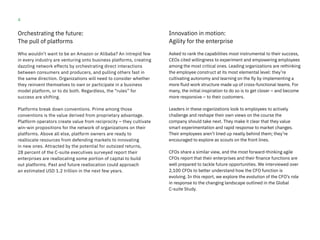
Orchestrating the future:
The pull of platforms
Who wouldn’t want to be an Amazon or Alibaba? An intrepid few
in every industry are venturing onto business platforms, creating
dazzling network effects by orchestrating direct interactions
between consumers and producers, and pulling others fast in
the same direction. Organizations will need to consider whether
they reinvent themselves to own or participate in a business
model platform, or to do both. Regardless, the “rules” for
success are shifting.
Platforms break down conventions. Prime among those
conventions is the value derived from proprietary advantage.
Platform operators create value from reciprocity – they cultivate
win-win propositions for the network of organizations on their
platforms. Above all else, platform owners are ready to
reallocate resources from defending markets to innovating
in new ones. Attracted by the potential for outsized returns,
28 percent of the C-suite executives surveyed report their
enterprises are reallocating
some portion of capital to build
out platforms. Past and future reallocation could approach
an estimated USD 1.2 trillion in the next few years.
Innovation in motion:
Agility for the enterprise
Asked to rank the capabilities most instrumental to their success,
CEOs cited willingness to experiment and empowering employees
among the most critical ones. Leading organizations are rethinking
the employee construct at its most elemental level: they’re
cultivating autonomy and learning on the fly by implementing a
more fluid work structure made up of cross-functional teams. For
many, the initial inspiration to do so is to get closer – and become
more responsive – to their customers.
Leaders in these organizations look to employees to actively
challenge and reshape their own views on the course the
company should take next. They make it clear that they value
smart experimentation and rapid response to market changes.
Their employees aren’t lined up neatly behind them; they’re
encouraged to explore as scouts on the front lines.
CFOs share a similar view, and the most forward-thinking agile
CFOs report that their enterprises and their finance functions are
well prepared to tackle future opportunities. We interviewed over
2,100 CFOs to better understand how the CFO function is
evolving. In this report, we explore the evolution of the CFO’s role
in response to the changing landscape outlined in the Global
C-suite Study.
5
CFO perspectives
An open agenda
Many in the C-suite report that disruption – the sudden incursion
of a previously unknown competitor in an industry – may be
dissipating as innovative industry incumbents take the lead and
more organizations shift from occasional transformations to
continuous and iterative reinvention. While C-suite executives
may be enjoying this respite from disruption, they are keenly aware
that threats remain.
This is especially true for CFOs. Three-quarters of CFOs cite
existential threats of some kind to their enterprises’ current
business models. Six in ten CFOs point to more innovative
competitors delivering more compelling value propositions.
Three in ten indicate new entrants are taking market share, and
approximately one in six point to some combination of product
commoditization eroding margins, or online and mobile channel
threats. Most concerning, one-sixth cite their own enterprise’s
struggle to scale for growth as a leading issue.
At the same time, the mandate in the C-suite has shifted. Instead
of simply playing defense against threats, more organizations
expect to continuously experiment and capitalize on new
opportunities – and often in tandem with other entities. The CFO’s
perspective on new strategic plays pursued in collaboration with
others takes center stage.
6
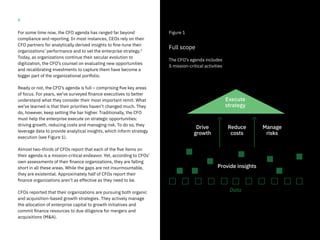
Figure 1
Full scope
The CFO’s agenda includes
5 mission-critical activities
Provide insights
Execute
strategy
Drive
growth
Reduce
costs
Manage
risks
Data
For some time now, the CFO agenda has ranged far beyond
compliance and reporting. In most instances, CEOs rely on their
CFO partners for analytically derived insights to fine-tune their
organizations’ performance and to set the enterprise strategy.2
Today, as organizations continue their secular evolution to
digitization, the CFO’s counsel on evaluating new opportunities
and recalibrating investments to capture them have become a
bigger part of the organizational portfolio.
Ready or not, the CFO’s agenda is full – comprising five key areas
of focus. For years, we’ve surveyed finance executives to better
understand what they consider their most important remit. What
we’ve learned is that their priorities haven’t changed much. They
do, however, keep setting the bar higher. Traditionally, the CFO
must help the enterprise execute on strategic opportunities:
driving growth, reducing costs and managing risk. To do so, they
leverage data to provide analytical insights, which inform strategy
execution (see Figure 1).
Almost two-thirds of CFOs report that each of the five items on
their agenda is a mission-critical endeavor. Yet, according to CFOs’
own assessments of their finance organizations, they are falling
short in all these areas. While the gaps are not insurmountable,
they are existential. Approximately half of CFOs report their
finance organizations aren’t as effective as they need to be.
CFOs reported that their organizations are pursuing both organic
and acquisition-based growth strategies. They actively manage
the allocation of enterprise capital to growth initiatives and
commit finance resources to due diligence for mergers and
acquisitions (M&A).
7
CFOs cite analytics as a key source for the discovery of new
growth opportunities, supported by the integration of enterprise
data with external market and competitor data. Further, CFOs can
leverage robust analytics with powerful scenario and what-if
analysis to evaluate acquisition opportunities.
Operational efficiency is equally important to the CFO agenda.
To that end, CFOs cite streamlining and digitizing operations as
the principal means to achieve it. An integral part of M&A due
diligence is development of a clear picture of scale economies
associated with acquired intellectual property and business
models. Similarly, capital investment in new digital technologies
to enable operational efficiency is a priority, with 66 percent citing
streamlining and digitizing finance operations as mission critical
to their enterprises. This side of the margin equation is focused on
cost reduction that, combined with revenue growth, leads to
improved margins, hence widening the financial moat.
As could be expected, risk management remains a top agenda
item, with 62 percent of CFOs focused on risks of all kinds, from
cyber to operational. Analytics to identify, assess and attempt to
anticipate risks, particularly those associated with competitive
disruption in the marketplace, are key to managing those risks.
Finally, as the expectations for analytics to deliver deep insights
ratchets up, what CFOs can deliver has moved beyond cutting
costs and managing risk to driving growth and setting strategy.
Sixty-one percent of CFOs cite enterprise data integration as a
key initiative to enable the delivery of analytics that enhance all
aspects of performance.
CFOs produce and leverage analytical insights that help them
assess the value of strategic opportunities, including any potential
risks. In turn, CFOs can provide and help interpret the analysis of
the performance of newly commercialized opportunities from a
risk-and-return perspective. Analytics yield the insights necessary
to evaluate the risk/return profile of capital allocated to growth
opportunities, whether organic or acquisitive, and set the bar for
expected returns.
As each investment returns a yield, the CFO, along with C-suite
peers, evaluates if and how the expected returns are being
achieved, interprets the nuances and adjusts appropriately.
In today’s fast-paced digital business environment, this ability to
adjust quickly – to be agile in response to change – is paramount.
It requires something else as well: open and ongoing collaboration
with C-suite peers.
CFO, Consumer Products, United States
“Success for us means continuous
profitable growth with least risk.
We can only do this with
consistently great insights.”
8
Figure 2
Three archetypes
CFO Reinventors
lead their industries
Reinventors
Practitioners
Aspirationals
29%
35%
36%
30%
50%
79%
High revenue
growth
High
profitability
Leading
innovation
33%
44%
71%
31%
40%
70%
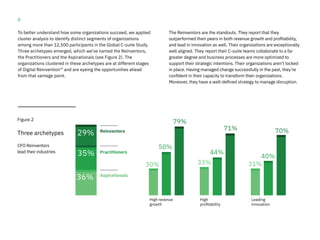
To better understand how some organizations succeed, we applied
cluster analysis to identify distinct segments of organizations
among more than 12,500 participants in the Global C-suite Study.
Three archetypes emerged, which we’ve named the Reinventors,
the Practitioners and the Aspirationals (see Figure 2). The
organizations clustered in these archetypes are at different stages
of Digital Reinvention™ and are eyeing the opportunities ahead
from that vantage point.
The Reinventors are the standouts. They report that they
outperformed their peers in both revenue growth and profitability,
and lead in innovation as well. Their organizations are exceptionally
well aligned. They report their C-suite teams collaborate to a far
greater degree and business processes are more optimized to
support their strategic intentions. Their organizations aren’t locked
in place. Having managed change successfully in the past, they’re
confident in their capacity to transform their organizations.
Moreover, they have a well-defined strategy to manage disruption.
9
The Reinventors have redirected their resources to achieve new
sources of scale – broad networks of partners – and extract new
value from ecosystems. They’re ahead of all others in co-creation
and close collaboration with customers and partners. They’ve
restructured their organizations and seeded a new culture to
encourage experimentation and bring new ideas to the fore.
Practitioners haven’t yet developed the capabilities to match
their ambitions. And they are ambitious. Almost one-half of the
Practitioners plan to launch new business models in the next few
years. Some are ready to leap ahead by taking on more risk to
“up their game” and disrupt their industry and others. More
Practitioners than Reinventors are considering one of the most
radical of the new business models – the platform business model.
The Aspirationals, as their name implies, have a ways to go in both
their digital transformation and their ability to move quickly to
seize new opportunities.
Of the 1,996 CFOs responses analyzed, over a quarter (29 percent)
came from Reinventor organizations, 35 percent from Practitioner
organizations and 36 percent from Aspirational organizations. The
CFO Reinventors are more effective across all dimensions of the
finance agenda, especially in performance analytics, M&A and
organic growth opportunities. Sixty-five percent of CFO Reinventors
report they are effective at the full CFO agenda. Just 48 percent of
CFO Practitioners and 38 percent of CFO Aspirationals say they are
effective. Moreover, 70 percent of CFO Reinventors say they’re
effective at growing revenue from their existing businesses and also
identifying new organic growth opportunities.
CFO, Industrial Products, Brazil
“An effective finance organization is
not enough – we have to help
enable the rest of the enterprise
to be agile. That requires reliability,
support and understanding the
business through insights.”
10
Steering a new direction
CFOs align with the rest of the C-suite on their views of the
competitive landscape. Just one-quarter of CFOs cite a high level
of disruption in their industry, and three-quarters report that the
disruption that does exist is being led by innovative industry
incumbents rather than startups or even the digital giants. For
many, the sudden shock of unanticipated disruptions may be
waning, but the requirement to change remains strong.
The born-on-the-net digital giants, for example, have already
demonstrated the primacy of compelling customer experiences.
Across all organizations, seven in ten organizations now expect to
emphasize experiences over products. In recent years, incumbents
partnering with startups, especially tech-based organizations, have
established the value to be gained from expanded partner
networks. Now, 63 percent of all surveyed organizations expect to
expand their partner networks in the next few years.
For CFO Reinventors, setting strategic direction with their C-suite
peers isn’t a one-and-done exercise but an ongoing activity – a
continuous recalibration of what opportunities to pursue and how
to get there. This iterative approach to strategy seems especially
well suited to collaboration.
11
No
disruption
Figure 3
Reinventors
Practitioners
Aspirationals
Onboard
Reinventor CFOs
lead with strategy
40%
53%
66%
Take an active role in the strategic direction of the enterprise
Q: How effective is your finance organization in supporting the enterprise in each of the
following areas? (Very effective)
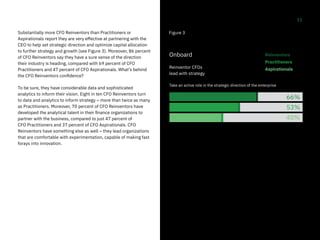
Substantially more CFO Reinventors than Practitioners or
Aspirationals report they are very effective at partnering with the
CEO to help set strategic direction and optimize capital allocation
to further strategy and growth (see Figure 3). Moreover, 86 percent
of CFO Reinventors say they have a sure sense of the direction
their industry is heading, compared with 69 percent of CFO
Practitioners and 47 percent of CFO Aspirationals. What’s behind
the CFO Reinventors confidence?
To be sure, they have considerable data and sophisticated
analytics to inform their vision. Eight in ten CFO Reinventors turn
to data and analytics to inform strategy – more than twice as many
as Practitioners. Moreover, 70 percent of CFO Reinventors have
developed the analytical talent in their finance organizations to
partner with the business, compared to just 47 percent of
CFO Practitioners and 37 percent of CFO Aspirationals. CFO
Reinventors have something else as well – they lead organizations
that are comfortable with experimentation, capable of making fast
forays into innovation.
11
12
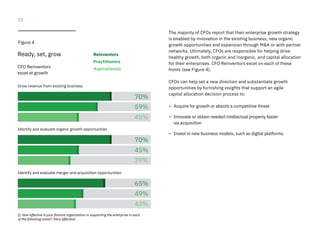
The majority of CFOs report that their enterprise growth strategy
is enabled by innovation in the existing business, new organic
growth opportunities and expansion through M&A or with partner
networks. Ultimately, CFOs are responsible for helping drive
healthy growth, both organic and inorganic, and capital allocation
for their enterprises. CFO Reinventors excel on each of these
fronts (see Figure 4).
CFOs can help set a new direction and substantiate growth
opportunities by furnishing insights that support an agile
capital allocation decision process to:
–– Acquire for growth or absorb a competitive threat
–– Innovate or obtain needed intellectual property faster
via acquisition
–– Invest in new business models, such as digital platforms.
Grow revenue from existing business
Q: How effective is your finance organization in supporting the enterprise in each
of the following areas? (Very effective)
Figure 4
Reinventors
Practitioners
Aspirationals
Ready, set, grow
CFO Reinventors
excel at growth
45%
59%
70%
Identify and evaluate organic growth opportunities
39%
45%
70%
Identify and evaluate merger and acquisition opportunities
43%
49%
65%
13
Q: To what extent do you agree with the following statements about the leadership
across your enterprise? (To a large extent)
Figure 5
In synch
CFO Reinventors thrive among
a collaborative C-suite
84%
60%
47%
Reinventors
Practitioners
Aspirationals
To be agile, enterprises must be quicker to innovate or respond to
disruption. Constantly interrogating the business landscape and
applying rigorous analysis to drive out actionable insights are
certainly prerequisites for agility.
Reinventor CFOs are more astute at helping the organization
find and place the right bets. They can do so in part by
establishing a culture that encourages experimentation and
speed. Three-quarters of CFO Reinventors, compared to
42 percent of Practitioners and 39 percent of Aspirationals,
report they have a culture that rewards both fast failure and
successful innovation, acknowledging the value they place
on experimentation.
Agility is also enabled by real collaboration across the C-suite
to execute on strategic course changes and swiftly evaluate the
merits of new opportunities uncovered through experimentation.
CFO Reinventors are better than their CFO counterparts at
collaborating with their C-suite peers on strategy execution. This
collaboration crosses multiple domains including risk management
(CRO), technology investments (CIO), new markets and customers
(CMO), new operational capabilities (COO) and talent (CHRO). In
fact, 84 percent of CFO Reinventors say that their leadership works
together effectively in a collaborative, collegial and productive way
versus just 60 percent of CFO Practitioners and 47 percent of CFO
Aspirationals (see Figure 5).
14
Orchestrating advantage
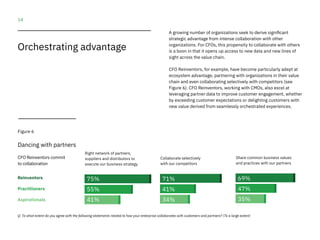
A growing number of organizations seek to derive significant
strategic advantage from intense collaboration with other
organizations. For CFOs, this propensity to collaborate with others
is a boon in that it opens up access to new data and new lines of
sight across the value chain.
CFO Reinventors, for example, have become particularly adept at
ecosystem advantage, partnering with organizations in their value
chain and even collaborating selectively with competitors (see
Figure 6). CFO Reinventors, working with CMOs, also excel at
leveraging partner data to improve customer engagement, whether
by exceeding customer expectations or delighting customers with
new value derived from seamlessly orchestrated experiences.
Figure 6
Dancing with partners
CFO Reinventors commit
to collaboration
Reinventors
Practitioners
Aspirationals
Right network of partners,
suppliers and distributors to
execute our business strategy
75%
55%
41%
Collaborate selectively
with our competitors
71%
41%
34%
Share common business values
and practices with our partners
69%
47%
35%
Q: To what extent do you agree with the following statements related to how your enterprise collaborates with customers and partners? (To a large extent)
15
For some, the natural evolution of the ecosystem approach is
taking form in the platform business model, which connects
producers directly with consumers, enabling organizations to grow
faster and generate higher profits. Just 6 percent of CFO
respondents say their enterprises have a platform model
established in the market. Yet 36 percent state their enterprises
are building or considering a platform business model.
What are the characteristics of a platform that generates growth?
It helps drive new customer experiences, cultivate and orchestrate
data as an asset to hone performance, and reallocate capital and
resources from the role of defending markets to innovating in
new ones.
Already, organizations are reallocating a vast amount of capital
– expected to reach USD 1.2 trillion in just a few years – to the
platform business model. CFOs will need to wield new tools and
insights to orchestrate and execute on this important opportunity.
To operate in an ecosystem or platform environment, CFOs need to
consider a number of factors. They need to examine new ways to
assess and reduce risks in concert with other organizations. They
should share performance analytics across the full value chain –
including at times competitors – to help enterprises stay in synch.
As more organizations extend their value-creation activities to
collaboration with ecosystems on platforms, understanding and
experimenting with emerging technologies becomes more
important than ever. For most, emerging technologies, such as
artificial intelligence (AI), automation and blockchain, offer new
opportunities when built on a foundation of mobile, cloud, data
and analytics capabilities.
CFO, Automotive, India
“We use digital and cognitive
capability for better decision
making and collaboration.”
16
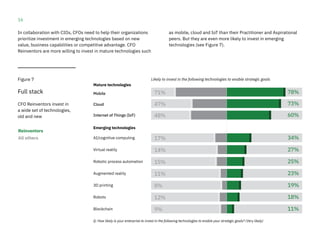
In collaboration with CIOs, CFOs need to help their organizations
prioritize investment in emerging technologies based on new
value, business capabilities or competitive advantage. CFO
Reinventors are more willing to invest in mature technologies such
Mature technologies
Mobile
Cloud
Internet of Things (IoT)
Emerging technologies
AI/cognitive computing
Virtual reality
Robotic process automation
Augmented reality
3D printing
Robots
Blockchain
Q: How likely is your enterprise to invest in the following technologies to enable your strategic goals? (Very likely)
Figure 7
Full stack
CFO Reinventors invest in
a wide set of technologies,
old and new
Likely to invest in the following technologies to enable strategic goals
as mobile, cloud and IoT than their Practitioner and Aspirational
peers. But they are even more likely to invest in emerging
technologies (see Figure 7).
Reinventors
All others
78%71%
73%47%
60%48%
34%17%
27%14%
25%15%
23%11%
19%8%
18%12%
11%9%
17
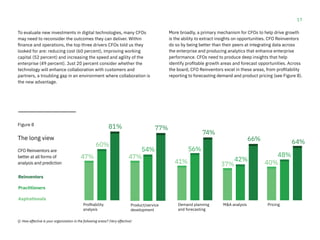
To evaluate new investments in digital technologies, many CFOs
may need to reconsider the outcomes they can deliver. Within
finance and operations, the top three drivers CFOs told us they
looked for are: reducing cost (60 percent), improving working
capital (52 percent) and increasing the speed and agility of the
enterprise (49 percent). Just 20 percent consider whether the
technology will enhance collaboration with customers and
partners, a troubling gap in an environment where collaboration is
the new advantage.
More broadly, a primary mechanism for CFOs to help drive growth
is the ability to extract insights on opportunities. CFO Reinventors
do so by being better than their peers at integrating data across
the enterprise and producing analytics that enhance enterprise
performance. CFOs need to produce deep insights that help
identify profitable growth areas and forecast opportunities. Across
the board, CFO Reinventors excel in these areas, from profitability
reporting to forecasting demand and product pricing (see Figure 8).
Figure 8
The long view
CFO Reinventors are
better at all forms of
analysis and prediction 41%
56%
74%
Demand planning
and forecasting
M&A analysis Pricing
37%
42%
66%
40%
48%
64%
Reinventors
Practitioners
Aspirationals
47%
60%
81%
Profitability
analysis
Product/service
development
47%
54%
77%
Q: How effective is your organization in the following areas? (Very effective)
18
And all of these must be measured and evaluated with their
CMO and COO peers. The biggest gap between CFO Reinventors
and their CFO peers lies in the area of M&A analysis to fuel
acquisitive growth.
Aligned with enterprise direction and growth, CFOs need to help
identify opportunities to enhance operational efficiency and reduce
costs. This requires looking at traditional levers such as changing
the enterprise’s operating model, optimizing business processes,
evaluating spend and rationalizing infrastructure. But it also
requires technology investments to drive optimization and support
scalable growth and market share.
Figure 9
Reinventors
Practitioners
Aspirationals
Coin toss
CFO Reinventors improve
the cost side of margins
33%
43%
54%
Reduce costs across the enterprise
Q: How effective is your finance organization in supporting the enterprise in each of
the following areas? (Very effective)
CFO, Telecommunications, Mexico
“We have implemented and
established more digital
platforms to expand our business
partner networks, which has led
to the transformation of our
business models.”
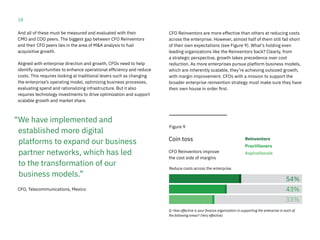
CFO Reinventors are more effective than others at reducing costs
across the enterprise. However, almost half of them still fall short
of their own expectations (see Figure 9). What’s holding even
leading organizations like the Reinventors back? Clearly, from
a strategic perspective, growth takes precedence over cost
reduction. As more enterprises pursue platform business models,
which are inherently scalable, they’re achieving outsized growth,
with margin improvement. CFOs with a mission to support the
broader enterprise reinvention strategy must make sure they have
their own house in order first.
19
As collaboration in the pursuit of digitization, new value chains and
shared platforms grows in importance, CFOs must ensure that
their own departments are fine-tuned for agility. This requires new
ways of working within the finance function beyond simply
digitizing services and processes to automating and augmenting
them with AI and cognitive technologies.
Beyond utilizing digital technologies to create fully integrated,
flexible and agile operating environments, CFOs must elevate their
teams to be full partners with other functions. For many, that
means empowering their teams to lead from the front lines, scope
new opportunities and act on their insights.
CFO Reinventor organizations stand out from others in the dynamic
interplay between their vision, culture and operations. Their
leaders have a strong vision for their enterprises but are eager to
hone it and even change course. CFO Reinventors develop this
more dynamic sense of vision by actively promoting transparency
and continual dialogue with employees.
CFO Reinventors lead from a position of trust: 77 percent actively
solicit ideas from employees to develop new approaches,
compared to 52 percent of CFO Practitioners and 42 percent of
CFO Aspirationals. Three-quarters of CFO Reinventors empower
their teams to decide the best course of action. These leaders
aren’t afraid to let their teams see their views evolve. Doing so
models a new way forward.
CFO Reinventors’ organizations have more efficient and more
effective finance operations than their peers. They achieve this
by rethinking the employee construct at its most elemental level:
Finance first
20
they cultivate continuous learning by implementing a more fluid
work structure made up of cross-functional teams. And they
continuously invest in employee skills to remain competitive.
Establishing commonality across the function and the enterprise
has long been a necessity to achieve greater finance operations
efficiency and more trusted insights, and yet still too many fall
short. It’s no surprise that CFO Reinventors have mastered the
adoption of common processes, common planning platforms and
enterprise-wide information standards.
Order to cash
Procure to pay
Payroll
Treasury and cash management
External financial reporting
Accounting close and consolidation
Intercompany processing
Fixed assets
Travel and expense
Q: To what extent has your finance organization optimized the following finance and
accounting processes by implementing digital technology? (To a large extent)
Figure 11
Honing processes
CFO Reinventors implement
digital technologies to
enhance finance processes
Reinventors
All others
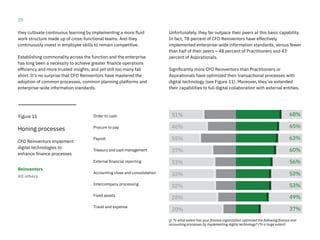
Unfortunately, they far outpace their peers at this basic capability.
In fact, 78 percent of CFO Reinventors have effectively
implemented enterprise-wide information standards, versus fewer
than half of their peers – 48 percent of Practitioners and 43
percent of Aspirationals.	
Significantly more CFO Reinventors than Practitioners or
Aspirationals have optimized their transactional processes with
digital technology (see Figure 11). Moreover, they’ve extended
their capabilities to full digital collaboration with external entities.
68%51%
65%46%
63%55%
60%37%
56%33%
53%33%
53%32%
49%28%
37%20%
21
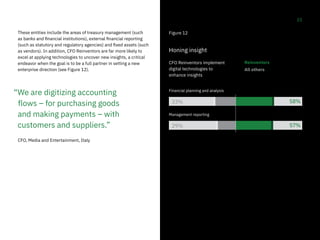
These entities include the areas of treasury management (such
as banks and financial institutions), external financial reporting
(such as statutory and regulatory agencies) and fixed assets (such
as vendors). In addition, CFO Reinventors are far more likely to
excel at applying technologies to uncover new insights, a critical
endeavor when the goal is to be a full partner in setting a new
enterprise direction (see Figure 12).
Figure 12
Honing insight
CFO Reinventors implement
digital technologies to
enhance insights
Reinventors
All others
Q: To what extent has your finance organization optimized the following finance
and accounting processes by implementing digital technology? (To a large extent)
CFO, Media and Entertainment, Italy
“We are digitizing accounting
flows – for purchasing goods
and making payments – with
customers and suppliers.”
Financial planning and analysis
Management reporting
58%33%
57%29%
21
22
The CFO Reinventors plot a good path to the future. They are using
Digital Reinvention as a catalyst not just for the enterprise but for
the transformation of the CFO role. They actively help set enterprise
direction, orchestrate investment and growth for new advantage,
and nurture talent while building an agile culture. What actions can
all CFOs take to follow the lead of CFO Reinventors?
Keep sight of finance fundamentals
Digitize finance processes. Exploit new technologies (such as
robotic process automation, AI and advanced analytics) to
enhance processes. Leverage opportunities to take advantage of
specialists with advanced technical capabilities.
Create a single version of the financial truth. Implement finance
process commonality with process owners. Establish data
standards, rationalize financial platforms and reframe analytics to
measure the current reality.
Enhance business insight capabilities. Put the proper analytics
technologies in place. Set operational data standards. Implement
common decision-support processes. Increase analytic
transparency and ubiquity.
Getting to cognitive finance
23
Clarify strategic direction
Enable complex performance analysis. Actively scan competitive
threats. Identify acquisition candidates for growth or needed
intellectual property. Evaluate new business models, industry-
shaping platforms and ecosystem strategies.
Implement strategy across the C-suite. Collaborate extensively
with C-suite peers on strategy execution in such areas as risk
management, technology investments, new markets, operational
capabilities and skills.
Get closer to the business. Accelerate analytics skills development
to support meaningful interactions with the business. Augment the
skills of current staff with AI, and acquire talent with needed skills.
Commit with frequency
Set the standard. Establish a formal way for deciding what
emerging technologies will provide new value and capabilities or
enable new products and services. Adopt a fluid capital
reallocation mindset.
Focus on profitable growth. Create market-shaping and capability-
building investments that inject innovation into the enterprise. Find
a balance between cost takeout and innovation.
Find the right partners. Look for opportunities to co-create with
partners and competitors. Determine which platform options are
right for your enterprise – building and owning one with partners
and competitors or joining existing established platforms as a
participant.
24
Related IBM IBV C-suite Program executive reports
To read the full report, “Incumbents Strike Back,” please go to
ibm.com/globalcsuitestudy.
For more information
To learn more about this IBM Institute for Business Value study,
please contact us at iibv@us.ibm.com. Follow @IBMIBV on Twitter,
and for a full catalog of our research or to subscribe to our
newsletter, visit: ibm.com/iibv.
Access IBM Institute for Business Value executive reports on your
mobile device by downloading the free “IBM IBV” apps for phone
or tablet from your app store.
The right partner for a changing world
At IBM, we collaborate with our clients, bringing together business
insight, advanced research and technology to give them a distinct
advantage in today’s rapidly changing environment.
IBM Institute for Business Value
The IBM Institute for Business Value, part of IBM Services,
develops fact-based strategic insights for senior business
executives around critical public and private sector issues.
Related IBM IBV C-suite and CFO-specific reports
Fuessler, William, Martin Harmer, Spencer Lin and Carl Nordman. “Unlocking
the potential of digital: Digital Reinvention in finance.” IBM Institute for
Business Value. January 2018. http://www-935.ibm.com/services/us/gbs/
thoughtleadership/drfinance/
Fuessler, William, Spencer Lin and Carl Nordman. “The cognitive CFO: How
‘leaders’ are increasing finance IQ.” IBM Institute for Business Value. May
2017. https://www-935.ibm.com/services/us/gbs/thoughtleadership/
cognitivecfo/
Lin, Spencer and Carl Nordman. “The CFO mission to uncover the unknown:
Applying analytics and cognitive computing for efficiency and insight.” IBM
Institute for Business Value. November 2016. https://www-935.ibm.com/
services/us/gbs/thoughtleadership/cfomission/
Notes and sources
1	 “Incumbents Strike Back: Insights from the Global C-suite Study.” IBM
Institute for Business Value. February 2018. http://www.ibm.com/
globalcsuitestudy
2	 “Pushing the frontiers: CFO insights from the Global C-suite Study.”
IBM Institute for Business Value. February 2014. https://www-01.ibm.
com/common/ssi/cgi-bin/ssialias?htmlfid=GBE03590USEN
25
© Copyright IBM Corporation 2018
IBM Corporation
New Orchard Road
Armonk, NY 10504
Produced in the United States of America
June 2018
IBM, the IBM logo, ibm.com and Watson are trademarks of International
Business Machines Corp., registered in many jurisdictions worldwide. Other
product and service names might be trademarks of IBM or other companies.
A current list of IBM trademarks is available on the web at “Copyright and
trademark information” at: ibm.com/legal/copytrade.shtml.
This document is current as of the initial date of publication and may be
changed by IBM at any time. Not all offerings are available in every country
in which IBM operates.
THE INFORMATION IN THIS DOCUMENT IS PROVIDED “AS IS” WITHOUT
ANY WARRANTY, EXPRESS OR IMPLIED, INCLUDING WITHOUT ANY
WARRANTIES OF MERCHANTABILITY, FITNESS FOR A PARTICULAR
PURPOSE AND ANY WARRANTY OR CONDITION OF NON-INFRINGEMENT.
IBM products are warranted according to the terms and conditions of the
agreements under which they are provided.
This report is intended for general guidance only. It is not intended to be a
substitute for detailed research or the exercise of professional judgment.
IBM shall not be responsible for any loss whatsoever sustained by any
organization or person who relies on this publication.
The data used in this report may be derived from third-party sources and
IBM does not independently verify, validate or audit such data. The results
from the use of such data are provided on an “as is” basis and IBM makes no
representations or warranties, express or implied.
29016429USEN-00
26

Elevate your enterprise cfo role report

  • 1.
    A Elevate your enterprise Chief Financial Officer IBM Institutefor Business Value Global C-suite Study 19th edition
  • 2.
    B The IBM Institutefor Business Value, in cooperation with Oxford Economics, interviewed 2,102 Chief Financial Officers. In 184 face-to-face and 1,918 phone interviews, both quantitative and qualitative responses were collected. The analytical basis for this CFO report uses 1,996 valid responses from the total data sample collected. More than 12,800 CxOs, representing six C-suite roles, 20 industries and 112 countries, contributed to our latest research. We used the IBM Watson Natural Language Classifier to analyze their contextual responses and ascertain overarching themes. We also used various statistical methods, including cluster analysis and discriminant analysis, to scrutinize the millions of data points we collected.
  • 3.
    1 Essential finance Companies invirtually every industry are undergoing a secular change to new, platform- based businesses. To thrive, organizations need to digitally reinvent their enterprise business and operating models. CFOs continue to be instrumental in providing the analytical insights to help the enterprise invest capital into new opportunities. Essential to this process is a highly collaborative, in-synch C-suite. The CFO’s newest mandate – to help steer the strategic direction of the enterprise and do so iteratively – requires changes to their finance organizations. Startlingly, nearly half of CFOs report their own finance organizations fall short of what’s required.
  • 4.
    2 Two decades afterthe Internet became a platform for transformation, we’re still wondering how it all might turn out. The signals aren’t always clear. Today, winner-take-all organizations are on the rise, but collaborative ecosystems are flourishing as well. Even in industries where competitive concentration is increasing, innovation hasn’t – as would be expected – flatlined. Which way to the future? The organizations that are prospering aren’t lying in wait to time the next inflection point – the moment when a new technology, business model or means of production really takes off. Remaking the enterprise, they recognize, isn’t a matter of timing but of continuity. What’s required, now more than ever, is the fortitude for perpetual reinvention. It’s a matter of seeking and championing change even when the status quo happens to be working quite well. Drawing from the responses to a survey of executives across the C-suite, IBM client engagements and our work with academics, the 19th edition of the IBM Global C-suite Study, “Incumbents Strike Back,” covers four topics that describe the changing business landscape.1 A broader context Perspective from the Global C-suite Study
  • 5.
    3 Dancing with disruption: Incumbentshit their stride Is disruption dead? Certainly, there’s less of it than most C-suite executives anticipated. Just under three in ten say they’re experiencing significant disruption; hardly the deluge expected. What happened? As industries consolidated, startups deprived of venture capital funding stalled at the gate – or were snapped up by incumbents. Confounding the situation, C-suite executives report that it’s not the fearsome digital giants they’re concerned about most, but the once lumbering, now innovative, industry incumbents that have gained the capacity to strike first and strike back. Disruption hasn’t gone underground; instead it’s emerging as a capability incumbents are ready to embrace. They orchestrate advantage by continuously reallocating resources to invest in promising new areas. They have learned to move fast, experiment and iterate. They’re reinventing themselves before they are forced by competitors to reconsider their options. Trust in the journey: The path to personalization Personalization is a huge opportunity to grow revenues and loyalty, but absent true customer insight, too many organizations are in danger not just of falling short of their targets, but disappointing their customers. Leading organizations are modeling a new path to insight; they are design thinkers. They use data to interrogate their environments, create context and reveal what’s deeply human about their customers. To achieve the elegant and irresistible design of the customer experience, they don’t start with solutions; instead, they seek to ask the next best question. They excel at two activities – customer co-creation and detailed journey mapping. These activities generate insights in abundance, feed on-target personalization and have equally important second- order effects: they propagate trust. Trust between peers in co-creation communities is transferred to the enterprise and extended outside the community by a cadre of influencers. Likewise, journey maps cement trust by instilling a culture of accountability to customers inside the organization. Leading organizations dedicated to discovering their customers’ unmet needs don’t just ask for loyalty on the basis of personalization. They earn and provide reasons to trust.
  • 6.
    4 Orchestrating the future: Thepull of platforms Who wouldn’t want to be an Amazon or Alibaba? An intrepid few in every industry are venturing onto business platforms, creating dazzling network effects by orchestrating direct interactions between consumers and producers, and pulling others fast in the same direction. Organizations will need to consider whether they reinvent themselves to own or participate in a business model platform, or to do both. Regardless, the “rules” for success are shifting. Platforms break down conventions. Prime among those conventions is the value derived from proprietary advantage. Platform operators create value from reciprocity – they cultivate win-win propositions for the network of organizations on their platforms. Above all else, platform owners are ready to reallocate resources from defending markets to innovating in new ones. Attracted by the potential for outsized returns, 28 percent of the C-suite executives surveyed report their enterprises are reallocating
some portion of capital to build out platforms. Past and future reallocation could approach an estimated USD 1.2 trillion in the next few years. Innovation in motion: Agility for the enterprise Asked to rank the capabilities most instrumental to their success, CEOs cited willingness to experiment and empowering employees among the most critical ones. Leading organizations are rethinking the employee construct at its most elemental level: they’re cultivating autonomy and learning on the fly by implementing a more fluid work structure made up of cross-functional teams. For many, the initial inspiration to do so is to get closer – and become more responsive – to their customers. Leaders in these organizations look to employees to actively challenge and reshape their own views on the course the company should take next. They make it clear that they value smart experimentation and rapid response to market changes. Their employees aren’t lined up neatly behind them; they’re encouraged to explore as scouts on the front lines. CFOs share a similar view, and the most forward-thinking agile CFOs report that their enterprises and their finance functions are well prepared to tackle future opportunities. We interviewed over 2,100 CFOs to better understand how the CFO function is evolving. In this report, we explore the evolution of the CFO’s role in response to the changing landscape outlined in the Global C-suite Study.
  • 7.
    5 CFO perspectives An openagenda Many in the C-suite report that disruption – the sudden incursion of a previously unknown competitor in an industry – may be dissipating as innovative industry incumbents take the lead and more organizations shift from occasional transformations to continuous and iterative reinvention. While C-suite executives may be enjoying this respite from disruption, they are keenly aware that threats remain. This is especially true for CFOs. Three-quarters of CFOs cite existential threats of some kind to their enterprises’ current business models. Six in ten CFOs point to more innovative competitors delivering more compelling value propositions. Three in ten indicate new entrants are taking market share, and approximately one in six point to some combination of product commoditization eroding margins, or online and mobile channel threats. Most concerning, one-sixth cite their own enterprise’s struggle to scale for growth as a leading issue. At the same time, the mandate in the C-suite has shifted. Instead of simply playing defense against threats, more organizations expect to continuously experiment and capitalize on new opportunities – and often in tandem with other entities. The CFO’s perspective on new strategic plays pursued in collaboration with others takes center stage.
  • 8.
    6 Figure 1 Full scope TheCFO’s agenda includes 5 mission-critical activities Provide insights Execute strategy Drive growth Reduce costs Manage risks Data For some time now, the CFO agenda has ranged far beyond compliance and reporting. In most instances, CEOs rely on their CFO partners for analytically derived insights to fine-tune their organizations’ performance and to set the enterprise strategy.2 Today, as organizations continue their secular evolution to digitization, the CFO’s counsel on evaluating new opportunities and recalibrating investments to capture them have become a bigger part of the organizational portfolio. Ready or not, the CFO’s agenda is full – comprising five key areas of focus. For years, we’ve surveyed finance executives to better understand what they consider their most important remit. What we’ve learned is that their priorities haven’t changed much. They do, however, keep setting the bar higher. Traditionally, the CFO must help the enterprise execute on strategic opportunities: driving growth, reducing costs and managing risk. To do so, they leverage data to provide analytical insights, which inform strategy execution (see Figure 1). Almost two-thirds of CFOs report that each of the five items on their agenda is a mission-critical endeavor. Yet, according to CFOs’ own assessments of their finance organizations, they are falling short in all these areas. While the gaps are not insurmountable, they are existential. Approximately half of CFOs report their finance organizations aren’t as effective as they need to be. CFOs reported that their organizations are pursuing both organic and acquisition-based growth strategies. They actively manage the allocation of enterprise capital to growth initiatives and commit finance resources to due diligence for mergers and acquisitions (M&A).
  • 9.
    7 CFOs cite analyticsas a key source for the discovery of new growth opportunities, supported by the integration of enterprise data with external market and competitor data. Further, CFOs can leverage robust analytics with powerful scenario and what-if analysis to evaluate acquisition opportunities. Operational efficiency is equally important to the CFO agenda. To that end, CFOs cite streamlining and digitizing operations as the principal means to achieve it. An integral part of M&A due diligence is development of a clear picture of scale economies associated with acquired intellectual property and business models. Similarly, capital investment in new digital technologies to enable operational efficiency is a priority, with 66 percent citing streamlining and digitizing finance operations as mission critical to their enterprises. This side of the margin equation is focused on cost reduction that, combined with revenue growth, leads to improved margins, hence widening the financial moat. As could be expected, risk management remains a top agenda item, with 62 percent of CFOs focused on risks of all kinds, from cyber to operational. Analytics to identify, assess and attempt to anticipate risks, particularly those associated with competitive disruption in the marketplace, are key to managing those risks. Finally, as the expectations for analytics to deliver deep insights ratchets up, what CFOs can deliver has moved beyond cutting costs and managing risk to driving growth and setting strategy. Sixty-one percent of CFOs cite enterprise data integration as a key initiative to enable the delivery of analytics that enhance all aspects of performance. CFOs produce and leverage analytical insights that help them assess the value of strategic opportunities, including any potential risks. In turn, CFOs can provide and help interpret the analysis of the performance of newly commercialized opportunities from a risk-and-return perspective. Analytics yield the insights necessary to evaluate the risk/return profile of capital allocated to growth opportunities, whether organic or acquisitive, and set the bar for expected returns. As each investment returns a yield, the CFO, along with C-suite peers, evaluates if and how the expected returns are being achieved, interprets the nuances and adjusts appropriately. In today’s fast-paced digital business environment, this ability to adjust quickly – to be agile in response to change – is paramount. It requires something else as well: open and ongoing collaboration with C-suite peers. CFO, Consumer Products, United States “Success for us means continuous profitable growth with least risk. We can only do this with consistently great insights.”
  • 10.
    8 Figure 2 Three archetypes CFOReinventors lead their industries Reinventors Practitioners Aspirationals 29% 35% 36% 30% 50% 79% High revenue growth High profitability Leading innovation 33% 44% 71% 31% 40% 70% To better understand how some organizations succeed, we applied cluster analysis to identify distinct segments of organizations among more than 12,500 participants in the Global C-suite Study. Three archetypes emerged, which we’ve named the Reinventors, the Practitioners and the Aspirationals (see Figure 2). The organizations clustered in these archetypes are at different stages of Digital Reinvention™ and are eyeing the opportunities ahead from that vantage point. The Reinventors are the standouts. They report that they outperformed their peers in both revenue growth and profitability, and lead in innovation as well. Their organizations are exceptionally well aligned. They report their C-suite teams collaborate to a far greater degree and business processes are more optimized to support their strategic intentions. Their organizations aren’t locked in place. Having managed change successfully in the past, they’re confident in their capacity to transform their organizations. Moreover, they have a well-defined strategy to manage disruption.
  • 11.
    9 The Reinventors haveredirected their resources to achieve new sources of scale – broad networks of partners – and extract new value from ecosystems. They’re ahead of all others in co-creation and close collaboration with customers and partners. They’ve restructured their organizations and seeded a new culture to encourage experimentation and bring new ideas to the fore. Practitioners haven’t yet developed the capabilities to match their ambitions. And they are ambitious. Almost one-half of the Practitioners plan to launch new business models in the next few years. Some are ready to leap ahead by taking on more risk to “up their game” and disrupt their industry and others. More Practitioners than Reinventors are considering one of the most radical of the new business models – the platform business model. The Aspirationals, as their name implies, have a ways to go in both their digital transformation and their ability to move quickly to seize new opportunities. Of the 1,996 CFOs responses analyzed, over a quarter (29 percent) came from Reinventor organizations, 35 percent from Practitioner organizations and 36 percent from Aspirational organizations. The CFO Reinventors are more effective across all dimensions of the finance agenda, especially in performance analytics, M&A and organic growth opportunities. Sixty-five percent of CFO Reinventors report they are effective at the full CFO agenda. Just 48 percent of CFO Practitioners and 38 percent of CFO Aspirationals say they are effective. Moreover, 70 percent of CFO Reinventors say they’re effective at growing revenue from their existing businesses and also identifying new organic growth opportunities. CFO, Industrial Products, Brazil “An effective finance organization is not enough – we have to help enable the rest of the enterprise to be agile. That requires reliability, support and understanding the business through insights.”
  • 12.
    10 Steering a newdirection CFOs align with the rest of the C-suite on their views of the competitive landscape. Just one-quarter of CFOs cite a high level of disruption in their industry, and three-quarters report that the disruption that does exist is being led by innovative industry incumbents rather than startups or even the digital giants. For many, the sudden shock of unanticipated disruptions may be waning, but the requirement to change remains strong. The born-on-the-net digital giants, for example, have already demonstrated the primacy of compelling customer experiences. Across all organizations, seven in ten organizations now expect to emphasize experiences over products. In recent years, incumbents partnering with startups, especially tech-based organizations, have established the value to be gained from expanded partner networks. Now, 63 percent of all surveyed organizations expect to expand their partner networks in the next few years. For CFO Reinventors, setting strategic direction with their C-suite peers isn’t a one-and-done exercise but an ongoing activity – a continuous recalibration of what opportunities to pursue and how to get there. This iterative approach to strategy seems especially well suited to collaboration.
  • 13.
    11 No disruption Figure 3 Reinventors Practitioners Aspirationals Onboard Reinventor CFOs leadwith strategy 40% 53% 66% Take an active role in the strategic direction of the enterprise Q: How effective is your finance organization in supporting the enterprise in each of the following areas? (Very effective) Substantially more CFO Reinventors than Practitioners or Aspirationals report they are very effective at partnering with the CEO to help set strategic direction and optimize capital allocation to further strategy and growth (see Figure 3). Moreover, 86 percent of CFO Reinventors say they have a sure sense of the direction their industry is heading, compared with 69 percent of CFO Practitioners and 47 percent of CFO Aspirationals. What’s behind the CFO Reinventors confidence? To be sure, they have considerable data and sophisticated analytics to inform their vision. Eight in ten CFO Reinventors turn to data and analytics to inform strategy – more than twice as many as Practitioners. Moreover, 70 percent of CFO Reinventors have developed the analytical talent in their finance organizations to partner with the business, compared to just 47 percent of CFO Practitioners and 37 percent of CFO Aspirationals. CFO Reinventors have something else as well – they lead organizations that are comfortable with experimentation, capable of making fast forays into innovation. 11
  • 14.
    12 The majority ofCFOs report that their enterprise growth strategy is enabled by innovation in the existing business, new organic growth opportunities and expansion through M&A or with partner networks. Ultimately, CFOs are responsible for helping drive healthy growth, both organic and inorganic, and capital allocation for their enterprises. CFO Reinventors excel on each of these fronts (see Figure 4). CFOs can help set a new direction and substantiate growth opportunities by furnishing insights that support an agile capital allocation decision process to: –– Acquire for growth or absorb a competitive threat –– Innovate or obtain needed intellectual property faster via acquisition –– Invest in new business models, such as digital platforms. Grow revenue from existing business Q: How effective is your finance organization in supporting the enterprise in each of the following areas? (Very effective) Figure 4 Reinventors Practitioners Aspirationals Ready, set, grow CFO Reinventors excel at growth 45% 59% 70% Identify and evaluate organic growth opportunities 39% 45% 70% Identify and evaluate merger and acquisition opportunities 43% 49% 65%
  • 15.
    13 Q: To whatextent do you agree with the following statements about the leadership across your enterprise? (To a large extent) Figure 5 In synch CFO Reinventors thrive among a collaborative C-suite 84% 60% 47% Reinventors Practitioners Aspirationals To be agile, enterprises must be quicker to innovate or respond to disruption. Constantly interrogating the business landscape and applying rigorous analysis to drive out actionable insights are certainly prerequisites for agility. Reinventor CFOs are more astute at helping the organization find and place the right bets. They can do so in part by establishing a culture that encourages experimentation and speed. Three-quarters of CFO Reinventors, compared to 42 percent of Practitioners and 39 percent of Aspirationals, report they have a culture that rewards both fast failure and successful innovation, acknowledging the value they place on experimentation. Agility is also enabled by real collaboration across the C-suite to execute on strategic course changes and swiftly evaluate the merits of new opportunities uncovered through experimentation. CFO Reinventors are better than their CFO counterparts at collaborating with their C-suite peers on strategy execution. This collaboration crosses multiple domains including risk management (CRO), technology investments (CIO), new markets and customers (CMO), new operational capabilities (COO) and talent (CHRO). In fact, 84 percent of CFO Reinventors say that their leadership works together effectively in a collaborative, collegial and productive way versus just 60 percent of CFO Practitioners and 47 percent of CFO Aspirationals (see Figure 5).
  • 16.
    14 Orchestrating advantage A growingnumber of organizations seek to derive significant strategic advantage from intense collaboration with other organizations. For CFOs, this propensity to collaborate with others is a boon in that it opens up access to new data and new lines of sight across the value chain. CFO Reinventors, for example, have become particularly adept at ecosystem advantage, partnering with organizations in their value chain and even collaborating selectively with competitors (see Figure 6). CFO Reinventors, working with CMOs, also excel at leveraging partner data to improve customer engagement, whether by exceeding customer expectations or delighting customers with new value derived from seamlessly orchestrated experiences. Figure 6 Dancing with partners CFO Reinventors commit to collaboration Reinventors Practitioners Aspirationals Right network of partners, suppliers and distributors to execute our business strategy 75% 55% 41% Collaborate selectively with our competitors 71% 41% 34% Share common business values and practices with our partners 69% 47% 35% Q: To what extent do you agree with the following statements related to how your enterprise collaborates with customers and partners? (To a large extent)
  • 17.
    15 For some, thenatural evolution of the ecosystem approach is taking form in the platform business model, which connects producers directly with consumers, enabling organizations to grow faster and generate higher profits. Just 6 percent of CFO respondents say their enterprises have a platform model established in the market. Yet 36 percent state their enterprises are building or considering a platform business model. What are the characteristics of a platform that generates growth? It helps drive new customer experiences, cultivate and orchestrate data as an asset to hone performance, and reallocate capital and resources from the role of defending markets to innovating in new ones. Already, organizations are reallocating a vast amount of capital – expected to reach USD 1.2 trillion in just a few years – to the platform business model. CFOs will need to wield new tools and insights to orchestrate and execute on this important opportunity. To operate in an ecosystem or platform environment, CFOs need to consider a number of factors. They need to examine new ways to assess and reduce risks in concert with other organizations. They should share performance analytics across the full value chain – including at times competitors – to help enterprises stay in synch. As more organizations extend their value-creation activities to collaboration with ecosystems on platforms, understanding and experimenting with emerging technologies becomes more important than ever. For most, emerging technologies, such as artificial intelligence (AI), automation and blockchain, offer new opportunities when built on a foundation of mobile, cloud, data and analytics capabilities. CFO, Automotive, India “We use digital and cognitive capability for better decision making and collaboration.”
  • 18.
    16 In collaboration withCIOs, CFOs need to help their organizations prioritize investment in emerging technologies based on new value, business capabilities or competitive advantage. CFO Reinventors are more willing to invest in mature technologies such Mature technologies Mobile Cloud Internet of Things (IoT) Emerging technologies AI/cognitive computing Virtual reality Robotic process automation Augmented reality 3D printing Robots Blockchain Q: How likely is your enterprise to invest in the following technologies to enable your strategic goals? (Very likely) Figure 7 Full stack CFO Reinventors invest in a wide set of technologies, old and new Likely to invest in the following technologies to enable strategic goals as mobile, cloud and IoT than their Practitioner and Aspirational peers. But they are even more likely to invest in emerging technologies (see Figure 7). Reinventors All others 78%71% 73%47% 60%48% 34%17% 27%14% 25%15% 23%11% 19%8% 18%12% 11%9%
  • 19.
    17 To evaluate newinvestments in digital technologies, many CFOs may need to reconsider the outcomes they can deliver. Within finance and operations, the top three drivers CFOs told us they looked for are: reducing cost (60 percent), improving working capital (52 percent) and increasing the speed and agility of the enterprise (49 percent). Just 20 percent consider whether the technology will enhance collaboration with customers and partners, a troubling gap in an environment where collaboration is the new advantage. More broadly, a primary mechanism for CFOs to help drive growth is the ability to extract insights on opportunities. CFO Reinventors do so by being better than their peers at integrating data across the enterprise and producing analytics that enhance enterprise performance. CFOs need to produce deep insights that help identify profitable growth areas and forecast opportunities. Across the board, CFO Reinventors excel in these areas, from profitability reporting to forecasting demand and product pricing (see Figure 8). Figure 8 The long view CFO Reinventors are better at all forms of analysis and prediction 41% 56% 74% Demand planning and forecasting M&A analysis Pricing 37% 42% 66% 40% 48% 64% Reinventors Practitioners Aspirationals 47% 60% 81% Profitability analysis Product/service development 47% 54% 77% Q: How effective is your organization in the following areas? (Very effective)
  • 20.
    18 And all ofthese must be measured and evaluated with their CMO and COO peers. The biggest gap between CFO Reinventors and their CFO peers lies in the area of M&A analysis to fuel acquisitive growth. Aligned with enterprise direction and growth, CFOs need to help identify opportunities to enhance operational efficiency and reduce costs. This requires looking at traditional levers such as changing the enterprise’s operating model, optimizing business processes, evaluating spend and rationalizing infrastructure. But it also requires technology investments to drive optimization and support scalable growth and market share. Figure 9 Reinventors Practitioners Aspirationals Coin toss CFO Reinventors improve the cost side of margins 33% 43% 54% Reduce costs across the enterprise Q: How effective is your finance organization in supporting the enterprise in each of the following areas? (Very effective) CFO, Telecommunications, Mexico “We have implemented and established more digital platforms to expand our business partner networks, which has led to the transformation of our business models.” CFO Reinventors are more effective than others at reducing costs across the enterprise. However, almost half of them still fall short of their own expectations (see Figure 9). What’s holding even leading organizations like the Reinventors back? Clearly, from a strategic perspective, growth takes precedence over cost reduction. As more enterprises pursue platform business models, which are inherently scalable, they’re achieving outsized growth, with margin improvement. CFOs with a mission to support the broader enterprise reinvention strategy must make sure they have their own house in order first.
  • 21.
    19 As collaboration inthe pursuit of digitization, new value chains and shared platforms grows in importance, CFOs must ensure that their own departments are fine-tuned for agility. This requires new ways of working within the finance function beyond simply digitizing services and processes to automating and augmenting them with AI and cognitive technologies. Beyond utilizing digital technologies to create fully integrated, flexible and agile operating environments, CFOs must elevate their teams to be full partners with other functions. For many, that means empowering their teams to lead from the front lines, scope new opportunities and act on their insights. CFO Reinventor organizations stand out from others in the dynamic interplay between their vision, culture and operations. Their leaders have a strong vision for their enterprises but are eager to hone it and even change course. CFO Reinventors develop this more dynamic sense of vision by actively promoting transparency and continual dialogue with employees. CFO Reinventors lead from a position of trust: 77 percent actively solicit ideas from employees to develop new approaches, compared to 52 percent of CFO Practitioners and 42 percent of CFO Aspirationals. Three-quarters of CFO Reinventors empower their teams to decide the best course of action. These leaders aren’t afraid to let their teams see their views evolve. Doing so models a new way forward. CFO Reinventors’ organizations have more efficient and more effective finance operations than their peers. They achieve this by rethinking the employee construct at its most elemental level: Finance first
  • 22.
    20 they cultivate continuouslearning by implementing a more fluid work structure made up of cross-functional teams. And they continuously invest in employee skills to remain competitive. Establishing commonality across the function and the enterprise has long been a necessity to achieve greater finance operations efficiency and more trusted insights, and yet still too many fall short. It’s no surprise that CFO Reinventors have mastered the adoption of common processes, common planning platforms and enterprise-wide information standards. Order to cash Procure to pay Payroll Treasury and cash management External financial reporting Accounting close and consolidation Intercompany processing Fixed assets Travel and expense Q: To what extent has your finance organization optimized the following finance and accounting processes by implementing digital technology? (To a large extent) Figure 11 Honing processes CFO Reinventors implement digital technologies to enhance finance processes Reinventors All others Unfortunately, they far outpace their peers at this basic capability. In fact, 78 percent of CFO Reinventors have effectively implemented enterprise-wide information standards, versus fewer than half of their peers – 48 percent of Practitioners and 43 percent of Aspirationals. Significantly more CFO Reinventors than Practitioners or Aspirationals have optimized their transactional processes with digital technology (see Figure 11). Moreover, they’ve extended their capabilities to full digital collaboration with external entities. 68%51% 65%46% 63%55% 60%37% 56%33% 53%33% 53%32% 49%28% 37%20%
  • 23.
    21 These entities includethe areas of treasury management (such as banks and financial institutions), external financial reporting (such as statutory and regulatory agencies) and fixed assets (such as vendors). In addition, CFO Reinventors are far more likely to excel at applying technologies to uncover new insights, a critical endeavor when the goal is to be a full partner in setting a new enterprise direction (see Figure 12). Figure 12 Honing insight CFO Reinventors implement digital technologies to enhance insights Reinventors All others Q: To what extent has your finance organization optimized the following finance and accounting processes by implementing digital technology? (To a large extent) CFO, Media and Entertainment, Italy “We are digitizing accounting flows – for purchasing goods and making payments – with customers and suppliers.” Financial planning and analysis Management reporting 58%33% 57%29% 21
  • 24.
    22 The CFO Reinventorsplot a good path to the future. They are using Digital Reinvention as a catalyst not just for the enterprise but for the transformation of the CFO role. They actively help set enterprise direction, orchestrate investment and growth for new advantage, and nurture talent while building an agile culture. What actions can all CFOs take to follow the lead of CFO Reinventors? Keep sight of finance fundamentals Digitize finance processes. Exploit new technologies (such as robotic process automation, AI and advanced analytics) to enhance processes. Leverage opportunities to take advantage of specialists with advanced technical capabilities. Create a single version of the financial truth. Implement finance process commonality with process owners. Establish data standards, rationalize financial platforms and reframe analytics to measure the current reality. Enhance business insight capabilities. Put the proper analytics technologies in place. Set operational data standards. Implement common decision-support processes. Increase analytic transparency and ubiquity. Getting to cognitive finance
  • 25.
    23 Clarify strategic direction Enablecomplex performance analysis. Actively scan competitive threats. Identify acquisition candidates for growth or needed intellectual property. Evaluate new business models, industry- shaping platforms and ecosystem strategies. Implement strategy across the C-suite. Collaborate extensively with C-suite peers on strategy execution in such areas as risk management, technology investments, new markets, operational capabilities and skills. Get closer to the business. Accelerate analytics skills development to support meaningful interactions with the business. Augment the skills of current staff with AI, and acquire talent with needed skills. Commit with frequency Set the standard. Establish a formal way for deciding what emerging technologies will provide new value and capabilities or enable new products and services. Adopt a fluid capital reallocation mindset. Focus on profitable growth. Create market-shaping and capability- building investments that inject innovation into the enterprise. Find a balance between cost takeout and innovation. Find the right partners. Look for opportunities to co-create with partners and competitors. Determine which platform options are right for your enterprise – building and owning one with partners and competitors or joining existing established platforms as a participant.
  • 26.
    24 Related IBM IBVC-suite Program executive reports To read the full report, “Incumbents Strike Back,” please go to ibm.com/globalcsuitestudy. For more information To learn more about this IBM Institute for Business Value study, please contact us at iibv@us.ibm.com. Follow @IBMIBV on Twitter, and for a full catalog of our research or to subscribe to our newsletter, visit: ibm.com/iibv. Access IBM Institute for Business Value executive reports on your mobile device by downloading the free “IBM IBV” apps for phone or tablet from your app store. The right partner for a changing world At IBM, we collaborate with our clients, bringing together business insight, advanced research and technology to give them a distinct advantage in today’s rapidly changing environment. IBM Institute for Business Value The IBM Institute for Business Value, part of IBM Services, develops fact-based strategic insights for senior business executives around critical public and private sector issues. Related IBM IBV C-suite and CFO-specific reports Fuessler, William, Martin Harmer, Spencer Lin and Carl Nordman. “Unlocking the potential of digital: Digital Reinvention in finance.” IBM Institute for Business Value. January 2018. http://www-935.ibm.com/services/us/gbs/ thoughtleadership/drfinance/ Fuessler, William, Spencer Lin and Carl Nordman. “The cognitive CFO: How ‘leaders’ are increasing finance IQ.” IBM Institute for Business Value. May 2017. https://www-935.ibm.com/services/us/gbs/thoughtleadership/ cognitivecfo/ Lin, Spencer and Carl Nordman. “The CFO mission to uncover the unknown: Applying analytics and cognitive computing for efficiency and insight.” IBM Institute for Business Value. November 2016. https://www-935.ibm.com/ services/us/gbs/thoughtleadership/cfomission/ Notes and sources 1 “Incumbents Strike Back: Insights from the Global C-suite Study.” IBM Institute for Business Value. February 2018. http://www.ibm.com/ globalcsuitestudy 2 “Pushing the frontiers: CFO insights from the Global C-suite Study.” IBM Institute for Business Value. February 2014. https://www-01.ibm. com/common/ssi/cgi-bin/ssialias?htmlfid=GBE03590USEN
  • 27.
    25 © Copyright IBMCorporation 2018 IBM Corporation New Orchard Road Armonk, NY 10504 Produced in the United States of America June 2018 IBM, the IBM logo, ibm.com and Watson are trademarks of International Business Machines Corp., registered in many jurisdictions worldwide. Other product and service names might be trademarks of IBM or other companies. A current list of IBM trademarks is available on the web at “Copyright and trademark information” at: ibm.com/legal/copytrade.shtml. This document is current as of the initial date of publication and may be changed by IBM at any time. Not all offerings are available in every country in which IBM operates. THE INFORMATION IN THIS DOCUMENT IS PROVIDED “AS IS” WITHOUT ANY WARRANTY, EXPRESS OR IMPLIED, INCLUDING WITHOUT ANY WARRANTIES OF MERCHANTABILITY, FITNESS FOR A PARTICULAR PURPOSE AND ANY WARRANTY OR CONDITION OF NON-INFRINGEMENT. IBM products are warranted according to the terms and conditions of the agreements under which they are provided. This report is intended for general guidance only. It is not intended to be a substitute for detailed research or the exercise of professional judgment. IBM shall not be responsible for any loss whatsoever sustained by any organization or person who relies on this publication. The data used in this report may be derived from third-party sources and IBM does not independently verify, validate or audit such data. The results from the use of such data are provided on an “as is” basis and IBM makes no representations or warranties, express or implied. 29016429USEN-00
  • 28.