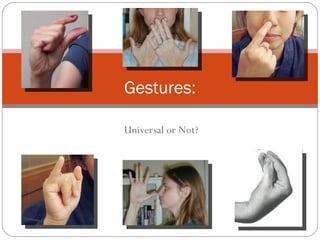
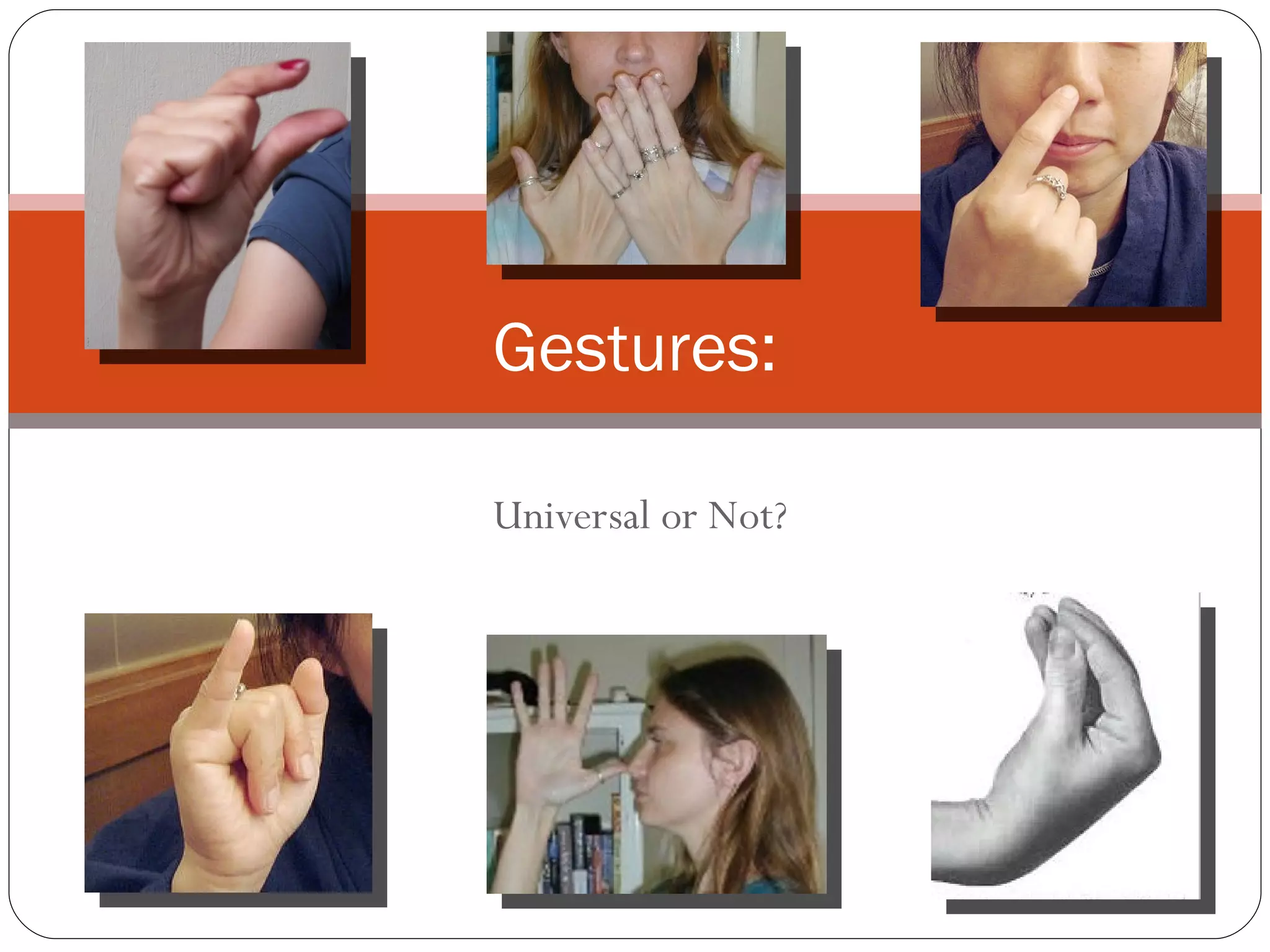
Gestures:

Universal or Not?
Background Data
 There have been many studies documenting the differences
  in gestures between languages.
 The same gesture can have different meanings in different
  languages.
 Also, the same concept can have different gestures across
  languages.
Previous Research
 By having native English and native Spanish speakers describe
  the same cartoon, McNeill found that the English speakers
  used more path descriptions accompanied by segmented and
  extreme gestures whereas Spanish speakers used more
  manner terms, less segmented and less extreme gestures.
More Research
 One observation that has been studied extensively is the
  difference between Italian and American gestures. Iverson et.
  Al. found that these differences influence language
  acquisition such that Italian children enter the two-word
  stage later than American children.
A bit more research
 Lastly, a study by Maynard found that Japanese speakers nod
  3 times as often in conversations. They nod at different parts
  in the sentence and possibly for different reasons.
Hypothesis
Gestures can be used to inform the listener about the speaker.

If gestures are specific to a language then English speakers will
   be able to identify other English speakers by their gestures.
Methods
 Showed subjects 6 YouTube videos featuring speakers of
  different languages.
 The clips had 10 – 30 seconds straight of gesturing that
  would allow us to cover the speaker’s faces
 Then we asked them the following questions:
Survey questions
 What is your native language?
 Do you speak any other languages?
 What gender are you?


 Are these people speaking English or not? Why?
Results
 Overall, the subjects were good at figuring out which
  speakers were not speaking English
 More Asians knew that the Asian videos were not English
  than any other ethnicity
 More people thought that French was English than British
  English
 Most people thought the American in the Italian setting was
  not speaking English
Results con’t.
 The subjects gave many reasons for why they chose English
  or non-English. Among the most common were:
   The speaker’s gestures reminded them of someone they knew
   Background
   Hand and arm movements (gestures)
Criteria for hand and arm movements
 Most of the no answers were because the gestures were too
  quick or too much.
 Most of the yes answers said that English gesturing is more
  informal, slower, calmer and smaller.
 Different subjects used the same criteria to draw different
  conclusions
Problems
 Did not counterbalance e.g. did not show videos in different
  orders.
 Didn’t control for setting e.g. different clothes, backgrounds
  etc.
 We didn’t specify which dialect of English we were asking
  about.
Conclusion
 Even though the subjects were not able to identify English
  speakers by their gestures they were able to identify non-
  English speakers by their gestures.
 Our most interesting finding was that there is a prevalent
  perception of what English gestures look like.

Gestures Presentation

  • 1.
  • 2.
    Background Data  Therehave been many studies documenting the differences in gestures between languages.  The same gesture can have different meanings in different languages.  Also, the same concept can have different gestures across languages.
  • 3.
    Previous Research  Byhaving native English and native Spanish speakers describe the same cartoon, McNeill found that the English speakers used more path descriptions accompanied by segmented and extreme gestures whereas Spanish speakers used more manner terms, less segmented and less extreme gestures.
  • 4.
    More Research  Oneobservation that has been studied extensively is the difference between Italian and American gestures. Iverson et. Al. found that these differences influence language acquisition such that Italian children enter the two-word stage later than American children.
  • 5.
    A bit moreresearch  Lastly, a study by Maynard found that Japanese speakers nod 3 times as often in conversations. They nod at different parts in the sentence and possibly for different reasons.
  • 6.
    Hypothesis Gestures can beused to inform the listener about the speaker. If gestures are specific to a language then English speakers will be able to identify other English speakers by their gestures.
  • 7.
    Methods  Showed subjects6 YouTube videos featuring speakers of different languages.  The clips had 10 – 30 seconds straight of gesturing that would allow us to cover the speaker’s faces  Then we asked them the following questions:
  • 8.
    Survey questions  Whatis your native language?  Do you speak any other languages?  What gender are you?  Are these people speaking English or not? Why?
  • 9.
    Results  Overall, thesubjects were good at figuring out which speakers were not speaking English  More Asians knew that the Asian videos were not English than any other ethnicity  More people thought that French was English than British English  Most people thought the American in the Italian setting was not speaking English
  • 10.
    Results con’t.  Thesubjects gave many reasons for why they chose English or non-English. Among the most common were:  The speaker’s gestures reminded them of someone they knew  Background  Hand and arm movements (gestures)
  • 11.
    Criteria for handand arm movements  Most of the no answers were because the gestures were too quick or too much.  Most of the yes answers said that English gesturing is more informal, slower, calmer and smaller.  Different subjects used the same criteria to draw different conclusions
  • 12.
    Problems  Did notcounterbalance e.g. did not show videos in different orders.  Didn’t control for setting e.g. different clothes, backgrounds etc.  We didn’t specify which dialect of English we were asking about.
  • 13.
    Conclusion  Even thoughthe subjects were not able to identify English speakers by their gestures they were able to identify non- English speakers by their gestures.  Our most interesting finding was that there is a prevalent perception of what English gestures look like.