GESTURES AND
EMOJIS
GROUP – 10
KADASI VINEETH JOSE - 21200025
LOKESH YERUBOTU - 21200011
S MANEESH WARRIER - 21200047
PRIYANKA S - 21200057
JITHU KIRAN K - 21200093
ARJUN S CHIDAMBARAM - 21200045
DEEPAK J PRASAD - 21200082
AJAI MOHAN - 21200055
NAMRATA SINKU - 21200002
SRINIVASAN MRIDHULA - 21200100
Introduction:
• The fundamental idea behind communication is to convey your
thoughts and have a meaningful discourse.
• Gestures have the power to act as effective tools of communication.
• On the other hand, emojis are a visual way of conveying emotion.
• Emojis are rapidly changing the nature of how we communicate.
They're breaking down language barriers and accelerating human
interaction.
Gestures
Lokesh Yerubotu-21200011
• A Gesture is a form of non-verbal communication or non-
vocal communication in which visible bodily actions communicate
particular messages, either in place of, or in conjunction with, speech.
• Gestures include movement of the hands, face, or other parts of the body.
• Gestures differ from physical non-verbal communication that does not
communicate specific messages, such as
purely expressive displays, proxemics, or displays of joint attention.
• Gestures allow individuals to communicate a variety of feelings and
thoughts, from contempt and hostility to approval and affection, often
together with body language in addition to words when they speak.
Lokesh Yerubotu-21200011
Informative
gestures
Communicative
gestures
Manual
gestures
Symbolic Deictic Motor Lexical
Lokesh Yerubotu-21200011
Gestures in our daily life
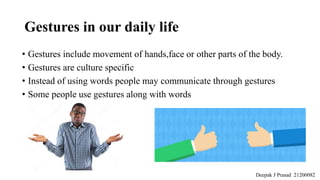
• Gestures include movement of hands,face or other parts of the body.
• Gestures are culture specific
• Instead of using words people may communicate through gestures
• Some people use gestures along with words
Deepak J Prasad 21200082
Power of Handshake
• Globally Widespread
Greeting or parting
Gesture
• “Let your handshake be a
greater bond than any
written contract.”
ARJUN S CHIDAMBARAM - 21200045
NAM-AS-TE
• The Indian Way Of
Greeting One Another
• Three syllables and one
simple word
ARJUN S CHIDAMBARAM - 21200045
MUDRAS
• Expressing
With Gesture
• Soul of Indian
Classical
Dance
ARJUN S CHIDAMBARAM - 21200045
THUMBS UP
A gesture used to indicate
satisfaction or approval.
S MANEESH WARRIER - 21200047
AJAI MOHAN
FACEPALM
A gesture used as an
expression of dismay,
exasperation or
embarrassment
S MANEESH WARRIER - 21200047
AJAI MOHAN
3-FINGERS GESTURE
A gesture used to express or
comment on something
which looks good or super.
S MANEESH WARRIER - 21200047
JITHU KIRAN K
Hand-on-mouth
Gesture used to express an
element of surprise.
S MANEESH WARRIER - 21200047
DEEPAK J PRASAD
Finger pointing
Gesture used to indicate
anger, generally threatening
or issuing a warning.
S MANEESH WARRIER - 21200047
DEEPAK J PRASAD
EMOJIS
• Emojis are ideograms and smileys used in electronic messages and
webpages. They exist in various genres, including facial expressions,
common objects, places and types of weather, and animals.
• They help in conveying our messages, so that misinterpretations do not
take place.
S MANEESH WARRIER - 21200047
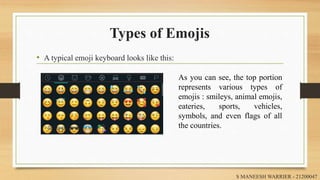
Types of Emojis
• A typical emoji keyboard looks like this:
As you can see, the top portion
represents various types of
emojis : smileys, animal emojis,
eateries, sports, vehicles,
symbols, and even flags of all
the countries.
S MANEESH WARRIER - 21200047
Emojis in Social Media
• We use emojis mostly in our social media applications and websites 60
million emojis are being sent daily on Facebook messenger alone, and
around the world, 250 to 350 emojis are tweeted per second.
• Emojis can convey the message in visual manner. Important social media
platforms like Whatsapp and Facebook have come up with a huge set of
emojis.
• Emojis can reduce your word count and make your text more
attractiveEmojis can even overcome the language barriers since they are
universal and can be interpreted by anyone.
JITHU KIRAN K
- 21200093
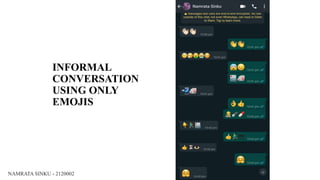
INFORMAL
CONVERSATION
USING ONLY
EMOJIS
NAMRATA SINKU - 2120002
CONCLUSION
Gestures :
• make the communication more effective and appealing
• helps communication possible even breaking language barriers
Emojis:
• emojis are the 21st Century’s digital answer to express emotions and
adding life to our messages
AJAI MOHAN - 21200055
Gestures and emojis

Gestures and emojis

  • 1.
    GESTURES AND EMOJIS GROUP –10 KADASI VINEETH JOSE - 21200025 LOKESH YERUBOTU - 21200011 S MANEESH WARRIER - 21200047 PRIYANKA S - 21200057 JITHU KIRAN K - 21200093 ARJUN S CHIDAMBARAM - 21200045 DEEPAK J PRASAD - 21200082 AJAI MOHAN - 21200055 NAMRATA SINKU - 21200002 SRINIVASAN MRIDHULA - 21200100
  • 2.
    Introduction: • The fundamentalidea behind communication is to convey your thoughts and have a meaningful discourse. • Gestures have the power to act as effective tools of communication. • On the other hand, emojis are a visual way of conveying emotion. • Emojis are rapidly changing the nature of how we communicate. They're breaking down language barriers and accelerating human interaction.
  • 3.
  • 4.
    • A Gestureis a form of non-verbal communication or non- vocal communication in which visible bodily actions communicate particular messages, either in place of, or in conjunction with, speech. • Gestures include movement of the hands, face, or other parts of the body. • Gestures differ from physical non-verbal communication that does not communicate specific messages, such as purely expressive displays, proxemics, or displays of joint attention. • Gestures allow individuals to communicate a variety of feelings and thoughts, from contempt and hostility to approval and affection, often together with body language in addition to words when they speak. Lokesh Yerubotu-21200011
  • 5.
  • 6.
    Gestures in ourdaily life • Gestures include movement of hands,face or other parts of the body. • Gestures are culture specific • Instead of using words people may communicate through gestures • Some people use gestures along with words Deepak J Prasad 21200082
  • 7.
  • 8.
    Power of Handshake •Globally Widespread Greeting or parting Gesture • “Let your handshake be a greater bond than any written contract.” ARJUN S CHIDAMBARAM - 21200045
  • 9.
    NAM-AS-TE • The IndianWay Of Greeting One Another • Three syllables and one simple word ARJUN S CHIDAMBARAM - 21200045
  • 10.
    MUDRAS • Expressing With Gesture •Soul of Indian Classical Dance ARJUN S CHIDAMBARAM - 21200045
  • 11.
    THUMBS UP A gestureused to indicate satisfaction or approval. S MANEESH WARRIER - 21200047 AJAI MOHAN
  • 12.
    FACEPALM A gesture usedas an expression of dismay, exasperation or embarrassment S MANEESH WARRIER - 21200047 AJAI MOHAN
  • 13.
    3-FINGERS GESTURE A gestureused to express or comment on something which looks good or super. S MANEESH WARRIER - 21200047 JITHU KIRAN K
  • 14.
    Hand-on-mouth Gesture used toexpress an element of surprise. S MANEESH WARRIER - 21200047 DEEPAK J PRASAD
  • 15.
    Finger pointing Gesture usedto indicate anger, generally threatening or issuing a warning. S MANEESH WARRIER - 21200047 DEEPAK J PRASAD
  • 16.
    EMOJIS • Emojis areideograms and smileys used in electronic messages and webpages. They exist in various genres, including facial expressions, common objects, places and types of weather, and animals. • They help in conveying our messages, so that misinterpretations do not take place. S MANEESH WARRIER - 21200047
  • 17.
    Types of Emojis •A typical emoji keyboard looks like this: As you can see, the top portion represents various types of emojis : smileys, animal emojis, eateries, sports, vehicles, symbols, and even flags of all the countries. S MANEESH WARRIER - 21200047
  • 18.
    Emojis in SocialMedia • We use emojis mostly in our social media applications and websites 60 million emojis are being sent daily on Facebook messenger alone, and around the world, 250 to 350 emojis are tweeted per second. • Emojis can convey the message in visual manner. Important social media platforms like Whatsapp and Facebook have come up with a huge set of emojis. • Emojis can reduce your word count and make your text more attractiveEmojis can even overcome the language barriers since they are universal and can be interpreted by anyone.
  • 19.
  • 20.
  • 21.
    CONCLUSION Gestures : • makethe communication more effective and appealing • helps communication possible even breaking language barriers Emojis: • emojis are the 21st Century’s digital answer to express emotions and adding life to our messages AJAI MOHAN - 21200055