The Gerund &
Gerundive!
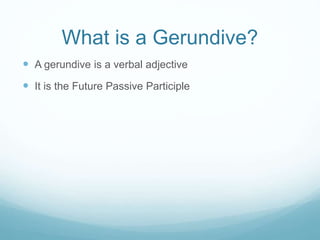
What is a Gerundive?
 A gerundive is a verbal adjective
 It is the Future Passive Participle
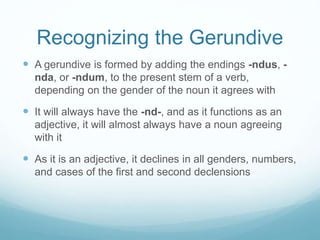
Recognizing the Gerundive
 A gerundive is formed by adding the endings -ndus, -
nda, or -ndum, to the present stem of a verb,
depending on the gender of the noun it agrees with
 It will always have the -nd-, and as it functions as an
adjective, it will almost always have a noun agreeing
with it
 As it is an adjective, it declines in all genders, numbers,
and cases of the first and second declensions
The Functions of the
Gerundive
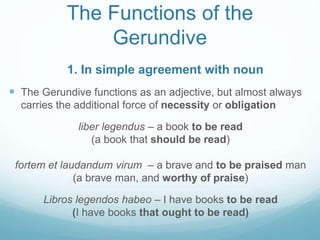
 The Gerundive functions as an adjective, but almost always
carries the additional force of necessity or obligation
liber legendus – a book to be read
(a book that should be read)
fortem et laudandum virum – a brave and to be praised man
(a brave man, and worthy of praise)
Libros legendos habeo – I have books to be read
(I have books that ought to be read)
1. In simple agreement with noun
The Functions of the
Gerundive
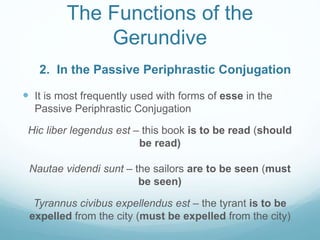
 It is most frequently used with forms of esse in the
Passive Periphrastic Conjugation
Hic liber legendus est – this book is to be read (should
be read)
Nautae videndi sunt – the sailors are to be seen (must
be seen)
Tyrannus civibus expellendus est – the tyrant is to be
expelled from the city (must be expelled from the city)
2. In the Passive Periphrastic Conjugation
The Functions of the
Gerundive
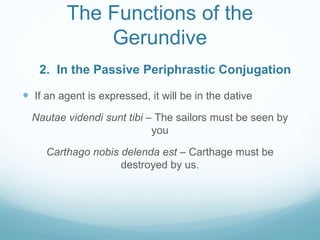
 If an agent is expressed, it will be in the dative
Nautae videndi sunt tibi – The sailors must be seen by
you
Carthago nobis delenda est – Carthage must be
destroyed by us.
2. In the Passive Periphrastic Conjugation
The Functions of the
Gerundive
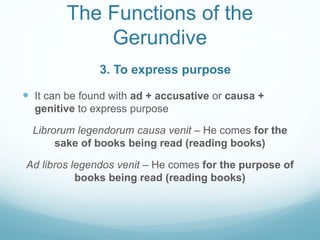
 It can be found with ad + accusative or causa +
genitive to express purpose
Librorum legendorum causa venit – He comes for the
sake of books being read (reading books)
Ad libros legendos venit – He comes for the purpose of
books being read (reading books)
3. To express purpose
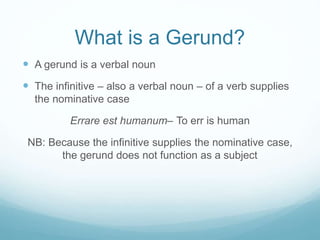
What is a Gerund?
 A gerund is a verbal noun
 The infinitive – also a verbal noun – of a verb supplies
the nominative case
Errare est humanum– To err is human
NB: Because the infinitive supplies the nominative case,
the gerund does not function as a subject
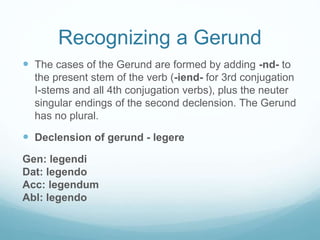
Recognizing a Gerund
 The cases of the Gerund are formed by adding -nd- to
the present stem of the verb (-iend- for 3rd conjugation
I-stems and all 4th conjugation verbs), plus the neuter
singular endings of the second declension. The Gerund
has no plural.
 Declension of gerund - legere
Gen: legendi
Dat: legendo
Acc: legendum
Abl: legendo
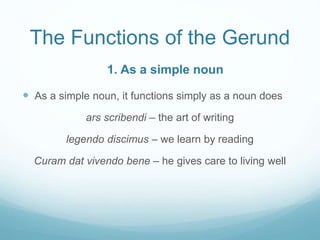
The Functions of the Gerund
 As a simple noun, it functions simply as a noun does
ars scribendi – the art of writing
legendo discimus – we learn by reading
Curam dat vivendo bene – he gives care to living well
1. As a simple noun
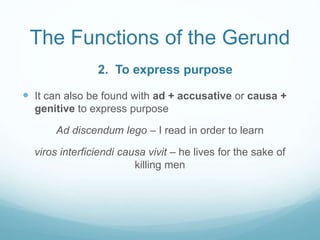
The Functions of the Gerund
 It can also be found with ad + accusative or causa +
genitive to express purpose
Ad discendum lego – I read in order to learn
viros interficiendi causa vivit – he lives for the sake of
killing men
2. To express purpose
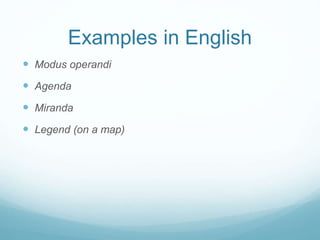
Examples in English
 Modus operandi
 Agenda
 Miranda
 Legend (on a map)

Gerund and gerundives

  • 1.
  • 2.
    What is aGerundive?  A gerundive is a verbal adjective  It is the Future Passive Participle
  • 3.
    Recognizing the Gerundive A gerundive is formed by adding the endings -ndus, - nda, or -ndum, to the present stem of a verb, depending on the gender of the noun it agrees with  It will always have the -nd-, and as it functions as an adjective, it will almost always have a noun agreeing with it  As it is an adjective, it declines in all genders, numbers, and cases of the first and second declensions
  • 4.
    The Functions ofthe Gerundive  The Gerundive functions as an adjective, but almost always carries the additional force of necessity or obligation liber legendus – a book to be read (a book that should be read) fortem et laudandum virum – a brave and to be praised man (a brave man, and worthy of praise) Libros legendos habeo – I have books to be read (I have books that ought to be read) 1. In simple agreement with noun
  • 5.
    The Functions ofthe Gerundive  It is most frequently used with forms of esse in the Passive Periphrastic Conjugation Hic liber legendus est – this book is to be read (should be read) Nautae videndi sunt – the sailors are to be seen (must be seen) Tyrannus civibus expellendus est – the tyrant is to be expelled from the city (must be expelled from the city) 2. In the Passive Periphrastic Conjugation
  • 6.
    The Functions ofthe Gerundive  If an agent is expressed, it will be in the dative Nautae videndi sunt tibi – The sailors must be seen by you Carthago nobis delenda est – Carthage must be destroyed by us. 2. In the Passive Periphrastic Conjugation
  • 7.
    The Functions ofthe Gerundive  It can be found with ad + accusative or causa + genitive to express purpose Librorum legendorum causa venit – He comes for the sake of books being read (reading books) Ad libros legendos venit – He comes for the purpose of books being read (reading books) 3. To express purpose
  • 8.
    What is aGerund?  A gerund is a verbal noun  The infinitive – also a verbal noun – of a verb supplies the nominative case Errare est humanum– To err is human NB: Because the infinitive supplies the nominative case, the gerund does not function as a subject
  • 9.
    Recognizing a Gerund The cases of the Gerund are formed by adding -nd- to the present stem of the verb (-iend- for 3rd conjugation I-stems and all 4th conjugation verbs), plus the neuter singular endings of the second declension. The Gerund has no plural.  Declension of gerund - legere Gen: legendi Dat: legendo Acc: legendum Abl: legendo
  • 10.
    The Functions ofthe Gerund  As a simple noun, it functions simply as a noun does ars scribendi – the art of writing legendo discimus – we learn by reading Curam dat vivendo bene – he gives care to living well 1. As a simple noun
  • 11.
    The Functions ofthe Gerund  It can also be found with ad + accusative or causa + genitive to express purpose Ad discendum lego – I read in order to learn viros interficiendi causa vivit – he lives for the sake of killing men 2. To express purpose
  • 12.
    Examples in English Modus operandi  Agenda  Miranda  Legend (on a map)

Editor's Notes

  • #5 It does not function exactly as English does, so here is where you make it work -