MARKET OVERVIEW
Company Formation
• Establishment of a “GmbH”
• Steps for formation of “GmbH”
• Taxation Of Corporations
• Incentives
• ESTABLISHMENT OF A GMBH
– High flexibility and few obligations.
– At least one shareholder (private individual or legal
entity) is required in order to establish a GmbH.
– Two mandatory corporate bodies.
• Main Body (shareholder(s))
• Executive body (managing director(s))
– The company must have a physical German
business address and at least a local
representative.
– The GmbH requires a minimum share capital of
EUR25,000. It can be contributed in cash or in kind
(e.g. real estate or patents). Liability is limited to the
corporation‘s business assets including share
capital.
Establishment of
a “GmbH”
Company Formation
• Establishment of a “GmbH”
• Steps for formation of “GmbH”
• Taxation Of Corporations
• Incentives
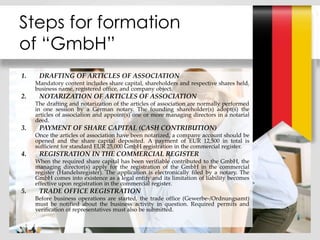
1. DRAFTING OF ARTICLES OF ASSOCIATION
Mandatory content includes share capital, shareholders and respective shares held,
business name, registered office, and company object.
2. NOTARIZATION OF ARTICLES OF ASSOCIATION
The drafting and notarization of the articles of association are normally performed
in one session by a German notary. The founding shareholder(s) adopt(s) the
articles of association and appoint(s) one or more managing directors in a notarial
deed.
3. PAYMENT OF SHARE CAPITAL (CASH CONTRIBUTION)
Once the articles of association have been notarized, a company account should be
opened and the share capital deposited. A payment of EUR 12,500 in total is
sufficient for standard EUR 25,000 GmbH registration in the commercial register.
4. REGISTRATION IN THE COMMERCIAL REGISTER
When the required share capital has been verifiable contributed to the GmbH, the
managing director(s) apply for the registration of the GmbH in the commercial
register (Handelsregister). The application is electronically filed by a notary. The
GmbH comes into existence as a legal entity and its limitation of liability becomes
effective upon registration in the commercial register.
5. TRADE OFFICE REGISTRATION
Before business operations are started, the trade office (Gewerbe-/Ordnungsamt)
must be notified about the business activity in question. Required permits and
verification of representatives must also be submitted.
Steps for formation
of “GmbH”
Company Formation
• Establishment of a “GmbH”
• Steps for formation of “GmbH”
• Taxation Of Corporations
• Incentives
Taxation Of
Corporations
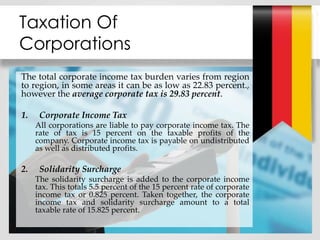
The total corporate income tax burden varies from region
to region, in some areas it can be as low as 22.83 percent.,
however the average corporate tax is 29.83 percent.
1. Corporate Income Tax
All corporations are liable to pay corporate income tax. The
rate of tax is 15 percent on the taxable profits of the
company. Corporate income tax is payable on undistributed
as well as distributed profits.
2. Solidarity Surcharge
The solidarity surcharge is added to the corporate income
tax. This totals 5.5 percent of the 15 percent rate of corporate
income tax or 0.825 percent. Taken together, the corporate
income tax and solidarity surcharge amount to a total
taxable rate of 15.825 percent.
Taxation Of
Corporations
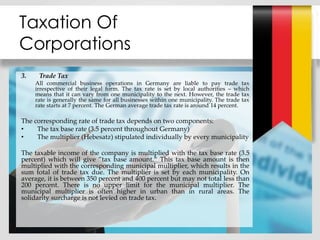
3. Trade Tax
All commercial business operations in Germany are liable to pay trade tax
irrespective of their legal form. The tax rate is set by local authorities – which
means that it can vary from one municipality to the next. However, the trade tax
rate is generally the same for all businesses within one municipality. The trade tax
rate starts at 7 percent. The German average trade tax rate is around 14 percent.
The corresponding rate of trade tax depends on two components:
• The tax base rate (3.5 percent throughout Germany)
• The multiplier (Hebesatz) stipulated individually by every municipality
The taxable income of the company is multiplied with the tax base rate (3.5
percent) which will give ”tax base amount.“ This tax base amount is then
multiplied with the corresponding municipal multiplier, which results in the
sum total of trade tax due. The multiplier is set by each municipality. On
average, it is between 350 percent and 400 percent but may not total less than
200 percent. There is no upper limit for the municipal multiplier. The
municipal multiplier is often higher in urban than in rural areas. The
solidarity surcharge is not levied on trade tax.
Taxation Of
Corporations
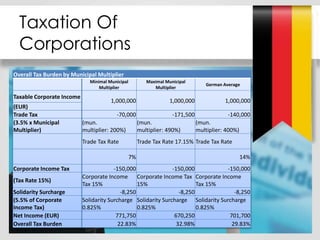
Overall Tax Burden by Municipal Multiplier
Minimal Municipal
Multiplier
Maximal Municipal
Multiplier
German Average
Taxable Corporate Income
1,000,000 1,000,000 1,000,000
(EUR)
Trade Tax -70,000 -171,500 -140,000
(3.5% x Municipal
Multiplier)
(mun.
multiplier: 200%)
(mun.
multiplier: 490%)
(mun.
multiplier: 400%)
Trade Tax Rate Trade Tax Rate 17.15% Trade Tax Rate
7% 14%
Corporate Income Tax -150,000 -150,000 -150,000
(Tax Rate 15%)
Corporate Income
Tax 15%
Corporate Income Tax
15%
Corporate Income
Tax 15%
Solidarity Surcharge -8,250 -8,250 -8,250
(5.5% of Corporate
Income Tax)
Solidarity Surcharge
0.825%
Solidarity Surcharge
0.825%
Solidarity Surcharge
0.825%
Net Income (EUR) 771,750 670,250 701,700
Overall Tax Burden 22.83% 32.98% 29.83%
Company Formation
• Establishment of a “GmbH”
• Steps for formation of “GmbH”
• Taxation Of Corporations
• Incentives
Incentives
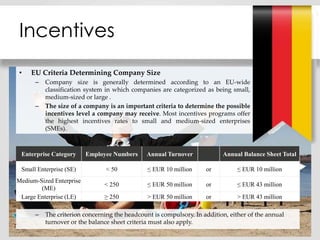
• EU Criteria Determining Company Size
– Company size is generally determined according to an EU-wide
classification system in which companies are categorized as being small,
medium-sized or large .
– The size of a company is an important criteria to determine the possible
incentives level a company may receive. Most incentives programs offer
the highest incentives rates to small and medium-sized enterprises
(SMEs).
Enterprise Category Employee Numbers Annual Turnover Annual Balance Sheet Total
Small Enterprise (SE) < 50 ≤ EUR 10 million or ≤ EUR 10 million
Medium-Sized Enterprise
(ME)
< 250 ≤ EUR 50 million or ≤ EUR 43 million
Large Enterprise (LE) ≥ 250 > EUR 50 million or > EUR 43 million
– The criterion concerning the headcount is compulsory. In addition, either of the annual
turnover or the balance sheet criteria must also apply.
Incentives
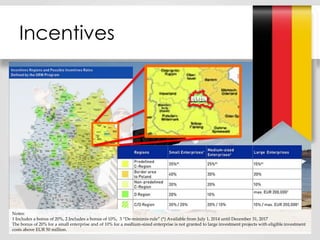
Notes:
1 Includes a bonus of 20%, 2 Includes a bonus of 10%, 3 “De-minimis-rule” (*) Available from July 1, 2014 until December 31, 2017
The bonus of 20% for a small enterprise and of 10% for a medium-sized enterprise is not granted to large investment projects with eligible investment
costs above EUR 50 million.
Agenda
• Germany: An Overview
• Economy & Investment Overview
• Business Environment: Germany
• Innovation & Technology
• Labour Market & Population Skill Set
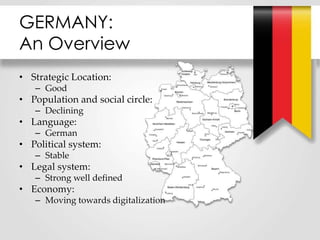
GERMANY:
An Overview
• Strategic Location:
– Good
• Population and social circle:
– Declining
• Language:
– German
• Political system:
– Stable
• Legal system:
– Strong well defined
• Economy:
– Moving towards digitalization
Agenda
• Germany: An Overview
• Economy & Investment Overview
• Business Environment: Germany
• Innovation & Technology
• Labour Market & Population Skill Set
Economy & Investment
Overview
• ECONOMIC CLIMATE
– Social market and free spirited, but
under strict and legal administrative
control.
– Laws against unfair competition.
– Highly motivated, well-trained and
disciplined work force.
– Well-established trade union to
safeguard protection for employees.
– The labor force - 41.2 million gainfully
employed by 3.6 million enterprises.
Economy & Investment
Overview
• FOREIGN INVESTMENT
– Worldwide important investment location. No 5
worldwide ( 2012)
– New investments on high level and stable.
– The foreign direct investment inflows:
2008 – 8.1 USD Billion
2009 – 22.5 USD Billion
2010 – 65.6 USD Billion
2011 – 59.4 USD Billion
Though Germany saw a fall in FDI in 2012 but then
again rose in 2013 and 2014.
– Most important industries for foreign investments
: ICT, software & Services, automotive, machine
building, chemistry.
Economy & Investment
Overview
• LOCAL CONSIDERATIONS
– No free trade or privileged economic zones
within Germany.
– There is an arrangement for exempting IT and
certain other skilled employees from non-EU
countries
– There is no hindrance to obtaining in-depth
marketing information, initiating searches for
potential investment targets, or to obtaining
the necessary outside professional support for
the solution of complex problems.
Agenda
• Germany: An Overview
• Economy & Investment Overview
• Business Environment: Germany
• Innovation & Technology
• Labour Market & Population Skill Set
Business Environment:
Germany
• KEY FACTS:
– Germany ranked 4th out of 148 economies, demonstrating
its attractive business environment. (GCI) 2013;
– Fiscal discipline resulted in 0.0% in its general
government net budget in 2013, versus a deficit of 4.2%
of total GDP in 2010;
– Taxes hamper Germany’s competitiveness, at total tax
rate equated to 49.4% of commercial profits, higher than
the OECD average of 41.3%, according to the World
Bank’s Ease of Doing Business (Doing Business) 2014
report;
– R&D expenditure amounting to 3.0% of total GDP in
2013, above the EU average of 2.1%.
– 26.4% of the German population aged 15+ attained higher
education, above the 2013 EU average of 21.5% in 2013.
– Healthy GDP per person employed standing at
US$80,620 in 2013, above the EU average of US$71,350.
Business Environment:
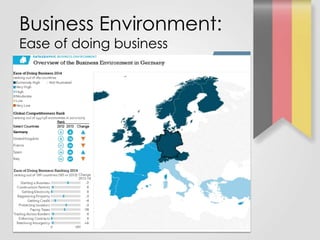
Ease of doing business
Business Environment:
OPERATING ENVIRONMENT
• EASE OF DOING BUSINESS
– Germany ranked 21st out of 189 countries, versus 19th
out of 185 countries in the previous year.
– Germany’s worst category was “Starting a Business”
(111th) which is incongruent with the country’s image as a
highly efficient economy.
– Dropped from 104th out of 185 countries in Doing
Business 2013, as no further reforms were undertaken in
this area and Eurozone uncertainty adversely impacted
Germany’s business environment.
– The time taken to start a business and associated costs of
14.5 days and 4.7% of income per capita respectively,
versus 11.1 and 3.6% for the OECD average respectively
and is done in 9 different procedures.
Business Environment:
TAX ENVIRONMENT
• TAX Rates
– Effective corporation tax rate is between 30% and 33%(2014),
depending on surcharges and trade tax.
– The total tax rate equated to 49.4% of commercial profits,
somewhat higher than the OECD average of 41.3%.
– Whilst labour tax and contributions were 21.8% of
commercial profits, compared with 23.1% for the regional
average.
– The standard value-added-tax (VAT) is 19.0% (2014), with a
reduced rate of 7.0% applicable on certain goods and
services, books, hotel accommodation, food and agricultural
produce.
– VAT exemption on Land, buildings, financial transactions,
medical services, education and insurance.
Agenda
• Germany: An Overview
• Economy & Investment Overview
• Business Environment: Germany
• Innovation & Technology
• Labour Market & Population Skill Set
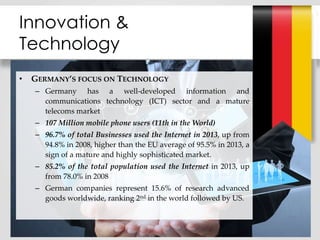
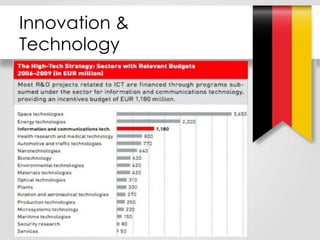
• GERMANY’S FOCUS ON TECHNOLOGY
– Germany has a well-developed information and
communications technology (ICT) sector and a mature
telecoms market
– 107 Million mobile phone users (11th in the World)
– 96.7% of total Businesses used the Internet in 2013, up from
94.8% in 2008, higher than the EU average of 95.5% in 2013, a
sign of a mature and highly sophisticated market.
– 85.2% of the total population used the Internet in 2013, up
from 78.0% in 2008
– German companies represent 15.6% of research advanced
goods worldwide, ranking 2nd in the world followed by US.
Innovation &
Technology
Innovation &
Technology
Agenda
• Germany: An Overview
• Economy & Investment Overview
• Business Environment: Germany
• Innovation & Technology
• Labour Market & Population Skill Set
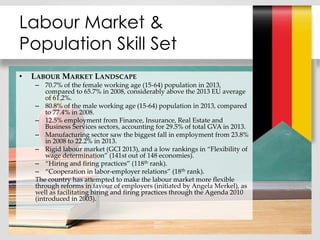
• LABOUR MARKET LANDSCAPE
– 70.7% of the female working age (15-64) population in 2013,
compared to 65.7% in 2008, considerably above the 2013 EU average
of 61.2%.
– 80.8% of the male working age (15-64) population in 2013, compared
to 77.4% in 2008.
– 12.5% employment from Finance, Insurance, Real Estate and
Business Services sectors, accounting for 29.5% of total GVA in 2013.
– Manufacturing sector saw the biggest fall in employment from 23.8%
in 2008 to 22.2% in 2013.
– Rigid labour market (GCI 2013), and a low rankings in “Flexibility of
wage determination” (141st out of 148 economies).
– “Hiring and firing practices” (118th rank).
– “Cooperation in labor-employer relations” (18th rank).
The country has attempted to make the labour market more flexible
through reforms in favour of employers (initiated by Angela Merkel), as
well as facilitating hiring and firing practices through the Agenda 2010
(introduced in 2003).
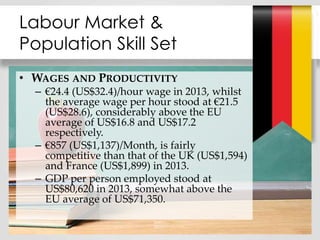
Labour Market &
Population Skill Set
• WAGES AND PRODUCTIVITY
– €24.4 (US$32.4)/hour wage in 2013, whilst
the average wage per hour stood at €21.5
(US$28.6), considerably above the EU
average of US$16.8 and US$17.2
respectively.
– €857 (US$1,137)/Month, is fairly
competitive than that of the UK (US$1,594)
and France (US$1,899) in 2013.
– GDP per person employed stood at
US$80,620 in 2013, somewhat above the
EU average of US$71,350.
Labour Market &
Population Skill Set
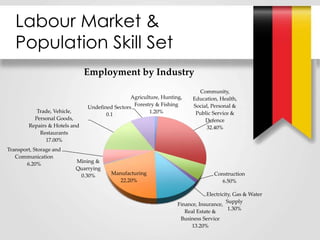
Labour Market &
Population Skill Set
Agriculture, Hunting,
Forestry & Fishing
1.20%
Community,
Education, Health,
Social, Personal &
Public Service &
Defence
32.40%
Construction
6.50%
Electricity, Gas & Water
Supply
1.30%
Finance, Insurance,
Real Estate &
Business Service
13.20%
Manufacturing
22.20%
Mining &
Quarrying
0.30%
Transport, Storage and
Communication
6.20%
Trade, Vehicle,
Personal Goods,
Repairs & Hotels and
Restaurants
17.00%
Undefined Sectors
0.1
Employment by Industry
Author: Rahil Pathan
Email – rahil.pathan@cahead.com
Business Executive
C Ahead Info Technologies India Pvt. Ltd.

Germany Market Overview

  • 1.
  • 2.
    Company Formation • Establishmentof a “GmbH” • Steps for formation of “GmbH” • Taxation Of Corporations • Incentives
  • 3.
    • ESTABLISHMENT OFA GMBH – High flexibility and few obligations. – At least one shareholder (private individual or legal entity) is required in order to establish a GmbH. – Two mandatory corporate bodies. • Main Body (shareholder(s)) • Executive body (managing director(s)) – The company must have a physical German business address and at least a local representative. – The GmbH requires a minimum share capital of EUR25,000. It can be contributed in cash or in kind (e.g. real estate or patents). Liability is limited to the corporation‘s business assets including share capital. Establishment of a “GmbH”
  • 4.
    Company Formation • Establishmentof a “GmbH” • Steps for formation of “GmbH” • Taxation Of Corporations • Incentives
  • 5.
    1. DRAFTING OFARTICLES OF ASSOCIATION Mandatory content includes share capital, shareholders and respective shares held, business name, registered office, and company object. 2. NOTARIZATION OF ARTICLES OF ASSOCIATION The drafting and notarization of the articles of association are normally performed in one session by a German notary. The founding shareholder(s) adopt(s) the articles of association and appoint(s) one or more managing directors in a notarial deed. 3. PAYMENT OF SHARE CAPITAL (CASH CONTRIBUTION) Once the articles of association have been notarized, a company account should be opened and the share capital deposited. A payment of EUR 12,500 in total is sufficient for standard EUR 25,000 GmbH registration in the commercial register. 4. REGISTRATION IN THE COMMERCIAL REGISTER When the required share capital has been verifiable contributed to the GmbH, the managing director(s) apply for the registration of the GmbH in the commercial register (Handelsregister). The application is electronically filed by a notary. The GmbH comes into existence as a legal entity and its limitation of liability becomes effective upon registration in the commercial register. 5. TRADE OFFICE REGISTRATION Before business operations are started, the trade office (Gewerbe-/Ordnungsamt) must be notified about the business activity in question. Required permits and verification of representatives must also be submitted. Steps for formation of “GmbH”
  • 6.
    Company Formation • Establishmentof a “GmbH” • Steps for formation of “GmbH” • Taxation Of Corporations • Incentives
  • 7.
    Taxation Of Corporations The totalcorporate income tax burden varies from region to region, in some areas it can be as low as 22.83 percent., however the average corporate tax is 29.83 percent. 1. Corporate Income Tax All corporations are liable to pay corporate income tax. The rate of tax is 15 percent on the taxable profits of the company. Corporate income tax is payable on undistributed as well as distributed profits. 2. Solidarity Surcharge The solidarity surcharge is added to the corporate income tax. This totals 5.5 percent of the 15 percent rate of corporate income tax or 0.825 percent. Taken together, the corporate income tax and solidarity surcharge amount to a total taxable rate of 15.825 percent.
  • 8.
    Taxation Of Corporations 3. TradeTax All commercial business operations in Germany are liable to pay trade tax irrespective of their legal form. The tax rate is set by local authorities – which means that it can vary from one municipality to the next. However, the trade tax rate is generally the same for all businesses within one municipality. The trade tax rate starts at 7 percent. The German average trade tax rate is around 14 percent. The corresponding rate of trade tax depends on two components: • The tax base rate (3.5 percent throughout Germany) • The multiplier (Hebesatz) stipulated individually by every municipality The taxable income of the company is multiplied with the tax base rate (3.5 percent) which will give ”tax base amount.“ This tax base amount is then multiplied with the corresponding municipal multiplier, which results in the sum total of trade tax due. The multiplier is set by each municipality. On average, it is between 350 percent and 400 percent but may not total less than 200 percent. There is no upper limit for the municipal multiplier. The municipal multiplier is often higher in urban than in rural areas. The solidarity surcharge is not levied on trade tax.
  • 9.
    Taxation Of Corporations Overall TaxBurden by Municipal Multiplier Minimal Municipal Multiplier Maximal Municipal Multiplier German Average Taxable Corporate Income 1,000,000 1,000,000 1,000,000 (EUR) Trade Tax -70,000 -171,500 -140,000 (3.5% x Municipal Multiplier) (mun. multiplier: 200%) (mun. multiplier: 490%) (mun. multiplier: 400%) Trade Tax Rate Trade Tax Rate 17.15% Trade Tax Rate 7% 14% Corporate Income Tax -150,000 -150,000 -150,000 (Tax Rate 15%) Corporate Income Tax 15% Corporate Income Tax 15% Corporate Income Tax 15% Solidarity Surcharge -8,250 -8,250 -8,250 (5.5% of Corporate Income Tax) Solidarity Surcharge 0.825% Solidarity Surcharge 0.825% Solidarity Surcharge 0.825% Net Income (EUR) 771,750 670,250 701,700 Overall Tax Burden 22.83% 32.98% 29.83%
  • 10.
    Company Formation • Establishmentof a “GmbH” • Steps for formation of “GmbH” • Taxation Of Corporations • Incentives
  • 11.
    Incentives • EU CriteriaDetermining Company Size – Company size is generally determined according to an EU-wide classification system in which companies are categorized as being small, medium-sized or large . – The size of a company is an important criteria to determine the possible incentives level a company may receive. Most incentives programs offer the highest incentives rates to small and medium-sized enterprises (SMEs). Enterprise Category Employee Numbers Annual Turnover Annual Balance Sheet Total Small Enterprise (SE) < 50 ≤ EUR 10 million or ≤ EUR 10 million Medium-Sized Enterprise (ME) < 250 ≤ EUR 50 million or ≤ EUR 43 million Large Enterprise (LE) ≥ 250 > EUR 50 million or > EUR 43 million – The criterion concerning the headcount is compulsory. In addition, either of the annual turnover or the balance sheet criteria must also apply.
  • 12.
    Incentives Notes: 1 Includes abonus of 20%, 2 Includes a bonus of 10%, 3 “De-minimis-rule” (*) Available from July 1, 2014 until December 31, 2017 The bonus of 20% for a small enterprise and of 10% for a medium-sized enterprise is not granted to large investment projects with eligible investment costs above EUR 50 million.
  • 13.
    Agenda • Germany: AnOverview • Economy & Investment Overview • Business Environment: Germany • Innovation & Technology • Labour Market & Population Skill Set
  • 14.
    GERMANY: An Overview • StrategicLocation: – Good • Population and social circle: – Declining • Language: – German • Political system: – Stable • Legal system: – Strong well defined • Economy: – Moving towards digitalization
  • 15.
    Agenda • Germany: AnOverview • Economy & Investment Overview • Business Environment: Germany • Innovation & Technology • Labour Market & Population Skill Set
  • 16.
    Economy & Investment Overview •ECONOMIC CLIMATE – Social market and free spirited, but under strict and legal administrative control. – Laws against unfair competition. – Highly motivated, well-trained and disciplined work force. – Well-established trade union to safeguard protection for employees. – The labor force - 41.2 million gainfully employed by 3.6 million enterprises.
  • 17.
    Economy & Investment Overview •FOREIGN INVESTMENT – Worldwide important investment location. No 5 worldwide ( 2012) – New investments on high level and stable. – The foreign direct investment inflows: 2008 – 8.1 USD Billion 2009 – 22.5 USD Billion 2010 – 65.6 USD Billion 2011 – 59.4 USD Billion Though Germany saw a fall in FDI in 2012 but then again rose in 2013 and 2014. – Most important industries for foreign investments : ICT, software & Services, automotive, machine building, chemistry.
  • 18.
    Economy & Investment Overview •LOCAL CONSIDERATIONS – No free trade or privileged economic zones within Germany. – There is an arrangement for exempting IT and certain other skilled employees from non-EU countries – There is no hindrance to obtaining in-depth marketing information, initiating searches for potential investment targets, or to obtaining the necessary outside professional support for the solution of complex problems.
  • 19.
    Agenda • Germany: AnOverview • Economy & Investment Overview • Business Environment: Germany • Innovation & Technology • Labour Market & Population Skill Set
  • 20.
    Business Environment: Germany • KEYFACTS: – Germany ranked 4th out of 148 economies, demonstrating its attractive business environment. (GCI) 2013; – Fiscal discipline resulted in 0.0% in its general government net budget in 2013, versus a deficit of 4.2% of total GDP in 2010; – Taxes hamper Germany’s competitiveness, at total tax rate equated to 49.4% of commercial profits, higher than the OECD average of 41.3%, according to the World Bank’s Ease of Doing Business (Doing Business) 2014 report; – R&D expenditure amounting to 3.0% of total GDP in 2013, above the EU average of 2.1%. – 26.4% of the German population aged 15+ attained higher education, above the 2013 EU average of 21.5% in 2013. – Healthy GDP per person employed standing at US$80,620 in 2013, above the EU average of US$71,350.
  • 21.
  • 22.
    Business Environment: OPERATING ENVIRONMENT •EASE OF DOING BUSINESS – Germany ranked 21st out of 189 countries, versus 19th out of 185 countries in the previous year. – Germany’s worst category was “Starting a Business” (111th) which is incongruent with the country’s image as a highly efficient economy. – Dropped from 104th out of 185 countries in Doing Business 2013, as no further reforms were undertaken in this area and Eurozone uncertainty adversely impacted Germany’s business environment. – The time taken to start a business and associated costs of 14.5 days and 4.7% of income per capita respectively, versus 11.1 and 3.6% for the OECD average respectively and is done in 9 different procedures.
  • 23.
    Business Environment: TAX ENVIRONMENT •TAX Rates – Effective corporation tax rate is between 30% and 33%(2014), depending on surcharges and trade tax. – The total tax rate equated to 49.4% of commercial profits, somewhat higher than the OECD average of 41.3%. – Whilst labour tax and contributions were 21.8% of commercial profits, compared with 23.1% for the regional average. – The standard value-added-tax (VAT) is 19.0% (2014), with a reduced rate of 7.0% applicable on certain goods and services, books, hotel accommodation, food and agricultural produce. – VAT exemption on Land, buildings, financial transactions, medical services, education and insurance.
  • 24.
    Agenda • Germany: AnOverview • Economy & Investment Overview • Business Environment: Germany • Innovation & Technology • Labour Market & Population Skill Set
  • 25.
    • GERMANY’S FOCUSON TECHNOLOGY – Germany has a well-developed information and communications technology (ICT) sector and a mature telecoms market – 107 Million mobile phone users (11th in the World) – 96.7% of total Businesses used the Internet in 2013, up from 94.8% in 2008, higher than the EU average of 95.5% in 2013, a sign of a mature and highly sophisticated market. – 85.2% of the total population used the Internet in 2013, up from 78.0% in 2008 – German companies represent 15.6% of research advanced goods worldwide, ranking 2nd in the world followed by US. Innovation & Technology
  • 26.
  • 27.
    Agenda • Germany: AnOverview • Economy & Investment Overview • Business Environment: Germany • Innovation & Technology • Labour Market & Population Skill Set
  • 28.
    • LABOUR MARKETLANDSCAPE – 70.7% of the female working age (15-64) population in 2013, compared to 65.7% in 2008, considerably above the 2013 EU average of 61.2%. – 80.8% of the male working age (15-64) population in 2013, compared to 77.4% in 2008. – 12.5% employment from Finance, Insurance, Real Estate and Business Services sectors, accounting for 29.5% of total GVA in 2013. – Manufacturing sector saw the biggest fall in employment from 23.8% in 2008 to 22.2% in 2013. – Rigid labour market (GCI 2013), and a low rankings in “Flexibility of wage determination” (141st out of 148 economies). – “Hiring and firing practices” (118th rank). – “Cooperation in labor-employer relations” (18th rank). The country has attempted to make the labour market more flexible through reforms in favour of employers (initiated by Angela Merkel), as well as facilitating hiring and firing practices through the Agenda 2010 (introduced in 2003). Labour Market & Population Skill Set
  • 29.
    • WAGES ANDPRODUCTIVITY – €24.4 (US$32.4)/hour wage in 2013, whilst the average wage per hour stood at €21.5 (US$28.6), considerably above the EU average of US$16.8 and US$17.2 respectively. – €857 (US$1,137)/Month, is fairly competitive than that of the UK (US$1,594) and France (US$1,899) in 2013. – GDP per person employed stood at US$80,620 in 2013, somewhat above the EU average of US$71,350. Labour Market & Population Skill Set
  • 30.
    Labour Market & PopulationSkill Set Agriculture, Hunting, Forestry & Fishing 1.20% Community, Education, Health, Social, Personal & Public Service & Defence 32.40% Construction 6.50% Electricity, Gas & Water Supply 1.30% Finance, Insurance, Real Estate & Business Service 13.20% Manufacturing 22.20% Mining & Quarrying 0.30% Transport, Storage and Communication 6.20% Trade, Vehicle, Personal Goods, Repairs & Hotels and Restaurants 17.00% Undefined Sectors 0.1 Employment by Industry
  • 31.
    Author: Rahil Pathan Email– rahil.pathan@cahead.com Business Executive C Ahead Info Technologies India Pvt. Ltd.