
Geo-Search: Serving Location Based
Search Results for Onsite Search
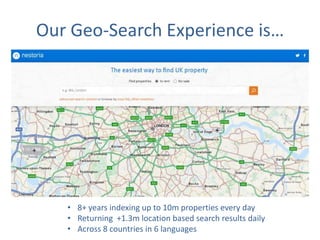
Our Geo-Search Experience is…

• 8+ years indexing up to 10m properties every day
• Returning +1.3m location based search results daily
• Across 8 countries in 6 languages
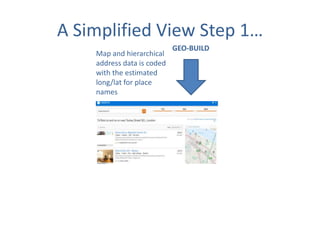
A Simplified View Step 1…
Map and hierarchical
address data is coded
with the estimated
long/lat for place
names

GEO-BUILD
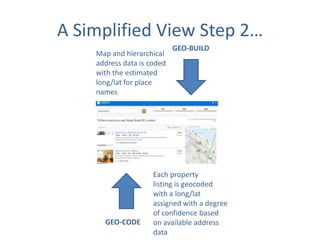
A Simplified View Step 2…
Map and hierarchical
address data is coded
with the estimated
long/lat for place
names

GEO-CODE

GEO-BUILD

Each property
listing is geocoded
with a long/lat
assigned with a degree
of confidence based
on available address
data
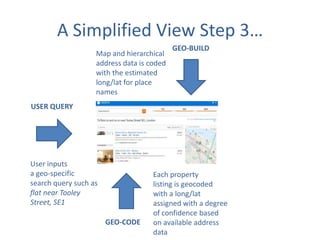
A Simplified View Step 3…
Map and hierarchical
address data is coded
with the estimated
long/lat for place
names

GEO-BUILD

USER QUERY

User inputs
a geo-specific
search query such as
flat near Tooley
Street, SE1
GEO-CODE

Each property
listing is geocoded
with a long/lat
assigned with a degree
of confidence based
on available address
data
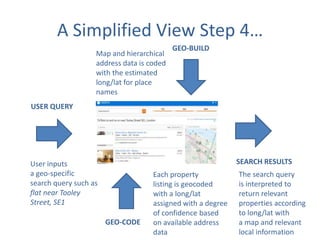
A Simplified View Step 4…
Map and hierarchical
address data is coded
with the estimated
long/lat for place
names

GEO-BUILD

USER QUERY

SEARCH RESULTS

User inputs
a geo-specific
search query such as
flat near Tooley
Street, SE1
GEO-CODE

Each property
listing is geocoded
with a long/lat
assigned with a degree
of confidence based
on available address
data

The search query
is interpreted to
return relevant
properties according
to long/lat with
a map and relevant
local information
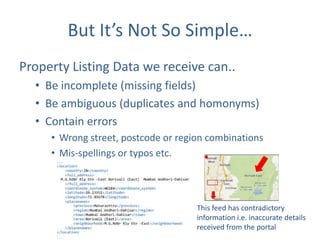
But It’s Not So Simple…
Property Listing Data we receive can..
• Be incomplete (missing fields)
• Be ambiguous (duplicates and homonyms)
• Contain errors
• Wrong street, postcode or region combinations
• Mis-spellings or typos etc.

This feed has contradictory
information i.e. inaccurate details
received from the portal
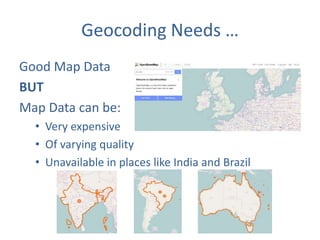
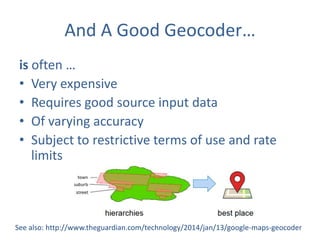
Geocoding Needs …
Good Map Data
BUT
Map Data can be:
• Very expensive
• Of varying quality
• Unavailable in places like India and Brazil
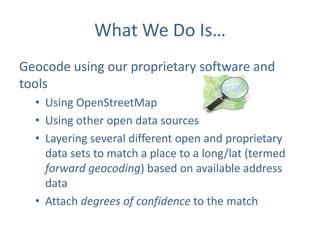
And A Good Geocoder…
is often …
• Very expensive
• Requires good source input data
• Of varying accuracy
• Subject to restrictive terms of use and rate
limits

See also: http://www.theguardian.com/technology/2014/jan/13/google-maps-geocoder
What We Do Is…
Geocode using our proprietary software and
tools
• Using OpenStreetMap
• Using other open data sources
• Layering several different open and proprietary
data sets to match a place to a long/lat (termed
forward geocoding) based on available address
data
• Attach degrees of confidence to the match
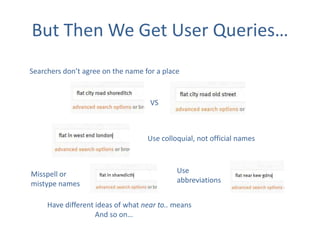
But Then We Get User Queries…
Searchers don’t agree on the name for a place

VS

Use colloquial, not official names

Misspell or
mistype names

Use
abbreviations

Have different ideas of what near to.. means
And so on…
Across Different Countries…
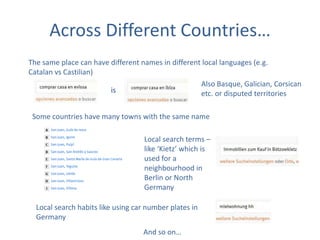
The same place can have different names in different local languages (e.g.
Catalan vs Castilian)
Also Basque, Galician, Corsican
is
etc. or disputed territories
Some countries have many towns with the same name
Local search terms –
like ‘Kietz’ which is
used for a
neighbourhood in
Berlin or North
Germany
Local search habits like using car number plates in
Germany
And so on…
So We…
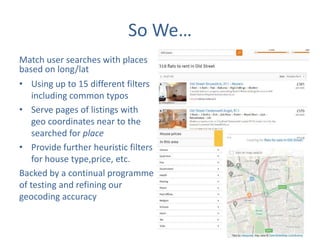
Match user searches with places
based on long/lat
• Using up to 15 different filters
including common typos
• Serve pages of listings with
geo coordinates near to the
searched for place
• Provide further heuristic filters
for house type,price, etc.
Backed by a continual programme
of testing and refining our
geocoding accuracy
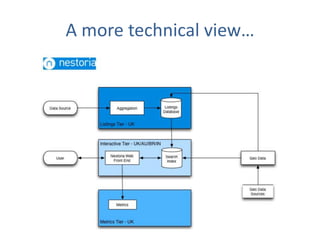
A more technical view…
This Could Be Relevant To You …
If your users search for
•
•
•
•

‘Hotel near …’
‘Supermarket near …’
‘Click and Collect near …’
‘Restaurant near…’ etc.

• Using colloquial names or ambiguous queries or
searches near ‘landmarks’ or ‘streets’ etc.
• And your current solution only accepts towns or
postcodes and/or returns approximate answers
We Could Help..
Improve user satisfaction with your site search
by:
• Providing access to our geocoding technology
• To forward geocode site searches and match these
to the relevant results
• Enabling you to return more relevant search
results for users that are searching using language
that makes sense to them
A couple of comments…
• We are experts in forward geocoding names
or street addresses to a long/lat
• BUT NOT in reverse geocoding names or street
address from a long/lat
• We can share our expertise across the 8
countries where Nestoria currently operates
and also use these skills for other countries
Some Terminology…
• Geocoding (or forward geo-coding) is the process of finding
associated geographic coordinates (often expressed as
latitude and longitude) from other geographic data, such as
street addresses, or ZIP codes (postal codes)*
• Reverse geocoding is the opposite: finding an associated
textual location such as a street address, from geographic
coordinates*
• A geocoder is a piece of software or a (web) service that
helps in this process*
• Our geo-build is the process by which map data and
hierarchical address data (street, town, province…) is
entered into a database and coded to return the estimated
geographic coordinates for search queries
*Wikipedia
Contact Us
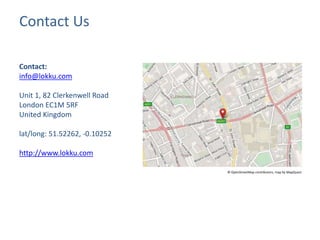
Contact:
info@lokku.com
Unit 1, 82 Clerkenwell Road
London EC1M 5RF
United Kingdom
lat/long: 51.52262, -0.10252
http://www.lokku.com
© OpenStreetMap contributors, map by MapQuest
Appendix
Parent company of OpenCage Data and property search engine Nestoria
Founded 2006 by 2 senior Yahoo! Search Executives
Serving clients globally from Clerkenwell, London
Team of 15 - experts in aggregation, all things geo, local search (ex. Yahoo!, Nokia)
UK Open Data Institute Member

Organize #geomob - quarterly meetup of location based service developers
http://geomobldn.org
Learn more: http://www.lokku.com
Residential property search engine
Operates in 8 markets: Australia, Brazil, France, Germany, India, Italy, Spain, UK
3 million unique users searching for >10 million places every month
Extensive experience in geocoding, local search, local SEM
First-mover in using OSM as alternative to Google Maps: http://bit.ly/1a0sopt

Learn more: http://www.nestoria.com
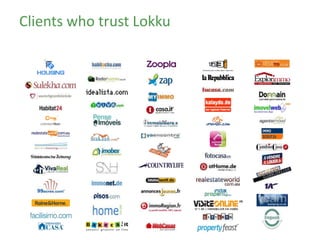
Clients who trust Lokku
OpenStreetMap
The Free Wiki World Map
Collaborative project to create a free, editable map of the world
Started in 2004 by Steve Coast in London
1.4 million registered participants
2+ billion data points, growing continually

Data available under Open Data Commons Open Database License (ODbL).
http://www.openstreetmap.org/copyright
Learn more: http://www.openstreetmap.org/about

Geo-search-location-based-results-for-site-search

  • 1.
    Geo-Search: Serving LocationBased Search Results for Onsite Search
  • 2.
    Our Geo-Search Experienceis… • 8+ years indexing up to 10m properties every day • Returning +1.3m location based search results daily • Across 8 countries in 6 languages
  • 3.
    A Simplified ViewStep 1… Map and hierarchical address data is coded with the estimated long/lat for place names GEO-BUILD
  • 4.
    A Simplified ViewStep 2… Map and hierarchical address data is coded with the estimated long/lat for place names GEO-CODE GEO-BUILD Each property listing is geocoded with a long/lat assigned with a degree of confidence based on available address data
  • 5.
    A Simplified ViewStep 3… Map and hierarchical address data is coded with the estimated long/lat for place names GEO-BUILD USER QUERY User inputs a geo-specific search query such as flat near Tooley Street, SE1 GEO-CODE Each property listing is geocoded with a long/lat assigned with a degree of confidence based on available address data
  • 6.
    A Simplified ViewStep 4… Map and hierarchical address data is coded with the estimated long/lat for place names GEO-BUILD USER QUERY SEARCH RESULTS User inputs a geo-specific search query such as flat near Tooley Street, SE1 GEO-CODE Each property listing is geocoded with a long/lat assigned with a degree of confidence based on available address data The search query is interpreted to return relevant properties according to long/lat with a map and relevant local information
  • 7.
    But It’s NotSo Simple… Property Listing Data we receive can.. • Be incomplete (missing fields) • Be ambiguous (duplicates and homonyms) • Contain errors • Wrong street, postcode or region combinations • Mis-spellings or typos etc. This feed has contradictory information i.e. inaccurate details received from the portal
  • 8.
    Geocoding Needs … GoodMap Data BUT Map Data can be: • Very expensive • Of varying quality • Unavailable in places like India and Brazil
  • 9.
    And A GoodGeocoder… is often … • Very expensive • Requires good source input data • Of varying accuracy • Subject to restrictive terms of use and rate limits See also: http://www.theguardian.com/technology/2014/jan/13/google-maps-geocoder
  • 10.
    What We DoIs… Geocode using our proprietary software and tools • Using OpenStreetMap • Using other open data sources • Layering several different open and proprietary data sets to match a place to a long/lat (termed forward geocoding) based on available address data • Attach degrees of confidence to the match
  • 11.
    But Then WeGet User Queries… Searchers don’t agree on the name for a place VS Use colloquial, not official names Misspell or mistype names Use abbreviations Have different ideas of what near to.. means And so on…
  • 12.
    Across Different Countries… Thesame place can have different names in different local languages (e.g. Catalan vs Castilian) Also Basque, Galician, Corsican is etc. or disputed territories Some countries have many towns with the same name Local search terms – like ‘Kietz’ which is used for a neighbourhood in Berlin or North Germany Local search habits like using car number plates in Germany And so on…
  • 13.
    So We… Match usersearches with places based on long/lat • Using up to 15 different filters including common typos • Serve pages of listings with geo coordinates near to the searched for place • Provide further heuristic filters for house type,price, etc. Backed by a continual programme of testing and refining our geocoding accuracy
  • 14.
  • 15.
    This Could BeRelevant To You … If your users search for • • • • ‘Hotel near …’ ‘Supermarket near …’ ‘Click and Collect near …’ ‘Restaurant near…’ etc. • Using colloquial names or ambiguous queries or searches near ‘landmarks’ or ‘streets’ etc. • And your current solution only accepts towns or postcodes and/or returns approximate answers
  • 16.
    We Could Help.. Improveuser satisfaction with your site search by: • Providing access to our geocoding technology • To forward geocode site searches and match these to the relevant results • Enabling you to return more relevant search results for users that are searching using language that makes sense to them
  • 17.
    A couple ofcomments… • We are experts in forward geocoding names or street addresses to a long/lat • BUT NOT in reverse geocoding names or street address from a long/lat • We can share our expertise across the 8 countries where Nestoria currently operates and also use these skills for other countries
  • 18.
    Some Terminology… • Geocoding(or forward geo-coding) is the process of finding associated geographic coordinates (often expressed as latitude and longitude) from other geographic data, such as street addresses, or ZIP codes (postal codes)* • Reverse geocoding is the opposite: finding an associated textual location such as a street address, from geographic coordinates* • A geocoder is a piece of software or a (web) service that helps in this process* • Our geo-build is the process by which map data and hierarchical address data (street, town, province…) is entered into a database and coded to return the estimated geographic coordinates for search queries *Wikipedia
  • 19.
    Contact Us Contact: info@lokku.com Unit 1,82 Clerkenwell Road London EC1M 5RF United Kingdom lat/long: 51.52262, -0.10252 http://www.lokku.com © OpenStreetMap contributors, map by MapQuest
  • 20.
  • 21.
    Parent company ofOpenCage Data and property search engine Nestoria Founded 2006 by 2 senior Yahoo! Search Executives Serving clients globally from Clerkenwell, London Team of 15 - experts in aggregation, all things geo, local search (ex. Yahoo!, Nokia) UK Open Data Institute Member Organize #geomob - quarterly meetup of location based service developers http://geomobldn.org Learn more: http://www.lokku.com
  • 22.
    Residential property searchengine Operates in 8 markets: Australia, Brazil, France, Germany, India, Italy, Spain, UK 3 million unique users searching for >10 million places every month Extensive experience in geocoding, local search, local SEM First-mover in using OSM as alternative to Google Maps: http://bit.ly/1a0sopt Learn more: http://www.nestoria.com
  • 23.
  • 24.
    OpenStreetMap The Free WikiWorld Map Collaborative project to create a free, editable map of the world Started in 2004 by Steve Coast in London 1.4 million registered participants 2+ billion data points, growing continually Data available under Open Data Commons Open Database License (ODbL). http://www.openstreetmap.org/copyright Learn more: http://www.openstreetmap.org/about