Drowsiness, tiredness, or dizziness
occurs after treatment in a small
number of patients (1-3%). Minor
bleeding or bruising occurs after
dry needling in 15-20% of treat-
ments and is considered normal.
Temporary pain during dry nee-
dling occurs in 60-70% of treat-
ments. Fainting can occur in cer-
tain patients (0.3%), particularly at
the first treatment session when
needling the head or neck regions.
Dry needling is very safe; however
serious side effects can occur in
less than 1 per 10,000 (less than
0.01%) treatments. Small nerves or
blood vessels may be damaged
from dry needling which can result
in pain, numbness, or tingling;
however, this is a very rare event
and is usually temporary.
Is Dry Needling
safe?
Pioneering Brain & Spine Care
Since 1940
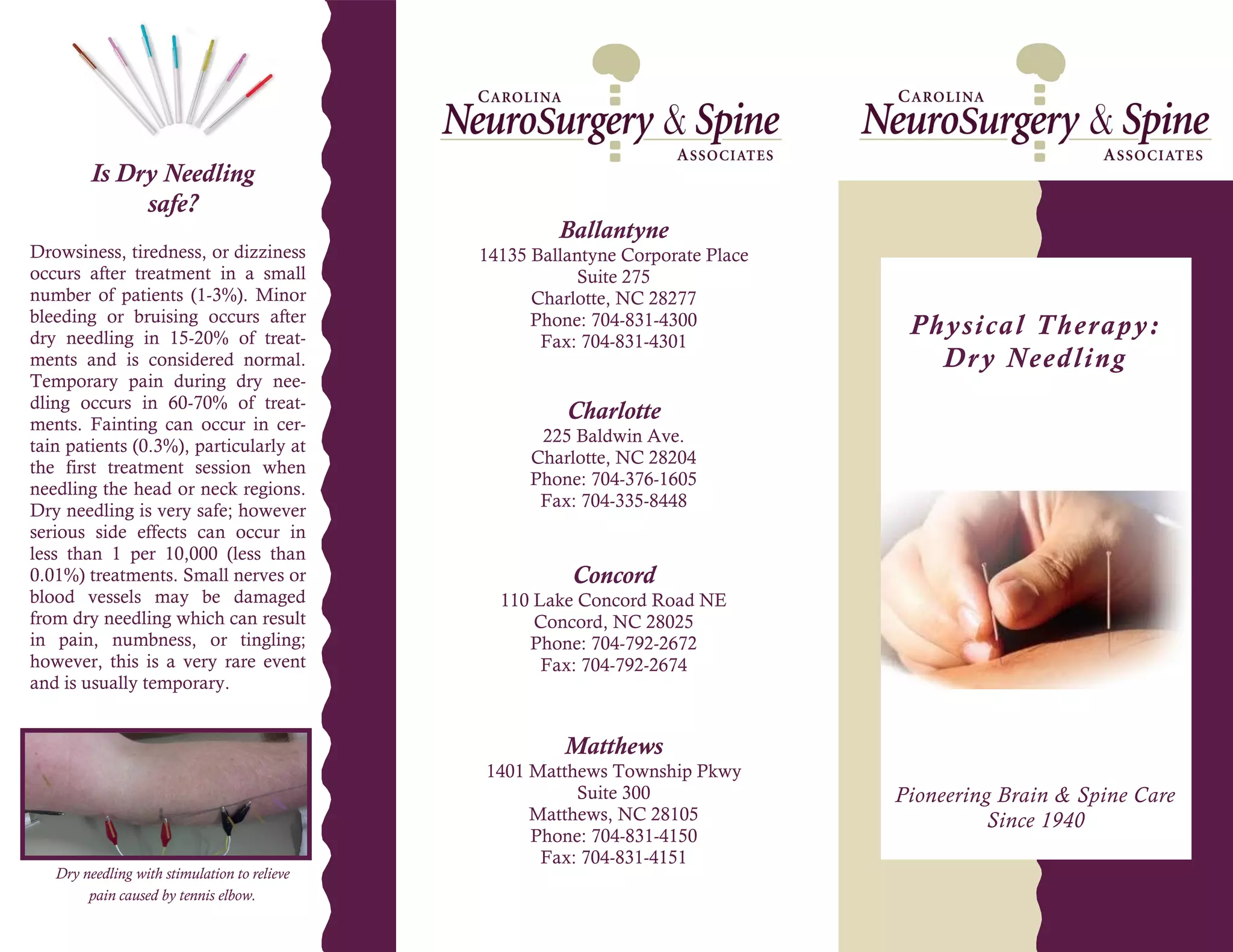
Physical Therapy:
Dry Needling
Dry needling with stimulation to relieve
pain caused by tennis elbow.
Charlotte
225 Baldwin Ave.
Charlotte, NC 28204
Phone: 704-376-1605
Fax: 704-335-8448
Matthews
1401 Matthews Township Pkwy
Suite 300
Matthews, NC 28105
Phone: 704-831-4150
Fax: 704-831-4151
Ballantyne
14135 Ballantyne Corporate Place
Suite 275
Charlotte, NC 28277
Phone: 704-831-4300
Fax: 704-831-4301
Concord
110 Lake Concord Road NE
Concord, NC 28025
Phone: 704-792-2672
Fax: 704-792-2674
What is Dry Needling?
Dry needling is a form of thera-
py in which thin needles are in-
serted into myofascial trigger
points (painful knots in mus-
cles) in order to stimulate a
healing response in painful mus-
culoskeletal conditions. Dry
needling is not acupuncture or
Oriental medicine; that is, it
does not have the purpose of
altering the flow of energy (‘Qi’)
along traditional Chinese merid-
ians for the treatment of diseas-
es. In fact, dry needling is a
modern, science-based interven-
tion for the treatment of pain
and dysfunction in musculoskel-
etal conditions such as muscle
spasms, neck pain, shoulder im-
pingement, tennis elbow, carpal
tunnel syndrome, headaches,
knee pain, shin splints, plantar
fasciitis, or low back pain.
How does Dry Needling
Work?
If something causes pain and if that
pain occurs often enough or if the
trauma is great enough, the muscle
will become damaged and a spasm
may result. When a muscle is
spasmed there is reduced blood
flow within the muscle. This means
less oxygen and nutrients make it
to the muscle, which prevents heal-
ing. Muscle fibers die off and get
replaced by fibrous scar tissue. This in
turn holds the muscle tight, prevents
muscle waste products (such as lactic ac-
id) from leaving the muscle, and causes
continued spasm and pain. A reflex arc is
formed where the pain causes spasm and
the spasm causes pain and this can con-
tinue for months or even years.
When appropriately stimulated, the nerv-
ous system's natural response to an injury
is to begin a chain of reactions to aid
healing. Restarting or augmenting the
nervous system response to a minute and
focused noxious stimulus is the goal of
dry needling technique. Neurochemicals,
such as endorphins and corticosteroids,
are released, the immune system brings
white blood cells to the injured area, and
red blood cells carrying oxygen and nutri-
ents run to the site (an inflamma-
tory response). All of these pro-
cesses aid in healing.
Dry needling also helps to relax
contracted muscles. Since the
presence of the needle in a tense
muscle may be painful, the nerv-
ous system sends the appropriate
feedback to the muscle to inhibit
or stop its spasm. This spasm is
often the cause of the pain or
dysfunction experienced by the
patient. So by achieving an inhi-
bition or ceasing of spasm, dry
needling can take away the cause
of pain and dysfunction.
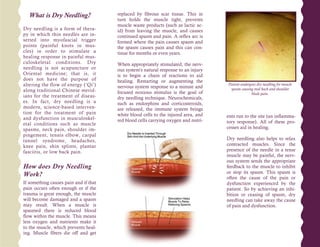
Patient undergoes dry needling for muscle
spasm causing mid back and shoulder
blade pain.

Dry Needling Brochure All Locations

  • 1.
    Drowsiness, tiredness, ordizziness occurs after treatment in a small number of patients (1-3%). Minor bleeding or bruising occurs after dry needling in 15-20% of treat- ments and is considered normal. Temporary pain during dry nee- dling occurs in 60-70% of treat- ments. Fainting can occur in cer- tain patients (0.3%), particularly at the first treatment session when needling the head or neck regions. Dry needling is very safe; however serious side effects can occur in less than 1 per 10,000 (less than 0.01%) treatments. Small nerves or blood vessels may be damaged from dry needling which can result in pain, numbness, or tingling; however, this is a very rare event and is usually temporary. Is Dry Needling safe? Pioneering Brain & Spine Care Since 1940 Physical Therapy: Dry Needling Dry needling with stimulation to relieve pain caused by tennis elbow. Charlotte 225 Baldwin Ave. Charlotte, NC 28204 Phone: 704-376-1605 Fax: 704-335-8448 Matthews 1401 Matthews Township Pkwy Suite 300 Matthews, NC 28105 Phone: 704-831-4150 Fax: 704-831-4151 Ballantyne 14135 Ballantyne Corporate Place Suite 275 Charlotte, NC 28277 Phone: 704-831-4300 Fax: 704-831-4301 Concord 110 Lake Concord Road NE Concord, NC 28025 Phone: 704-792-2672 Fax: 704-792-2674
  • 2.
    What is DryNeedling? Dry needling is a form of thera- py in which thin needles are in- serted into myofascial trigger points (painful knots in mus- cles) in order to stimulate a healing response in painful mus- culoskeletal conditions. Dry needling is not acupuncture or Oriental medicine; that is, it does not have the purpose of altering the flow of energy (‘Qi’) along traditional Chinese merid- ians for the treatment of diseas- es. In fact, dry needling is a modern, science-based interven- tion for the treatment of pain and dysfunction in musculoskel- etal conditions such as muscle spasms, neck pain, shoulder im- pingement, tennis elbow, carpal tunnel syndrome, headaches, knee pain, shin splints, plantar fasciitis, or low back pain. How does Dry Needling Work? If something causes pain and if that pain occurs often enough or if the trauma is great enough, the muscle will become damaged and a spasm may result. When a muscle is spasmed there is reduced blood flow within the muscle. This means less oxygen and nutrients make it to the muscle, which prevents heal- ing. Muscle fibers die off and get replaced by fibrous scar tissue. This in turn holds the muscle tight, prevents muscle waste products (such as lactic ac- id) from leaving the muscle, and causes continued spasm and pain. A reflex arc is formed where the pain causes spasm and the spasm causes pain and this can con- tinue for months or even years. When appropriately stimulated, the nerv- ous system's natural response to an injury is to begin a chain of reactions to aid healing. Restarting or augmenting the nervous system response to a minute and focused noxious stimulus is the goal of dry needling technique. Neurochemicals, such as endorphins and corticosteroids, are released, the immune system brings white blood cells to the injured area, and red blood cells carrying oxygen and nutri- ents run to the site (an inflamma- tory response). All of these pro- cesses aid in healing. Dry needling also helps to relax contracted muscles. Since the presence of the needle in a tense muscle may be painful, the nerv- ous system sends the appropriate feedback to the muscle to inhibit or stop its spasm. This spasm is often the cause of the pain or dysfunction experienced by the patient. So by achieving an inhi- bition or ceasing of spasm, dry needling can take away the cause of pain and dysfunction. Patient undergoes dry needling for muscle spasm causing mid back and shoulder blade pain.