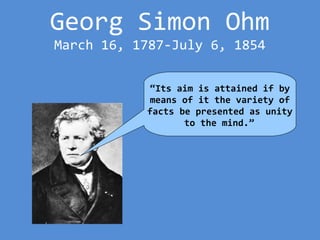
Georg Simon Ohm
March 16, 1787-July 6, 1854
“Its aim is attained if by
means of it the variety of
facts be presented as unity
to the mind.”
Meet Ohm
•
German born citizen from Erlangen,
Germany
•
Both parents were both very hard
working individuals who believed
education was the key to success.
His father worked as a university locksmith, while his
mother grew up as the daughter of a tailor, neither of
which grew up with a formal education
•
In all Ohm had two other siblings: a sister named
Elizabeth Barbera and a brother named Martin, who later
became a well known mathematician
•
Georg graduated from the University of Erlangen-
Nurenberg where he received a doctorate in math
Education and Ohm
In 1805 Ohm entered the University of Erlangen but he
became carried away with student life. Rather than
concentrate on his studies he spent time dancing, ice
skating and playing billiards. Ohm's father, angry that
his son was wasting the educational opportunity that he
himself had never been fortunate enough to experience,
demanded that Ohm leave the university after three
semesters. Soon after Ohm took up some teaching jobs
while still keeping private math studies. Never quite
feeling happy, Ohm returned to the University of Erlangen
in April 1811 to continue his studies of math. By October
25, 1811 Ohm had received a doctorate in math from
Erlangen.
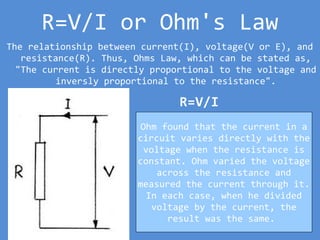
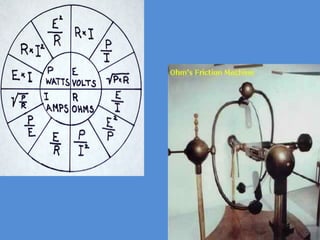
R=V/I or Ohm's Law
The relationship between current(I), voltage(V or E), and
resistance(R). Thus, Ohms Law, which can be stated as,
"The current is directly proportional to the voltage and
inversly proportional to the resistance".
R=V/I
Ohm found that the current in a
circuit varies directly with the
voltage when the resistance is
constant. Ohm varied the voltage
across the resistance and
measured the current through it.
In each case, when he divided
voltage by the current, the
result was the same.
Awards, Recognitions,
Accomplishments
In 1841 the Royal Society in
London honored Ohm with the
Copley medal, which then
carried the same significance
as the Nobel prize does today.
The same year Ohm became
a member of the Academia di
Turino, and in 1842 a foreign
member of the Royal Society in
London. Thus, the eccentric
who used to be seen out
walking his dog in the forests
on the outskirts of Nuremberg
finally became an
internationally recognized and
well-known expert. Even has a
"For his
researches into
the laws of
electric currents
contained in
various memoirs
published in
Schweiggers
Journal,
Poggendorffs
Annalen and in a
separate work
entitled Die
galvanische Kette
mathematisch
bearbeitet"
References
Corrosion science and engineering information hub. 17 Oct. 2010.
Electronic Circuits Projects Diagrams Free. 17 Oct. 2010
94235989

Georg ohm

  • 1.
    Georg Simon Ohm March16, 1787-July 6, 1854 “Its aim is attained if by means of it the variety of facts be presented as unity to the mind.”
  • 2.
    Meet Ohm • German borncitizen from Erlangen, Germany • Both parents were both very hard working individuals who believed education was the key to success. His father worked as a university locksmith, while his mother grew up as the daughter of a tailor, neither of which grew up with a formal education • In all Ohm had two other siblings: a sister named Elizabeth Barbera and a brother named Martin, who later became a well known mathematician • Georg graduated from the University of Erlangen- Nurenberg where he received a doctorate in math
  • 3.
    Education and Ohm In1805 Ohm entered the University of Erlangen but he became carried away with student life. Rather than concentrate on his studies he spent time dancing, ice skating and playing billiards. Ohm's father, angry that his son was wasting the educational opportunity that he himself had never been fortunate enough to experience, demanded that Ohm leave the university after three semesters. Soon after Ohm took up some teaching jobs while still keeping private math studies. Never quite feeling happy, Ohm returned to the University of Erlangen in April 1811 to continue his studies of math. By October 25, 1811 Ohm had received a doctorate in math from Erlangen.
  • 4.
    R=V/I or Ohm'sLaw The relationship between current(I), voltage(V or E), and resistance(R). Thus, Ohms Law, which can be stated as, "The current is directly proportional to the voltage and inversly proportional to the resistance". R=V/I Ohm found that the current in a circuit varies directly with the voltage when the resistance is constant. Ohm varied the voltage across the resistance and measured the current through it. In each case, when he divided voltage by the current, the result was the same.
  • 6.
    Awards, Recognitions, Accomplishments In 1841the Royal Society in London honored Ohm with the Copley medal, which then carried the same significance as the Nobel prize does today. The same year Ohm became a member of the Academia di Turino, and in 1842 a foreign member of the Royal Society in London. Thus, the eccentric who used to be seen out walking his dog in the forests on the outskirts of Nuremberg finally became an internationally recognized and well-known expert. Even has a "For his researches into the laws of electric currents contained in various memoirs published in Schweiggers Journal, Poggendorffs Annalen and in a separate work entitled Die galvanische Kette mathematisch bearbeitet"
  • 7.
    References Corrosion science andengineering information hub. 17 Oct. 2010. Electronic Circuits Projects Diagrams Free. 17 Oct. 2010 94235989