Objective: Understand the concept of geopolitics.
Analyze the similarities and differences between the
theories of Wallerstein, Ratzel, Mackinder and Spykman.
1. I believe that America should try and gain more land
around the world.
2. I believe that weak countries should be taken over by
stronger countries.
3. I believe that every state should make attempts to expand
their borders.
4. I believe that each state is doomed to fail no matter what
resources they have.
5. Like all great states in history, I believe that America will
fall to a greater state.
 Geography + power + politics + international relations
 Helps us understand the arrangements & forces that are
transforming the map of the world
 Classical geopolitics
 German School – sought to explain why certain states are powerful and
how to become powerful
 British/America School – sought to offer strategic advice for states and
explain why countries interact at the global scale the way they do
 Most geo-politicians today fall into the British/American school
of thought
 Immanuel Wallerstein
 Explains how the Capitalist World Economy was created
 Connections between economic & political factors of states
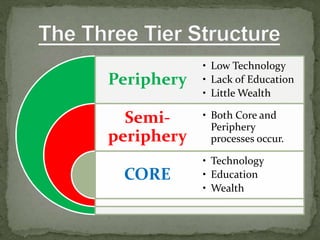
 Core
 Periphery
 Semi-periphery
 Colonialism
 Capitalism
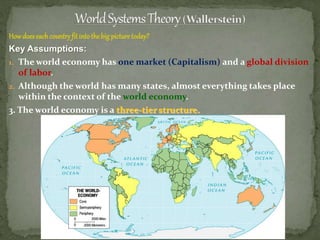
Howdoeseachcountryfitintothebig picturetoday?
Key Assumptions:
1. The world economy has one market (Capitalism) and a global division
of labor.
2. Although the world has many states, almost everything takes place
within the context of the world economy.
3. The world economy is a three-tier structure.
Periphery
Semi-
periphery
CORE
• Low Technology
• Lack of Education
• Little Wealth
• Both Core and
Periphery
processes occur.
• Technology
• Education
• Wealth
 Europeans laid ground rules for state system and for the rules of
capitalist world economy – (Colonialism set this up…& every state
is interdependent now.)
 Concentration of wealth brought to Europe during colonialism is
the reason for today’s uneven global distribution of power
 Each state fits in somehow
 Need to understand spatial & functional relationships within
world economy to understand any state
 Political independence is possible not economic independence
 Wealth allows for ability to influence others or achieve political
goals
 Often, political power is lacking where there is no wealth
What do you notice about the location of Core / Semi-Periphery / Periphery?
How does this connect to previous units on:
Population
Migration
Religion
Colonization
Globalization
 Overemphasizes economic factors in political development
 Very state-centric
 No consideration of internal factors
 No clear identification of core/semi-periphery/periphery
https://www.youtube.com/watch?v=ubEhjuDBRKM
German 1844-1904 – What’s going on then?
• Why are some states powerful?
• How do states become more powerful?
Main Idea: States must grow, they can only thrive when they attain more
territory (Organic State Theory)
Details:
State resembles a living organism & goes through the life cycle
To thrive, state needs nourishment through lebensraum (living space)
If state is confined, it will die
Borders are temporary
Colonialism / imperialism drive this theory
 Criticisms
 Based on speculation
 Ultimately led to Nazi expansionism, Hitler embraced
geopolitics to justify the right for lebensraum because of racial
superiority
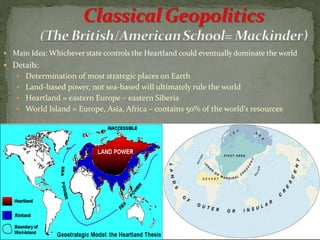
 Main Idea: Whichever state controls the Heartland could eventually dominate the world
 Details:
 Determination of most strategic places on Earth
 Land-based power, not sea-based will ultimately rule the world
 Heartland = eastern Europe – eastern Siberia
 World Island = Europe, Asia, Africa – contains 50% of the world’s resources
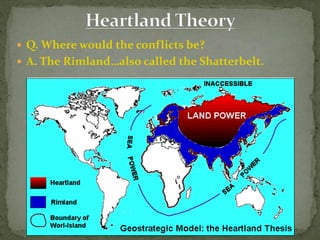
 Q. Where would the conflicts be?
 A. The Rimland…also called the Shatterbelt.
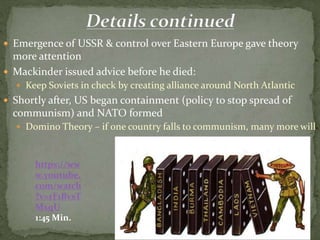
 Emergence of USSR & control over Eastern Europe gave theory
more attention
 Mackinder issued advice before he died:
 Keep Soviets in check by creating alliance around North Atlantic
 Shortly after, US began containment (policy to stop spread of
communism) and NATO formed
 Domino Theory – if one country falls to communism, many more will
https://ww
w.youtube.
com/watch
?v=rF1BvsT
MxqU
1:45 Min.
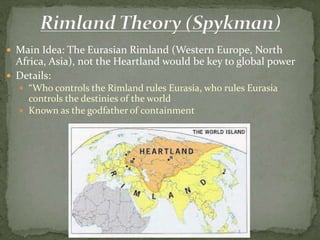
 Main Idea: The Eurasian Rimland (Western Europe, North
Africa, Asia), not the Heartland would be key to global power
 Details:
 “Who controls the Rimland rules Eurasia, who rules Eurasia
controls the destinies of the world
 Known as the godfather of containment
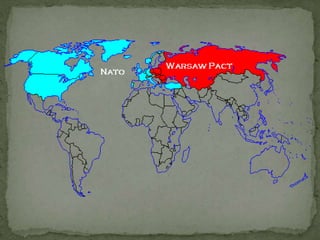
 Must control the
Heartland…but how?
 Warsaw Pact response was
response to NATO.
Geopolitical_Theories.ppt

Geopolitical_Theories.ppt

  • 1.
    Objective: Understand theconcept of geopolitics. Analyze the similarities and differences between the theories of Wallerstein, Ratzel, Mackinder and Spykman.
  • 2.
    1. I believethat America should try and gain more land around the world. 2. I believe that weak countries should be taken over by stronger countries. 3. I believe that every state should make attempts to expand their borders. 4. I believe that each state is doomed to fail no matter what resources they have. 5. Like all great states in history, I believe that America will fall to a greater state.
  • 3.
     Geography +power + politics + international relations  Helps us understand the arrangements & forces that are transforming the map of the world  Classical geopolitics  German School – sought to explain why certain states are powerful and how to become powerful  British/America School – sought to offer strategic advice for states and explain why countries interact at the global scale the way they do  Most geo-politicians today fall into the British/American school of thought
  • 4.
     Immanuel Wallerstein Explains how the Capitalist World Economy was created  Connections between economic & political factors of states  Core  Periphery  Semi-periphery  Colonialism  Capitalism
  • 5.
    Howdoeseachcountryfitintothebig picturetoday? Key Assumptions: 1.The world economy has one market (Capitalism) and a global division of labor. 2. Although the world has many states, almost everything takes place within the context of the world economy. 3. The world economy is a three-tier structure.
  • 6.
    Periphery Semi- periphery CORE • Low Technology •Lack of Education • Little Wealth • Both Core and Periphery processes occur. • Technology • Education • Wealth
  • 7.
     Europeans laidground rules for state system and for the rules of capitalist world economy – (Colonialism set this up…& every state is interdependent now.)  Concentration of wealth brought to Europe during colonialism is the reason for today’s uneven global distribution of power  Each state fits in somehow  Need to understand spatial & functional relationships within world economy to understand any state  Political independence is possible not economic independence  Wealth allows for ability to influence others or achieve political goals  Often, political power is lacking where there is no wealth
  • 8.
    What do younotice about the location of Core / Semi-Periphery / Periphery? How does this connect to previous units on: Population Migration Religion Colonization Globalization
  • 9.
     Overemphasizes economicfactors in political development  Very state-centric  No consideration of internal factors  No clear identification of core/semi-periphery/periphery
  • 10.
  • 11.
    German 1844-1904 –What’s going on then? • Why are some states powerful? • How do states become more powerful? Main Idea: States must grow, they can only thrive when they attain more territory (Organic State Theory) Details: State resembles a living organism & goes through the life cycle To thrive, state needs nourishment through lebensraum (living space) If state is confined, it will die Borders are temporary Colonialism / imperialism drive this theory
  • 12.
     Criticisms  Basedon speculation  Ultimately led to Nazi expansionism, Hitler embraced geopolitics to justify the right for lebensraum because of racial superiority
  • 13.
     Main Idea:Whichever state controls the Heartland could eventually dominate the world  Details:  Determination of most strategic places on Earth  Land-based power, not sea-based will ultimately rule the world  Heartland = eastern Europe – eastern Siberia  World Island = Europe, Asia, Africa – contains 50% of the world’s resources
  • 14.
     Q. Wherewould the conflicts be?  A. The Rimland…also called the Shatterbelt.
  • 15.
     Emergence ofUSSR & control over Eastern Europe gave theory more attention  Mackinder issued advice before he died:  Keep Soviets in check by creating alliance around North Atlantic  Shortly after, US began containment (policy to stop spread of communism) and NATO formed  Domino Theory – if one country falls to communism, many more will https://ww w.youtube. com/watch ?v=rF1BvsT MxqU 1:45 Min.
  • 16.
     Main Idea:The Eurasian Rimland (Western Europe, North Africa, Asia), not the Heartland would be key to global power  Details:  “Who controls the Rimland rules Eurasia, who rules Eurasia controls the destinies of the world  Known as the godfather of containment
  • 17.
     Must controlthe Heartland…but how?  Warsaw Pact response was response to NATO.