Geometry in the Real World Jesse Wright Period 1, Geometry
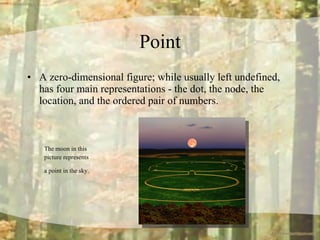
Point A zero-dimensional figure; while usually left undefined, has four main representations - the dot, the node, the location, and the ordered pair of numbers. The moon in this  picture represents  a point in the sky.
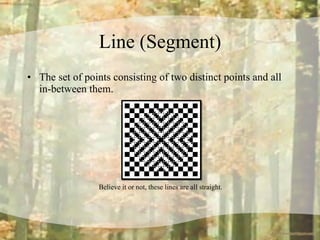
Line (Segment) The set of points consisting of two distinct points and all in-between them. Believe it or not, these lines are all straight.
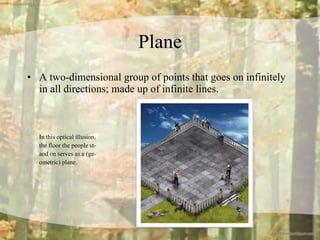
Plane A two-dimensional group of points that goes on infinitely in all directions; made up of infinite lines.  In this optical illusion, the floor the people st- and on serves as a (ge- ometric) plane.
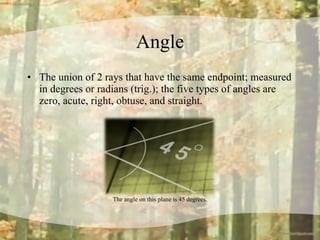
Angle The union of 2 rays that have the same endpoint; measured in degrees or radians (trig.); the five types of angles are zero, acute, right, obtuse, and straight.  The angle on this plane is 45 degrees.
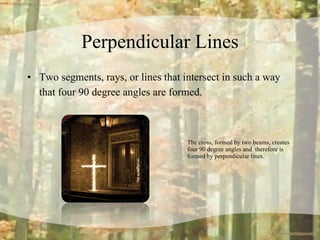
Perpendicular Lines Two segments, rays, or lines that intersect in such a way that four 90 degree angles are formed.   The cross, formed by two beams, creates  four 90 degree angles and  therefore is  formed by perpendicular lines.
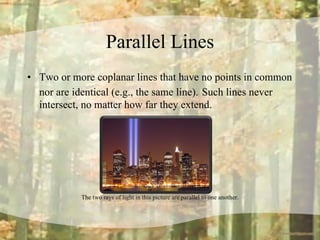
Parallel Lines Two or more coplanar lines that have no points in common nor are identical (e.g., the same line).   Such lines never intersect, no matter how far they extend. The two rays of light in this picture are parallel to one another.
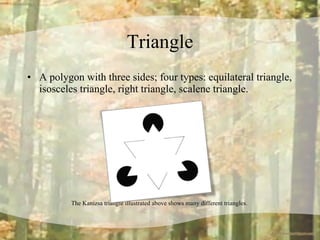
Triangle A polygon with three sides; four types: equilateral triangle, isosceles triangle, right triangle, scalene triangle.  The Kanizsa triangle illustrated above shows many different triangles.
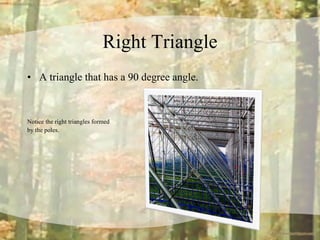
Right Triangle A triangle that has a 90 degree angle. Notice the right triangles formed  by the poles.
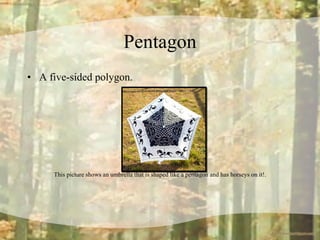
Pentagon A five-sided polygon. This picture shows an umbrella that is shaped like a pentagon and has horseys on it!.
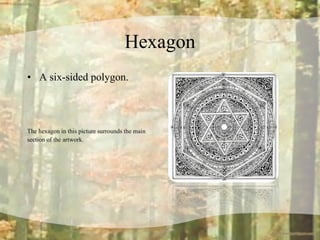
Hexagon A six-sided polygon. The hexagon in this picture surrounds the main section of the artwork.
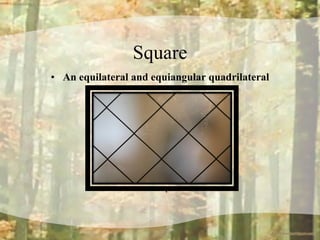
Square An equilateral and equiangular quadrilateral See all the squares?!
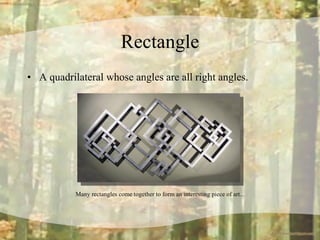
Rectangle A quadrilateral whose angles are all right angles. Many rectangles come together to form an interesting piece of art...
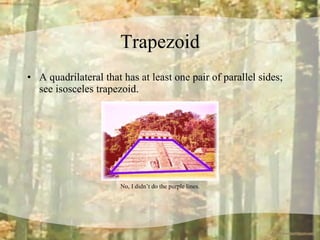
Trapezoid A quadrilateral that has at least one pair of parallel sides; see isosceles trapezoid.  No, I didn’t do the purple lines.
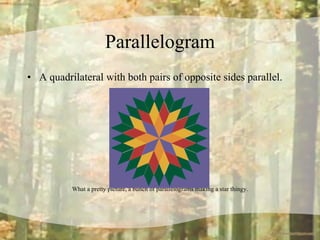
Parallelogram A quadrilateral with both pairs of opposite sides parallel. What a pretty picture, a bunch of parallelograms making a star thingy.
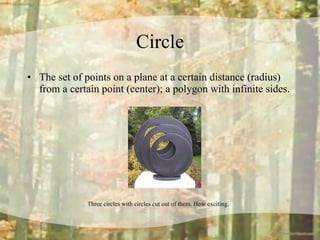
Circle The set of points on a plane at a certain distance (radius) from a certain point (center); a polygon with infinite sides. Three circles with circles cut out of them. How exciting.
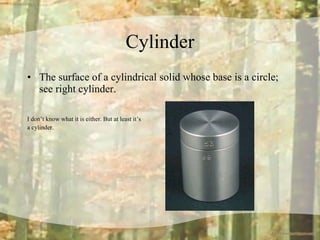
Cylinder The surface of a cylindrical solid whose base is a circle; see right cylinder. I don’t know what it is either. But at least it’s  a cylinder.
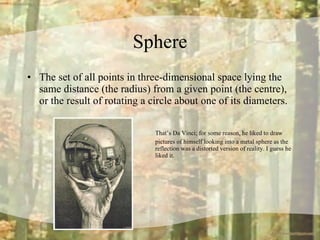
Sphere The set of all points in three-dimensional space lying the same distance (the radius) from a given point (the centre), or the result of rotating a circle about one of its diameters. That’s Da Vinci; for some reason, he liked to draw  pictures of himself looking into a metal sphere as the  reflection was a distorted version of reality. I guess he  liked it.
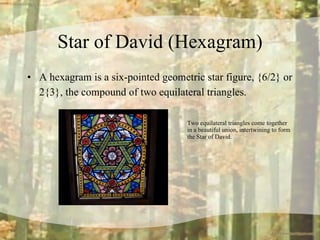
Star of David (Hexagram) A hexagram is a six-pointed geometric star figure, {6/2} or 2{3}, the compound of two equilateral triangles.   Two equilateral triangles come together  in a beautiful union, intertwining to form  the Star of David.
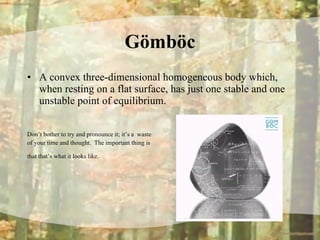
Gömböc A convex three-dimensional homogeneous body which, when resting on a flat surface, has just one stable and one unstable point of equilibrium.  Don’t bother to try and pronounce it; it’s a  waste  of your time and thought.  The important thing is  that that’s what it looks like.
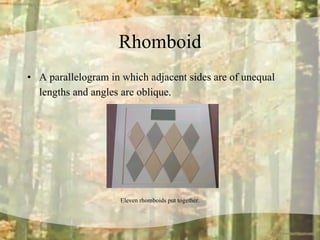
Rhomboid A parallelogram in which adjacent sides are of unequal lengths and angles are oblique.   Eleven rhomboids put together.
The End

Geometry In The Real World

  • 1.
    Geometry in theReal World Jesse Wright Period 1, Geometry
  • 2.
    Point A zero-dimensionalfigure; while usually left undefined, has four main representations - the dot, the node, the location, and the ordered pair of numbers. The moon in this picture represents a point in the sky.
  • 3.
    Line (Segment) Theset of points consisting of two distinct points and all in-between them. Believe it or not, these lines are all straight.
  • 4.
    Plane A two-dimensionalgroup of points that goes on infinitely in all directions; made up of infinite lines. In this optical illusion, the floor the people st- and on serves as a (ge- ometric) plane.
  • 5.
    Angle The unionof 2 rays that have the same endpoint; measured in degrees or radians (trig.); the five types of angles are zero, acute, right, obtuse, and straight. The angle on this plane is 45 degrees.
  • 6.
    Perpendicular Lines Twosegments, rays, or lines that intersect in such a way that four 90 degree angles are formed. The cross, formed by two beams, creates four 90 degree angles and therefore is formed by perpendicular lines.
  • 7.
    Parallel Lines Twoor more coplanar lines that have no points in common nor are identical (e.g., the same line). Such lines never intersect, no matter how far they extend. The two rays of light in this picture are parallel to one another.
  • 8.
    Triangle A polygonwith three sides; four types: equilateral triangle, isosceles triangle, right triangle, scalene triangle. The Kanizsa triangle illustrated above shows many different triangles.
  • 9.
    Right Triangle Atriangle that has a 90 degree angle. Notice the right triangles formed by the poles.
  • 10.
    Pentagon A five-sidedpolygon. This picture shows an umbrella that is shaped like a pentagon and has horseys on it!.
  • 11.
    Hexagon A six-sidedpolygon. The hexagon in this picture surrounds the main section of the artwork.
  • 12.
    Square An equilateraland equiangular quadrilateral See all the squares?!
  • 13.
    Rectangle A quadrilateralwhose angles are all right angles. Many rectangles come together to form an interesting piece of art...
  • 14.
    Trapezoid A quadrilateralthat has at least one pair of parallel sides; see isosceles trapezoid. No, I didn’t do the purple lines.
  • 15.
    Parallelogram A quadrilateralwith both pairs of opposite sides parallel. What a pretty picture, a bunch of parallelograms making a star thingy.
  • 16.
    Circle The setof points on a plane at a certain distance (radius) from a certain point (center); a polygon with infinite sides. Three circles with circles cut out of them. How exciting.
  • 17.
    Cylinder The surfaceof a cylindrical solid whose base is a circle; see right cylinder. I don’t know what it is either. But at least it’s a cylinder.
  • 18.
    Sphere The setof all points in three-dimensional space lying the same distance (the radius) from a given point (the centre), or the result of rotating a circle about one of its diameters. That’s Da Vinci; for some reason, he liked to draw pictures of himself looking into a metal sphere as the reflection was a distorted version of reality. I guess he liked it.
  • 19.
    Star of David(Hexagram) A hexagram is a six-pointed geometric star figure, {6/2} or 2{3}, the compound of two equilateral triangles. Two equilateral triangles come together in a beautiful union, intertwining to form the Star of David.
  • 20.
    Gömböc A convexthree-dimensional homogeneous body which, when resting on a flat surface, has just one stable and one unstable point of equilibrium. Don’t bother to try and pronounce it; it’s a waste of your time and thought. The important thing is that that’s what it looks like.
  • 21.
    Rhomboid A parallelogramin which adjacent sides are of unequal lengths and angles are oblique. Eleven rhomboids put together.
  • 22.