MELINDA R.
TEVES
PREPARED BY:
BSED MATH2A
INTRODUCTI
ON Lorem ipsum dolor sit amet, consectetur
adipiscing elit. Duis vulputate nulla at ante
rhoncus, vel efficitur felis condimentum.
Proin odio odio.
Lorem ipsum dolor sit amet, consectetur
adipiscing elit. Duis vulputate nulla at ante
rhoncus, vel efficitur felis condimentum.
Proin odio odio.
GEOMETRIC
TRANSFORMATION
GROUP OF
TRANSFORMATION
INTRODUCTI
ON
• Reversible: Geometric transformations
can be reversed, meaning that the
original object can be recovered from the
transformed object.
• Combinable: Geometric transformations
can be combined in sequence to produce
more complex transformations.
• Preserve shape: Geometric
transformations do not change the shape
of an object, only its size, position, or
orientation.
Geometric transformation
• is a bijection of a set that has a geometric structure by itself or
another set.
• If a shape is transformed, its appearance is changed.
• After that, the shape could be congruent or similar to its
preimage.
• The actual meaning of transformations is a change of
appearance of something.
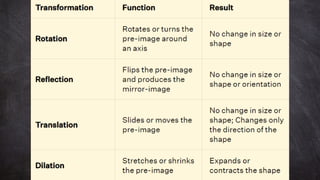
TRANSFORMATION
FOUR KINDS OF
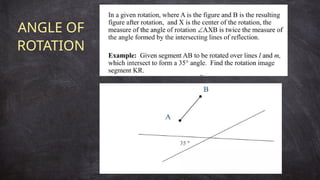
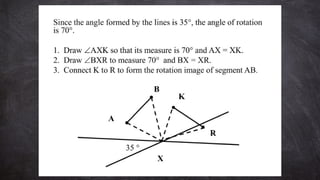
ANGLE OF
ROTATION
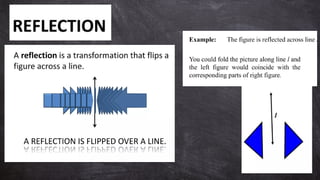
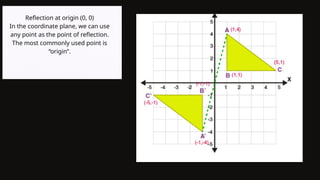
Reflection at origin (0, 0)
In the coordinate plane, we can use
any point as the point of reflection.
The most commonly used point is
“origin”.
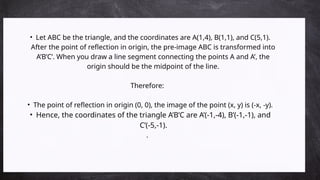
• Let ABC be the triangle, and the coordinates are A(1,4), B(1,1), and C(5,1).
After the point of reflection in origin, the pre-image ABC is transformed into
A’B’C’. When you draw a line segment connecting the points A and A’, the
origin should be the midpoint of the line.
Therefore:
• The point of reflection in origin (0, 0), the image of the point (x, y) is (-x, -y).
• Hence, the coordinates of the triangle A’B’C are A’(-1,-4), B’(-1,-1), and
C’(-5,-1).
.
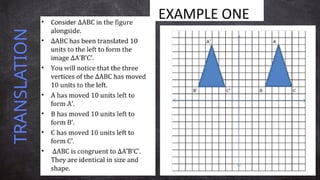
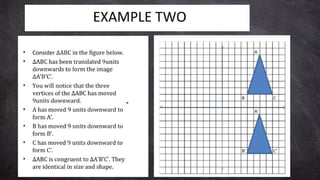
TRANSLATION
CONCLUSION:
• Geometric transformations involve
changing the size, position, or
orientation of a geometric object.
• There are five main types of transformations:
translations, rotations, reflections, dilations,
and glide reflections.
THE END
WARNER & SPENCER MARCH 2023
THANK YOU

GEOMETRIC-TRANSFORMATION modern geometry.pptx

  • 1.
  • 2.
    INTRODUCTI ON Lorem ipsumdolor sit amet, consectetur adipiscing elit. Duis vulputate nulla at ante rhoncus, vel efficitur felis condimentum. Proin odio odio. Lorem ipsum dolor sit amet, consectetur adipiscing elit. Duis vulputate nulla at ante rhoncus, vel efficitur felis condimentum. Proin odio odio.
  • 3.
  • 4.
    INTRODUCTI ON • Reversible: Geometrictransformations can be reversed, meaning that the original object can be recovered from the transformed object. • Combinable: Geometric transformations can be combined in sequence to produce more complex transformations. • Preserve shape: Geometric transformations do not change the shape of an object, only its size, position, or orientation.
  • 5.
    Geometric transformation • isa bijection of a set that has a geometric structure by itself or another set. • If a shape is transformed, its appearance is changed. • After that, the shape could be congruent or similar to its preimage. • The actual meaning of transformations is a change of appearance of something.
  • 6.
  • 8.
  • 11.
    Reflection at origin(0, 0) In the coordinate plane, we can use any point as the point of reflection. The most commonly used point is “origin”.
  • 12.
    • Let ABCbe the triangle, and the coordinates are A(1,4), B(1,1), and C(5,1). After the point of reflection in origin, the pre-image ABC is transformed into A’B’C’. When you draw a line segment connecting the points A and A’, the origin should be the midpoint of the line. Therefore: • The point of reflection in origin (0, 0), the image of the point (x, y) is (-x, -y). • Hence, the coordinates of the triangle A’B’C are A’(-1,-4), B’(-1,-1), and C’(-5,-1). .
  • 13.
  • 18.
    CONCLUSION: • Geometric transformationsinvolve changing the size, position, or orientation of a geometric object. • There are five main types of transformations: translations, rotations, reflections, dilations, and glide reflections.
  • 19.
    THE END WARNER &SPENCER MARCH 2023 THANK YOU