1
Subject: Research
Methadology
Lectures
Assistant Professor: Kamran Ullah (PhD)
 Department of BIOLOGY
 The University of HARIPUR
2
MOTIVATION IN RESEARCH 1.5
 What makes people to undertake research? This is a question of fundamental
importance. The possible motives for doing research may be either one or more
of the following:
1. Desire to get a research degree along with its consequential benefits;
2. Desire to face the challenge in solving the unsolved problems, i.e., concern
over practical problems initiates research;
3. Desire to get intellectual joy of doing some creative work;
4. Desire to be of service to society;
5. Desire to get respectability.
 However, this is not an exhaustive list of factors motivating people to undertake
research studies.
 Many more factors such as directives of government, employment conditions,
curiosity about new things, desire to understand causal relationships, social
thinking may as well motivate (or at times compel) people to perform research
operations.
3
CRITERIA OF A GOOD RESEARCH 1
 Purpose clearly defined.
 Research process detailed.
 Research design thoroughly planned.
 High ethical standards applied.
 Limitations frankly revealed.
 Adequate analysis for decision maker’s needs.
 Findings presented unambiguously (clearly).
 Conclusions justified.
 Researcher’s experience reflected.
4
SIGNIFICANCE OF RESEARCH 3
 Hudson Maxim define as *All progress is born of inquiry. Doubt is often
better than overconfidence, for it leads to inquiry, and inquiry leads to
invention*.
 Increased amounts of research make progress possible. Research
inculcates (instructs or teaches) scientific and inductive thinking and it
promotes the development of logical habits of thinking and organisation.
 The role of research in several fields of applied economics, whether related
to business or to the economy as a whole, has greatly increased in modern
times.
 The increasingly complex nature of business and government has focused
attention on the use of research in solving operational problems. Research,
as an aid to economic policy, has gained added importance, both for
government and business.
 Research provides the basis for nearly all government policies in our
system. For instance, government’s budgets rest in part on an analysis of
and desires of the people and on the availability of revenues to meet these
 * * Inductive reasoning is a method of reasoning in which a general principle
is derived from a body of observations.
5
 Research has its special significance in solving various operational and planning
problems of business and industry.
 Research is equally important for social scientists in studying social relationships and in
seeking answers to various social problems.
In addition to what has been stated above, the significance of research can also be
understood keeping in view the following points:
o To those students who are to write a master’s or Ph.D. thesis, research may mean a
careerism or a way to attain a high position in the social structure;
o To professionals in research methodology, research may mean a source of livelihood
(funds or income).
o To philosophers and thinkers, research may mean the outlet for new ideas and insights;
o To literary men and women, research may mean the development of new styles and
creative work;
o To analysts and intellectuals, research may mean the generalizations of new theories.
Thus, research is the fountain of knowledge for the sake of knowledge and an important
source of providing guidelines for solving different business, governmental and social
problems. It is a sort of formal training which enables one to understand the new
developments in one’s field in a better way.
MEANING OF RESEARCH
6
Research in general refers to
.
knowledge or for relevant information on
 A scientific and systematic search for
a specific topic.
art of scientific investigation.
 Research is an
 Research is a careful investigation or inquiry especially through search for new
facts in any branch of knowledge.
 “Redman and Mory” define research as a “systematized effort to gain new
knowledge.”
a movement from the known to the unknown.
 Research is a movement,
 “Clifford Woody” defines research as “a comprises defining and redefining
problems, formulating hypothesis or suggested solutions; collecting, organizing
and evaluating data; making deductions and reaching conclusions; and at last,
carefully testing the conclusions to determine whether they fit the formulating
hypothesis”.
OBJECTIVES OF RESEARCH
7
 The purpose of research is to discover answers through the application of
scientific procedures.
 The main aim of research is to find out the truth which is hidden and which
has not been discovered as yet.
Research objectives falling into a number of following broad groupings:
 Exploratory or Formulative Research studies: To gain familiarity with a
phenomenon or to achieve new insights into it. Some of the more popular
research design
methods of exploratory include literature searches, depth
interviews, focus groups, and case analyses.
For example, 'a study into the implications of COVID-19 pandemic into the
global economy' is an exploratory research. COVID-19 pandemic is a recent
phenomenon and the study can generate an initial knowledge about economic
implications of the phenomenon.
A pandemic is basically a global epidemic -- an epidemic that spreads to
more than one continent.
 Descriptive Research studies: To describe accurately the characteristics of a
particular individual, situation or a group.
 Descriptive research includes surveys and fact-finding enquiries of different
kinds. The major purpose of descriptive research is description of the state of
affairs (activities, businesses) as it exists at present. In social science and
business research we quite often use the term Ex post facto research for
descriptive research studies.
 The main characteristic of this method is that the researcher has no control
over the variables; he can only report what has happened or what is happening.
Most ex post facto research projects are used for descriptive studies in which
the researcher seeks to measure such items as, for example, frequency of
shopping, preferences of people, or similar data.
 A survey will be carried out to gather enough data about the income of the
employees, then their performance will be evaluated and compared to their
income.
8
 Diagnostic Research studies: To determine the frequency with which
something occurs or with which it is associated with something else.
Diagnostic tests are approaches used in clinical practice to identify with high
accuracy the disease of a particular patient and thus to provide early and
proper treatment
9
 Hypothesis-Testing Research studies: To test a hypothesis of a causal
relationship between variables. For example, suppose a biologist believes that
a certain fertilizer will cause plants to grow more during a one-month period
than they normally do, which is currently 20 inches. To test this, she applies
the fertilizer to each of the plants in her laboratory for one month.
Analytical research: The researcher has to use facts or information already
available and analyze these to make a critical evaluation of the material.
Some Other Types of Research:
Quantitative vs. Qualitative Conceptual vs. Empirical
One-time research vs. Longitudinal research.
CRITERIA OF A GOOD RESEARCH
 Purpose clearly defined.
 Research process detailed.
 Research design thoroughly planned.
 High ethical standards applied.
 Limitations frankly revealed.
 Adequate analysis for decision maker’s needs.
 Findings presented unambiguously (clearly).
 Conclusions justified.
 Researcher’s experience reflected.
10
QUALITIES OF GOOD RESEARCH
 Systematic
 Logical (Valid)
 Empirical
 Replicable
 Creative
 Use of multiple methods
11
PROBLEMS IN RESEARCH
Uncontrollable variables
Human tendencies
Time and money
Lack of computerization
Lack of scientific training in the methodology of research
Insufficient interaction between university research departments and business
establishments.
Lack of confidence on the part of business units to give information.
Lack of code of conduct
Difficulty of adequate and timely secretarial assistance
Poor library management and functioning
Difficulty of timely availability of published data
Ignorance
12
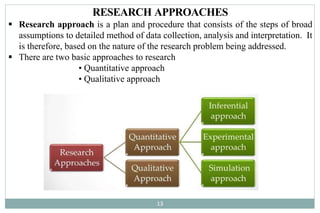
RESEARCH APPROACHES
 Research approach is a plan and procedure that consists of the steps of broad
assumptions to detailed method of data collection, analysis and interpretation. It
is therefore, based on the nature of the research problem being addressed.
 There are two basic approaches to research
‱ Quantitative approach
‱ Qualitative approach
13
 Quantitative approach involves the generation of data in quantitative form
which can be subjected to rigorous quantitative analysis in a proper fashion.
 This approach can be further sub-classified into
1) Inferential approach
2) Experimental approach
3) Simulation approach
 The purpose of inferential approach to research is to form a data base
from which to infer characteristics or relationships of population. This usually
means survey research where a sample of population is studied (questioned or
observed) to determine its characteristics, and it is then inferred that the population
has the same characteristics.
 Experimental approach is characterized by much greater control over the research
environment and in this case some variables are manipulated to observe their
effect on other variables.
 Simulation approach involves the construction of an artificial environment within
which relevant information and data can be generated. Simulation approach useful
in building models for understanding future conditions.
14
SIGNIFICANCE OF RESEARCH
15
 Hudson Maxim define as *All progress is born of inquiry. Doubt is often better
than overconfidence, for it leads to inquiry, and inquiry leads to invention*.
 Increased amounts of research make progress possible. Research inculcates
(instructs or teaches) scientific and inductive thinking and it promotes the
development of logical habits of thinking and organisation.
 The role of research in several fields of applied economics, whether related to
business or to the economy as a whole, has greatly increased in modern times.
 The increasingly complex nature of business and government has focused
attention on the use of research in solving operational problems. Research, as an
aid to economic policy, has gained added importance, both for government and
business.
 Research provides the basis for nearly all government policies in our economic
system. For instance, government’s budgets rest in part on an analysis of the needs
and desires of the people and on the availability of revenues to meet these needs.
 * * Inductive reasoning is a method of reasoning in which a general principle is
derived from a body of observations.
 Research has its special significance in solving various operational and planning
problems of business and industry.
 Research is equally important for social scientists in studying social relationships and
in seeking answers to various social problems.
In addition to what has been stated above, the
significance of research can also be understood keeping in
view the following points:
o To those students who are to write a master’s or Ph.D. thesis, research may mean a
careerism or a way to attain a high position in the social structure;
o To professionals in research methodology, research may mean a source of livelihood
(funds or income).
o To philosophers and thinkers, research may mean the
outlet for new ideas and
insights;
o To literary men and women, research may mean the development of new styles
and creative work;
o To analysts and intellectuals, research may mean the generalizations of new theories.
Thus, research is the fountain of knowledge for the sake of knowledge and an important
source of providing guidelines for solving different business, governmental and social
problems. It is a sort of formal training which enables one to understand the new
developments in one’s field in a better way.
16
17
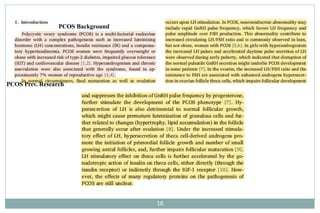
PCOS Background
18
PCOS Prev. Research
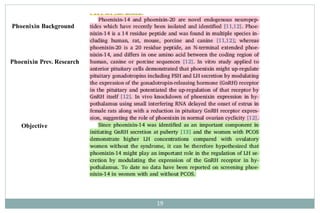
Phoenixin Background
19
Phoenixin Prev. Research
Objective
https://www.campuschin
a.org/universities/index.h
tml?fbclid=IwAR3qFlQ4E
9N7BfZ4C3v_1kkK5JZYaM
HKMhfsXiIgXDLhng8LAv
p11smgac4
21
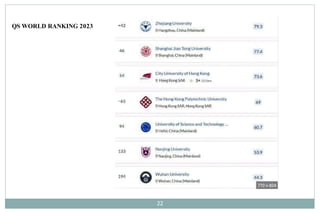
QS WORLD RANKING 2023
22
23
24
25
26/47
27/47
28/47
29/47
30/47
31/47

Geological time scale explanations

  • 1.
    1 Subject: Research Methadology Lectures Assistant Professor:Kamran Ullah (PhD)  Department of BIOLOGY  The University of HARIPUR
  • 2.
    2 MOTIVATION IN RESEARCH1.5  What makes people to undertake research? This is a question of fundamental importance. The possible motives for doing research may be either one or more of the following: 1. Desire to get a research degree along with its consequential benefits; 2. Desire to face the challenge in solving the unsolved problems, i.e., concern over practical problems initiates research; 3. Desire to get intellectual joy of doing some creative work; 4. Desire to be of service to society; 5. Desire to get respectability.  However, this is not an exhaustive list of factors motivating people to undertake research studies.  Many more factors such as directives of government, employment conditions, curiosity about new things, desire to understand causal relationships, social thinking may as well motivate (or at times compel) people to perform research operations.
  • 3.
    3 CRITERIA OF AGOOD RESEARCH 1  Purpose clearly defined.  Research process detailed.  Research design thoroughly planned.  High ethical standards applied.  Limitations frankly revealed.  Adequate analysis for decision maker’s needs.  Findings presented unambiguously (clearly).  Conclusions justified.  Researcher’s experience reflected.
  • 4.
    4 SIGNIFICANCE OF RESEARCH3  Hudson Maxim define as *All progress is born of inquiry. Doubt is often better than overconfidence, for it leads to inquiry, and inquiry leads to invention*.  Increased amounts of research make progress possible. Research inculcates (instructs or teaches) scientific and inductive thinking and it promotes the development of logical habits of thinking and organisation.  The role of research in several fields of applied economics, whether related to business or to the economy as a whole, has greatly increased in modern times.  The increasingly complex nature of business and government has focused attention on the use of research in solving operational problems. Research, as an aid to economic policy, has gained added importance, both for government and business.  Research provides the basis for nearly all government policies in our system. For instance, government’s budgets rest in part on an analysis of and desires of the people and on the availability of revenues to meet these  * * Inductive reasoning is a method of reasoning in which a general principle is derived from a body of observations.
  • 5.
    5  Research hasits special significance in solving various operational and planning problems of business and industry.  Research is equally important for social scientists in studying social relationships and in seeking answers to various social problems. In addition to what has been stated above, the significance of research can also be understood keeping in view the following points: o To those students who are to write a master’s or Ph.D. thesis, research may mean a careerism or a way to attain a high position in the social structure; o To professionals in research methodology, research may mean a source of livelihood (funds or income). o To philosophers and thinkers, research may mean the outlet for new ideas and insights; o To literary men and women, research may mean the development of new styles and creative work; o To analysts and intellectuals, research may mean the generalizations of new theories. Thus, research is the fountain of knowledge for the sake of knowledge and an important source of providing guidelines for solving different business, governmental and social problems. It is a sort of formal training which enables one to understand the new developments in one’s field in a better way.
  • 6.
    MEANING OF RESEARCH 6 Researchin general refers to
. knowledge or for relevant information on  A scientific and systematic search for a specific topic. art of scientific investigation.  Research is an  Research is a careful investigation or inquiry especially through search for new facts in any branch of knowledge.  “Redman and Mory” define research as a “systematized effort to gain new knowledge.” a movement from the known to the unknown.  Research is a movement,  “Clifford Woody” defines research as “a comprises defining and redefining problems, formulating hypothesis or suggested solutions; collecting, organizing and evaluating data; making deductions and reaching conclusions; and at last, carefully testing the conclusions to determine whether they fit the formulating hypothesis”.
  • 7.
    OBJECTIVES OF RESEARCH 7 The purpose of research is to discover answers through the application of scientific procedures.  The main aim of research is to find out the truth which is hidden and which has not been discovered as yet. Research objectives falling into a number of following broad groupings:  Exploratory or Formulative Research studies: To gain familiarity with a phenomenon or to achieve new insights into it. Some of the more popular research design methods of exploratory include literature searches, depth interviews, focus groups, and case analyses. For example, 'a study into the implications of COVID-19 pandemic into the global economy' is an exploratory research. COVID-19 pandemic is a recent phenomenon and the study can generate an initial knowledge about economic implications of the phenomenon. A pandemic is basically a global epidemic -- an epidemic that spreads to more than one continent.
  • 8.
     Descriptive Researchstudies: To describe accurately the characteristics of a particular individual, situation or a group.  Descriptive research includes surveys and fact-finding enquiries of different kinds. The major purpose of descriptive research is description of the state of affairs (activities, businesses) as it exists at present. In social science and business research we quite often use the term Ex post facto research for descriptive research studies.  The main characteristic of this method is that the researcher has no control over the variables; he can only report what has happened or what is happening. Most ex post facto research projects are used for descriptive studies in which the researcher seeks to measure such items as, for example, frequency of shopping, preferences of people, or similar data.  A survey will be carried out to gather enough data about the income of the employees, then their performance will be evaluated and compared to their income. 8
  • 9.
     Diagnostic Researchstudies: To determine the frequency with which something occurs or with which it is associated with something else. Diagnostic tests are approaches used in clinical practice to identify with high accuracy the disease of a particular patient and thus to provide early and proper treatment 9  Hypothesis-Testing Research studies: To test a hypothesis of a causal relationship between variables. For example, suppose a biologist believes that a certain fertilizer will cause plants to grow more during a one-month period than they normally do, which is currently 20 inches. To test this, she applies the fertilizer to each of the plants in her laboratory for one month. Analytical research: The researcher has to use facts or information already available and analyze these to make a critical evaluation of the material. Some Other Types of Research: Quantitative vs. Qualitative Conceptual vs. Empirical One-time research vs. Longitudinal research.
  • 10.
    CRITERIA OF AGOOD RESEARCH  Purpose clearly defined.  Research process detailed.  Research design thoroughly planned.  High ethical standards applied.  Limitations frankly revealed.  Adequate analysis for decision maker’s needs.  Findings presented unambiguously (clearly).  Conclusions justified.  Researcher’s experience reflected. 10
  • 11.
    QUALITIES OF GOODRESEARCH  Systematic  Logical (Valid)  Empirical  Replicable  Creative  Use of multiple methods 11
  • 12.
    PROBLEMS IN RESEARCH Uncontrollablevariables Human tendencies Time and money Lack of computerization Lack of scientific training in the methodology of research Insufficient interaction between university research departments and business establishments. Lack of confidence on the part of business units to give information. Lack of code of conduct Difficulty of adequate and timely secretarial assistance Poor library management and functioning Difficulty of timely availability of published data Ignorance 12
  • 13.
    RESEARCH APPROACHES  Researchapproach is a plan and procedure that consists of the steps of broad assumptions to detailed method of data collection, analysis and interpretation. It is therefore, based on the nature of the research problem being addressed.  There are two basic approaches to research ‱ Quantitative approach ‱ Qualitative approach 13
  • 14.
     Quantitative approachinvolves the generation of data in quantitative form which can be subjected to rigorous quantitative analysis in a proper fashion.  This approach can be further sub-classified into 1) Inferential approach 2) Experimental approach 3) Simulation approach  The purpose of inferential approach to research is to form a data base from which to infer characteristics or relationships of population. This usually means survey research where a sample of population is studied (questioned or observed) to determine its characteristics, and it is then inferred that the population has the same characteristics.  Experimental approach is characterized by much greater control over the research environment and in this case some variables are manipulated to observe their effect on other variables.  Simulation approach involves the construction of an artificial environment within which relevant information and data can be generated. Simulation approach useful in building models for understanding future conditions. 14
  • 15.
    SIGNIFICANCE OF RESEARCH 15 Hudson Maxim define as *All progress is born of inquiry. Doubt is often better than overconfidence, for it leads to inquiry, and inquiry leads to invention*.  Increased amounts of research make progress possible. Research inculcates (instructs or teaches) scientific and inductive thinking and it promotes the development of logical habits of thinking and organisation.  The role of research in several fields of applied economics, whether related to business or to the economy as a whole, has greatly increased in modern times.  The increasingly complex nature of business and government has focused attention on the use of research in solving operational problems. Research, as an aid to economic policy, has gained added importance, both for government and business.  Research provides the basis for nearly all government policies in our economic system. For instance, government’s budgets rest in part on an analysis of the needs and desires of the people and on the availability of revenues to meet these needs.  * * Inductive reasoning is a method of reasoning in which a general principle is derived from a body of observations.
  • 16.
     Research hasits special significance in solving various operational and planning problems of business and industry.  Research is equally important for social scientists in studying social relationships and in seeking answers to various social problems. In addition to what has been stated above, the significance of research can also be understood keeping in view the following points: o To those students who are to write a master’s or Ph.D. thesis, research may mean a careerism or a way to attain a high position in the social structure; o To professionals in research methodology, research may mean a source of livelihood (funds or income). o To philosophers and thinkers, research may mean the outlet for new ideas and insights; o To literary men and women, research may mean the development of new styles and creative work; o To analysts and intellectuals, research may mean the generalizations of new theories. Thus, research is the fountain of knowledge for the sake of knowledge and an important source of providing guidelines for solving different business, governmental and social problems. It is a sort of formal training which enables one to understand the new developments in one’s field in a better way. 16
  • 17.
  • 18.
  • 19.
  • 20.
  • 21.
  • 22.
  • 23.
  • 24.
  • 25.
  • 26.
  • 27.
  • 28.
  • 29.
  • 30.
  • 31.