INTRODUCTION TO RESEARCH
1
 What is Research?
 What is the Value of Research?
 Objectives of Research
 Motivation in Research
 Characteristics of Research
 Significance of Research
 Criteria of Good Research
 Scientific Research
 Qualitative and Quantitative Research
 Ethics in Research
2
 Research in common language refers to a search
for knowledge.
 The Advanced Learner’s Dictionary lays down the
meaning of research as “a careful investigation or
inquiry specially through search for new facts in
any branch of knowledge.”
3
 The word research is composed of two syllables,
re and search.
 re is a prefix meaning again, anew or over again
 search is a verb meaning to examine closely and
carefully, to test and try, or to probe.
 Together they form a noun describing a careful,
systematic, patient study and investigation in
some field of knowledge, undertaken to establish
facts or principles.
4
 Research is asking questions and finding answers.
It is the discovery of answers to questions through
the application of scientific and systematic
procedures.
 Research is an activity directed toward the
solution of a problem with a view to discovering
and developing an organized body of knowledge.
5
 Research is defined as an organized, systematic,
objective, data based, scientific, inquiry or
investigation into a specific problem, undertaken
with the purpose of finding answers or solutions
to it.
6
 Research provides solutions to problems
 Research provides new information or aid information
in the existing body of knowledge.
 Research provides the needed information that guides
the policy makers, decision makers, business
managers, and other stakeholders to make informed
decisions and to improve decision making process.
7
 Research helps in generating theories and models
 Research helps in developing methodologies
8
 The purpose of research is to discover answers to
questions.
 The main aim of research is to find out the truth
which is hidden and which has not been
discovered as yet.
9
 The research objectives are divided into following broad
groups:
 To gain familiarity with a phenomenon or to achieve new
insights into it (studies with this objective are termed as
exploratory research studies)
 To portray accurately the characteristics of a particular
phenomenon (studies with this objective are known as
descriptive research studies)
 To explain or test causal relationship between
factors/variables (studies with this objective are known as
explanatory or causal research studies).
10
 What makes people to undertake research? The
possible motives for doing research may be either
one or more of the following:
 Desire to get a research degree.
 Desire to undertake the challenge in solving the
unsolved problems.
 Desire to help society by discovering and
generating new facts, information and knowledge.
 Desire to get recognition.
11
 Research is a process of collecting, analyzing and
interpreting information to answer questions.
 But to qualify as research, the process must have
certain characteristics: it must, as far as possible,
be controlled, rigorous, systematic, valid and
verifiable, empirical and critical.
12
 Controlled
In real life there are many factors that affect an
outcome. The concept of control implies that, in
exploring causality in relation to two variables
(factors), one set up his study in a way that
minimizes the effects of other factors affecting the
relationship.
 Rigorous
The concept of rigorous implies the procedures
followed to find answers to questions are relevant,
appropriate and justified.
13
 Systematic
This concept implies that the procedure adopted
to undertake an investigation follow a certain
logical sequence.
 Valid and verifiable
This concept implies that whatever one conclude
on the basis of findings is correct and can be
verified by others.
14
 Empirical
This means that any conclusion drawn are based
upon hard evidence gathered from information
collected from real life experiences or
observations.
 Critical
The critical scrutiny of the procedures used and
the methods employed is crucial to a research
inquiry. The process of investigation must be
foolproof and free from drawbacks.
15
 Research inculcates scientific and inductive
thinking and it promotes the development of
logical habits of thinking and organization.
 The role of research in several fields of applied
economics, whether related to business or to the
economy as a whole, has greatly increased in
modern times.
16
The following aspects emphasize the significance
of research.
 Government Policies
 Allocation of National Resources
 Investigation of Economic Structure
 Solution of Operational and Planning Problems of
Business and Industry
 New Knowledge
 Organizational and Social Control and Prediction
17
 Purpose/ objectives should be clearly defined
 Research process should be detailed to ensure
comprehensiveness
 Research design should be selected based on
sound logic and realistic assumptions.
 Procedures used should be described in sufficient
details
 Analysis of data should be done with appropriate
methods of analysis
18
 Findings and conclusions should be consistent
with the results obtained in the analysis
 Scope should be clearly stated
 Assumptions should be clearly stated
 Limitations should be clearly stated
19
 Scientific approach to research implies an objective,
logical and systematic research wherein
 the researcher is guided by the rules of logical
reasoning
 the investigation proceeds in an orderly manner
 Conducted through observations and experiments
20
 The goal of scientific research is to explain,
predict, and/or control phenomena.
 Characteristics of Scientific Research are
1. Purposive
2. Objective
3. Rational
4. Verifiable/ Testable
5. Generalizable
6. Empirical
7. Replicable
21
 Research is usually classified into two categories
 Quantitative Research
 Qualitative Research
 These two types of researches are complementary-
one supplementing the other.
 Qualitative research is not a substitute for
quantitative research, it is not to supplement the
quantitative research.
22
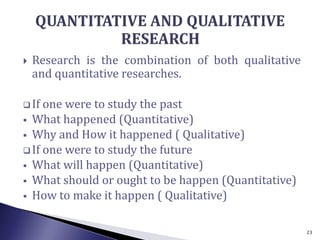
 Research is the combination of both qualitative
and quantitative researches.
 If one were to study the past
 What happened (Quantitative)
 Why and How it happened ( Qualitative)
 If one were to study the future
 What will happen (Quantitative)
 What should or ought to be happen (Quantitative)
 How to make it happen ( Qualitative)
23
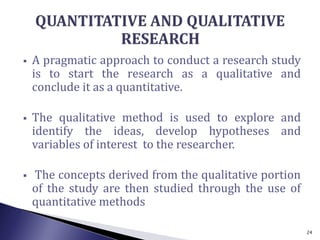
 A pragmatic approach to conduct a research study
is to start the research as a qualitative and
conclude it as a quantitative.
 The qualitative method is used to explore and
identify the ideas, develop hypotheses and
variables of interest to the researcher.
 The concepts derived from the qualitative portion
of the study are then studied through the use of
quantitative methods
24
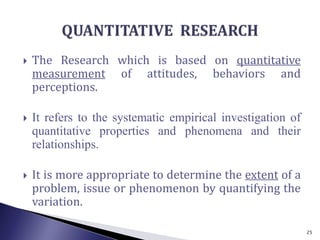
 The Research which is based on quantitative
measurement of attitudes, behaviors and
perceptions.
 It refers to the systematic empirical investigation of
quantitative properties and phenomena and their
relationships.
 It is more appropriate to determine the extent of a
problem, issue or phenomenon by quantifying the
variation.
25
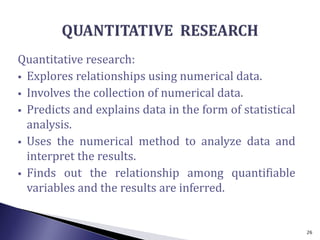
Quantitative research:
 Explores relationships using numerical data.
 Involves the collection of numerical data.
 Predicts and explains data in the form of statistical
analysis.
 Uses the numerical method to analyze data and
interpret the results.
 Finds out the relationship among quantifiable
variables and the results are inferred.
26
 How much growth has been taken place in prices
during the year 2010?
 What is the average income of individual
household in Punjab?
27
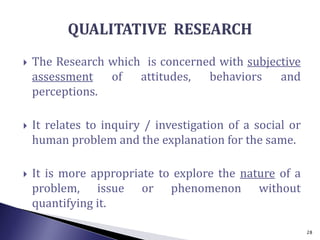
 The Research which is concerned with subjective
assessment of attitudes, behaviors and
perceptions.
 It relates to inquiry / investigation of a social or
human problem and the explanation for the same.
 It is more appropriate to explore the nature of a
problem, issue or phenomenon without
quantifying it.
28
Qualitative research :
 Conducted to have an insight and better
understanding of not only about the current
situation is but also why it is so.
 Explores relationships using textual data.
 Is more open and responsive to the research
participants.
 Uses a variety of methods and data collection
strategies
29
 Why the market share of the company has been
declining?
 What are the factors that motivate the employees
in an organization?
30
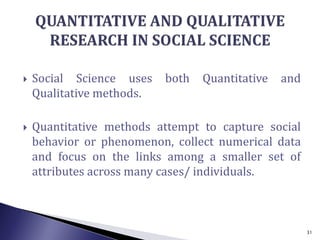
 Social Science uses both Quantitative and
Qualitative methods.
 Quantitative methods attempt to capture social
behavior or phenomenon, collect numerical data
and focus on the links among a smaller set of
attributes across many cases/ individuals.
31
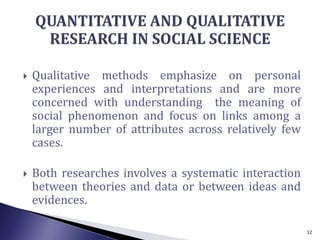
 Qualitative methods emphasize on personal
experiences and interpretations and are more
concerned with understanding the meaning of
social phenomenon and focus on links among a
larger number of attributes across relatively few
cases.
 Both researches involves a systematic interaction
between theories and data or between ideas and
evidences.
32
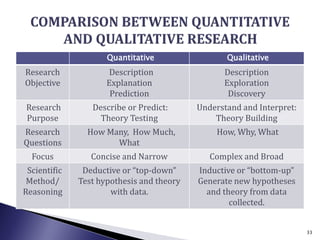
Quantitative Qualitative
Research
Objective
Description
Explanation
Prediction
Description
Exploration
Discovery
Research
Purpose
Describe or Predict:
Theory Testing
Understand and Interpret:
Theory Building
Research
Questions
How Many, How Much,
What
How, Why, What
Focus Concise and Narrow Complex and Broad
Scientific
Method/
Reasoning
Deductive or “top-down”
Test hypothesis and theory
with data.
Inductive or “bottom-up”
Generate new hypotheses
and theory from data
collected.
33
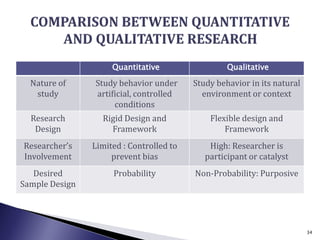
Quantitative Qualitative
Nature of
study
Study behavior under
artificial, controlled
conditions
Study behavior in its natural
environment or context
Research
Design
Rigid Design and
Framework
Flexible design and
Framework
Researcher’s
Involvement
Limited : Controlled to
prevent bias
High: Researcher is
participant or catalyst
Desired
Sample Design
Probability Non-Probability: Purposive
34
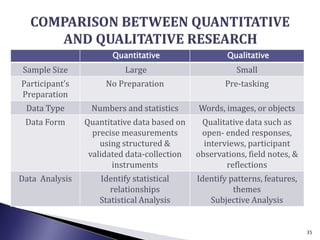
Quantitative Qualitative
Sample Size Large Small
Participant’s
Preparation
No Preparation Pre-tasking
Data Type Numbers and statistics Words, images, or objects
Data Form Quantitative data based on
precise measurements
using structured &
validated data-collection
instruments
Qualitative data such as
open- ended responses,
interviews, participant
observations, field notes, &
reflections
Data Analysis Identify statistical
relationships
Statistical Analysis
Identify patterns, features,
themes
Subjective Analysis
35
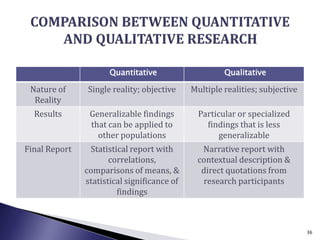
Quantitative Qualitative
Nature of
Reality
Single reality; objective Multiple realities; subjective
Results Generalizable findings
that can be applied to
other populations
Particular or specialized
findings that is less
generalizable
Final Report Statistical report with
correlations,
comparisons of means, &
statistical significance of
findings
Narrative report with
contextual description &
direct quotations from
research participants
36
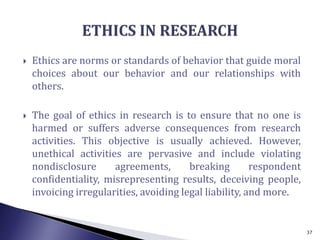
 Ethics are norms or standards of behavior that guide moral
choices about our behavior and our relationships with
others.
 The goal of ethics in research is to ensure that no one is
harmed or suffers adverse consequences from research
activities. This objective is usually achieved. However,
unethical activities are pervasive and include violating
nondisclosure agreements, breaking respondent
confidentiality, misrepresenting results, deceiving people,
invoicing irregularities, avoiding legal liability, and more.
37

Introduction-to-Research---Lec-1-26092022-015602pm.pdf

  • 1.
  • 2.
     What isResearch?  What is the Value of Research?  Objectives of Research  Motivation in Research  Characteristics of Research  Significance of Research  Criteria of Good Research  Scientific Research  Qualitative and Quantitative Research  Ethics in Research 2
  • 3.
     Research incommon language refers to a search for knowledge.  The Advanced Learner’s Dictionary lays down the meaning of research as “a careful investigation or inquiry specially through search for new facts in any branch of knowledge.” 3
  • 4.
     The wordresearch is composed of two syllables, re and search.  re is a prefix meaning again, anew or over again  search is a verb meaning to examine closely and carefully, to test and try, or to probe.  Together they form a noun describing a careful, systematic, patient study and investigation in some field of knowledge, undertaken to establish facts or principles. 4
  • 5.
     Research isasking questions and finding answers. It is the discovery of answers to questions through the application of scientific and systematic procedures.  Research is an activity directed toward the solution of a problem with a view to discovering and developing an organized body of knowledge. 5
  • 6.
     Research isdefined as an organized, systematic, objective, data based, scientific, inquiry or investigation into a specific problem, undertaken with the purpose of finding answers or solutions to it. 6
  • 7.
     Research providessolutions to problems  Research provides new information or aid information in the existing body of knowledge.  Research provides the needed information that guides the policy makers, decision makers, business managers, and other stakeholders to make informed decisions and to improve decision making process. 7
  • 8.
     Research helpsin generating theories and models  Research helps in developing methodologies 8
  • 9.
     The purposeof research is to discover answers to questions.  The main aim of research is to find out the truth which is hidden and which has not been discovered as yet. 9
  • 10.
     The researchobjectives are divided into following broad groups:  To gain familiarity with a phenomenon or to achieve new insights into it (studies with this objective are termed as exploratory research studies)  To portray accurately the characteristics of a particular phenomenon (studies with this objective are known as descriptive research studies)  To explain or test causal relationship between factors/variables (studies with this objective are known as explanatory or causal research studies). 10
  • 11.
     What makespeople to undertake research? The possible motives for doing research may be either one or more of the following:  Desire to get a research degree.  Desire to undertake the challenge in solving the unsolved problems.  Desire to help society by discovering and generating new facts, information and knowledge.  Desire to get recognition. 11
  • 12.
     Research isa process of collecting, analyzing and interpreting information to answer questions.  But to qualify as research, the process must have certain characteristics: it must, as far as possible, be controlled, rigorous, systematic, valid and verifiable, empirical and critical. 12
  • 13.
     Controlled In reallife there are many factors that affect an outcome. The concept of control implies that, in exploring causality in relation to two variables (factors), one set up his study in a way that minimizes the effects of other factors affecting the relationship.  Rigorous The concept of rigorous implies the procedures followed to find answers to questions are relevant, appropriate and justified. 13
  • 14.
     Systematic This conceptimplies that the procedure adopted to undertake an investigation follow a certain logical sequence.  Valid and verifiable This concept implies that whatever one conclude on the basis of findings is correct and can be verified by others. 14
  • 15.
     Empirical This meansthat any conclusion drawn are based upon hard evidence gathered from information collected from real life experiences or observations.  Critical The critical scrutiny of the procedures used and the methods employed is crucial to a research inquiry. The process of investigation must be foolproof and free from drawbacks. 15
  • 16.
     Research inculcatesscientific and inductive thinking and it promotes the development of logical habits of thinking and organization.  The role of research in several fields of applied economics, whether related to business or to the economy as a whole, has greatly increased in modern times. 16
  • 17.
    The following aspectsemphasize the significance of research.  Government Policies  Allocation of National Resources  Investigation of Economic Structure  Solution of Operational and Planning Problems of Business and Industry  New Knowledge  Organizational and Social Control and Prediction 17
  • 18.
     Purpose/ objectivesshould be clearly defined  Research process should be detailed to ensure comprehensiveness  Research design should be selected based on sound logic and realistic assumptions.  Procedures used should be described in sufficient details  Analysis of data should be done with appropriate methods of analysis 18
  • 19.
     Findings andconclusions should be consistent with the results obtained in the analysis  Scope should be clearly stated  Assumptions should be clearly stated  Limitations should be clearly stated 19
  • 20.
     Scientific approachto research implies an objective, logical and systematic research wherein  the researcher is guided by the rules of logical reasoning  the investigation proceeds in an orderly manner  Conducted through observations and experiments 20
  • 21.
     The goalof scientific research is to explain, predict, and/or control phenomena.  Characteristics of Scientific Research are 1. Purposive 2. Objective 3. Rational 4. Verifiable/ Testable 5. Generalizable 6. Empirical 7. Replicable 21
  • 22.
     Research isusually classified into two categories  Quantitative Research  Qualitative Research  These two types of researches are complementary- one supplementing the other.  Qualitative research is not a substitute for quantitative research, it is not to supplement the quantitative research. 22

  • 23.
     Research isthe combination of both qualitative and quantitative researches.  If one were to study the past  What happened (Quantitative)  Why and How it happened ( Qualitative)  If one were to study the future  What will happen (Quantitative)  What should or ought to be happen (Quantitative)  How to make it happen ( Qualitative) 23
  • 24.
     A pragmaticapproach to conduct a research study is to start the research as a qualitative and conclude it as a quantitative.  The qualitative method is used to explore and identify the ideas, develop hypotheses and variables of interest to the researcher.  The concepts derived from the qualitative portion of the study are then studied through the use of quantitative methods 24
  • 25.
     The Researchwhich is based on quantitative measurement of attitudes, behaviors and perceptions.  It refers to the systematic empirical investigation of quantitative properties and phenomena and their relationships.  It is more appropriate to determine the extent of a problem, issue or phenomenon by quantifying the variation. 25
  • 26.
    Quantitative research:  Exploresrelationships using numerical data.  Involves the collection of numerical data.  Predicts and explains data in the form of statistical analysis.  Uses the numerical method to analyze data and interpret the results.  Finds out the relationship among quantifiable variables and the results are inferred. 26
  • 27.
     How muchgrowth has been taken place in prices during the year 2010?  What is the average income of individual household in Punjab? 27
  • 28.
     The Researchwhich is concerned with subjective assessment of attitudes, behaviors and perceptions.  It relates to inquiry / investigation of a social or human problem and the explanation for the same.  It is more appropriate to explore the nature of a problem, issue or phenomenon without quantifying it. 28
  • 29.
    Qualitative research : Conducted to have an insight and better understanding of not only about the current situation is but also why it is so.  Explores relationships using textual data.  Is more open and responsive to the research participants.  Uses a variety of methods and data collection strategies 29
  • 30.
     Why themarket share of the company has been declining?  What are the factors that motivate the employees in an organization? 30
  • 31.
     Social Scienceuses both Quantitative and Qualitative methods.  Quantitative methods attempt to capture social behavior or phenomenon, collect numerical data and focus on the links among a smaller set of attributes across many cases/ individuals. 31
  • 32.
     Qualitative methodsemphasize on personal experiences and interpretations and are more concerned with understanding the meaning of social phenomenon and focus on links among a larger number of attributes across relatively few cases.  Both researches involves a systematic interaction between theories and data or between ideas and evidences. 32
  • 33.
    Quantitative Qualitative Research Objective Description Explanation Prediction Description Exploration Discovery Research Purpose Describe orPredict: Theory Testing Understand and Interpret: Theory Building Research Questions How Many, How Much, What How, Why, What Focus Concise and Narrow Complex and Broad Scientific Method/ Reasoning Deductive or “top-down” Test hypothesis and theory with data. Inductive or “bottom-up” Generate new hypotheses and theory from data collected. 33
  • 34.
    Quantitative Qualitative Nature of study Studybehavior under artificial, controlled conditions Study behavior in its natural environment or context Research Design Rigid Design and Framework Flexible design and Framework Researcher’s Involvement Limited : Controlled to prevent bias High: Researcher is participant or catalyst Desired Sample Design Probability Non-Probability: Purposive 34
  • 35.
    Quantitative Qualitative Sample SizeLarge Small Participant’s Preparation No Preparation Pre-tasking Data Type Numbers and statistics Words, images, or objects Data Form Quantitative data based on precise measurements using structured & validated data-collection instruments Qualitative data such as open- ended responses, interviews, participant observations, field notes, & reflections Data Analysis Identify statistical relationships Statistical Analysis Identify patterns, features, themes Subjective Analysis 35
  • 36.
    Quantitative Qualitative Nature of Reality Singlereality; objective Multiple realities; subjective Results Generalizable findings that can be applied to other populations Particular or specialized findings that is less generalizable Final Report Statistical report with correlations, comparisons of means, & statistical significance of findings Narrative report with contextual description & direct quotations from research participants 36
  • 37.
     Ethics arenorms or standards of behavior that guide moral choices about our behavior and our relationships with others.  The goal of ethics in research is to ensure that no one is harmed or suffers adverse consequences from research activities. This objective is usually achieved. However, unethical activities are pervasive and include violating nondisclosure agreements, breaking respondent confidentiality, misrepresenting results, deceiving people, invoicing irregularities, avoiding legal liability, and more. 37