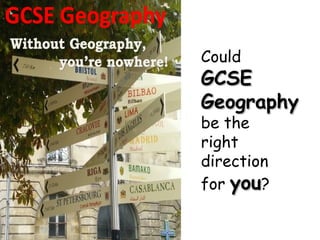
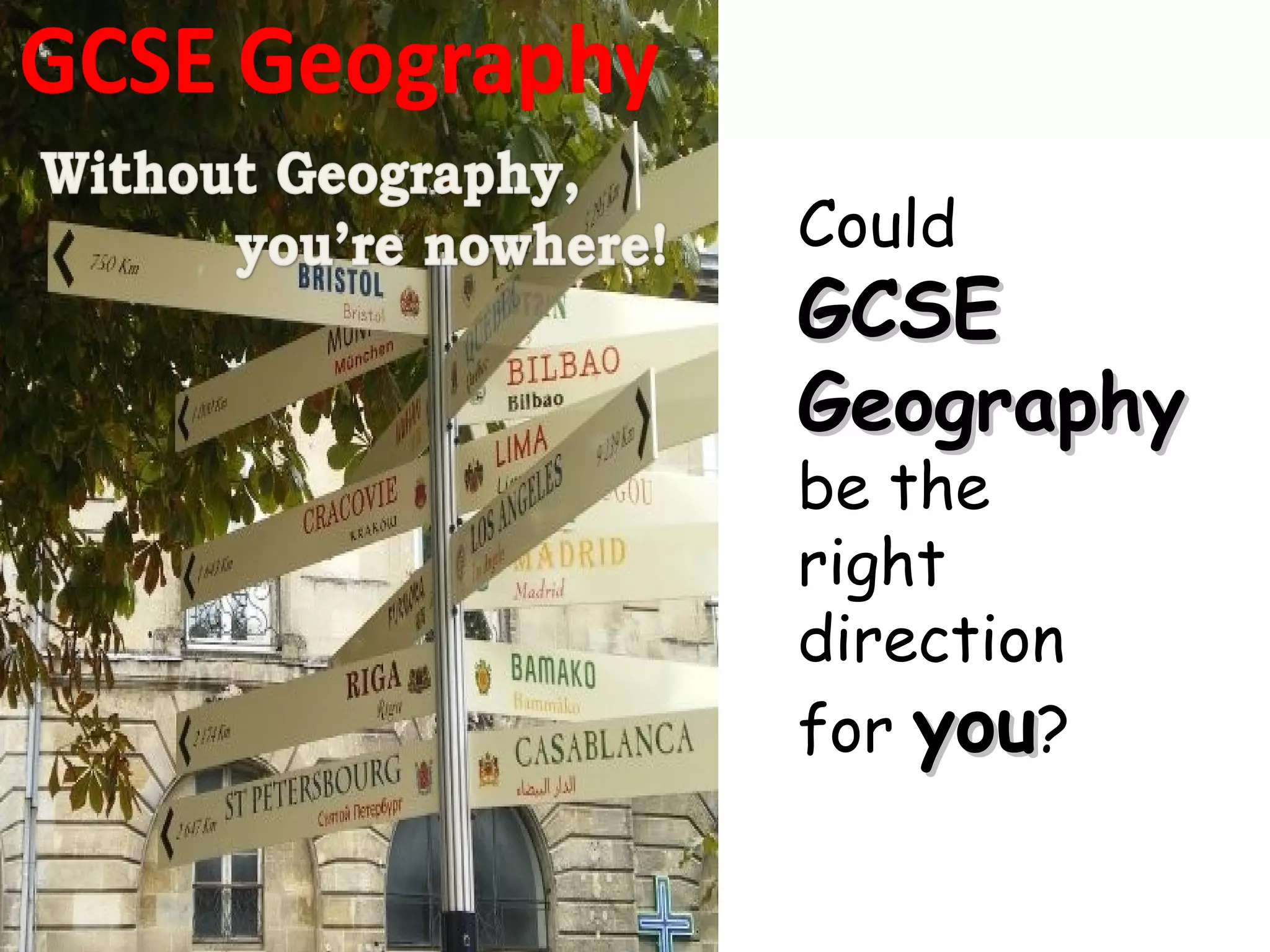
Could  GCSE Geography   be the  right direction  for  you ?
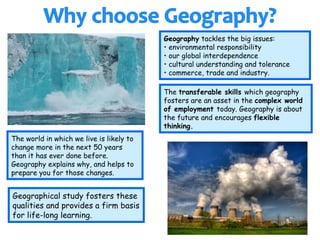
The world in which we live is likely to change more in the next 50 years than it has ever done before.  Geography explains why, and helps to prepare you for those changes. Geography  tackles the big issues: •  environmental responsibility •  our global interdependence •  cultural understanding and tolerance •  commerce, trade and industry. Geographical study fosters these qualities and provides a firm basis for life-long learning. The  transferable skills  which geography fosters are an asset in the  complex world of employment  today. Geography is about the future and encourages  flexible thinking.
GCSE  AQA  Specification A
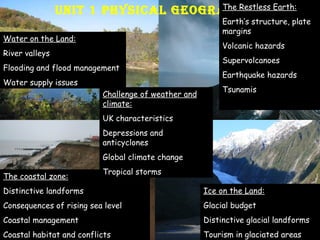
Unit 1 Physical geography Water on the Land: River valleys Flooding and flood management Water supply issues The coastal zone: Distinctive landforms Consequences of rising sea level Coastal management Coastal habitat and conflicts Ice on the Land: Glacial budget Distinctive glacial landforms Tourism in glaciated areas The Restless Earth: Earth’s structure, plate margins Volcanic hazards Supervolcanoes Earthquake hazards Tsunamis Challenge of weather and climate: UK characteristics Depressions and anticyclones Global climate change Tropical storms
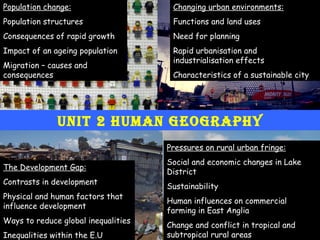
Unit 2 human geography Population change: Population structures Consequences of rapid growth Impact of an ageing population Migration – causes and consequences Changing urban environments: Functions and land uses Need for planning Rapid urbanisation and industrialisation effects Characteristics of a sustainable city The Development Gap: Contrasts in development Physical and human factors that influence development Ways to reduce global inequalities Inequalities within the E.U Pressures on rural urban fringe: Social and economic changes in Lake District Sustainability  Human influences on commercial farming in East Anglia Change and conflict in tropical and subtropical rural areas
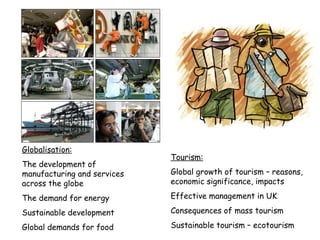
Globalisation: The development of manufacturing and services across the globe The demand for energy Sustainable development Global demands for food Tourism: Global growth of tourism – reasons, economic significance, impacts Effective management in UK Consequences of mass tourism Sustainable tourism – ecotourism
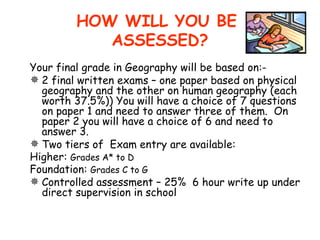
HOW WILL YOU BE  ASSESSED? Your final grade in Geography will be based on:- 2 final written exams – one paper based on physical geography and the other on human geography (each worth 37.5%)) You will have a choice of 7 questions on paper 1 and need to answer three of them.  On paper 2 you will have a choice of 6 and need to answer 3.  Two tiers of  Exam entry are available: Higher:  Grades A* to D Foundation:  Grades C to G Controlled ass essment – 25%  6 hour write up under direct supervision in school
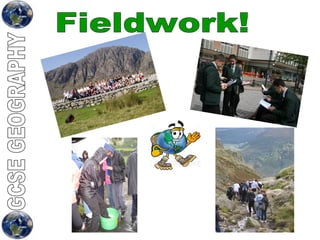
Fieldwork!
 
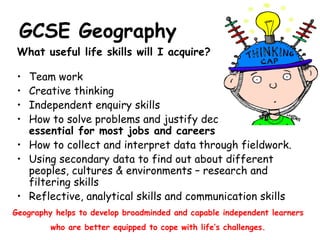
GCSE Geography What useful life skills will I acquire? Team work  Creative thinking Independent enquiry skills How to solve problems and justify decisions made –  essential for most jobs and careers How to collect and interpret data through fieldwork. Using secondary data to find out about different peoples, cultures & environments – research and filtering skills Reflective, analytical skills and communication skills Geography helps to develop broadminded and capable independent learners who are better equipped to cope with life’s challenges.
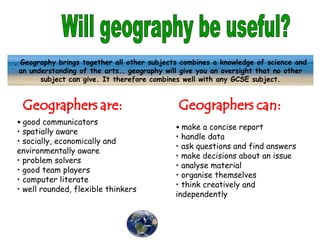
.  Geography brings together all other subjects combines a knowledge of science and an understanding of the arts.. geography will give you an oversight that no other subject can give. It therefore combines well with any GCSE subject. •  make a concise report •  handle data •  ask questions and find answers •  make decisions about an issue •  analyse material •  organise themselves •  think creatively and independently •  good communicators •  spatially aware •  socially, economically and environmentally aware •  problem solvers •  good team players •  computer literate •  well rounded, flexible thinkers Will geography be useful?
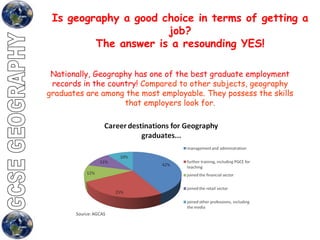
Nationally, Geography has one of the best graduate employment records in the country!  Compared to other subjects, geography graduates are among the most employable. They possess the skills that employers look for. Is geography a good choice in terms of getting a job? The answer is a resounding YES!
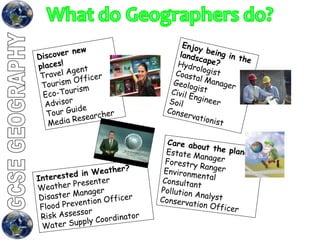
Care about the planet? Estate Manager Forestry Ranger Environmental Consultant Pollution Analyst Conservation Officer Discover new places! Travel Agent Tourism Officer Eco-Tourism Advisor Tour Guide Media Researcher Enjoy being in the landscape? Hydrologist Coastal Manager Geologist Civil Engineer Soil Conservationist Interested in Weather? Weather Presenter Disaster Manager Flood Prevention Officer Risk Assessor Water Supply Coordinator
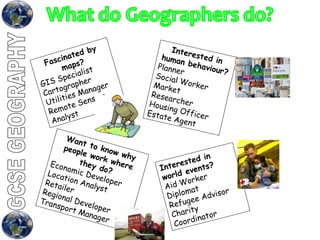
Fascinated by maps? GIS Specialist Cartographer Utilities Manager Remote Sensing Analyst Interested in human behaviour? Planner Social Worker Market Researcher Housing Officer Estate Agent Want to know why people work where they do? Economic Developer Location Analyst Retailer Regional Developer Transport Manager Interested in world events? Aid Worker Diplomat Refugee Advisor Charity Coordinator
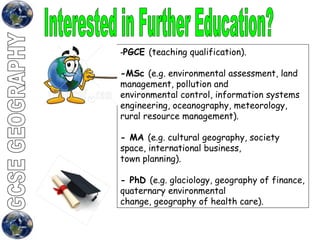
Interested in Further Education?  - PGCE  (teaching qualification). -MSc  (e.g. environmental assessment, land management, pollution and environmental control, information systems engineering, oceanography, meteorology, rural resource management). - MA  (e.g. cultural geography, society space, international business, town planning). - PhD  (e.g. glaciology, geography of finance, quaternary environmental change, geography of health care).
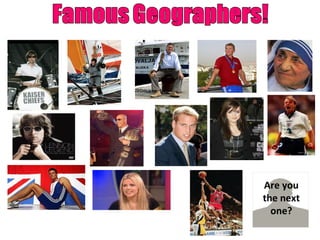
Are you the next one?
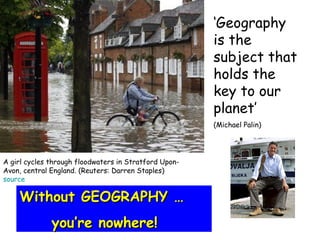
‘ Geography is the subject that holds the key to our planet’ (Michael Palin) A girl   cycles through floodwaters in Stratford Upon-Avon, central England. (Reuters: Darren Staples) source  Without GEOGRAPHY … you’re nowhere!
view at  http://tudorgeog2011.blogspot.com
Acknowledgements Jo Blackshaw, Oakhampton College Liz Smith, Seaford Head Community College

Geog Options 09

  • 1.
    Could GCSEGeography be the right direction for you ?
  • 2.
    The world inwhich we live is likely to change more in the next 50 years than it has ever done before. Geography explains why, and helps to prepare you for those changes. Geography tackles the big issues: • environmental responsibility • our global interdependence • cultural understanding and tolerance • commerce, trade and industry. Geographical study fosters these qualities and provides a firm basis for life-long learning. The transferable skills which geography fosters are an asset in the complex world of employment today. Geography is about the future and encourages flexible thinking.
  • 3.
    GCSE AQA Specification A
  • 4.
    Unit 1 Physicalgeography Water on the Land: River valleys Flooding and flood management Water supply issues The coastal zone: Distinctive landforms Consequences of rising sea level Coastal management Coastal habitat and conflicts Ice on the Land: Glacial budget Distinctive glacial landforms Tourism in glaciated areas The Restless Earth: Earth’s structure, plate margins Volcanic hazards Supervolcanoes Earthquake hazards Tsunamis Challenge of weather and climate: UK characteristics Depressions and anticyclones Global climate change Tropical storms
  • 5.
    Unit 2 humangeography Population change: Population structures Consequences of rapid growth Impact of an ageing population Migration – causes and consequences Changing urban environments: Functions and land uses Need for planning Rapid urbanisation and industrialisation effects Characteristics of a sustainable city The Development Gap: Contrasts in development Physical and human factors that influence development Ways to reduce global inequalities Inequalities within the E.U Pressures on rural urban fringe: Social and economic changes in Lake District Sustainability Human influences on commercial farming in East Anglia Change and conflict in tropical and subtropical rural areas
  • 6.
    Globalisation: The developmentof manufacturing and services across the globe The demand for energy Sustainable development Global demands for food Tourism: Global growth of tourism – reasons, economic significance, impacts Effective management in UK Consequences of mass tourism Sustainable tourism – ecotourism
  • 7.
    HOW WILL YOUBE ASSESSED? Your final grade in Geography will be based on:- 2 final written exams – one paper based on physical geography and the other on human geography (each worth 37.5%)) You will have a choice of 7 questions on paper 1 and need to answer three of them. On paper 2 you will have a choice of 6 and need to answer 3. Two tiers of Exam entry are available: Higher: Grades A* to D Foundation: Grades C to G Controlled ass essment – 25% 6 hour write up under direct supervision in school
  • 8.
  • 9.
  • 10.
    GCSE Geography Whatuseful life skills will I acquire? Team work Creative thinking Independent enquiry skills How to solve problems and justify decisions made – essential for most jobs and careers How to collect and interpret data through fieldwork. Using secondary data to find out about different peoples, cultures & environments – research and filtering skills Reflective, analytical skills and communication skills Geography helps to develop broadminded and capable independent learners who are better equipped to cope with life’s challenges.
  • 11.
    . Geographybrings together all other subjects combines a knowledge of science and an understanding of the arts.. geography will give you an oversight that no other subject can give. It therefore combines well with any GCSE subject. • make a concise report • handle data • ask questions and find answers • make decisions about an issue • analyse material • organise themselves • think creatively and independently • good communicators • spatially aware • socially, economically and environmentally aware • problem solvers • good team players • computer literate • well rounded, flexible thinkers Will geography be useful?
  • 12.
    Nationally, Geography hasone of the best graduate employment records in the country! Compared to other subjects, geography graduates are among the most employable. They possess the skills that employers look for. Is geography a good choice in terms of getting a job? The answer is a resounding YES!
  • 13.
    Care about theplanet? Estate Manager Forestry Ranger Environmental Consultant Pollution Analyst Conservation Officer Discover new places! Travel Agent Tourism Officer Eco-Tourism Advisor Tour Guide Media Researcher Enjoy being in the landscape? Hydrologist Coastal Manager Geologist Civil Engineer Soil Conservationist Interested in Weather? Weather Presenter Disaster Manager Flood Prevention Officer Risk Assessor Water Supply Coordinator
  • 14.
    Fascinated by maps?GIS Specialist Cartographer Utilities Manager Remote Sensing Analyst Interested in human behaviour? Planner Social Worker Market Researcher Housing Officer Estate Agent Want to know why people work where they do? Economic Developer Location Analyst Retailer Regional Developer Transport Manager Interested in world events? Aid Worker Diplomat Refugee Advisor Charity Coordinator
  • 15.
    Interested in FurtherEducation? - PGCE (teaching qualification). -MSc (e.g. environmental assessment, land management, pollution and environmental control, information systems engineering, oceanography, meteorology, rural resource management). - MA (e.g. cultural geography, society space, international business, town planning). - PhD (e.g. glaciology, geography of finance, quaternary environmental change, geography of health care).
  • 16.
    Are you thenext one?
  • 17.
    ‘ Geography isthe subject that holds the key to our planet’ (Michael Palin) A girl cycles through floodwaters in Stratford Upon-Avon, central England. (Reuters: Darren Staples) source Without GEOGRAPHY … you’re nowhere!
  • 18.
    view at http://tudorgeog2011.blogspot.com
  • 19.
    Acknowledgements Jo Blackshaw,Oakhampton College Liz Smith, Seaford Head Community College

Editor's Notes

  • #2 Geography – what’s it all about? Is it right for you? Geography is It’s a dynamic subject, constantly changing and is about the world around you Geography Investigates the earth and its people - provides you with snapshots of different landscapes and communities.