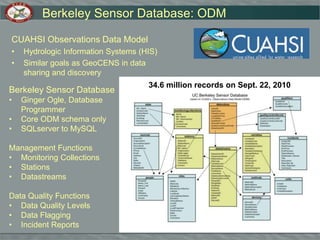
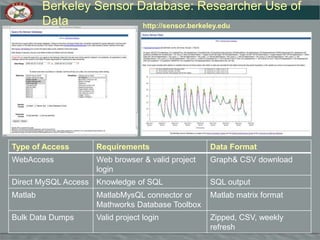
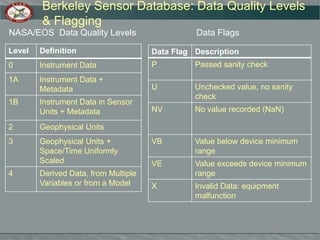
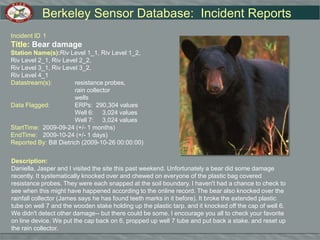
Angelo Coast Range ReserveEnvironmental Sensor ObservatoryCollin BodeProject Manager, Desktop Watersheds Integrative Program, National Center for Earth-surface Dynamics & Specialist, Integrative Biology, UC Berkeley
Angelo Coast Range Reserve NCED primary field site
 UC Natural Reserve System
 Rapidly eroding upland watershed
 South Fork Eel River
 Vegetation:
Douglas Fir, Redwood
Oak, Madrone
Chaparral
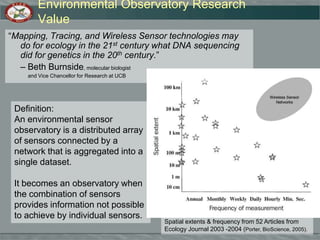
BanffEnvironmental Observatory Research Value“Mapping, Tracing, and Wireless Sensor technologies may do for ecology in the 21st century what DNA sequencing did for genetics in the 20th century.” 	– Beth Burnside, molecular biologist 	     and Vice Chancellor for Research at UCBDefinition: An environmental sensor observatory is a distributed array of sensors connected by a network that is aggregated into a single dataset. It becomes an observatory when the combination of sensors provides information not possible to achieve by individual sensors.  Spatial extents & frequency from 52 Articles from Ecology Journal 2003 -2004 (Porter, BioScience, 2005).
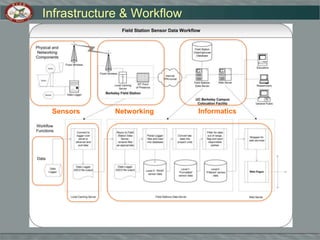
Infrastructure & WorkflowInformaticsNetworkingSensors
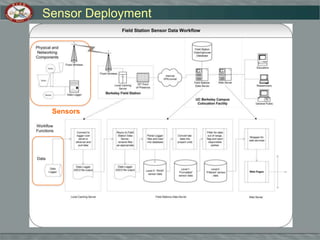
Sensor DeploymentSensors
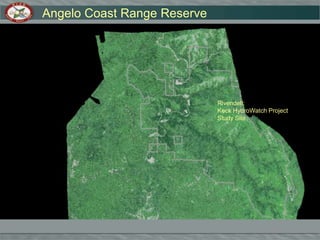
Sensors: Keck HydroWatch Project	PI:    Inez Fung, Atmospheric Scientist, Climate modelerCo-PI’s:Bill Dietrich, GeomorphologistTodd Dawson, Tree physiologyDavid Culler, Computer ScienceMotes, TinyOS, CENSPurpose:  Trace and understand water movement between atmosphere to subsurface mediated by vegetation.Field Site: Rivendell130 x 30 meter north facing micro-watershedDominated by Douglas FirElder Creek at base
Angelo Coast Range ReserveRivendell: Keck HydroWatch Project Study Site
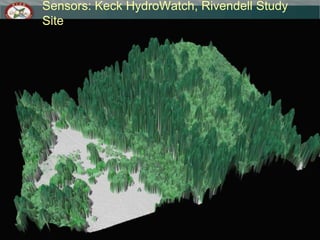
Sensors: Keck HydroWatch, Rivendell Study Site
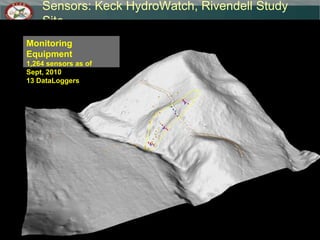
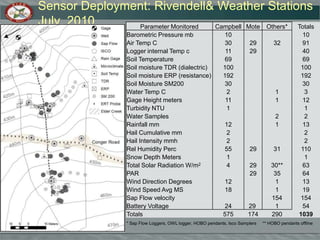
Sensors: Keck HydroWatch, Rivendell Study SiteMonitoring Equipment1,264 sensors as of Sept, 201013 DataLoggers
Sensor Deployment: Rivendell & Weather Stations  July, 2010
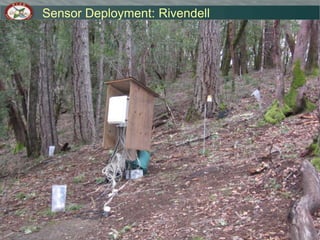
Sensor Deployment: Rivendell
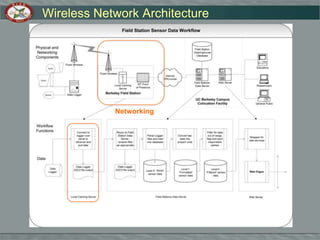
Wireless Network ArchitectureNetworking
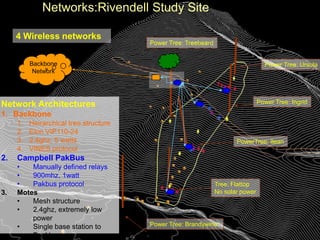
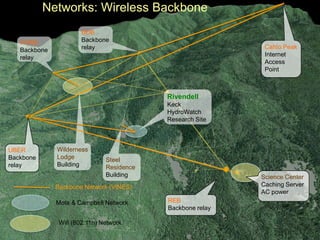
Networks:Rivendell Study Site4 Wireless networksPower Tree: TreebeardBackboneNetworkPower Tree: UrsulaPower Tree: IngridNetwork ArchitecturesBackboneHeirarchical tree structureEion VIP110-242.4ghz, 5 watts VINES protocolCampbell PakBusManually defined relays
900mhz, 1watt
Pakbus protocolMotesMesh structure

GeoCENS presentation on Angelo Coast Range Reserve Environmental Sensor Observatory by Collin Bode in Banff on September 23, 2010