An Introduction to Principles and Practice
               July 8, 2011


              Presented by
Biomarkers in Psychiatry


              Jay Lombard, DO
Chief Scientific Officer and Medical Director
                  Genomind


                                                2
Our mission is to advance the care of patients
suffering from neuropsychiatric disorders using
innovative approaches to diagnosis and treatment.

       Brain Science to Better Lives


              The information contained in this presentation is provided for your general information only. Genomind does not
              give medical advice or engage in the practice of medicine, and under no circumstances renders diagnoses or
              recommends particular treatment for specific individuals. In all cases, It is the role of the clinician to determine
              the appropriate course of treatment.
                                                                                                                                     3
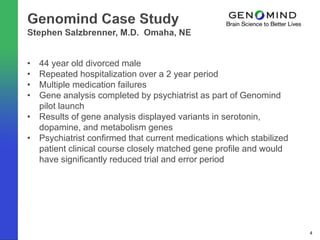
• 44 year old divorced male
• Repeated hospitalization over a 2 year period
• Multiple medication failures
• Gene analysis completed by psychiatrist as part of Genomind
  pilot launch
• Results of gene analysis displayed variants in serotonin,
  dopamine, and metabolism genes
• Psychiatrist confirmed that current medications which stabilized
  patient clinical course closely matched gene profile and would
  have significantly reduced trial and error period


                                                                     4
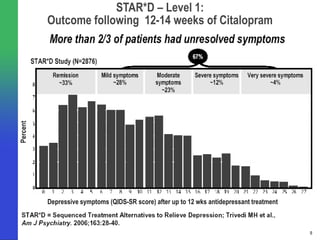
STAR*D – Level 1:
Outcome following 12-14 weeks of Citalopram


Depressive symptoms (QIDS-SR score) after up to 12 wks antidepressant treatment


                                                                                  5
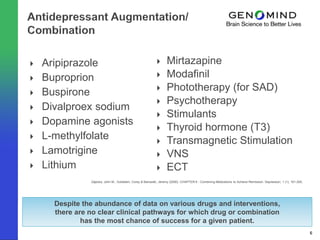
   Aripiprazole                                                  Mirtazapine
   Buproprion                                                    Modafinil
   Buspirone                                                     Phototherapy (for SAD)
                                                                  Psychotherapy
   Divalproex sodium
                                                                  Stimulants
   Dopamine agonists
                                                                  Thyroid hormone (T3)
   L-methylfolate                                                Transmagnetic Stimulation
   Lamotrigine                                                   VNS
   Lithium                                                       ECT
                Zajecka, John M., Goldstein, Corey & Barowski, Jeremy (2006). CHAPTER 6 - Combining Medications to Achieve Remission. Depression, 1 (1), 161-200.


      Despite the abundance of data on various drugs and interventions,
      there are no clear clinical pathways for which drug or combination
              has the most chance of success for a given patient.
                                                                                                                                                                    6
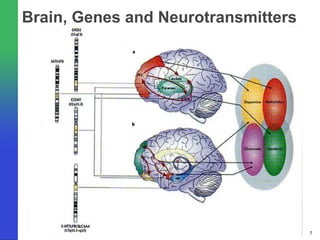
Brain, Genes and Neurotransmitters


                                     7
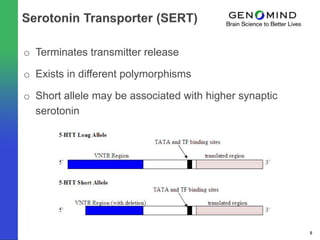
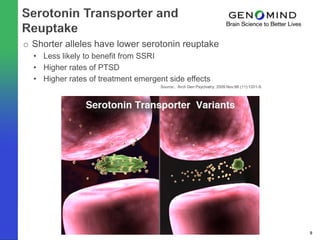
o Terminates transmitter release

o Exists in different polymorphisms

o Short allele may be associated with higher synaptic
  serotonin


                                                        8
o Shorter alleles have lower serotonin reuptake
  • Less likely to benefit from SSRI
  • Higher rates of PTSD
  • Higher rates of treatment emergent side effects
                                     Source:. Arch Gen Psychiatry. 2009 Nov;66 (11):1201-9.


                                                                                              9
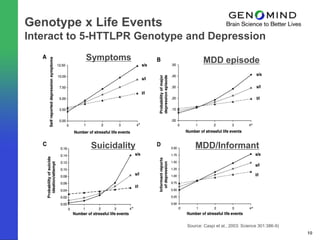
Genotype x Life Events
Interact to 5-HTTLPR Genotype and Depression
           Symptoms                  MDD episode


            Suicidality          MDD/Informant


                             Source: Caspi et al., 2003: Science 301:386-9)
                                                                              10
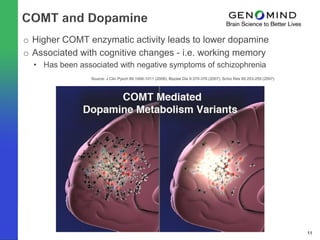
o Higher COMT enzymatic activity leads to lower dopamine
o Associated with cognitive changes - i.e. working memory
  • Has been associated with negative symptoms of schizophrenia
                 Source: J Clin Pysch 69:1006-1011 (2008); Bipolar Dis 9:370-376 (2007); Schiz Res 95:253-255 (2007)


                                                                                                                       11
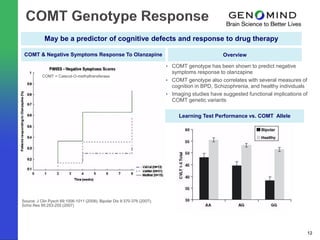
May be a predictor of cognitive defects and response to drug therapy

 COMT & Negative Symptoms Response To Olanzapine                                                 Overview

                                                                          • COMT genotype has been shown to predict negative
                                                                            symptoms response to olanzapine
           COMT = Catecol-O-methyltransferase
                                                                          • COMT genotype also correlates with several measures of
                                                                            cognition in BPD, Schizophrenia, and healthy individuals
                                                                          • Imaging studies have suggested functional implications of
                                                                            COMT genetic variants

                                                                               Learning Test Performance vs. COMT Allele


Source: J Clin Pysch 69:1006-1011 (2008); Bipolar Dis 9:370-376 (2007);
Schiz Res 95:253-255 (2007)


                                                                                                                                    12
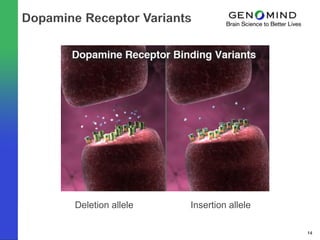
o Deletion alleles of the dopamine receptor results in
  changes in dopamine binding affinity
                    Source: Fazio, et al. Neuroimage. 2011 Feb 14;54(4):2915-2


o Associated with schizophrenia in Japanese, Swedish
  and Portuguese populations
                   Source: Molecular Psychiatry (2002) 7, 1002-1005. doi:10.1038/sj.mp.4001126


o Meta-analysis of gene polymorphisms demonstrates
  reduced response to antipsychotic drug therapy
                   Source: Malhotra, et al. Am. Journal of Psychiatry July 2010


                                                                                                 13
Deletion allele   Insertion allele

                                     14
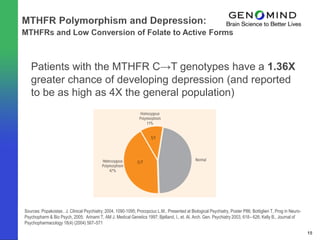
Patients with the MTHFR C→T genotypes have a 1.36X
   greater chance of developing depression (and reported
   to be as high as 4X the general population)


Sources: Popakostas , J. Clinical Psychiatry; 2004, 1090-1095; Procopciuc L.M., Presented at Biological Psychiatry, Poster P86; Bottiglieri T, Prog in Neuro-
Psychopharm & Bio Psych, 2005; Arinami T, AM J. Medical Genetics 1997; Bjelland, I., et. Al, Arch. Gen. Psychiatry 2003, 618– 626; Kelly B., Journal of
Psychopharmacology 18(4) (2004) 567–571

                                                                                                                                                                15
CACNA1C Polymorphisms


o CACNA1C is the gene encoding the alpha subunit of
  the L type voltage gated calcium channel
o Variations in the CACNA1C are associated with altered
  calcium gating and excessive neuronal depolarization
o CACNA1C rs has been associated with increased risk
  of bipolar disease, TRD, autism and schizophrenia

                    Source: Liam S Carroll and Michael J Owen Genome Med. 2009; 1(10): 102.


                                                                                              16
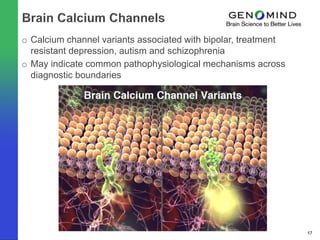
o Calcium channel variants associated with bipolar, treatment
  resistant depression, autism and schizophrenia
o May indicate common pathophysiological mechanisms across
  diagnostic boundaries


                                                                17
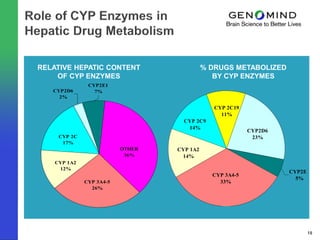
RELATIVE HEPATIC CONTENT                    % DRUGS METABOLIZED
    OF CYP ENZYMES                             BY CYP ENZYMES
               CYP2E1
   CYP2D6        7%
     2%

                                               CYP 2C19
                                                 11%
                                    CYP 2C9
                                     14%
                                                          CYP2D6
     CYP 2C                                                23%
      17%
                          OTHER   CYP 1A2
                           36%     14%
    CYP 1A2
     12%
                                                                   CYP2E1
                                              CYP 3A4-5
                                                                     5%
              CYP 3A4-5                         33%
                26%


                                                                        18
Clinical Pathway to Adoption


       Nancy Grden
      General Manager
        Genomind


                               19
Represents a significant unmet need in psychiatry


o   TRD is a major depressive disorder (patients who are not responsive to
    adequate courses of at least 2 antidepressants)
    •   Treatment resistance related to unique disturbances in brain function/structure
o   1.7 million people worldwide suffer from TRD/MDD
    •    ~2/3 of patients with MDD fail to remit with an initial antidepressant
    •    ~1/2 of this group will fail to reach remission with 3 more interventions
o   TRD increases depression-related costs from $1,455 to $28,001
    •    TRD patients have 12% more outpatient visits, re-hospitalized twice as often,
         and have 40% higher medical cost overall
    •    TRD untreated exacerbates metabolic syndrome and co-morbid conditions
    •    TRD contributes disproportionately to healthcare costs, functional impairment
         and diminished quality of life

        Source - Cost Burden of Treatment Resistance in Patients With Depression,
        The American Journal of Managed Care, May-2010


                                                                                          20
Our Business
  o Genomind enhances the care of patients suffering from mental health
     disorders by developing DNA tests to guide personalized medicine and
     treatment options

Our Background
  o Founded in 2009 by Ronald I. Dozoretz, MD and Jay Lombard, DO
  o Headquartered in Philadelphia, PA
  o 9 patents pending

Our Activities
  o The Genecept™ Assay launched to 2,300 Psychiatric and Physician
     KOLs marks our initial market introduction
  o Active partnerships with leading managed care organizations to
     demonstrate cost effectiveness, compliance, and efficacy


                                                                            21
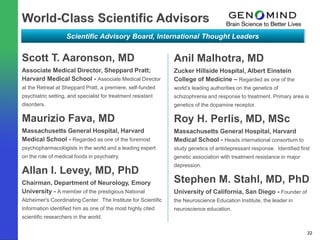
Scientific Advisory Board, International Thought Leaders


Scott T. Aaronson, MD                                           Anil Malhotra, MD
Associate Medical Director, Sheppard Pratt;                     Zucker Hillside Hospital, Albert Einstein
Harvard Medical School - Associate Medical Director             College of Medicine – Regarded as one of the
at the Retreat at Sheppard Pratt, a premiere, self-funded       world’s leading authorities on the genetics of
psychiatric setting, and specialist for treatment resistant     schizophrenia and response to treatment. Primary area is
disorders.                                                      genetics of the dopamine receptor.

Maurizio Fava, MD                                               Roy H. Perlis, MD, MSc
Massachusetts General Hospital, Harvard                         Massachusetts General Hospital, Harvard
Medical School - Regarded as one of the foremost                Medical School - Heads international consortium to
psychopharmacologists in the world and a leading expert         study genetics of antidepressant response. Identified first
on the role of medical foods in psychiatry.                     genetic association with treatment resistance in major
                                                                depression.
Allan I. Levey, MD, PhD
Chairman, Department of Neurology, Emory                        Stephen M. Stahl, MD, PhD
University - A member of the prestigious National               University of California, San Diego - Founder of
Alzheimer's Coordinating Center. The Institute for Scientific   the Neuroscience Education Institute, the leader in
Information identified him as one of the most highly cited      neuroscience education.
scientific researchers in the world.

                                                                                                                          22
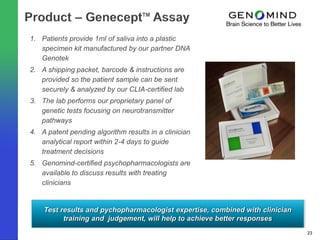
1. Patients provide 1ml of saliva into a plastic
   specimen kit manufactured by our partner DNA
   Genotek
2. A shipping packet, barcode & instructions are
   provided so the patient sample can be sent
   securely & analyzed by our CLIA-certified lab
3. The lab performs our proprietary panel of
   genetic tests focusing on neurotransmitter
   pathways
4. A patent pending algorithm results in a clinician
   analytical report within 2-4 days to guide
   treatment decisions
5. Genomind-certified psychopharmacologists are
   available to discuss results with treating
   clinicians


    Test results and pychopharmacologist expertise, combined with clinician
          training and judgement, will help to achieve better responses
                                                                              23
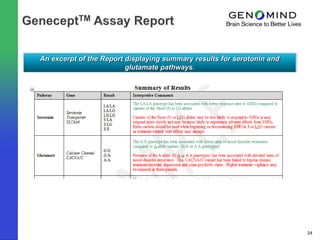
An excerpt of the Report displaying summary results for serotonin and
                         glutamate pathways.


                                                                        24
o Initial pilots completed and new studies underway
o Early Adopter Program and current availability from clinicians
o Initial Feedback from Pilots has demonstrated:
    •   Strong interest and motivation in the psychiatric community to
        employ biomarkers in practice
    •   94% of clinicians found the test very helpful and consistent with
        their clinical impressions
    •   100% of clinicians would incorporate the GeneceptTM Assay
        into their practice with 3rd party reimbursement
    •   A high number of depressed non-responders have genetic
        variants, suggesting alternative neurochemical approaches are
        warranted


                                                                            25
Contact Information

Nancy Grden                   nancy.grden@genomind.com
General Manager

Dr. Jay Lombard               jay.lombard@genomind.com
Chief Scientific Officer
and Medical Director


               Genomind
            www.genomind.com
              877.895.8658
                                                         26

Genomind NAMI Presentation by Dr. Jay Lombard

  • 1.
    An Introduction toPrinciples and Practice July 8, 2011 Presented by
  • 2.
    Biomarkers in Psychiatry Jay Lombard, DO Chief Scientific Officer and Medical Director Genomind 2
  • 3.
    Our mission isto advance the care of patients suffering from neuropsychiatric disorders using innovative approaches to diagnosis and treatment. Brain Science to Better Lives The information contained in this presentation is provided for your general information only. Genomind does not give medical advice or engage in the practice of medicine, and under no circumstances renders diagnoses or recommends particular treatment for specific individuals. In all cases, It is the role of the clinician to determine the appropriate course of treatment. 3
  • 4.
    • 44 yearold divorced male • Repeated hospitalization over a 2 year period • Multiple medication failures • Gene analysis completed by psychiatrist as part of Genomind pilot launch • Results of gene analysis displayed variants in serotonin, dopamine, and metabolism genes • Psychiatrist confirmed that current medications which stabilized patient clinical course closely matched gene profile and would have significantly reduced trial and error period 4
  • 5.
    STAR*D – Level1: Outcome following 12-14 weeks of Citalopram Depressive symptoms (QIDS-SR score) after up to 12 wks antidepressant treatment 5
  • 6.
    Aripiprazole  Mirtazapine  Buproprion  Modafinil  Buspirone  Phototherapy (for SAD)  Psychotherapy  Divalproex sodium  Stimulants  Dopamine agonists  Thyroid hormone (T3)  L-methylfolate  Transmagnetic Stimulation  Lamotrigine  VNS  Lithium  ECT Zajecka, John M., Goldstein, Corey & Barowski, Jeremy (2006). CHAPTER 6 - Combining Medications to Achieve Remission. Depression, 1 (1), 161-200. Despite the abundance of data on various drugs and interventions, there are no clear clinical pathways for which drug or combination has the most chance of success for a given patient. 6
  • 7.
    Brain, Genes andNeurotransmitters 7
  • 8.
    o Terminates transmitterrelease o Exists in different polymorphisms o Short allele may be associated with higher synaptic serotonin 8
  • 9.
    o Shorter alleleshave lower serotonin reuptake • Less likely to benefit from SSRI • Higher rates of PTSD • Higher rates of treatment emergent side effects Source:. Arch Gen Psychiatry. 2009 Nov;66 (11):1201-9. 9
  • 10.
    Genotype x LifeEvents Interact to 5-HTTLPR Genotype and Depression Symptoms MDD episode Suicidality MDD/Informant Source: Caspi et al., 2003: Science 301:386-9) 10
  • 11.
    o Higher COMTenzymatic activity leads to lower dopamine o Associated with cognitive changes - i.e. working memory • Has been associated with negative symptoms of schizophrenia Source: J Clin Pysch 69:1006-1011 (2008); Bipolar Dis 9:370-376 (2007); Schiz Res 95:253-255 (2007) 11
  • 12.
    May be apredictor of cognitive defects and response to drug therapy COMT & Negative Symptoms Response To Olanzapine Overview • COMT genotype has been shown to predict negative symptoms response to olanzapine COMT = Catecol-O-methyltransferase • COMT genotype also correlates with several measures of cognition in BPD, Schizophrenia, and healthy individuals • Imaging studies have suggested functional implications of COMT genetic variants Learning Test Performance vs. COMT Allele Source: J Clin Pysch 69:1006-1011 (2008); Bipolar Dis 9:370-376 (2007); Schiz Res 95:253-255 (2007) 12
  • 13.
    o Deletion allelesof the dopamine receptor results in changes in dopamine binding affinity Source: Fazio, et al. Neuroimage. 2011 Feb 14;54(4):2915-2 o Associated with schizophrenia in Japanese, Swedish and Portuguese populations Source: Molecular Psychiatry (2002) 7, 1002-1005. doi:10.1038/sj.mp.4001126 o Meta-analysis of gene polymorphisms demonstrates reduced response to antipsychotic drug therapy Source: Malhotra, et al. Am. Journal of Psychiatry July 2010 13
  • 14.
    Deletion allele Insertion allele 14
  • 15.
    Patients with theMTHFR C→T genotypes have a 1.36X greater chance of developing depression (and reported to be as high as 4X the general population) Sources: Popakostas , J. Clinical Psychiatry; 2004, 1090-1095; Procopciuc L.M., Presented at Biological Psychiatry, Poster P86; Bottiglieri T, Prog in Neuro- Psychopharm & Bio Psych, 2005; Arinami T, AM J. Medical Genetics 1997; Bjelland, I., et. Al, Arch. Gen. Psychiatry 2003, 618– 626; Kelly B., Journal of Psychopharmacology 18(4) (2004) 567–571 15
  • 16.
    CACNA1C Polymorphisms o CACNA1Cis the gene encoding the alpha subunit of the L type voltage gated calcium channel o Variations in the CACNA1C are associated with altered calcium gating and excessive neuronal depolarization o CACNA1C rs has been associated with increased risk of bipolar disease, TRD, autism and schizophrenia Source: Liam S Carroll and Michael J Owen Genome Med. 2009; 1(10): 102. 16
  • 17.
    o Calcium channelvariants associated with bipolar, treatment resistant depression, autism and schizophrenia o May indicate common pathophysiological mechanisms across diagnostic boundaries 17
  • 18.
    RELATIVE HEPATIC CONTENT % DRUGS METABOLIZED OF CYP ENZYMES BY CYP ENZYMES CYP2E1 CYP2D6 7% 2% CYP 2C19 11% CYP 2C9 14% CYP2D6 CYP 2C 23% 17% OTHER CYP 1A2 36% 14% CYP 1A2 12% CYP2E1 CYP 3A4-5 5% CYP 3A4-5 33% 26% 18
  • 19.
    Clinical Pathway toAdoption Nancy Grden General Manager Genomind 19
  • 20.
    Represents a significantunmet need in psychiatry o TRD is a major depressive disorder (patients who are not responsive to adequate courses of at least 2 antidepressants) • Treatment resistance related to unique disturbances in brain function/structure o 1.7 million people worldwide suffer from TRD/MDD • ~2/3 of patients with MDD fail to remit with an initial antidepressant • ~1/2 of this group will fail to reach remission with 3 more interventions o TRD increases depression-related costs from $1,455 to $28,001 • TRD patients have 12% more outpatient visits, re-hospitalized twice as often, and have 40% higher medical cost overall • TRD untreated exacerbates metabolic syndrome and co-morbid conditions • TRD contributes disproportionately to healthcare costs, functional impairment and diminished quality of life Source - Cost Burden of Treatment Resistance in Patients With Depression, The American Journal of Managed Care, May-2010 20
  • 21.
    Our Business o Genomind enhances the care of patients suffering from mental health disorders by developing DNA tests to guide personalized medicine and treatment options Our Background o Founded in 2009 by Ronald I. Dozoretz, MD and Jay Lombard, DO o Headquartered in Philadelphia, PA o 9 patents pending Our Activities o The Genecept™ Assay launched to 2,300 Psychiatric and Physician KOLs marks our initial market introduction o Active partnerships with leading managed care organizations to demonstrate cost effectiveness, compliance, and efficacy 21
  • 22.
    Scientific Advisory Board,International Thought Leaders Scott T. Aaronson, MD Anil Malhotra, MD Associate Medical Director, Sheppard Pratt; Zucker Hillside Hospital, Albert Einstein Harvard Medical School - Associate Medical Director College of Medicine – Regarded as one of the at the Retreat at Sheppard Pratt, a premiere, self-funded world’s leading authorities on the genetics of psychiatric setting, and specialist for treatment resistant schizophrenia and response to treatment. Primary area is disorders. genetics of the dopamine receptor. Maurizio Fava, MD Roy H. Perlis, MD, MSc Massachusetts General Hospital, Harvard Massachusetts General Hospital, Harvard Medical School - Regarded as one of the foremost Medical School - Heads international consortium to psychopharmacologists in the world and a leading expert study genetics of antidepressant response. Identified first on the role of medical foods in psychiatry. genetic association with treatment resistance in major depression. Allan I. Levey, MD, PhD Chairman, Department of Neurology, Emory Stephen M. Stahl, MD, PhD University - A member of the prestigious National University of California, San Diego - Founder of Alzheimer's Coordinating Center. The Institute for Scientific the Neuroscience Education Institute, the leader in Information identified him as one of the most highly cited neuroscience education. scientific researchers in the world. 22
  • 23.
    1. Patients provide1ml of saliva into a plastic specimen kit manufactured by our partner DNA Genotek 2. A shipping packet, barcode & instructions are provided so the patient sample can be sent securely & analyzed by our CLIA-certified lab 3. The lab performs our proprietary panel of genetic tests focusing on neurotransmitter pathways 4. A patent pending algorithm results in a clinician analytical report within 2-4 days to guide treatment decisions 5. Genomind-certified psychopharmacologists are available to discuss results with treating clinicians Test results and pychopharmacologist expertise, combined with clinician training and judgement, will help to achieve better responses 23
  • 24.
    An excerpt ofthe Report displaying summary results for serotonin and glutamate pathways. 24
  • 25.
    o Initial pilotscompleted and new studies underway o Early Adopter Program and current availability from clinicians o Initial Feedback from Pilots has demonstrated: • Strong interest and motivation in the psychiatric community to employ biomarkers in practice • 94% of clinicians found the test very helpful and consistent with their clinical impressions • 100% of clinicians would incorporate the GeneceptTM Assay into their practice with 3rd party reimbursement • A high number of depressed non-responders have genetic variants, suggesting alternative neurochemical approaches are warranted 25
  • 26.
    Contact Information Nancy Grden nancy.grden@genomind.com General Manager Dr. Jay Lombard jay.lombard@genomind.com Chief Scientific Officer and Medical Director Genomind www.genomind.com 877.895.8658 26