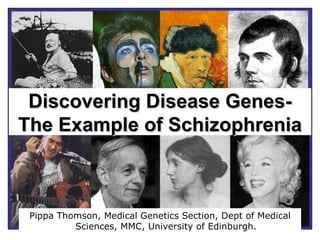
Discovering Disease Genes-  The Example of Schizophrenia   Pippa Thomson,  Medical Genetics Section, Dept of Medical Sciences, MMC, University of Edinburgh.
Importance of the illness Severe psychiatric  Affects ~1% of the population One of the top 10 causes of disability worldwide Economic cost (23% Drug, 14% Hospital) Pharmacological rationale for treatment weak or absent 1/3rd patients unresponsive or experience  unacceptable side effects Strong genetic component concordance rate between identical twins of 60%
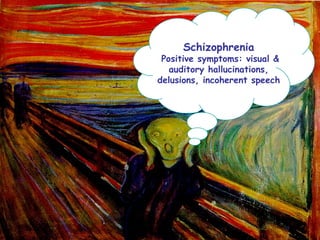
Schizophrenia Positive symptoms: visual & auditory hallucinations, delusions, incoherent speech
Schizophrenia   Negative symptoms: withdrawal & isolation, impaired attention & blunted emotions
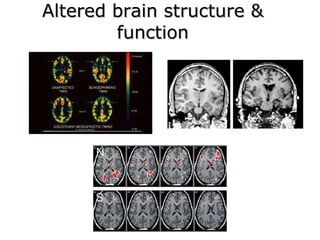
Altered brain structure & function
High Heels Cause Schizophrenia  and 6 Other Outlandish Medical Theories  2. High-heeled shoes cause schizophrenia.  You have to wonder where some medical theories originate. Why did Swedish scientist Jarl Flensmark decide to study  a connection between heeled shoes and the incidence of schizophrenia ? The world may never know. But his initial research seems sound, and he has connected certain brain activity with stimulation of certain points on the feet. The spread of schizophrenia around the globe has closely followed the spread of availability of heeled shoes. Is it an eerie coincidence or a real cause for concern? Look out, men - this theory applies not only to stilettos, but to any shoe with a heel. remedicated.com
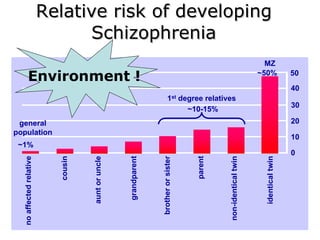
Relative risk of developing Schizophrenia Environment !
Benefits of gene identification Understand aetiology Improved drug development & testing  Development of definitive diagnostic tests Understanding of interaction with non-genetic risk factors Insight into normal brain development & function Kraepelin, 1896  “ As we do not know what causes the illness there cannot be a rational treatment”
Allelic architecture and mapping strategy Magnitude of effect Frequency in population Family-based  linkage studies Association studies in populations Unlikely to exist Fnct. Studies
Locus Identification-problems Uncertainty in diagnostic boundaries Non-Mendelian inheritance Variable age of onset  Genetic heterogeneity  Many different genes can cause the illness 1% risk world wide phenotypic variation Oligogenic/polygenic causation More than one mutant gene required to produce phenotype
Locus identification- reducing the problems Single large families Avoid bilineal descent   rigorous interviews family history Reduce genetic heterogeneity Significant LOD score = gene of major effect  Reduce uncertainty of diagnosis  classify minor diagnoses as unaffected >1 category of affected phenotype
Marker analysis in multiply affected family or families Look for co-segregation of a particular allele with phenotype Results expressed as a LOD score (Significant at > 3) = log  (likelihood of data, if locus & disease are linked)   ----------------------------------------------------------------   (likelihood of data, if locus & disease are not linked) Generally a large region is identified Linkage Analysis
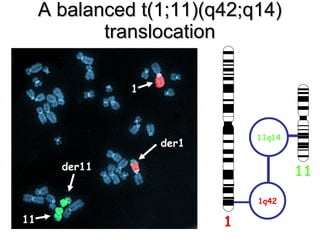
A balanced t(1;11)(q42;q14) translocation der1 der11 11 1 1 1q42 11q14 11
? recurrent major depression minor diagnosis unaffected schizophrenia bipolar affective disorder (1;11)(q42;q14) translocation translocation increases risk by 50-fold t(1;11) co-segregates with major mental illness
Genetic association studies seek to relate variation in human DNA sequence with a disease or trait Association method provides greater power to detect common genetic variants conferring susceptibility to complex phenotypes  Estimates population attributable risk (effect size)  Controls should match cases and be a representative sample of the population. Controls Schizophrenics 100’s  Individuals =  1%  Schizophrenia 100’s  Individuals =  100%  Schizophrenia
Case-control association studies Comparison of frequencies of polymorphisms between populations of cases and controls (usually a simple chi-square test or logistic regression) Polymorphism studied can be directly responsible for the defect    frequency of  cases >>> controls Polymorphism studied can be in linkage disequilibrium with the mutation responsible for the disease    %T cases >> controls Association studies can be conducted for candidate genes, or through a whole region or across the whole genome (WTCCC) p Mb T A G C
SNPs are genotyped in parent-offspring trios, initially in CEPH trios. This can be used to identify SNPs that co-segregate (i.e. are in linkage disequilibrium) versus those that segregate independently. A subset of SNPs can therefore be chosen that best represent the genetic diversity in a region/gene, reducing the costs of genotyping. Summary of genotyped SNPs:  Populations   CEU  CHB+JPT YRI Total Non-Redundant   3,204,709   3,244,897  3,150,433  International HapMap project http://www.hapmap.org/
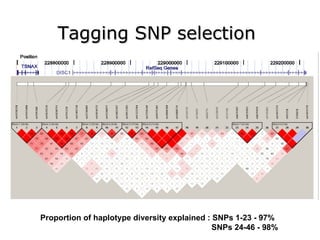
Region of interest HapMap genotyped SNPs Known SNPs* Known genes in the regions Linkage Disequilibrium (LD) *http://www.ncbi.nlm.nih.gov/SNP/
Tagging SNP selection  Proportion of haplotype diversity explained : SNPs 1-23 - 97%   SNPs 24-46 - 98%
DISC2 TRANSLOCATION LOD=7.1, SCOTLAND Genetic evidence implicating  DISC1  in psychiatric illness 1 SCZ  &   BPAD  &   MDD SCOTLAND SCZ ,  BPAD HAPLOTYPE p =0.0044,  p =0.0016 2 3 4 5 6 7 8 9 10 11 12 13 DISC1 LOD=2, BRITAIN & ICELAND  (Curtis et al 2003) D1S251 LOD=1, TAIWAN  (Hwu et al 2003) SCZ BPAD HAPLOTYPE p =0.00024, FINLAND  (Hennah et al 2003) SCZ  &   SCZAFF LOD=3.21, FINLAND  (Ekelund et al 2001) SCZ D1S2709 p =0.000027, North-America  (Hodgkinson et al 2004) rs6675281 SCZAFF
Table 1. Summary of current evidence supporting several of the more promising genes implicated in schizophrenia, bipolar disorder, and mixed bipolar-psychosis phenotypes Craddock et al., SCZ Bulletin, 2006 Genes for Schizophrenia ? >130 genes implicated
DISC1 interactome protein-protein interactions Chris Carter, http://www.polygenicpathways.co.uk/disc11_vml.htm
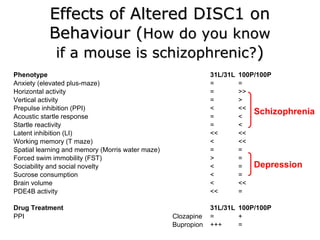
ENU generated mouse mutants  Two independent lines with missense mutations in DISC1 exon 2 Q31L (Glutamine-Leucine)  Q- hydrophillic; L – hydrophobic  L100P (Leucine-Proline) Predicted to cause transition in polypeptide chain direction Normal levels of DISC1 protein in brain L100P line models schizophrenia; Q31L, depression Effects of altered DISC1 on gene expression Clapcote et al., Neuron. 2007 May 3; 54 ( 3 ): 387-402 .
Schizophrenia Depression Effects of Altered DISC1 on Behaviour ( How do you know if a mouse is schizophrenic? )
Effects of altered DISC1 on gene expression Samples collected and microarray study ongoing  Mutated lines vs background strain (C57/BL6) 47,000 transcripts Hippocampus Adult and embryonic stage- Microarray Confirmation/Investigation of changes Series of embryonic; postnatal and adult stages Drug treated adult mice Detect disrupted pathways
Resequencing, SNP detection, genome comparisons, gene expression, transcription factor studies, small RNA analysis  Individual genomes – All SNPs in each individual Currently : Using the Illumina 1G to sequence genes in the DISC1 pathway.  Total sequence read 3.5megabases in 1200 individuals Identify coding and non-coding polymorphisms Mutation detection Detection of variants in conserved regions Detection of variants affecting binding of transcription factors Whole genome sequencing
Psychiatric Genetics- Unanswered Questions How many susceptibility genes are there?  What is their function?  Is function conserved across species?  Can we relate gene (dys)function to mental (dis)order?  Do gene variants predict risk, course, outcome and response to treatment?  Will gene discovery lead to drug discovery?  How do genes and environment interact?  How and when will the patient benefit?
DISC1 Kirsty Millar Shaun Mackie Fumiaki Ogawa Jennifer Chubb Becky Carlyle Nick Bradshaw Sheila Christie Steve Clapcote Kathy Evans Sarah Brown William Hennah Medical Genetics Prof David Porteous Prof Douglas Blackwood Walter Muir Ben Pickard Other collaborators DISC1 Consortium Wellcome Trust CRF Illumina, San Diego Cold Spring Harbor laboratories Acknowledgements

Schizophrenia

  • 1.
    Discovering Disease Genes- The Example of Schizophrenia Pippa Thomson, Medical Genetics Section, Dept of Medical Sciences, MMC, University of Edinburgh.
  • 2.
    Importance of theillness Severe psychiatric Affects ~1% of the population One of the top 10 causes of disability worldwide Economic cost (23% Drug, 14% Hospital) Pharmacological rationale for treatment weak or absent 1/3rd patients unresponsive or experience unacceptable side effects Strong genetic component concordance rate between identical twins of 60%
  • 3.
    Schizophrenia Positive symptoms:visual & auditory hallucinations, delusions, incoherent speech
  • 4.
    Schizophrenia Negative symptoms: withdrawal & isolation, impaired attention & blunted emotions
  • 5.
  • 6.
    High Heels CauseSchizophrenia and 6 Other Outlandish Medical Theories 2. High-heeled shoes cause schizophrenia. You have to wonder where some medical theories originate. Why did Swedish scientist Jarl Flensmark decide to study a connection between heeled shoes and the incidence of schizophrenia ? The world may never know. But his initial research seems sound, and he has connected certain brain activity with stimulation of certain points on the feet. The spread of schizophrenia around the globe has closely followed the spread of availability of heeled shoes. Is it an eerie coincidence or a real cause for concern? Look out, men - this theory applies not only to stilettos, but to any shoe with a heel. remedicated.com
  • 7.
    Relative risk ofdeveloping Schizophrenia Environment !
  • 8.
    Benefits of geneidentification Understand aetiology Improved drug development & testing Development of definitive diagnostic tests Understanding of interaction with non-genetic risk factors Insight into normal brain development & function Kraepelin, 1896 “ As we do not know what causes the illness there cannot be a rational treatment”
  • 9.
    Allelic architecture andmapping strategy Magnitude of effect Frequency in population Family-based linkage studies Association studies in populations Unlikely to exist Fnct. Studies
  • 10.
    Locus Identification-problems Uncertaintyin diagnostic boundaries Non-Mendelian inheritance Variable age of onset Genetic heterogeneity Many different genes can cause the illness 1% risk world wide phenotypic variation Oligogenic/polygenic causation More than one mutant gene required to produce phenotype
  • 11.
    Locus identification- reducingthe problems Single large families Avoid bilineal descent rigorous interviews family history Reduce genetic heterogeneity Significant LOD score = gene of major effect Reduce uncertainty of diagnosis classify minor diagnoses as unaffected >1 category of affected phenotype
  • 12.
    Marker analysis inmultiply affected family or families Look for co-segregation of a particular allele with phenotype Results expressed as a LOD score (Significant at > 3) = log (likelihood of data, if locus & disease are linked) ---------------------------------------------------------------- (likelihood of data, if locus & disease are not linked) Generally a large region is identified Linkage Analysis
  • 13.
    A balanced t(1;11)(q42;q14)translocation der1 der11 11 1 1 1q42 11q14 11
  • 14.
    ? recurrent majordepression minor diagnosis unaffected schizophrenia bipolar affective disorder (1;11)(q42;q14) translocation translocation increases risk by 50-fold t(1;11) co-segregates with major mental illness
  • 15.
    Genetic association studiesseek to relate variation in human DNA sequence with a disease or trait Association method provides greater power to detect common genetic variants conferring susceptibility to complex phenotypes Estimates population attributable risk (effect size) Controls should match cases and be a representative sample of the population. Controls Schizophrenics 100’s Individuals = 1% Schizophrenia 100’s Individuals = 100% Schizophrenia
  • 16.
    Case-control association studiesComparison of frequencies of polymorphisms between populations of cases and controls (usually a simple chi-square test or logistic regression) Polymorphism studied can be directly responsible for the defect  frequency of cases >>> controls Polymorphism studied can be in linkage disequilibrium with the mutation responsible for the disease  %T cases >> controls Association studies can be conducted for candidate genes, or through a whole region or across the whole genome (WTCCC) p Mb T A G C
  • 17.
    SNPs are genotypedin parent-offspring trios, initially in CEPH trios. This can be used to identify SNPs that co-segregate (i.e. are in linkage disequilibrium) versus those that segregate independently. A subset of SNPs can therefore be chosen that best represent the genetic diversity in a region/gene, reducing the costs of genotyping. Summary of genotyped SNPs: Populations CEU CHB+JPT YRI Total Non-Redundant 3,204,709 3,244,897 3,150,433 International HapMap project http://www.hapmap.org/
  • 18.
    Region of interestHapMap genotyped SNPs Known SNPs* Known genes in the regions Linkage Disequilibrium (LD) *http://www.ncbi.nlm.nih.gov/SNP/
  • 19.
    Tagging SNP selection Proportion of haplotype diversity explained : SNPs 1-23 - 97% SNPs 24-46 - 98%
  • 20.
    DISC2 TRANSLOCATION LOD=7.1,SCOTLAND Genetic evidence implicating DISC1 in psychiatric illness 1 SCZ & BPAD & MDD SCOTLAND SCZ , BPAD HAPLOTYPE p =0.0044, p =0.0016 2 3 4 5 6 7 8 9 10 11 12 13 DISC1 LOD=2, BRITAIN & ICELAND (Curtis et al 2003) D1S251 LOD=1, TAIWAN (Hwu et al 2003) SCZ BPAD HAPLOTYPE p =0.00024, FINLAND (Hennah et al 2003) SCZ & SCZAFF LOD=3.21, FINLAND (Ekelund et al 2001) SCZ D1S2709 p =0.000027, North-America (Hodgkinson et al 2004) rs6675281 SCZAFF
  • 21.
    Table 1. Summaryof current evidence supporting several of the more promising genes implicated in schizophrenia, bipolar disorder, and mixed bipolar-psychosis phenotypes Craddock et al., SCZ Bulletin, 2006 Genes for Schizophrenia ? >130 genes implicated
  • 22.
    DISC1 interactome protein-proteininteractions Chris Carter, http://www.polygenicpathways.co.uk/disc11_vml.htm
  • 23.
    ENU generated mousemutants Two independent lines with missense mutations in DISC1 exon 2 Q31L (Glutamine-Leucine) Q- hydrophillic; L – hydrophobic L100P (Leucine-Proline) Predicted to cause transition in polypeptide chain direction Normal levels of DISC1 protein in brain L100P line models schizophrenia; Q31L, depression Effects of altered DISC1 on gene expression Clapcote et al., Neuron. 2007 May 3; 54 ( 3 ): 387-402 .
  • 24.
    Schizophrenia Depression Effectsof Altered DISC1 on Behaviour ( How do you know if a mouse is schizophrenic? )
  • 25.
    Effects of alteredDISC1 on gene expression Samples collected and microarray study ongoing Mutated lines vs background strain (C57/BL6) 47,000 transcripts Hippocampus Adult and embryonic stage- Microarray Confirmation/Investigation of changes Series of embryonic; postnatal and adult stages Drug treated adult mice Detect disrupted pathways
  • 26.
    Resequencing, SNP detection,genome comparisons, gene expression, transcription factor studies, small RNA analysis Individual genomes – All SNPs in each individual Currently : Using the Illumina 1G to sequence genes in the DISC1 pathway. Total sequence read 3.5megabases in 1200 individuals Identify coding and non-coding polymorphisms Mutation detection Detection of variants in conserved regions Detection of variants affecting binding of transcription factors Whole genome sequencing
  • 27.
    Psychiatric Genetics- UnansweredQuestions How many susceptibility genes are there? What is their function? Is function conserved across species? Can we relate gene (dys)function to mental (dis)order? Do gene variants predict risk, course, outcome and response to treatment? Will gene discovery lead to drug discovery? How do genes and environment interact? How and when will the patient benefit?
  • 28.
    DISC1 Kirsty MillarShaun Mackie Fumiaki Ogawa Jennifer Chubb Becky Carlyle Nick Bradshaw Sheila Christie Steve Clapcote Kathy Evans Sarah Brown William Hennah Medical Genetics Prof David Porteous Prof Douglas Blackwood Walter Muir Ben Pickard Other collaborators DISC1 Consortium Wellcome Trust CRF Illumina, San Diego Cold Spring Harbor laboratories Acknowledgements