Extinct Species CloningEMILY COSTELLOand CAITLIN HARTNETTMs. MartinezPeriod 8
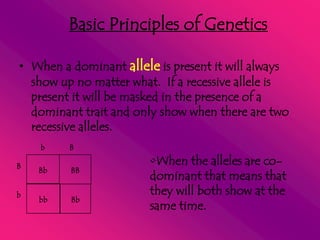
Basic Principles of GeneticsWhen a dominant allele is present it will always show up no matter what.  If a recessive allele is present it will be masked in the presence of a dominant trait and only show when there are two recessive alleles.b            BWhen the alleles are co-dominant that means that they will both show at the same time.Bb
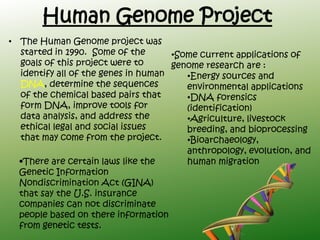
Human Genome ProjectThe Human Genome project was started in 1990.  Some of the goals of this project were to identify all of the genes in human DNA, determine the sequences of the chemical based pairs that form DNA, improve tools for data analysis, and address the ethical legal and social issues that may come from the project.Some current applications of genome research are :
Energy sources and environmental applications
DNA forensics (identification)
Agriculture, livestock breeding, and bioprocessing
Bioarchaeology, anthropology, evolution, and human migration
There are certain laws like the Genetic Information Nondiscrimination Act (GINA) that say the U.S. insurance companies can not discriminate people based on there information from genetic tests. Genetic DisordersSingle gene disorder- hereditary disorders caused by a single gene.Chromosomes abnormalities-  reflects an atypical number of chromosome or a structural abnormality in one or more chromosomesMulti-factorial disorders- one caused by the interaction of genetic and sometimes also no genetic, environmental factors, e.g., diabetes mellitusIn a single gene disorder there is only one gene that has a mutation. Multi-factorial disorders are similar to the single gene disorder because they both result in errors directly within the genes in our cells. The difference between these two is that multi-factorial genetic diseases arise when multiple genes have a mutation.Some examples are of single gene disorder are cystic fibrosis, sickle cell anemia, Tay-Sachs disease, myotonic dystrophy, Duchenne and Becker muscular dystrophies, Fragile syndrome and spinal muscular atrophy. Some examples of chromosome abnormality are Down Syndrome, Trisomies 13 or 18, Turner Syndrome, and Triple X.Some examples of Multi-factorial disorders are breast, bowel, ovary, there is also Alzheimer's, diabetes, and multiple sclerosis.
How do Chromosome Abnormalities occur?Chromosome abnormalities mostly occur when there is an error in cell division. There is two different types of cell divisions. There is Meiosis and Mitosis. Something could go wrong within these. Meiosis is when there is only half the number of chromosomes, 23 instead of 46.  Mitosis is when there is two duplicates of 46 cells. Some examples of chromosome abnormalities are Down Syndrome, Klinefelter Syndrome, and Triple X.
Genetic disorders (continued)If you had a concern about your child having a genetic disorder you could go to a doctor who specializes in this field and they could perform a blood test to determine if the child has a karyotype that shows whether or not it will have a particular disorder.  You could also check your pedigree to see if your baby could possibly have a genetic disorder.  For example, if one of your ancestors had a certain disease you could check to see if the baby might possibly be afflicted with that disease due to heredity.  That is usually the reason a pediatrician asks about the baby’s family history when the first examine them as a newborn.
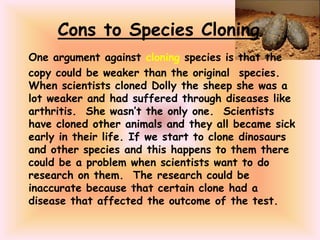
Cons to Species CloningOne argument against cloning species is that the copy could be weaker than the original  species.  When scientists cloned Dolly the sheep she was a lot weaker and had suffered through diseases like arthritis.  She wasn’t the only one.  Scientists have cloned other animals and they all became sick early in their life. If we start to clone dinosaurs and other species and this happens to them there could be a problem when scientists want to do research on them.  The research could be inaccurate because that certain clone had a disease that affected the outcome of the test.
More ConsAnother argument against species cloning is that cloning is very expensive.  When scientists cloned Dolly it cost about $750,000 and she only lived for around six years.  Sheep that have not been cloned usually live for approximately 11 to 12 years.  The expense of genetically engineering sheep or other animals is therefore very costly and its benefit should be looked at more closely.  If cloning is only going to be used for animals then it is too costly and a naturally produced animal has more of a benefit.  If scientists are trying to learn more about cloning so they can use if for other purposes then they need to continue to watch the costs and make sure it is worth effort and cost.
Pros to Species cloningAn advantage of species cloning is that once we clone the species scientists can do a lot more research on that species.  The longer it has been since the species have gone extinct the harder it is for the scientists to do research on the extinct animals.  We cold bring back animals like the dodo bird and many animals in the ocean. Did you know bees are dying at a very fast rate?  Bees help pollinate over 100 crops, and we rely on honeybees for one third  of the food we eat.   This could be a problem but not if scientists can clone them.

Genetic issues project

  • 1.
    Extinct Species CloningEMILYCOSTELLOand CAITLIN HARTNETTMs. MartinezPeriod 8
  • 2.
    Basic Principles ofGeneticsWhen a dominant allele is present it will always show up no matter what. If a recessive allele is present it will be masked in the presence of a dominant trait and only show when there are two recessive alleles.b BWhen the alleles are co-dominant that means that they will both show at the same time.Bb
  • 3.
    Human Genome ProjectTheHuman Genome project was started in 1990. Some of the goals of this project were to identify all of the genes in human DNA, determine the sequences of the chemical based pairs that form DNA, improve tools for data analysis, and address the ethical legal and social issues that may come from the project.Some current applications of genome research are :
  • 4.
    Energy sources andenvironmental applications
  • 5.
  • 6.
  • 7.
  • 8.
    There are certainlaws like the Genetic Information Nondiscrimination Act (GINA) that say the U.S. insurance companies can not discriminate people based on there information from genetic tests. Genetic DisordersSingle gene disorder- hereditary disorders caused by a single gene.Chromosomes abnormalities- reflects an atypical number of chromosome or a structural abnormality in one or more chromosomesMulti-factorial disorders- one caused by the interaction of genetic and sometimes also no genetic, environmental factors, e.g., diabetes mellitusIn a single gene disorder there is only one gene that has a mutation. Multi-factorial disorders are similar to the single gene disorder because they both result in errors directly within the genes in our cells. The difference between these two is that multi-factorial genetic diseases arise when multiple genes have a mutation.Some examples are of single gene disorder are cystic fibrosis, sickle cell anemia, Tay-Sachs disease, myotonic dystrophy, Duchenne and Becker muscular dystrophies, Fragile syndrome and spinal muscular atrophy. Some examples of chromosome abnormality are Down Syndrome, Trisomies 13 or 18, Turner Syndrome, and Triple X.Some examples of Multi-factorial disorders are breast, bowel, ovary, there is also Alzheimer's, diabetes, and multiple sclerosis.
  • 9.
    How do ChromosomeAbnormalities occur?Chromosome abnormalities mostly occur when there is an error in cell division. There is two different types of cell divisions. There is Meiosis and Mitosis. Something could go wrong within these. Meiosis is when there is only half the number of chromosomes, 23 instead of 46. Mitosis is when there is two duplicates of 46 cells. Some examples of chromosome abnormalities are Down Syndrome, Klinefelter Syndrome, and Triple X.
  • 10.
    Genetic disorders (continued)Ifyou had a concern about your child having a genetic disorder you could go to a doctor who specializes in this field and they could perform a blood test to determine if the child has a karyotype that shows whether or not it will have a particular disorder. You could also check your pedigree to see if your baby could possibly have a genetic disorder. For example, if one of your ancestors had a certain disease you could check to see if the baby might possibly be afflicted with that disease due to heredity. That is usually the reason a pediatrician asks about the baby’s family history when the first examine them as a newborn.
  • 11.
    Cons to SpeciesCloningOne argument against cloning species is that the copy could be weaker than the original species. When scientists cloned Dolly the sheep she was a lot weaker and had suffered through diseases like arthritis. She wasn’t the only one. Scientists have cloned other animals and they all became sick early in their life. If we start to clone dinosaurs and other species and this happens to them there could be a problem when scientists want to do research on them. The research could be inaccurate because that certain clone had a disease that affected the outcome of the test.
  • 12.
    More ConsAnother argumentagainst species cloning is that cloning is very expensive. When scientists cloned Dolly it cost about $750,000 and she only lived for around six years. Sheep that have not been cloned usually live for approximately 11 to 12 years. The expense of genetically engineering sheep or other animals is therefore very costly and its benefit should be looked at more closely. If cloning is only going to be used for animals then it is too costly and a naturally produced animal has more of a benefit. If scientists are trying to learn more about cloning so they can use if for other purposes then they need to continue to watch the costs and make sure it is worth effort and cost.
  • 13.
    Pros to SpeciescloningAn advantage of species cloning is that once we clone the species scientists can do a lot more research on that species. The longer it has been since the species have gone extinct the harder it is for the scientists to do research on the extinct animals. We cold bring back animals like the dodo bird and many animals in the ocean. Did you know bees are dying at a very fast rate? Bees help pollinate over 100 crops, and we rely on honeybees for one third of the food we eat. This could be a problem but not if scientists can clone them.