 Search technique used in computing to find the true or approximate solutions to
optimization and search problems
 Categorized as global search heuristic
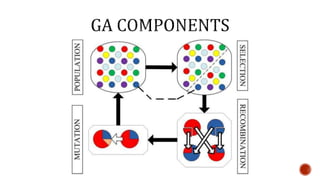
 Uses techniques inspired by evolutionary biology such as inheritance, mutation, selection,
crossover (also called recombination)
 Implemented as a computer simulation in which population of abstract representation
(chromosomes/ genotype/ genome) of candidate solutions (individual/ creatures) to an
optimization problem evolves towards a better solution
 Solutions are represented in binary but other encodings are also possible
 Evolution starts from a population of randomly generated individuals and happens in
generations
 In each generation, the fitness of every individual is evaluated, multiple individuals are
selected form current population and modified to form a new population
 The new population is then used in the next iteration of the algorithm
 The algorithm terminates when the desired number of generation has been produced or a
satisfactory fitness level has been reached
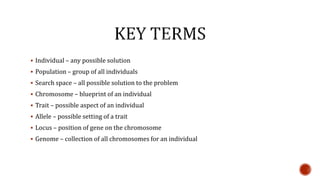
 Individual – any possible solution
 Population – group of all individuals
 Search space – all possible solution to the problem
 Chromosome – blueprint of an individual
 Trait – possible aspect of an individual
 Allele – possible setting of a trait
 Locus – position of gene on the chromosome
 Genome – collection of all chromosomes for an individual
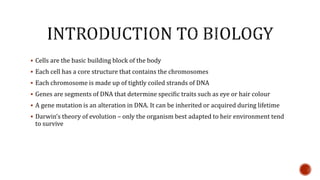
 Cells are the basic building block of the body
 Each cell has a core structure that contains the chromosomes
 Each chromosome is made up of tightly coiled strands of DNA
 Genes are segments of DNA that determine specific traits such as eye or hair colour
 A gene mutation is an alteration in DNA. It can be inherited or acquired during lifetime
 Darwin’s theory of evolution – only the organism best adapted to heir environment tend
to survive
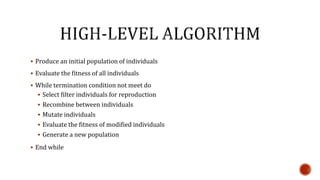
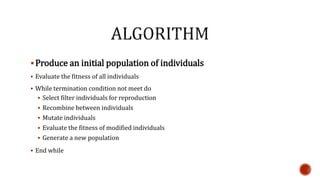
 Produce an initial population of individuals
 Evaluate the fitness of all individuals
 While termination condition not meet do
 Select filter individuals for reproduction
 Recombine between individuals
 Mutate individuals
 Evaluate the fitness of modified individuals
 Generate a new population
 End while
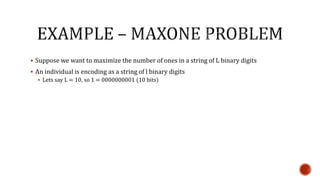
 Suppose we want to maximize the number of ones in a string of L binary digits
 An individual is encoding as a string of l binary digits
 Lets say L = 10, so 1 = 0000000001 (10 bits)
Produce an initial population of individuals
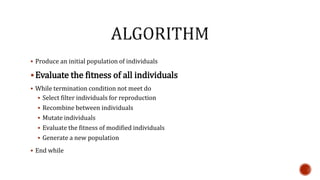
 Evaluate the fitness of all individuals
 While termination condition not meet do
 Select filter individuals for reproduction
 Recombine between individuals
 Mutate individuals
 Evaluate the fitness of modified individuals
 Generate a new population
 End while
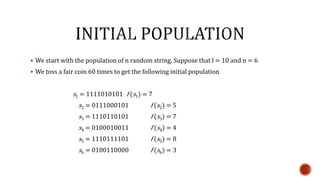
 We start with the population of n random string. Suppose that l = 10 and n = 6
 We toss a fair coin 60 times to get the following initial population
s1 = 1111010101 f (s1) = 7
s2 = 0111000101 f (s2) = 5
s3 = 1110110101 f (s3) = 7
s4 = 0100010011 f (s4) = 4
s5 = 1110111101 f (s5) = 8
s6 = 0100110000 f (s6) = 3
 Produce an initial population of individuals
Evaluate the fitness of all individuals
 While termination condition not meet do
 Select filter individuals for reproduction
 Recombine between individuals
 Mutate individuals
 Evaluate the fitness of modified individuals
 Generate a new population
 End while
 Generates and combines multiple predictions
 Bagging: Bootstrap Aggregating
 Boosting
 Tends to get better results since there is deliberately introduced significant diversity
among models
 Bagging and boosting are meta-algorithms that pool decisions from multiple classifiers
 Improves stability and accuracy of machine-learning algorithms used in statistical
classification and regression
 Reduces variance and helps avoid overfitting
 Technique: given a standard training set D of size n, bagging generates m new training
set Di each of size n’ by sampling from D uniformly and with replacement
 If n’=n, then for large n, the set Di is expected to have the fractions of unique examples of
D, the rest being duplicates
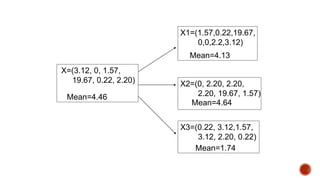
 Lets calculate the average price of a house
 From F, get a sample x = (x1, x2, …, xn) and calculate the average u
 Now get several samples from F
 Its impossible to get multiple samples. So we use bootstrap
 Repeat B time:
 Generate a sample Lk of of size n from L by sampling with replacement
 Compute x* for x
 We now have bootstrap values
 X* = (x1*, ……., x2*)
X=(3.12, 0, 1.57,
19.67, 0.22, 2.20)
Mean=4.46
X1=(1.57,0.22,19.67,
0,0,2.2,3.12)
Mean=4.13
X2=(0, 2.20, 2.20,
2.20, 19.67, 1.57)
Mean=4.64
X3=(0.22, 3.12,1.57,
3.12, 2.20, 0.22)
Mean=1.74
 Based on the question: can a set of weak learners produce a strong learners?
 Weak learner is a classifier that is strongly related to true classification
 Strong learner is a classifier that is well-correlated with true classification

Genetic algorithm

  • 2.
     Search techniqueused in computing to find the true or approximate solutions to optimization and search problems  Categorized as global search heuristic  Uses techniques inspired by evolutionary biology such as inheritance, mutation, selection, crossover (also called recombination)  Implemented as a computer simulation in which population of abstract representation (chromosomes/ genotype/ genome) of candidate solutions (individual/ creatures) to an optimization problem evolves towards a better solution  Solutions are represented in binary but other encodings are also possible
  • 3.
     Evolution startsfrom a population of randomly generated individuals and happens in generations  In each generation, the fitness of every individual is evaluated, multiple individuals are selected form current population and modified to form a new population  The new population is then used in the next iteration of the algorithm  The algorithm terminates when the desired number of generation has been produced or a satisfactory fitness level has been reached
  • 4.
     Individual –any possible solution  Population – group of all individuals  Search space – all possible solution to the problem  Chromosome – blueprint of an individual  Trait – possible aspect of an individual  Allele – possible setting of a trait  Locus – position of gene on the chromosome  Genome – collection of all chromosomes for an individual
  • 5.
     Cells arethe basic building block of the body  Each cell has a core structure that contains the chromosomes  Each chromosome is made up of tightly coiled strands of DNA  Genes are segments of DNA that determine specific traits such as eye or hair colour  A gene mutation is an alteration in DNA. It can be inherited or acquired during lifetime  Darwin’s theory of evolution – only the organism best adapted to heir environment tend to survive
  • 6.
     Produce aninitial population of individuals  Evaluate the fitness of all individuals  While termination condition not meet do  Select filter individuals for reproduction  Recombine between individuals  Mutate individuals  Evaluate the fitness of modified individuals  Generate a new population  End while
  • 8.
     Suppose wewant to maximize the number of ones in a string of L binary digits  An individual is encoding as a string of l binary digits  Lets say L = 10, so 1 = 0000000001 (10 bits)
  • 9.
    Produce an initialpopulation of individuals  Evaluate the fitness of all individuals  While termination condition not meet do  Select filter individuals for reproduction  Recombine between individuals  Mutate individuals  Evaluate the fitness of modified individuals  Generate a new population  End while
  • 10.
     We startwith the population of n random string. Suppose that l = 10 and n = 6  We toss a fair coin 60 times to get the following initial population s1 = 1111010101 f (s1) = 7 s2 = 0111000101 f (s2) = 5 s3 = 1110110101 f (s3) = 7 s4 = 0100010011 f (s4) = 4 s5 = 1110111101 f (s5) = 8 s6 = 0100110000 f (s6) = 3
  • 11.
     Produce aninitial population of individuals Evaluate the fitness of all individuals  While termination condition not meet do  Select filter individuals for reproduction  Recombine between individuals  Mutate individuals  Evaluate the fitness of modified individuals  Generate a new population  End while
  • 13.
     Generates andcombines multiple predictions  Bagging: Bootstrap Aggregating  Boosting  Tends to get better results since there is deliberately introduced significant diversity among models  Bagging and boosting are meta-algorithms that pool decisions from multiple classifiers
  • 14.
     Improves stabilityand accuracy of machine-learning algorithms used in statistical classification and regression  Reduces variance and helps avoid overfitting  Technique: given a standard training set D of size n, bagging generates m new training set Di each of size n’ by sampling from D uniformly and with replacement  If n’=n, then for large n, the set Di is expected to have the fractions of unique examples of D, the rest being duplicates
  • 15.
     Lets calculatethe average price of a house  From F, get a sample x = (x1, x2, …, xn) and calculate the average u  Now get several samples from F  Its impossible to get multiple samples. So we use bootstrap  Repeat B time:  Generate a sample Lk of of size n from L by sampling with replacement  Compute x* for x  We now have bootstrap values  X* = (x1*, ……., x2*)
  • 16.
    X=(3.12, 0, 1.57, 19.67,0.22, 2.20) Mean=4.46 X1=(1.57,0.22,19.67, 0,0,2.2,3.12) Mean=4.13 X2=(0, 2.20, 2.20, 2.20, 19.67, 1.57) Mean=4.64 X3=(0.22, 3.12,1.57, 3.12, 2.20, 0.22) Mean=1.74
  • 17.
     Based onthe question: can a set of weak learners produce a strong learners?  Weak learner is a classifier that is strongly related to true classification  Strong learner is a classifier that is well-correlated with true classification