Generic Collection Types                       v1.0
How to enrich the programmer's PLSQL toolkit


Arnold Reuser
Agenda


  1        Serving a need

  2        What Generic Collection Types can do for you

  3        How you can make a difference


Page  2                     Generic Collection Types v1.0
Serving a need

Missing feature of PLSQL

 PLSQL provides the collection types table and varray
   - Collection types that allow you to declare index-by tables, nested tables and
     variable-size arrays.
   - Collection types that reflect a table like structure.

 PLSQL does not provide generic collection types
   - Collection types as lists, maps, sets, trees, graphs, …
   - Collection types with a specialized purpose and their own unique strengths and
     weaknesses


Page  3                             Generic Collection Types v1.0
Serving a need

Missing feature of PLSQL

 PLSQL types however can be used as building blocks
 Building blocks to create generic collection types
 Collection types as lists, maps, sets, trees, graphs, ….
 Collection types that will enrich the PLSQL programmer's toolkit


Page  4                     Generic Collection Types v1.0
Serving a need

Missing feature of PLSQL

 A rich PLSQL programmer's toolkit will help shift the focus
 Shift the focus from purely technical problems to business problems
 Which will help the business generate more value


Page  5                    Generic Collection Types v1.0
What Generic Collection Types can do for you


 Current status
 Practical applications


Page  6                   Generic Collection Types v1.0
Current Status


           Collection Type   Description
           Collection        collection of elements

           List              ordered collection of elements, permitting duplicates

           Set               collection of elements, forbids duplicates within the collection.

           Map               key to value pairs, without duplicate keys

           Tree              hierarchical collection of elements

           Graph             interconnected collection of elements


Page  7                     Generic Collection Types v1.0
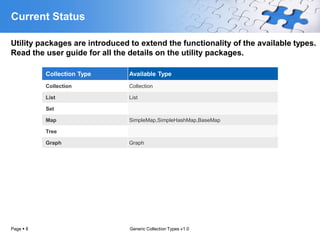
Current Status

Utility packages are introduced to extend the functionality of the available types.
Read the user guide for all the details on the utility packages.

           Collection Type      Available Type
           Collection           Collection

           List                 List

           Set

           Map                  SimpleMap,SimpleHashMap,BaseMap

           Tree

           Graph                Graph


Page  8                        Generic Collection Types v1.0
Practical Applications

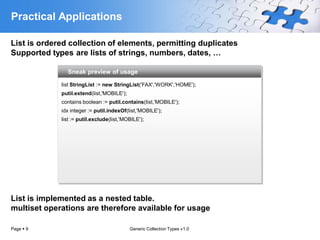
List is ordered collection of elements, permitting duplicates
Supported types are lists of strings, numbers, dates, …

               Sneak preview of usage

             list StringList := new StringList('FAX','WORK','HOME');
             putil.extend(list,'MOBILE');
             contains boolean := putil.contains(list,'MOBILE');
             idx integer := putil.indexOf(list,'MOBILE');
             list := putil.exclude(list,'MOBILE');


List is implemented as a nested table.
multiset operations are therefore available for usage

Page  9                                    Generic Collection Types v1.0
Practical Applications

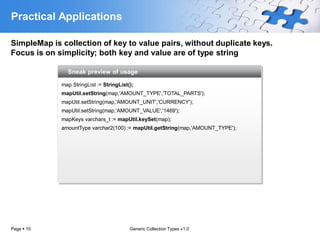
SimpleMap is collection of key to value pairs, without duplicate keys.
Focus is on simplicity; both key and value are of type string

               Sneak preview of usage

             map StringList := StringList();
             mapUtil.setString(map,'AMOUNT_TYPE','TOTAL_PARTS');
             mapUtil.setString(map,'AMOUNT_UNIT','CURRENCY');
             mapUtil.setString(map,'AMOUNT_VALUE','1469');
             mapKeys varchars_t := mapUtil.keySet(map);
             amountType varchar2(100) := mapUtil.getString(map,'AMOUNT_TYPE');


Page  10                                 Generic Collection Types v1.0
Practical Applications

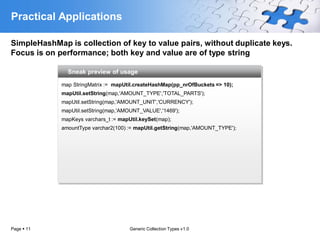
SimpleHashMap is collection of key to value pairs, without duplicate keys.
Focus is on performance; both key and value are of type string

               Sneak preview of usage

             map StringMatrix := mapUtil.createHashMap(pp_nrOfBuckets => 10);
             mapUtil.setString(map,'AMOUNT_TYPE','TOTAL_PARTS');
             mapUtil.setString(map,'AMOUNT_UNIT','CURRENCY');
             mapUtil.setString(map,'AMOUNT_VALUE','1469');
             mapKeys varchars_t := mapUtil.keySet(map);
             amountType varchar2(100) := mapUtil.getString(map,'AMOUNT_TYPE');


Page  11                              Generic Collection Types v1.0
Practical Applications

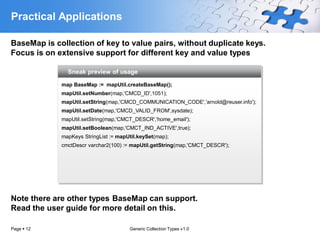
BaseMap is collection of key to value pairs, without duplicate keys.
Focus is on extensive support for different key and value types

               Sneak preview of usage

             map BaseMap := mapUtil.createBaseMap();
             mapUtil.setNumber(map,'CMCD_ID',1051);
             mapUtil.setString(map,'CMCD_COMMUNICATION_CODE','arnold@reuser.info');
             mapUtil.setDate(map,'CMCD_VALID_FROM',sysdate);
             mapUtil.setString(map,'CMCT_DESCR','home_email');
             mapUtil.setBoolean(map,'CMCT_IND_ACTIVE',true);
             mapKeys StringList := mapUtil.keySet(map);
             cmctDescr varchar2(100) := mapUtil.getString(map,'CMCT_DESCR');


Note there are other types BaseMap can support.
Read the user guide for more detail on this.

Page  12                              Generic Collection Types v1.0
Practical Applications

Graph is an interconnected collection of elements.

 Graphs can be used to represent a dynamic hierarchical structure e.g. XML
 Graphs can be used to define other generic types e.g. BaseMap
 Graphs are used if no other data structure delivers a proper solution
 Graphs provide extensive support for different value types
 Graphs have their roots in discrete mathematics.

How the elements of a Graph are connected is up to you.
If you really need a Graph. Read the user guide and code thoroughly.


Page  13                      Generic Collection Types v1.0
How you can make a difference


 Give it a try
 Be a happy user
 Tell us and the whole wide world about it!
 If you would like to get in touch.
  Drop me a mail at arnold@reuser.info


Page  14                   Generic Collection Types v1.0
Do You Have
                    Any Questions?
                    We would be happy to help.


Page  15   Generic Collection Types v1.0

Generic collection types in PLSQL

  • 1.
    Generic Collection Types v1.0 How to enrich the programmer's PLSQL toolkit Arnold Reuser
  • 2.
    Agenda 1 Serving a need 2 What Generic Collection Types can do for you 3 How you can make a difference Page  2 Generic Collection Types v1.0
  • 3.
    Serving a need Missingfeature of PLSQL  PLSQL provides the collection types table and varray - Collection types that allow you to declare index-by tables, nested tables and variable-size arrays. - Collection types that reflect a table like structure.  PLSQL does not provide generic collection types - Collection types as lists, maps, sets, trees, graphs, … - Collection types with a specialized purpose and their own unique strengths and weaknesses Page  3 Generic Collection Types v1.0
  • 4.
    Serving a need Missingfeature of PLSQL  PLSQL types however can be used as building blocks  Building blocks to create generic collection types  Collection types as lists, maps, sets, trees, graphs, ….  Collection types that will enrich the PLSQL programmer's toolkit Page  4 Generic Collection Types v1.0
  • 5.
    Serving a need Missingfeature of PLSQL  A rich PLSQL programmer's toolkit will help shift the focus  Shift the focus from purely technical problems to business problems  Which will help the business generate more value Page  5 Generic Collection Types v1.0
  • 6.
    What Generic CollectionTypes can do for you  Current status  Practical applications Page  6 Generic Collection Types v1.0
  • 7.
    Current Status Collection Type Description Collection collection of elements List ordered collection of elements, permitting duplicates Set collection of elements, forbids duplicates within the collection. Map key to value pairs, without duplicate keys Tree hierarchical collection of elements Graph interconnected collection of elements Page  7 Generic Collection Types v1.0
  • 8.
    Current Status Utility packagesare introduced to extend the functionality of the available types. Read the user guide for all the details on the utility packages. Collection Type Available Type Collection Collection List List Set Map SimpleMap,SimpleHashMap,BaseMap Tree Graph Graph Page  8 Generic Collection Types v1.0
  • 9.
    Practical Applications List isordered collection of elements, permitting duplicates Supported types are lists of strings, numbers, dates, … Sneak preview of usage list StringList := new StringList('FAX','WORK','HOME'); putil.extend(list,'MOBILE'); contains boolean := putil.contains(list,'MOBILE'); idx integer := putil.indexOf(list,'MOBILE'); list := putil.exclude(list,'MOBILE'); List is implemented as a nested table. multiset operations are therefore available for usage Page  9 Generic Collection Types v1.0
  • 10.
    Practical Applications SimpleMap iscollection of key to value pairs, without duplicate keys. Focus is on simplicity; both key and value are of type string Sneak preview of usage map StringList := StringList(); mapUtil.setString(map,'AMOUNT_TYPE','TOTAL_PARTS'); mapUtil.setString(map,'AMOUNT_UNIT','CURRENCY'); mapUtil.setString(map,'AMOUNT_VALUE','1469'); mapKeys varchars_t := mapUtil.keySet(map); amountType varchar2(100) := mapUtil.getString(map,'AMOUNT_TYPE'); Page  10 Generic Collection Types v1.0
  • 11.
    Practical Applications SimpleHashMap iscollection of key to value pairs, without duplicate keys. Focus is on performance; both key and value are of type string Sneak preview of usage map StringMatrix := mapUtil.createHashMap(pp_nrOfBuckets => 10); mapUtil.setString(map,'AMOUNT_TYPE','TOTAL_PARTS'); mapUtil.setString(map,'AMOUNT_UNIT','CURRENCY'); mapUtil.setString(map,'AMOUNT_VALUE','1469'); mapKeys varchars_t := mapUtil.keySet(map); amountType varchar2(100) := mapUtil.getString(map,'AMOUNT_TYPE'); Page  11 Generic Collection Types v1.0
  • 12.
    Practical Applications BaseMap iscollection of key to value pairs, without duplicate keys. Focus is on extensive support for different key and value types Sneak preview of usage map BaseMap := mapUtil.createBaseMap(); mapUtil.setNumber(map,'CMCD_ID',1051); mapUtil.setString(map,'CMCD_COMMUNICATION_CODE','arnold@reuser.info'); mapUtil.setDate(map,'CMCD_VALID_FROM',sysdate); mapUtil.setString(map,'CMCT_DESCR','home_email'); mapUtil.setBoolean(map,'CMCT_IND_ACTIVE',true); mapKeys StringList := mapUtil.keySet(map); cmctDescr varchar2(100) := mapUtil.getString(map,'CMCT_DESCR'); Note there are other types BaseMap can support. Read the user guide for more detail on this. Page  12 Generic Collection Types v1.0
  • 13.
    Practical Applications Graph isan interconnected collection of elements.  Graphs can be used to represent a dynamic hierarchical structure e.g. XML  Graphs can be used to define other generic types e.g. BaseMap  Graphs are used if no other data structure delivers a proper solution  Graphs provide extensive support for different value types  Graphs have their roots in discrete mathematics. How the elements of a Graph are connected is up to you. If you really need a Graph. Read the user guide and code thoroughly. Page  13 Generic Collection Types v1.0
  • 14.
    How you canmake a difference  Give it a try  Be a happy user  Tell us and the whole wide world about it!  If you would like to get in touch. Drop me a mail at arnold@reuser.info Page  14 Generic Collection Types v1.0
  • 15.
    Do You Have Any Questions? We would be happy to help. Page  15 Generic Collection Types v1.0