Generative AI vs Predictive AI:
The Ultimate Comparison Guide
Ever had that moment when your Netflix suggested a show so perfect you
wondered if they were reading your mind? Now, imagine that same tech aiding
doctors in diagnosing diseases before the onset of symptoms. Welcome to the
world of artificial intelligence, characterized by two predominant forms:
generative AI and predictive AI, each with radically different purposes.
In this comprehensive comparison guide, we’re breaking down generative AI vs.
predictive AI without the technical jargon that can make your eyes glaze over.
One creates, one forecasts. Both are shaping the way we live, work, and play.
But understanding the difference between generative and predictive AI could be
the edge your business needs in 2025.
The question is not which is better — it’s which one solves your particular
problem. And that answer? Well, it’s more surprising than you might think.
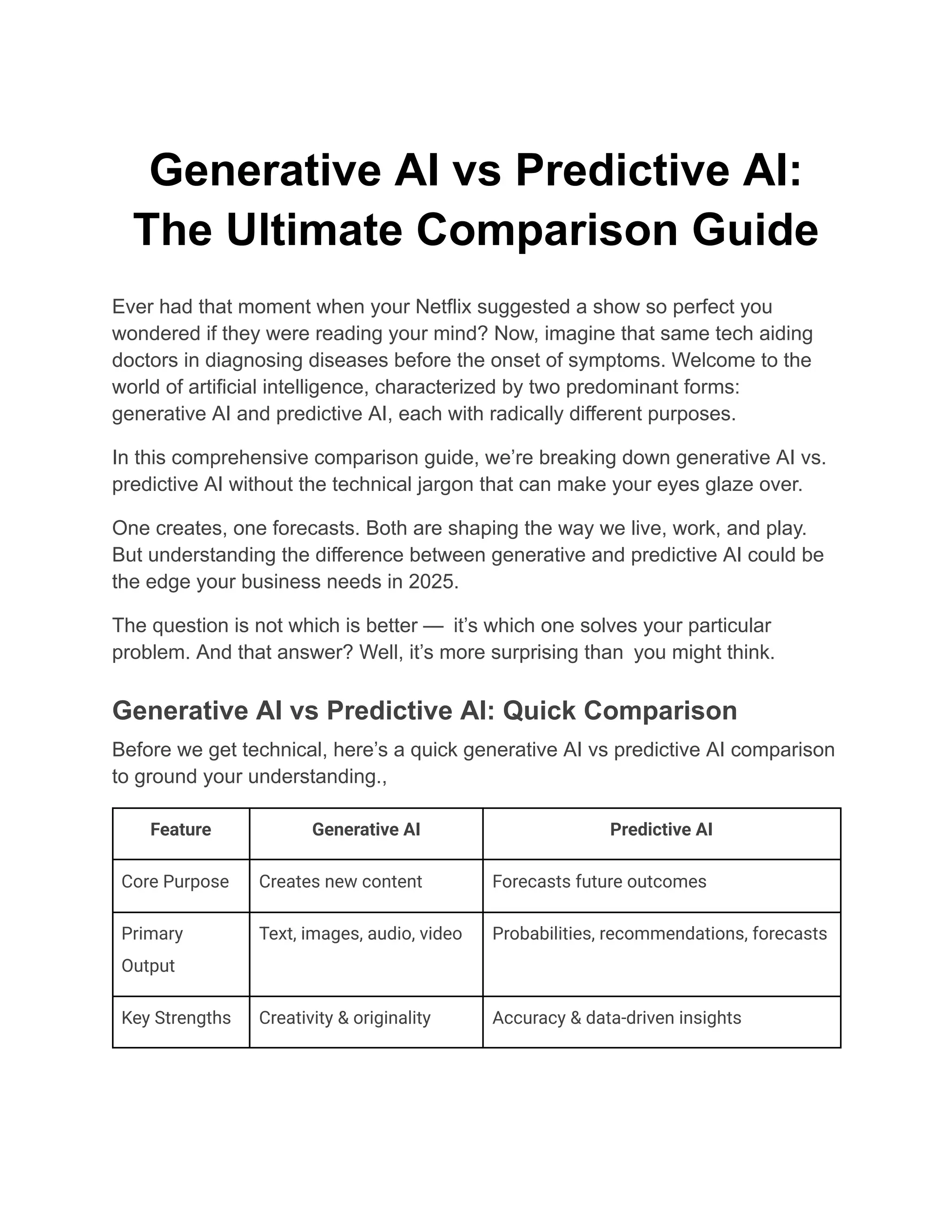
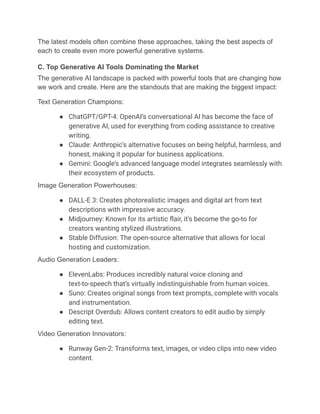
Generative AI vs Predictive AI: Quick Comparison
Before we get technical, here’s a quick generative AI vs predictive AI comparison
to ground your understanding.,
Feature Generative AI Predictive AI
Core Purpose Creates new content Forecasts future outcomes
Primary
Output
Text, images, audio, video Probabilities, recommendations, forecasts
Key Strengths Creativity & originality Accuracy & data-driven insights
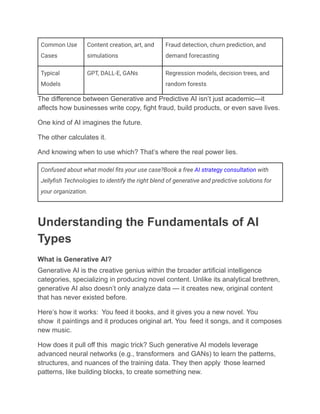
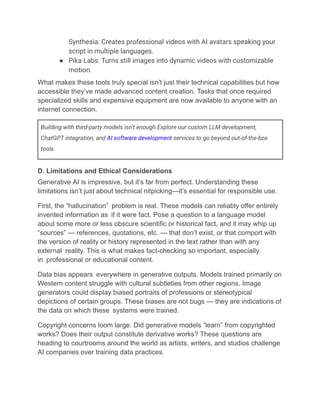
Common Use
Cases
Content creation, art, and
simulations
Fraud detection, churn prediction, and
demand forecasting
Typical
Models
GPT, DALL-E, GANs Regression models, decision trees, and
random forests
The difference between Generative and Predictive AI isn’t just academic—it
affects how businesses write copy, fight fraud, build products, or even save lives.
One kind of AI imagines the future.
The other calculates it.
And knowing when to use which? That’s where the real power lies.
Confused about what model fits your use case?Book a free AI strategy consultation with
Jellyfish Technologies to identify the right blend of generative and predictive solutions for
your organization.
Understanding the Fundamentals of AI
Types
What is Generative AI?
Generative AI is the creative genius within the broader artificial intelligence
categories, specializing in producing novel content. Unlike its analytical brethren,
generative AI also doesn’t only analyze data — it creates new, original content
that has never existed before.
Here’s how it works: You feed it books, and it gives you a new novel. You
show it paintings and it produces original art. You feed it songs, and it composes
new music.
How does it pull off this magic trick? Such generative AI models leverage
advanced neural networks (e.g., transformers and GANs) to learn the patterns,
structures, and nuances of the training data. They then apply those learned
patterns, like building blocks, to create something new.
The real breakthrough happened when these systems got good enough to create
content that’s genuinely useful and sometimes indistinguishable from
human-created work. Those tools are some of the best-known generative AI
examples, such as ChatGPT, DALL-E, and Midjourney, which are all, in effect,
deep learning algorithms trained on massive datasets.
What makes generative AI so powerful is its ability to understand context and
relationships between different concepts. It’s not only regurgitating what it’s seen
before — it’s synthesizing and reforming that knowledge into something new.
What is Predictive AI?
Predictive AI is the tech world’s crystal ball. Its superpower? Culling mountains of
historical data to make educated guesses about what comes next.
When Netflix suggests shows you might like or Amazon suggests products,
that’s predictive AI in action. These are classic predictive AI use cases—Netflix
recommendations, Amazon product suggestions, and dynamic pricing
algorithms.
And the real-world applications are countless, often invisible to us. Weather
forecasts? Predictive AI. Fraud warning on your credit card? Predictive AI. Stock
market analysis tools? You guessed it.
The secret sauce behind predictive AI is its ability to identify patterns in historical
data that humans might miss. By analyzing millions of data points, these systems
can identify subtle correlations and leverage them to make surprisingly accurate
forecasts.
Unlike generative AI, predictive platforms aren’t attempting to come up with
something new. They are aiming for precision and accuracy in predicting specific
outcomes based on what’s already happened.
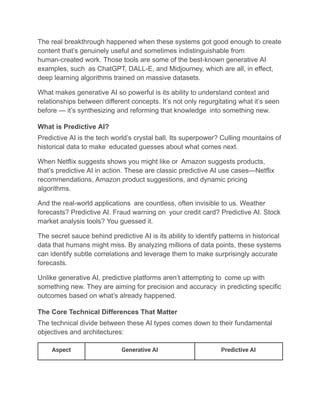
The Core Technical Differences That Matter
The technical divide between these AI types comes down to their fundamental
objectives and architectures:
Aspect Generative AI Predictive AI
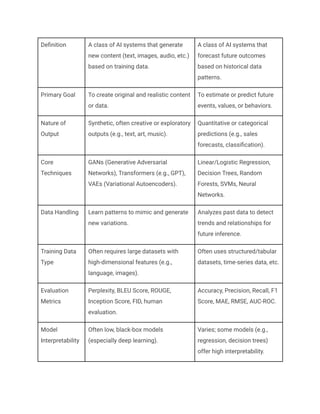
Definition A class of AI systems that generate
new content (text, images, audio, etc.)
based on training data.
A class of AI systems that
forecast future outcomes
based on historical data
patterns.
Primary Goal To create original and realistic content
or data.
To estimate or predict future
events, values, or behaviors.
Nature of
Output
Synthetic, often creative or exploratory
outputs (e.g., text, art, music).
Quantitative or categorical
predictions (e.g., sales
forecasts, classification).
Core
Techniques
GANs (Generative Adversarial
Networks), Transformers (e.g., GPT),
VAEs (Variational Autoencoders).
Linear/Logistic Regression,
Decision Trees, Random
Forests, SVMs, Neural
Networks.
Data Handling Learn patterns to mimic and generate
new variations.
Analyzes past data to detect
trends and relationships for
future inference.
Training Data
Type
Often requires large datasets with
high-dimensional features (e.g.,
language, images).
Often uses structured/tabular
datasets, time-series data, etc.
Evaluation
Metrics
Perplexity, BLEU Score, ROUGE,
Inception Score, FID, human
evaluation.
Accuracy, Precision, Recall, F1
Score, MAE, RMSE, AUC-ROC.
Model
Interpretability
Often low, black-box models
(especially deep learning).
Varies; some models (e.g.,
regression, decision trees)
offer high interpretability.
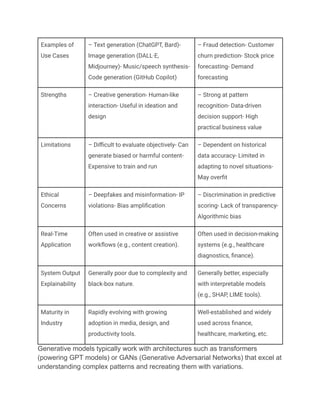
Examples of
Use Cases
– Text generation (ChatGPT, Bard)-
Image generation (DALL·E,
Midjourney)- Music/speech synthesis-
Code generation (GitHub Copilot)
– Fraud detection- Customer
churn prediction- Stock price
forecasting- Demand
forecasting
Strengths – Creative generation- Human-like
interaction- Useful in ideation and
design
– Strong at pattern
recognition- Data-driven
decision support- High
practical business value
Limitations – Difficult to evaluate objectively- Can
generate biased or harmful content-
Expensive to train and run
– Dependent on historical
data accuracy- Limited in
adapting to novel situations-
May overfit
Ethical
Concerns
– Deepfakes and misinformation- IP
violations- Bias amplification
– Discrimination in predictive
scoring- Lack of transparency-
Algorithmic bias
Real-Time
Application
Often used in creative or assistive
workflows (e.g., content creation).
Often used in decision-making
systems (e.g., healthcare
diagnostics, finance).
System Output
Explainability
Generally poor due to complexity and
black-box nature.
Generally better, especially
with interpretable models
(e.g., SHAP, LIME tools).
Maturity in
Industry
Rapidly evolving with growing
adoption in media, design, and
productivity tools.
Well-established and widely
used across finance,
healthcare, marketing, etc.
Generative models typically work with architectures such as transformers
(powering GPT models) or GANs (Generative Adversarial Networks) that excel at
understanding complex patterns and recreating them with variations.
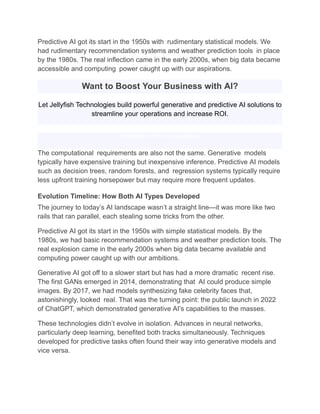
Predictive AI got its start in the 1950s with rudimentary statistical models. We
had rudimentary recommendation systems and weather prediction tools in place
by the 1980s. The real inflection came in the early 2000s, when big data became
accessible and computing power caught up with our aspirations.
Want to Boost Your Business with AI?
Let Jellyfish Technologies build powerful generative and predictive AI solutions to
streamline your operations and increase ROI.
Schedule a Free Consultation
The computational requirements are also not the same. Generative models
typically have expensive training but inexpensive inference. Predictive AI models
such as decision trees, random forests, and regression systems typically require
less upfront training horsepower but may require more frequent updates.
Evolution Timeline: How Both AI Types Developed
The journey to today’s AI landscape wasn’t a straight line—it was more like two
rails that ran parallel, each stealing some tricks from the other.
Predictive AI got its start in the 1950s with simple statistical models. By the
1980s, we had basic recommendation systems and weather prediction tools. The
real explosion came in the early 2000s when big data became available and
computing power caught up with our ambitions.
Generative AI got off to a slower start but has had a more dramatic recent rise.
The first GANs emerged in 2014, demonstrating that AI could produce simple
images. By 2017, we had models synthesizing fake celebrity faces that,
astonishingly, looked real. That was the turning point: the public launch in 2022
of ChatGPT, which demonstrated generative AI’s capabilities to the masses.
These technologies didn’t evolve in isolation. Advances in neural networks,
particularly deep learning, benefited both tracks simultaneously. Techniques
developed for predictive tasks often found their way into generative models and
vice versa.
Today’s cutting-edge systems increasingly blur the distinction between prediction
and generation to a great extent. Modern large language models don’t just
predict the next word—they generate entire narratives while maintaining
coherence across thousands of tokens.
Generative AI: Capabilities and Real-World
Applications
A. Content Creation Powers: Text, Images, Audio, and Video Generation
Generative AI is revolutionizing how we create digital content across every
medium you can imagine. From design to writing, generative AI applications are
disrupting traditional workflows across several verticals all at once.
Take text generation. Tools like GPT-4 are churning out everything from
marketing copy to fiction that’s harder and harder to distinguish from
human-authored content. Need a product description for your e-commerce site?
Or maybe a detailed research report on market trends? Generative AI can draft it
in seconds.
Image generation has exploded in capability, driving innovations in computer
vision development for design, medical imaging, and manufacturing. DALL-E,
Midjourney, and Stable Diffusion can generate breathtaking visuals from
mundane text prompts. Artists are using these tools to visualize concepts,
designers are rapidly prototyping ideas, and marketers are producing custom
visuals without expensive photoshoots.
Audio generation is equally impressive. AI is now capable of creating realistic
human voices, generating original music, and producing sound effects. These
tools are being used to make audiobooks, podcasts, and custom-made music
tracks without the need for recording studios or session musicians.
The newest frontier is the video generation. Tools such as Runway ML and
Synthesia can produce videos based on text prompts, turn still images into
video, or generate completely original footage, with AI avatars delivering scripted
content.
Where the real magic happens is when these capabilities collide—that’s how
generative AI is reshaping industries by compressing an entire production
workflow into a series of prompts. Imagine writing a script, generating matching
visuals, adding AI-created voiceovers, and producing background music—all
using generative models. What once required a production team can now be
accomplished by a single person. What can generative AI do in real-world
applications? Just about everything from design to scripting.
B. How Generative Models Work
Behind the flashy outputs of generative AI lies some seriously clever math and
computer science. These systems aren’t magic—they’re complex
pattern-recognition machines.
Underneath it all, most generative models are simply neural networks that have
been trained on large data sets. Here’s a closer look at how some of the more
popular techniques operate:
Transformers power text generation models like GPT. They analyze patterns in
language by looking at how words relate to each other. When you next ask for
content, they predict which words should follow, given their estimation of the
patterns they have learned. It’s as if you had a hyper-advanced autocomplete
that read context better.
Diffusion models drive most modern image generators. They reverse-engineer
from noise. First, they learn how to progressively add noise to images until they
become static. Then they invent a mechanism to reverse the process, beginning
with random noise and carefully removing it to form an image according to your
description. It’s like seeing a photograph emerge from a fuzzy blob into a
recognizable picture.
Variational Autoencoders (VAEs) compress and decompress data into a latent
code. Consider them as “learning the gist of what makes members of the
category the things that they are, and using that information to form new
instances.
GANs (Generative Adversarial Networks) set two AI systems in opposition: one
generates content and the other judges it. In this competition, the generator is
learning to generate more and more realistic data. It’s like constantly having an
artist and a critic trying to one-up each other to be better.
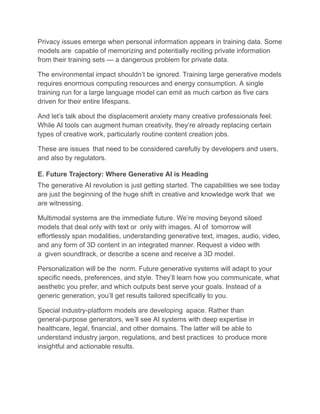
The latest models often combine these approaches, taking the best aspects of
each to create even more powerful generative systems.
C. Top Generative AI Tools Dominating the Market
The generative AI landscape is packed with powerful tools that are changing how
we work and create. Here are the standouts that are making the biggest impact:
Text Generation Champions:
●​ ChatGPT/GPT-4: OpenAI’s conversational AI has become the face of
generative AI, used for everything from coding assistance to creative
writing.
●​ Claude: Anthropic’s alternative focuses on being helpful, harmless, and
honest, making it popular for business applications.
●​ Gemini: Google’s advanced language model integrates seamlessly with
their ecosystem of products.
Image Generation Powerhouses:
●​ DALL-E 3: Creates photorealistic images and digital art from text
descriptions with impressive accuracy.
●​ Midjourney: Known for its artistic flair, it’s become the go-to for
creators wanting stylized illustrations.
●​ Stable Diffusion: The open-source alternative that allows for local
hosting and customization.
Audio Generation Leaders:
●​ ElevenLabs: Produces incredibly natural voice cloning and
text-to-speech that’s virtually indistinguishable from human voices.
●​ Suno: Creates original songs from text prompts, complete with vocals
and instrumentation.
●​ Descript Overdub: Allows content creators to edit audio by simply
editing text.
Video Generation Innovators:
●​ Runway Gen-2: Transforms text, images, or video clips into new video
content.​
​
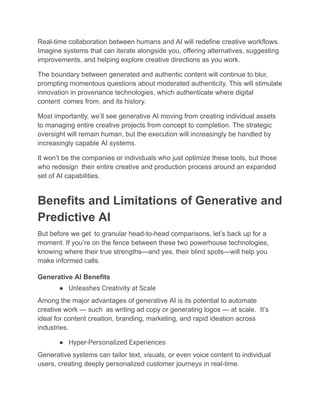
Synthesia: Creates professional videos with AI avatars speaking your
script in multiple languages.
●​ Pika Labs: Turns still images into dynamic videos with customizable
motion.
What makes these tools truly special isn’t just their technical capabilities but how
accessible they’ve made advanced content creation. Tasks that once required
specialized skills and expensive equipment are now available to anyone with an
internet connection.
Building with third-party models isn’t enough.Explore our custom LLM development,
ChatGPT integration, and AI software development services to go beyond out-of-the-box
tools.
D. Limitations and Ethical Considerations
Generative AI is impressive, but it’s far from perfect. Understanding these
limitations isn’t just about technical nitpicking—it’s essential for responsible use.
First, the “hallucination” problem is real. These models can reliably offer entirely
invented information as if it were fact. Pose a question to a language model
about some more or less obscure scientific or historical fact, and it may whip up
“sources” — references, quotations, etc. — that don’t exist, or that comport with
the version of reality or history represented in the text rather than with any
external reality. This is what makes fact-checking so important, especially
in professional or educational content.
Data bias appears everywhere in generative outputs. Models trained primarily on
Western content struggle with cultural subtleties from other regions. Image
generators could display biased portraits of professions or stereotypical
depictions of certain groups. These biases are not bugs — they are indications of
the data on which these systems were trained.
Copyright concerns loom large. Did generative models “learn” from copyrighted
works? Does their output constitute derivative works? These questions are
heading to courtrooms around the world as artists, writers, and studios challenge
AI companies over training data practices.
Privacy issues emerge when personal information appears in training data. Some
models are capable of memorizing and potentially reciting private information
from their training sets — a dangerous problem for private data.
The environmental impact shouldn’t be ignored. Training large generative models
requires enormous computing resources and energy consumption. A single
training run for a large language model can emit as much carbon as five cars
driven for their entire lifespans.
And let’s talk about the displacement anxiety many creative professionals feel.
While AI tools can augment human creativity, they’re already replacing certain
types of creative work, particularly routine content creation jobs.
These are issues that need to be considered carefully by developers and users,
and also by regulators.
E. Future Trajectory: Where Generative AI is Heading
The generative AI revolution is just getting started. The capabilities we see today
are just the beginning of the huge shift in creative and knowledge work that we
are witnessing.
Multimodal systems are the immediate future. We’re moving beyond siloed
models that deal only with text or only with images. AI of tomorrow will
effortlessly span modalities, understanding generative text, images, audio, video,
and any form of 3D content in an integrated manner. Request a video with
a given soundtrack, or describe a scene and receive a 3D model.
Personalization will be the norm. Future generative systems will adapt to your
specific needs, preferences, and style. They’ll learn how you communicate, what
aesthetic you prefer, and which outputs best serve your goals. Instead of a
generic generation, you’ll get results tailored specifically to you.
Special industry-platform models are developing apace. Rather than
general-purpose generators, we’ll see AI systems with deep expertise in
healthcare, legal, financial, and other domains. The latter will be able to
understand industry jargon, regulations, and best practices to produce more
insightful and actionable results.
Real-time collaboration between humans and AI will redefine creative workflows.
Imagine systems that can iterate alongside you, offering alternatives, suggesting
improvements, and helping explore creative directions as you work.
The boundary between generated and authentic content will continue to blur,
prompting momentous questions about moderated authenticity. This will stimulate
innovation in provenance technologies, which authenticate where digital
content comes from, and its history.
Most importantly, we’ll see generative AI moving from creating individual assets
to managing entire creative projects from concept to completion. The strategic
oversight will remain human, but the execution will increasingly be handled by
increasingly capable AI systems.
It won’t be the companies or individuals who just optimize these tools, but those
who redesign their entire creative and production process around an expanded
set of AI capabilities.
Benefits and Limitations of Generative and
Predictive AI
But before we get to granular head-to-head comparisons, let’s back up for a
moment. If you’re on the fence between these two powerhouse technologies,
knowing where their true strengths—and yes, their blind spots—will help you
make informed calls.
Generative AI Benefits
●​ Unleashes Creativity at Scale
Among the major advantages of generative AI is its potential to automate
creative work — such as writing ad copy or generating logos — at scale. It’s
ideal for content creation, branding, marketing, and rapid ideation across
industries.
●​ Hyper-Personalized Experiences
Generative systems can tailor text, visuals, or even voice content to individual
users, creating deeply personalized customer journeys in real-time.
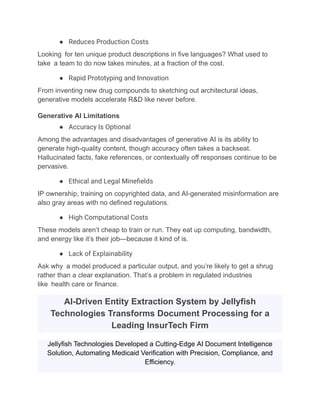
●​ Reduces Production Costs
Looking for ten unique product descriptions in five languages? What used to
take a team to do now takes minutes, at a fraction of the cost.
●​ Rapid Prototyping and Innovation
From inventing new drug compounds to sketching out architectural ideas,
generative models accelerate R&D like never before.
Generative AI Limitations
●​ Accuracy Is Optional
Among the advantages and disadvantages of generative AI is its ability to
generate high-quality content, though accuracy often takes a backseat.
Hallucinated facts, fake references, or contextually off responses continue to be
pervasive.
●​ Ethical and Legal Minefields
IP ownership, training on copyrighted data, and AI-generated misinformation are
also gray areas with no defined regulations.
●​ High Computational Costs
These models aren’t cheap to train or run. They eat up computing, bandwidth,
and energy like it’s their job—because it kind of is.
●​ Lack of Explainability
Ask why a model produced a particular output, and you’re likely to get a shrug
rather than a clear explanation. That’s a problem in regulated industries
like health care or finance.
AI-Driven Entity Extraction System by Jellyfish
Technologies Transforms Document Processing for a
Leading InsurTech Firm
Jellyfish Technologies Developed a Cutting-Edge AI Document Intelligence
Solution, Automating Medicaid Verification with Precision, Compliance, and
Efficiency.
Download Full Case Study
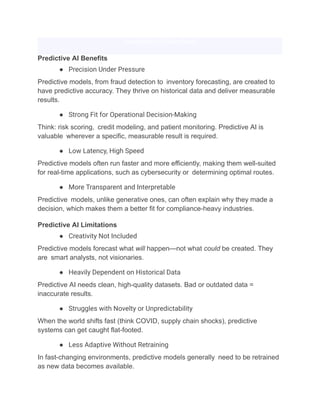
Predictive AI Benefits
●​ Precision Under Pressure
Predictive models, from fraud detection to inventory forecasting, are created to
have predictive accuracy. They thrive on historical data and deliver measurable
results.
●​ Strong Fit for Operational Decision-Making
Think: risk scoring, credit modeling, and patient monitoring. Predictive AI is
valuable wherever a specific, measurable result is required.
●​ Low Latency, High Speed
Predictive models often run faster and more efficiently, making them well-suited
for real-time applications, such as cybersecurity or determining optimal routes.
●​ More Transparent and Interpretable
Predictive models, unlike generative ones, can often explain why they made a
decision, which makes them a better fit for compliance-heavy industries.
Predictive AI Limitations
●​ Creativity Not Included
Predictive models forecast what will happen—not what could be created. They
are smart analysts, not visionaries.
●​ Heavily Dependent on Historical Data
Predictive AI needs clean, high-quality datasets. Bad or outdated data =
inaccurate results.
●​ Struggles with Novelty or Unpredictability
When the world shifts fast (think COVID, supply chain shocks), predictive
systems can get caught flat-footed.
●​ Less Adaptive Without Retraining
In fast-changing environments, predictive models generally need to be retrained
as new data becomes available.
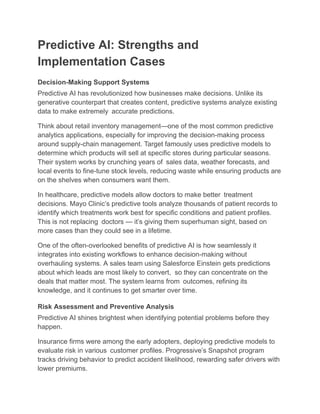
Predictive AI: Strengths and
Implementation Cases
Decision-Making Support Systems
Predictive AI has revolutionized how businesses make decisions. Unlike its
generative counterpart that creates content, predictive systems analyze existing
data to make extremely accurate predictions.
Think about retail inventory management—one of the most common predictive
analytics applications, especially for improving the decision-making process
around supply-chain management. Target famously uses predictive models to
determine which products will sell at specific stores during particular seasons.
Their system works by crunching years of sales data, weather forecasts, and
local events to fine-tune stock levels, reducing waste while ensuring products are
on the shelves when consumers want them.
In healthcare, predictive models allow doctors to make better treatment
decisions. Mayo Clinic’s predictive tools analyze thousands of patient records to
identify which treatments work best for specific conditions and patient profiles.
This is not replacing doctors — it’s giving them superhuman sight, based on
more cases than they could see in a lifetime.
One of the often-overlooked benefits of predictive AI is how seamlessly it
integrates into existing workflows to enhance decision-making without
overhauling systems. A sales team using Salesforce Einstein gets predictions
about which leads are most likely to convert, so they can concentrate on the
deals that matter most. The system learns from outcomes, refining its
knowledge, and it continues to get smarter over time.
Risk Assessment and Preventive Analysis
Predictive AI shines brightest when identifying potential problems before they
happen.
Insurance firms were among the early adopters, deploying predictive models to
evaluate risk in various customer profiles. Progressive’s Snapshot program
tracks driving behavior to predict accident likelihood, rewarding safer drivers with
lower premiums.
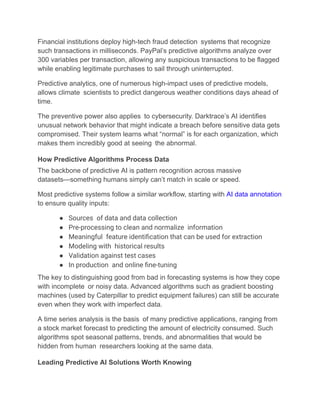
Financial institutions deploy high-tech fraud detection systems that recognize
such transactions in milliseconds. PayPal’s predictive algorithms analyze over
300 variables per transaction, allowing any suspicious transactions to be flagged
while enabling legitimate purchases to sail through uninterrupted.
Predictive analytics, one of numerous high-impact uses of predictive models,
allows climate scientists to predict dangerous weather conditions days ahead of
time.
The preventive power also applies to cybersecurity. Darktrace’s AI identifies
unusual network behavior that might indicate a breach before sensitive data gets
compromised. Their system learns what “normal” is for each organization, which
makes them incredibly good at seeing the abnormal.
How Predictive Algorithms Process Data
The backbone of predictive AI is pattern recognition across massive
datasets—something humans simply can’t match in scale or speed.
Most predictive systems follow a similar workflow, starting with AI data annotation
to ensure quality inputs:
●​ Sources of data and data collection
●​ Pre-processing to clean and normalize information
●​ Meaningful feature identification that can be used for extraction
●​ Modeling with historical results
●​ Validation against test cases
●​ In production and online fine-tuning
The key to distinguishing good from bad in forecasting systems is how they cope
with incomplete or noisy data. Advanced algorithms such as gradient boosting
machines (used by Caterpillar to predict equipment failures) can still be accurate
even when they work with imperfect data.
A time series analysis is the basis of many predictive applications, ranging from
a stock market forecast to predicting the amount of electricity consumed. Such
algorithms spot seasonal patterns, trends, and abnormalities that would be
hidden from human researchers looking at the same data.
Leading Predictive AI Solutions Worth Knowing
A few platforms have positioned themselves squarely in the lead when it comes
to predictive AI:
DataRobot democratizes predictive modeling through automated machine
learning. Their platform evaluates hundreds of model combinations to find the
optimal approach for specific prediction tasks, making advanced AI accessible to
companies without specialized data science teams.
H2O.AI provides open-source solutions that underpin the predictive capabilities
of companies such as PayPal and Kaiser Permanente. Their AutoML capabilities
can automatically determine the best algorithms for a given prediction problem.
IBM Watson remains a heavyweight in predictive analytics, particularly for
enterprise applications. Their NLP capabilities mean that predictive systems can
take on unstructured data, such as customer comments and support tickets.
For certain industry use cases, Palantir has defined modern predictive analytics
in the government and defense sector, and Uptake has done the same in
industrial predictive maintenance.
The best predictive solutions aren’t one-size-fits-all tools; they’re an integrated
system that augments other business processes with predictive intelligence.
Head-to-Head Comparison: Key Differentiators
Processing Requirements and Infrastructure Needs
Ever tried running both generative AI and predictive AI systems? It’s hard
to imagine two hardware requirements that are less alike.
When it comes to comparisons, generative AI is the power-hungry beast in
question. The models, e.g. GPT-4 and DALL-E 3, are huge and can only be
feasibly run on giant clusters of GPUs with nontrivial hardware accelerators.
We’re talking about systems that require:
●​ High-end NVIDIA A100 or H100 GPUs (e.g. at least 8 per server)
●​ High-speed memory in terabytes
●​ Specialized cooling facilities
●​ Power management designed for the enterprise
Predictive AI, by contrast, can often be run on far more modest arrangements.
Also, many predictive models works well on:
●​ Standard CPUs for many applications
●​ Single GPUs for more complex models
●​ Cloud-based solutions with flexible scaling
●​ Edge devices for real-time applications
That’s more than an academic difference — it practically falls right to your
bottom line in terms of deployment options.
Data Dependency: Quality vs. Quantity
The data hunger between these AI methods is night and day.
Generative AI models, it turns out, are data gluttons. They also require a lot of
data to get good results:
Generative AI Predictive AI
Billions of data points Thousands to millions of data points
Less sensitive to data quality Highly sensitive to data quality
Benefits from diverse data sources Benefits from domain-specific data
Requires constant training updates Can remain effective with periodic updates
When it comes to predictive AI, it’s not how much data that counts; it’s whether
you have the right data. A good dataset of 10,000 relevant examples, if
well-curated, can easily beat a disorderly collection of millions of records.
The real kicker? Garbage in, garbage out applies differently. Predictive AI
models exhibit immediate degradation with low-quality data, and generative
models are capable of still working but generating subtly degraded or biased
outputs that are difficult to perceive.
Accuracy and Performance Metrics
The comparison of what it means to “succeed” between these technologies is
radically different.
Predictive AI has clear-cut metrics:
●​ Precision and recall percentages
●​ F1 scores
●​ AUC-ROC curves
●​ Mean Absolute Error (MAE)
●​ Root Mean Square Error (RMSE)
These measures provide you with black-and-white answers to differences in
performance.
Generative AI? That’s where things get fuzzy. We rely on:
●​ Human evaluation scores
●​ BLEU, ROUGE, or METEOR scores for text
●​ FID and IS scores for images
●​ Perplexity measurements
●​ Coherence and relevance testing
The predictive world gives you concrete numbers to judge success. The
generative realm often leaves you asking, “Does this feel right?” which makes
optimization trickier.
Cost Implications for Businesses
The financial picture between these AI approaches couldn’t be more stark.
Generative AI comes with a premium price tag:
●​ Training costs often reach millions of dollars
●​ Inference costs remain high due to computational demands
●​ Specialized AI talent commands salaries of $200K+
●​ Ongoing maintenance requires dedicated teams
Predictive AI tends to be more budget-friendly:
●​ Training costs typically in thousands to tens of thousands
●​ Inference can be extremely cheap once deployed
●​ A wider talent pool is available at more moderate salaries
●​ Maintenance often requires fewer resources
Many businesses face sticker shock when moving from predictive to generative
applications. What used to cost $5,000 monthly in cloud resources suddenly
jumps to $50,000 or more.
Ready to Get Started with AI?
Partner with Jellyfish Technologies for custom AI tools that drive growth,
efficiency, and smart automation.
Schedule a Free Consultation
Integration Complexity with Existing Systems
Plugging AI into your business isn’t created equal.
Predictive AI typically fits into existing workflows like a missing puzzle piece:
●​ Clear input/output interfaces
●​ Standard API frameworks
●​ Established MLOps practices
●​ Familiar deployment patterns
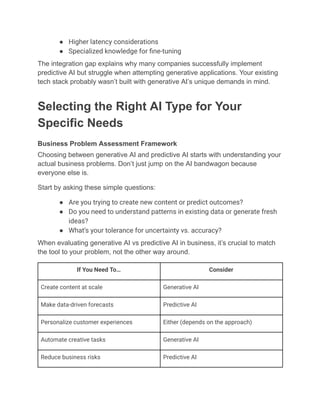
Generative AI often requires rethinking entire systems:
●​ Complex prompt engineering requirements
●​ Novel evaluation frameworks
●​ Unpredictable outputs requiring guardrails
●​ Higher latency considerations
●​ Specialized knowledge for fine-tuning
The integration gap explains why many companies successfully implement
predictive AI but struggle when attempting generative applications. Your existing
tech stack probably wasn’t built with generative AI’s unique demands in mind.
Selecting the Right AI Type for Your
Specific Needs
Business Problem Assessment Framework
Choosing between generative AI and predictive AI starts with understanding your
actual business problems. Don’t just jump on the AI bandwagon because
everyone else is.
Start by asking these simple questions:
●​ Are you trying to create new content or predict outcomes?
●​ Do you need to understand patterns in existing data or generate fresh
ideas?
●​ What’s your tolerance for uncertainty vs. accuracy?
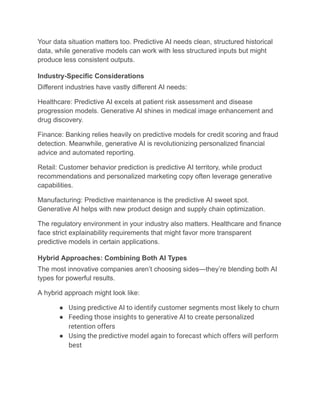
When evaluating generative AI vs predictive AI in business, it’s crucial to match
the tool to your problem, not the other way around.
If You Need To… Consider
Create content at scale Generative AI
Make data-driven forecasts Predictive AI
Personalize customer experiences Either (depends on the approach)
Automate creative tasks Generative AI
Reduce business risks Predictive AI
Your data situation matters too. Predictive AI needs clean, structured historical
data, while generative models can work with less structured inputs but might
produce less consistent outputs.
Industry-Specific Considerations
Different industries have vastly different AI needs:
Healthcare: Predictive AI excels at patient risk assessment and disease
progression models. Generative AI shines in medical image enhancement and
drug discovery.
Finance: Banking relies heavily on predictive models for credit scoring and fraud
detection. Meanwhile, generative AI is revolutionizing personalized financial
advice and automated reporting.
Retail: Customer behavior prediction is predictive AI territory, while product
recommendations and personalized marketing copy often leverage generative
capabilities.
Manufacturing: Predictive maintenance is the predictive AI sweet spot.
Generative AI helps with new product design and supply chain optimization.
The regulatory environment in your industry also matters. Healthcare and finance
face strict explainability requirements that might favor more transparent
predictive models in certain applications.
Hybrid Approaches: Combining Both AI Types
The most innovative companies aren’t choosing sides—they’re blending both AI
types for powerful results.
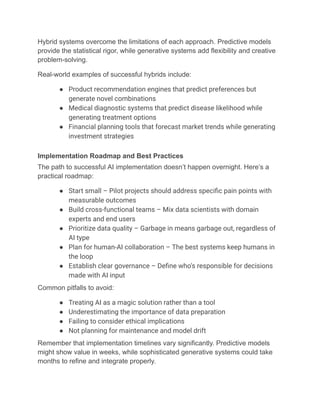
A hybrid approach might look like:
●​ Using predictive AI to identify customer segments most likely to churn
●​ Feeding those insights to generative AI to create personalized
retention offers
●​ Using the predictive model again to forecast which offers will perform
best
Hybrid systems overcome the limitations of each approach. Predictive models
provide the statistical rigor, while generative systems add flexibility and creative
problem-solving.
Real-world examples of successful hybrids include:
●​ Product recommendation engines that predict preferences but
generate novel combinations
●​ Medical diagnostic systems that predict disease likelihood while
generating treatment options
●​ Financial planning tools that forecast market trends while generating
investment strategies
Implementation Roadmap and Best Practices
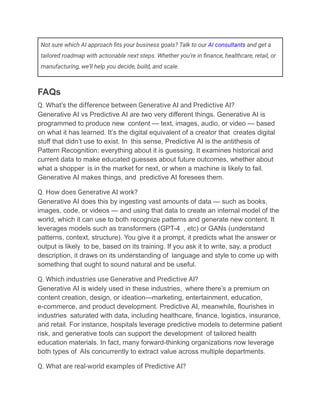
The path to successful AI implementation doesn’t happen overnight. Here’s a
practical roadmap:
●​ Start small – Pilot projects should address specific pain points with
measurable outcomes
●​ Build cross-functional teams – Mix data scientists with domain
experts and end users
●​ Prioritize data quality – Garbage in means garbage out, regardless of
AI type
●​ Plan for human-AI collaboration – The best systems keep humans in
the loop
●​ Establish clear governance – Define who’s responsible for decisions
made with AI input
Common pitfalls to avoid:
●​ Treating AI as a magic solution rather than a tool
●​ Underestimating the importance of data preparation
●​ Failing to consider ethical implications
●​ Not planning for maintenance and model drift
Remember that implementation timelines vary significantly. Predictive models
might show value in weeks, while sophisticated generative systems could take
months to refine and integrate properly.
Not sure which AI approach fits your business goals? Talk to our AI consultants and get a
tailored roadmap with actionable next steps. Whether you’re in finance, healthcare, retail, or
manufacturing, we’ll help you decide, build, and scale.
FAQs
Q. What’s the difference between Generative AI and Predictive AI?
Generative AI vs Predictive AI are two very different things. Generative AI is
programmed to produce new content — text, images, audio, or video — based
on what it has learned. It’s the digital equivalent of a creator that creates digital
stuff that didn’t use to exist. In this sense, Predictive AI is the antithesis of
Pattern Recognition: everything about it is guessing. It examines historical and
current data to make educated guesses about future outcomes, whether about
what a shopper is in the market for next, or when a machine is likely to fail.
Generative AI makes things, and predictive AI foresees them.
Q. How does Generative AI work?
Generative AI does this by ingesting vast amounts of data — such as books,
images, code, or videos — and using that data to create an internal model of the
world, which it can use to both recognize patterns and generate new content. It
leverages models such as transformers (GPT-4 , etc) or GANs (understand
patterns, context, structure). You give it a prompt, it predicts what the answer or
output is likely to be, based on its training. If you ask it to write, say, a product
description, it draws on its understanding of language and style to come up with
something that ought to sound natural and be useful.
Q. Which industries use Generative and Predictive AI?
Generative AI is widely used in these industries, where there’s a premium on
content creation, design, or ideation—marketing, entertainment, education,
e-commerce, and product development. Predictive AI, meanwhile, flourishes in
industries saturated with data, including healthcare, finance, logistics, insurance,
and retail. For instance, hospitals leverage predictive models to determine patient
risk, and generative tools can support the development of tailored health
education materials. In fact, many forward-thinking organizations now leverage
both types of AIs concurrently to extract value across multiple departments.
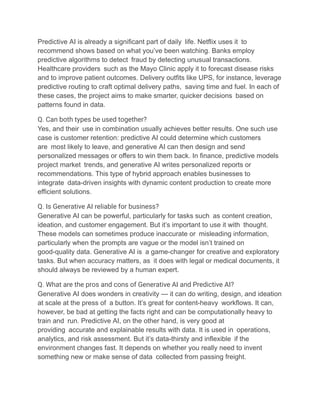
Q. What are real-world examples of Predictive AI?
Predictive AI is already a significant part of daily life. Netflix uses it to
recommend shows based on what you’ve been watching. Banks employ
predictive algorithms to detect fraud by detecting unusual transactions.
Healthcare providers such as the Mayo Clinic apply it to forecast disease risks
and to improve patient outcomes. Delivery outfits like UPS, for instance, leverage
predictive routing to craft optimal delivery paths, saving time and fuel. In each of
these cases, the project aims to make smarter, quicker decisions based on
patterns found in data.
Q. Can both types be used together?
Yes, and their use in combination usually achieves better results. One such use
case is customer retention: predictive AI could determine which customers
are most likely to leave, and generative AI can then design and send
personalized messages or offers to win them back. In finance, predictive models
project market trends, and generative AI writes personalized reports or
recommendations. This type of hybrid approach enables businesses to
integrate data-driven insights with dynamic content production to create more
efficient solutions.
Q. Is Generative AI reliable for business?
Generative AI can be powerful, particularly for tasks such as content creation,
ideation, and customer engagement. But it’s important to use it with thought.
These models can sometimes produce inaccurate or misleading information,
particularly when the prompts are vague or the model isn’t trained on
good-quality data. Generative AI is a game-changer for creative and exploratory
tasks. But when accuracy matters, as it does with legal or medical documents, it
should always be reviewed by a human expert.
Q. What are the pros and cons of Generative AI and Predictive AI?
Generative AI does wonders in creativity — it can do writing, design, and ideation
at scale at the press of a button. It’s great for content-heavy workflows. It can,
however, be bad at getting the facts right and can be computationally heavy to
train and run. Predictive AI, on the other hand, is very good at
providing accurate and explainable results with data. It is used in operations,
analytics, and risk assessment. But it’s data-thirsty and inflexible if the
environment changes fast. It depends on whether you really need to invent
something new or make sense of data collected from passing freight.
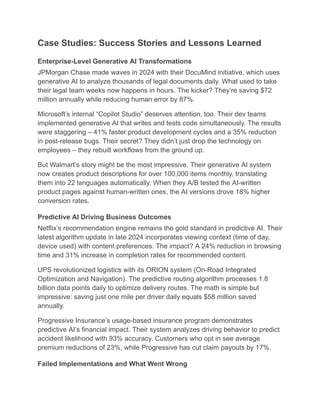
Case Studies: Success Stories and Lessons Learned
Enterprise-Level Generative AI Transformations
JPMorgan Chase made waves in 2024 with their DocuMind initiative, which uses
generative AI to analyze thousands of legal documents daily. What used to take
their legal team weeks now happens in hours. The kicker? They’re saving $72
million annually while reducing human error by 87%.
Microsoft’s internal “Copilot Studio” deserves attention, too. Their dev teams
implemented generative AI that writes and tests code simultaneously. The results
were staggering – 41% faster product development cycles and a 35% reduction
in post-release bugs. Their secret? They didn’t just drop the technology on
employees – they rebuilt workflows from the ground up.
But Walmart’s story might be the most impressive. Their generative AI system
now creates product descriptions for over 100,000 items monthly, translating
them into 22 languages automatically. When they A/B tested the AI-written
product pages against human-written ones, the AI versions drove 18% higher
conversion rates.
Predictive AI Driving Business Outcomes
Netflix’s recommendation engine remains the gold standard in predictive AI. Their
latest algorithm update in late 2024 incorporates viewing context (time of day,
device used) with content preferences. The impact? A 24% reduction in browsing
time and 31% increase in completion rates for recommended content.
UPS revolutionized logistics with its ORION system (On-Road Integrated
Optimization and Navigation). The predictive routing algorithm processes 1.8
billion data points daily to optimize delivery routes. The math is simple but
impressive: saving just one mile per driver daily equals $58 million saved
annually.
Progressive Insurance’s usage-based insurance program demonstrates
predictive AI’s financial impact. Their system analyzes driving behavior to predict
accident likelihood with 93% accuracy. Customers who opt in see average
premium reductions of 23%, while Progressive has cut claim payouts by 17%.
Failed Implementations and What Went Wrong
Target’s 2023 generative AI chatbot disaster serves as a cautionary tale. Their
customer service AI was rushed to production without sufficient training on
product returns. The result? The system approved fraudulent returns costing $43
million before being pulled offline. The lesson: even the best AI needs rigorous
boundary testing.
IBM’s Watson for Oncology promised to revolutionize cancer treatment but
ultimately failed to deliver clinical value. Despite investing $62 million, the system
couldn’t keep pace with rapidly evolving cancer research. The critical mistake?
IBM trained the AI primarily on hypothetical cases rather than diverse real-world
patient data.
Zillow’s house-flipping algorithm demonstrates how predictive AI can fail
spectacularly when market conditions change. Their model didn’t account for
post-pandemic volatility, resulting in a $304 million write-down when they couldn’t
resell purchased properties. The painful truth: predictive AI excels with stable
patterns but struggles with unprecedented scenarios.
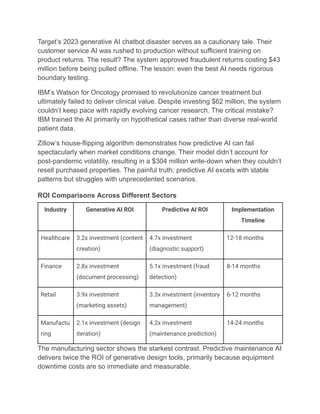
ROI Comparisons Across Different Sectors
Industry Generative AI ROI Predictive AI ROI Implementation
Timeline
Healthcare 3.2x investment (content
creation)
4.7x investment
(diagnostic support)
12-18 months
Finance 2.8x investment
(document processing)
5.1x investment (fraud
detection)
8-14 months
Retail 3.9x investment
(marketing assets)
3.3x investment (inventory
management)
6-12 months
Manufactu
ring
2.1x investment (design
iteration)
4.2x investment
(maintenance prediction)
14-24 months
The manufacturing sector shows the starkest contrast. Predictive maintenance AI
delivers twice the ROI of generative design tools, primarily because equipment
downtime costs are so immediate and measurable.
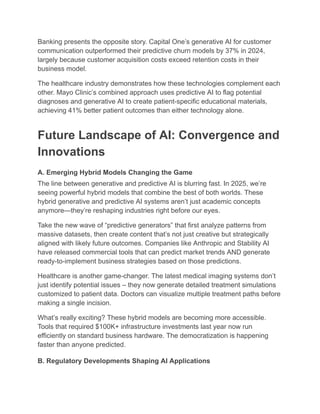
Banking presents the opposite story. Capital One’s generative AI for customer
communication outperformed their predictive churn models by 37% in 2024,
largely because customer acquisition costs exceed retention costs in their
business model.
The healthcare industry demonstrates how these technologies complement each
other. Mayo Clinic’s combined approach uses predictive AI to flag potential
diagnoses and generative AI to create patient-specific educational materials,
achieving 41% better patient outcomes than either technology alone.
Future Landscape of AI: Convergence and
Innovations
A. Emerging Hybrid Models Changing the Game
The line between generative and predictive AI is blurring fast. In 2025, we’re
seeing powerful hybrid models that combine the best of both worlds. These
hybrid generative and predictive AI systems aren’t just academic concepts
anymore—they’re reshaping industries right before our eyes.
Take the new wave of “predictive generators” that first analyze patterns from
massive datasets, then create content that’s not just creative but strategically
aligned with likely future outcomes. Companies like Anthropic and Stability AI
have released commercial tools that can predict market trends AND generate
ready-to-implement business strategies based on those predictions.
Healthcare is another game-changer. The latest medical imaging systems don’t
just identify potential issues – they now generate detailed treatment simulations
customized to patient data. Doctors can visualize multiple treatment paths before
making a single incision.
What’s really exciting? These hybrid models are becoming more accessible.
Tools that required $100K+ infrastructure investments last year now run
efficiently on standard business hardware. The democratization is happening
faster than anyone predicted.
B. Regulatory Developments Shaping AI Applications
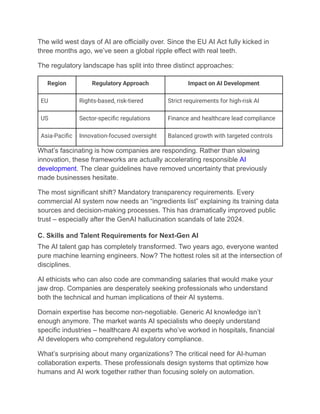
The wild west days of AI are officially over. Since the EU AI Act fully kicked in
three months ago, we’ve seen a global ripple effect with real teeth.
The regulatory landscape has split into three distinct approaches:
Region Regulatory Approach Impact on AI Development
EU Rights-based, risk-tiered Strict requirements for high-risk AI
US Sector-specific regulations Finance and healthcare lead compliance
Asia-Pacific Innovation-focused oversight Balanced growth with targeted controls
What’s fascinating is how companies are responding. Rather than slowing
innovation, these frameworks are actually accelerating responsible AI
development. The clear guidelines have removed uncertainty that previously
made businesses hesitate.
The most significant shift? Mandatory transparency requirements. Every
commercial AI system now needs an “ingredients list” explaining its training data
sources and decision-making processes. This has dramatically improved public
trust – especially after the GenAI hallucination scandals of late 2024.
C. Skills and Talent Requirements for Next-Gen AI
The AI talent gap has completely transformed. Two years ago, everyone wanted
pure machine learning engineers. Now? The hottest roles sit at the intersection of
disciplines.
AI ethicists who can also code are commanding salaries that would make your
jaw drop. Companies are desperately seeking professionals who understand
both the technical and human implications of their AI systems.
Domain expertise has become non-negotiable. Generic AI knowledge isn’t
enough anymore. The market wants AI specialists who deeply understand
specific industries – healthcare AI experts who’ve worked in hospitals, financial
AI developers who comprehend regulatory compliance.
What’s surprising about many organizations? The critical need for AI-human
collaboration experts. These professionals design systems that optimize how
humans and AI work together rather than focusing solely on automation.
The education sector is racing to catch up. We’re seeing specialized graduate
programs in “AI-Human Interaction Design” and “Ethical AI Implementation”
popping up at major universities. But the most successful professionals are those
who cross-train themselves through specialized bootcamps while working.
D. Strategic Planning for AI Integration in 2025 and Beyond
Gone are the days when AI strategy meant “let’s experiment with a chatbot.”
Today’s successful companies are building comprehensive AI roadmaps that
span their entire organization.
The most effective approach? Targeted vertical integration rather than horizontal
implementation. Companies are finding dramatically better ROI by deeply
integrating AI throughout specific business units rather than deploying shallow AI
tools across the entire organization.
Small businesses are finding their footing, too. The emergence of
industry-specific AI packages has leveled the playing field. A local healthcare
provider can now implement specialized medical AI that rivals what industry
giants were building in-house just 18 months ago.
What’s the biggest strategic mistake companies are making? Treating AI as a
tech initiative rather than a business transformation. Organizations seeing the
best results have cross-functional AI steering committees where business
leaders outnumber technical staff.
Looking ahead to 2026, we’re seeing early adopters of “AI operating systems” –
comprehensive platforms that coordinate multiple AI tools across an
organization. These systems are showing 3-4x efficiency improvements over
piecemeal AI implementations.
Final Words
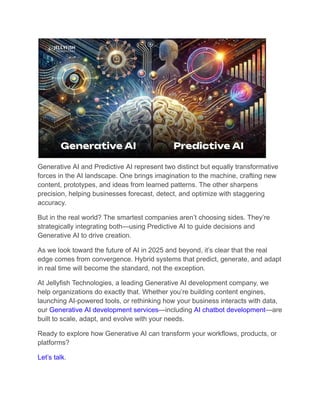
Generative AI and Predictive AI represent two distinct but equally transformative
forces in the AI landscape. One brings imagination to the machine, crafting new
content, prototypes, and ideas from learned patterns. The other sharpens
precision, helping businesses forecast, detect, and optimize with staggering
accuracy.
But in the real world? The smartest companies aren’t choosing sides. They’re
strategically integrating both—using Predictive AI to guide decisions and
Generative AI to drive creation.
As we look toward the future of AI in 2025 and beyond, it’s clear that the real
edge comes from convergence. Hybrid systems that predict, generate, and adapt
in real time will become the standard, not the exception.
At Jellyfish Technologies, a leading Generative AI development company, we
help organizations do exactly that. Whether you’re building content engines,
launching AI-powered tools, or rethinking how your business interacts with data,
our Generative AI development services—including AI chatbot development—are
built to scale, adapt, and evolve with your needs.
Ready to explore how Generative AI can transform your workflows, products, or
platforms?
Let’s talk.

Generative AI vs Predictive AI-The Ultimate Comparison Guide

  • 1.
    Generative AI vsPredictive AI: The Ultimate Comparison Guide Ever had that moment when your Netflix suggested a show so perfect you wondered if they were reading your mind? Now, imagine that same tech aiding doctors in diagnosing diseases before the onset of symptoms. Welcome to the world of artificial intelligence, characterized by two predominant forms: generative AI and predictive AI, each with radically different purposes. In this comprehensive comparison guide, we’re breaking down generative AI vs. predictive AI without the technical jargon that can make your eyes glaze over. One creates, one forecasts. Both are shaping the way we live, work, and play. But understanding the difference between generative and predictive AI could be the edge your business needs in 2025. The question is not which is better — it’s which one solves your particular problem. And that answer? Well, it’s more surprising than you might think. Generative AI vs Predictive AI: Quick Comparison Before we get technical, here’s a quick generative AI vs predictive AI comparison to ground your understanding., Feature Generative AI Predictive AI Core Purpose Creates new content Forecasts future outcomes Primary Output Text, images, audio, video Probabilities, recommendations, forecasts Key Strengths Creativity & originality Accuracy & data-driven insights
  • 2.
    Common Use Cases Content creation,art, and simulations Fraud detection, churn prediction, and demand forecasting Typical Models GPT, DALL-E, GANs Regression models, decision trees, and random forests The difference between Generative and Predictive AI isn’t just academic—it affects how businesses write copy, fight fraud, build products, or even save lives. One kind of AI imagines the future. The other calculates it. And knowing when to use which? That’s where the real power lies. Confused about what model fits your use case?Book a free AI strategy consultation with Jellyfish Technologies to identify the right blend of generative and predictive solutions for your organization. Understanding the Fundamentals of AI Types What is Generative AI? Generative AI is the creative genius within the broader artificial intelligence categories, specializing in producing novel content. Unlike its analytical brethren, generative AI also doesn’t only analyze data — it creates new, original content that has never existed before. Here’s how it works: You feed it books, and it gives you a new novel. You show it paintings and it produces original art. You feed it songs, and it composes new music. How does it pull off this magic trick? Such generative AI models leverage advanced neural networks (e.g., transformers and GANs) to learn the patterns, structures, and nuances of the training data. They then apply those learned patterns, like building blocks, to create something new.
  • 3.
    The real breakthroughhappened when these systems got good enough to create content that’s genuinely useful and sometimes indistinguishable from human-created work. Those tools are some of the best-known generative AI examples, such as ChatGPT, DALL-E, and Midjourney, which are all, in effect, deep learning algorithms trained on massive datasets. What makes generative AI so powerful is its ability to understand context and relationships between different concepts. It’s not only regurgitating what it’s seen before — it’s synthesizing and reforming that knowledge into something new. What is Predictive AI? Predictive AI is the tech world’s crystal ball. Its superpower? Culling mountains of historical data to make educated guesses about what comes next. When Netflix suggests shows you might like or Amazon suggests products, that’s predictive AI in action. These are classic predictive AI use cases—Netflix recommendations, Amazon product suggestions, and dynamic pricing algorithms. And the real-world applications are countless, often invisible to us. Weather forecasts? Predictive AI. Fraud warning on your credit card? Predictive AI. Stock market analysis tools? You guessed it. The secret sauce behind predictive AI is its ability to identify patterns in historical data that humans might miss. By analyzing millions of data points, these systems can identify subtle correlations and leverage them to make surprisingly accurate forecasts. Unlike generative AI, predictive platforms aren’t attempting to come up with something new. They are aiming for precision and accuracy in predicting specific outcomes based on what’s already happened. The Core Technical Differences That Matter The technical divide between these AI types comes down to their fundamental objectives and architectures: Aspect Generative AI Predictive AI
  • 4.
    Definition A classof AI systems that generate new content (text, images, audio, etc.) based on training data. A class of AI systems that forecast future outcomes based on historical data patterns. Primary Goal To create original and realistic content or data. To estimate or predict future events, values, or behaviors. Nature of Output Synthetic, often creative or exploratory outputs (e.g., text, art, music). Quantitative or categorical predictions (e.g., sales forecasts, classification). Core Techniques GANs (Generative Adversarial Networks), Transformers (e.g., GPT), VAEs (Variational Autoencoders). Linear/Logistic Regression, Decision Trees, Random Forests, SVMs, Neural Networks. Data Handling Learn patterns to mimic and generate new variations. Analyzes past data to detect trends and relationships for future inference. Training Data Type Often requires large datasets with high-dimensional features (e.g., language, images). Often uses structured/tabular datasets, time-series data, etc. Evaluation Metrics Perplexity, BLEU Score, ROUGE, Inception Score, FID, human evaluation. Accuracy, Precision, Recall, F1 Score, MAE, RMSE, AUC-ROC. Model Interpretability Often low, black-box models (especially deep learning). Varies; some models (e.g., regression, decision trees) offer high interpretability.
  • 5.
    Examples of Use Cases –Text generation (ChatGPT, Bard)- Image generation (DALL·E, Midjourney)- Music/speech synthesis- Code generation (GitHub Copilot) – Fraud detection- Customer churn prediction- Stock price forecasting- Demand forecasting Strengths – Creative generation- Human-like interaction- Useful in ideation and design – Strong at pattern recognition- Data-driven decision support- High practical business value Limitations – Difficult to evaluate objectively- Can generate biased or harmful content- Expensive to train and run – Dependent on historical data accuracy- Limited in adapting to novel situations- May overfit Ethical Concerns – Deepfakes and misinformation- IP violations- Bias amplification – Discrimination in predictive scoring- Lack of transparency- Algorithmic bias Real-Time Application Often used in creative or assistive workflows (e.g., content creation). Often used in decision-making systems (e.g., healthcare diagnostics, finance). System Output Explainability Generally poor due to complexity and black-box nature. Generally better, especially with interpretable models (e.g., SHAP, LIME tools). Maturity in Industry Rapidly evolving with growing adoption in media, design, and productivity tools. Well-established and widely used across finance, healthcare, marketing, etc. Generative models typically work with architectures such as transformers (powering GPT models) or GANs (Generative Adversarial Networks) that excel at understanding complex patterns and recreating them with variations.
  • 6.
    Predictive AI gotits start in the 1950s with rudimentary statistical models. We had rudimentary recommendation systems and weather prediction tools in place by the 1980s. The real inflection came in the early 2000s, when big data became accessible and computing power caught up with our aspirations. Want to Boost Your Business with AI? Let Jellyfish Technologies build powerful generative and predictive AI solutions to streamline your operations and increase ROI. Schedule a Free Consultation The computational requirements are also not the same. Generative models typically have expensive training but inexpensive inference. Predictive AI models such as decision trees, random forests, and regression systems typically require less upfront training horsepower but may require more frequent updates. Evolution Timeline: How Both AI Types Developed The journey to today’s AI landscape wasn’t a straight line—it was more like two rails that ran parallel, each stealing some tricks from the other. Predictive AI got its start in the 1950s with simple statistical models. By the 1980s, we had basic recommendation systems and weather prediction tools. The real explosion came in the early 2000s when big data became available and computing power caught up with our ambitions. Generative AI got off to a slower start but has had a more dramatic recent rise. The first GANs emerged in 2014, demonstrating that AI could produce simple images. By 2017, we had models synthesizing fake celebrity faces that, astonishingly, looked real. That was the turning point: the public launch in 2022 of ChatGPT, which demonstrated generative AI’s capabilities to the masses. These technologies didn’t evolve in isolation. Advances in neural networks, particularly deep learning, benefited both tracks simultaneously. Techniques developed for predictive tasks often found their way into generative models and vice versa.
  • 7.
    Today’s cutting-edge systemsincreasingly blur the distinction between prediction and generation to a great extent. Modern large language models don’t just predict the next word—they generate entire narratives while maintaining coherence across thousands of tokens. Generative AI: Capabilities and Real-World Applications A. Content Creation Powers: Text, Images, Audio, and Video Generation Generative AI is revolutionizing how we create digital content across every medium you can imagine. From design to writing, generative AI applications are disrupting traditional workflows across several verticals all at once. Take text generation. Tools like GPT-4 are churning out everything from marketing copy to fiction that’s harder and harder to distinguish from human-authored content. Need a product description for your e-commerce site? Or maybe a detailed research report on market trends? Generative AI can draft it in seconds. Image generation has exploded in capability, driving innovations in computer vision development for design, medical imaging, and manufacturing. DALL-E, Midjourney, and Stable Diffusion can generate breathtaking visuals from mundane text prompts. Artists are using these tools to visualize concepts, designers are rapidly prototyping ideas, and marketers are producing custom visuals without expensive photoshoots. Audio generation is equally impressive. AI is now capable of creating realistic human voices, generating original music, and producing sound effects. These tools are being used to make audiobooks, podcasts, and custom-made music tracks without the need for recording studios or session musicians. The newest frontier is the video generation. Tools such as Runway ML and Synthesia can produce videos based on text prompts, turn still images into video, or generate completely original footage, with AI avatars delivering scripted content.
  • 8.
    Where the realmagic happens is when these capabilities collide—that’s how generative AI is reshaping industries by compressing an entire production workflow into a series of prompts. Imagine writing a script, generating matching visuals, adding AI-created voiceovers, and producing background music—all using generative models. What once required a production team can now be accomplished by a single person. What can generative AI do in real-world applications? Just about everything from design to scripting. B. How Generative Models Work Behind the flashy outputs of generative AI lies some seriously clever math and computer science. These systems aren’t magic—they’re complex pattern-recognition machines. Underneath it all, most generative models are simply neural networks that have been trained on large data sets. Here’s a closer look at how some of the more popular techniques operate: Transformers power text generation models like GPT. They analyze patterns in language by looking at how words relate to each other. When you next ask for content, they predict which words should follow, given their estimation of the patterns they have learned. It’s as if you had a hyper-advanced autocomplete that read context better. Diffusion models drive most modern image generators. They reverse-engineer from noise. First, they learn how to progressively add noise to images until they become static. Then they invent a mechanism to reverse the process, beginning with random noise and carefully removing it to form an image according to your description. It’s like seeing a photograph emerge from a fuzzy blob into a recognizable picture. Variational Autoencoders (VAEs) compress and decompress data into a latent code. Consider them as “learning the gist of what makes members of the category the things that they are, and using that information to form new instances. GANs (Generative Adversarial Networks) set two AI systems in opposition: one generates content and the other judges it. In this competition, the generator is learning to generate more and more realistic data. It’s like constantly having an artist and a critic trying to one-up each other to be better.
  • 9.
    The latest modelsoften combine these approaches, taking the best aspects of each to create even more powerful generative systems. C. Top Generative AI Tools Dominating the Market The generative AI landscape is packed with powerful tools that are changing how we work and create. Here are the standouts that are making the biggest impact: Text Generation Champions: ●​ ChatGPT/GPT-4: OpenAI’s conversational AI has become the face of generative AI, used for everything from coding assistance to creative writing. ●​ Claude: Anthropic’s alternative focuses on being helpful, harmless, and honest, making it popular for business applications. ●​ Gemini: Google’s advanced language model integrates seamlessly with their ecosystem of products. Image Generation Powerhouses: ●​ DALL-E 3: Creates photorealistic images and digital art from text descriptions with impressive accuracy. ●​ Midjourney: Known for its artistic flair, it’s become the go-to for creators wanting stylized illustrations. ●​ Stable Diffusion: The open-source alternative that allows for local hosting and customization. Audio Generation Leaders: ●​ ElevenLabs: Produces incredibly natural voice cloning and text-to-speech that’s virtually indistinguishable from human voices. ●​ Suno: Creates original songs from text prompts, complete with vocals and instrumentation. ●​ Descript Overdub: Allows content creators to edit audio by simply editing text. Video Generation Innovators: ●​ Runway Gen-2: Transforms text, images, or video clips into new video content.​ ​
  • 10.
    Synthesia: Creates professionalvideos with AI avatars speaking your script in multiple languages. ●​ Pika Labs: Turns still images into dynamic videos with customizable motion. What makes these tools truly special isn’t just their technical capabilities but how accessible they’ve made advanced content creation. Tasks that once required specialized skills and expensive equipment are now available to anyone with an internet connection. Building with third-party models isn’t enough.Explore our custom LLM development, ChatGPT integration, and AI software development services to go beyond out-of-the-box tools. D. Limitations and Ethical Considerations Generative AI is impressive, but it’s far from perfect. Understanding these limitations isn’t just about technical nitpicking—it’s essential for responsible use. First, the “hallucination” problem is real. These models can reliably offer entirely invented information as if it were fact. Pose a question to a language model about some more or less obscure scientific or historical fact, and it may whip up “sources” — references, quotations, etc. — that don’t exist, or that comport with the version of reality or history represented in the text rather than with any external reality. This is what makes fact-checking so important, especially in professional or educational content. Data bias appears everywhere in generative outputs. Models trained primarily on Western content struggle with cultural subtleties from other regions. Image generators could display biased portraits of professions or stereotypical depictions of certain groups. These biases are not bugs — they are indications of the data on which these systems were trained. Copyright concerns loom large. Did generative models “learn” from copyrighted works? Does their output constitute derivative works? These questions are heading to courtrooms around the world as artists, writers, and studios challenge AI companies over training data practices.
  • 11.
    Privacy issues emergewhen personal information appears in training data. Some models are capable of memorizing and potentially reciting private information from their training sets — a dangerous problem for private data. The environmental impact shouldn’t be ignored. Training large generative models requires enormous computing resources and energy consumption. A single training run for a large language model can emit as much carbon as five cars driven for their entire lifespans. And let’s talk about the displacement anxiety many creative professionals feel. While AI tools can augment human creativity, they’re already replacing certain types of creative work, particularly routine content creation jobs. These are issues that need to be considered carefully by developers and users, and also by regulators. E. Future Trajectory: Where Generative AI is Heading The generative AI revolution is just getting started. The capabilities we see today are just the beginning of the huge shift in creative and knowledge work that we are witnessing. Multimodal systems are the immediate future. We’re moving beyond siloed models that deal only with text or only with images. AI of tomorrow will effortlessly span modalities, understanding generative text, images, audio, video, and any form of 3D content in an integrated manner. Request a video with a given soundtrack, or describe a scene and receive a 3D model. Personalization will be the norm. Future generative systems will adapt to your specific needs, preferences, and style. They’ll learn how you communicate, what aesthetic you prefer, and which outputs best serve your goals. Instead of a generic generation, you’ll get results tailored specifically to you. Special industry-platform models are developing apace. Rather than general-purpose generators, we’ll see AI systems with deep expertise in healthcare, legal, financial, and other domains. The latter will be able to understand industry jargon, regulations, and best practices to produce more insightful and actionable results.
  • 12.
    Real-time collaboration betweenhumans and AI will redefine creative workflows. Imagine systems that can iterate alongside you, offering alternatives, suggesting improvements, and helping explore creative directions as you work. The boundary between generated and authentic content will continue to blur, prompting momentous questions about moderated authenticity. This will stimulate innovation in provenance technologies, which authenticate where digital content comes from, and its history. Most importantly, we’ll see generative AI moving from creating individual assets to managing entire creative projects from concept to completion. The strategic oversight will remain human, but the execution will increasingly be handled by increasingly capable AI systems. It won’t be the companies or individuals who just optimize these tools, but those who redesign their entire creative and production process around an expanded set of AI capabilities. Benefits and Limitations of Generative and Predictive AI But before we get to granular head-to-head comparisons, let’s back up for a moment. If you’re on the fence between these two powerhouse technologies, knowing where their true strengths—and yes, their blind spots—will help you make informed calls. Generative AI Benefits ●​ Unleashes Creativity at Scale Among the major advantages of generative AI is its potential to automate creative work — such as writing ad copy or generating logos — at scale. It’s ideal for content creation, branding, marketing, and rapid ideation across industries. ●​ Hyper-Personalized Experiences Generative systems can tailor text, visuals, or even voice content to individual users, creating deeply personalized customer journeys in real-time.
  • 13.
    ●​ Reduces ProductionCosts Looking for ten unique product descriptions in five languages? What used to take a team to do now takes minutes, at a fraction of the cost. ●​ Rapid Prototyping and Innovation From inventing new drug compounds to sketching out architectural ideas, generative models accelerate R&D like never before. Generative AI Limitations ●​ Accuracy Is Optional Among the advantages and disadvantages of generative AI is its ability to generate high-quality content, though accuracy often takes a backseat. Hallucinated facts, fake references, or contextually off responses continue to be pervasive. ●​ Ethical and Legal Minefields IP ownership, training on copyrighted data, and AI-generated misinformation are also gray areas with no defined regulations. ●​ High Computational Costs These models aren’t cheap to train or run. They eat up computing, bandwidth, and energy like it’s their job—because it kind of is. ●​ Lack of Explainability Ask why a model produced a particular output, and you’re likely to get a shrug rather than a clear explanation. That’s a problem in regulated industries like health care or finance. AI-Driven Entity Extraction System by Jellyfish Technologies Transforms Document Processing for a Leading InsurTech Firm Jellyfish Technologies Developed a Cutting-Edge AI Document Intelligence Solution, Automating Medicaid Verification with Precision, Compliance, and Efficiency.
  • 14.
    Download Full CaseStudy Predictive AI Benefits ●​ Precision Under Pressure Predictive models, from fraud detection to inventory forecasting, are created to have predictive accuracy. They thrive on historical data and deliver measurable results. ●​ Strong Fit for Operational Decision-Making Think: risk scoring, credit modeling, and patient monitoring. Predictive AI is valuable wherever a specific, measurable result is required. ●​ Low Latency, High Speed Predictive models often run faster and more efficiently, making them well-suited for real-time applications, such as cybersecurity or determining optimal routes. ●​ More Transparent and Interpretable Predictive models, unlike generative ones, can often explain why they made a decision, which makes them a better fit for compliance-heavy industries. Predictive AI Limitations ●​ Creativity Not Included Predictive models forecast what will happen—not what could be created. They are smart analysts, not visionaries. ●​ Heavily Dependent on Historical Data Predictive AI needs clean, high-quality datasets. Bad or outdated data = inaccurate results. ●​ Struggles with Novelty or Unpredictability When the world shifts fast (think COVID, supply chain shocks), predictive systems can get caught flat-footed. ●​ Less Adaptive Without Retraining In fast-changing environments, predictive models generally need to be retrained as new data becomes available.
  • 15.
    Predictive AI: Strengthsand Implementation Cases Decision-Making Support Systems Predictive AI has revolutionized how businesses make decisions. Unlike its generative counterpart that creates content, predictive systems analyze existing data to make extremely accurate predictions. Think about retail inventory management—one of the most common predictive analytics applications, especially for improving the decision-making process around supply-chain management. Target famously uses predictive models to determine which products will sell at specific stores during particular seasons. Their system works by crunching years of sales data, weather forecasts, and local events to fine-tune stock levels, reducing waste while ensuring products are on the shelves when consumers want them. In healthcare, predictive models allow doctors to make better treatment decisions. Mayo Clinic’s predictive tools analyze thousands of patient records to identify which treatments work best for specific conditions and patient profiles. This is not replacing doctors — it’s giving them superhuman sight, based on more cases than they could see in a lifetime. One of the often-overlooked benefits of predictive AI is how seamlessly it integrates into existing workflows to enhance decision-making without overhauling systems. A sales team using Salesforce Einstein gets predictions about which leads are most likely to convert, so they can concentrate on the deals that matter most. The system learns from outcomes, refining its knowledge, and it continues to get smarter over time. Risk Assessment and Preventive Analysis Predictive AI shines brightest when identifying potential problems before they happen. Insurance firms were among the early adopters, deploying predictive models to evaluate risk in various customer profiles. Progressive’s Snapshot program tracks driving behavior to predict accident likelihood, rewarding safer drivers with lower premiums.
  • 16.
    Financial institutions deployhigh-tech fraud detection systems that recognize such transactions in milliseconds. PayPal’s predictive algorithms analyze over 300 variables per transaction, allowing any suspicious transactions to be flagged while enabling legitimate purchases to sail through uninterrupted. Predictive analytics, one of numerous high-impact uses of predictive models, allows climate scientists to predict dangerous weather conditions days ahead of time. The preventive power also applies to cybersecurity. Darktrace’s AI identifies unusual network behavior that might indicate a breach before sensitive data gets compromised. Their system learns what “normal” is for each organization, which makes them incredibly good at seeing the abnormal. How Predictive Algorithms Process Data The backbone of predictive AI is pattern recognition across massive datasets—something humans simply can’t match in scale or speed. Most predictive systems follow a similar workflow, starting with AI data annotation to ensure quality inputs: ●​ Sources of data and data collection ●​ Pre-processing to clean and normalize information ●​ Meaningful feature identification that can be used for extraction ●​ Modeling with historical results ●​ Validation against test cases ●​ In production and online fine-tuning The key to distinguishing good from bad in forecasting systems is how they cope with incomplete or noisy data. Advanced algorithms such as gradient boosting machines (used by Caterpillar to predict equipment failures) can still be accurate even when they work with imperfect data. A time series analysis is the basis of many predictive applications, ranging from a stock market forecast to predicting the amount of electricity consumed. Such algorithms spot seasonal patterns, trends, and abnormalities that would be hidden from human researchers looking at the same data. Leading Predictive AI Solutions Worth Knowing
  • 17.
    A few platformshave positioned themselves squarely in the lead when it comes to predictive AI: DataRobot democratizes predictive modeling through automated machine learning. Their platform evaluates hundreds of model combinations to find the optimal approach for specific prediction tasks, making advanced AI accessible to companies without specialized data science teams. H2O.AI provides open-source solutions that underpin the predictive capabilities of companies such as PayPal and Kaiser Permanente. Their AutoML capabilities can automatically determine the best algorithms for a given prediction problem. IBM Watson remains a heavyweight in predictive analytics, particularly for enterprise applications. Their NLP capabilities mean that predictive systems can take on unstructured data, such as customer comments and support tickets. For certain industry use cases, Palantir has defined modern predictive analytics in the government and defense sector, and Uptake has done the same in industrial predictive maintenance. The best predictive solutions aren’t one-size-fits-all tools; they’re an integrated system that augments other business processes with predictive intelligence. Head-to-Head Comparison: Key Differentiators
  • 18.
    Processing Requirements andInfrastructure Needs Ever tried running both generative AI and predictive AI systems? It’s hard to imagine two hardware requirements that are less alike. When it comes to comparisons, generative AI is the power-hungry beast in question. The models, e.g. GPT-4 and DALL-E 3, are huge and can only be feasibly run on giant clusters of GPUs with nontrivial hardware accelerators. We’re talking about systems that require: ●​ High-end NVIDIA A100 or H100 GPUs (e.g. at least 8 per server) ●​ High-speed memory in terabytes ●​ Specialized cooling facilities ●​ Power management designed for the enterprise Predictive AI, by contrast, can often be run on far more modest arrangements. Also, many predictive models works well on: ●​ Standard CPUs for many applications ●​ Single GPUs for more complex models ●​ Cloud-based solutions with flexible scaling ●​ Edge devices for real-time applications That’s more than an academic difference — it practically falls right to your bottom line in terms of deployment options. Data Dependency: Quality vs. Quantity The data hunger between these AI methods is night and day. Generative AI models, it turns out, are data gluttons. They also require a lot of data to get good results: Generative AI Predictive AI Billions of data points Thousands to millions of data points Less sensitive to data quality Highly sensitive to data quality Benefits from diverse data sources Benefits from domain-specific data
  • 19.
    Requires constant trainingupdates Can remain effective with periodic updates When it comes to predictive AI, it’s not how much data that counts; it’s whether you have the right data. A good dataset of 10,000 relevant examples, if well-curated, can easily beat a disorderly collection of millions of records. The real kicker? Garbage in, garbage out applies differently. Predictive AI models exhibit immediate degradation with low-quality data, and generative models are capable of still working but generating subtly degraded or biased outputs that are difficult to perceive. Accuracy and Performance Metrics The comparison of what it means to “succeed” between these technologies is radically different. Predictive AI has clear-cut metrics: ●​ Precision and recall percentages ●​ F1 scores ●​ AUC-ROC curves ●​ Mean Absolute Error (MAE) ●​ Root Mean Square Error (RMSE) These measures provide you with black-and-white answers to differences in performance. Generative AI? That’s where things get fuzzy. We rely on: ●​ Human evaluation scores ●​ BLEU, ROUGE, or METEOR scores for text ●​ FID and IS scores for images ●​ Perplexity measurements ●​ Coherence and relevance testing The predictive world gives you concrete numbers to judge success. The generative realm often leaves you asking, “Does this feel right?” which makes optimization trickier. Cost Implications for Businesses The financial picture between these AI approaches couldn’t be more stark.
  • 20.
    Generative AI comeswith a premium price tag: ●​ Training costs often reach millions of dollars ●​ Inference costs remain high due to computational demands ●​ Specialized AI talent commands salaries of $200K+ ●​ Ongoing maintenance requires dedicated teams Predictive AI tends to be more budget-friendly: ●​ Training costs typically in thousands to tens of thousands ●​ Inference can be extremely cheap once deployed ●​ A wider talent pool is available at more moderate salaries ●​ Maintenance often requires fewer resources Many businesses face sticker shock when moving from predictive to generative applications. What used to cost $5,000 monthly in cloud resources suddenly jumps to $50,000 or more. Ready to Get Started with AI? Partner with Jellyfish Technologies for custom AI tools that drive growth, efficiency, and smart automation. Schedule a Free Consultation Integration Complexity with Existing Systems Plugging AI into your business isn’t created equal. Predictive AI typically fits into existing workflows like a missing puzzle piece: ●​ Clear input/output interfaces ●​ Standard API frameworks ●​ Established MLOps practices ●​ Familiar deployment patterns Generative AI often requires rethinking entire systems: ●​ Complex prompt engineering requirements ●​ Novel evaluation frameworks ●​ Unpredictable outputs requiring guardrails
  • 21.
    ●​ Higher latencyconsiderations ●​ Specialized knowledge for fine-tuning The integration gap explains why many companies successfully implement predictive AI but struggle when attempting generative applications. Your existing tech stack probably wasn’t built with generative AI’s unique demands in mind. Selecting the Right AI Type for Your Specific Needs Business Problem Assessment Framework Choosing between generative AI and predictive AI starts with understanding your actual business problems. Don’t just jump on the AI bandwagon because everyone else is. Start by asking these simple questions: ●​ Are you trying to create new content or predict outcomes? ●​ Do you need to understand patterns in existing data or generate fresh ideas? ●​ What’s your tolerance for uncertainty vs. accuracy? When evaluating generative AI vs predictive AI in business, it’s crucial to match the tool to your problem, not the other way around. If You Need To… Consider Create content at scale Generative AI Make data-driven forecasts Predictive AI Personalize customer experiences Either (depends on the approach) Automate creative tasks Generative AI Reduce business risks Predictive AI
  • 22.
    Your data situationmatters too. Predictive AI needs clean, structured historical data, while generative models can work with less structured inputs but might produce less consistent outputs. Industry-Specific Considerations Different industries have vastly different AI needs: Healthcare: Predictive AI excels at patient risk assessment and disease progression models. Generative AI shines in medical image enhancement and drug discovery. Finance: Banking relies heavily on predictive models for credit scoring and fraud detection. Meanwhile, generative AI is revolutionizing personalized financial advice and automated reporting. Retail: Customer behavior prediction is predictive AI territory, while product recommendations and personalized marketing copy often leverage generative capabilities. Manufacturing: Predictive maintenance is the predictive AI sweet spot. Generative AI helps with new product design and supply chain optimization. The regulatory environment in your industry also matters. Healthcare and finance face strict explainability requirements that might favor more transparent predictive models in certain applications. Hybrid Approaches: Combining Both AI Types The most innovative companies aren’t choosing sides—they’re blending both AI types for powerful results. A hybrid approach might look like: ●​ Using predictive AI to identify customer segments most likely to churn ●​ Feeding those insights to generative AI to create personalized retention offers ●​ Using the predictive model again to forecast which offers will perform best
  • 23.
    Hybrid systems overcomethe limitations of each approach. Predictive models provide the statistical rigor, while generative systems add flexibility and creative problem-solving. Real-world examples of successful hybrids include: ●​ Product recommendation engines that predict preferences but generate novel combinations ●​ Medical diagnostic systems that predict disease likelihood while generating treatment options ●​ Financial planning tools that forecast market trends while generating investment strategies Implementation Roadmap and Best Practices The path to successful AI implementation doesn’t happen overnight. Here’s a practical roadmap: ●​ Start small – Pilot projects should address specific pain points with measurable outcomes ●​ Build cross-functional teams – Mix data scientists with domain experts and end users ●​ Prioritize data quality – Garbage in means garbage out, regardless of AI type ●​ Plan for human-AI collaboration – The best systems keep humans in the loop ●​ Establish clear governance – Define who’s responsible for decisions made with AI input Common pitfalls to avoid: ●​ Treating AI as a magic solution rather than a tool ●​ Underestimating the importance of data preparation ●​ Failing to consider ethical implications ●​ Not planning for maintenance and model drift Remember that implementation timelines vary significantly. Predictive models might show value in weeks, while sophisticated generative systems could take months to refine and integrate properly.
  • 24.
    Not sure whichAI approach fits your business goals? Talk to our AI consultants and get a tailored roadmap with actionable next steps. Whether you’re in finance, healthcare, retail, or manufacturing, we’ll help you decide, build, and scale. FAQs Q. What’s the difference between Generative AI and Predictive AI? Generative AI vs Predictive AI are two very different things. Generative AI is programmed to produce new content — text, images, audio, or video — based on what it has learned. It’s the digital equivalent of a creator that creates digital stuff that didn’t use to exist. In this sense, Predictive AI is the antithesis of Pattern Recognition: everything about it is guessing. It examines historical and current data to make educated guesses about future outcomes, whether about what a shopper is in the market for next, or when a machine is likely to fail. Generative AI makes things, and predictive AI foresees them. Q. How does Generative AI work? Generative AI does this by ingesting vast amounts of data — such as books, images, code, or videos — and using that data to create an internal model of the world, which it can use to both recognize patterns and generate new content. It leverages models such as transformers (GPT-4 , etc) or GANs (understand patterns, context, structure). You give it a prompt, it predicts what the answer or output is likely to be, based on its training. If you ask it to write, say, a product description, it draws on its understanding of language and style to come up with something that ought to sound natural and be useful. Q. Which industries use Generative and Predictive AI? Generative AI is widely used in these industries, where there’s a premium on content creation, design, or ideation—marketing, entertainment, education, e-commerce, and product development. Predictive AI, meanwhile, flourishes in industries saturated with data, including healthcare, finance, logistics, insurance, and retail. For instance, hospitals leverage predictive models to determine patient risk, and generative tools can support the development of tailored health education materials. In fact, many forward-thinking organizations now leverage both types of AIs concurrently to extract value across multiple departments. Q. What are real-world examples of Predictive AI?
  • 25.
    Predictive AI isalready a significant part of daily life. Netflix uses it to recommend shows based on what you’ve been watching. Banks employ predictive algorithms to detect fraud by detecting unusual transactions. Healthcare providers such as the Mayo Clinic apply it to forecast disease risks and to improve patient outcomes. Delivery outfits like UPS, for instance, leverage predictive routing to craft optimal delivery paths, saving time and fuel. In each of these cases, the project aims to make smarter, quicker decisions based on patterns found in data. Q. Can both types be used together? Yes, and their use in combination usually achieves better results. One such use case is customer retention: predictive AI could determine which customers are most likely to leave, and generative AI can then design and send personalized messages or offers to win them back. In finance, predictive models project market trends, and generative AI writes personalized reports or recommendations. This type of hybrid approach enables businesses to integrate data-driven insights with dynamic content production to create more efficient solutions. Q. Is Generative AI reliable for business? Generative AI can be powerful, particularly for tasks such as content creation, ideation, and customer engagement. But it’s important to use it with thought. These models can sometimes produce inaccurate or misleading information, particularly when the prompts are vague or the model isn’t trained on good-quality data. Generative AI is a game-changer for creative and exploratory tasks. But when accuracy matters, as it does with legal or medical documents, it should always be reviewed by a human expert. Q. What are the pros and cons of Generative AI and Predictive AI? Generative AI does wonders in creativity — it can do writing, design, and ideation at scale at the press of a button. It’s great for content-heavy workflows. It can, however, be bad at getting the facts right and can be computationally heavy to train and run. Predictive AI, on the other hand, is very good at providing accurate and explainable results with data. It is used in operations, analytics, and risk assessment. But it’s data-thirsty and inflexible if the environment changes fast. It depends on whether you really need to invent something new or make sense of data collected from passing freight.
  • 26.
    Case Studies: SuccessStories and Lessons Learned Enterprise-Level Generative AI Transformations JPMorgan Chase made waves in 2024 with their DocuMind initiative, which uses generative AI to analyze thousands of legal documents daily. What used to take their legal team weeks now happens in hours. The kicker? They’re saving $72 million annually while reducing human error by 87%. Microsoft’s internal “Copilot Studio” deserves attention, too. Their dev teams implemented generative AI that writes and tests code simultaneously. The results were staggering – 41% faster product development cycles and a 35% reduction in post-release bugs. Their secret? They didn’t just drop the technology on employees – they rebuilt workflows from the ground up. But Walmart’s story might be the most impressive. Their generative AI system now creates product descriptions for over 100,000 items monthly, translating them into 22 languages automatically. When they A/B tested the AI-written product pages against human-written ones, the AI versions drove 18% higher conversion rates. Predictive AI Driving Business Outcomes Netflix’s recommendation engine remains the gold standard in predictive AI. Their latest algorithm update in late 2024 incorporates viewing context (time of day, device used) with content preferences. The impact? A 24% reduction in browsing time and 31% increase in completion rates for recommended content. UPS revolutionized logistics with its ORION system (On-Road Integrated Optimization and Navigation). The predictive routing algorithm processes 1.8 billion data points daily to optimize delivery routes. The math is simple but impressive: saving just one mile per driver daily equals $58 million saved annually. Progressive Insurance’s usage-based insurance program demonstrates predictive AI’s financial impact. Their system analyzes driving behavior to predict accident likelihood with 93% accuracy. Customers who opt in see average premium reductions of 23%, while Progressive has cut claim payouts by 17%. Failed Implementations and What Went Wrong
  • 27.
    Target’s 2023 generativeAI chatbot disaster serves as a cautionary tale. Their customer service AI was rushed to production without sufficient training on product returns. The result? The system approved fraudulent returns costing $43 million before being pulled offline. The lesson: even the best AI needs rigorous boundary testing. IBM’s Watson for Oncology promised to revolutionize cancer treatment but ultimately failed to deliver clinical value. Despite investing $62 million, the system couldn’t keep pace with rapidly evolving cancer research. The critical mistake? IBM trained the AI primarily on hypothetical cases rather than diverse real-world patient data. Zillow’s house-flipping algorithm demonstrates how predictive AI can fail spectacularly when market conditions change. Their model didn’t account for post-pandemic volatility, resulting in a $304 million write-down when they couldn’t resell purchased properties. The painful truth: predictive AI excels with stable patterns but struggles with unprecedented scenarios. ROI Comparisons Across Different Sectors Industry Generative AI ROI Predictive AI ROI Implementation Timeline Healthcare 3.2x investment (content creation) 4.7x investment (diagnostic support) 12-18 months Finance 2.8x investment (document processing) 5.1x investment (fraud detection) 8-14 months Retail 3.9x investment (marketing assets) 3.3x investment (inventory management) 6-12 months Manufactu ring 2.1x investment (design iteration) 4.2x investment (maintenance prediction) 14-24 months The manufacturing sector shows the starkest contrast. Predictive maintenance AI delivers twice the ROI of generative design tools, primarily because equipment downtime costs are so immediate and measurable.
  • 28.
    Banking presents theopposite story. Capital One’s generative AI for customer communication outperformed their predictive churn models by 37% in 2024, largely because customer acquisition costs exceed retention costs in their business model. The healthcare industry demonstrates how these technologies complement each other. Mayo Clinic’s combined approach uses predictive AI to flag potential diagnoses and generative AI to create patient-specific educational materials, achieving 41% better patient outcomes than either technology alone. Future Landscape of AI: Convergence and Innovations A. Emerging Hybrid Models Changing the Game The line between generative and predictive AI is blurring fast. In 2025, we’re seeing powerful hybrid models that combine the best of both worlds. These hybrid generative and predictive AI systems aren’t just academic concepts anymore—they’re reshaping industries right before our eyes. Take the new wave of “predictive generators” that first analyze patterns from massive datasets, then create content that’s not just creative but strategically aligned with likely future outcomes. Companies like Anthropic and Stability AI have released commercial tools that can predict market trends AND generate ready-to-implement business strategies based on those predictions. Healthcare is another game-changer. The latest medical imaging systems don’t just identify potential issues – they now generate detailed treatment simulations customized to patient data. Doctors can visualize multiple treatment paths before making a single incision. What’s really exciting? These hybrid models are becoming more accessible. Tools that required $100K+ infrastructure investments last year now run efficiently on standard business hardware. The democratization is happening faster than anyone predicted. B. Regulatory Developments Shaping AI Applications
  • 29.
    The wild westdays of AI are officially over. Since the EU AI Act fully kicked in three months ago, we’ve seen a global ripple effect with real teeth. The regulatory landscape has split into three distinct approaches: Region Regulatory Approach Impact on AI Development EU Rights-based, risk-tiered Strict requirements for high-risk AI US Sector-specific regulations Finance and healthcare lead compliance Asia-Pacific Innovation-focused oversight Balanced growth with targeted controls What’s fascinating is how companies are responding. Rather than slowing innovation, these frameworks are actually accelerating responsible AI development. The clear guidelines have removed uncertainty that previously made businesses hesitate. The most significant shift? Mandatory transparency requirements. Every commercial AI system now needs an “ingredients list” explaining its training data sources and decision-making processes. This has dramatically improved public trust – especially after the GenAI hallucination scandals of late 2024. C. Skills and Talent Requirements for Next-Gen AI The AI talent gap has completely transformed. Two years ago, everyone wanted pure machine learning engineers. Now? The hottest roles sit at the intersection of disciplines. AI ethicists who can also code are commanding salaries that would make your jaw drop. Companies are desperately seeking professionals who understand both the technical and human implications of their AI systems. Domain expertise has become non-negotiable. Generic AI knowledge isn’t enough anymore. The market wants AI specialists who deeply understand specific industries – healthcare AI experts who’ve worked in hospitals, financial AI developers who comprehend regulatory compliance. What’s surprising about many organizations? The critical need for AI-human collaboration experts. These professionals design systems that optimize how humans and AI work together rather than focusing solely on automation.
  • 30.
    The education sectoris racing to catch up. We’re seeing specialized graduate programs in “AI-Human Interaction Design” and “Ethical AI Implementation” popping up at major universities. But the most successful professionals are those who cross-train themselves through specialized bootcamps while working. D. Strategic Planning for AI Integration in 2025 and Beyond Gone are the days when AI strategy meant “let’s experiment with a chatbot.” Today’s successful companies are building comprehensive AI roadmaps that span their entire organization. The most effective approach? Targeted vertical integration rather than horizontal implementation. Companies are finding dramatically better ROI by deeply integrating AI throughout specific business units rather than deploying shallow AI tools across the entire organization. Small businesses are finding their footing, too. The emergence of industry-specific AI packages has leveled the playing field. A local healthcare provider can now implement specialized medical AI that rivals what industry giants were building in-house just 18 months ago. What’s the biggest strategic mistake companies are making? Treating AI as a tech initiative rather than a business transformation. Organizations seeing the best results have cross-functional AI steering committees where business leaders outnumber technical staff. Looking ahead to 2026, we’re seeing early adopters of “AI operating systems” – comprehensive platforms that coordinate multiple AI tools across an organization. These systems are showing 3-4x efficiency improvements over piecemeal AI implementations. Final Words
  • 31.
    Generative AI andPredictive AI represent two distinct but equally transformative forces in the AI landscape. One brings imagination to the machine, crafting new content, prototypes, and ideas from learned patterns. The other sharpens precision, helping businesses forecast, detect, and optimize with staggering accuracy. But in the real world? The smartest companies aren’t choosing sides. They’re strategically integrating both—using Predictive AI to guide decisions and Generative AI to drive creation. As we look toward the future of AI in 2025 and beyond, it’s clear that the real edge comes from convergence. Hybrid systems that predict, generate, and adapt in real time will become the standard, not the exception. At Jellyfish Technologies, a leading Generative AI development company, we help organizations do exactly that. Whether you’re building content engines, launching AI-powered tools, or rethinking how your business interacts with data, our Generative AI development services—including AI chatbot development—are built to scale, adapt, and evolve with your needs. Ready to explore how Generative AI can transform your workflows, products, or platforms? Let’s talk.