PF SMS iconsPF SMS icons
1
https://learn.extension.org/events/3108
This material is based upon work supported by the National Institute of Food and Agriculture, U.S. Department of Agriculture, and the Office of Family
Readiness Policy, U.S. Department of Defense under Award Numbers 2014-48770-22587 and 2015-48770-24368.
Financial Planning for Different
Generations: Touchstones,
Tasks, and Teaching Strategies
Source:
Clipart
Panda
Webinar Objectives
• Increase knowledge about characteristics of
generations
• Increase knowledge about generational personal
finance practices
• Increase knowledge about generational personal
finance action steps
• Increase knowledge about generational financial
education resources
2
Part 2
Generational
Personal Finance
Barbara O’Neill, Ph.D., CFP®
Rutgers Cooperative Extension
boneill@njaes.rutgers.edu
3
Talkin’ ‘Bout My Generation
4
https://www.youtube.com/watch?v=sU5KBUGvM3U
The Influence of Early
Environments
“What imprints on younger people impacts
them for the rest of their lives”
Cam Marston, Generational Insights
https://generationalinsights.com/about/
5
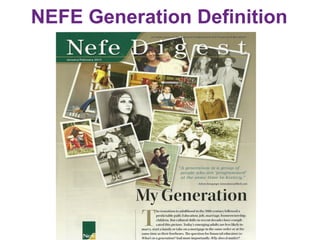
NEFE Generation Definition
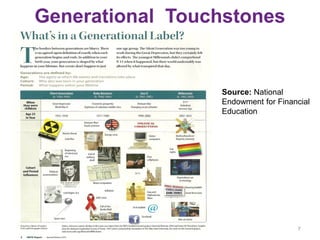
Generational Touchstones
7
Source: National
Endowment for Financial
Education
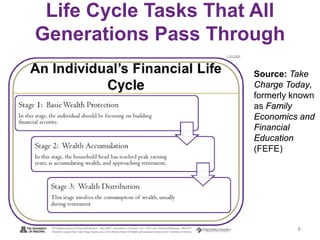
Life Cycle Tasks That All
Generations Pass Through
8
Source: Take
Charge Today,
formerly known
as Family
Economics and
Financial
Education
(FEFE)
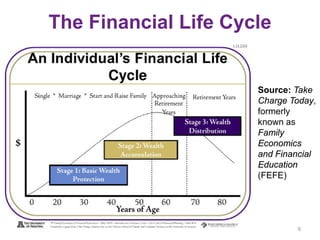
The Financial Life Cycle
9
Source: Take
Charge Today,
formerly
known as
Family
Economics
and Financial
Education
(FEFE)
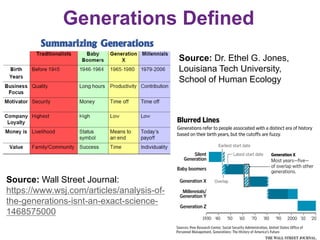
Generations Defined
10
Source: Dr. Ethel G. Jones,
Louisiana Tech University,
School of Human Ecology
Source: Wall Street Journal:
https://www.wsj.com/articles/analysis-of-
the-generations-isnt-an-exact-science-
1468575000
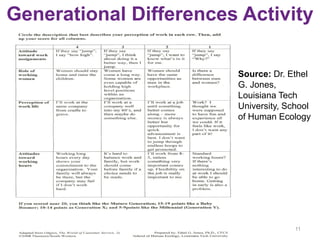
Generational Differences Activity
11
Source: Dr. Ethel
G. Jones,
Louisiana Tech
University, School
of Human Ecology
Question #1:
How Much do You Know
About Generations and
Personal Finance?
12
Generational
Personal Finance
Practices
13
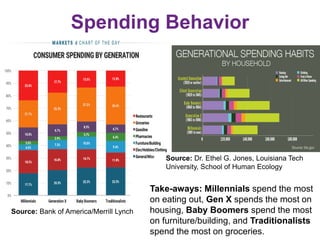
Spending Behavior
Source: Dr. Ethel G. Jones, Louisiana Tech
University, School of Human Ecology
Source: Bank of America/Merrill Lynch
Take-aways: Millennials spend the most
on eating out, Gen X spends the most on
housing, Baby Boomers spend the most
on furniture/building, and Traditionalists
spend the most on groceries.
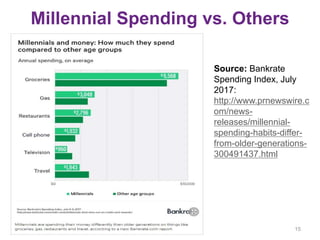
Millennial Spending vs. Others
15
Source: Bankrate
Spending Index, July
2017:
http://www.prnewswire.c
om/news-
releases/millennial-
spending-habits-differ-
from-older-generations-
300491437.html
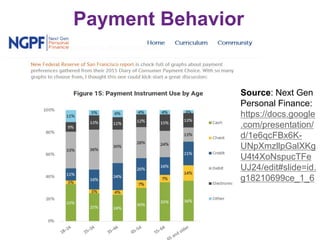
Payment Behavior
Source: Next Gen
Personal Finance:
https://docs.google
.com/presentation/
d/1e6qcFBx6K-
UNpXmzllpGalXKg
U4t4XoNspucTFe
UJ24/edit#slide=id.
g18210699ce_1_6
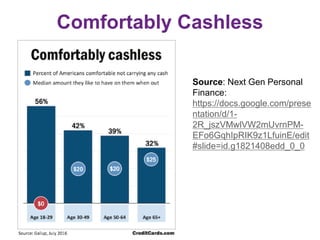
Comfortably Cashless
Source: Next Gen Personal
Finance:
https://docs.google.com/prese
ntation/d/1-
2R_jszVMwlVW2mUvrnPM-
EFo6GqhIpRIK9z1LfuinE/edit
#slide=id.g1821408edd_0_0
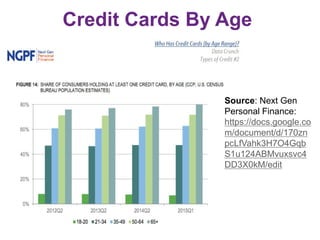
Credit Cards By Age
Source: Next Gen
Personal Finance:
https://docs.google.co
m/document/d/170zn
pcLfVahk3H7O4Gqb
S1u124ABMvuxsvc4
DD3X0kM/edit
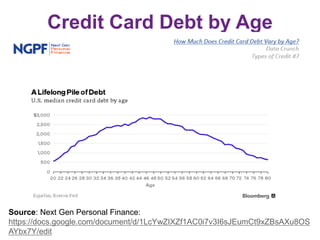
Credit Card Debt by Age
Source: Next Gen Personal Finance:
https://docs.google.com/document/d/1LcYwZIXZf1AC0i7v3I6sJEumCt9xZBsAXu8OS
AYbx7Y/edit
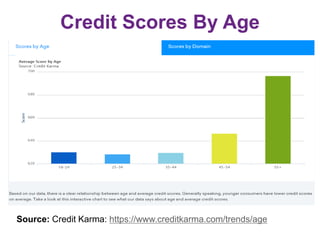
Credit Scores By Age
Source: Credit Karma: https://www.creditkarma.com/trends/age
Auto Insurance Premiums By Age
Source: Value Penguin via Next Gen Personal Finance:
https://docs.google.com/document/d/1sgTUFbCvNyUbEyAiIiUNsXIAxX9PD
4OSoACjt0xzczE/edit
Health Insurance Premiums By Age
Source: Value Penguin via Next Gen Personal Finance:
https://docs.google.com/document/d/13kyHDBg91oCZUzmWip7PRCi9CUm
FDmg89d1kXHBkuLM/edit
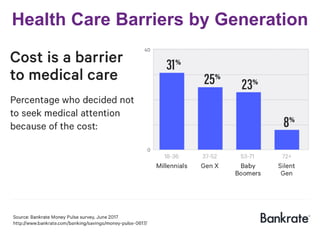
Health Care Barriers by Generation
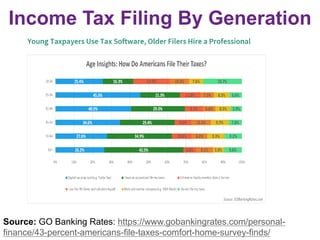
Income Tax Filing By Generation
Source: GO Banking Rates: https://www.gobankingrates.com/personal-
finance/43-percent-americans-file-taxes-comfort-home-survey-finds/
Question #2:
Comments So Far?
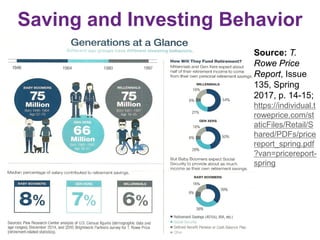
Saving and Investing Behavior
Source: T.
Rowe Price
Report, Issue
135, Spring
2017, p. 14-15;
https://individual.t
roweprice.com/st
aticFiles/Retail/S
hared/PDFs/price
report_spring.pdf
?van=pricereport-
spring
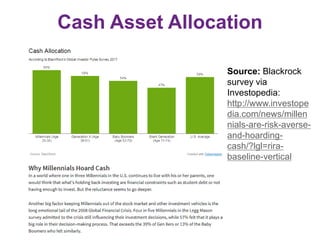
Cash Asset Allocation
Source: Blackrock
survey via
Investopedia:
http://www.investope
dia.com/news/millen
nials-are-risk-averse-
and-hoarding-
cash/?lgl=rira-
baseline-vertical
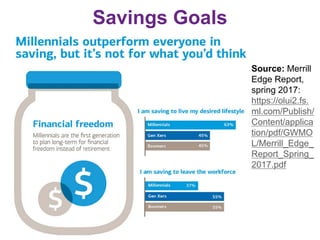
Savings Goals
Source: Merrill
Edge Report,
spring 2017:
https://olui2.fs.
ml.com/Publish/
Content/applica
tion/pdf/GWMO
L/Merrill_Edge_
Report_Spring_
2017.pdf
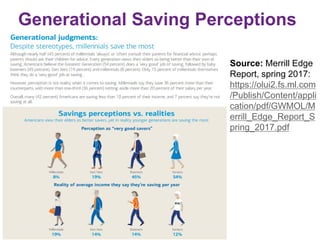
Generational Saving Perceptions
Source: Merrill Edge
Report, spring 2017:
https://olui2.fs.ml.com
/Publish/Content/appli
cation/pdf/GWMOL/M
errill_Edge_Report_S
pring_2017.pdf
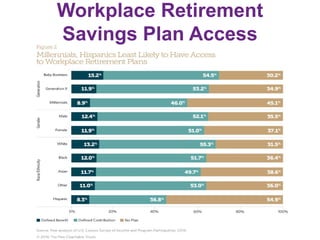
Workplace Retirement
Savings Plan Access
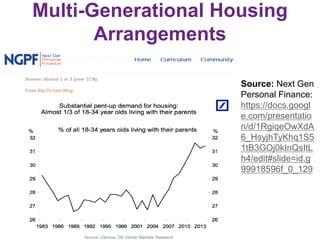
Multi-Generational Housing
Arrangements
Source: Next Gen
Personal Finance:
https://docs.googl
e.com/presentatio
n/d/1RgiqeOwXdA
6_HsyjhTyKhq1S5
1tB3GOj0kInQsItL
h4/edit#slide=id.g
99918596f_0_129
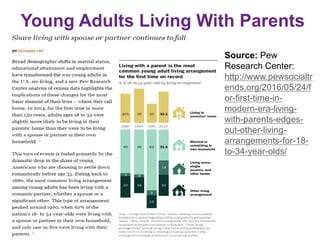
Young Adults Living With Parents
Source: Pew
Research Center:
http://www.pewsocialtr
ends.org/2016/05/24/f
or-first-time-in-
modern-era-living-
with-parents-edges-
out-other-living-
arrangements-for-18-
to-34-year-olds/
Question #3:
More Comments?
Generational
Personal Finance
Action Steps
34
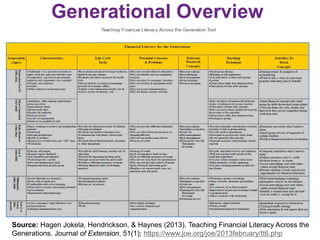
Generational Overview
Source: Hagen Jokela, Hendrickson, & Haynes (2013). Teaching Financial Literacy Across the
Generations. Journal of Extension, 51(1); https://www.joe.org/joe/2013february/tt6.php
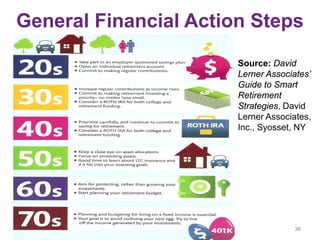
General Financial Action Steps
36
Source: David
Lerner Associates’
Guide to Smart
Retirement
Strategies, David
Lerner Associates,
Inc., Syosset, NY
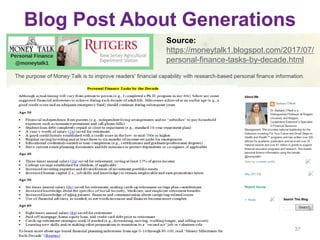
Blog Post About Generations
37
Source:
https://moneytalk1.blogspot.com/2017/07/
personal-finance-tasks-by-decade.html
Millennials (Gen Y):
Age 17-35 in 2017 (b. 1982-2000)
• Train for a career and establish a household
• Learn to budget and “pay yourself first”
• Organize a repayment plan for student loans
• Build an adequate emergency fund
• Fund a Roth IRA account for retirement savings
• Start 529 plans or other savings plans for children
• Build a positive credit history
• Minimize taxes (e.g., tax credits)
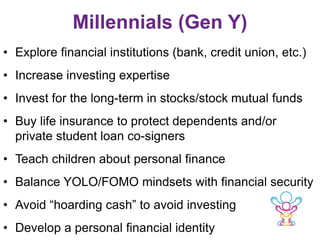
Millennials (Gen Y)
• Explore financial institutions (bank, credit union, etc.)
• Increase investing expertise
• Invest for the long-term in stocks/stock mutual funds
• Buy life insurance to protect dependents and/or
private student loan co-signers
• Teach children about personal finance
• Balance YOLO/FOMO mindsets with financial security
• Avoid “hoarding cash” to avoid investing
• Develop a personal financial identity
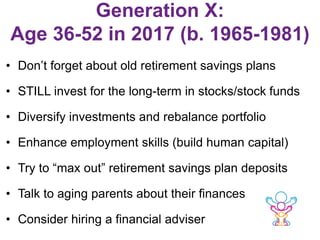
Generation X:
Age 36-52 in 2017 (b. 1965-1981)
• Don’t forget about old retirement savings plans
• STILL invest for the long-term in stocks/stock funds
• Diversify investments and rebalance portfolio
• Enhance employment skills (build human capital)
• Try to “max out” retirement savings plan deposits
• Talk to aging parents about their finances
• Consider hiring a financial adviser
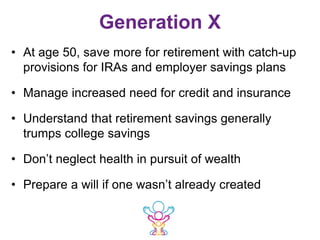
Generation X
• At age 50, save more for retirement with catch-up
provisions for IRAs and employer savings plans
• Manage increased need for credit and insurance
• Understand that retirement savings generally
trumps college savings
• Don’t neglect health in pursuit of wealth
• Prepare a will if one wasn’t already created
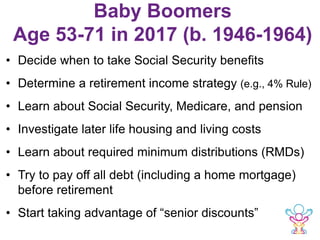
Baby Boomers
Age 53-71 in 2017 (b. 1946-1964)
• Decide when to take Social Security benefits
• Determine a retirement income strategy (e.g., 4% Rule)
• Learn about Social Security, Medicare, and pension
• Investigate later life housing and living costs
• Learn about required minimum distributions (RMDs)
• Try to pay off all debt (including a home mortgage)
before retirement
• Start taking advantage of “senior discounts”
Baby Boomers
• Consider long-term care insurance or earmark a
portion of savings to “self-insure”
• Invest in college savings plans for grandchildren
• Consolidate accounts for simplification
• Consider taking classes and/or building networks
for a “second act” (e.g., freelance work)
• Review estate plan and adjust as needed
• Care for aging parents or other dependents
• Make the most of remaining paychecks to save for
retirement
Mature/Silent/Traditionalists
Age 72-90 in 2017 (b. 1927-1945)
• Get more strategic about philanthropy (e.g., large
gifts, charitable trusts, donor advised funds, etc.)
• Talk to children/heirs about finances and estate plan
• Streamline/consolidate financial accounts
• Gift heirlooms while alive to see recipient enjoy them
• Downsize and/or donate “stuff”
• Hire help as needed (e.g., yard work, cleaning)
Mature/Silent/Traditionalists
• Make it easy to manage money and pay bills (e.g.,
direct deposits and automatic withdrawals)
• Make sure family members know where to find
personal and financial documents
• Adjust lifestyle to a declining real income, if needed
• Take RMDs from retirement savings plans
• Regularly review beneficiary designation on life
insurance and retirement savings plans
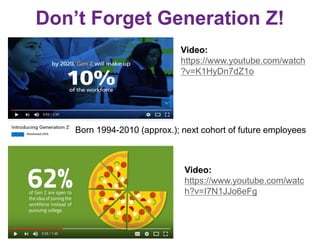
Don’t Forget Generation Z!
Video:
https://www.youtube.com/watch
?v=K1HyDn7dZ1o
Born 1994-2010 (approx.); next cohort of future employees
Video:
https://www.youtube.com/watc
h?v=I7N1JJo6eFg
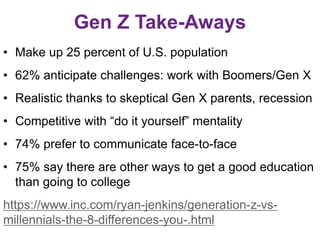
Gen Z Take-Aways
• Make up 25 percent of U.S. population
• 62% anticipate challenges: work with Boomers/Gen X
• Realistic thanks to skeptical Gen X parents, recession
• Competitive with “do it yourself” mentality
• 74% prefer to communicate face-to-face
• 75% say there are other ways to get a good education
than going to college
https://www.inc.com/ryan-jenkins/generation-z-vs-
millennials-the-8-differences-you-.html
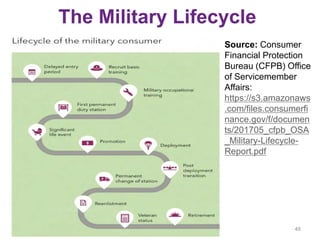
The Military Lifecycle
48
Source: Consumer
Financial Protection
Bureau (CFPB) Office
of Servicemember
Affairs:
https://s3.amazonaws
.com/files.consumerfi
nance.gov/f/documen
ts/201705_cfpb_OSA
_Military-Lifecycle-
Report.pdf
Question #4:
Other Action Steps by
Generation?
Generational
Personal Finance
Resources
50
Journal of Financial Planning
Blog Post
Source:
https://practicemanageme
ntblog.onefpa.org/2017/0
6/27/be-a-gen-savvy-
planner-take-off-your-
generational-lenses/
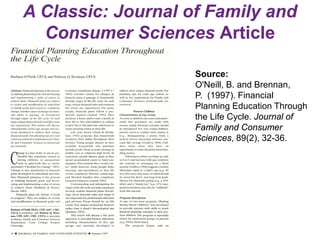
A Classic: Journal of Family and
Consumer Sciences Article
Source:
O'Neill, B. and Brennan,
P. (1997). Financial
Planning Education Through
the Life Cycle. Journal of
Family and Consumer
Sciences, 89(2), 32-36.
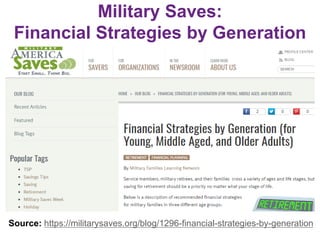
Military Saves:
Financial Strategies by Generation
Source: https://militarysaves.org/blog/1296-financial-strategies-by-generation
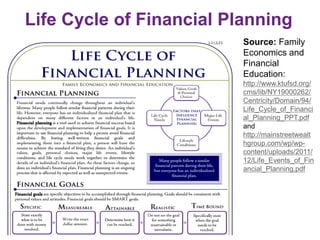
Life Cycle of Financial Planning
Source: Family
Economics and
Financial
Education:
http://www.ktufsd.org/
cms/lib/NY19000262/
Centricity/Domain/94/
Life_Cycle_of_Financi
al_Planning_PPT.pdf
and
http://mainstreetwealt
hgroup.com/wp/wp-
content/uploads/2011/
12/Life_Events_of_Fin
ancial_Planning.pdf
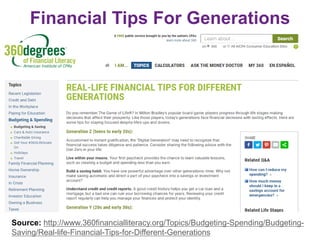
Financial Tips For Generations
Source: http://www.360financialliteracy.org/Topics/Budgeting-Spending/Budgeting-
Saving/Real-life-Financial-Tips-for-Different-Generations
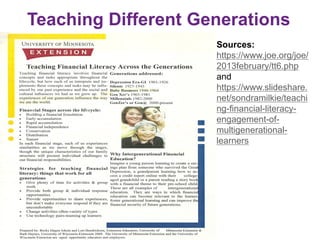
Teaching Different Generations
Sources:
https://www.joe.org/joe/
2013february/tt6.php
and
https://www.slideshare.
net/sondramilkie/teachi
ng-financial-literacy-
engagement-of-
multigenerational-
learners
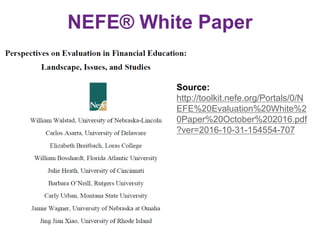
NEFE® White Paper
Source:
http://toolkit.nefe.org/Portals/0/N
EFE%20Evaluation%20White%2
0Paper%20October%202016.pdf
?ver=2016-10-31-154554-707
Question #5:
Other Good
Generational Personal
Finance Resources?
What is one significant
thing
that you learned today?
59
Key Take-Away for Practitioners:
Don’t Impose YOUR “Social Clock”
on Other People!
Social Clock- “a cultural timeline of expectations
of what people should do at a certain age”
(William Doherty, U of Minnesota)
– Late 20s/30s: “So when are you two going to
have a baby?”
– Late 50s/60s: “So when are you going to retire?”
– Late 60s/70s+: “Are you still working? Why?”
https://www.wsj.com/articles/its-ok-to-party-when-
you-turn-60-1500914273 60
61This material is based upon work supported by the National Institute of Food and Agriculture, U.S. Department of Agriculture, and the Office of Family
Readiness Policy, U.S. Department of Defense under Award Numbers 2014-48770-22587 and 2015-48770-24368.

Generations and Personal Finance-10-17

  • 1.
    PF SMS iconsPFSMS icons 1 https://learn.extension.org/events/3108 This material is based upon work supported by the National Institute of Food and Agriculture, U.S. Department of Agriculture, and the Office of Family Readiness Policy, U.S. Department of Defense under Award Numbers 2014-48770-22587 and 2015-48770-24368. Financial Planning for Different Generations: Touchstones, Tasks, and Teaching Strategies Source: Clipart Panda
  • 2.
    Webinar Objectives • Increaseknowledge about characteristics of generations • Increase knowledge about generational personal finance practices • Increase knowledge about generational personal finance action steps • Increase knowledge about generational financial education resources 2
  • 3.
    Part 2 Generational Personal Finance BarbaraO’Neill, Ph.D., CFP® Rutgers Cooperative Extension boneill@njaes.rutgers.edu 3
  • 4.
    Talkin’ ‘Bout MyGeneration 4 https://www.youtube.com/watch?v=sU5KBUGvM3U
  • 5.
    The Influence ofEarly Environments “What imprints on younger people impacts them for the rest of their lives” Cam Marston, Generational Insights https://generationalinsights.com/about/ 5
  • 6.
  • 7.
  • 8.
    Life Cycle TasksThat All Generations Pass Through 8 Source: Take Charge Today, formerly known as Family Economics and Financial Education (FEFE)
  • 9.
    The Financial LifeCycle 9 Source: Take Charge Today, formerly known as Family Economics and Financial Education (FEFE)
  • 10.
    Generations Defined 10 Source: Dr.Ethel G. Jones, Louisiana Tech University, School of Human Ecology Source: Wall Street Journal: https://www.wsj.com/articles/analysis-of- the-generations-isnt-an-exact-science- 1468575000
  • 11.
    Generational Differences Activity 11 Source:Dr. Ethel G. Jones, Louisiana Tech University, School of Human Ecology
  • 12.
    Question #1: How Muchdo You Know About Generations and Personal Finance? 12
  • 13.
  • 14.
    Spending Behavior Source: Dr.Ethel G. Jones, Louisiana Tech University, School of Human Ecology Source: Bank of America/Merrill Lynch Take-aways: Millennials spend the most on eating out, Gen X spends the most on housing, Baby Boomers spend the most on furniture/building, and Traditionalists spend the most on groceries.
  • 15.
    Millennial Spending vs.Others 15 Source: Bankrate Spending Index, July 2017: http://www.prnewswire.c om/news- releases/millennial- spending-habits-differ- from-older-generations- 300491437.html
  • 16.
    Payment Behavior Source: NextGen Personal Finance: https://docs.google .com/presentation/ d/1e6qcFBx6K- UNpXmzllpGalXKg U4t4XoNspucTFe UJ24/edit#slide=id. g18210699ce_1_6
  • 17.
    Comfortably Cashless Source: NextGen Personal Finance: https://docs.google.com/prese ntation/d/1- 2R_jszVMwlVW2mUvrnPM- EFo6GqhIpRIK9z1LfuinE/edit #slide=id.g1821408edd_0_0
  • 18.
    Credit Cards ByAge Source: Next Gen Personal Finance: https://docs.google.co m/document/d/170zn pcLfVahk3H7O4Gqb S1u124ABMvuxsvc4 DD3X0kM/edit
  • 19.
    Credit Card Debtby Age Source: Next Gen Personal Finance: https://docs.google.com/document/d/1LcYwZIXZf1AC0i7v3I6sJEumCt9xZBsAXu8OS AYbx7Y/edit
  • 20.
    Credit Scores ByAge Source: Credit Karma: https://www.creditkarma.com/trends/age
  • 21.
    Auto Insurance PremiumsBy Age Source: Value Penguin via Next Gen Personal Finance: https://docs.google.com/document/d/1sgTUFbCvNyUbEyAiIiUNsXIAxX9PD 4OSoACjt0xzczE/edit
  • 22.
    Health Insurance PremiumsBy Age Source: Value Penguin via Next Gen Personal Finance: https://docs.google.com/document/d/13kyHDBg91oCZUzmWip7PRCi9CUm FDmg89d1kXHBkuLM/edit
  • 23.
    Health Care Barriersby Generation
  • 24.
    Income Tax FilingBy Generation Source: GO Banking Rates: https://www.gobankingrates.com/personal- finance/43-percent-americans-file-taxes-comfort-home-survey-finds/
  • 25.
  • 26.
    Saving and InvestingBehavior Source: T. Rowe Price Report, Issue 135, Spring 2017, p. 14-15; https://individual.t roweprice.com/st aticFiles/Retail/S hared/PDFs/price report_spring.pdf ?van=pricereport- spring
  • 27.
    Cash Asset Allocation Source:Blackrock survey via Investopedia: http://www.investope dia.com/news/millen nials-are-risk-averse- and-hoarding- cash/?lgl=rira- baseline-vertical
  • 28.
    Savings Goals Source: Merrill EdgeReport, spring 2017: https://olui2.fs. ml.com/Publish/ Content/applica tion/pdf/GWMO L/Merrill_Edge_ Report_Spring_ 2017.pdf
  • 29.
    Generational Saving Perceptions Source:Merrill Edge Report, spring 2017: https://olui2.fs.ml.com /Publish/Content/appli cation/pdf/GWMOL/M errill_Edge_Report_S pring_2017.pdf
  • 30.
  • 31.
    Multi-Generational Housing Arrangements Source: NextGen Personal Finance: https://docs.googl e.com/presentatio n/d/1RgiqeOwXdA 6_HsyjhTyKhq1S5 1tB3GOj0kInQsItL h4/edit#slide=id.g 99918596f_0_129
  • 32.
    Young Adults LivingWith Parents Source: Pew Research Center: http://www.pewsocialtr ends.org/2016/05/24/f or-first-time-in- modern-era-living- with-parents-edges- out-other-living- arrangements-for-18- to-34-year-olds/
  • 33.
  • 34.
  • 35.
    Generational Overview Source: HagenJokela, Hendrickson, & Haynes (2013). Teaching Financial Literacy Across the Generations. Journal of Extension, 51(1); https://www.joe.org/joe/2013february/tt6.php
  • 36.
    General Financial ActionSteps 36 Source: David Lerner Associates’ Guide to Smart Retirement Strategies, David Lerner Associates, Inc., Syosset, NY
  • 37.
    Blog Post AboutGenerations 37 Source: https://moneytalk1.blogspot.com/2017/07/ personal-finance-tasks-by-decade.html
  • 38.
    Millennials (Gen Y): Age17-35 in 2017 (b. 1982-2000) • Train for a career and establish a household • Learn to budget and “pay yourself first” • Organize a repayment plan for student loans • Build an adequate emergency fund • Fund a Roth IRA account for retirement savings • Start 529 plans or other savings plans for children • Build a positive credit history • Minimize taxes (e.g., tax credits)
  • 39.
    Millennials (Gen Y) •Explore financial institutions (bank, credit union, etc.) • Increase investing expertise • Invest for the long-term in stocks/stock mutual funds • Buy life insurance to protect dependents and/or private student loan co-signers • Teach children about personal finance • Balance YOLO/FOMO mindsets with financial security • Avoid “hoarding cash” to avoid investing • Develop a personal financial identity
  • 40.
    Generation X: Age 36-52in 2017 (b. 1965-1981) • Don’t forget about old retirement savings plans • STILL invest for the long-term in stocks/stock funds • Diversify investments and rebalance portfolio • Enhance employment skills (build human capital) • Try to “max out” retirement savings plan deposits • Talk to aging parents about their finances • Consider hiring a financial adviser
  • 41.
    Generation X • Atage 50, save more for retirement with catch-up provisions for IRAs and employer savings plans • Manage increased need for credit and insurance • Understand that retirement savings generally trumps college savings • Don’t neglect health in pursuit of wealth • Prepare a will if one wasn’t already created
  • 42.
    Baby Boomers Age 53-71in 2017 (b. 1946-1964) • Decide when to take Social Security benefits • Determine a retirement income strategy (e.g., 4% Rule) • Learn about Social Security, Medicare, and pension • Investigate later life housing and living costs • Learn about required minimum distributions (RMDs) • Try to pay off all debt (including a home mortgage) before retirement • Start taking advantage of “senior discounts”
  • 43.
    Baby Boomers • Considerlong-term care insurance or earmark a portion of savings to “self-insure” • Invest in college savings plans for grandchildren • Consolidate accounts for simplification • Consider taking classes and/or building networks for a “second act” (e.g., freelance work) • Review estate plan and adjust as needed • Care for aging parents or other dependents • Make the most of remaining paychecks to save for retirement
  • 44.
    Mature/Silent/Traditionalists Age 72-90 in2017 (b. 1927-1945) • Get more strategic about philanthropy (e.g., large gifts, charitable trusts, donor advised funds, etc.) • Talk to children/heirs about finances and estate plan • Streamline/consolidate financial accounts • Gift heirlooms while alive to see recipient enjoy them • Downsize and/or donate “stuff” • Hire help as needed (e.g., yard work, cleaning)
  • 45.
    Mature/Silent/Traditionalists • Make iteasy to manage money and pay bills (e.g., direct deposits and automatic withdrawals) • Make sure family members know where to find personal and financial documents • Adjust lifestyle to a declining real income, if needed • Take RMDs from retirement savings plans • Regularly review beneficiary designation on life insurance and retirement savings plans
  • 46.
    Don’t Forget GenerationZ! Video: https://www.youtube.com/watch ?v=K1HyDn7dZ1o Born 1994-2010 (approx.); next cohort of future employees Video: https://www.youtube.com/watc h?v=I7N1JJo6eFg
  • 47.
    Gen Z Take-Aways •Make up 25 percent of U.S. population • 62% anticipate challenges: work with Boomers/Gen X • Realistic thanks to skeptical Gen X parents, recession • Competitive with “do it yourself” mentality • 74% prefer to communicate face-to-face • 75% say there are other ways to get a good education than going to college https://www.inc.com/ryan-jenkins/generation-z-vs- millennials-the-8-differences-you-.html
  • 48.
    The Military Lifecycle 48 Source:Consumer Financial Protection Bureau (CFPB) Office of Servicemember Affairs: https://s3.amazonaws .com/files.consumerfi nance.gov/f/documen ts/201705_cfpb_OSA _Military-Lifecycle- Report.pdf
  • 49.
    Question #4: Other ActionSteps by Generation?
  • 50.
  • 51.
    Journal of FinancialPlanning Blog Post Source: https://practicemanageme ntblog.onefpa.org/2017/0 6/27/be-a-gen-savvy- planner-take-off-your- generational-lenses/
  • 52.
    A Classic: Journalof Family and Consumer Sciences Article Source: O'Neill, B. and Brennan, P. (1997). Financial Planning Education Through the Life Cycle. Journal of Family and Consumer Sciences, 89(2), 32-36.
  • 53.
    Military Saves: Financial Strategiesby Generation Source: https://militarysaves.org/blog/1296-financial-strategies-by-generation
  • 54.
    Life Cycle ofFinancial Planning Source: Family Economics and Financial Education: http://www.ktufsd.org/ cms/lib/NY19000262/ Centricity/Domain/94/ Life_Cycle_of_Financi al_Planning_PPT.pdf and http://mainstreetwealt hgroup.com/wp/wp- content/uploads/2011/ 12/Life_Events_of_Fin ancial_Planning.pdf
  • 55.
    Financial Tips ForGenerations Source: http://www.360financialliteracy.org/Topics/Budgeting-Spending/Budgeting- Saving/Real-life-Financial-Tips-for-Different-Generations
  • 56.
  • 57.
  • 58.
    Question #5: Other Good GenerationalPersonal Finance Resources?
  • 59.
    What is onesignificant thing that you learned today? 59
  • 60.
    Key Take-Away forPractitioners: Don’t Impose YOUR “Social Clock” on Other People! Social Clock- “a cultural timeline of expectations of what people should do at a certain age” (William Doherty, U of Minnesota) – Late 20s/30s: “So when are you two going to have a baby?” – Late 50s/60s: “So when are you going to retire?” – Late 60s/70s+: “Are you still working? Why?” https://www.wsj.com/articles/its-ok-to-party-when- you-turn-60-1500914273 60
  • 61.
    61This material isbased upon work supported by the National Institute of Food and Agriculture, U.S. Department of Agriculture, and the Office of Family Readiness Policy, U.S. Department of Defense under Award Numbers 2014-48770-22587 and 2015-48770-24368.