Online course
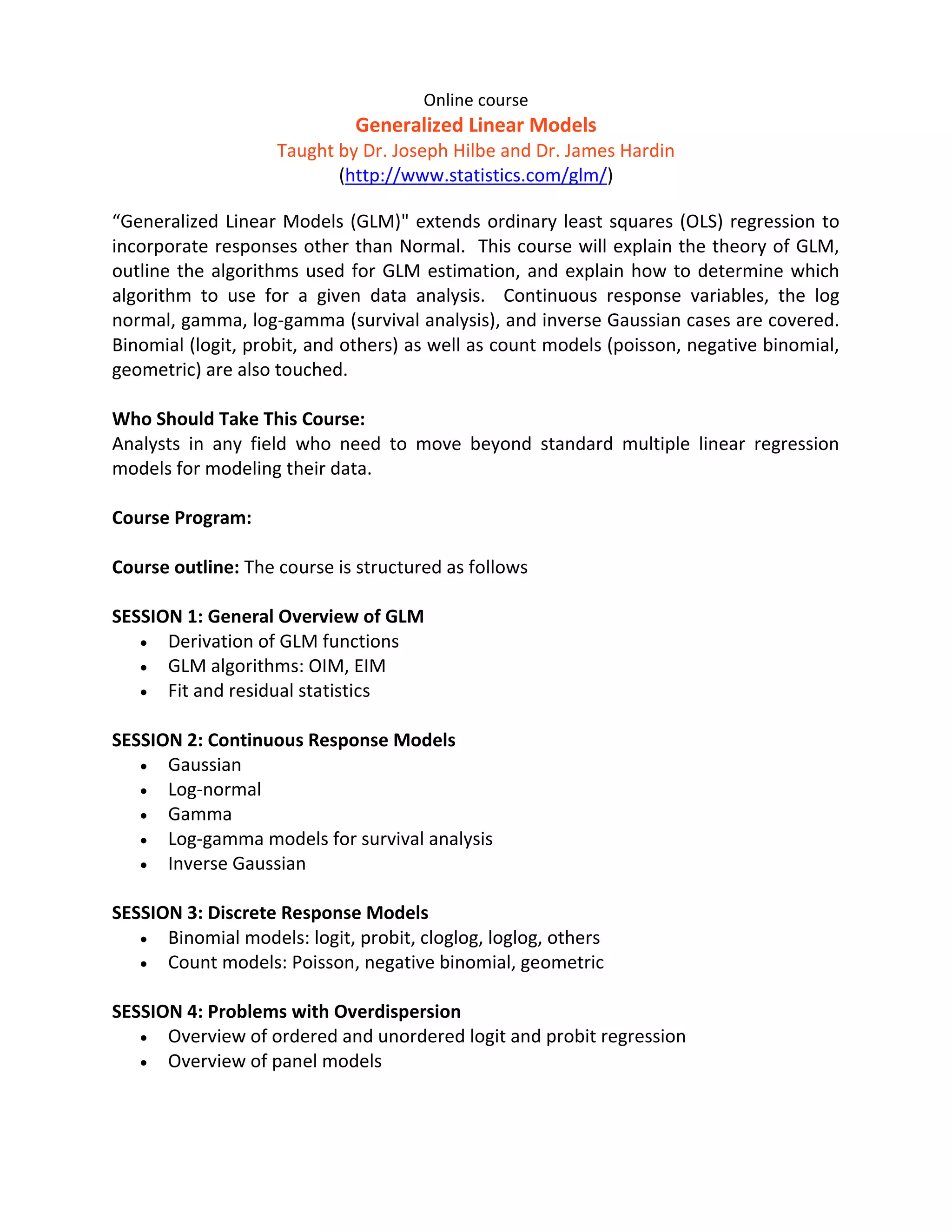
                             Generalized Linear Models
                    Taught by Dr. Joseph Hilbe and Dr. James Hardin
                           (http://www.statistics.com/glm/)

“Generalized Linear Models (GLM)" extends ordinary least squares (OLS) regression to
incorporate responses other than Normal. This course will explain the theory of GLM,
outline the algorithms used for GLM estimation, and explain how to determine which
algorithm to use for a given data analysis. Continuous response variables, the log
normal, gamma, log-gamma (survival analysis), and inverse Gaussian cases are covered.
Binomial (logit, probit, and others) as well as count models (poisson, negative binomial,
geometric) are also touched.

Who Should Take This Course:
Analysts in any field who need to move beyond standard multiple linear regression
models for modeling their data.

Course Program:

Course outline: The course is structured as follows

SESSION 1: General Overview of GLM
    Derivation of GLM functions
    GLM algorithms: OIM, EIM
    Fit and residual statistics


SESSION 2: Continuous Response Models
    Gaussian
    Log-normal
    Gamma
    Log-gamma models for survival analysis
    Inverse Gaussian


SESSION 3: Discrete Response Models
    Binomial models: logit, probit, cloglog, loglog, others
    Count models: Poisson, negative binomial, geometric


SESSION 4: Problems with Overdispersion
    Overview of ordered and unordered logit and probit regression
    Overview of panel models
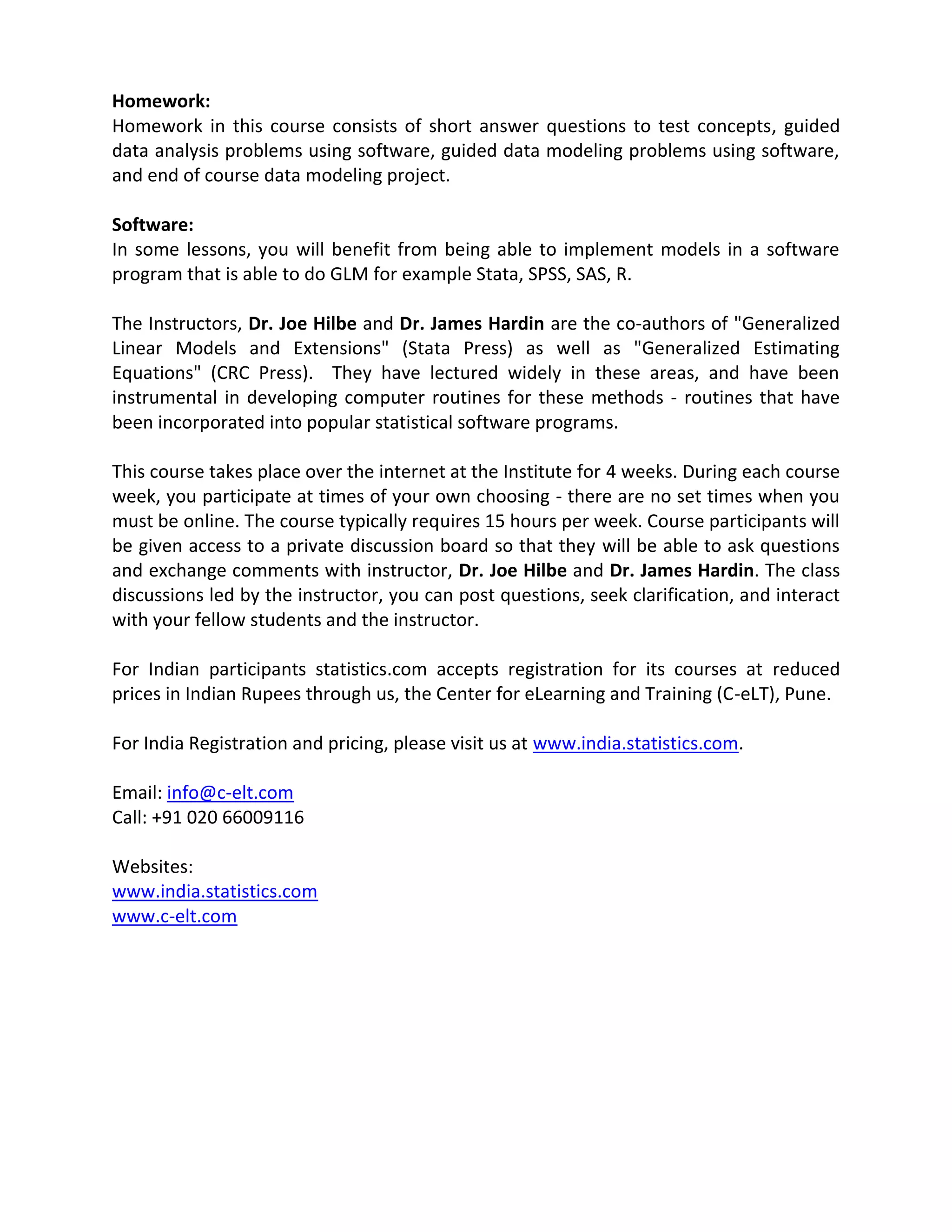
Homework:
Homework in this course consists of short answer questions to test concepts, guided
data analysis problems using software, guided data modeling problems using software,
and end of course data modeling project.

Software:
In some lessons, you will benefit from being able to implement models in a software
program that is able to do GLM for example Stata, SPSS, SAS, R.

The Instructors, Dr. Joe Hilbe and Dr. James Hardin are the co-authors of "Generalized
Linear Models and Extensions" (Stata Press) as well as "Generalized Estimating
Equations" (CRC Press). They have lectured widely in these areas, and have been
instrumental in developing computer routines for these methods - routines that have
been incorporated into popular statistical software programs.

This course takes place over the internet at the Institute for 4 weeks. During each course
week, you participate at times of your own choosing - there are no set times when you
must be online. The course typically requires 15 hours per week. Course participants will
be given access to a private discussion board so that they will be able to ask questions
and exchange comments with instructor, Dr. Joe Hilbe and Dr. James Hardin. The class
discussions led by the instructor, you can post questions, seek clarification, and interact
with your fellow students and the instructor.

For Indian participants statistics.com accepts registration for its courses at reduced
prices in Indian Rupees through us, the Center for eLearning and Training (C-eLT), Pune.

For India Registration and pricing, please visit us at www.india.statistics.com.

Email: info@c-elt.com
Call: +91 020 66009116

Websites:
www.india.statistics.com
www.c-elt.com

Generalized Linear Models

  • 1.
    Online course Generalized Linear Models Taught by Dr. Joseph Hilbe and Dr. James Hardin (http://www.statistics.com/glm/) “Generalized Linear Models (GLM)" extends ordinary least squares (OLS) regression to incorporate responses other than Normal. This course will explain the theory of GLM, outline the algorithms used for GLM estimation, and explain how to determine which algorithm to use for a given data analysis. Continuous response variables, the log normal, gamma, log-gamma (survival analysis), and inverse Gaussian cases are covered. Binomial (logit, probit, and others) as well as count models (poisson, negative binomial, geometric) are also touched. Who Should Take This Course: Analysts in any field who need to move beyond standard multiple linear regression models for modeling their data. Course Program: Course outline: The course is structured as follows SESSION 1: General Overview of GLM  Derivation of GLM functions  GLM algorithms: OIM, EIM  Fit and residual statistics SESSION 2: Continuous Response Models  Gaussian  Log-normal  Gamma  Log-gamma models for survival analysis  Inverse Gaussian SESSION 3: Discrete Response Models  Binomial models: logit, probit, cloglog, loglog, others  Count models: Poisson, negative binomial, geometric SESSION 4: Problems with Overdispersion  Overview of ordered and unordered logit and probit regression  Overview of panel models
  • 2.
    Homework: Homework in thiscourse consists of short answer questions to test concepts, guided data analysis problems using software, guided data modeling problems using software, and end of course data modeling project. Software: In some lessons, you will benefit from being able to implement models in a software program that is able to do GLM for example Stata, SPSS, SAS, R. The Instructors, Dr. Joe Hilbe and Dr. James Hardin are the co-authors of "Generalized Linear Models and Extensions" (Stata Press) as well as "Generalized Estimating Equations" (CRC Press). They have lectured widely in these areas, and have been instrumental in developing computer routines for these methods - routines that have been incorporated into popular statistical software programs. This course takes place over the internet at the Institute for 4 weeks. During each course week, you participate at times of your own choosing - there are no set times when you must be online. The course typically requires 15 hours per week. Course participants will be given access to a private discussion board so that they will be able to ask questions and exchange comments with instructor, Dr. Joe Hilbe and Dr. James Hardin. The class discussions led by the instructor, you can post questions, seek clarification, and interact with your fellow students and the instructor. For Indian participants statistics.com accepts registration for its courses at reduced prices in Indian Rupees through us, the Center for eLearning and Training (C-eLT), Pune. For India Registration and pricing, please visit us at www.india.statistics.com. Email: info@c-elt.com Call: +91 020 66009116 Websites: www.india.statistics.com www.c-elt.com