General Household
Survey 2017
Measuring the progress of development in the country
21 June 2018
@StatsSA
StatsSA
ICON ICON
Education Health and Social
Development
Housing
Food security AgricultureHousehold access to
services and facilities
Education
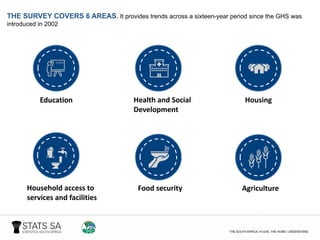
THE SURVEY COVERS 6 AREAS. It provides trends across a sixteen-year period since the GHS was
introduced in 2002
Methodology
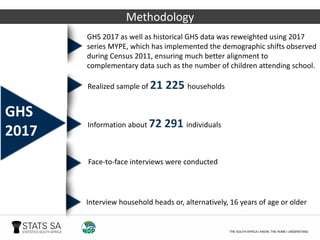
GHS 2017 as well as historical GHS data was reweighted using 2017
series MYPE, which has implemented the demographic shifts observed
during Census 2011, ensuring much better alignment to
complementary data such as the number of children attending school.
Realized sample of 21 225 households
Information about 72 291 individuals
Face-to-face interviews were conducted
Interview household heads or, alternatively, 16 years of age or older
GHS
2017
Education
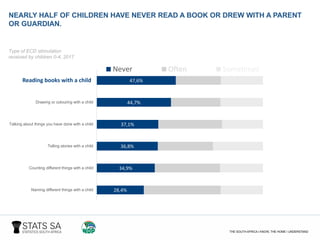
47,6%
44,7%
37,1%
36,8%
34,9%
28,4%
Reading books with a child
Drawing or colouring with a child
Talking about things you have done with a child
Telling stories with a child
Counting different things with a child
Naming different things with a child
Never Often Sometimes
Reading books with a child
Type of ECD stimulation
received by children 0-4, 2017
NEARLY HALF OF CHILDREN HAVE NEVER READ A BOOK OR DREW WITH A PARENT
OR GUARDIAN.
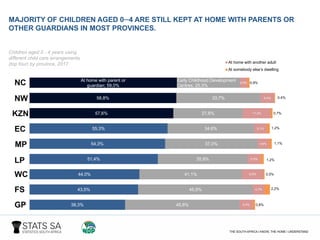
38,3%
43,5%
44,0%
51,4%
54,3%
55,3%
57,6%
58,8%
At home with parent or
guardian; 59,0%
45,8%
45,9%
41,1%
35,9%
37,0%
34,6%
27,8%
33,7%
Early Childhood Development
Centres; 25,3%
5,4%
4,7%
8,5%
5,3%
4,6%
5,1%
11,2%
5,4%
2,9%
0,8%
2,2%
0,5%
1,2%
1,1%
1,2%
0,7%
0,4%
0,9%
0,0 10,0 20,0 30,0 40,0 50,0 60,0 70,0 80,0 90,0 100,0
GP
FS
WC
LP
MP
EC
KZN
NW
NC
Chart Title
At home with another adult
At somebody else’s dwelling
NC
NW
EC
MP
LP
WC
FS
GP
KZN
Children aged 0 - 4 years using
different child care arrangements
(top four) by province, 2017
MAJORITY OF CHILDREN AGED 0─4 ARE STILL KEPT AT HOME WITH PARENTS OR
OTHER GUARDIANS IN MOST PROVINCES.
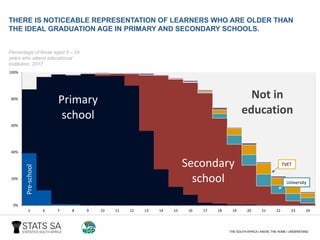
Pre-school
Primary
school
Secondary
school
Not in
education
0%
20%
40%
60%
80%
100%
5 6 7 8 9 10 11 12 13 14 15 16 17 18 19 20 21 22 23 24
TVET
University
Percentage of those aged 5 – 24
years who attend educational
institution, 2017
THERE IS NOTICEABLE REPRESENTATION OF LEARNERS WHO ARE OLDER THAN
THE IDEAL GRADUATION AGE IN PRIMARY AND SECONDARY SCHOOLS.
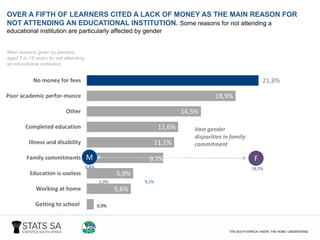
21,8%
18,9%
14,5%
11,6%
11,1%
9,7%
5,9%
5,6%
0,9%
0,0 5,0 10,0 15,0 20,0 25,0
No money for fees
Poor academic perfor-mance
Other
Completed education
Illness and disability
Family commitments
Education is useless
Working at home
Getting to school
Main reasons given by persons
aged 7 to 18 years for not attending
an educational institution
OVER A FIFTH OF LEARNERS CITED A LACK OF MONEY AS THE MAIN REASON FOR
NOT ATTENDING AN EDUCATIONAL INSTITUTION. Some reasons for not attending a
educational institution are particularly affected by gender
M
0,4%
F
18,5%
Vast gender
disparities in family
commitment
9,1%2,9%
33,6%
38,3%
0%
10%
20%
30%
40%
2002
2017
Percentage
21,3%
29,2%
0,0
10,0
20,0
30,0
40,0
2002
2017
17,4%
9,1%
0,0
10,0
20,0
30,0
40,0
2002
2017
11,4%
4,7%
0%
10%
20%
30%
40%
2002
2017
Percentage
9,2%
13,9%
0,0
10,0
20,0
30,0
40,0
2002
2017
Post-School
7,0%
4,4%
0,0
10,0
20,0
30,0
40,0
2002
2017
Completed Primary
Some Secondary NSC/Grade 12
Some PrimaryNone
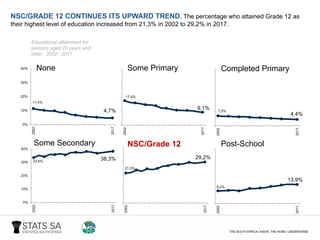
NSC/GRADE 12 CONTINUES ITS UPWARD TREND. The percentage who attained Grade 12 as
their highest level of education increased from 21,3% in 2002 to 29,2% in 2017.
Educational attainment for
persons aged 20 years and
older , 2002 - 2017
2%
24%
13%
16%
22%
10%
3%
1%
11%
4%
2013 2017
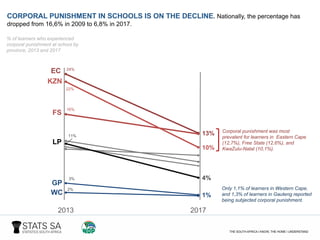
CORPORAL PUNISHMENT IN SCHOOLS IS ON THE DECLINE. Nationally, the percentage has
dropped from 16,6% in 2009 to 6,8% in 2017.
EC
KZN
FS
WC
GP
LP
Only 1,1% of learners in Western Cape,
and 1,3% of learners in Gauteng reported
being subjected corporal punishment.
Corporal punishment was most
prevalent for learners in Eastern Cape
(12,7%), Free State (12,6%), and
KwaZulu-Natal (10,1%).
% of learners who experienced
corporal punishment at school by
province, 2013 and 2017
Lack of books Classes too large Fees too high
1,2%
2,6%
2,7%
2,7%
2,9%
4,1%
4,1%
6,3%
8,7%
0 2 4 6 8 10
WC
GP
NC
NW
EC
FS
KZN
MP
LP
1,1%
2,4%
2,5%
2,6%
3,8%
4,5%
5,2%
5,3%
7,7%
0 2 4 6 8 10
LP
FS
KZN
EC
NC
GP
NW
MP
WC
0,6%
0,7%
1,6%
2,5%
3,0%
4,0%
4,2%
4,3%
4,8%
0 2 4 6
NC
LP
KZN
NW
EC
MP
WC
GP
FS
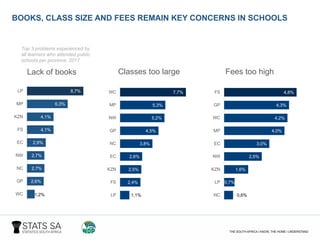
Top 3 problems experienced by
all learners who attended public
schools per province, 2017
BOOKS, CLASS SIZE AND FEES REMAIN KEY CONCERNS IN SCHOOLS
2,9%
3,6%
12,8%
15,5%
3,4% 3,5%
13,8%
18,0%
0%
2%
4%
6%
8%
10%
12%
14%
16%
18%
20%
Black African Coloured Indian / Asian White
2002 2017
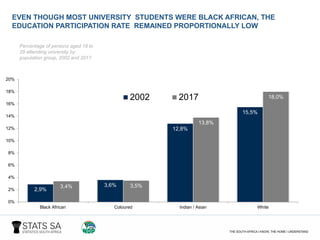
Percentage of persons aged 18 to
29 attending university by
population group, 2002 and 2017
EVEN THOUGH MOST UNIVERSITY STUDENTS WERE BLACK AFRICAN, THE
EDUCATION PARTICIPATION RATE REMAINED PROPORTIONALLY LOW
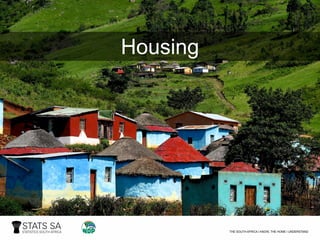
Housing
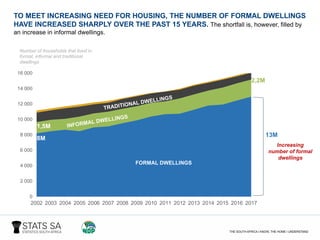
Number of households that lived in
formal, informal and traditional
dwellings
TO MEET INCREASING NEED FOR HOUSING, THE NUMBER OF FORMAL DWELLINGS
HAVE INCREASED SHARPLY OVER THE PAST 15 YEARS. The shortfall is, however, filled by
an increase in informal dwellings.
Increasing
number of formal
dwellings
TRADITIONAL DWELLINGS
13M
0
2 000
4 000
6 000
8 000
10 000
12 000
14 000
16 000
2002 2003 2004 2005 2006 2007 2008 2009 2010 2011 2012 2013 2014 2015 2016 2017
8M
TRADITIONAL DWELLINGS
FORMAL DWELLINGS
INFORMAL DWELLINGS
1,5M
2,2M
South Africa
13,6%
LP
5,5%
MP
9%
KZN
6,8%
EC
7%
FS
16%
NW
19,9%
NC
12,6%
WC
19,0%
GP
19,8%
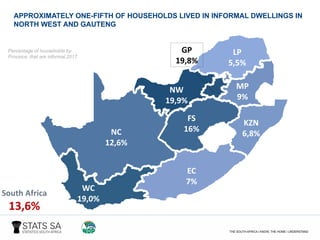
Percentage of households by
Province, that are informal,2017
APPROXIMATELY ONE-FIFTH OF HOUSEHOLDS LIVED IN INFORMAL DWELLINGS IN
NORTH WEST AND GAUTENG
91%
LP
91%
FS
89%
MP
87%
WC
NC
92%
83%
KZN
81%
NW
80%
GP
85%
EC
SA 84%
2002 2017 2002 2017
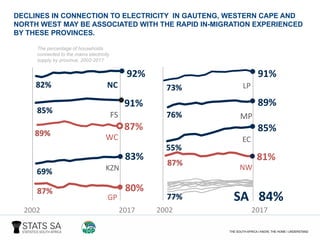
The percentage of households
connected to the mains electricity
supply by province, 2002-2017
DECLINES IN CONNECTION TO ELECTRICITY IN GAUTENG, WESTERN CAPE AND
NORTH WEST MAY BE ASSOCIATED WITH THE RAPID IN-MIGRATION EXPERIENCED
BY THESE PROVINCES.
89%
87%
87%
55%
82%
85%
69%
76%
73%
77%
6,3%
75,9%
4,1%
15,4%
16,5%
4,2%
8,4%
0%
20%
40%
60%
80%
100%
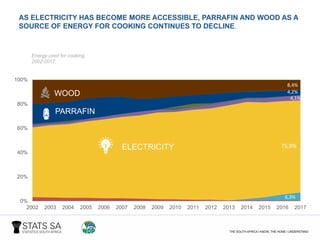
2002 2003 2004 2005 2006 2007 2008 2009 2010 2011 2012 2013 2014 2015 2016 2017
ELECTRICITY
WOOD
PARRAFIN
AS ELECTRICITY HAS BECOME MORE ACCESSIBLE, PARRAFIN AND WOOD AS A
SOURCE OF ENERGY FOR COOKING CONTINUES TO DECLINE.
Energy used for cooking,
2002-2017
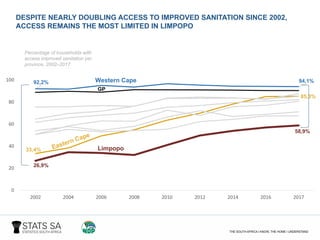
92,2% 94,1%
33,4%
85,3%
26,9%
58,9%
0
20
40
60
80
100
2002 2004 2006 2008 2010 2012 2014 2016 2017
DESPITE NEARLY DOUBLING ACCESS TO IMPROVED SANITATION SINCE 2002,
ACCESS REMAINS THE MOST LIMITED IN LIMPOPO
Limpopo
Percentage of households with
access improved sanitation per
province, 2002–2017
Western Cape
Eastern Cape
GP
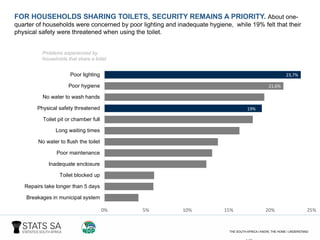
23,7%
21,6%
19%
0% 5% 10% 15% 20% 25%
Poor lighting
Poor hygiene
No water to wash hands
Physical safety threatened
Toilet pit or chamber full
Long waiting times
No water to flush the toilet
Poor maintenance
Inadequate enclosure
Toilet blocked up
Repairs take longer than 5 days
Breakages in municipal system
Problems experienced by
households that share a toilet
FOR HOUSEHOLDS SHARING TOILETS, SECURITY REMAINS A PRIORITY. About one-
quarter of households were concerned by poor lighting and inadequate hygiene, while 19% felt that their
physical safety were threatened when using the toilet.
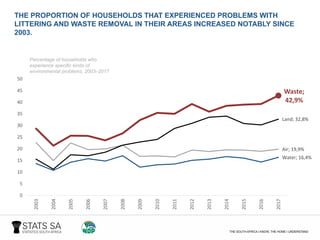
Waste;
42,9%
Water; 16,4%
Air; 19,9%
Land; 32,8%
0
5
10
15
20
25
30
35
40
45
50
2003
2004
2005
2006
2007
2008
2009
2010
2011
2012
2013
2014
2015
2016
2017
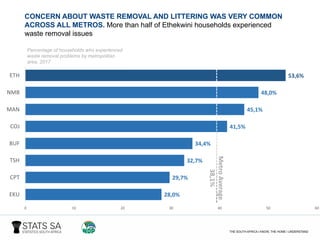
THE PROPORTION OF HOUSEHOLDS THAT EXPERIENCED PROBLEMS WITH
LITTERING AND WASTE REMOVAL IN THEIR AREAS INCREASED NOTABLY SINCE
2003.
Percentage of households who
experience specific kinds of
environmental problems, 2003–2017
28,0%
29,7%
32,7%
34,4%
41,5%
45,1%
48,0%
53,6%
0 10 20 30 40 50 60
EKU
CPT
TSH
BUF
COJ
MAN
NMB
ETH
MetroAverage
38,1%
Percentage of households who experienced
waste removal problems by metropolitan
area, 2017
CONCERN ABOUT WASTE REMOVAL AND LITTERING WAS VERY COMMON
ACROSS ALL METROS. More than half of Ethekwini households experienced
waste removal issues
85,5%
41,1%
0
10
20
30
40
50
60
70
80
90
100
2004 2006 2008 2010 2012 2014 2016
Access to piped water Pay for water
63,9%
25,3%
10,8%
0
10
20
30
40
50
60
70
80
90
100
2005
2006
2007
2008
2009
2010
2011
2012
2013
2014
2015
2016
2017
Chart Title
Good Average Poor
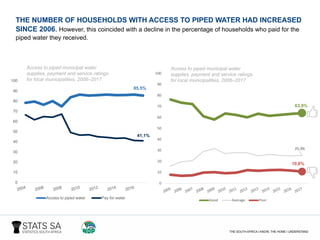
THE NUMBER OF HOUSEHOLDS WITH ACCESS TO PIPED WATER HAD INCREASED
SINCE 2006. However, this coincided with a decline in the percentage of households who paid for the
piped water they received.
Access to piped municipal water
supplies, payment and service ratings
for local municipalities, 2006–2017
Access to piped municipal water
supplies, payment and service ratings
for local municipalities, 2006–2017
TELECOMMUNICATIONS
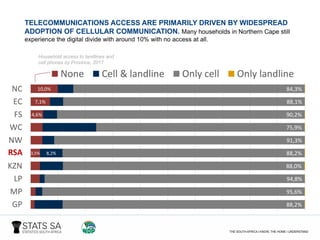
TELECOMMUNICATIONS ACCESS ARE PRIMARILY DRIVEN BY WIDESPREAD
ADOPTION OF CELLULAR COMMUNICATION. Many households in Northern Cape still
experience the digital divide with around 10% with no access at all.
Household access to landlines and
cell phones by Province, 2017
3,5%
4,6%
7,1%
10,0%
8,2%
88,2%
95,6%
94,8%
88,0%
88,2%
91,3%
75,9%
90,2%
88,1%
84,3%
GP
MP
LP
KZN
RSA
NW
WC
FS
EC
NC
None Cell & landline Only cell Only landline
RSA
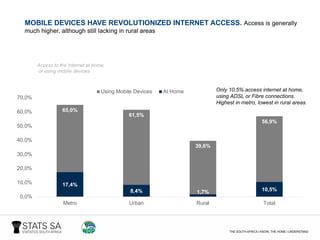
MOBILE DEVICES HAVE REVOLUTIONIZED INTERNET ACCESS. Access is generally
much higher, although still lacking in rural areas
Access to the Internet at home,
or using mobile devices
Only 10,5% access internet at home,
using ADSL or Fibre connections.
Highest in metro, lowest in rural areas.
65,0%
61,5%
39,6%
56,9%
17,4%
8,4% 1,7% 10,5%
0,0%
10,0%
20,0%
30,0%
40,0%
50,0%
60,0%
70,0%
Metro Urban Rural Total
Using Mobile Devices At Home
HEALTH
Factors such as where we live, the state of our environment, genetics,
our income and education level, all have considerable impacts on
health
8,3%
9,9%
12,6%
13,9%
14,9%
15,5%
16,3%
16,9%
24,8%
25,0%
0,0 5,0 10,0 15,0 20,0 25,0 30,0
LP
EC
KZN
MP
FS
NW
NC
RSA
WC
GP
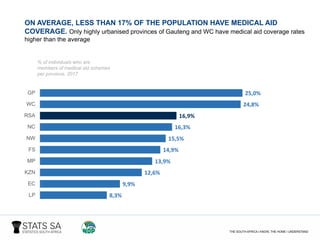
ON AVERAGE, LESS THAN 17% OF THE POPULATION HAVE MEDICAL AID
COVERAGE. Only highly urbanised provinces of Gauteng and WC have medical aid coverage rates
higher than the average
% of individuals who are
members of medical aid schemes
per province, 2017
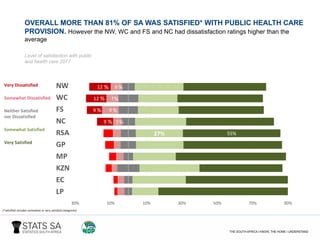
OVERALL MORE THAN 81% OF SA WAS SATISFIED* WITH PUBLIC HEALTH CARE
PROVISION. However the NW, WC and FS and NC had dissatisfaction ratings higher than the
average
90%70%50%30%10%10%30%50%70%90%
NW
WC
FS
NC
RSA
GP
MP
KZN
EC
LP
Level of satisfaction with public
and health care 2017
27% 55%
6
7
9
5
12
12
9
9
70% 50% 30% 10% 10% 30% 50% 70% 90%
NW
WC
FS
NC
RSA
GP
MP
KZN
EC
LP
Very Dissatisfied
Somewhat Dissatisfied
Neither Satisfied
nor Dissatisfied
Very Satisfied
Somewhat Satisfied
% %
%
%
% %
%
%
(*satisfied includes somewhat or very satisfied categories)
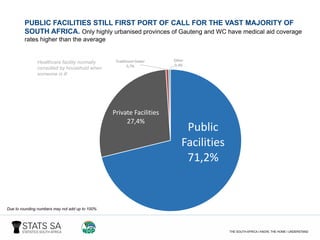
PUBLIC FACILITIES STILL FIRST PORT OF CALL FOR THE VAST MAJORITY OF
SOUTH AFRICA. Only highly urbanised provinces of Gauteng and WC have medical aid coverage
rates higher than the average
Healthcare facility normally
consulted by household when
someone is ill
Public
Facilities
71,2%
Private Facilities
27,4%
Traditional healer
0,7%
Other
0,4%
Due to rounding numbers may not add up to 100%
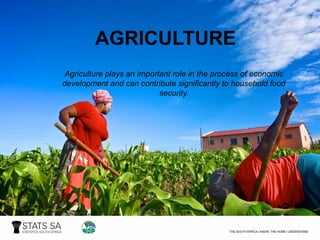
AGRICULTURE
Agriculture plays an important role in the process of economic
development and can contribute significantly to household food
security.
48,3%
58,7%
59,2%
48,4%
78,4%
75,1%
79,0%
81,9%
91,5%
WC
GP
N
W
NC
FS
KZ
N
MP
EC
LP
2,8%
4,5%
8,7%
10,1%
16,9%
18,2%
25,4%
30,2%
41,2%
WC
GP
NW
NC
FS
KZN
MP
EC
LPExtra Source of Food
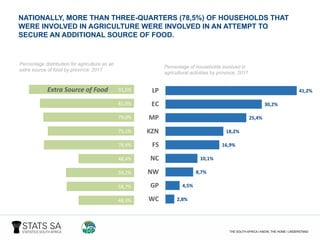
Percentage distribution for agriculture as an
extra source of food by province, 2017
Percentage of households involved in
agricultural activities by province, 2017
NATIONALLY, MORE THAN THREE-QUARTERS (78,5%) OF HOUSEHOLDS THAT
WERE INVOLVED IN AGRICULTURE WERE INVOLVED IN AN ATTEMPT TO
SECURE AN ADDITIONAL SOURCE OF FOOD.
8,2%
1,7%
8,2%
7,8%
2,5%
1,5%
2,7%
1,2%
1,7%
WC
GP
N
W
NC
FS
KZ
N
MP
EC
LP
2,8%
4,5%
8,7%
10,1%
16,9%
18,2%
25,4%
30,2%
41,2%
WC
GP
NW
NC
FS
KZN
MP
EC
LP
36,7%
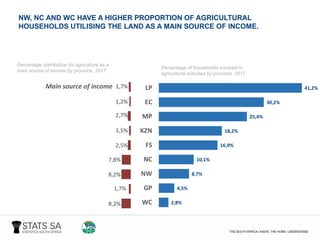
Percentage distribution for agriculture as a
main source of income by province, 2017
Percentage of households involved in
agricultural activities by province, 2017
NW, NC AND WC HAVE A HIGHER PROPORTION OF AGRICULTURAL
HOUSEHOLDS UTILISING THE LAND AS A MAIN SOURCE OF INCOME.
Main source of income
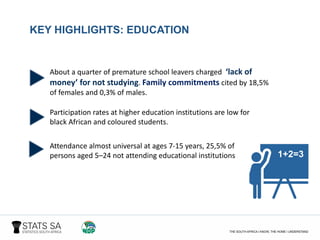
About a quarter of premature school leavers charged ‘lack of
money’ for not studying. Family commitments cited by 18,5%
of females and 0,3% of males.
Participation rates at higher education institutions are low for
black African and coloured students.
Attendance almost universal at ages 7-15 years, 25,5% of
persons aged 5–24 not attending educational institutions
KEY HIGHLIGHTS: EDUCATION
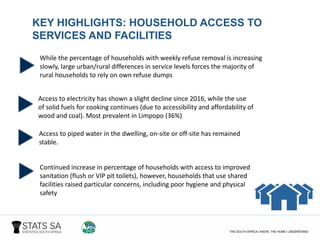
While the percentage of households with weekly refuse removal is increasing
slowly, large urban/rural differences in service levels forces the majority of
rural households to rely on own refuse dumps
Access to electricity has shown a slight decline since 2016, while the use
of solid fuels for cooking continues (due to accessibility and affordability of
wood and coal). Most prevalent in Limpopo (36%)
Access to piped water in the dwelling, on-site or off-site has remained
stable.
Continued increase in percentage of households with access to improved
sanitation (flush or VIP pit toilets), however, households that use shared
facilities raised particular concerns, including poor hygiene and physical
safety
KEY HIGHLIGHTS: HOUSEHOLD ACCESS TO
SERVICES AND FACILITIES
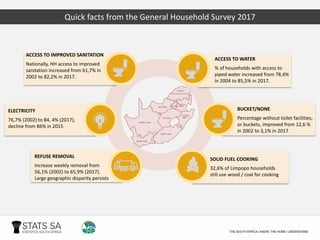
ACCESS TO IMPROVED SANITATION
Nationally, HH access to improved
sanitation increased from 61,7% in
2002 to 82,2% in 2017.
REFUSE REMOVAL
Increase weekly removal from
56,1% (2002) to 65,9% (2017).
Large geographic disparity persists
ELECTRICITY
76,7% (2002) to 84, 4% (2017),
decline from 86% in 2015
BUCKET/NONE
Percentage without toilet facilities,
or buckets, improved from 12,6 %
in 2002 to 3,1% in 2017
SOLID FUEL COOKING
32,6% of Limpopo households
still use wood / coal for cooking
Quick facts from the General Household Survey 2017
ACCESS TO WATER
% of households with access to
piped water increased from 78,4%
in 2004 to 85,5% in 2017.
Thank You

General Household Survey (GHS), 2017

  • 1.
    General Household Survey 2017 Measuringthe progress of development in the country 21 June 2018 @StatsSA StatsSA
  • 2.
    ICON ICON Education Healthand Social Development Housing Food security AgricultureHousehold access to services and facilities Education THE SURVEY COVERS 6 AREAS. It provides trends across a sixteen-year period since the GHS was introduced in 2002
  • 3.
    Methodology GHS 2017 aswell as historical GHS data was reweighted using 2017 series MYPE, which has implemented the demographic shifts observed during Census 2011, ensuring much better alignment to complementary data such as the number of children attending school. Realized sample of 21 225 households Information about 72 291 individuals Face-to-face interviews were conducted Interview household heads or, alternatively, 16 years of age or older GHS 2017
  • 4.
  • 5.
    47,6% 44,7% 37,1% 36,8% 34,9% 28,4% Reading books witha child Drawing or colouring with a child Talking about things you have done with a child Telling stories with a child Counting different things with a child Naming different things with a child Never Often Sometimes Reading books with a child Type of ECD stimulation received by children 0-4, 2017 NEARLY HALF OF CHILDREN HAVE NEVER READ A BOOK OR DREW WITH A PARENT OR GUARDIAN.
  • 6.
    38,3% 43,5% 44,0% 51,4% 54,3% 55,3% 57,6% 58,8% At home withparent or guardian; 59,0% 45,8% 45,9% 41,1% 35,9% 37,0% 34,6% 27,8% 33,7% Early Childhood Development Centres; 25,3% 5,4% 4,7% 8,5% 5,3% 4,6% 5,1% 11,2% 5,4% 2,9% 0,8% 2,2% 0,5% 1,2% 1,1% 1,2% 0,7% 0,4% 0,9% 0,0 10,0 20,0 30,0 40,0 50,0 60,0 70,0 80,0 90,0 100,0 GP FS WC LP MP EC KZN NW NC Chart Title At home with another adult At somebody else’s dwelling NC NW EC MP LP WC FS GP KZN Children aged 0 - 4 years using different child care arrangements (top four) by province, 2017 MAJORITY OF CHILDREN AGED 0─4 ARE STILL KEPT AT HOME WITH PARENTS OR OTHER GUARDIANS IN MOST PROVINCES.
  • 7.
    Pre-school Primary school Secondary school Not in education 0% 20% 40% 60% 80% 100% 5 67 8 9 10 11 12 13 14 15 16 17 18 19 20 21 22 23 24 TVET University Percentage of those aged 5 – 24 years who attend educational institution, 2017 THERE IS NOTICEABLE REPRESENTATION OF LEARNERS WHO ARE OLDER THAN THE IDEAL GRADUATION AGE IN PRIMARY AND SECONDARY SCHOOLS.
  • 8.
    21,8% 18,9% 14,5% 11,6% 11,1% 9,7% 5,9% 5,6% 0,9% 0,0 5,0 10,015,0 20,0 25,0 No money for fees Poor academic perfor-mance Other Completed education Illness and disability Family commitments Education is useless Working at home Getting to school Main reasons given by persons aged 7 to 18 years for not attending an educational institution OVER A FIFTH OF LEARNERS CITED A LACK OF MONEY AS THE MAIN REASON FOR NOT ATTENDING AN EDUCATIONAL INSTITUTION. Some reasons for not attending a educational institution are particularly affected by gender M 0,4% F 18,5% Vast gender disparities in family commitment 9,1%2,9%
  • 9.
    33,6% 38,3% 0% 10% 20% 30% 40% 2002 2017 Percentage 21,3% 29,2% 0,0 10,0 20,0 30,0 40,0 2002 2017 17,4% 9,1% 0,0 10,0 20,0 30,0 40,0 2002 2017 11,4% 4,7% 0% 10% 20% 30% 40% 2002 2017 Percentage 9,2% 13,9% 0,0 10,0 20,0 30,0 40,0 2002 2017 Post-School 7,0% 4,4% 0,0 10,0 20,0 30,0 40,0 2002 2017 Completed Primary Some SecondaryNSC/Grade 12 Some PrimaryNone NSC/GRADE 12 CONTINUES ITS UPWARD TREND. The percentage who attained Grade 12 as their highest level of education increased from 21,3% in 2002 to 29,2% in 2017. Educational attainment for persons aged 20 years and older , 2002 - 2017
  • 10.
    2% 24% 13% 16% 22% 10% 3% 1% 11% 4% 2013 2017 CORPORAL PUNISHMENTIN SCHOOLS IS ON THE DECLINE. Nationally, the percentage has dropped from 16,6% in 2009 to 6,8% in 2017. EC KZN FS WC GP LP Only 1,1% of learners in Western Cape, and 1,3% of learners in Gauteng reported being subjected corporal punishment. Corporal punishment was most prevalent for learners in Eastern Cape (12,7%), Free State (12,6%), and KwaZulu-Natal (10,1%). % of learners who experienced corporal punishment at school by province, 2013 and 2017
  • 11.
    Lack of booksClasses too large Fees too high 1,2% 2,6% 2,7% 2,7% 2,9% 4,1% 4,1% 6,3% 8,7% 0 2 4 6 8 10 WC GP NC NW EC FS KZN MP LP 1,1% 2,4% 2,5% 2,6% 3,8% 4,5% 5,2% 5,3% 7,7% 0 2 4 6 8 10 LP FS KZN EC NC GP NW MP WC 0,6% 0,7% 1,6% 2,5% 3,0% 4,0% 4,2% 4,3% 4,8% 0 2 4 6 NC LP KZN NW EC MP WC GP FS Top 3 problems experienced by all learners who attended public schools per province, 2017 BOOKS, CLASS SIZE AND FEES REMAIN KEY CONCERNS IN SCHOOLS
  • 12.
    2,9% 3,6% 12,8% 15,5% 3,4% 3,5% 13,8% 18,0% 0% 2% 4% 6% 8% 10% 12% 14% 16% 18% 20% Black AfricanColoured Indian / Asian White 2002 2017 Percentage of persons aged 18 to 29 attending university by population group, 2002 and 2017 EVEN THOUGH MOST UNIVERSITY STUDENTS WERE BLACK AFRICAN, THE EDUCATION PARTICIPATION RATE REMAINED PROPORTIONALLY LOW
  • 13.
  • 14.
    Number of householdsthat lived in formal, informal and traditional dwellings TO MEET INCREASING NEED FOR HOUSING, THE NUMBER OF FORMAL DWELLINGS HAVE INCREASED SHARPLY OVER THE PAST 15 YEARS. The shortfall is, however, filled by an increase in informal dwellings. Increasing number of formal dwellings TRADITIONAL DWELLINGS 13M 0 2 000 4 000 6 000 8 000 10 000 12 000 14 000 16 000 2002 2003 2004 2005 2006 2007 2008 2009 2010 2011 2012 2013 2014 2015 2016 2017 8M TRADITIONAL DWELLINGS FORMAL DWELLINGS INFORMAL DWELLINGS 1,5M 2,2M
  • 15.
    South Africa 13,6% LP 5,5% MP 9% KZN 6,8% EC 7% FS 16% NW 19,9% NC 12,6% WC 19,0% GP 19,8% Percentage ofhouseholds by Province, that are informal,2017 APPROXIMATELY ONE-FIFTH OF HOUSEHOLDS LIVED IN INFORMAL DWELLINGS IN NORTH WEST AND GAUTENG
  • 16.
    91% LP 91% FS 89% MP 87% WC NC 92% 83% KZN 81% NW 80% GP 85% EC SA 84% 2002 20172002 2017 The percentage of households connected to the mains electricity supply by province, 2002-2017 DECLINES IN CONNECTION TO ELECTRICITY IN GAUTENG, WESTERN CAPE AND NORTH WEST MAY BE ASSOCIATED WITH THE RAPID IN-MIGRATION EXPERIENCED BY THESE PROVINCES. 89% 87% 87% 55% 82% 85% 69% 76% 73% 77%
  • 17.
    6,3% 75,9% 4,1% 15,4% 16,5% 4,2% 8,4% 0% 20% 40% 60% 80% 100% 2002 2003 20042005 2006 2007 2008 2009 2010 2011 2012 2013 2014 2015 2016 2017 ELECTRICITY WOOD PARRAFIN AS ELECTRICITY HAS BECOME MORE ACCESSIBLE, PARRAFIN AND WOOD AS A SOURCE OF ENERGY FOR COOKING CONTINUES TO DECLINE. Energy used for cooking, 2002-2017
  • 18.
    92,2% 94,1% 33,4% 85,3% 26,9% 58,9% 0 20 40 60 80 100 2002 20042006 2008 2010 2012 2014 2016 2017 DESPITE NEARLY DOUBLING ACCESS TO IMPROVED SANITATION SINCE 2002, ACCESS REMAINS THE MOST LIMITED IN LIMPOPO Limpopo Percentage of households with access improved sanitation per province, 2002–2017 Western Cape Eastern Cape GP
  • 19.
    23,7% 21,6% 19% 0% 5% 10%15% 20% 25% Poor lighting Poor hygiene No water to wash hands Physical safety threatened Toilet pit or chamber full Long waiting times No water to flush the toilet Poor maintenance Inadequate enclosure Toilet blocked up Repairs take longer than 5 days Breakages in municipal system Problems experienced by households that share a toilet FOR HOUSEHOLDS SHARING TOILETS, SECURITY REMAINS A PRIORITY. About one- quarter of households were concerned by poor lighting and inadequate hygiene, while 19% felt that their physical safety were threatened when using the toilet.
  • 20.
    Waste; 42,9% Water; 16,4% Air; 19,9% Land;32,8% 0 5 10 15 20 25 30 35 40 45 50 2003 2004 2005 2006 2007 2008 2009 2010 2011 2012 2013 2014 2015 2016 2017 THE PROPORTION OF HOUSEHOLDS THAT EXPERIENCED PROBLEMS WITH LITTERING AND WASTE REMOVAL IN THEIR AREAS INCREASED NOTABLY SINCE 2003. Percentage of households who experience specific kinds of environmental problems, 2003–2017
  • 21.
    28,0% 29,7% 32,7% 34,4% 41,5% 45,1% 48,0% 53,6% 0 10 2030 40 50 60 EKU CPT TSH BUF COJ MAN NMB ETH MetroAverage 38,1% Percentage of households who experienced waste removal problems by metropolitan area, 2017 CONCERN ABOUT WASTE REMOVAL AND LITTERING WAS VERY COMMON ACROSS ALL METROS. More than half of Ethekwini households experienced waste removal issues
  • 22.
    85,5% 41,1% 0 10 20 30 40 50 60 70 80 90 100 2004 2006 20082010 2012 2014 2016 Access to piped water Pay for water 63,9% 25,3% 10,8% 0 10 20 30 40 50 60 70 80 90 100 2005 2006 2007 2008 2009 2010 2011 2012 2013 2014 2015 2016 2017 Chart Title Good Average Poor THE NUMBER OF HOUSEHOLDS WITH ACCESS TO PIPED WATER HAD INCREASED SINCE 2006. However, this coincided with a decline in the percentage of households who paid for the piped water they received. Access to piped municipal water supplies, payment and service ratings for local municipalities, 2006–2017 Access to piped municipal water supplies, payment and service ratings for local municipalities, 2006–2017
  • 23.
  • 24.
    TELECOMMUNICATIONS ACCESS AREPRIMARILY DRIVEN BY WIDESPREAD ADOPTION OF CELLULAR COMMUNICATION. Many households in Northern Cape still experience the digital divide with around 10% with no access at all. Household access to landlines and cell phones by Province, 2017 3,5% 4,6% 7,1% 10,0% 8,2% 88,2% 95,6% 94,8% 88,0% 88,2% 91,3% 75,9% 90,2% 88,1% 84,3% GP MP LP KZN RSA NW WC FS EC NC None Cell & landline Only cell Only landline RSA
  • 25.
    MOBILE DEVICES HAVEREVOLUTIONIZED INTERNET ACCESS. Access is generally much higher, although still lacking in rural areas Access to the Internet at home, or using mobile devices Only 10,5% access internet at home, using ADSL or Fibre connections. Highest in metro, lowest in rural areas. 65,0% 61,5% 39,6% 56,9% 17,4% 8,4% 1,7% 10,5% 0,0% 10,0% 20,0% 30,0% 40,0% 50,0% 60,0% 70,0% Metro Urban Rural Total Using Mobile Devices At Home
  • 26.
    HEALTH Factors such aswhere we live, the state of our environment, genetics, our income and education level, all have considerable impacts on health
  • 27.
    8,3% 9,9% 12,6% 13,9% 14,9% 15,5% 16,3% 16,9% 24,8% 25,0% 0,0 5,0 10,015,0 20,0 25,0 30,0 LP EC KZN MP FS NW NC RSA WC GP ON AVERAGE, LESS THAN 17% OF THE POPULATION HAVE MEDICAL AID COVERAGE. Only highly urbanised provinces of Gauteng and WC have medical aid coverage rates higher than the average % of individuals who are members of medical aid schemes per province, 2017
  • 28.
    OVERALL MORE THAN81% OF SA WAS SATISFIED* WITH PUBLIC HEALTH CARE PROVISION. However the NW, WC and FS and NC had dissatisfaction ratings higher than the average 90%70%50%30%10%10%30%50%70%90% NW WC FS NC RSA GP MP KZN EC LP Level of satisfaction with public and health care 2017 27% 55% 6 7 9 5 12 12 9 9 70% 50% 30% 10% 10% 30% 50% 70% 90% NW WC FS NC RSA GP MP KZN EC LP Very Dissatisfied Somewhat Dissatisfied Neither Satisfied nor Dissatisfied Very Satisfied Somewhat Satisfied % % % % % % % % (*satisfied includes somewhat or very satisfied categories)
  • 29.
    PUBLIC FACILITIES STILLFIRST PORT OF CALL FOR THE VAST MAJORITY OF SOUTH AFRICA. Only highly urbanised provinces of Gauteng and WC have medical aid coverage rates higher than the average Healthcare facility normally consulted by household when someone is ill Public Facilities 71,2% Private Facilities 27,4% Traditional healer 0,7% Other 0,4% Due to rounding numbers may not add up to 100%
  • 30.
    AGRICULTURE Agriculture plays animportant role in the process of economic development and can contribute significantly to household food security.
  • 31.
    48,3% 58,7% 59,2% 48,4% 78,4% 75,1% 79,0% 81,9% 91,5% WC GP N W NC FS KZ N MP EC LP 2,8% 4,5% 8,7% 10,1% 16,9% 18,2% 25,4% 30,2% 41,2% WC GP NW NC FS KZN MP EC LPExtra Source ofFood Percentage distribution for agriculture as an extra source of food by province, 2017 Percentage of households involved in agricultural activities by province, 2017 NATIONALLY, MORE THAN THREE-QUARTERS (78,5%) OF HOUSEHOLDS THAT WERE INVOLVED IN AGRICULTURE WERE INVOLVED IN AN ATTEMPT TO SECURE AN ADDITIONAL SOURCE OF FOOD.
  • 32.
    8,2% 1,7% 8,2% 7,8% 2,5% 1,5% 2,7% 1,2% 1,7% WC GP N W NC FS KZ N MP EC LP 2,8% 4,5% 8,7% 10,1% 16,9% 18,2% 25,4% 30,2% 41,2% WC GP NW NC FS KZN MP EC LP 36,7% Percentage distribution foragriculture as a main source of income by province, 2017 Percentage of households involved in agricultural activities by province, 2017 NW, NC AND WC HAVE A HIGHER PROPORTION OF AGRICULTURAL HOUSEHOLDS UTILISING THE LAND AS A MAIN SOURCE OF INCOME. Main source of income
  • 33.
    About a quarterof premature school leavers charged ‘lack of money’ for not studying. Family commitments cited by 18,5% of females and 0,3% of males. Participation rates at higher education institutions are low for black African and coloured students. Attendance almost universal at ages 7-15 years, 25,5% of persons aged 5–24 not attending educational institutions KEY HIGHLIGHTS: EDUCATION
  • 34.
    While the percentageof households with weekly refuse removal is increasing slowly, large urban/rural differences in service levels forces the majority of rural households to rely on own refuse dumps Access to electricity has shown a slight decline since 2016, while the use of solid fuels for cooking continues (due to accessibility and affordability of wood and coal). Most prevalent in Limpopo (36%) Access to piped water in the dwelling, on-site or off-site has remained stable. Continued increase in percentage of households with access to improved sanitation (flush or VIP pit toilets), however, households that use shared facilities raised particular concerns, including poor hygiene and physical safety KEY HIGHLIGHTS: HOUSEHOLD ACCESS TO SERVICES AND FACILITIES
  • 35.
    ACCESS TO IMPROVEDSANITATION Nationally, HH access to improved sanitation increased from 61,7% in 2002 to 82,2% in 2017. REFUSE REMOVAL Increase weekly removal from 56,1% (2002) to 65,9% (2017). Large geographic disparity persists ELECTRICITY 76,7% (2002) to 84, 4% (2017), decline from 86% in 2015 BUCKET/NONE Percentage without toilet facilities, or buckets, improved from 12,6 % in 2002 to 3,1% in 2017 SOLID FUEL COOKING 32,6% of Limpopo households still use wood / coal for cooking Quick facts from the General Household Survey 2017 ACCESS TO WATER % of households with access to piped water increased from 78,4% in 2004 to 85,5% in 2017.
  • 36.