Roman Agaev, M.Sc, PMP
Owner, Supra Information Technology ltd.


               General error handling approach


                          Author: Roman Agaev
                    Date: Tuesday, March 27, 2007


                                      -1-
Roman Agaev, M.Sc, PMP
Owner, Supra Information Technology ltd.

                                                      Contents
 Abstract.........................................................................................................................3
1 Analysis.......................................................................................................................3
2 Design.........................................................................................................................4
3 Conclusion...................................................................................................................7
  3.1 Usage Examples...............................................................................................7
4 Appendixes..................................................................................................................8


                                                               -2-
Roman Agaev, M.Sc, PMP
Owner, Supra Information Technology ltd.

                                                 Tables
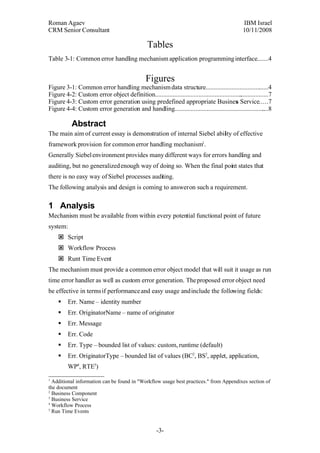
Table 3-1: Common error handling mechanism application programming interface....5


                                                Figures
Figure 3-1: Common error handling mechanism data structure....................................4
Figure 4-2: Custom error object definition....................................................................7
Figure 4-3: Custom error generation using predefined appropriate Business Service...7
Figure 4-4: Custom error generation and handling........................................................8

     Abstract
The main aim of current essay is demonstration of internal Siebel ability of effective
framework provision for common error handling mechanism1.
Generally Siebel environment provides many different ways for errors handling and
auditing, but no generalized enough way of doing so. When the final point states that
there is no easy way of Siebel processes auditing.
The following analysis and design is coming to answer on such a requirement.


     1Analysis
Mechanism must be available from within every potential functional point of future
system:
    Script
    Workflow Process
    Runt Time Event
The mechanism must provide a common error object model that will suit it usage as
run time error handler as well as custom error generation. The proposed error object
need be effective in terms if performance and easy usage and include the following
fields:
    Err. Name – identity number
    Err. OriginatorName – name of originator
    Err. Message
    Err. Code
    Err. Type – bounded list of values: custom, runtime (default)


1
  Additional information can be found in "Workflow usage best practices." from Appendixes section of
the document


                                                     -3-
Roman Agaev, M.Sc, PMP
Owner, Supra Information Technology ltd.
    Err. OriginatorType – bounded list of values (BC2, BS3, applet, application, WP4,
       RTE5)
    Err. OriginatorId – Row Id if existed
    Err. HighLevelProcessName – unbounded list of values
    Err. ProcessName – unbounded list of values
The mechanism must allow effective visualization and query for recently occurred
errors per each of sequenced above fields.


    2Design
The analysis can be handled using cacheable Business Service that will hold a data
structure consisted of predefined errors. The Business Service will consist of several
predefined methods that will define full API of the module.
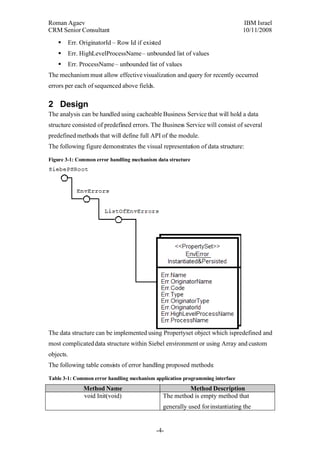
The following figure demonstrates the visual representation of data structure:

Figure 3-1: Common error handling mechanism data structure


The data structure can be implemented using Propertyset object which is predefined
and most complicated data structure within Siebel environment or using Array and
custom objects.
2
  Business Component
3
  Business Service
4
  Workflow Process
5
  Run Time Events


                                             -4-
Roman Agaev, M.Sc, PMP
Owner, Supra Information Technology ltd.
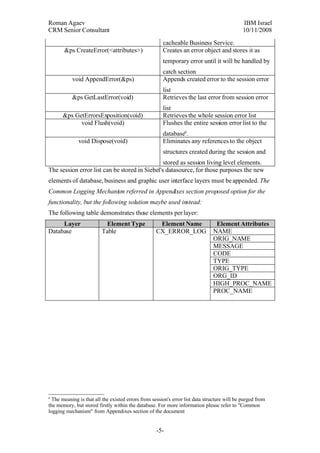
The following table consists of error handling proposed methods:

Table 3-1: Common error handling mechanism application programming interface
                Method Name                                     Method Description
                void Init(void)                        The method is empty method that
                                                       generally used for instantiating the
                                                       cacheable Business Service.
       &ps CreateError(<attributes>)                   Creates an error object and stores it as
                                                       temporary error until it will be handled by
                                                       catch section
           void AppendError(&ps)                       Appends created error to the session error
                                                       list
           &ps GetLastError(void)                      Retrieves the last error from session error
                                                       list
      &ps GetErrorsExposition(void)                    Retrieves the whole session error list
            void Flush(void)                           Flushes the entire session error list to the
                                                       database6.
              void Dispose(void)                       Eliminates any references to the object
                                                       structures created during the session and
                                              stored as session living level elements.
The session error list can be stored in Siebel's datasource, for those purposes the new
elements of database, business and graphic user interface layers must be appended.
The Common Logging Mechanism referred in Appendixes section proposed option for
the functionality, but the following solution maybe used instead:
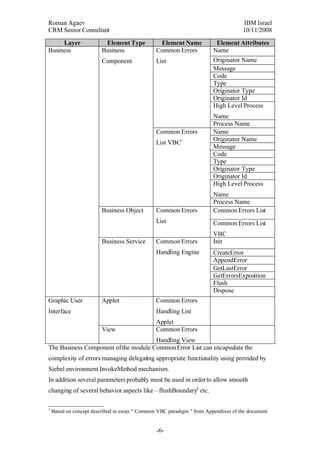
The following table demonstrates those elements per layer:
     Layer                Element Type               Element Name               Element Attributes
Database                 Table                      CX_ERROR_LOG               NAME
                                                                               ORIG_NAME
                                                                               MESSAGE
                                                                               CODE
                                                                               TYPE
                                                                               ORIG_TYPE
                                                                               ORG_ID
                                                                               HIGH_PROC_NAME
                                                                               PROC_NAME

Business                 Business                   Common Errors              Name
                         Component                  List                       Originator Name
                                                                               Message
6
  The meaning is that all the existed errors from session's error list data structure will be purged from
the memory, but stored firstly within the database. For more information please refer to "Common
logging mechanism" from Appendixes section of the document


                                                    -5-
Roman Agaev, M.Sc, PMP
Owner, Supra Information Technology ltd.
      Layer              Element Type           Element Name           Element Attributes
                                                                      Code
                                                                      Type
                                                                      Originator Type
                                                                      Originator Id
                                                                      High Level Process
                                                                      Name
                                                                      Process Name
                                              Common Errors           Name
                                                                      Originator Name
                                              List VBC7
                                                                      Message
                                                                      Code
                                                                      Type
                                                                      Originator Type
                                                                      Originator Id
                                                                      High Level Process
                                                                      Name
                                                                      Process Name
                      Business Object         Common Errors           Common Errors List
                                              List                    Common Errors List
                                                                      VBC
                      Business Service        Common Errors           Init
                                              Handling Engine         CreateError
                                                                      AppendError
                                                                      GetLastError
                                                                      GetErrorsExposition
                                                                      Flush
                                                                      Dispose
Graphic User          Applet                  Common Errors
Interface                                     Handling List
                                              Applet
                      View                    Common Errors
                                      Handling View
The Business Component of the module Common Error List can encapsulate the
complexity of errors managing delegating appropriate functionality using provided by
Siebel environment InvokeMethod mechanism.
In addition several parameters probably must be used in order to allow smooth
changing of several behavior aspects like – flushBoundary8 etc.


7
 Based on concept described in essay " Common VBC paradigm " from Appendixes of the document
8
 The parameters should be populated using " System parameters paradigm" from Appendixes of the
document


                                              -6-
Roman Agaev, M.Sc, PMP
Owner, Supra Information Technology ltd.

     3Conclusion
The usage of such an approach will generalize the neediness of many different
functional points for auditing their run time errors as well as custom ones. It must be
realized that in any other cases the developer will be in front of choice, and in many
cases not very well based, designed and logically defined decision will lead to
decentralized and type less error handling.

      3.1Usage Examples
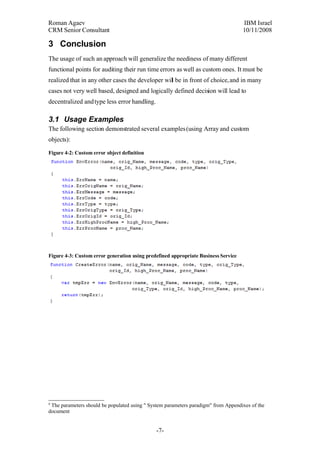
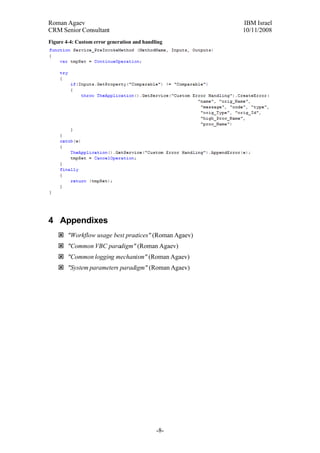
The following section demonstrated several examples (using Array and custom
objects):

Figure 4-2: Custom error object definition


Figure 4-3: Custom error generation using predefined appropriate Business Service


                                             -7-
Roman Agaev, M.Sc, PMP
Owner, Supra Information Technology ltd.
Figure 4-4: Custom error generation and handling


    4Appendixes
    "Workflow usage best practices" (Roman Agaev)
    "Common VBC paradigm" (Roman Agaev)
    "Common logging mechanism" (Roman Agaev)
    "System parameters paradigm" (Roman Agaev)


                                            -8-

General Error Handling Approach

  • 1.
    Roman Agaev, M.Sc,PMP Owner, Supra Information Technology ltd. General error handling approach Author: Roman Agaev Date: Tuesday, March 27, 2007 -1-
  • 2.
    Roman Agaev, M.Sc,PMP Owner, Supra Information Technology ltd. Contents Abstract.........................................................................................................................3 1 Analysis.......................................................................................................................3 2 Design.........................................................................................................................4 3 Conclusion...................................................................................................................7 3.1 Usage Examples...............................................................................................7 4 Appendixes..................................................................................................................8 -2-
  • 3.
    Roman Agaev, M.Sc,PMP Owner, Supra Information Technology ltd. Tables Table 3-1: Common error handling mechanism application programming interface....5 Figures Figure 3-1: Common error handling mechanism data structure....................................4 Figure 4-2: Custom error object definition....................................................................7 Figure 4-3: Custom error generation using predefined appropriate Business Service...7 Figure 4-4: Custom error generation and handling........................................................8 Abstract The main aim of current essay is demonstration of internal Siebel ability of effective framework provision for common error handling mechanism1. Generally Siebel environment provides many different ways for errors handling and auditing, but no generalized enough way of doing so. When the final point states that there is no easy way of Siebel processes auditing. The following analysis and design is coming to answer on such a requirement. 1Analysis Mechanism must be available from within every potential functional point of future system: Script Workflow Process Runt Time Event The mechanism must provide a common error object model that will suit it usage as run time error handler as well as custom error generation. The proposed error object need be effective in terms if performance and easy usage and include the following fields: Err. Name – identity number Err. OriginatorName – name of originator Err. Message Err. Code Err. Type – bounded list of values: custom, runtime (default) 1 Additional information can be found in "Workflow usage best practices." from Appendixes section of the document -3-
  • 4.
    Roman Agaev, M.Sc,PMP Owner, Supra Information Technology ltd. Err. OriginatorType – bounded list of values (BC2, BS3, applet, application, WP4, RTE5) Err. OriginatorId – Row Id if existed Err. HighLevelProcessName – unbounded list of values Err. ProcessName – unbounded list of values The mechanism must allow effective visualization and query for recently occurred errors per each of sequenced above fields. 2Design The analysis can be handled using cacheable Business Service that will hold a data structure consisted of predefined errors. The Business Service will consist of several predefined methods that will define full API of the module. The following figure demonstrates the visual representation of data structure: Figure 3-1: Common error handling mechanism data structure The data structure can be implemented using Propertyset object which is predefined and most complicated data structure within Siebel environment or using Array and custom objects. 2 Business Component 3 Business Service 4 Workflow Process 5 Run Time Events -4-
  • 5.
    Roman Agaev, M.Sc,PMP Owner, Supra Information Technology ltd. The following table consists of error handling proposed methods: Table 3-1: Common error handling mechanism application programming interface Method Name Method Description void Init(void) The method is empty method that generally used for instantiating the cacheable Business Service. &ps CreateError(<attributes>) Creates an error object and stores it as temporary error until it will be handled by catch section void AppendError(&ps) Appends created error to the session error list &ps GetLastError(void) Retrieves the last error from session error list &ps GetErrorsExposition(void) Retrieves the whole session error list void Flush(void) Flushes the entire session error list to the database6. void Dispose(void) Eliminates any references to the object structures created during the session and stored as session living level elements. The session error list can be stored in Siebel's datasource, for those purposes the new elements of database, business and graphic user interface layers must be appended. The Common Logging Mechanism referred in Appendixes section proposed option for the functionality, but the following solution maybe used instead: The following table demonstrates those elements per layer: Layer Element Type Element Name Element Attributes Database Table CX_ERROR_LOG NAME ORIG_NAME MESSAGE CODE TYPE ORIG_TYPE ORG_ID HIGH_PROC_NAME PROC_NAME Business Business Common Errors Name Component List Originator Name Message 6 The meaning is that all the existed errors from session's error list data structure will be purged from the memory, but stored firstly within the database. For more information please refer to "Common logging mechanism" from Appendixes section of the document -5-
  • 6.
    Roman Agaev, M.Sc,PMP Owner, Supra Information Technology ltd. Layer Element Type Element Name Element Attributes Code Type Originator Type Originator Id High Level Process Name Process Name Common Errors Name Originator Name List VBC7 Message Code Type Originator Type Originator Id High Level Process Name Process Name Business Object Common Errors Common Errors List List Common Errors List VBC Business Service Common Errors Init Handling Engine CreateError AppendError GetLastError GetErrorsExposition Flush Dispose Graphic User Applet Common Errors Interface Handling List Applet View Common Errors Handling View The Business Component of the module Common Error List can encapsulate the complexity of errors managing delegating appropriate functionality using provided by Siebel environment InvokeMethod mechanism. In addition several parameters probably must be used in order to allow smooth changing of several behavior aspects like – flushBoundary8 etc. 7 Based on concept described in essay " Common VBC paradigm " from Appendixes of the document 8 The parameters should be populated using " System parameters paradigm" from Appendixes of the document -6-
  • 7.
    Roman Agaev, M.Sc,PMP Owner, Supra Information Technology ltd. 3Conclusion The usage of such an approach will generalize the neediness of many different functional points for auditing their run time errors as well as custom ones. It must be realized that in any other cases the developer will be in front of choice, and in many cases not very well based, designed and logically defined decision will lead to decentralized and type less error handling. 3.1Usage Examples The following section demonstrated several examples (using Array and custom objects): Figure 4-2: Custom error object definition Figure 4-3: Custom error generation using predefined appropriate Business Service -7-
  • 8.
    Roman Agaev, M.Sc,PMP Owner, Supra Information Technology ltd. Figure 4-4: Custom error generation and handling 4Appendixes "Workflow usage best practices" (Roman Agaev) "Common VBC paradigm" (Roman Agaev) "Common logging mechanism" (Roman Agaev) "System parameters paradigm" (Roman Agaev) -8-