Counting Atoms
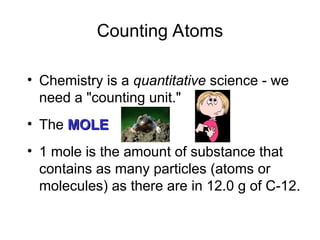
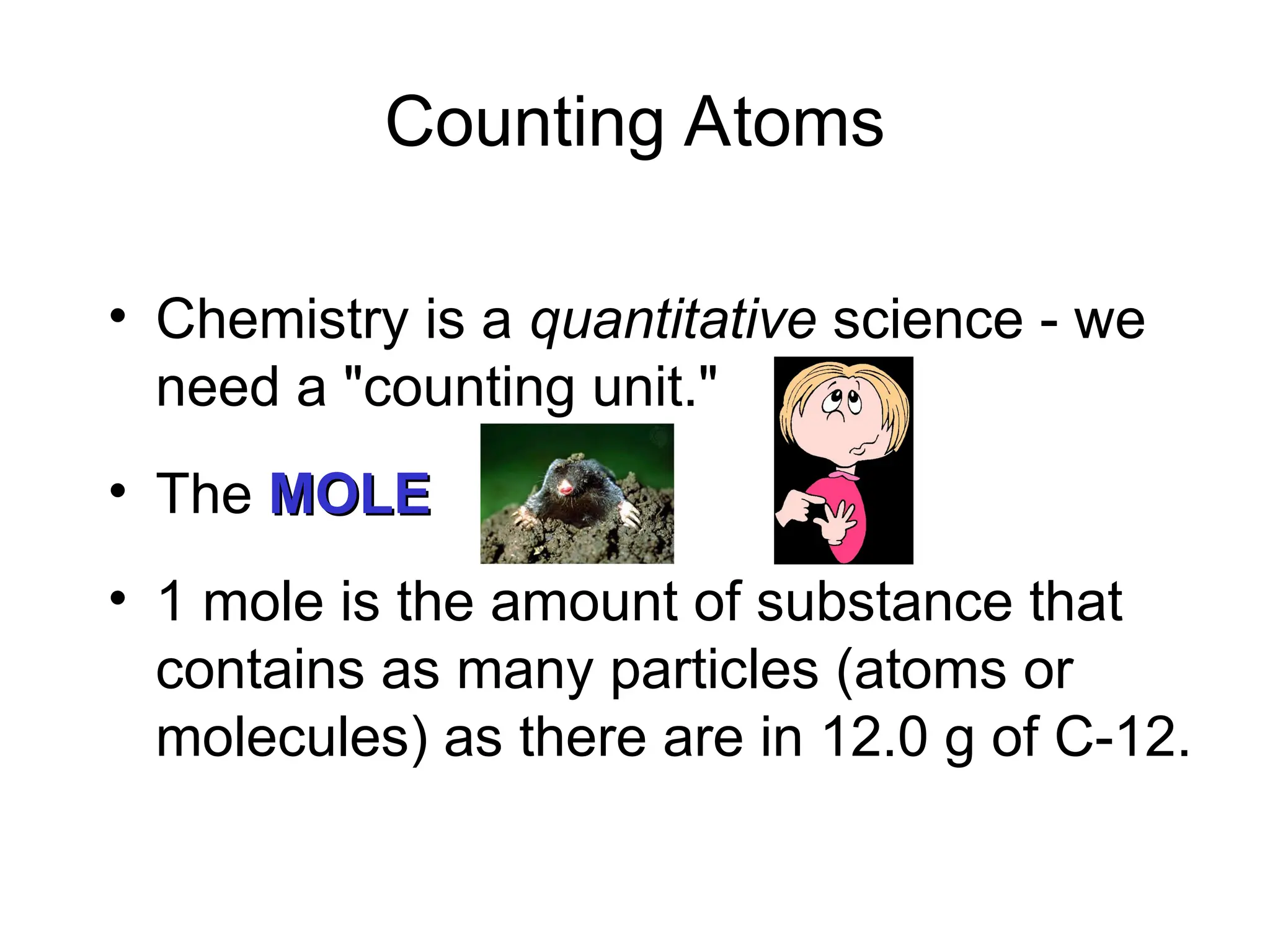
• Chemistry is a quantitative science - we
need a "counting unit."
• The MOLE
MOLE
• 1 mole is the amount of substance that
contains as many particles (atoms or
molecules) as there are in 12.0 g of C-12.
The Mole is Developed
Carbon Atoms Hydrogen Atoms Mass Ratio
Number Mass (amu) Number Mass (amu) Mass carbon / Mass hydrogen
12
1
12 amu = 12
1 amu 1
24
[2 x 12]
2
[2 x 1]
24 amu = 12
2 amu 1
120
[10 x 12]
10
[10 x 1]
120 amu = 12
10 amu 1
600
[50 x 12] 50
[50 x 1]
600 amu = 12
50 amu 1
(6.02 x 10²³
) x (12)
Avogadro’s
number (6.02 x 10²³
) x (1)
(6.02 x 10²³
) x (12) = 12
(6.02 x 10²³
) x (1) 1
Avogadro’s
number
Avogadr
oPaper
Amadeo
Avogadro
(1776 – 1856)
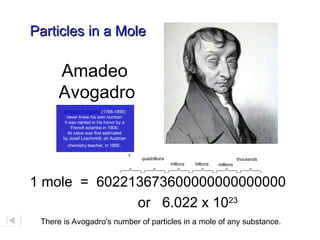
1 mole = 602213673600000000000000
or 6.022 x 10²³
thousands
millions
billions
trillions
quadrillions
?
There is Avogadro's number of particles in a mole of any substance.
Particles in a Mole
Particles in a Mole
Amedeo Avogadro (1766-1856)
never knew his own number;
it was named in his honor by a
French scientist in 1909.
its value was first estimated
by Josef Loschmidt, an Austrian
chemistry teacher, in 1895.
Careers in Chemistry -
Philosopher
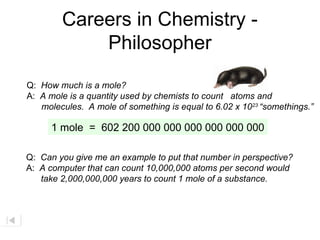
Q: How much is a mole?
A: A mole is a quantity used by chemists to count atoms and
molecules. A mole of something is equal to 6.02 x 10²³
“somethings.”
1 mole = 602 200 000 000 000 000 000 000
Q: Can you give me an example to put that number in perspective?
A: A computer that can count 10,000,000 atoms per second would
take 2,000,000,000 years to count 1 mole of a substance.
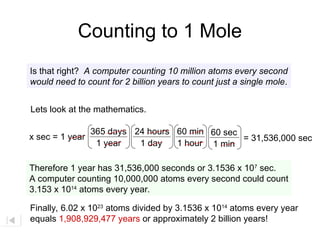
Counting to 1 Mole
Is that right? A computer counting 10 million atoms every second
would need to count for 2 billion years to count just a single mole.
Lets look at the mathematics.
Therefore 1 year has 31,536,000 seconds or 3.1536 x 10⁷
sec.
A computer counting 10,000,000 atoms every second could count
3.153 x 10¹⁴
atoms every year.
Finally, 6.02 x 10²³
atoms divided by 3.1536 x 10¹⁴
atoms every year
equals 1,908,929,477 years or approximately 2 billion years!
x sec = 1 year
365 days
1 year 1 day
24 hours 60 min
1 hour
60 sec
1 min
= 31,536,000 sec
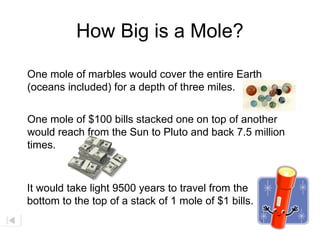
How Big is a Mole?
One mole of marbles would cover the entire Earth
(oceans included) for a depth of three miles.
One mole of $100 bills stacked one on top of another
would reach from the Sun to Pluto and back 7.5 million
times.
It would take light 9500 years to travel from the
bottom to the top of a stack of 1 mole of $1 bills.
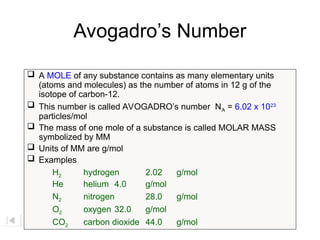
Avogadro’s Number
 A MOLE of any substance contains as many elementary units
(atoms and molecules) as the number of atoms in 12 g of the
isotope of carbon-12.
 This number is called AVOGADRO’s number NA = 6.02 x 10²³
particles/mol
 The mass of one mole of a substance is called MOLAR MASS
symbolized by MM
 Units of MM are g/mol
 Examples
H2 hydrogen 2.02 g/mol
He helium 4.0 g/mol
N2 nitrogen 28.0 g/mol
O2 oxygen 32.0 g/mol
CO2 carbon dioxide 44.0 g/mol
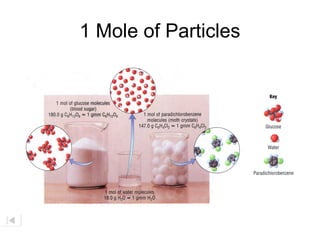
1 Mole of Particles

GENERAL CHEMISTRY - The Mole Concept.ppt

  • 1.
    Counting Atoms • Chemistryis a quantitative science - we need a "counting unit." • The MOLE MOLE • 1 mole is the amount of substance that contains as many particles (atoms or molecules) as there are in 12.0 g of C-12.
  • 2.
    The Mole isDeveloped Carbon Atoms Hydrogen Atoms Mass Ratio Number Mass (amu) Number Mass (amu) Mass carbon / Mass hydrogen 12 1 12 amu = 12 1 amu 1 24 [2 x 12] 2 [2 x 1] 24 amu = 12 2 amu 1 120 [10 x 12] 10 [10 x 1] 120 amu = 12 10 amu 1 600 [50 x 12] 50 [50 x 1] 600 amu = 12 50 amu 1 (6.02 x 10²³ ) x (12) Avogadro’s number (6.02 x 10²³ ) x (1) (6.02 x 10²³ ) x (12) = 12 (6.02 x 10²³ ) x (1) 1 Avogadro’s number Avogadr oPaper
  • 3.
    Amadeo Avogadro (1776 – 1856) 1mole = 602213673600000000000000 or 6.022 x 10²³ thousands millions billions trillions quadrillions ? There is Avogadro's number of particles in a mole of any substance. Particles in a Mole Particles in a Mole Amedeo Avogadro (1766-1856) never knew his own number; it was named in his honor by a French scientist in 1909. its value was first estimated by Josef Loschmidt, an Austrian chemistry teacher, in 1895.
  • 4.
    Careers in Chemistry- Philosopher Q: How much is a mole? A: A mole is a quantity used by chemists to count atoms and molecules. A mole of something is equal to 6.02 x 10²³ “somethings.” 1 mole = 602 200 000 000 000 000 000 000 Q: Can you give me an example to put that number in perspective? A: A computer that can count 10,000,000 atoms per second would take 2,000,000,000 years to count 1 mole of a substance.
  • 5.
    Counting to 1Mole Is that right? A computer counting 10 million atoms every second would need to count for 2 billion years to count just a single mole. Lets look at the mathematics. Therefore 1 year has 31,536,000 seconds or 3.1536 x 10⁷ sec. A computer counting 10,000,000 atoms every second could count 3.153 x 10¹⁴ atoms every year. Finally, 6.02 x 10²³ atoms divided by 3.1536 x 10¹⁴ atoms every year equals 1,908,929,477 years or approximately 2 billion years! x sec = 1 year 365 days 1 year 1 day 24 hours 60 min 1 hour 60 sec 1 min = 31,536,000 sec
  • 6.
    How Big isa Mole? One mole of marbles would cover the entire Earth (oceans included) for a depth of three miles. One mole of $100 bills stacked one on top of another would reach from the Sun to Pluto and back 7.5 million times. It would take light 9500 years to travel from the bottom to the top of a stack of 1 mole of $1 bills.
  • 7.
    Avogadro’s Number  AMOLE of any substance contains as many elementary units (atoms and molecules) as the number of atoms in 12 g of the isotope of carbon-12.  This number is called AVOGADRO’s number NA = 6.02 x 10²³ particles/mol  The mass of one mole of a substance is called MOLAR MASS symbolized by MM  Units of MM are g/mol  Examples H2 hydrogen 2.02 g/mol He helium 4.0 g/mol N2 nitrogen 28.0 g/mol O2 oxygen 32.0 g/mol CO2 carbon dioxide 44.0 g/mol
  • 8.
    1 Mole ofParticles

Editor's Notes

  • #1 Objectives: To state the value of Avogadro’s number: 6.02 x10²³. To state the mass of Avogadro’s number of atoms for any element by referring to the periodic table. To relate the moles of a substance to the number of particles. http://www.birdxcanada.com/sonic/mole_400.jpg
  • #2 http://web.syr.edu/~nstefanc/New%20Counting.JPG http://www.wildcru.org/research/farming/moles/mole1.jpg
  • #3 http://dbhs.wvusd.k12.ca.us/webdocs/ChemTeamIndex2.html (link for Avogadro paper)
  • #4 A more precise value of Avagadro’s number = 6.022045 E23. How could you determine the number of sugar crystals in a bowl of sugar? Is it possible to get a reasonably close estimate?
  • #5 A more precise value of Avagadro’s number = 6.022045 E23. How could you determine the number of sugar crystals in a bowl of sugar? Is it possible to get a reasonably close estimate?
  • #6 The Cray-1 supercomputer prototype was built by Cray Research, Inc. The Cray-1 contained 200,000 integrated circuits and could perform 100 million floating point operations per second (100 MFLOPS). Using this machine it would still take 200 million years to count to 1 mole!
  • #8 6.02 x 10²³ softballs = volume of Earth 6.02 x 10²³ Olympic shot puts = mass of Earth 6.02 x 10²³ atoms H laid side by side would encircle Earth ~1,000,000 times