GENERAL AND LOCAL ANAESTHETICS
Dr. Jonathan Kiprop
Fac. Dr. Gichuhi
30th June, 2017
19/21/2018 Dr.Kiprop J.
GENERAL ANAESTHETICS
9/21/2018 2Dr.Kiprop J.
Outline
1. Introduction
2. Overview
3. Pre-anaesthetic medications
4. Inhalation anaesthetics
5. Intravenous anaesthetics
6. Conclusion
9/21/2018 3Dr.Kiprop J.
9/21/2018 Dr.Kiprop J. 4
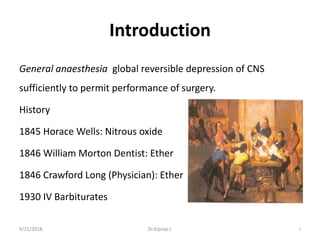
Introduction
General anaesthesia global reversible depression of CNS
sufficiently to permit performance of surgery.
History
1845 Horace Wells: Nitrous oxide
1846 William Morton Dentist: Ether
1846 Crawford Long (Physician): Ether
1930 IV Barbiturates
9/21/2018 5Dr.Kiprop J.
Conceptual framework
• Pre-anaesthetic evaluation
• Pre-anaesthetic medication
• Induction of anaesthesia
• Maintenance
• Surgery
• Reversal/ emergence
• Post-operative monitoring
9/21/2018 6Dr.Kiprop J.
• It is the administration of drugs prior to general anaesthesia
(GA) so as to make anaesthesia safer for the patient.
• Ensures comfort to the patient & to minimize adverse effects of
anaesthesia
Pre-anaesthetic Medication
Aims
• Relief of anxiety & apprehension pre-operatively & facilitate
smooth induction
• Amnesia for pre- & post-operative events
• Potentiate action of anaesthetics, so less dose is needed
9/21/2018 8Dr.Kiprop J.
Aims…
• Antiemetic effect extending to post-operative period
• Decrease secretions & vagal stimulation caused by anaesthetics
• Decrease acidity & volume of gastric juice to prevent reflux &
aspiration pneumonia
Drugs used for pre-anesthetic
medication
• Anxiolytics
- Provide relief from apprehension & anxiety
- Post-operative amnesia
e.g. Diazepam (5-10mg oral), Lorazepam (2mg i.m.) (avoided co-
administration with morphine, pethidine)
Cont..
• Sedatives-hypnotics-
- e.g. Promethazine (25mg i.m.) has sedative, antiemetic &
anticholinergic action
- Causes negligible respiratory depression & suitable for
children
• Anticholinergics-
- Atropine (0.5mg i.m.) or Hyoscine (0.5mg i.m.) or
Glycopyrrolate (0.1-0.3mg i.m.) one hour before surgery(not used
nowadays)
- Reduces salivary & bronchial secretions, vagal bradycardia,
hypotension
- Glycopyrrolate(selective peripheral action) acts rapidly,
longer acting, potent antisecretory agent, prevents vagal
bradycardia effectively
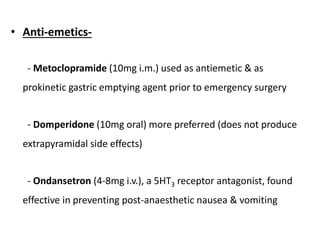
• Anti-emetics-
- Metoclopramide (10mg i.m.) used as antiemetic & as
prokinetic gastric emptying agent prior to emergency surgery
- Domperidone (10mg oral) more preferred (does not produce
extrapyramidal side effects)
- Ondansetron (4-8mg i.v.), a 5HT3 receptor antagonist, found
effective in preventing post-anaesthetic nausea & vomiting
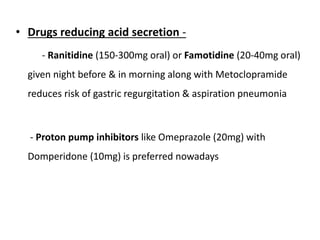
• Drugs reducing acid secretion -
- Ranitidine (150-300mg oral) or Famotidine (20-40mg oral)
given night before & in morning along with Metoclopramide
reduces risk of gastric regurgitation & aspiration pneumonia
- Proton pump inhibitors like Omeprazole (20mg) with
Domperidone (10mg) is preferred nowadays
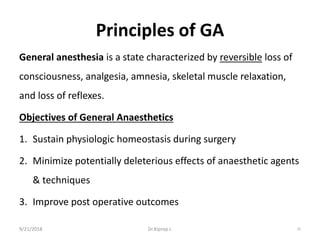
Principles of GA
General anesthesia is a state characterized by reversible loss of
consciousness, analgesia, amnesia, skeletal muscle relaxation,
and loss of reflexes.
Objectives of General Anaesthetics
1. Sustain physiologic homeostasis during surgery
2. Minimize potentially deleterious effects of anaesthetic agents
& techniques
3. Improve post operative outcomes
9/21/2018 15Dr.Kiprop J.
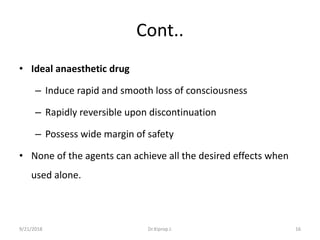
Cont..
• Ideal anaesthetic drug
– Induce rapid and smooth loss of consciousness
– Rapidly reversible upon discontinuation
– Possess wide margin of safety
• None of the agents can achieve all the desired effects when
used alone.
9/21/2018 16Dr.Kiprop J.
Important terms
• Balanced anesthesia: Anesthesia produced by a mixture of
drugs, often including both inhaled and intravenous agents
– Rationale…take advantage of favourable properties of each agent
while minimizing the SE
• Inhalation anesthesia: Anesthesia induced by inhalation of
drug
• Minimum Alveolar Anesthetic Concentration (MAC): The
alveolar concentration of an anesthetic that is required to
prevent a response to a standardized painful stimulus in 50%
of patients.
9/21/2018 17Dr.Kiprop J.
Important terms
• Analgesia: A state of decreased awareness of pain,
sometimes with
• Amnesia: partial or total loss of memory
• Induction: administration of a drug or combination of drugs
at the beginning of an anaesthetic that results in a state of
general anaesthesia…upto surgical anaesthesia plane 2
9/21/2018 18Dr.Kiprop J.
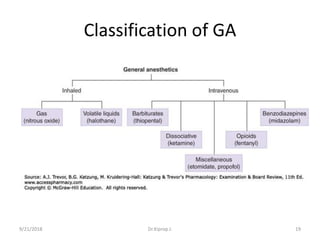
Classification of GA
9/21/2018 19Dr.Kiprop J.
Stages of Anesthesia
• Modern anesthetics act very rapidly and achieve deep
anesthesia quickly.
• With older and more slowly acting anesthetics, the
progressively greater depth of central depression associated
with increasing dose or time of exposure is traditionally
described as stages of anesthesia.
• Stage 1: Analgesia
– In stage 1, the patient has decreased awareness of pain, sometimes
with amnesia. Consciousness may be impaired but is not lost. Normal
reflexes but eyelash reflex may be abolishded
9/21/2018 20Dr.Kiprop J.
Stages of Anaesthesia
• Stage 2: Disinhibition/excitement
– the patient appears to be delirious and excited. Amnesia occurs,
reflexes are enhanced, and respiration is typically irregular; retching
and incontinence may occur. Laryngospasm, regurgitation, coughing
• Stage 3: Surgical Anesthesia
– the patient is unconscious and has no pain reflexes; respiration is very
regular, and blood pressure is maintained.
• Stage 4: Medullary Depression
– patient develops severe respiratory and cardiovascular depression that
requires mechanical and pharmacologic support.
9/21/2018 21Dr.Kiprop J.
Mechanism of Action
• Exact mechanism unknown
• Affects neurons at various cellular location- synapse
– Presynaptic effect - alters the release of neurotransmitters
– Post synaptic effect- may change the frequency or amplitude of
impulses exiting the synapse.
• Organ level: strengthen inhibition or diminishes excitation
within the CNS
a)Inhibitory ion channels: Cl-and K channels, GABA & glycine.
9/21/2018 22Dr.Kiprop J.
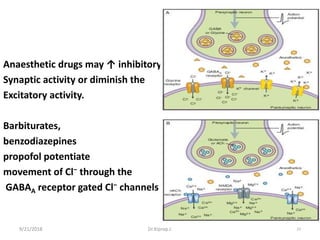
9/21/2018 23
Anaesthetic drugs may ↑ inhibitory
Synaptic activity or diminish the
Excitatory activity.
Barbiturates,
benzodiazepines
propofol potentiate
movement of Cl⁻ through the
GABAA receptor gated Cl⁻ channels
Dr.Kiprop J.
Cont…
 Gycline: Barbiturates, propofol & benzodiazepines
b) Excitatory ion channels: activated by ACH (nicotinic &
muscarinic receptors), excitatory amino acids ( N-methyl-D-
Aspartate (NMDA), or serotonin (5-HT₂ or 5-HT₃).
 NMDA receptors blocked by : N₂O & ketamine
9/21/2018 24Dr.Kiprop J.
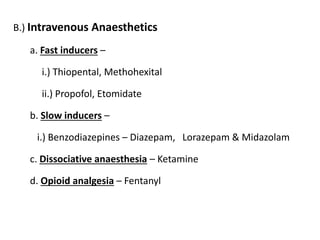
B.) Intravenous Anaesthetics
a. Fast inducers –
i.) Thiopental, Methohexital
ii.) Propofol, Etomidate
b. Slow inducers –
i.) Benzodiazepines – Diazepam, Lorazepam & Midazolam
c. Dissociative anaesthesia – Ketamine
d. Opioid analgesia – Fentanyl
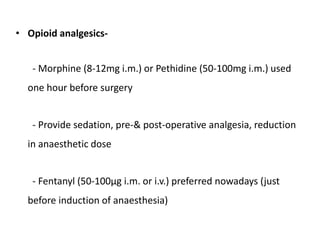
• Opioid analgesics-
- Morphine (8-12mg i.m.) or Pethidine (50-100mg i.m.) used
one hour before surgery
- Provide sedation, pre-& post-operative analgesia, reduction
in anaesthetic dose
- Fentanyl (50-100μg i.m. or i.v.) preferred nowadays (just
before induction of anaesthesia)
Intravenous Anaesthetics
1. Barbiturates
2. Propofol
3. Etomidate
4. Ketamine
9/21/2018 27Dr.Kiprop J.
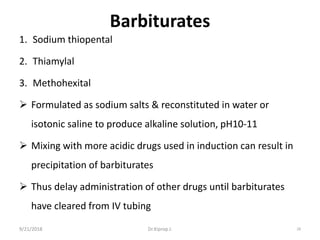
Barbiturates
1. Sodium thiopental
2. Thiamylal
3. Methohexital
 Formulated as sodium salts & reconstituted in water or
isotonic saline to produce alkaline solution, pH10-11
 Mixing with more acidic drugs used in induction can result in
precipitation of barbiturates
 Thus delay administration of other drugs until barbiturates
have cleared from IV tubing
9/21/2018 28Dr.Kiprop J.
Barbiturates
 Induction anaesthesia: 3-5mg/kg within a minute
 duration of anaesthesia 5—8minutes
 Neonates & infants requires high induction dose (5—8mg/kg)
 Pregnant women & elderly patients require less dose (1—
3mg/kg).
 Thiopental & Thiamylal produce little or no pain on injection
site
 Methohexital elicits mild pain
 Veno-irritation can be reduced by injection into a large vein or
give lidocaine prior to injection.
9/21/2018 29Dr.Kiprop J.
Barbiturates cont…
 Intra-arterial injection of thiobarbiturates can induce severe
inflammatory & potentially necrotic reaction thus should be
avoided.
 Thiopental evokes garlic taste prior to inducing anaesthesia
 Methohexital & lesser extent other barbiturates can induce
excitement phenomena→ muscle tremors, hypertonus &
hiccups
Pharmacokinetics
 Duration of action depends on redistribution
 Lipid solubility makes thiopental rapidly acting.
9/21/2018 30Dr.Kiprop J.
Barbiturates cont…
 Half life 12hours
 Highly bound to plasma proteins – 85%
 Metabolised in the liver
 Renal excretion of inactive metabolites
 Small fraction of thiopental undergoes desulfuration to longer
acting hypnotic pentobarbital.
 Prolonged usage of thiopental & thiamylal can cause coma
due to slow elimination & large volume distribution
9/21/2018 31Dr.Kiprop J.
Barbiturates cont…
Systemic Effects
CNS: ↓ cerebral oxygen consumption in a dose dependant manner
↓ cerebral blood flow & ICP
 Thiopental has protective effects against cerebral ischemia &
intra-ocular pressure
 Effective as anticonvulsants-Rx of status epilepticus
CVS: dose-dependant ↓ in BP due to vasodilation, venodilation &
lesser in cardiac contractility
↑HR as compensatory response to lower BP
9/21/2018 32Dr.Kiprop J.
Barbiturates cont…
Respiratory System:
 Respiratory depressant
 Induction dose ↓ minute ventilation & tidal volume with
smaller & inconsistent ↓ in RR
 ↓ reflex responses to hypercarbia & hypoxia
 Higher doses or presence of other respiratory depressants
such as opioids, can result in apnoea
 Safe in asthmatics as it has little effect on bronchomotor tone
9/21/2018 33Dr.Kiprop J.
Barbiturates cont…
Other effects
 Analgesic effect
 Short term administration has no clinically significant effect on
hepatic, renal or endocrine system.
 Single induction dose does not alter tone of gravid uterus
 But may produce transient depression of newborn activity
 Drug induced histamine release
C/I in pts with acute or variegate porphyria- may produce fatal
attacks
9/21/2018 34Dr.Kiprop J.
Propofol
 Most commonly used IV anaesthetic for induction anaesthesia
 Propofol (2,6-diisopropylphenol) alkyl phenol, with hypnotic
properties
 Poor solubility in H₂O, formulated as an emulsion containing
10% soy-bean oil, 2.25% glycerol & 1.2% lecithin, egg yolk
phosphatide fraction
 Solution appears milky white & slightly viscous, pH approx 7.
MOA: potentiation of chloride current mediated thru’ GABAA
receptor
9/21/2018 35Dr.Kiprop J.
Propofol cont..
Clinical Uses..
1. Induction anaesthesia: bolus injection of 1-2mg/kg IV
2. Maintenance anaesthesia: allows for continuous infusion
3. Sedation in monitored anaesthetic care sedation in ICU,
conscious sedation & short duration GA outside operating
room eg interventional radiology suites, emergency room
9/21/2018 36Dr.Kiprop J.
Propofol cont..
Pharmacokinetics
 Rapidly metabolized in liver – resulting in water soluble inactive
metabolites.
 High plasma clearance &exceeds hepatic blood flow →
extrahepatic metabolism mainly in the lungs. Accounts for up to
30% of bolus.
 Excreted in urine
 Plasma half life 2-4min, duration of action 3-8 minutes
 Highly bound to plasma proteins (97%)
 Recovery more complete , no ‘hangover’. Reversal in 8-10min
9/21/2018 37Dr.Kiprop J.
Propofol cont..
System Effects
CNS: hypnotic, no analgesic effects
 General suppression of CNS activity , occasional excitatory
effects such as twitching or spontaneous movement
observed.
 Peripheral vasodilation can ↓ cerebral perfusion pressure →
 ↓cerebral blood flow, cerebral metabolic rate for O₂, ICP &
intra-ocular pressure.
 Safe in patients with seizure disorders
9/21/2018 38Dr.Kiprop J.
Propofol cont..
CVS: most pronounced ↓ in systemic BP due to Vasodilation in
both arterial & venous circulation → ↓ in preload & afterload
 Effect more pronounced in elderly, pts with ↓ intravascular
fluid volume & rapid injection
Respiratory effects
 Respiratory depressant generally produces apnoea after
induction dose
 Maintenance infusion reduces minute ventilation thru’
reduction in tidal volume
9/21/2018 39Dr.Kiprop J.
Propofol cont..
 Reduction in ventilatory response to hypoxia & hypercapnia
 Can cause greater reduction in upper airway reflexes thus
suitable for instrumentation of airway.
NB!! Pts should be monitored to ensure adequate oxygenation &
ventilation
Others
 Significant anti-emetic action
 Good for sedation or anaesthesia for pts at high risk for
Nausea & vomiting
9/21/2018 40Dr.Kiprop J.
Ketamine
 “Dissociative anaesthetic” patient feels detached from
environment & self whilst patient’s eyes remain open with a
slow nystagmic gaze
 profound analgesia, unresponsive to commands & amnesia.
 partially water-soluble & highly lipid soluble phencyclidine
derivative
 Onset of action 60-90sec IV; 1-2min IM
 Duration of induction 10-15min
MOA is complex, but the major effect is probably produced
through inhibition of the NMDA receptor complex.
9/21/2018 41Dr.Kiprop J.
Ketamine cont..
 not commonly used for maintenance anaesthesia, its short
context-sensitive half-time
 Small bolus doses 0.2–0.8 mg/kg IV may be useful during
regional anaesthesia.
 provides effective analgesia with
 It’s usage limited by unpleasant psychotomimetic side effects
 potent analgesia with minimal respiratory depression.
 adjunct administered at sub-analgesic doses to limit or
reverse opioid tolerance
9/21/2018 42Dr.Kiprop J.
Ketamine cont..
Pharmacokinetics
 Multiple administration routes –IV, IM, oral, rectal, epidural
 Metabolism occurs primarily in the liver and involves N -
demethylation by the CYP450 system.
 Norketamine, the primary active metabolite, is less potent
(one third to one fifth the potency of ketamine) subsequently
hydroxylated & conjugated into water-soluble inactive
metabolites.
 inactive metabolite excreted in urine.
 Low protein binding (12%)
9/21/2018 43Dr.Kiprop J.
Ketamine cont..
Systemic Effects
 amnesia is not as complete as with the benzodiazepines.
 Reflexes are often preserved
 The eyes remain open and the pupils are moderately dilated
with a nystagmic gaze.
 Frequently, ↑ lacrimation and salivation
 Premedication with an anticholinergic drug
9/21/2018 44Dr.Kiprop J.
Ketamine cont..
CNS: cerebral vasodilator that ↑cerebral blood flow & cerebral
metabolism rate of O₂.
 Not recommended for use in patients with intracranial
pathology, especially ↑ ICP
 potential to produce myoclonic activity but is considered an
anticonvulsant & may be recommended for treatment of
status epilepticus when more conventional drugs are
ineffective.
 Limited usage due unpleasant emergence reactions-vivid
colourful dreams, hallucinations, out-of-body experiences,
and increased and distorted visual, tactile, and auditory
sensitivity. Fear & confusion
9/21/2018 45Dr.Kiprop J.
Ketamine cont..
 euphoric state may also be induced thus the potential for
abuse.
 Children usually have a lower incidence of & less severe
emergence reactions.
 Combination with benzodiazepine may limit the unpleasant
emergence reactions & also ↑ amnesia.
CVS: produce transient but significant ↑in systemic BP, HR
and cardiac output, by centrally mediated sympathetic
stimulation
9/21/2018 46Dr.Kiprop J.
Ketamine cont..
 ↑ cardiac workload and myocardial oxygen consumption, are
not always desirable & can be blunted by co-administration of
benzodiazepines, opioids, or inhaled anaesthetics.
Respiratory Effects: not thought to produce significant
respiratory depression.
 When singly used, the respiratory response to hypercapnia is
preserved and blood gases remain stable.
 Transient hypoventilation & rarely, a short period of apnoea
can follow rapid administration of a large intravenous dose for
induction anaesthesia.
9/21/2018 47Dr.Kiprop J.
Ketamine cont..
 Relaxes bronchial smooth muscles and may be helpful in pts
with reactive airways & in the management of pts
experiencing bronchoconstriction
 Can be used in asthmatics
9/21/2018 48Dr.Kiprop J.
Ketamine cont..
Clinical Uses
 Unique characteristics: profound analgesia, stimulation of the
sympathetic nervous system, bronchodilation, and minimal
respiratory depression.
 Rapidly produces hypnotic state
 useful option for premedication in mentally challenged and
uncooperative paediatric patients.
 Used in burn pts, debridement, & skin grafting procedures
 Induction anaesthesia achieved with, 1–2 mg/kg IV or 4–6
mg/kg IM
9/21/2018 49Dr.Kiprop J.
Etomidate
 Carboxylated imidazole derivative
 Poorly soluble in water thus supplied as 2mg/ml solution on
35% propylene glycol, pH 6.9
 MOA: Potentiation of GABAA-mediated chloride currents
 IV anaesthetic with hypnotic but no analgesic effects.
 Minimal haemodynamic effects
 Endocrine side effects limits it’s use for continuous infusions
9/21/2018 50Dr.Kiprop J.
Etomidate cont..
Clinical Uses
Alternative to propofol and barbiturates for the rapid IV
induction of anaesthesia, especially in pts with compromised
myocardial contractility.
Pharmacokinetics
 Induction dose produces rapid onset anaesthesia & recovery
depends on redistribution to inactive tissue sites
 Highly plasma protein bound (77%)
9/21/2018 51Dr.Kiprop J.
Etomidate cont..
 Metabolism primarily by ester hydrolysis to inactive
metabolite
 Excreted in urine (78%) & bile (22%)
 ˂3% excreted as unchanged drug
 Short elimination half life
 Larger doses, repeated boluses or continuous infusion can
safely be administered
Systemic Effects
CNS: potent vasoconstrictor as reflected by ↓ in cerebral
blood flow & ICP
Effects similar to those of thiopental
9/21/2018 52Dr.Kiprop J.
Etomidate cont..
CVS: cardiovascular stability after bolus injection
 ↓ in systemic BP is modest or absent & reflects ↓in systemic
vascular resistance
 Systemic BP-lowering effects of etomidate exaggerated in
presence of hypovolaemia
 Optimization of hypovolemic pts required before induction
anaesthesia
 Minimal changes in HR & cardiac output
 Minimal depressant effects on myocardial contractility
9/21/2018 53Dr.Kiprop J.
Etomidate cont..
Respiratory System: less pronounced depressant effects on
ventilation
Apnoea may follow rapid IV injection
Depression of ventilation may be exaggerated when combined
with inhaled anaesthetic or opioids.
Endocrine: adrenocortical suppression by producing dose-
dependant inhibition of 11β-hydroxylase, enzyme for conversion
of cholesterol to cortisol
Suppression last for 4-8hours.
9/21/2018 54Dr.Kiprop J.
Etomidate cont..
Side effects
 Pain on injection site followed by venous irritation
 Involuntary myoclonic movements common but may be
masked by neuromuscular blocking drugs.
 Awakening after a single intravenous dose of etomidate is
rapid, with little evidence of any residual depressant effects.
 postoperative nausea and vomiting may be more common
than in thiopental or propofol.
9/21/2018 55Dr.Kiprop J.
Dexmedetomidine
• Recent IV anaesthetic
• Highly selective alpha 2 adrenergic agonist at locus caeruleus
• Produce sedation, hypnosis, and analgesia
• Approved for brief post op sedation upto 24hrs
• Minimal effect on resp.
9/21/2018 Dr.Kiprop J. 56
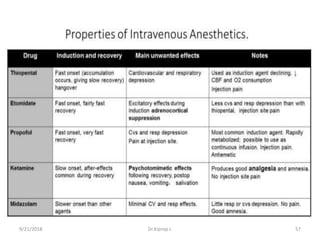
9/21/2018 Dr.Kiprop J. 57
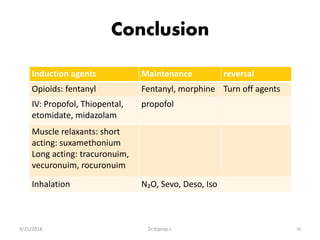
Conclusion
Induction agents Maintenance reversal
Opioids: fentanyl Fentanyl, morphine Turn off agents
IV: Propofol, Thiopental,
etomidate, midazolam
propofol
Muscle relaxants: short
acting: suxamethonium
Long acting: tracuronuim,
vecuronuim, rocuronuim
Inhalation N₂O, Sevo, Deso, Iso
9/21/2018 58Dr.Kiprop J.
Inhalation anaesthetics
1. Gas: nitrous oxide (N₂O)
– Has high vapour pressure but low boiling point. Gas at
room temp.
2. Volatile liquids:
– Ether
– Halothane
– Isoflurane
9/21/2018 59Dr.Kiprop J.
Pharmacokinetics
9/21/2018 60Dr.Kiprop J.
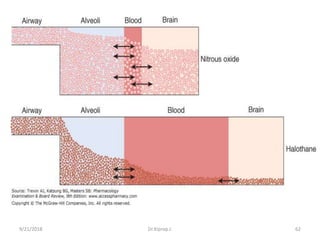
Pharmacokinetics
 Distributes between tissue or between blood and gas, and
equilibrium achieved when the partial pressure of the two tissues
is equal.
 Partial pressure of the anesthetic in tissue is equal to the inspired
gas after sufficient inhalation
 Thus partition co-efficient is the ratio of anesthetic concentration
in two tissues when partial pressures in the two tissues are equal
 Blood:Gas, Blood:Brain, Blood:Fat partition coefficient.
 This shows that inhalational anesthetics are more soluble in some
tissues than in others
9/21/2018 61Dr.Kiprop J.
9/21/2018 62Dr.Kiprop J.
Pharmacokinetics
 Equilibrium is clinically achieved when partial pressure (PP)
in inspired air is equal to the PP in end-tidal (alveolar) gas
 Equilibrium is achieved quickly for agents that are not
soluble in blood or tissue
 Anesthetic induction requires that brain PP be equal to
mean alveolar concentration (MAC)
9/21/2018 63Dr.Kiprop J.
Pharmacokinetics
 Due to good brain perfusion, anesthetic PP in brain becomes
equal to PP in alveolar gas & in blood within few minutes
 Rate of rise of PP is slower for anesthetics that are soluble in
blood and other tissue
9/21/2018 64Dr.Kiprop J.
Pharmacokinetics
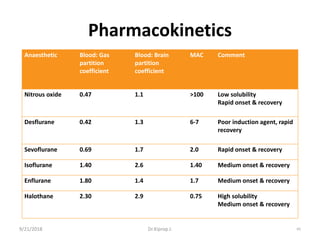
Anaesthetic Blood: Gas
partition
coefficient
Blood: Brain
partition
coefficient
MAC Comment
Nitrous oxide 0.47 1.1 ˃100 Low solubility
Rapid onset & recovery
Desflurane 0.42 1.3 6-7 Poor induction agent, rapid
recovery
Sevoflurane 0.69 1.7 2.0 Rapid onset & recovery
Isoflurane 1.40 2.6 1.40 Medium onset & recovery
Enflurane 1.80 1.4 1.7 Medium onset & recovery
Halothane 2.30 2.9 0.75 High solubility
Medium onset & recovery
9/21/2018 65Dr.Kiprop J.
1. Nitrous Oxide (N₂O)
“Laughing gas”
Colourless, odourless gas @ room temp
Non-flammable nor explosive but supports combustion
Weak anaesthetic agent
Pharmacokinetics :
Insoluble in blood & other tissues
Rapidly reaches equilibrium btn gas delivery & alveolar
anaesthetic conc → rapid induction
9/21/2018 66Dr.Kiprop J.
N₂O cont..
Can be combined with halogenated IV anaesthetics to
speed induction anaesthesia
Rapid emergence following discontinuation
Discontinuation may lead to diffusional anoxia/hypoxia ..by
affecting oxygenation by directly displacing oxygen,or by
diluting alveolar carbondioxide thus may decrease
respiratory drive and ventilation. Critical in the first 5-10
minutes . Term coined Fink.
9/21/2018 67Dr.Kiprop J.
N2O
To avoid hypoxia, 100% O₂.
99% eliminated unchanged via lungs
Interact with Vit B₁₂ → megaloblastic anaemia & peripheral
neuropathy
9/21/2018 Dr.Kiprop J. 68
9/21/2018 69
N₂O: Clinical Uses
1. Weak anaesthetic agent
2. Analgesia @ low conc.
3. Sedation at 50% conc. → dental procedures
4. Used as adjunct to other anaesthetics
Systemic Effects:
CVS: depressant effects on cardiac function generally are not
observed in pts b/coz of the stimulatory effects of N₂O on the
sympathetic nervous system
Dr.Kiprop J.
N₂O cont…
When co-administered with halogenated inhalational
anaesthetics, it generally produces an ↑ in HR, arterial BP, and
cardiac output.
Co-administration with an opioid will generally ↓ arterial BP
& cardiac output.
 increases venous tone in both the peripheral and pulmonary
vasculature.
Should not be used in patients pre-existing pulmonary
hypertension.
9/21/2018 70Dr.Kiprop J.
9/21/2018 71
Respiratory System:
 ↑respiratory rate, ↓ in tidal volume in spontaneously breathing
patients.
 Even modest conc. of N₂O markedly depress the ventilatory
response to hypoxia.
CNS: Administered alone, it can significantly ↑ cerebral blood flow
and ICP.
 Co-administered with IV anaesthetic agents, increases in
cerebral blood flow are attenuated or abolished.
 When added to a halogenated inhalational anaesthetic, its
vasodilatory effect on the cerebral vasculature is slightly reduced
Dr.Kiprop J.
N₂O cont..
Muscle: does not relax skeletal muscle or enhance the effects of
neuromuscular blocking drugs.
 N₂O does NOT trigger malignant hyperthermia.
Kidney, Liver, and Gastrointestinal Tract
 Nitrous oxide is neither nephrotoxic nor hepatotoxic
 Note Nitrous oxide is relatively contraindicated in cases of
intestinal obstruction or pneumothorax.
9/21/2018 72Dr.Kiprop J.
2. Halothane
 Halogenated Volatile liquid , light sensitive
 Inflammable nor explosive when mixed with O₂ or air
Pharmacokinetics
 High fat soluble, high blood :gas coefficient (2.3)
 Slow induction & recovery
 Eliminated unchanged via lungs
 Metabolized in liver by CYP450 into trifluoroacetylchloride
metabolite
9/21/2018 73Dr.Kiprop J.
Halothane cont..
Clinical Uses
 Potent, non-pungent anaesthetic & well tolerated for
maintenance anaesthesia
 Used for induction especially in children
Systemic Effects
CVS: Dose dependant ↓ in arterial blood pressure
directly depressed myocardial contractility
9/21/2018 74Dr.Kiprop J.
Halothane cont..
 ↓ mean arterial pressure about 20—25% at MAC.
 Induce reduction on BP & HR → disappear several hours
after administration b/coz of progressive sympathetic
stimulation.
 Sinus bradycardia & atrioventricular rhythms due to direct
depressive effects on SAN
Respiratory System: spontaneous respiration rapid & shallow
↓ alveolar ventilation → ↑ arterial CO₂ tension from
40mmHg ˃ 50mmHg at 1MAC.
9/21/2018 75Dr.Kiprop J.
Halothane cont..
 Inhibits peripheral chemoreceptor responses to arterial
hypoxemia→ no tachycardia &hypertension.
CNS: dilates cerebral vasculature, ↑ cerebral blood flow → ↑ICP
especially in pts with space occupying lesions, oedema, ↑ICP
Attenuates auto-regulation of cerebral flow
Muscle: muscle relaxation via central depressant effects
 potentiates actions of non-depolarized muscle relaxants by ↑
duration of action & magnitude of effects
9/21/2018 76Dr.Kiprop J.
Halothane cont..
 Trigger malignant hyperthermia: heritable genetic disorder of
muscle characterized by muscle rigidity, hyperthermia, rapid
onset of tachycardia & hypercapnia
 Rx: dantrolene; immediate discontinue procedure
 Relaxes uterine smooth muscles- help to manipulation of
foetus in prenatal period or removal of retained placenta
Kidney, liver & GIT:
 Reduced concentrated urine due to halothane-induced
reduction of renal blood flow & GFR
9/21/2018 77Dr.Kiprop J.
Halothane cont..
 Not associated with nephrotoxicity
 ↓ splanchnic & hepatic blood flow
 Fulminant hepatic necrosis→ fever, anorexia, nausea &
vomiting, rash & peripheral eosinophilia; develops several
days after anaesthesia
 Halothane hepatitis → immune response to hepatic proteins
that become trifluoroacetylated as a result of halothane
metabolism
9/21/2018 78Dr.Kiprop J.
3. Isoflurane
 Volatile liquid
 Neither flammable nor explosive
 Pungent odour
Pharmacokinetics
 Low blood: gas partition coefficient, lower than that of
halothane (1.4)
 Induction & recovery are relatively rapid
 ˃99% excreted unchanged in lungs
 Does not appear to be mutagenic, teratogenic or carcinogenic
9/21/2018 79Dr.Kiprop J.
Isoflurane cont..
Clinical Uses
 Maintenance GA
 Induction can be achieved in ˂10min with inhaled conc. of 3%
isoflurane in O₂
 Drugs such as opioids, N₂O decreases conc. required for GA.
9/21/2018 80Dr.Kiprop J.
Isoflurane cont..
Systemic Effects
CVS: Conc - dependant ↓ in arterial BP, cardiac output
maintained & hypotension result in ↓ systemic vascular
resistance.
 Vasodilation in most vascular beds eg skin & muscle
 Coronary vasodilator →↑coronary blood flow &↓ myocardial
O₂ consumption
 Mildly elevated HR as compensatory response to ↓blood
pressure
9/21/2018 81Dr.Kiprop J.
Isoflurane cont..
Rapid changes in isoflurane conc. can produce transient tachycardia
& hypertension due to isoflurane- induced sympathetic stimulation.
Respiratory System: Pts spontaneously breathing isoflurane have a
normal RR but a reduced tidal volume, resulting in a marked
reduction in alveolar ventilation and an ↑ in arterial CO₂ tension
 Depresses the ventilatory response to hypercapnia & hypoxia
 Effective bronchodilator
 Airway irritant & can stimulate airway reflexes such as coughing
& laryngospasm during induction
9/21/2018 82Dr.Kiprop J.
9/21/2018 83
CNS: ↓ cerebral metabolic O₂ consumption
 Causes less cerebral vasodilation
 Preferred for neurological procedures
 Effects on cerebral blood flow can be reversed with
hyperventilation.
Muscles: skeletal muscle relaxation via central effects
 Enhances effects of depolarizing & non depolarizing muscle
relaxants
 Relaxes uterine smooth muscles
Kidney, Liver & GIT:
↓ splanchnic hepatic & renal blood flow & GFR
Dr.Kiprop J.
4.Sevoflurane
 Clear, colourless volatile liquid
 Non-flammable and non-explosive in mixtures of air or
oxygen.
 It can undergo an exothermic reaction with desiccated CO₂
absorbent to produce airway burns or spontaneous
ignition, explosion, and fire.
 Sevoflurane reaction with desiccated CO₂ absorbent also
can produce CO → serious patient injury
9/21/2018 84Dr.Kiprop J.
Sevoflurane cont..
Pharmacokinetics
 Low solubility in blood & other tissues thus rapid induction
anaesthesia, & rapid emergence following discontinuation
 3% of absorbed sevoflurane is biotransformed by CYP2E1 to
lexafluoroisopropanol & organic fluoride
 Interaction with soda lime (CO₂) absorbent produces
pentafluoroisopropenyl fluoromethyl ether
9/21/2018 85Dr.Kiprop J.
Sevoflurane cont..
Clinical Uses
 Inhalation induction anaesthesia especially in children
because it is not irritating to the airway
 Used in outpatient anaesthesia due to its rapid recovery
profile
Systemic Effects
CVS:
 Hypotensive effect due to systemic vasodilation
 Produces a conc-dependent ↓ in cardiac output.
 Unlike isoflurane or desflurane, it does not produce
tachycardia and thus may be a preferable agent in patients
prone to MI.
9/21/2018 86Dr.Kiprop J.
Sevoflurane cont..
Respiratory system: conc- dependant ↓ in tidal volume & ↑ RR
in spontaneously breathing patients.
 Not irritating to airway
 Potent bronchodilator
CNS: effects similar to isoflurane & desflurane.
 ↑ ICP in pts with poor intracranial compliance response to
hypocapnia is preserved during sevoflurane anaesthesia,
 increases in ICP can be prevented by hyperventilation.
9/21/2018 87Dr.Kiprop J.
Sevoflurane cont..
Muscle:
 Produces skeletal muscle relaxation
 Enhances the effects of non-depolarizing & depolarizing
neuromuscular blocking agents.
Kidney, Liver & GIT
 potential nephrotoxicity of compound A
(pentafluoroisopropenyl fluoromethyl ether).
 FDA recommends that sevoflurane be administered with fresh
gas flows of at least 2 L/min to minimize accumulation of
compound A.
 no evidence of renal impairment or hepatic toxicity
9/21/2018 88Dr.Kiprop J.
5. Enflurane
 Clear, colorless, non-flammable & non-explosive liquid
 Mild sweet odor, volatile
 Halogenated ether & structural isomer of isoflurane
Pharmacokinetics
 Administered by vaporizing
 Blood: gas partition coefficient (1:8), relatively slow induction
& recovery.
 2-8% of absorbed enflurane metabolized by hepatic CYP2E1
9/21/2018 89Dr.Kiprop J.
Enflurane cont..
 Metabolite by-product as fluoride but low & non-toxic.
 Isoniazid enhances metabolism of enflurane which ↑ serum
fluoride.
Clinical Use
 Mainly in maintenance of GA
 Can induce GA in ˂10 minutes
 Conc. required to produce anaesthesia ↓ when co-
administered with N₂O or opioids
9/21/2018 90Dr.Kiprop J.
Enflurane cont..
Systemic Effects
CVS: conc- dependant ↓ in arterial BP due to depression of
myocardial contractility & peripheral resistance
 Minimal effects on HR
Respiratory System: similar to those of halothane
 Greater depression of ventilatory response to hypoxia &
hypercarbia
 Effective bronchodilator
9/21/2018 91Dr.Kiprop J.
Enflurane cont..
CNS: cerebral vasodilator, ↑ICP in some patients
 ↓cerebral metabolic O₂ consumption may produce electrical
seizure activity. Seizures are self-limiting
C/I: pts with seizure disorders
Muscle: significant skeletal muscle relaxation
 Enhances effects of non-depolarizing muscle relaxants
 Malignant hyperthermia can occur
 Relaxes uterine smooth muscles & may ↑ uterine bleeding.
9/21/2018 92Dr.Kiprop J.
Enflurane cont..
Kidney, Liver & GIT
 Reduce renal blood flow, GFR and urine volume
 Effects reversed with discontinuation
 ↓ splanchnic & hepatic blood flow in proportion to reduced
arterial blood but does not appear to alter liver function or be
hepatotoxic
9/21/2018 93Dr.Kiprop J.
6.Desflurane
 Highly volatile liquid at room temp.
 Delivery of precise conc. requires use of special heated
vaporizer that delivers pure vapour then diluted appropriately
with other gases (O₂, air or N₂O)
 Non-flammable & non-explosive in mixtures of air or O₂
Pharmacokinetics
 Partitions poorly into blood, fat, and other peripheral tissues.
 Alveolar & blood conc. rapidly rise to level of inspired conc
thus
9/21/2018 94Dr.Kiprop J.
Desflurane cont..
 Provide very rapid induction, and rapid emergence from
anaesthesia.
 Minimally metabolized
 ˃ 99% of absorbed desflurane is eliminated unchanged via the
lungs.
Clinical Uses
 Maintenance anaesthesia in adults & children
 Used for outpatient surgical procedures b/coz of fast
induction & recovery
9/21/2018 95Dr.Kiprop J.
Desflurane cont..
 Irritates the airway in awake pts provoking coughing,
salivation & bronchospasm.
Systemic Effects
CVS: ↓ arterial BP progressively with depth of anesthesia by
decreasing systemic vascular resistance
 Cardiac output preserved & perfusion in major organ beds
eg splanchnic, renal, cerebral & coronary.
 Marked ↑HR occurs during induction & with abrupt ↑ in
delivery conc. which results from desflurane –induced
stimulation of sympathetic Nervous system
9/21/2018 96Dr.Kiprop J.
Desflurane cont..
Respiratory System: ↑ respiratory depression as conc. increases
& ↓ in tidal volume
 Tachypnoea less common in comparison to halothane
Bronchodilation
CNS:
 Frank seizures
 Does not aggravate seizures in epileptic patients
 Reduces cerebral oxygen consumption
 Vasodilation ↑ cerebral blood flow & ↑ ICP
9/21/2018 97Dr.Kiprop J.
Desflurane cont..
Muscle:
• Direct skeletal muscle relaxation ↑ with depth of anesthesia
• Enhances effects of depolarizing & non-depolarizing
neuromuscular blocking agents
• Uterine muscle relaxation
Kidney:
• Reduce renal blood flow, GFR and urine volume
• Nephrotoxicity
Liver: no hepatotoxicity
9/21/2018 98Dr.Kiprop J.
Local Anesthetics
9/21/2018 99Dr.Kiprop J.
Introduction
• Local anaesthetic agents reversibly block impulse conduction
along nerve axons and other excitable membranes.
• Local anesthesia is the condition that results when sensory
transmission from a local area of the body to the CNS is
blocked.
• Methods of administration:
– Nerve Block
– Infiltration
– Topical
9/21/2018 100Dr.Kiprop J.
9/21/2018 Dr.Kiprop J. 101
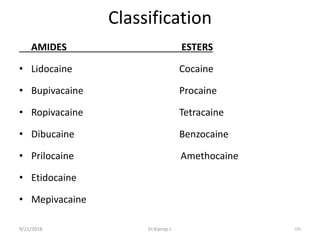
Classification
AMIDES ESTERS
• Lidocaine Cocaine
• Bupivacaine Procaine
• Ropivacaine Tetracaine
• Dibucaine Benzocaine
• Prilocaine Amethocaine
• Etidocaine
• Mepivacaine
9/21/2018 102Dr.Kiprop J.
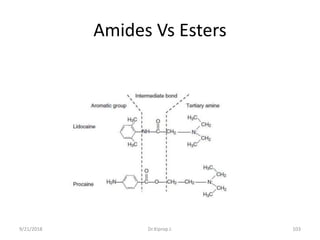
Amides Vs Esters
9/21/2018 Dr.Kiprop J. 103
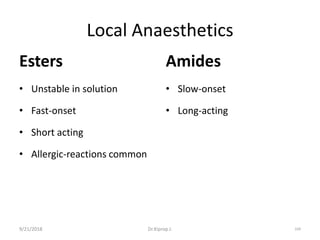
Local Anaesthetics
Esters
• Unstable in solution
• Fast-onset
• Short acting
• Allergic-reactions common
Amides
• Slow-onset
• Long-acting
9/21/2018 104Dr.Kiprop J.
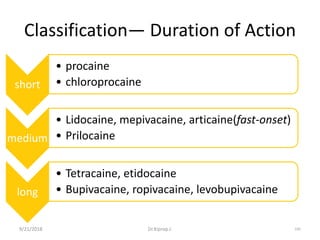
Classification— Duration of Action
9/21/2018 105
short
• procaine
• chloroprocaine
medium
• Lidocaine, mepivacaine, articaine(fast-onset)
• Prilocaine
long
• Tetracaine, etidocaine
• Bupivacaine, ropivacaine, levobupivacaine
Dr.Kiprop J.
Introduction: Chemistry
• Each local anaesthetic agent consists of lipophilic group
connected via ester/amide to an ionized group.
• Esters are prone to hydrolysis therefore shorter duration of
action
• LAs are weak bases
• They exist as either uncharged base/ cation
• Cation is more active at receptor site since it cannot readily
escape from closed channels
• Uncharged form penetrates membranes faster
9/21/2018 106Dr.Kiprop J.
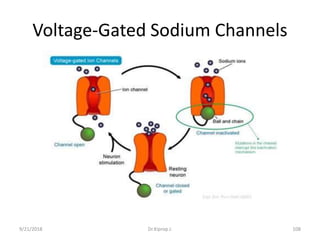
Mechanism of Action
• Local anaesthetics act mainly by inhibiting Na+ influx in
neuronal cell membrane. They block voltage-gated Na+
channels.
• Influx of Na+ is interrupted thus no action potential.
• Hence no impulse from 1st order neuron
9/21/2018 107Dr.Kiprop J.
Voltage-Gated Sodium Channels
9/21/2018 108Dr.Kiprop J.
Local Anaesthetics
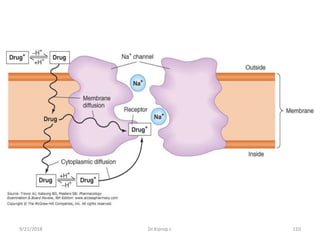
• LA gain access to their receptors from cytoplasm or plasma
membrane
• Non-ionized form reaches effective intracellular levels
• Ionized form more effective
9/21/2018 109Dr.Kiprop J.
9/21/2018 110Dr.Kiprop J.
Cont..
• Affinity for receptors depends on state of channel itself.
• High concentrations of K+ enhance LA activity
• High conc. of Ca2+ antagonize LA
• Inflammation reduces effects of LA because a smaller % LA is
non-ionized & available across membrane
• This is perhaps due to peroxynitrite
9/21/2018 111Dr.Kiprop J.
Pharmacokinetics
• Local anesthetics are usually administered by injection into
dermis and soft tissues located in the area of nerves.
• Absorption and distribution are not as important in
controlling the onset of effect as in determining the rate of
offset of local analgesia, and the likelihood of CNS and cardiac
toxicity.
• Topical application of local anesthetics (eg, transmucosal or
transdermal) requires drug diffusion for both onset and offset
of anesthetic effect.
9/21/2018 112Dr.Kiprop J.
Cont..
• Onset of action may be accelerated by the addition of sodium
bicarbonate, which enhances intracellular access of these
weakly basic compounds.
• Articaine has the fastest onset of action.
9/21/2018 Dr.Kiprop J. 113
Absorption
• Systemic absorption of injected local anesthetic from the site
of administration is determined by several factors, including
dosage, site of injection, drug-tissue binding, local blood flow,
use of vasoconstrictors and the physicochemical properties of
the drug itself.
• Highly vascularity results in more rapid absorption and thus
higher blood levels.
• Poorly perfused tissue such as tendon, dermis, or
subcutaneous fat results in prolonged local effect.
9/21/2018 114Dr.Kiprop J.
Vasoconstictors
• For regional anesthesia involving block of large nerves,
maximum blood levels of local anesthetic decrease according
to the site of administration in the following order: intercostal
(highest) > caudal > epidural > brachial plexus > sciatic nerve
(lowest).
• Vasoconstrictor reduce systemic absorption of local
anesthetics from the injection site by decreasing blood flow in
these areas. It enhances and prolongs the DOA of the drug.
9/21/2018 115Dr.Kiprop J.
Vasoconstictors
• Vasoconstrictors are less effective in prolonging anesthetic
action of the more lipid-soluble, long-acting drugs (eg,
bupivacaine and ropivacaine), possibly because these
molecules are highly tissue-bound.
• Cocaine is unique owing to its intrinsic sympathomimetic
properties.
9/21/2018 116Dr.Kiprop J.
Distribution
• The amide local anesthetics are widely distributed after
intravenous bolus administration.
• There is also evidence that sequestration can occur in
lipophilic storage sites (eg, fat).
• It has an initial rapid distribution phase, which consists of
uptake into highly perfused organs such as the brain, liver,
kidney, and heart, followed by
• A slower distribution phase occurs with uptake into
moderately well-perfused tissues, such as muscle and GIT
9/21/2018 117Dr.Kiprop J.
Metabolism and Excretion
• Converted into water soluble metabolites and excreted in
urine.
• Amides in the liver and esters in plasma
• Since local anesthetics in the uncharged form diffuse readily
through lipid membranes, little or no urinary excretion of the
neutral form occurs.
• Acidification of urine promotes ionization of the tertiary
amine base to the more water-soluble charged form, which is
more readily excreted.
9/21/2018 118Dr.Kiprop J.
Metabolism and Excretion
• Ester-type local anesthetics are hydrolyzed very rapidly in the
blood by circulating butyrylcholinesterase
(pseudocholinesterase) to inactive metabolites.
• Therefore, procaine and chloroprocaine have very short
plasma half-lives (< 1 minute).
• The amide linkage of amide local anesthetics is hydrolyzed by
liver microsomal cytochrome P450 isozymes.
9/21/2018 119Dr.Kiprop J.
Metabolism and Excretion
• variable rate of liver metabolism of individual amide
compounds, the approximate order being prilocaine (fastest)
> lidocaine > mepivacaine > ropivacaine > bupivacaine and
levobupivacaine (slowest).
• Toxicity from amide-type local anesthetics is more likely to
occur in patients with hepatic disease.
• Decreased hepatic elimination of local anesthetics with
reduced hepatic blood flow.
9/21/2018 120Dr.Kiprop J.
Pharmacodynamics
• The blockade of sodium channels by most local anesthetics is
both voltage- and time-dependent:
• Channels in the rested state, which predominate at more
negative membrane potentials, have a much lower affinity for
local anesthetics than activated (open state) and inactivated
channels, which predominate at more positive membrane
potentials
9/21/2018 121Dr.Kiprop J.
B. Structure-Activity Characteristics Of
Local Anesthetics
• The smaller and more lipophilic the local anesthetic, the faster
the rate of interaction with the sodium channel receptor.
• Potency is also positively correlated with lipid solubility
• Lidocaine, procaine, and mepivacaine are more water-soluble
than tetracaine, bupivacaine, and ropivacaine.
• The latter agents are more potent and have longer durations
of local anesthetic action.
9/21/2018 122Dr.Kiprop J.
Cont..
• These long-acting local anesthetics also bind more extensively
to proteins and can be displaced from these binding sites by
other protein-bound drugs.
• In the case of optically active agents (eg, bupivacaine), the
S(+)isomer can usually be shown to be moderately more
potent than the R(-) isomer.
9/21/2018 123Dr.Kiprop J.
C. Other Actions On Nerves
• Local anesthetics are capable of blocking all nerves, their
actions are not limited to the desired loss of sensation.
• Motor paralysis may limit the ability of the patient to
cooperate during obstetric delivery or ambulate after
outpatient surgery.
• During spinal anesthesia, motor paralysis may impair
respiratory activity.
• Residual autonomic blockade interferes with bladder
function resulting in urinary retention and may cause
hypotension
9/21/2018 124Dr.Kiprop J.
Cont..
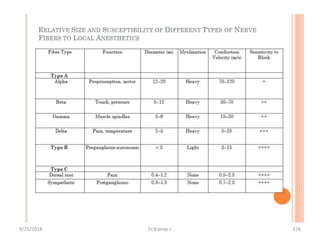
• Differential sensitivity of various types of nerve fibers to local
anesthetics depends on fiber diameter, myelination,
physiologic firing rate, and anatomic location.
• In general, smaller fibers are blocked more easily than larger
fibers, and myelinated fibers are blocked more easily than
unmyelinated fibers.
• Fibres at the periphery are blocked first due to early exposure
to higher conc. of LA
9/21/2018 125Dr.Kiprop J.
9/21/2018 Dr.Kiprop J. 126
Other Tissues
• Weak blocking effects on skeletal muscle neuromuscular
transmission, but these actions have no clinical application.
• The mood elevation induced by cocaine reflects actions on
dopamine or other amine-mediated synaptic transmission in
the CNS rather than a local anesthetic action on membranes.
9/21/2018 127Dr.Kiprop J.
Clinical Uses
• Minor surgical procedures.
• Local anesthetics are also used in spinal anesthesia and to
produce autonomic blockade in ischemic conditions
• Slow epidural infusion at low concentrations has been used
successfully for postoperative analgesia….tachyphylaxis
• Intravenous local anesthetics may be used for the
perioperative period analgesia.
• Parenteral forms of local anesthetics are sometimes used
adjunctively in neuropathic pain states.
9/21/2018 128Dr.Kiprop J.
Toxicity
CNS Effects
• The important toxic effects of most local anesthetics are in the
CNS.
• All local anesthetics are capable of producing a spectrum of
central effects, including light-headedness or sedation,
restlessness, nystagmus, and tonic-clonic convulsions.
• Severe convulsions may be followed by coma with respiratory
and cardiovascular depression.
9/21/2018 129Dr.Kiprop J.
Toxicity
Cardiovascular Effects
• With the exception of cocaine, all local anesthetics are
vasodilators.
• Patients with pre-existing cardiovascular disease may develop
heart block and other disturbances of cardiac electrical
function at high plasma levels of local anesthetics.
• Bupivacaine, a racemic mixture of two isomers may produce
severe cardiovascular toxicity, including arrhythmias and
hypotension. The (S)isomer, levobupivicaine, is less
cardiotoxic.
9/21/2018 130Dr.Kiprop J.
Cont…
• Cardiotoxicity has also been reported for ropivicaine.
• The ability of cocaine to block norepinephrine reuptake at
sympathetic neuroeffector junctions and the drug's
vasoconstricting actions contribute to cardiovascular toxicity.
• When cocaine is used as a drug of abuse, its cardiovascular
toxicity includes severe hypertension with cerebral
hemorrhage, cardiac arrhythmias, and myocardial infarction.
9/21/2018 131Dr.Kiprop J.
Cont..
• Prilocaine is metabolized to products that include o-toluidine,
an agent capable of converting hemoglobin to
methemoglobin. Though tolerated in healthy persons, even
moderate methemoglobinemia can cause decompensation in
patients with cardiac or pulmonary disease.
• The ester-type local anesthetics are metabolized to products
that can cause antibody formation in some patients.
9/21/2018 132Dr.Kiprop J.
Cont..
• Allergic responses to local anesthetics are rare and can
usually be prevented by using an agent from the amide
subclass.
• Local neurotoxic action in high conc. that includes histologic
damage and permanent impairment of function.
9/21/2018 133Dr.Kiprop J.
Toxicity
• With the exception of cocaine, all local anesthetics are
vasodilators.
• Cocaine leads to vasoconstrition & hypertension. Hence
ulceration.
• Resuscitation from bupivacaine toxicity is by propofol
• Pregnancy increases susceptibility to LA toxicity
9/21/2018 134Dr.Kiprop J.
Treatment of Toxicity
• Severe toxicity is treated symptomatically; there are no
antidotes.
• Convulsions are usually managed with intravenous diazepam
or a short-acting barbiturate such as thiopental.
• Occasionally, a neuromuscular blocking drug may be used to
control violent convulsive activity.
• Hyperventilation with oxygen is helpful.
• The cardiovascular toxicity of bupivacaine overdose is difficult
to treat and has caused fatalities in healthy young adults.
9/21/2018 135Dr.Kiprop J.
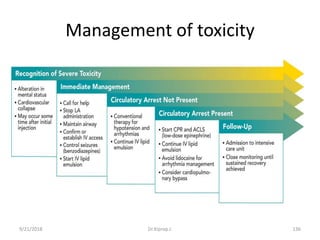
Management of toxicity
9/21/2018 Dr.Kiprop J. 136
References
1. Trevor AJ, Katzung, BG & Maters SB (2007). Katzung & Trevor’s
Basic & Clinical Pharmacology, 11th Edition. Chapter 25, 429-
448. USA. McGraw-Hill.
2. Brunton LL, Chabner BA & Knollmann BC (2011) Goodman &
Gilman's The Pharmacological Basis of Therapeutics, 12th
edition. Chapter 13, 221-240.
3. www.emedicine.Medscape.com/article/0verview.
4. www.drugs.com/...html
9/21/2018 137Dr.Kiprop J.
138
Thank You.
9/21/2018 Dr.Kiprop J.
9/21/2018 Dr. Kiprop. J 139

General and local anesthesia

  • 1.
    GENERAL AND LOCALANAESTHETICS Dr. Jonathan Kiprop Fac. Dr. Gichuhi 30th June, 2017 19/21/2018 Dr.Kiprop J.
  • 2.
  • 3.
    Outline 1. Introduction 2. Overview 3.Pre-anaesthetic medications 4. Inhalation anaesthetics 5. Intravenous anaesthetics 6. Conclusion 9/21/2018 3Dr.Kiprop J.
  • 4.
  • 5.
    Introduction General anaesthesia globalreversible depression of CNS sufficiently to permit performance of surgery. History 1845 Horace Wells: Nitrous oxide 1846 William Morton Dentist: Ether 1846 Crawford Long (Physician): Ether 1930 IV Barbiturates 9/21/2018 5Dr.Kiprop J.
  • 6.
    Conceptual framework • Pre-anaestheticevaluation • Pre-anaesthetic medication • Induction of anaesthesia • Maintenance • Surgery • Reversal/ emergence • Post-operative monitoring 9/21/2018 6Dr.Kiprop J.
  • 7.
    • It isthe administration of drugs prior to general anaesthesia (GA) so as to make anaesthesia safer for the patient. • Ensures comfort to the patient & to minimize adverse effects of anaesthesia Pre-anaesthetic Medication
  • 8.
    Aims • Relief ofanxiety & apprehension pre-operatively & facilitate smooth induction • Amnesia for pre- & post-operative events • Potentiate action of anaesthetics, so less dose is needed 9/21/2018 8Dr.Kiprop J.
  • 9.
    Aims… • Antiemetic effectextending to post-operative period • Decrease secretions & vagal stimulation caused by anaesthetics • Decrease acidity & volume of gastric juice to prevent reflux & aspiration pneumonia
  • 10.
    Drugs used forpre-anesthetic medication • Anxiolytics - Provide relief from apprehension & anxiety - Post-operative amnesia e.g. Diazepam (5-10mg oral), Lorazepam (2mg i.m.) (avoided co- administration with morphine, pethidine)
  • 11.
    Cont.. • Sedatives-hypnotics- - e.g.Promethazine (25mg i.m.) has sedative, antiemetic & anticholinergic action - Causes negligible respiratory depression & suitable for children
  • 12.
    • Anticholinergics- - Atropine(0.5mg i.m.) or Hyoscine (0.5mg i.m.) or Glycopyrrolate (0.1-0.3mg i.m.) one hour before surgery(not used nowadays) - Reduces salivary & bronchial secretions, vagal bradycardia, hypotension - Glycopyrrolate(selective peripheral action) acts rapidly, longer acting, potent antisecretory agent, prevents vagal bradycardia effectively
  • 13.
    • Anti-emetics- - Metoclopramide(10mg i.m.) used as antiemetic & as prokinetic gastric emptying agent prior to emergency surgery - Domperidone (10mg oral) more preferred (does not produce extrapyramidal side effects) - Ondansetron (4-8mg i.v.), a 5HT3 receptor antagonist, found effective in preventing post-anaesthetic nausea & vomiting
  • 14.
    • Drugs reducingacid secretion - - Ranitidine (150-300mg oral) or Famotidine (20-40mg oral) given night before & in morning along with Metoclopramide reduces risk of gastric regurgitation & aspiration pneumonia - Proton pump inhibitors like Omeprazole (20mg) with Domperidone (10mg) is preferred nowadays
  • 15.
    Principles of GA Generalanesthesia is a state characterized by reversible loss of consciousness, analgesia, amnesia, skeletal muscle relaxation, and loss of reflexes. Objectives of General Anaesthetics 1. Sustain physiologic homeostasis during surgery 2. Minimize potentially deleterious effects of anaesthetic agents & techniques 3. Improve post operative outcomes 9/21/2018 15Dr.Kiprop J.
  • 16.
    Cont.. • Ideal anaestheticdrug – Induce rapid and smooth loss of consciousness – Rapidly reversible upon discontinuation – Possess wide margin of safety • None of the agents can achieve all the desired effects when used alone. 9/21/2018 16Dr.Kiprop J.
  • 17.
    Important terms • Balancedanesthesia: Anesthesia produced by a mixture of drugs, often including both inhaled and intravenous agents – Rationale…take advantage of favourable properties of each agent while minimizing the SE • Inhalation anesthesia: Anesthesia induced by inhalation of drug • Minimum Alveolar Anesthetic Concentration (MAC): The alveolar concentration of an anesthetic that is required to prevent a response to a standardized painful stimulus in 50% of patients. 9/21/2018 17Dr.Kiprop J.
  • 18.
    Important terms • Analgesia:A state of decreased awareness of pain, sometimes with • Amnesia: partial or total loss of memory • Induction: administration of a drug or combination of drugs at the beginning of an anaesthetic that results in a state of general anaesthesia…upto surgical anaesthesia plane 2 9/21/2018 18Dr.Kiprop J.
  • 19.
  • 20.
    Stages of Anesthesia •Modern anesthetics act very rapidly and achieve deep anesthesia quickly. • With older and more slowly acting anesthetics, the progressively greater depth of central depression associated with increasing dose or time of exposure is traditionally described as stages of anesthesia. • Stage 1: Analgesia – In stage 1, the patient has decreased awareness of pain, sometimes with amnesia. Consciousness may be impaired but is not lost. Normal reflexes but eyelash reflex may be abolishded 9/21/2018 20Dr.Kiprop J.
  • 21.
    Stages of Anaesthesia •Stage 2: Disinhibition/excitement – the patient appears to be delirious and excited. Amnesia occurs, reflexes are enhanced, and respiration is typically irregular; retching and incontinence may occur. Laryngospasm, regurgitation, coughing • Stage 3: Surgical Anesthesia – the patient is unconscious and has no pain reflexes; respiration is very regular, and blood pressure is maintained. • Stage 4: Medullary Depression – patient develops severe respiratory and cardiovascular depression that requires mechanical and pharmacologic support. 9/21/2018 21Dr.Kiprop J.
  • 22.
    Mechanism of Action •Exact mechanism unknown • Affects neurons at various cellular location- synapse – Presynaptic effect - alters the release of neurotransmitters – Post synaptic effect- may change the frequency or amplitude of impulses exiting the synapse. • Organ level: strengthen inhibition or diminishes excitation within the CNS a)Inhibitory ion channels: Cl-and K channels, GABA & glycine. 9/21/2018 22Dr.Kiprop J.
  • 23.
    9/21/2018 23 Anaesthetic drugsmay ↑ inhibitory Synaptic activity or diminish the Excitatory activity. Barbiturates, benzodiazepines propofol potentiate movement of Cl⁻ through the GABAA receptor gated Cl⁻ channels Dr.Kiprop J.
  • 24.
    Cont…  Gycline: Barbiturates,propofol & benzodiazepines b) Excitatory ion channels: activated by ACH (nicotinic & muscarinic receptors), excitatory amino acids ( N-methyl-D- Aspartate (NMDA), or serotonin (5-HT₂ or 5-HT₃).  NMDA receptors blocked by : N₂O & ketamine 9/21/2018 24Dr.Kiprop J.
  • 25.
    B.) Intravenous Anaesthetics a.Fast inducers – i.) Thiopental, Methohexital ii.) Propofol, Etomidate b. Slow inducers – i.) Benzodiazepines – Diazepam, Lorazepam & Midazolam c. Dissociative anaesthesia – Ketamine d. Opioid analgesia – Fentanyl
  • 26.
    • Opioid analgesics- -Morphine (8-12mg i.m.) or Pethidine (50-100mg i.m.) used one hour before surgery - Provide sedation, pre-& post-operative analgesia, reduction in anaesthetic dose - Fentanyl (50-100μg i.m. or i.v.) preferred nowadays (just before induction of anaesthesia)
  • 27.
    Intravenous Anaesthetics 1. Barbiturates 2.Propofol 3. Etomidate 4. Ketamine 9/21/2018 27Dr.Kiprop J.
  • 28.
    Barbiturates 1. Sodium thiopental 2.Thiamylal 3. Methohexital  Formulated as sodium salts & reconstituted in water or isotonic saline to produce alkaline solution, pH10-11  Mixing with more acidic drugs used in induction can result in precipitation of barbiturates  Thus delay administration of other drugs until barbiturates have cleared from IV tubing 9/21/2018 28Dr.Kiprop J.
  • 29.
    Barbiturates  Induction anaesthesia:3-5mg/kg within a minute  duration of anaesthesia 5—8minutes  Neonates & infants requires high induction dose (5—8mg/kg)  Pregnant women & elderly patients require less dose (1— 3mg/kg).  Thiopental & Thiamylal produce little or no pain on injection site  Methohexital elicits mild pain  Veno-irritation can be reduced by injection into a large vein or give lidocaine prior to injection. 9/21/2018 29Dr.Kiprop J.
  • 30.
    Barbiturates cont…  Intra-arterialinjection of thiobarbiturates can induce severe inflammatory & potentially necrotic reaction thus should be avoided.  Thiopental evokes garlic taste prior to inducing anaesthesia  Methohexital & lesser extent other barbiturates can induce excitement phenomena→ muscle tremors, hypertonus & hiccups Pharmacokinetics  Duration of action depends on redistribution  Lipid solubility makes thiopental rapidly acting. 9/21/2018 30Dr.Kiprop J.
  • 31.
    Barbiturates cont…  Halflife 12hours  Highly bound to plasma proteins – 85%  Metabolised in the liver  Renal excretion of inactive metabolites  Small fraction of thiopental undergoes desulfuration to longer acting hypnotic pentobarbital.  Prolonged usage of thiopental & thiamylal can cause coma due to slow elimination & large volume distribution 9/21/2018 31Dr.Kiprop J.
  • 32.
    Barbiturates cont… Systemic Effects CNS:↓ cerebral oxygen consumption in a dose dependant manner ↓ cerebral blood flow & ICP  Thiopental has protective effects against cerebral ischemia & intra-ocular pressure  Effective as anticonvulsants-Rx of status epilepticus CVS: dose-dependant ↓ in BP due to vasodilation, venodilation & lesser in cardiac contractility ↑HR as compensatory response to lower BP 9/21/2018 32Dr.Kiprop J.
  • 33.
    Barbiturates cont… Respiratory System: Respiratory depressant  Induction dose ↓ minute ventilation & tidal volume with smaller & inconsistent ↓ in RR  ↓ reflex responses to hypercarbia & hypoxia  Higher doses or presence of other respiratory depressants such as opioids, can result in apnoea  Safe in asthmatics as it has little effect on bronchomotor tone 9/21/2018 33Dr.Kiprop J.
  • 34.
    Barbiturates cont… Other effects Analgesic effect  Short term administration has no clinically significant effect on hepatic, renal or endocrine system.  Single induction dose does not alter tone of gravid uterus  But may produce transient depression of newborn activity  Drug induced histamine release C/I in pts with acute or variegate porphyria- may produce fatal attacks 9/21/2018 34Dr.Kiprop J.
  • 35.
    Propofol  Most commonlyused IV anaesthetic for induction anaesthesia  Propofol (2,6-diisopropylphenol) alkyl phenol, with hypnotic properties  Poor solubility in H₂O, formulated as an emulsion containing 10% soy-bean oil, 2.25% glycerol & 1.2% lecithin, egg yolk phosphatide fraction  Solution appears milky white & slightly viscous, pH approx 7. MOA: potentiation of chloride current mediated thru’ GABAA receptor 9/21/2018 35Dr.Kiprop J.
  • 36.
    Propofol cont.. Clinical Uses.. 1.Induction anaesthesia: bolus injection of 1-2mg/kg IV 2. Maintenance anaesthesia: allows for continuous infusion 3. Sedation in monitored anaesthetic care sedation in ICU, conscious sedation & short duration GA outside operating room eg interventional radiology suites, emergency room 9/21/2018 36Dr.Kiprop J.
  • 37.
    Propofol cont.. Pharmacokinetics  Rapidlymetabolized in liver – resulting in water soluble inactive metabolites.  High plasma clearance &exceeds hepatic blood flow → extrahepatic metabolism mainly in the lungs. Accounts for up to 30% of bolus.  Excreted in urine  Plasma half life 2-4min, duration of action 3-8 minutes  Highly bound to plasma proteins (97%)  Recovery more complete , no ‘hangover’. Reversal in 8-10min 9/21/2018 37Dr.Kiprop J.
  • 38.
    Propofol cont.. System Effects CNS:hypnotic, no analgesic effects  General suppression of CNS activity , occasional excitatory effects such as twitching or spontaneous movement observed.  Peripheral vasodilation can ↓ cerebral perfusion pressure →  ↓cerebral blood flow, cerebral metabolic rate for O₂, ICP & intra-ocular pressure.  Safe in patients with seizure disorders 9/21/2018 38Dr.Kiprop J.
  • 39.
    Propofol cont.. CVS: mostpronounced ↓ in systemic BP due to Vasodilation in both arterial & venous circulation → ↓ in preload & afterload  Effect more pronounced in elderly, pts with ↓ intravascular fluid volume & rapid injection Respiratory effects  Respiratory depressant generally produces apnoea after induction dose  Maintenance infusion reduces minute ventilation thru’ reduction in tidal volume 9/21/2018 39Dr.Kiprop J.
  • 40.
    Propofol cont..  Reductionin ventilatory response to hypoxia & hypercapnia  Can cause greater reduction in upper airway reflexes thus suitable for instrumentation of airway. NB!! Pts should be monitored to ensure adequate oxygenation & ventilation Others  Significant anti-emetic action  Good for sedation or anaesthesia for pts at high risk for Nausea & vomiting 9/21/2018 40Dr.Kiprop J.
  • 41.
    Ketamine  “Dissociative anaesthetic”patient feels detached from environment & self whilst patient’s eyes remain open with a slow nystagmic gaze  profound analgesia, unresponsive to commands & amnesia.  partially water-soluble & highly lipid soluble phencyclidine derivative  Onset of action 60-90sec IV; 1-2min IM  Duration of induction 10-15min MOA is complex, but the major effect is probably produced through inhibition of the NMDA receptor complex. 9/21/2018 41Dr.Kiprop J.
  • 42.
    Ketamine cont..  notcommonly used for maintenance anaesthesia, its short context-sensitive half-time  Small bolus doses 0.2–0.8 mg/kg IV may be useful during regional anaesthesia.  provides effective analgesia with  It’s usage limited by unpleasant psychotomimetic side effects  potent analgesia with minimal respiratory depression.  adjunct administered at sub-analgesic doses to limit or reverse opioid tolerance 9/21/2018 42Dr.Kiprop J.
  • 43.
    Ketamine cont.. Pharmacokinetics  Multipleadministration routes –IV, IM, oral, rectal, epidural  Metabolism occurs primarily in the liver and involves N - demethylation by the CYP450 system.  Norketamine, the primary active metabolite, is less potent (one third to one fifth the potency of ketamine) subsequently hydroxylated & conjugated into water-soluble inactive metabolites.  inactive metabolite excreted in urine.  Low protein binding (12%) 9/21/2018 43Dr.Kiprop J.
  • 44.
    Ketamine cont.. Systemic Effects amnesia is not as complete as with the benzodiazepines.  Reflexes are often preserved  The eyes remain open and the pupils are moderately dilated with a nystagmic gaze.  Frequently, ↑ lacrimation and salivation  Premedication with an anticholinergic drug 9/21/2018 44Dr.Kiprop J.
  • 45.
    Ketamine cont.. CNS: cerebralvasodilator that ↑cerebral blood flow & cerebral metabolism rate of O₂.  Not recommended for use in patients with intracranial pathology, especially ↑ ICP  potential to produce myoclonic activity but is considered an anticonvulsant & may be recommended for treatment of status epilepticus when more conventional drugs are ineffective.  Limited usage due unpleasant emergence reactions-vivid colourful dreams, hallucinations, out-of-body experiences, and increased and distorted visual, tactile, and auditory sensitivity. Fear & confusion 9/21/2018 45Dr.Kiprop J.
  • 46.
    Ketamine cont..  euphoricstate may also be induced thus the potential for abuse.  Children usually have a lower incidence of & less severe emergence reactions.  Combination with benzodiazepine may limit the unpleasant emergence reactions & also ↑ amnesia. CVS: produce transient but significant ↑in systemic BP, HR and cardiac output, by centrally mediated sympathetic stimulation 9/21/2018 46Dr.Kiprop J.
  • 47.
    Ketamine cont..  ↑cardiac workload and myocardial oxygen consumption, are not always desirable & can be blunted by co-administration of benzodiazepines, opioids, or inhaled anaesthetics. Respiratory Effects: not thought to produce significant respiratory depression.  When singly used, the respiratory response to hypercapnia is preserved and blood gases remain stable.  Transient hypoventilation & rarely, a short period of apnoea can follow rapid administration of a large intravenous dose for induction anaesthesia. 9/21/2018 47Dr.Kiprop J.
  • 48.
    Ketamine cont..  Relaxesbronchial smooth muscles and may be helpful in pts with reactive airways & in the management of pts experiencing bronchoconstriction  Can be used in asthmatics 9/21/2018 48Dr.Kiprop J.
  • 49.
    Ketamine cont.. Clinical Uses Unique characteristics: profound analgesia, stimulation of the sympathetic nervous system, bronchodilation, and minimal respiratory depression.  Rapidly produces hypnotic state  useful option for premedication in mentally challenged and uncooperative paediatric patients.  Used in burn pts, debridement, & skin grafting procedures  Induction anaesthesia achieved with, 1–2 mg/kg IV or 4–6 mg/kg IM 9/21/2018 49Dr.Kiprop J.
  • 50.
    Etomidate  Carboxylated imidazolederivative  Poorly soluble in water thus supplied as 2mg/ml solution on 35% propylene glycol, pH 6.9  MOA: Potentiation of GABAA-mediated chloride currents  IV anaesthetic with hypnotic but no analgesic effects.  Minimal haemodynamic effects  Endocrine side effects limits it’s use for continuous infusions 9/21/2018 50Dr.Kiprop J.
  • 51.
    Etomidate cont.. Clinical Uses Alternativeto propofol and barbiturates for the rapid IV induction of anaesthesia, especially in pts with compromised myocardial contractility. Pharmacokinetics  Induction dose produces rapid onset anaesthesia & recovery depends on redistribution to inactive tissue sites  Highly plasma protein bound (77%) 9/21/2018 51Dr.Kiprop J.
  • 52.
    Etomidate cont..  Metabolismprimarily by ester hydrolysis to inactive metabolite  Excreted in urine (78%) & bile (22%)  ˂3% excreted as unchanged drug  Short elimination half life  Larger doses, repeated boluses or continuous infusion can safely be administered Systemic Effects CNS: potent vasoconstrictor as reflected by ↓ in cerebral blood flow & ICP Effects similar to those of thiopental 9/21/2018 52Dr.Kiprop J.
  • 53.
    Etomidate cont.. CVS: cardiovascularstability after bolus injection  ↓ in systemic BP is modest or absent & reflects ↓in systemic vascular resistance  Systemic BP-lowering effects of etomidate exaggerated in presence of hypovolaemia  Optimization of hypovolemic pts required before induction anaesthesia  Minimal changes in HR & cardiac output  Minimal depressant effects on myocardial contractility 9/21/2018 53Dr.Kiprop J.
  • 54.
    Etomidate cont.. Respiratory System:less pronounced depressant effects on ventilation Apnoea may follow rapid IV injection Depression of ventilation may be exaggerated when combined with inhaled anaesthetic or opioids. Endocrine: adrenocortical suppression by producing dose- dependant inhibition of 11β-hydroxylase, enzyme for conversion of cholesterol to cortisol Suppression last for 4-8hours. 9/21/2018 54Dr.Kiprop J.
  • 55.
    Etomidate cont.. Side effects Pain on injection site followed by venous irritation  Involuntary myoclonic movements common but may be masked by neuromuscular blocking drugs.  Awakening after a single intravenous dose of etomidate is rapid, with little evidence of any residual depressant effects.  postoperative nausea and vomiting may be more common than in thiopental or propofol. 9/21/2018 55Dr.Kiprop J.
  • 56.
    Dexmedetomidine • Recent IVanaesthetic • Highly selective alpha 2 adrenergic agonist at locus caeruleus • Produce sedation, hypnosis, and analgesia • Approved for brief post op sedation upto 24hrs • Minimal effect on resp. 9/21/2018 Dr.Kiprop J. 56
  • 57.
  • 58.
    Conclusion Induction agents Maintenancereversal Opioids: fentanyl Fentanyl, morphine Turn off agents IV: Propofol, Thiopental, etomidate, midazolam propofol Muscle relaxants: short acting: suxamethonium Long acting: tracuronuim, vecuronuim, rocuronuim Inhalation N₂O, Sevo, Deso, Iso 9/21/2018 58Dr.Kiprop J.
  • 59.
    Inhalation anaesthetics 1. Gas:nitrous oxide (N₂O) – Has high vapour pressure but low boiling point. Gas at room temp. 2. Volatile liquids: – Ether – Halothane – Isoflurane 9/21/2018 59Dr.Kiprop J.
  • 60.
  • 61.
    Pharmacokinetics  Distributes betweentissue or between blood and gas, and equilibrium achieved when the partial pressure of the two tissues is equal.  Partial pressure of the anesthetic in tissue is equal to the inspired gas after sufficient inhalation  Thus partition co-efficient is the ratio of anesthetic concentration in two tissues when partial pressures in the two tissues are equal  Blood:Gas, Blood:Brain, Blood:Fat partition coefficient.  This shows that inhalational anesthetics are more soluble in some tissues than in others 9/21/2018 61Dr.Kiprop J.
  • 62.
  • 63.
    Pharmacokinetics  Equilibrium isclinically achieved when partial pressure (PP) in inspired air is equal to the PP in end-tidal (alveolar) gas  Equilibrium is achieved quickly for agents that are not soluble in blood or tissue  Anesthetic induction requires that brain PP be equal to mean alveolar concentration (MAC) 9/21/2018 63Dr.Kiprop J.
  • 64.
    Pharmacokinetics  Due togood brain perfusion, anesthetic PP in brain becomes equal to PP in alveolar gas & in blood within few minutes  Rate of rise of PP is slower for anesthetics that are soluble in blood and other tissue 9/21/2018 64Dr.Kiprop J.
  • 65.
    Pharmacokinetics Anaesthetic Blood: Gas partition coefficient Blood:Brain partition coefficient MAC Comment Nitrous oxide 0.47 1.1 ˃100 Low solubility Rapid onset & recovery Desflurane 0.42 1.3 6-7 Poor induction agent, rapid recovery Sevoflurane 0.69 1.7 2.0 Rapid onset & recovery Isoflurane 1.40 2.6 1.40 Medium onset & recovery Enflurane 1.80 1.4 1.7 Medium onset & recovery Halothane 2.30 2.9 0.75 High solubility Medium onset & recovery 9/21/2018 65Dr.Kiprop J.
  • 66.
    1. Nitrous Oxide(N₂O) “Laughing gas” Colourless, odourless gas @ room temp Non-flammable nor explosive but supports combustion Weak anaesthetic agent Pharmacokinetics : Insoluble in blood & other tissues Rapidly reaches equilibrium btn gas delivery & alveolar anaesthetic conc → rapid induction 9/21/2018 66Dr.Kiprop J.
  • 67.
    N₂O cont.. Can becombined with halogenated IV anaesthetics to speed induction anaesthesia Rapid emergence following discontinuation Discontinuation may lead to diffusional anoxia/hypoxia ..by affecting oxygenation by directly displacing oxygen,or by diluting alveolar carbondioxide thus may decrease respiratory drive and ventilation. Critical in the first 5-10 minutes . Term coined Fink. 9/21/2018 67Dr.Kiprop J.
  • 68.
    N2O To avoid hypoxia,100% O₂. 99% eliminated unchanged via lungs Interact with Vit B₁₂ → megaloblastic anaemia & peripheral neuropathy 9/21/2018 Dr.Kiprop J. 68
  • 69.
    9/21/2018 69 N₂O: ClinicalUses 1. Weak anaesthetic agent 2. Analgesia @ low conc. 3. Sedation at 50% conc. → dental procedures 4. Used as adjunct to other anaesthetics Systemic Effects: CVS: depressant effects on cardiac function generally are not observed in pts b/coz of the stimulatory effects of N₂O on the sympathetic nervous system Dr.Kiprop J.
  • 70.
    N₂O cont… When co-administeredwith halogenated inhalational anaesthetics, it generally produces an ↑ in HR, arterial BP, and cardiac output. Co-administration with an opioid will generally ↓ arterial BP & cardiac output.  increases venous tone in both the peripheral and pulmonary vasculature. Should not be used in patients pre-existing pulmonary hypertension. 9/21/2018 70Dr.Kiprop J.
  • 71.
    9/21/2018 71 Respiratory System: ↑respiratory rate, ↓ in tidal volume in spontaneously breathing patients.  Even modest conc. of N₂O markedly depress the ventilatory response to hypoxia. CNS: Administered alone, it can significantly ↑ cerebral blood flow and ICP.  Co-administered with IV anaesthetic agents, increases in cerebral blood flow are attenuated or abolished.  When added to a halogenated inhalational anaesthetic, its vasodilatory effect on the cerebral vasculature is slightly reduced Dr.Kiprop J.
  • 72.
    N₂O cont.. Muscle: doesnot relax skeletal muscle or enhance the effects of neuromuscular blocking drugs.  N₂O does NOT trigger malignant hyperthermia. Kidney, Liver, and Gastrointestinal Tract  Nitrous oxide is neither nephrotoxic nor hepatotoxic  Note Nitrous oxide is relatively contraindicated in cases of intestinal obstruction or pneumothorax. 9/21/2018 72Dr.Kiprop J.
  • 73.
    2. Halothane  HalogenatedVolatile liquid , light sensitive  Inflammable nor explosive when mixed with O₂ or air Pharmacokinetics  High fat soluble, high blood :gas coefficient (2.3)  Slow induction & recovery  Eliminated unchanged via lungs  Metabolized in liver by CYP450 into trifluoroacetylchloride metabolite 9/21/2018 73Dr.Kiprop J.
  • 74.
    Halothane cont.. Clinical Uses Potent, non-pungent anaesthetic & well tolerated for maintenance anaesthesia  Used for induction especially in children Systemic Effects CVS: Dose dependant ↓ in arterial blood pressure directly depressed myocardial contractility 9/21/2018 74Dr.Kiprop J.
  • 75.
    Halothane cont..  ↓mean arterial pressure about 20—25% at MAC.  Induce reduction on BP & HR → disappear several hours after administration b/coz of progressive sympathetic stimulation.  Sinus bradycardia & atrioventricular rhythms due to direct depressive effects on SAN Respiratory System: spontaneous respiration rapid & shallow ↓ alveolar ventilation → ↑ arterial CO₂ tension from 40mmHg ˃ 50mmHg at 1MAC. 9/21/2018 75Dr.Kiprop J.
  • 76.
    Halothane cont..  Inhibitsperipheral chemoreceptor responses to arterial hypoxemia→ no tachycardia &hypertension. CNS: dilates cerebral vasculature, ↑ cerebral blood flow → ↑ICP especially in pts with space occupying lesions, oedema, ↑ICP Attenuates auto-regulation of cerebral flow Muscle: muscle relaxation via central depressant effects  potentiates actions of non-depolarized muscle relaxants by ↑ duration of action & magnitude of effects 9/21/2018 76Dr.Kiprop J.
  • 77.
    Halothane cont..  Triggermalignant hyperthermia: heritable genetic disorder of muscle characterized by muscle rigidity, hyperthermia, rapid onset of tachycardia & hypercapnia  Rx: dantrolene; immediate discontinue procedure  Relaxes uterine smooth muscles- help to manipulation of foetus in prenatal period or removal of retained placenta Kidney, liver & GIT:  Reduced concentrated urine due to halothane-induced reduction of renal blood flow & GFR 9/21/2018 77Dr.Kiprop J.
  • 78.
    Halothane cont..  Notassociated with nephrotoxicity  ↓ splanchnic & hepatic blood flow  Fulminant hepatic necrosis→ fever, anorexia, nausea & vomiting, rash & peripheral eosinophilia; develops several days after anaesthesia  Halothane hepatitis → immune response to hepatic proteins that become trifluoroacetylated as a result of halothane metabolism 9/21/2018 78Dr.Kiprop J.
  • 79.
    3. Isoflurane  Volatileliquid  Neither flammable nor explosive  Pungent odour Pharmacokinetics  Low blood: gas partition coefficient, lower than that of halothane (1.4)  Induction & recovery are relatively rapid  ˃99% excreted unchanged in lungs  Does not appear to be mutagenic, teratogenic or carcinogenic 9/21/2018 79Dr.Kiprop J.
  • 80.
    Isoflurane cont.. Clinical Uses Maintenance GA  Induction can be achieved in ˂10min with inhaled conc. of 3% isoflurane in O₂  Drugs such as opioids, N₂O decreases conc. required for GA. 9/21/2018 80Dr.Kiprop J.
  • 81.
    Isoflurane cont.. Systemic Effects CVS:Conc - dependant ↓ in arterial BP, cardiac output maintained & hypotension result in ↓ systemic vascular resistance.  Vasodilation in most vascular beds eg skin & muscle  Coronary vasodilator →↑coronary blood flow &↓ myocardial O₂ consumption  Mildly elevated HR as compensatory response to ↓blood pressure 9/21/2018 81Dr.Kiprop J.
  • 82.
    Isoflurane cont.. Rapid changesin isoflurane conc. can produce transient tachycardia & hypertension due to isoflurane- induced sympathetic stimulation. Respiratory System: Pts spontaneously breathing isoflurane have a normal RR but a reduced tidal volume, resulting in a marked reduction in alveolar ventilation and an ↑ in arterial CO₂ tension  Depresses the ventilatory response to hypercapnia & hypoxia  Effective bronchodilator  Airway irritant & can stimulate airway reflexes such as coughing & laryngospasm during induction 9/21/2018 82Dr.Kiprop J.
  • 83.
    9/21/2018 83 CNS: ↓cerebral metabolic O₂ consumption  Causes less cerebral vasodilation  Preferred for neurological procedures  Effects on cerebral blood flow can be reversed with hyperventilation. Muscles: skeletal muscle relaxation via central effects  Enhances effects of depolarizing & non depolarizing muscle relaxants  Relaxes uterine smooth muscles Kidney, Liver & GIT: ↓ splanchnic hepatic & renal blood flow & GFR Dr.Kiprop J.
  • 84.
    4.Sevoflurane  Clear, colourlessvolatile liquid  Non-flammable and non-explosive in mixtures of air or oxygen.  It can undergo an exothermic reaction with desiccated CO₂ absorbent to produce airway burns or spontaneous ignition, explosion, and fire.  Sevoflurane reaction with desiccated CO₂ absorbent also can produce CO → serious patient injury 9/21/2018 84Dr.Kiprop J.
  • 85.
    Sevoflurane cont.. Pharmacokinetics  Lowsolubility in blood & other tissues thus rapid induction anaesthesia, & rapid emergence following discontinuation  3% of absorbed sevoflurane is biotransformed by CYP2E1 to lexafluoroisopropanol & organic fluoride  Interaction with soda lime (CO₂) absorbent produces pentafluoroisopropenyl fluoromethyl ether 9/21/2018 85Dr.Kiprop J.
  • 86.
    Sevoflurane cont.. Clinical Uses Inhalation induction anaesthesia especially in children because it is not irritating to the airway  Used in outpatient anaesthesia due to its rapid recovery profile Systemic Effects CVS:  Hypotensive effect due to systemic vasodilation  Produces a conc-dependent ↓ in cardiac output.  Unlike isoflurane or desflurane, it does not produce tachycardia and thus may be a preferable agent in patients prone to MI. 9/21/2018 86Dr.Kiprop J.
  • 87.
    Sevoflurane cont.. Respiratory system:conc- dependant ↓ in tidal volume & ↑ RR in spontaneously breathing patients.  Not irritating to airway  Potent bronchodilator CNS: effects similar to isoflurane & desflurane.  ↑ ICP in pts with poor intracranial compliance response to hypocapnia is preserved during sevoflurane anaesthesia,  increases in ICP can be prevented by hyperventilation. 9/21/2018 87Dr.Kiprop J.
  • 88.
    Sevoflurane cont.. Muscle:  Producesskeletal muscle relaxation  Enhances the effects of non-depolarizing & depolarizing neuromuscular blocking agents. Kidney, Liver & GIT  potential nephrotoxicity of compound A (pentafluoroisopropenyl fluoromethyl ether).  FDA recommends that sevoflurane be administered with fresh gas flows of at least 2 L/min to minimize accumulation of compound A.  no evidence of renal impairment or hepatic toxicity 9/21/2018 88Dr.Kiprop J.
  • 89.
    5. Enflurane  Clear,colorless, non-flammable & non-explosive liquid  Mild sweet odor, volatile  Halogenated ether & structural isomer of isoflurane Pharmacokinetics  Administered by vaporizing  Blood: gas partition coefficient (1:8), relatively slow induction & recovery.  2-8% of absorbed enflurane metabolized by hepatic CYP2E1 9/21/2018 89Dr.Kiprop J.
  • 90.
    Enflurane cont..  Metaboliteby-product as fluoride but low & non-toxic.  Isoniazid enhances metabolism of enflurane which ↑ serum fluoride. Clinical Use  Mainly in maintenance of GA  Can induce GA in ˂10 minutes  Conc. required to produce anaesthesia ↓ when co- administered with N₂O or opioids 9/21/2018 90Dr.Kiprop J.
  • 91.
    Enflurane cont.. Systemic Effects CVS:conc- dependant ↓ in arterial BP due to depression of myocardial contractility & peripheral resistance  Minimal effects on HR Respiratory System: similar to those of halothane  Greater depression of ventilatory response to hypoxia & hypercarbia  Effective bronchodilator 9/21/2018 91Dr.Kiprop J.
  • 92.
    Enflurane cont.. CNS: cerebralvasodilator, ↑ICP in some patients  ↓cerebral metabolic O₂ consumption may produce electrical seizure activity. Seizures are self-limiting C/I: pts with seizure disorders Muscle: significant skeletal muscle relaxation  Enhances effects of non-depolarizing muscle relaxants  Malignant hyperthermia can occur  Relaxes uterine smooth muscles & may ↑ uterine bleeding. 9/21/2018 92Dr.Kiprop J.
  • 93.
    Enflurane cont.. Kidney, Liver& GIT  Reduce renal blood flow, GFR and urine volume  Effects reversed with discontinuation  ↓ splanchnic & hepatic blood flow in proportion to reduced arterial blood but does not appear to alter liver function or be hepatotoxic 9/21/2018 93Dr.Kiprop J.
  • 94.
    6.Desflurane  Highly volatileliquid at room temp.  Delivery of precise conc. requires use of special heated vaporizer that delivers pure vapour then diluted appropriately with other gases (O₂, air or N₂O)  Non-flammable & non-explosive in mixtures of air or O₂ Pharmacokinetics  Partitions poorly into blood, fat, and other peripheral tissues.  Alveolar & blood conc. rapidly rise to level of inspired conc thus 9/21/2018 94Dr.Kiprop J.
  • 95.
    Desflurane cont..  Providevery rapid induction, and rapid emergence from anaesthesia.  Minimally metabolized  ˃ 99% of absorbed desflurane is eliminated unchanged via the lungs. Clinical Uses  Maintenance anaesthesia in adults & children  Used for outpatient surgical procedures b/coz of fast induction & recovery 9/21/2018 95Dr.Kiprop J.
  • 96.
    Desflurane cont..  Irritatesthe airway in awake pts provoking coughing, salivation & bronchospasm. Systemic Effects CVS: ↓ arterial BP progressively with depth of anesthesia by decreasing systemic vascular resistance  Cardiac output preserved & perfusion in major organ beds eg splanchnic, renal, cerebral & coronary.  Marked ↑HR occurs during induction & with abrupt ↑ in delivery conc. which results from desflurane –induced stimulation of sympathetic Nervous system 9/21/2018 96Dr.Kiprop J.
  • 97.
    Desflurane cont.. Respiratory System:↑ respiratory depression as conc. increases & ↓ in tidal volume  Tachypnoea less common in comparison to halothane Bronchodilation CNS:  Frank seizures  Does not aggravate seizures in epileptic patients  Reduces cerebral oxygen consumption  Vasodilation ↑ cerebral blood flow & ↑ ICP 9/21/2018 97Dr.Kiprop J.
  • 98.
    Desflurane cont.. Muscle: • Directskeletal muscle relaxation ↑ with depth of anesthesia • Enhances effects of depolarizing & non-depolarizing neuromuscular blocking agents • Uterine muscle relaxation Kidney: • Reduce renal blood flow, GFR and urine volume • Nephrotoxicity Liver: no hepatotoxicity 9/21/2018 98Dr.Kiprop J.
  • 99.
  • 100.
    Introduction • Local anaestheticagents reversibly block impulse conduction along nerve axons and other excitable membranes. • Local anesthesia is the condition that results when sensory transmission from a local area of the body to the CNS is blocked. • Methods of administration: – Nerve Block – Infiltration – Topical 9/21/2018 100Dr.Kiprop J.
  • 101.
  • 102.
    Classification AMIDES ESTERS • LidocaineCocaine • Bupivacaine Procaine • Ropivacaine Tetracaine • Dibucaine Benzocaine • Prilocaine Amethocaine • Etidocaine • Mepivacaine 9/21/2018 102Dr.Kiprop J.
  • 103.
  • 104.
    Local Anaesthetics Esters • Unstablein solution • Fast-onset • Short acting • Allergic-reactions common Amides • Slow-onset • Long-acting 9/21/2018 104Dr.Kiprop J.
  • 105.
    Classification— Duration ofAction 9/21/2018 105 short • procaine • chloroprocaine medium • Lidocaine, mepivacaine, articaine(fast-onset) • Prilocaine long • Tetracaine, etidocaine • Bupivacaine, ropivacaine, levobupivacaine Dr.Kiprop J.
  • 106.
    Introduction: Chemistry • Eachlocal anaesthetic agent consists of lipophilic group connected via ester/amide to an ionized group. • Esters are prone to hydrolysis therefore shorter duration of action • LAs are weak bases • They exist as either uncharged base/ cation • Cation is more active at receptor site since it cannot readily escape from closed channels • Uncharged form penetrates membranes faster 9/21/2018 106Dr.Kiprop J.
  • 107.
    Mechanism of Action •Local anaesthetics act mainly by inhibiting Na+ influx in neuronal cell membrane. They block voltage-gated Na+ channels. • Influx of Na+ is interrupted thus no action potential. • Hence no impulse from 1st order neuron 9/21/2018 107Dr.Kiprop J.
  • 108.
  • 109.
    Local Anaesthetics • LAgain access to their receptors from cytoplasm or plasma membrane • Non-ionized form reaches effective intracellular levels • Ionized form more effective 9/21/2018 109Dr.Kiprop J.
  • 110.
  • 111.
    Cont.. • Affinity forreceptors depends on state of channel itself. • High concentrations of K+ enhance LA activity • High conc. of Ca2+ antagonize LA • Inflammation reduces effects of LA because a smaller % LA is non-ionized & available across membrane • This is perhaps due to peroxynitrite 9/21/2018 111Dr.Kiprop J.
  • 112.
    Pharmacokinetics • Local anestheticsare usually administered by injection into dermis and soft tissues located in the area of nerves. • Absorption and distribution are not as important in controlling the onset of effect as in determining the rate of offset of local analgesia, and the likelihood of CNS and cardiac toxicity. • Topical application of local anesthetics (eg, transmucosal or transdermal) requires drug diffusion for both onset and offset of anesthetic effect. 9/21/2018 112Dr.Kiprop J.
  • 113.
    Cont.. • Onset ofaction may be accelerated by the addition of sodium bicarbonate, which enhances intracellular access of these weakly basic compounds. • Articaine has the fastest onset of action. 9/21/2018 Dr.Kiprop J. 113
  • 114.
    Absorption • Systemic absorptionof injected local anesthetic from the site of administration is determined by several factors, including dosage, site of injection, drug-tissue binding, local blood flow, use of vasoconstrictors and the physicochemical properties of the drug itself. • Highly vascularity results in more rapid absorption and thus higher blood levels. • Poorly perfused tissue such as tendon, dermis, or subcutaneous fat results in prolonged local effect. 9/21/2018 114Dr.Kiprop J.
  • 115.
    Vasoconstictors • For regionalanesthesia involving block of large nerves, maximum blood levels of local anesthetic decrease according to the site of administration in the following order: intercostal (highest) > caudal > epidural > brachial plexus > sciatic nerve (lowest). • Vasoconstrictor reduce systemic absorption of local anesthetics from the injection site by decreasing blood flow in these areas. It enhances and prolongs the DOA of the drug. 9/21/2018 115Dr.Kiprop J.
  • 116.
    Vasoconstictors • Vasoconstrictors areless effective in prolonging anesthetic action of the more lipid-soluble, long-acting drugs (eg, bupivacaine and ropivacaine), possibly because these molecules are highly tissue-bound. • Cocaine is unique owing to its intrinsic sympathomimetic properties. 9/21/2018 116Dr.Kiprop J.
  • 117.
    Distribution • The amidelocal anesthetics are widely distributed after intravenous bolus administration. • There is also evidence that sequestration can occur in lipophilic storage sites (eg, fat). • It has an initial rapid distribution phase, which consists of uptake into highly perfused organs such as the brain, liver, kidney, and heart, followed by • A slower distribution phase occurs with uptake into moderately well-perfused tissues, such as muscle and GIT 9/21/2018 117Dr.Kiprop J.
  • 118.
    Metabolism and Excretion •Converted into water soluble metabolites and excreted in urine. • Amides in the liver and esters in plasma • Since local anesthetics in the uncharged form diffuse readily through lipid membranes, little or no urinary excretion of the neutral form occurs. • Acidification of urine promotes ionization of the tertiary amine base to the more water-soluble charged form, which is more readily excreted. 9/21/2018 118Dr.Kiprop J.
  • 119.
    Metabolism and Excretion •Ester-type local anesthetics are hydrolyzed very rapidly in the blood by circulating butyrylcholinesterase (pseudocholinesterase) to inactive metabolites. • Therefore, procaine and chloroprocaine have very short plasma half-lives (< 1 minute). • The amide linkage of amide local anesthetics is hydrolyzed by liver microsomal cytochrome P450 isozymes. 9/21/2018 119Dr.Kiprop J.
  • 120.
    Metabolism and Excretion •variable rate of liver metabolism of individual amide compounds, the approximate order being prilocaine (fastest) > lidocaine > mepivacaine > ropivacaine > bupivacaine and levobupivacaine (slowest). • Toxicity from amide-type local anesthetics is more likely to occur in patients with hepatic disease. • Decreased hepatic elimination of local anesthetics with reduced hepatic blood flow. 9/21/2018 120Dr.Kiprop J.
  • 121.
    Pharmacodynamics • The blockadeof sodium channels by most local anesthetics is both voltage- and time-dependent: • Channels in the rested state, which predominate at more negative membrane potentials, have a much lower affinity for local anesthetics than activated (open state) and inactivated channels, which predominate at more positive membrane potentials 9/21/2018 121Dr.Kiprop J.
  • 122.
    B. Structure-Activity CharacteristicsOf Local Anesthetics • The smaller and more lipophilic the local anesthetic, the faster the rate of interaction with the sodium channel receptor. • Potency is also positively correlated with lipid solubility • Lidocaine, procaine, and mepivacaine are more water-soluble than tetracaine, bupivacaine, and ropivacaine. • The latter agents are more potent and have longer durations of local anesthetic action. 9/21/2018 122Dr.Kiprop J.
  • 123.
    Cont.. • These long-actinglocal anesthetics also bind more extensively to proteins and can be displaced from these binding sites by other protein-bound drugs. • In the case of optically active agents (eg, bupivacaine), the S(+)isomer can usually be shown to be moderately more potent than the R(-) isomer. 9/21/2018 123Dr.Kiprop J.
  • 124.
    C. Other ActionsOn Nerves • Local anesthetics are capable of blocking all nerves, their actions are not limited to the desired loss of sensation. • Motor paralysis may limit the ability of the patient to cooperate during obstetric delivery or ambulate after outpatient surgery. • During spinal anesthesia, motor paralysis may impair respiratory activity. • Residual autonomic blockade interferes with bladder function resulting in urinary retention and may cause hypotension 9/21/2018 124Dr.Kiprop J.
  • 125.
    Cont.. • Differential sensitivityof various types of nerve fibers to local anesthetics depends on fiber diameter, myelination, physiologic firing rate, and anatomic location. • In general, smaller fibers are blocked more easily than larger fibers, and myelinated fibers are blocked more easily than unmyelinated fibers. • Fibres at the periphery are blocked first due to early exposure to higher conc. of LA 9/21/2018 125Dr.Kiprop J.
  • 126.
  • 127.
    Other Tissues • Weakblocking effects on skeletal muscle neuromuscular transmission, but these actions have no clinical application. • The mood elevation induced by cocaine reflects actions on dopamine or other amine-mediated synaptic transmission in the CNS rather than a local anesthetic action on membranes. 9/21/2018 127Dr.Kiprop J.
  • 128.
    Clinical Uses • Minorsurgical procedures. • Local anesthetics are also used in spinal anesthesia and to produce autonomic blockade in ischemic conditions • Slow epidural infusion at low concentrations has been used successfully for postoperative analgesia….tachyphylaxis • Intravenous local anesthetics may be used for the perioperative period analgesia. • Parenteral forms of local anesthetics are sometimes used adjunctively in neuropathic pain states. 9/21/2018 128Dr.Kiprop J.
  • 129.
    Toxicity CNS Effects • Theimportant toxic effects of most local anesthetics are in the CNS. • All local anesthetics are capable of producing a spectrum of central effects, including light-headedness or sedation, restlessness, nystagmus, and tonic-clonic convulsions. • Severe convulsions may be followed by coma with respiratory and cardiovascular depression. 9/21/2018 129Dr.Kiprop J.
  • 130.
    Toxicity Cardiovascular Effects • Withthe exception of cocaine, all local anesthetics are vasodilators. • Patients with pre-existing cardiovascular disease may develop heart block and other disturbances of cardiac electrical function at high plasma levels of local anesthetics. • Bupivacaine, a racemic mixture of two isomers may produce severe cardiovascular toxicity, including arrhythmias and hypotension. The (S)isomer, levobupivicaine, is less cardiotoxic. 9/21/2018 130Dr.Kiprop J.
  • 131.
    Cont… • Cardiotoxicity hasalso been reported for ropivicaine. • The ability of cocaine to block norepinephrine reuptake at sympathetic neuroeffector junctions and the drug's vasoconstricting actions contribute to cardiovascular toxicity. • When cocaine is used as a drug of abuse, its cardiovascular toxicity includes severe hypertension with cerebral hemorrhage, cardiac arrhythmias, and myocardial infarction. 9/21/2018 131Dr.Kiprop J.
  • 132.
    Cont.. • Prilocaine ismetabolized to products that include o-toluidine, an agent capable of converting hemoglobin to methemoglobin. Though tolerated in healthy persons, even moderate methemoglobinemia can cause decompensation in patients with cardiac or pulmonary disease. • The ester-type local anesthetics are metabolized to products that can cause antibody formation in some patients. 9/21/2018 132Dr.Kiprop J.
  • 133.
    Cont.. • Allergic responsesto local anesthetics are rare and can usually be prevented by using an agent from the amide subclass. • Local neurotoxic action in high conc. that includes histologic damage and permanent impairment of function. 9/21/2018 133Dr.Kiprop J.
  • 134.
    Toxicity • With theexception of cocaine, all local anesthetics are vasodilators. • Cocaine leads to vasoconstrition & hypertension. Hence ulceration. • Resuscitation from bupivacaine toxicity is by propofol • Pregnancy increases susceptibility to LA toxicity 9/21/2018 134Dr.Kiprop J.
  • 135.
    Treatment of Toxicity •Severe toxicity is treated symptomatically; there are no antidotes. • Convulsions are usually managed with intravenous diazepam or a short-acting barbiturate such as thiopental. • Occasionally, a neuromuscular blocking drug may be used to control violent convulsive activity. • Hyperventilation with oxygen is helpful. • The cardiovascular toxicity of bupivacaine overdose is difficult to treat and has caused fatalities in healthy young adults. 9/21/2018 135Dr.Kiprop J.
  • 136.
  • 137.
    References 1. Trevor AJ,Katzung, BG & Maters SB (2007). Katzung & Trevor’s Basic & Clinical Pharmacology, 11th Edition. Chapter 25, 429- 448. USA. McGraw-Hill. 2. Brunton LL, Chabner BA & Knollmann BC (2011) Goodman & Gilman's The Pharmacological Basis of Therapeutics, 12th edition. Chapter 13, 221-240. 3. www.emedicine.Medscape.com/article/0verview. 4. www.drugs.com/...html 9/21/2018 137Dr.Kiprop J.
  • 138.
  • 139.

Editor's Notes

  • #6 Surgery was performed under GA ether in 1842 but public demonstartion was done in 1846
  • #11 Morphine and pethidine….RESPIRATORY DEPRESSION
  • #15 Recently, dexmedetomidine, a centrally active α2 receptor agonist has been introduced to sedate critically ill patients on ventilator in intensive care unit & even prior to anaesthesia. Blunts sympathetic response to surgery & stress does not depress ventilation & reduces anaesthetic as well as opioid requirement
  • #18 MAC vary with age, cardiovascular status, and use of adjuvant drugs. When two agents are used then the MAC is additive. MAC is expressed as a percentage of the inspired gas mixture. It is a std used to measure the potency of GA
  • #21 Observed by Guedel in 1937 in unpremedicated patients on diethyl ether with prolonged induction.
  • #22 Surgical anaesthesia has 4 planes Plane 1 - Rowing movements of eyeballs, later gets fixed. Eyes centrally placed, loss of conjunctival reflexes, pupils normal or small, increased lacrimation Plane 2 - Loss of corneal & laryngeal reflexes, regular deep breathing, pupillary dilatation, surgical procedures performed in this plane, lacrimation Plane 3 - Pupil starts dilating, light reflex lost - Marked muscle relaxation - Respiration mainly abdominal, shallow breathing, complete intercostal muscles paralysis - Eyeball movement absent Depression of lacrimation, Plane 4 - Complete muscle relaxation - Intercostal paralysis, shallow abdominal respiration - Complete loss of light, corneal & laryngeal reflexes Complete diaphragmatic paralysis, depression of cranial nerves stage 4..overdose, apnoea, pupils maximally dilated
  • #23 Spinal cord excitatory effects are impaired more than the inhibitory effects being potentiated
  • #26 Halogenated hydrocarbons..
  • #42 Dissociative anesthesia is a form of anesthesia characterized by catalepsy, catatonia, analgesia, and amnesia. It does not necessarily involve loss of consciousness and thus does not always imply a state of general anesthesia.
  • #54 Rapid offset
  • #60 Important to distinguish between gaseous and volatile anaesthetics. Volatile anaesthetics have low vapour pressures and a high boiling point and are liguid at room temperatures of 20 degrees at sea level.
  • #62 Blood: gas partition coefficient is a useful index of solubility and defines the relative affinity of an agt to blood compared to gas.. Lower value mean less molecules needed to raise the partial pressure in blood…rapid equilibration in the brain and thus faster onset of action..
  • #64 Uptake and distribution depends on solubility, anaesthetic conc. In inspired gas, pulmonary ventilation, pulmonary blood flow, arteriovenous coc. gradient,
  • #65 Methoxyflurane has a blood: gas coefeicient of 12.
  • #66 Nitrous oxide 104. MAC is expressed as a percentage. Most patients respond to 1.2 MAC 95% .
  • #67 Why inflammable or not…electrocautery and possible fire if used
  • #68 Decrease in alveolar oxygen tension when room air is inhaled at the conclusion of nitrous oxide anesthesia, because nitrous oxide diffusing out of the blood dilutes the alveolar oxygen..
  • #72 Second gas effect: N2O can concentrate the halogenated anesthetics in the alveoli when they are concomitantly administered because of its fast uptake from the alveolar gas.  Diffusion hypoxia: speed of N2O movement allows it to retard oxygen uptake during recovery.
  • #73 Malignant hyperthermia…defective ryanodine receptor. ..hypermetabolic state…increased intracellular Ca2+..can be triggered by GA and succinylcholine
  • #77  High ICP= SECONDARY BRAIN DAMAGE
  • #78 Rhabdomyolysis…hyperkalemia, increaded creatine kinase and oedema..myologlobimea which may damage the kidney, Dantrolene..inhibits the release of Ca from SR and reverses the process. DIC due to release of plasma thromboplastin Acidosis..cerebral oedema, compartment syndrome, death…
  • #79 H=H halothane= hepatotoxicity…..halothane hepatitis …reaction to neoantigen…
  • #82 Coronary steal syndrome
  • #101 Iontophoresis, also known as Ionization, is a physical process in which ions flow diffusively in a medium driven by the use of an electric current.
  • #103 Prilocaine, etidocaine also amides
  • #108 No generation or disruption of conduction of an electrical impulse
  • #109 Channelopathies can interrupt the mutation mechanism. Sodium channel blockers (eg, local anesthetics) bind more readily to open (activated) or inactivated sodium channels.
  • #112 Inflammation frequently decreases local anesthetic effects, especially in dental anesthesia in patients with pulpitis and periodontitis. The pharmacokinetics and the mode of action of local anesthetics are closely associated with the hydrophobic interactions between these drugs and lipid bilayers that change the membrane physicochemical property, fluidity. A lipid oxidant, peroxynitrite, is produced by inflammatory cells, and it may act on nerve cell membranes and affect anesthetic efficacy. With respect to this speculated action, we addressed whether peroxynitrite acted on membrane-constituting lipids to decrease the membrane interactivity of lidocaine. Membrane fluidity changes were determined by measuring the fluorescence polarization of liposomes prepared with different phospholipids.
  • #116 Epineprine may worsen existing HPN,
  • #129 Repeated epidural injection in anesthetic doses may lead to tachyphylaxis.
  • #134 Sodium channel blockers (eg, local anesthetics) bind more readily to open (activated) or inactivated sodium channels.
  • #135 The proposed mechanism is that lipid infusion creates a lipid phase that extracts the lipid-soluble molecules of the local anesthetic from the aqueous plasma phase (lipid sink hypothesis). A beneficial energetic-metabolic effect may also occur. An in vitro study demonstrated high solubility of local anesthetics in lipid emulsions and high binding capacity of these emulsions.
  • #137 The proposed mechanism is that lipid infusion creates a lipid phase that extracts the lipid-soluble molecules of the local anesthetic from the aqueous plasma phase (lipid sink hypothesis). A beneficial energetic-metabolic effect may also occur. An in vitro study demonstrated high solubility of local anesthetics in lipid emulsions and high binding capacity of these emulsions.