
GENDER ROLES PRESENTATION
Meng Small
MTE506
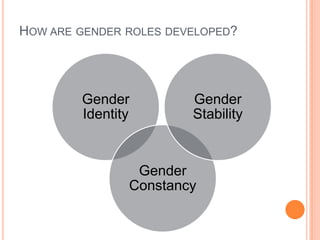
How are gender roles developed?
When are gender roles adopted?
What influences shape perceptions of
gender roles?
How might gender identity change from
early childhood through adolescence?
What observable behaviors might indicate
changes in gender identity?
HOW ARE GENDER ROLES DEVELOPED?
Gender
Identity
Gender
Constancy
Gender
Stability
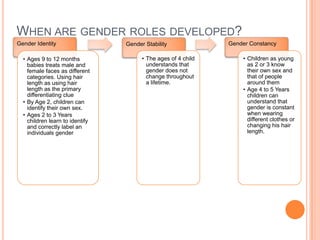
WHEN ARE GENDER ROLES DEVELOPED?
Gender Identity
• Ages 9 to 12 months
babies treats male and
female faces as different
categories. Using hair
length as using hair
length as the primary
differentiating clue
• By Age 2, children can
identify their own sex.
• Ages 2 to 3 Years
children learn to identify
and correctly label an
individuals gender
Gender Stability
• The ages of 4 child
understands that
gender does not
change throughout
a lifetime.
Gender Constancy
• Children as young
as 2 or 3 know
their own sex and
that of people
around them
• Age 4 to 5 Years
children can
understand that
gender is constant
when wearing
different clothes or
changing his hair
length.
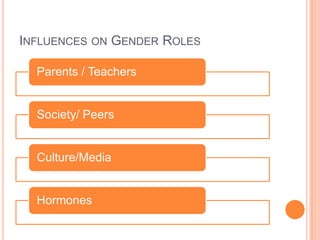
INFLUENCES ON GENDER ROLES
Parents / Teachers
Society/ Peers
Culture/Media
Hormones
HOW MIGHT GENDER IDENTITY CHANGE FROM
EARLY CHILDHOOD THROUGH ADOLESCENCE?
Playmate
Preference
Stereotyped
Behavior
Gender
Modeling
OBSERVABLE BEHAVIORS IN
GENDER IDENTITY
REFERENCES
 Bee, H., & Boyd, D. (2010). The developing child (12th ed.)
Boston, MA: Allyn & Bacon.
 Putnam, J. (2006). Influences on Children's Gender
Development. Retrieved from
http://www.extension.purdue.edu/providerparent/child%20gro
wth-development/influencesongender.htm
 Testosterone during pregnancy and gender role behavior of
preschool children: a longitudinal, population study.. (2002,
Nov-Dec). Child Development, 73(6), 1678-87. MEDLINE with
Full Text.
 University of South Alabama. (2005). Social Learning Theory.
Retrieved from
http://www.southalabama.edu/oll/mobile/theory_workbook/soci
al_learning_theory.htm
 Warren, P.N. (1998). Berdaches ... and Assumptions About
Berdaches. Retrieved from
Gender Roles 7

Gender role presentation

  • 1.
  • 2.
    How are genderroles developed? When are gender roles adopted? What influences shape perceptions of gender roles? How might gender identity change from early childhood through adolescence? What observable behaviors might indicate changes in gender identity?
  • 3.
    HOW ARE GENDERROLES DEVELOPED? Gender Identity Gender Constancy Gender Stability
  • 4.
    WHEN ARE GENDERROLES DEVELOPED? Gender Identity • Ages 9 to 12 months babies treats male and female faces as different categories. Using hair length as using hair length as the primary differentiating clue • By Age 2, children can identify their own sex. • Ages 2 to 3 Years children learn to identify and correctly label an individuals gender Gender Stability • The ages of 4 child understands that gender does not change throughout a lifetime. Gender Constancy • Children as young as 2 or 3 know their own sex and that of people around them • Age 4 to 5 Years children can understand that gender is constant when wearing different clothes or changing his hair length.
  • 5.
    INFLUENCES ON GENDERROLES Parents / Teachers Society/ Peers Culture/Media Hormones
  • 6.
    HOW MIGHT GENDERIDENTITY CHANGE FROM EARLY CHILDHOOD THROUGH ADOLESCENCE?
  • 7.
  • 8.
    REFERENCES  Bee, H.,& Boyd, D. (2010). The developing child (12th ed.) Boston, MA: Allyn & Bacon.  Putnam, J. (2006). Influences on Children's Gender Development. Retrieved from http://www.extension.purdue.edu/providerparent/child%20gro wth-development/influencesongender.htm  Testosterone during pregnancy and gender role behavior of preschool children: a longitudinal, population study.. (2002, Nov-Dec). Child Development, 73(6), 1678-87. MEDLINE with Full Text.  University of South Alabama. (2005). Social Learning Theory. Retrieved from http://www.southalabama.edu/oll/mobile/theory_workbook/soci al_learning_theory.htm  Warren, P.N. (1998). Berdaches ... and Assumptions About Berdaches. Retrieved from Gender Roles 7

Editor's Notes

  • #4 Research suggests that gender is a highly significant variable for children from the earliest days of life. For example, infants as young as 3 months of age distinguish between photos of male and female infants. Research also suggests that self-categorization is linked to cognitive development where a child’s understanding of gender progresses along with his or her general understanding of the world. Moreover, like general cognitive development, understanding of gender appears to involve a universal sequence of stages  (Bee & Boyd, 2010). The first stage is gender identity, which is simply a child’s ability to label his own sex correctly and to identify other people as men or women, boys or girls.  The second stage is gender stability, which is the understanding that people stay the same gender throughout life. The final stage in development of a gender concept, usually referred to as gender constancy, is the understanding that someone’s biological sex stays the same even though he may appear to change by wearing different clothes or changing his hair length (Bee & Boyd, 2010).
  • #5 Gender Identity:By 9 to 12 months, babies already treat male and female faces as if they were different categories, apparently using hair length as the primary differentiating clue.Within the next year, they begin to learn the verbal labels that go with these different categories. By age 2, if you show children a set of pictures of a same-sex child and several opposite-sex children and ask “Which one is you?” most children can correctly pick out the same-sex picture.Between ages 2 and 3, children learn to identify and label others correctly by sex, such as by pointing out “which one is a girl” or “which one is a boy” in a set of pictures. Hair length and clothing seem to be especially important cues in these early discriminations (Bee & Boyd, 2010). Gender Stability:Researchers have measured understanding of how gender does not change by asking children such questions as “When you were a little baby, were you a little girl or a little boy?” or “When you grow up, will you be a mommy or a daddy?” Most children understand this aspect of gender by about age 4.Gender Consistency:The understanding that someone’s biological sex stays the same even though he or she may appear to change by wearing different clothes or changing hair length. The child must figure out that although a boy wearing a dress may look like a girl, he is really still a boy. Children as young as 2 or 3 know their own sex and that of people around them, but children do not have a fully developed concept of gender until they are 5 or 6.
  • #6 There are several items that influence a child’s perception of gender roles:Parents teach by telling their children what they expect from them, by action and by making suggestive comments about the roles of gender in society. Parents may expect different things from their sons and daughters. That supports gender stereotypes. For example: Parents might expect their son to do well in math, and they expect their daughter to do well in arts and crafts (Putnam, 2006) . Teachers and peers can reinforce these behaviors when they tend to share a cultural similarity.Society and peers can also reinforce these roles in the same ways, by continuing to reinforce gender-specific stereotypes.Cultural influences can be very influential. Television, radio, magazines, and computer software often show men and women in limited roles, which can further the stereotypes. Hormones and biology can also play a part in how gender roles are influenced. Higher levels of testosterone have been linked to skewed gender test results. (“Testosterone during pregnancy and gender role behavior of preschool children: a longitudinal, population study.,” 2002). 
  • #7 In adolescence, teens’ understanding of and attitudes toward sex roles become central to the search for an identity. Puberty can have a profound impact on individual teenagers’ perceptions of themselves and adolescents understand that sex roles are social conventions, so their attitudes toward them are more flexible.However, increased flexibility may mean that teens experience more anxiety about how they should or should not behave, since cultural stereotypes are no longer seen as rigid dictates that must be followed. Because teens are actively searching for ways to incorporate gender into their own identities, parental attitudes as well as behavior become increasingly important in shaping teens’ ideas about gender and sex roles (Bee & Boyd, 2010).
  • #8 The observable behaviors in gender identity come in three main types. The first is playmate preference. “Long before age 3, girls and boys begin to show a preference for same-sex playmates and are much more sociable with playmates of the same sex—at a time when they do not yet have a concept of gender stability” (Bee & Boyd, 2010).Stereotyped children’s behavior is sex-typed earlier than are their ideas about sex roles or stereotypes. “For example, by 18 to 24 months, children begin to show some preference for sex-stereotyped toys, such as dolls for girls or trucks or building blocks for boys, which is some months before they can normally identify their own gender” (Bee & Boyd, 2010).Social learning theorists, have naturally emphasized the role of both direct reinforcement and modeling in shaping children’s sex-role behavior and attitudes, as well as the availability of stereotypical sex-role models in the various media to which children are exposed. They often include the notion that one’s own beliefs are at variance with those of the group, but that certain behaviors are required when presenting oneself to the group in order to maintain their acceptance (Bee & Boyd, 2010).