Sophia Huyer, Gender and Social Inclusion Research Leader
Gender and international
climate policy
An analysis of progress in
gender equality at COP21
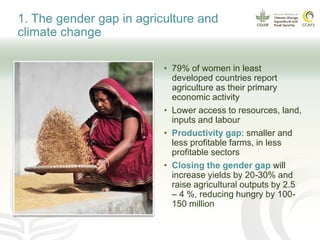
• 79% of women in least
developed countries report
agriculture as their primary
economic activity
• Lower access to resources, land,
inputs and labour
• Productivity gap: smaller and
less profitable farms, in less
profitable sectors
• Closing the gender gap will
increase yields by 20-30% and
raise agricultural outputs by 2.5
– 4 %, reducing hungry by 100-
150 million
1. The gender gap in agriculture and
climate change
• Gender differences exist in vulnerabilities and capacities to deal
with climate change impacts
• Household responsibilities for women include childcare, fuelwood
and water collection and increased agricultural work responsibilities
when men out-migrate
• Women may be less able to adapt because of financial or resource
constraints and because they have less access to information and
extension services
• Environmental stress causes intensification of women’s workloads,
as well as decreases in assets of poor households
• Women are less likely to buy micro-insurance if risk is low-
probability, while men are likely to buy more units of insurance
(Bangladesh)
• Women’s participation in REDD+ decision making is very low
(Vietnam)
• Men and women are changing cropping practices in response to
climate variability, with different impacts on access to and control of
the income from crops, as well as workloads
• Cultural norms related to gender roles may limit the ability of
women to respond to or make quick decisions in the face of climate
events.
• Differences in interactions with institutions
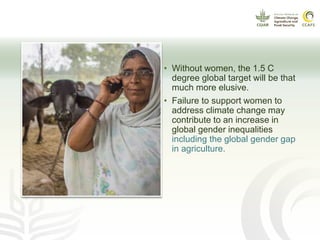
• Without women, the 1.5 C
degree global target will be that
much more elusive.
• Failure to support women to
address climate change may
contribute to an increase in
global gender inequalities
including the global gender gap
in agriculture.
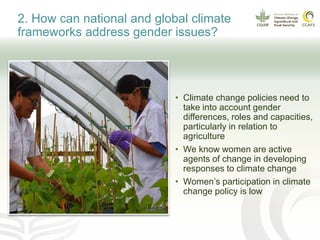
• Climate change policies need to
take into account gender
differences, roles and capacities,
particularly in relation to
agriculture
• We know women are active
agents of change in developing
responses to climate change
• Women’s participation in climate
change policy is low
2. How can national and global climate
frameworks address gender issues?
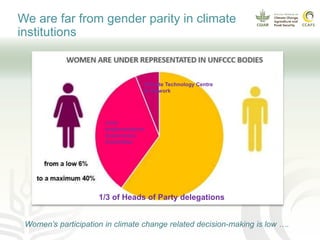
We are far from gender parity in climate
institutions
Climate Technology Centre
& Network
Joint
Implementation
Supervisory
Committee
1/3 of Heads of Party delegations
Women’s participation in climate change related decision-making is low ….
Gender in the UNFCC
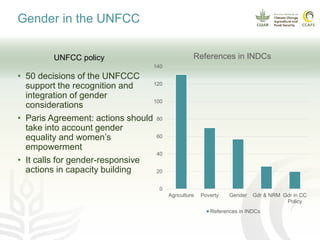
• 50 decisions of the UNFCCC
support the recognition and
integration of gender
considerations
• Paris Agreement: actions should
take into account gender
equality and women’s
empowerment
• It calls for gender-responsive
actions in capacity building
0
20
40
60
80
100
120
140
Agriculture Poverty Gender Gdr & NRM Gdr in CC
Policy
References in INDCs
References in INDCs
UNFCC policy
What’s missing?
• Women are considered “vulnerable victims”, need to support
resilience – majority of INDC references
• Lack of recognition of women’s knowledge and innovation or
their role in addressing climate change
• Where is the monitoring and evaluation for real change?
• Alignment with global gender policy: Gender equality, human
rights, active role of women
• Need to get beyond focus on numerical representation
Opportunities for input and advocacy
• REDD+
• Green Climate Fund
• Clean Development Mechanism
• Global Environment Facility
• Nationally Appropriate Mitigation Actions (NAMAs)
• NEPAD Development Comprehensive Africa Agriculture
Development Programme (NEPAD-CAADP)
• June 2016 workshop of the Lima Work Programme on Gender;
• Subsidiary Body for Scientific and Technical Advice next May
(SBSTA 44)
Thank you

Gender and international climate policy

  • 1.
    Sophia Huyer, Genderand Social Inclusion Research Leader Gender and international climate policy An analysis of progress in gender equality at COP21
  • 2.
    • 79% ofwomen in least developed countries report agriculture as their primary economic activity • Lower access to resources, land, inputs and labour • Productivity gap: smaller and less profitable farms, in less profitable sectors • Closing the gender gap will increase yields by 20-30% and raise agricultural outputs by 2.5 – 4 %, reducing hungry by 100- 150 million 1. The gender gap in agriculture and climate change
  • 3.
    • Gender differencesexist in vulnerabilities and capacities to deal with climate change impacts • Household responsibilities for women include childcare, fuelwood and water collection and increased agricultural work responsibilities when men out-migrate • Women may be less able to adapt because of financial or resource constraints and because they have less access to information and extension services • Environmental stress causes intensification of women’s workloads, as well as decreases in assets of poor households
  • 4.
    • Women areless likely to buy micro-insurance if risk is low- probability, while men are likely to buy more units of insurance (Bangladesh) • Women’s participation in REDD+ decision making is very low (Vietnam) • Men and women are changing cropping practices in response to climate variability, with different impacts on access to and control of the income from crops, as well as workloads • Cultural norms related to gender roles may limit the ability of women to respond to or make quick decisions in the face of climate events. • Differences in interactions with institutions
  • 5.
    • Without women,the 1.5 C degree global target will be that much more elusive. • Failure to support women to address climate change may contribute to an increase in global gender inequalities including the global gender gap in agriculture.
  • 6.
    • Climate changepolicies need to take into account gender differences, roles and capacities, particularly in relation to agriculture • We know women are active agents of change in developing responses to climate change • Women’s participation in climate change policy is low 2. How can national and global climate frameworks address gender issues?
  • 7.
    We are farfrom gender parity in climate institutions Climate Technology Centre & Network Joint Implementation Supervisory Committee 1/3 of Heads of Party delegations Women’s participation in climate change related decision-making is low ….
  • 8.
    Gender in theUNFCC • 50 decisions of the UNFCCC support the recognition and integration of gender considerations • Paris Agreement: actions should take into account gender equality and women’s empowerment • It calls for gender-responsive actions in capacity building 0 20 40 60 80 100 120 140 Agriculture Poverty Gender Gdr & NRM Gdr in CC Policy References in INDCs References in INDCs UNFCC policy
  • 9.
    What’s missing? • Womenare considered “vulnerable victims”, need to support resilience – majority of INDC references • Lack of recognition of women’s knowledge and innovation or their role in addressing climate change • Where is the monitoring and evaluation for real change? • Alignment with global gender policy: Gender equality, human rights, active role of women • Need to get beyond focus on numerical representation
  • 10.
    Opportunities for inputand advocacy • REDD+ • Green Climate Fund • Clean Development Mechanism • Global Environment Facility • Nationally Appropriate Mitigation Actions (NAMAs) • NEPAD Development Comprehensive Africa Agriculture Development Programme (NEPAD-CAADP) • June 2016 workshop of the Lima Work Programme on Gender; • Subsidiary Body for Scientific and Technical Advice next May (SBSTA 44)
  • 11.

Editor's Notes

  • #3 Rural women play an increasing role in smallholder agriculture as males migrate to urban centres They have less access than men to productive resources –> they produce less Cost of gender gap in agriculture 100 mn in Malawi 105 mn in Tanzania 67 million in Uganda
  • #5 Informal: Women engage in mutual insurance and risk-sharing networks, and social support institutions external to the village. Formal: registered, public and private external organizations that foster agriculture and livestock production tend to provide support primarily to men.