Using Gender Research in the  Project Cycle Findings from IFPRI’s Gender and Intrahousehold Research Program Agnes R. Quisumbing International Food Policy Research Institute
Overview Policy research aims to influence the decisions and actions of project planners and policymakers The practitioner’s guide is the outcome of a learning process—IFPRI researchers providing inputs to project planners, and project planners giving feedback to IFPRI researchers In this presentation, I show how IFPRI’s research results can feed into the stages of the project cycle Page
Page  Assess Needs and  Identify Problems Design Project Implement Project  Monitor Performance Evaluate The Project Life Cycle
The Research Findings in the Project Cycle Page  Project Cycle Stage General Research Finding Needs assessment and problem identification Households do not act as one when making decisions Share of resources controlled depends on bargaining power Both local norms and statutory laws determine women’s rights Project design and formulation Increasing resources controlled by women benefits families Project design features also have gender implications Innovative ways to increase women’s resources have made projects successful
The Research Findings in the Project Cycle Page  Project Cycle Stage General Research Finding Project implementation and monitoring Build gender-sensitive monitoring into project design and implementation Evaluation Paying attention to gender in program evaluations can improve performance and general development impacts
Needs Assessment and Problem Definition Page
Households do not act as one when making decisions Men and women do not always have the same preferences nor pool their resources Men’s and women’s resources have different effects on household decisionmaking Who  is targeted affects the outcome of policy Page  Source:  Quisumbing and Maluccio 2000 Assess Needs and  Identify Problems
Households may not pool resources nor share the same preferences Example from Burkina Faso (Alderman et al. 1996; Udry 1996;Smith and Chavas 1996) Plots managed by women have significantly lower yields than plots controlled by men—around 20% lower.  Men’s plots have higher labor inputs by both men and children. Fertilizer is more intensively applied on men’s plots. In Burkina Faso, output of households, where men and women did not share the same preferences, was 25% less responsive to maize prices than in households where preferences were the same. Page  Assess Needs and  Identify Problems
One’s share of resources depends on bargaining power, and women control fewer resources than men   Page  Source:  Quisumbing and Maluccio 2000 Assess Needs and  Identify Problems
Both local norms and statutory laws determine women’s rights Formal and informal legal and institutional frameworks are basis for women’s rights In Ethiopia, local norms most important factor explaining distribution of assets upon divorce or death  (Fafchamps and Quisumbing 2002) Local custom may evolve to become more beneficial to women, if women’s labor becomes more valuable  (Quisumbing, Otsuka, Payongayong and Aidoo 2001) Page  Assess Needs and  Identify Problems
The example of the evolution of inheritance law in Ghana Customary law in parts of Ghana does not usually favor women Inheritance by members of matriclan Wives and children do not inherit from husbands Husbands now giving wives “gifts” of cocoa land in return for helping establish cocoa Gifts have strong individual rights, benefiting women Page  Assess Needs and  Identify Problems
Legal reform is strengthening women’s rights In Ghana, the Intestate Succession Law (ISL) (1985) provides for wife and children if the man dies without a will. Distribution according to ISL:  3/16 to spouse, 9/16 to children, 1/8 to parent, 1/8 to matriclan Common interpretation of ISL:  1/3 each to surviving spouse, children, and matrilineal family—even more favorable towards women than the law! Page  Assess Needs and  Identify Problems
Policies and external forces can challenge traditional norms In Ethiopia, local administrations have granted user rights to women due to the land to the tiller policy Page  Assess Needs and  Identify Problems
Project Design and Formulation Page
Increasing resources controlled by women benefits families Equalizing resources held by women and men can increase agricultural yields by up to 20% (Alderman et al. 1996) Increases in women’s resources have the strongest effects on education, health, and nutrition (Hallman 2000; Smith et al. 2001) Women’s social networks help families cope with income shocks (Maluccio et al. 2001) Page  Design Project
Increasing women’s resources improves agricultural productivity Burkina Faso :  Output of women’s plots, and total household output could be increased by 10-20% by reallocating resources from men’s plots to women’s plots (Alderman et al. 1996) Ghana:   strengthening women’s property rights increases incentives to adopt agroforestry and is good for environmental management Page  Design Project
Improving women’s status and resources improves child health and nutrition Page  Contributions to reductions in  child malnutrition, 1970-95 Source: Smith and Haddad 2000 Design Project
Project design features also have gender implications   Example: Different dissemination methods of agricultural technology in Bangladesh Small-holder vegetable production, targeted to women Household-owned fishponds, targeted to both men and women Group-owned fishponds targeted to women Outcomes from these projects differed depending on how successful they were in reaching women Page  Design Project
Project modalities and cultural constraints affected project outcomes. Limited benefits from  vegetable production project  because: Land tenure system not in women’s favor Purdah meant women could not cultivate land, negotiate in market, sell produce  Women could not expand production to family’s agricultural  land In contrast, the  group fishpond project : Encouraged groups of poor women to participate in production, enabled women to negotiate with men Challenged gender division of labor and workplace Enabled women to save the income from fish production Page  Source:  Naved 2000 Income gains were small, but bigger effects came from credit given to women and opportunity to join credit programs Design Project
Innovative ways to increase women’s resources have made projects successful   Examples include:  Credit and technologies targeted to women (Sharma 2001; Bouis et al. 1998) Income transfers targeted to women (Skoufias and McClafferty 2001; Adato et al. 2000) Community day care programs (Ruel et al. 2001) Page  Design Project
Providing conditional cash transfers to women can improve children’s human capital outcomes The example of PROGRESA (Programa Nacional de Educaci ó n, Salud, y Alimentaci ó n) in M é xico: The program included various components:  cash transfers conditional on school attendance, regular attendance at clinics, improvement in health services, and nutritional supplements  Giving cash transfers directly to women was an innovation in the design of social programs in México.   Page  Design Project
Project Implementation and Monitoring Page
Build gender sensitive monitoring into project design and implementation Targeting  mechanism is important and quota targeting may conflict with program objectives  In Bangladesh: 30% of participants in the individual  fishpond production  program mandated by donor to be women Extension agents signed up women by talking to their husbands, but: Women’s role in fish production project remained limited Women did not know quantity or income from fish production Page  Implement Project  Monitor Performance
Gender considerations in staffing can be critical for project acceptability. In the PROGRESA evaluation, we found that women were uncomfortable when male doctors gave talks about Pap smears or family planning.  Participants and service providers may not understand program objectives, especially those related to intrahousehold objectives  In PROGRESA, infants and children to whom nutritional supplements were directed often received only a fraction of the nutrients which the program stipulated.  The supplement was often shared with other family members, even if sharing was a clear violation of the program rules. Page  Source: Adato, Coady, and Ruel 2000 Implement Project  Monitor Performance
Evaluation Page
Paying attention to gender issues in operations evaluations can improve the monitoring and evaluation of projects The objective of operations evaluations (OE) is to identify the elements of the program which experience operational problems, the sources of these problems, and to propose solutions  (Adato, Coady, and Ruel 2000) It is necessary to include all actors—men and women—who can influence or be affected by operational performance The operations evaluation of  PROGRESA included: beneficiaries, promotoras, school directors, and personnel of health clinics  Page  Evaluate
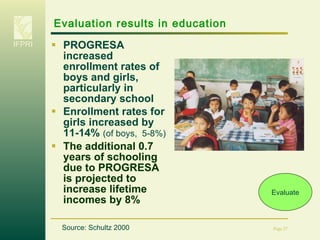
Evaluation results in education PROGRESA increased enrollment rates of boys and girls, particularly in secondary school  Enrollment rates for girls increased by 11-14%  (of boys,  5-8%) The additional 0.7 years of schooling due to PROGRESA is projected to increase lifetime incomes by 8% Page  Source: Schultz 2000 Evaluate
Evaluation results in health Morbidity of children in PROGRESA decreased by 12% Illness days of adults decreased by 19% PROGRESA had a significant effect on reducing the probability of low height for age, an indicator of long-term malnutrition  Page  Foto:(c) Patricia Poppe,JHU/CCP Source:  Gertler 2000; Behrman and Hoddinott 2000 Evaluate
What Next?  From research to practice and back Page

Using Gender Research In The Project Cycle

  • 1.
    Using Gender Researchin the Project Cycle Findings from IFPRI’s Gender and Intrahousehold Research Program Agnes R. Quisumbing International Food Policy Research Institute
  • 2.
    Overview Policy researchaims to influence the decisions and actions of project planners and policymakers The practitioner’s guide is the outcome of a learning process—IFPRI researchers providing inputs to project planners, and project planners giving feedback to IFPRI researchers In this presentation, I show how IFPRI’s research results can feed into the stages of the project cycle Page
  • 3.
    Page AssessNeeds and Identify Problems Design Project Implement Project Monitor Performance Evaluate The Project Life Cycle
  • 4.
    The Research Findingsin the Project Cycle Page Project Cycle Stage General Research Finding Needs assessment and problem identification Households do not act as one when making decisions Share of resources controlled depends on bargaining power Both local norms and statutory laws determine women’s rights Project design and formulation Increasing resources controlled by women benefits families Project design features also have gender implications Innovative ways to increase women’s resources have made projects successful
  • 5.
    The Research Findingsin the Project Cycle Page Project Cycle Stage General Research Finding Project implementation and monitoring Build gender-sensitive monitoring into project design and implementation Evaluation Paying attention to gender in program evaluations can improve performance and general development impacts
  • 6.
    Needs Assessment andProblem Definition Page
  • 7.
    Households do notact as one when making decisions Men and women do not always have the same preferences nor pool their resources Men’s and women’s resources have different effects on household decisionmaking Who is targeted affects the outcome of policy Page Source: Quisumbing and Maluccio 2000 Assess Needs and Identify Problems
  • 8.
    Households may notpool resources nor share the same preferences Example from Burkina Faso (Alderman et al. 1996; Udry 1996;Smith and Chavas 1996) Plots managed by women have significantly lower yields than plots controlled by men—around 20% lower. Men’s plots have higher labor inputs by both men and children. Fertilizer is more intensively applied on men’s plots. In Burkina Faso, output of households, where men and women did not share the same preferences, was 25% less responsive to maize prices than in households where preferences were the same. Page Assess Needs and Identify Problems
  • 9.
    One’s share ofresources depends on bargaining power, and women control fewer resources than men Page Source: Quisumbing and Maluccio 2000 Assess Needs and Identify Problems
  • 10.
    Both local normsand statutory laws determine women’s rights Formal and informal legal and institutional frameworks are basis for women’s rights In Ethiopia, local norms most important factor explaining distribution of assets upon divorce or death (Fafchamps and Quisumbing 2002) Local custom may evolve to become more beneficial to women, if women’s labor becomes more valuable (Quisumbing, Otsuka, Payongayong and Aidoo 2001) Page Assess Needs and Identify Problems
  • 11.
    The example ofthe evolution of inheritance law in Ghana Customary law in parts of Ghana does not usually favor women Inheritance by members of matriclan Wives and children do not inherit from husbands Husbands now giving wives “gifts” of cocoa land in return for helping establish cocoa Gifts have strong individual rights, benefiting women Page Assess Needs and Identify Problems
  • 12.
    Legal reform isstrengthening women’s rights In Ghana, the Intestate Succession Law (ISL) (1985) provides for wife and children if the man dies without a will. Distribution according to ISL: 3/16 to spouse, 9/16 to children, 1/8 to parent, 1/8 to matriclan Common interpretation of ISL: 1/3 each to surviving spouse, children, and matrilineal family—even more favorable towards women than the law! Page Assess Needs and Identify Problems
  • 13.
    Policies and externalforces can challenge traditional norms In Ethiopia, local administrations have granted user rights to women due to the land to the tiller policy Page Assess Needs and Identify Problems
  • 14.
    Project Design andFormulation Page
  • 15.
    Increasing resources controlledby women benefits families Equalizing resources held by women and men can increase agricultural yields by up to 20% (Alderman et al. 1996) Increases in women’s resources have the strongest effects on education, health, and nutrition (Hallman 2000; Smith et al. 2001) Women’s social networks help families cope with income shocks (Maluccio et al. 2001) Page Design Project
  • 16.
    Increasing women’s resourcesimproves agricultural productivity Burkina Faso : Output of women’s plots, and total household output could be increased by 10-20% by reallocating resources from men’s plots to women’s plots (Alderman et al. 1996) Ghana: strengthening women’s property rights increases incentives to adopt agroforestry and is good for environmental management Page Design Project
  • 17.
    Improving women’s statusand resources improves child health and nutrition Page Contributions to reductions in child malnutrition, 1970-95 Source: Smith and Haddad 2000 Design Project
  • 18.
    Project design featuresalso have gender implications Example: Different dissemination methods of agricultural technology in Bangladesh Small-holder vegetable production, targeted to women Household-owned fishponds, targeted to both men and women Group-owned fishponds targeted to women Outcomes from these projects differed depending on how successful they were in reaching women Page Design Project
  • 19.
    Project modalities andcultural constraints affected project outcomes. Limited benefits from vegetable production project because: Land tenure system not in women’s favor Purdah meant women could not cultivate land, negotiate in market, sell produce Women could not expand production to family’s agricultural land In contrast, the group fishpond project : Encouraged groups of poor women to participate in production, enabled women to negotiate with men Challenged gender division of labor and workplace Enabled women to save the income from fish production Page Source: Naved 2000 Income gains were small, but bigger effects came from credit given to women and opportunity to join credit programs Design Project
  • 20.
    Innovative ways toincrease women’s resources have made projects successful Examples include: Credit and technologies targeted to women (Sharma 2001; Bouis et al. 1998) Income transfers targeted to women (Skoufias and McClafferty 2001; Adato et al. 2000) Community day care programs (Ruel et al. 2001) Page Design Project
  • 21.
    Providing conditional cashtransfers to women can improve children’s human capital outcomes The example of PROGRESA (Programa Nacional de Educaci ó n, Salud, y Alimentaci ó n) in M é xico: The program included various components: cash transfers conditional on school attendance, regular attendance at clinics, improvement in health services, and nutritional supplements Giving cash transfers directly to women was an innovation in the design of social programs in México. Page Design Project
  • 22.
  • 23.
    Build gender sensitivemonitoring into project design and implementation Targeting mechanism is important and quota targeting may conflict with program objectives In Bangladesh: 30% of participants in the individual fishpond production program mandated by donor to be women Extension agents signed up women by talking to their husbands, but: Women’s role in fish production project remained limited Women did not know quantity or income from fish production Page Implement Project Monitor Performance
  • 24.
    Gender considerations instaffing can be critical for project acceptability. In the PROGRESA evaluation, we found that women were uncomfortable when male doctors gave talks about Pap smears or family planning. Participants and service providers may not understand program objectives, especially those related to intrahousehold objectives In PROGRESA, infants and children to whom nutritional supplements were directed often received only a fraction of the nutrients which the program stipulated. The supplement was often shared with other family members, even if sharing was a clear violation of the program rules. Page Source: Adato, Coady, and Ruel 2000 Implement Project Monitor Performance
  • 25.
  • 26.
    Paying attention togender issues in operations evaluations can improve the monitoring and evaluation of projects The objective of operations evaluations (OE) is to identify the elements of the program which experience operational problems, the sources of these problems, and to propose solutions (Adato, Coady, and Ruel 2000) It is necessary to include all actors—men and women—who can influence or be affected by operational performance The operations evaluation of PROGRESA included: beneficiaries, promotoras, school directors, and personnel of health clinics Page Evaluate
  • 27.
    Evaluation results ineducation PROGRESA increased enrollment rates of boys and girls, particularly in secondary school Enrollment rates for girls increased by 11-14% (of boys, 5-8%) The additional 0.7 years of schooling due to PROGRESA is projected to increase lifetime incomes by 8% Page Source: Schultz 2000 Evaluate
  • 28.
    Evaluation results inhealth Morbidity of children in PROGRESA decreased by 12% Illness days of adults decreased by 19% PROGRESA had a significant effect on reducing the probability of low height for age, an indicator of long-term malnutrition Page Foto:(c) Patricia Poppe,JHU/CCP Source: Gertler 2000; Behrman and Hoddinott 2000 Evaluate
  • 29.
    What Next? From research to practice and back Page