Meeting Security Benchmarks
and Compliance with Microsoft
SQL Server
K. Brian Kelley
About Me
• Security Related:
– Infrastructure & Security Architect
– Certified Information Systems Auditor (CISA)
– Accredited CISA Trainer
– Incident Handler / Penetration Tester
• SQL Server Related:
– Data Architect
– SQL Server security columnist / blogger
– SQL Server and Security speaker & trainer
Agenda
• What Audit and Compliance Focuses On
• The Three As
• Data Security
• Encryption and Obfuscation
• Detecting Structural Change
Audit and Compliance
Understanding the Jargon
What do I care about as an auditor?
• Information Systems (IS) processes
• Related business processes
• Controls over those processes
What’s a Control?
• Two parts:
– Objective
– Measure
• Objective: what you’re trying to achieve
• Measure: something done to fulfill said objective
The Control Mantra
• Documentation alone isn’t a control.
Therefore:
• No evidence? No control.
• No review? No control.
The Three A’s
What are the three A’s?
• Authentication: proving who you are
• Authorization: determining what rights/permissions
you have
• Accounting / Auditing: tracking what you do
Demo
Data Security
What to Look for in Data Security
• Permissions are important, so start there
• Should be tied to data classification
• Encompasses data encryption and obfuscation
• Data handling as well
Demo
Encryption / Obfuscation
Data Encryption
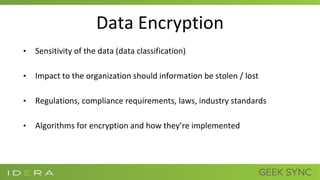
• Sensitivity of the data (data classification)
• Impact to the organization should information be stolen / lost
• Regulations, compliance requirements, laws, industry standards
• Algorithms for encryption and how they’re implemented
SQL Server Encryption Options
• Built-in Encryption Objects and Functions
• AlwaysEncrypted
• Transparent Data Encryption
Data Encryption – Operations
• Key Escrow must be specified, tested, and have
approved controls
• Performance impact
• Situations where the data exists in plaintext (in
memory, etc.)
Data Obfuscation
• Typically data, in its resting state, is unprotected.
• Could also exist at rest in non-encrypted way.
• For less that privileged access, data is masked in some way.
• Some include encryption as part of data obfuscation
Data Obfuscation in SQL Server
• Dynamic Data Masking - Introduced in SQL Server 2017
• Built into table definition - Uses algorithm you define
• Privileged users can still see unmasked data
• Seamless to application / reporting layer
Detecting Structural Change
DDL is important, too
What do I care about?
• Changes to Security Principals
• Changes to Security Permissions on Objects
• Changes to Objects Themselves
• Creation of New Databases
• Creation of New Objects
Out-of-the-box Options
• Extended Events are your friend.
• Other Options:
– Audit object (built on Extended Events)
– Triggers
– Default Trace
– Transaction Log (maybe)
Demo
What We Covered
• What Audit and Compliance Focuses On
• The Three As
• Data Security
• Encryption and Obfuscation
• Detecting Structural Change

Geek Sync | Meeting Security Benchmarks and Compliance with Microsoft SQL Server - K. Brian Kelley | IDERA

  • 1.
    Meeting Security Benchmarks andCompliance with Microsoft SQL Server K. Brian Kelley
  • 2.
    About Me • SecurityRelated: – Infrastructure & Security Architect – Certified Information Systems Auditor (CISA) – Accredited CISA Trainer – Incident Handler / Penetration Tester • SQL Server Related: – Data Architect – SQL Server security columnist / blogger – SQL Server and Security speaker & trainer
  • 3.
    Agenda • What Auditand Compliance Focuses On • The Three As • Data Security • Encryption and Obfuscation • Detecting Structural Change
  • 4.
  • 5.
    What do Icare about as an auditor? • Information Systems (IS) processes • Related business processes • Controls over those processes
  • 6.
    What’s a Control? •Two parts: – Objective – Measure • Objective: what you’re trying to achieve • Measure: something done to fulfill said objective
  • 7.
    The Control Mantra •Documentation alone isn’t a control. Therefore: • No evidence? No control. • No review? No control.
  • 8.
  • 9.
    What are thethree A’s? • Authentication: proving who you are • Authorization: determining what rights/permissions you have • Accounting / Auditing: tracking what you do
  • 10.
  • 11.
  • 12.
    What to Lookfor in Data Security • Permissions are important, so start there • Should be tied to data classification • Encompasses data encryption and obfuscation • Data handling as well
  • 13.
  • 14.
  • 15.
    Data Encryption • Sensitivityof the data (data classification) • Impact to the organization should information be stolen / lost • Regulations, compliance requirements, laws, industry standards • Algorithms for encryption and how they’re implemented
  • 16.
    SQL Server EncryptionOptions • Built-in Encryption Objects and Functions • AlwaysEncrypted • Transparent Data Encryption
  • 17.
    Data Encryption –Operations • Key Escrow must be specified, tested, and have approved controls • Performance impact • Situations where the data exists in plaintext (in memory, etc.)
  • 18.
    Data Obfuscation • Typicallydata, in its resting state, is unprotected. • Could also exist at rest in non-encrypted way. • For less that privileged access, data is masked in some way. • Some include encryption as part of data obfuscation
  • 19.
    Data Obfuscation inSQL Server • Dynamic Data Masking - Introduced in SQL Server 2017 • Built into table definition - Uses algorithm you define • Privileged users can still see unmasked data • Seamless to application / reporting layer
  • 20.
  • 21.
    What do Icare about? • Changes to Security Principals • Changes to Security Permissions on Objects • Changes to Objects Themselves • Creation of New Databases • Creation of New Objects
  • 22.
    Out-of-the-box Options • ExtendedEvents are your friend. • Other Options: – Audit object (built on Extended Events) – Triggers – Default Trace – Transaction Log (maybe)
  • 23.
  • 24.
    What We Covered •What Audit and Compliance Focuses On • The Three As • Data Security • Encryption and Obfuscation • Detecting Structural Change