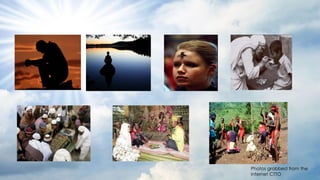
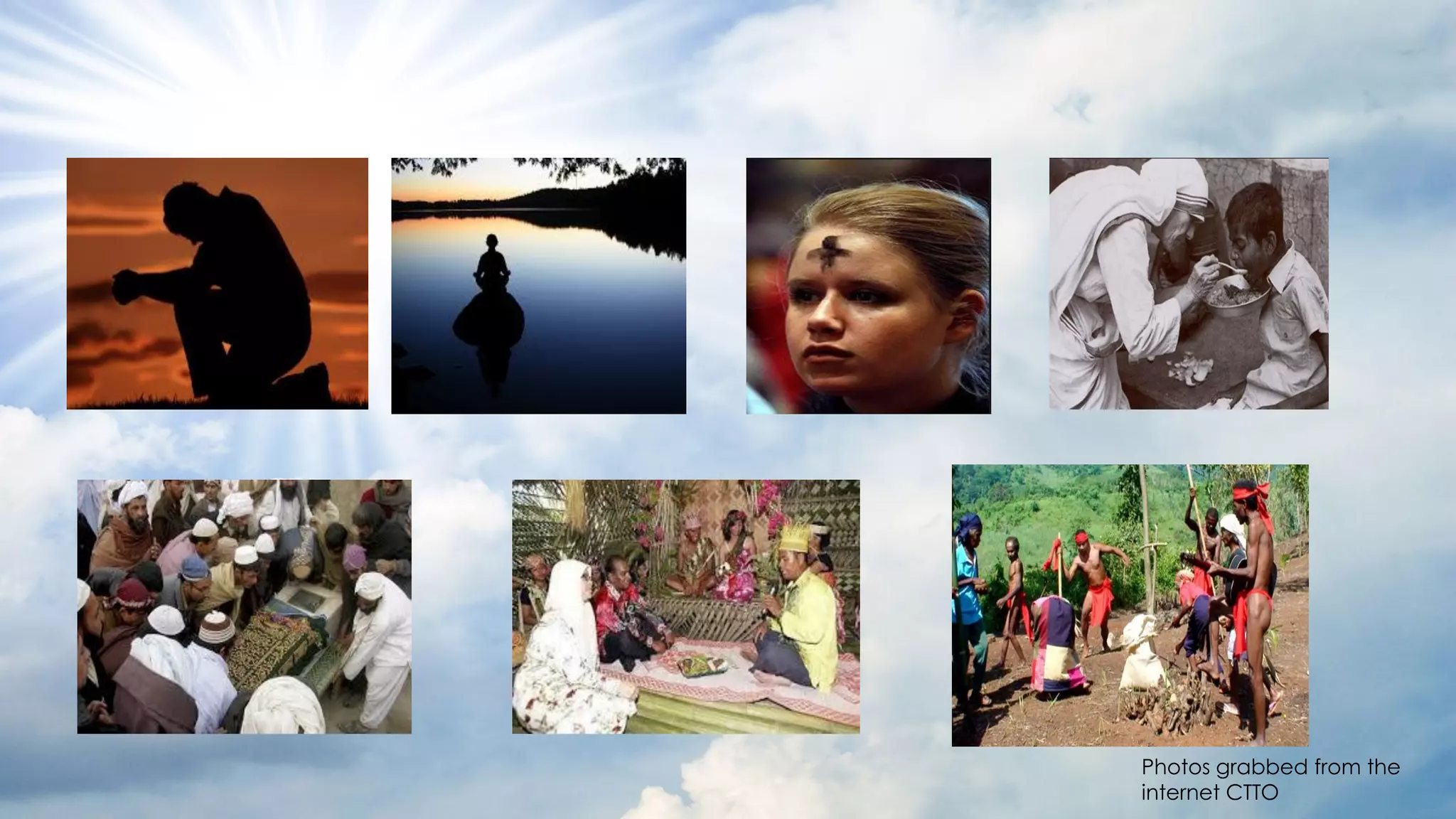
Photos grabbed from the
internet CTTO
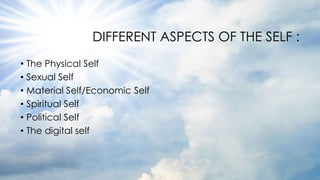
DIFFERENT ASPECTS OF THE SELF :
‱ The Physical Self
‱ Sexual Self
‱ Material Self/Economic Self
‱ Spiritual Self
‱ Political Self
‱ The digital self
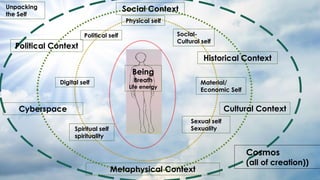
Material/
Economic Self
Physical self
Sexual self
Sexuality
Spiritual self
spirituality
Digital self
Political self Social-
Cultural self
Cultural Context
Social Context
Metaphysical Context
Historical Context
Unpacking
the Self
Cyberspace
Being
Breath
Life energy
Political Context
Cosmos
(all of creation))
‱“Ever more people today have the means to
live, but no meaning to live for.”- Victor Frankl
‱We often associate substance problems with
the poor , but oftentimes rich individuals
succumb to this problem, because they may
be financially rich, but are poor in spirit. – Dr.
Miriam P. Cue
THE SPIRITUAL SELF
Part 2:
Unpacking the Self - The self unfolding
LEARNING OUTCOMES
‱ Explain the spiritual aspect of the self and identity
‱ Demonstrate critical, reflective thought in integrating the
spiritual self with the other selves previously discussed
‱ Identify the different aspects of the spiritual self
‱ Examine oneself in the context of the spiritual self discussed
in class
SPIRITUAL SELF
‱Search for meaning/essence
‱Intuition and interconnectedness to the
metaphysical
‱Basis for the practice of religion, rituals,
ceremonies, etc.
THE SPIRITUAL SELF
Refers to the Spirituality labels that the human is longing
for a sense of meaning through morally responsible
relationships between diverse individuals, families,
communities, cultures, and religion.
WHAT IS SPIRITUALITY?
‱ Is a belief that people can connect with something
that is beyond mind and matter
‱ An aspect of religious traditions, and also existential
value system
SPIRITUALITY
.
‱A way of experiencing that comes about
through awareness of supreme dimension
and that is characterized by certain
identifiable values in regard to self, nature,
life, and whatever one considers ultimate
‱To be spiritual is to stand in a relationship
based on matters of the soul” – Carson, 1989
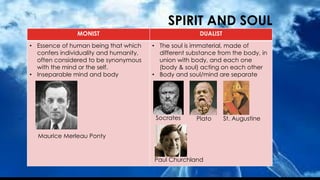
SPIRIT AND SOUL
MONIST DUALIST
‱ Essence of human being that which
confers individuality and humanity,
often considered to be synonymous
with the mind or the self.
‱ Inseparable mind and body
‱ The soul is immaterial, made of
different substance from the body, in
union with body, and each one
(body & soul) acting on each other
‱ Body and soul/mind are separate
Maurice Merleau Ponty
Plato
Socrates St. Augustine
Paul Churchland
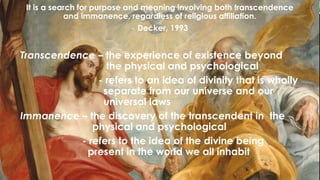
It is a search for purpose and meaning involving both transcendence
and immanence, regardless of religious affiliation.
- Decker, 1993
Transcendence – the experience of existence beyond
the physical and psychological
- refers to an idea of divinity that is wholly
separate from our universe and our
universal laws
Immanence – the discovery of the transcendent in the
physical and psychological
- refers to the idea of the divine being
present in the world we all inhabit
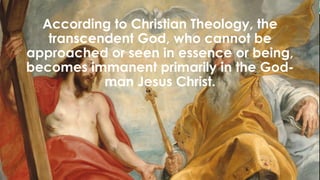
According to Christian Theology, the
transcendent God, who cannot be
approached or seen in essence or being,
becomes immanent primarily in the God-
man Jesus Christ.
ANCIENT BELIEFS
Egyptian ka (breath) survived death but remained near the
body, while the spiritual ba proceeded to the region of the
dead.
Chinese distinguished between a lower, sensitive soul, which
disappears with death, and a rational principle, the hun, which
survives the grave and is the object of ancestor worship.
Hebrews apparently had a concept of the soul but did not
separate it from the body,
Filipinos – kaluluwa, ikaruruwa or karuruwa, inikaduwa  the
soul has two existences: one physical, where it is connected to
the human body and its life, and other spiritual, where it exists on
its own.
Dungan/kalag of the Ilonggos
Among ancient peoples, both the Egyptians and the
Chinese conceived of a dual soul
Christian concepts of a body-soul dichotomy originated
with the ancient Greeks and were introduced into
Christian theology at an early date by St. Gregory of
Nyssa and by St. Augustine.
Epicureans considered the soul to be made up of
atoms like the rest of the body.
Platonists, the soul was an immaterial and incorporeal
substance, akin to the gods yet part of the world of
change and becoming.
Aristotle’s conception of the soul was obscure, though
he did state that it was a form inseparable from the
body.
‱ St. Thomas Aquinas concept of the soul as a motivating
principle of the body, independent but requiring the
substance of the body to make an individual.
‱ St. Augustine - the soul as a “rider” on the body, making
clear the split between the material and the immaterial,
with the soul representing the “true” person.
- although body and soul were separate, it
was not possible to conceive of a soul
without its body.
SOUL – RELIGION & THEOLOGY
‱Part of the individual which partakes
of divinity and often is considered to
survive the death of the body.
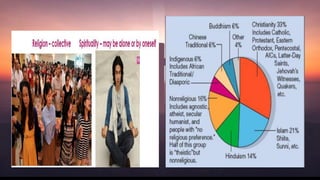
SPIRITUALITY & RELIGION
‱ Religion - an organized system of ideas about the
spiritual sphere or the supernatural along with
associated ceremonial practices by which people try
to interpret and/or influence aspects of the universe
otherwise beyond their control
‱ Spirituality - concerned with the sacred, as
distinguished from material matters. In contrast to
religion, spirituality is often individual rather than
collective and does not require a distinctive format or
traditional organization.
FUNCTIONS OF RELIGION
‱To explain things
‱To establish order
‱To justify things
‱To provide support
‱Socializes people
‱satisfies social and psychological needs
RITUAL
Ritual behavior – are established or fixed by traditional
rules, has been observed the world over and throughout
history.
‱ This classification is taken as a universal feature of religion.
‱ Belief systems, myths, and the like, are viewed as expressions of
the nature of the sacred realm in which ritual becomes the
determined conduct of the individual in a society expressing a
relation to the sacred and the profane.
‱ The sacred is that aspect of a community’s beliefs, myths,
and sacred objects that is set apart and forbidden.
Ceremony – a formal act or event that is a part of a social or
religious occasion
FUNCTIONS OF RITUALS
‱ Rituals and ceremonial acts, are not all religious in nature,
but those that are, play a crucial role in religious activity.
‱ Religious ritual is the means through which people relate to
and communicate with the supernatural;
‱ Ritual serves to relieve social-tensions and reinforce a group's
collective bonds;
‱ Above all, rituals provide means of marking many important
events and lessening the social disruption and individual
suffering of crises, such as death.
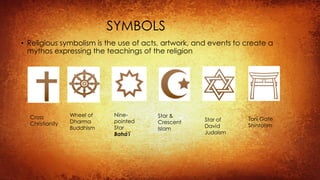
SYMBOLS
‱ Religious symbolism is the use of acts, artwork, and events to create a
mythos expressing the teachings of the religion
Cross
Christianity
Wheel of
Dharma
Buddhism
Nine-
pointed
Star
BahĂĄ'Ă­
Star &
Crescent
Islam
Star of
David
Judaism
Torii Gate
Shintoism
MEANINGS AND SYMBOLS
Rituals as a Means of Communication (Intangible effects)
We see, in some cultures, that rituals are conducted
as a form of communication with the spiritual world.
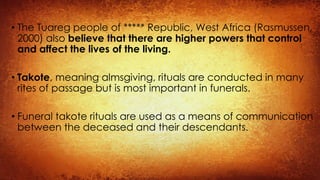
‱ The Tuareg people of ***** Republic, West Africa (Rasmussen,
2000) also believe that there are higher powers that control
and affect the lives of the living.
‱ Takote, meaning almsgiving, rituals are conducted in many
rites of passage but is most important in funerals.
‱ Funeral takote rituals are used as a means of communication
between the deceased and their descendants.
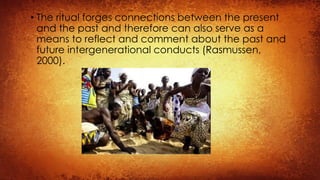
‱ The ritual forges connections between the present
and the past and therefore can also serve as a
means to reflect and comment about the past and
future intergenerational conducts (Rasmussen,
2000).
Rituals as a Means to Symbolize Transitions (Tangible
effects)
‱ It is very common that rituals are used to symbolize
transitions. Through these rituals, people take up new
responsibilities and new roles that are acknowledged by
the society.
MAGIC AND WITCHCRAFT
HOW WIDESPREAD IS BELIEF IN MAGIC,
SORCERY, AND WITCHCRAFT?
‱ In Africa, it is idle to begin with the question whether
witches exist or not,” states the book African
Traditional Religion, adding that “to Africans of every
category, witchcraft is an urgent reality.”
Those who believe in magic, sorcery, and
witchcraft include both the illiterate and the highly
educated. Religious leaders of Islam are also
believers.
ACCORDING TO POPULAR BELIEF, FROM
WHERE DO MAGICAL POWERS COME?
 Exists a mystical, spiritual power, or force.
God has control over it. Spirits and ancestors can use it.
And some humans also know how to tap it and use it,
either for good (white magic) or for bad (black magic).
WHAT IS WHITE MAGIC, AND HOW
IS IT PRACTICED?
White magic is supposed to provide protection against
evil.
- Those who practice white magic wear magical rings or
bracelets.
- They drink protective medicine or rub it on their bodies. In
their homes or in the ground, they hide articles believed to
have protective powers.
- They trust in amulets containing texts from the Koran or the
Bible.
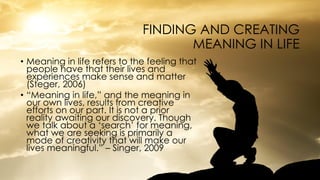
FINDING AND CREATING
MEANING IN LIFE
‱ Meaning in life refers to the feeling that
people have that their lives and
experiences make sense and matter
(Steger, 2006)
‱ “Meaning in life,” and the meaning in
our own lives, results from creative
efforts on our part. It is not a prior
reality awaiting our discovery. Though
we talk about a ‘search’ for meaning,
what we are seeking is primarily a
mode of creativity that will make our
lives meaningful.” – Singer, 2009
HOW TO FIND MEANING IN LIFE:
 According to Frankl, meaning can be
found through:
 Experiencing reality by interacting
authentically with the environment
and with others,
Giving something back to the world
through creativity and self-
expression, and
Changing our attitude when faced
with a situation or circumstance that
we cannot change.
FINDING MEANING IN LIFE
What will you do if people say
..
“What should I do with my life?” or
“What is my life purpose?”
1: What is important to me?
2: What am I truly good at?
3: What is my potential?
Life is full of choices.
Do you want to follow the path
that you have always known? Or
will you chart a new course?
Will you accept your life “as it is?”
Or, will you chase your potential,
knowing that you will never reach
it?
Will the search for your own
potential lead you to find
perfection in the journey?
The Spiritual Self.pdf

The Spiritual Self.pdf

  • 1.
    Photos grabbed fromthe internet CTTO
  • 2.
    DIFFERENT ASPECTS OFTHE SELF : ‱ The Physical Self ‱ Sexual Self ‱ Material Self/Economic Self ‱ Spiritual Self ‱ Political Self ‱ The digital self
  • 3.
    Material/ Economic Self Physical self Sexualself Sexuality Spiritual self spirituality Digital self Political self Social- Cultural self Cultural Context Social Context Metaphysical Context Historical Context Unpacking the Self Cyberspace Being Breath Life energy Political Context Cosmos (all of creation))
  • 4.
    ‱“Ever more peopletoday have the means to live, but no meaning to live for.”- Victor Frankl ‱We often associate substance problems with the poor , but oftentimes rich individuals succumb to this problem, because they may be financially rich, but are poor in spirit. – Dr. Miriam P. Cue
  • 5.
    THE SPIRITUAL SELF Part2: Unpacking the Self - The self unfolding
  • 6.
    LEARNING OUTCOMES ‱ Explainthe spiritual aspect of the self and identity ‱ Demonstrate critical, reflective thought in integrating the spiritual self with the other selves previously discussed ‱ Identify the different aspects of the spiritual self ‱ Examine oneself in the context of the spiritual self discussed in class
  • 7.
    SPIRITUAL SELF ‱Search formeaning/essence ‱Intuition and interconnectedness to the metaphysical ‱Basis for the practice of religion, rituals, ceremonies, etc.
  • 8.
    THE SPIRITUAL SELF Refersto the Spirituality labels that the human is longing for a sense of meaning through morally responsible relationships between diverse individuals, families, communities, cultures, and religion.
  • 9.
    WHAT IS SPIRITUALITY? ‱Is a belief that people can connect with something that is beyond mind and matter ‱ An aspect of religious traditions, and also existential value system
  • 10.
    SPIRITUALITY
. ‱A way ofexperiencing that comes about through awareness of supreme dimension and that is characterized by certain identifiable values in regard to self, nature, life, and whatever one considers ultimate ‱To be spiritual is to stand in a relationship based on matters of the soul” – Carson, 1989
  • 11.
    SPIRIT AND SOUL MONISTDUALIST ‱ Essence of human being that which confers individuality and humanity, often considered to be synonymous with the mind or the self. ‱ Inseparable mind and body ‱ The soul is immaterial, made of different substance from the body, in union with body, and each one (body & soul) acting on each other ‱ Body and soul/mind are separate Maurice Merleau Ponty Plato Socrates St. Augustine Paul Churchland
  • 12.
    It is asearch for purpose and meaning involving both transcendence and immanence, regardless of religious affiliation. - Decker, 1993 Transcendence – the experience of existence beyond the physical and psychological - refers to an idea of divinity that is wholly separate from our universe and our universal laws Immanence – the discovery of the transcendent in the physical and psychological - refers to the idea of the divine being present in the world we all inhabit
  • 13.
    According to ChristianTheology, the transcendent God, who cannot be approached or seen in essence or being, becomes immanent primarily in the God- man Jesus Christ.
  • 14.
    ANCIENT BELIEFS Egyptian ka(breath) survived death but remained near the body, while the spiritual ba proceeded to the region of the dead. Chinese distinguished between a lower, sensitive soul, which disappears with death, and a rational principle, the hun, which survives the grave and is the object of ancestor worship. Hebrews apparently had a concept of the soul but did not separate it from the body, Filipinos – kaluluwa, ikaruruwa or karuruwa, inikaduwa  the soul has two existences: one physical, where it is connected to the human body and its life, and other spiritual, where it exists on its own. Dungan/kalag of the Ilonggos Among ancient peoples, both the Egyptians and the Chinese conceived of a dual soul
  • 15.
    Christian concepts ofa body-soul dichotomy originated with the ancient Greeks and were introduced into Christian theology at an early date by St. Gregory of Nyssa and by St. Augustine. Epicureans considered the soul to be made up of atoms like the rest of the body. Platonists, the soul was an immaterial and incorporeal substance, akin to the gods yet part of the world of change and becoming. Aristotle’s conception of the soul was obscure, though he did state that it was a form inseparable from the body.
  • 16.
    ‱ St. ThomasAquinas concept of the soul as a motivating principle of the body, independent but requiring the substance of the body to make an individual. ‱ St. Augustine - the soul as a “rider” on the body, making clear the split between the material and the immaterial, with the soul representing the “true” person. - although body and soul were separate, it was not possible to conceive of a soul without its body.
  • 17.
    SOUL – RELIGION& THEOLOGY ‱Part of the individual which partakes of divinity and often is considered to survive the death of the body.
  • 18.
    SPIRITUALITY & RELIGION ‱Religion - an organized system of ideas about the spiritual sphere or the supernatural along with associated ceremonial practices by which people try to interpret and/or influence aspects of the universe otherwise beyond their control ‱ Spirituality - concerned with the sacred, as distinguished from material matters. In contrast to religion, spirituality is often individual rather than collective and does not require a distinctive format or traditional organization.
  • 20.
    FUNCTIONS OF RELIGION ‱Toexplain things ‱To establish order ‱To justify things ‱To provide support ‱Socializes people ‱satisfies social and psychological needs
  • 21.
    RITUAL Ritual behavior –are established or fixed by traditional rules, has been observed the world over and throughout history.
  • 22.
    ‱ This classificationis taken as a universal feature of religion. ‱ Belief systems, myths, and the like, are viewed as expressions of the nature of the sacred realm in which ritual becomes the determined conduct of the individual in a society expressing a relation to the sacred and the profane. ‱ The sacred is that aspect of a community’s beliefs, myths, and sacred objects that is set apart and forbidden. Ceremony – a formal act or event that is a part of a social or religious occasion
  • 23.
    FUNCTIONS OF RITUALS ‱Rituals and ceremonial acts, are not all religious in nature, but those that are, play a crucial role in religious activity. ‱ Religious ritual is the means through which people relate to and communicate with the supernatural; ‱ Ritual serves to relieve social-tensions and reinforce a group's collective bonds; ‱ Above all, rituals provide means of marking many important events and lessening the social disruption and individual suffering of crises, such as death.
  • 25.
    SYMBOLS ‱ Religious symbolismis the use of acts, artwork, and events to create a mythos expressing the teachings of the religion Cross Christianity Wheel of Dharma Buddhism Nine- pointed Star Bahá'í Star & Crescent Islam Star of David Judaism Torii Gate Shintoism
  • 27.
    MEANINGS AND SYMBOLS Ritualsas a Means of Communication (Intangible effects) We see, in some cultures, that rituals are conducted as a form of communication with the spiritual world.
  • 28.
    ‱ The Tuaregpeople of ***** Republic, West Africa (Rasmussen, 2000) also believe that there are higher powers that control and affect the lives of the living. ‱ Takote, meaning almsgiving, rituals are conducted in many rites of passage but is most important in funerals. ‱ Funeral takote rituals are used as a means of communication between the deceased and their descendants.
  • 29.
    ‱ The ritualforges connections between the present and the past and therefore can also serve as a means to reflect and comment about the past and future intergenerational conducts (Rasmussen, 2000).
  • 30.
    Rituals as aMeans to Symbolize Transitions (Tangible effects) ‱ It is very common that rituals are used to symbolize transitions. Through these rituals, people take up new responsibilities and new roles that are acknowledged by the society.
  • 31.
  • 32.
    HOW WIDESPREAD ISBELIEF IN MAGIC, SORCERY, AND WITCHCRAFT? ‱ In Africa, it is idle to begin with the question whether witches exist or not,” states the book African Traditional Religion, adding that “to Africans of every category, witchcraft is an urgent reality.” Those who believe in magic, sorcery, and witchcraft include both the illiterate and the highly educated. Religious leaders of Islam are also believers.
  • 33.
    ACCORDING TO POPULARBELIEF, FROM WHERE DO MAGICAL POWERS COME?  Exists a mystical, spiritual power, or force. God has control over it. Spirits and ancestors can use it. And some humans also know how to tap it and use it, either for good (white magic) or for bad (black magic).
  • 34.
    WHAT IS WHITEMAGIC, AND HOW IS IT PRACTICED? White magic is supposed to provide protection against evil. - Those who practice white magic wear magical rings or bracelets. - They drink protective medicine or rub it on their bodies. In their homes or in the ground, they hide articles believed to have protective powers. - They trust in amulets containing texts from the Koran or the Bible.
  • 35.
    FINDING AND CREATING MEANINGIN LIFE ‱ Meaning in life refers to the feeling that people have that their lives and experiences make sense and matter (Steger, 2006) ‱ “Meaning in life,” and the meaning in our own lives, results from creative efforts on our part. It is not a prior reality awaiting our discovery. Though we talk about a ‘search’ for meaning, what we are seeking is primarily a mode of creativity that will make our lives meaningful.” – Singer, 2009
  • 36.
    HOW TO FINDMEANING IN LIFE:  According to Frankl, meaning can be found through:  Experiencing reality by interacting authentically with the environment and with others, Giving something back to the world through creativity and self- expression, and Changing our attitude when faced with a situation or circumstance that we cannot change.
  • 37.
    FINDING MEANING INLIFE What will you do if people say
.. “What should I do with my life?” or “What is my life purpose?” 1: What is important to me? 2: What am I truly good at? 3: What is my potential?
  • 38.
    Life is fullof choices. Do you want to follow the path that you have always known? Or will you chart a new course? Will you accept your life “as it is?” Or, will you chase your potential, knowing that you will never reach it? Will the search for your own potential lead you to find perfection in the journey?