The easiest way to get
                 purest and highest yield
               from minimum amount of
                                    cells

                             IGEN Biotech


gDNA LC KIT®
gDNA LC Kit ®


DNA extraction from low cellularity samples                                                        (30 – 90 minutes, depending on sample type), for a total assay duration of
                                                                                                   approximately 3 hours.
gDNA LC Kit. IGEN Biotech
                                                                                                   The volumes of these six solutions are totally adjustable depending on number of
                                                                                                   extractions. It is also possible making up the process without pipetting, by an
       High yield from 50.000 cells only
                                                                                                   innovative measurement system of dripping.
       Fast, easy and clean. Storage at room temperature
                                                                                                   The kit is based on an organic-phase extraction (phenol/chloroform), based on an
       High purity and quality of obtained DNA
                                                                                                   optimized procedure due to cleaning and differentiating between phases and
       Product supported by CDTI (Spanish Centre for Industrial                                    providing great efficiency to the phase extraction.
       Technological development)

DNA extraction from low cellularity samples, as amniotic fluid, chorionic villus or
damaged samples is a difficult task due to poor obtained yields and large
necessary time to obtain appropriate DNA for subsequent applications. This
happens for example with forensic samples (blood and semen stains) and prenatal
diagnosis (amniotic fluid, chorionic villus).

Usual procedures with low-cellularity samples start with cell expansion through a
time-consuming in vitro culture. Final purpose is getting a sufficient amount of cells
to make subsequent analysis either by cytogenetics or molecular technologies. For
                                                                                                                                                     Figure      1.   Normal
this reason, diagnosis takes several days, even weeks.
                                                                                                                                                     stages      of   a   DNA

How it works                                                                                                                                         extraction by IGEN
                                                                                                                                                     Biotech’s kit (organic
IGEN’s Genomic DNA Extraction Kit has been specifically designed for low                                                                             phase).
cellularity samples and provides a rapid and easy extraction process based on 5
phases and involving six different solutions that make up the Kit. These phases are:
lysis, isolation, precipitation, washing, drying and resuspension. Longest phase is lysis


                                  Gustavo Fernández Balbuena 11 - 28002. Madrid. SPAIN - Tel. +34 91 510 29 99 - Fax.+34 91 519 13 26 – igen@igenbiotech.com -
gDNA LC Kit ®


High yield from low cellularity                                                                    High quality and purity of obtained DNA


Current genomic extraction kits usually focus their action on whole blood, plasma,                 Optimization of organic-phase separation provides an impurities-free DNA. In this

serum, mammalian or plant tissue, but there is no one targeting this type of                       sense, the most relevant factor is that recovered DNA recovered is RNA & peptide

samples. IGEN Biotech’s kit can extract DNA from approximately 50.000 cells,                       free without losing quality compared to other kits. As an example, methods based

providing an added value only reached by expensive automatics systems.                             on silica columns usually obtain DNA contaminated with traces of nucleotides. By
                                                                                                   the way, this kit also prevents protein and other macro-molecules contamination.
Yields of recovered DNA are independent of low cellularity samples. DNA can be
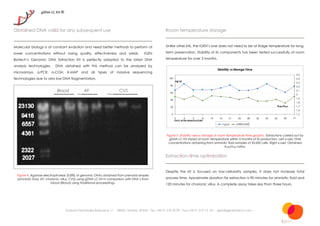
                                                                                                   Absorbance ratios (A260/A280) are between 1.7 – 1.9; which indicates both low RNA
obtained from concentrations of approximately 80 μg/ml. From minimal starting
                                                                                                   and peptide contamination and A260/A230 ratios are over 2.
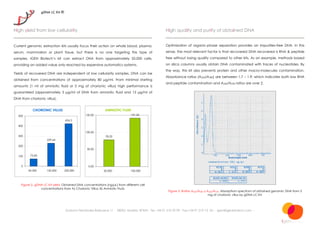
amounts (1 ml of amniotic fluid or 5 mg of chorionic villus) high performance is
guaranteed (approximately 3 μg/ml of DNA from amniotic fluid and 13 μg/ml of
DNA from chorionic villus).


            CHORIONIC VILLUS                                 AMNIOTIC FLUID
  500                                          150,00                         141,26

                                  424,3

  400

                                               100,00
  300                                                        78,22
                     229,64

  200
                                                50,00

  100     72,83


    0                                            0,00
         50.000      150.000      250.000                   50.000            100.000


    Figure 2. gDNA LC Kit yield. Obtained DNA concentrations (ng/μL) from different cell
                 concentrations from A) Chorionic Villus; B) Amniotic Fluid.
                                                                                                     Figure 3. Ratios A260/A280 y A260/A230. Absorptium spectrum of obtained genomic DNA from 2
                                                                                                                                   mg of chorionic villus by gDNA LC Kit.


                                  Gustavo Fernández Balbuena 11 - 28002. Madrid. SPAIN - Tel. +34 91 510 29 99 - Fax.+34 91 519 13 26 – igen@igenbiotech.com -
gDNA LC Kit ®


Obtained DNA valid for any subsequent use                                                           Room temperature storage


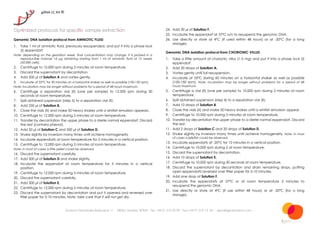
Molecular biology is at constant evolution and need better methods to perform at                    Unlike other kits, the IGEN’s one does not need to be at fridge temperature for long-

lower concentrations without losing quality, effectiveness and yields.                   IGEN       term preservation. Stability of its components has been tested successfully at room

Biotech’s Genomic DNA Extraction Kit is perfectly adapted to the latest DNA                         temperature for over 3 months.

analysis technologies.      DNA obtained with this method can be analyzed by
                                                                                                                                           Stability vs Storage Time
microarrays, q-PCR, a-CGH, X-MAP and all types of massive sequencing
                                                                                                                                                                                                    2,5
technologies due to very low DNA fragmentation.                                                        100                                                                                          2,4
                                                                                                             ng/μl
                                                                                                                                                                                                    2,3
                                                                                                       80                                                                                           2,2
                                                                                                                                                                                                    2,1
                                                                                                       60
                                                                                                                                                                                                    2
                                                                                                                                                                                                    1,9
                                                                                                       40
                                                                                                                                                                                                    1,8
                                                                                                       20                                                                         A280/A 260        1,7
                                                                                                                                                                                                    1,6
                                                                                                        0                                                                                           1,5
                                                                                                             2       4     5      8   14    16       21    24    28    36   45   52     69     77
                                                                                                             DAYS AFTER MANUFACTURE
                                                                                                                                                 ng/μl    A280/A260


                                                                                                     Figure 5. Stability versus storage at room temperature time graphic. Extractions carried out by
                                                                                                       gDNA LC Kit stored at room temperature within 3 months of its production. Left x-axis: DNA
                                                                                                      concentrations obtaining from amniotic fluid samples of 50.000 cells. Right x-axis: Obtained
                                                                                                                                               A280/A260 ratios.


                                                                                                    Extraction-time optimization


                                                                                                    Despite the kit is focused on low-cellularity samples, it does not increase total
  Figure 4. Agarose electrophoresis (0,8%) of genomic DNAs obtained from prenatal simples
  (amniotic fluid, AF; chorionic villus, CVS) using gDNA LC Kit in comparison with DNA´s from       process time. Aproximate duration for extraction is 90 minutes for amniotic fluid and
                          blood (Blood) using traditional proceedings.                              120 minutes for chorionic villus. A complete assay takes less than three hours.


                                   Gustavo Fernández Balbuena 11 - 28002. Madrid. SPAIN - Tel. +34 91 510 29 99 - Fax.+34 91 519 13 26 – igen@igenbiotech.com -
gDNA LC Kit ®


Optimized protocols for specific sample extraction                                                   24. Add 30 μl of Solution F.
                                                                                                     25. Incubate the eppendorf at 37ºC o/n to resuspend the genomic DNA.
Genomic DNA isolation protocol from AMNIOTIC FLUID                                                   26. Use directly or store at 4ºC (if used within 48 hours) or at -20ºC (for a long
                                                                                                         storage).
1.    Take 1 ml of amniotic fluid, previously resuspended, and put it into a phase lock
      (I) eppendorf.
                                                                                                     Genomic DNA isolation protocol from CHORIONIC VILLUS
Note: depending on the gestation week, final concentration may change. It is probed in a
    reproducible manner >3 μg obtaining starting from 1 ml of amniotic fluid of 15 weeks             1.    Take a little amount of chorionic villus (1-5 mg) and put it into a phase lock (I)
    (50.000 cells).                                                                                        eppendorf.
2.    Centrifuge to 12.000 rpm during 5 minutes at room temperature.                                 2.    Add 20 drops of Solution A.
3.    Discard the supernatant by decantation.                                                        3.    Vortex gently until full resuspension.
4.    Add 500 μl of Solution A and vortex gently.                                                    4.    Incubate at 55ºC during 60 minutes on a horizontal shaker as well as possible
5.  Incubate at 55ºC for 30 minutes on a horizontal shaker as well as possible (100-150 rpm).              (100-150 rpm). Note: incubation may be longer without problems for a period of 48
Note: Incubation may be longer without problems for a period of 48 hours maximum.                          hours maximum.
6.    Centrifuge a separation vial (II) (one per sample) to 12.000 rpm during 30                     5.  Centrifuge a vial (II) (one per sample) to 10.000 rpm during 2 minutes at room
      seconds at room temperature.                                                                       temperature.
7.    Spill obtained suspension (step 5) to a separation vial (II).                                  6. Spill obtained suspension (step 4) to a separation vial (II).
8.    Add 250 μl of Solution B.                                                                      7. Add 10 drops of Solution B.
9.    Close the vials (II) and make 50 heavy shakes until a whitish emulsion appears.                8. Close the vials (II) and make 50 heavy shakes until a whitish emulsion appear.
10.   Centrifuge to 12.000 rpm during 5 minutes at room temperature.                                 9. Centrifuge to 10.000 rpm during 2 minutes at room temperature.
11.   Transfer by decantation the upper phase to a sterile normal eppendorf. Discard                 10. Transfer by decantation the upper phase to a sterile normal eppendorf. Discard
      the rest (contains phenol).                                                                        the rest.
12.   Add 50 μl of Solution C and 500 μl of Solution D.                                              11. Add 2 drops of Solution C and 20 drops of Solution D.
13.   Shake slightly by inversion many times until achieve homogeneity.                              12. Shake slightly by inversion many times until achieve homogeneity. Note: in most
                                                                                                           of cases a jellyfish could be observed.
14.   Incubate eppendorfs at room temperature for 5 minutes in a vertical position.
                                                                                                     13. Incubate eppendorfs at -20ºC for 10 minutes in a vertical position.
15.   Centrifuge to 12.000 rpm during 5 minutes at room temperature.
Note: in most of cases a little pellet could be observed.                                            14. Centrifuge to 10.000 rpm during 2 at room temperature.
16. Discard the supernatant carefully.                                                               15. Discard the supernatant by decantation.
17. Add 500 μl of Solution D and shake slightly.                                                     16. Add 10 drops of Solution E.
18. Incubate the eppendorf at room temperature for 5 minutes in a vertical                           17. Centrifuge to 10.000 rpm during 30 seconds at room temperature.
    position.                                                                                        18. Discard the supernatant by decantation and drain remaining drops, putting
19. Centrifuge to 12.000 rpm during 5 minutes at room temperature.                                       open eppendorfs reversed over filter paper for 5-10 minutes.
20. Discard the supernatant carefully.                                                               19. Add one drop of Solution F.
21. Add 500 μl of Solution E.                                                                        20. Incubate the eppendorfs at 37ºC or at room temperature 5 minutes to
                                                                                                         resuspend the genomic DNA.
22. Centrifuge to 12.000 rpm during 5 minutes at room temperature.
                                                                                                     21. Use directly or store at 4ºC (if use within 48 hours) or at -20ºC (for a long
23. Discard the supernatant by decantation and put it opened and reversed over
                                                                                                         storage).
    filter paper for 5-10 minutes. Note: take care that it will not get dry.


                                    Gustavo Fernández Balbuena 11 - 28002. Madrid. SPAIN - Tel. +34 91 510 29 99 - Fax.+34 91 519 13 26 – igen@igenbiotech.com -

gDNA Prenatal Kit

  • 1.
    The easiest wayto get purest and highest yield from minimum amount of cells IGEN Biotech gDNA LC KIT®
  • 2.
    gDNA LC Kit® DNA extraction from low cellularity samples (30 – 90 minutes, depending on sample type), for a total assay duration of approximately 3 hours. gDNA LC Kit. IGEN Biotech The volumes of these six solutions are totally adjustable depending on number of extractions. It is also possible making up the process without pipetting, by an High yield from 50.000 cells only innovative measurement system of dripping. Fast, easy and clean. Storage at room temperature The kit is based on an organic-phase extraction (phenol/chloroform), based on an High purity and quality of obtained DNA optimized procedure due to cleaning and differentiating between phases and Product supported by CDTI (Spanish Centre for Industrial providing great efficiency to the phase extraction. Technological development) DNA extraction from low cellularity samples, as amniotic fluid, chorionic villus or damaged samples is a difficult task due to poor obtained yields and large necessary time to obtain appropriate DNA for subsequent applications. This happens for example with forensic samples (blood and semen stains) and prenatal diagnosis (amniotic fluid, chorionic villus). Usual procedures with low-cellularity samples start with cell expansion through a time-consuming in vitro culture. Final purpose is getting a sufficient amount of cells to make subsequent analysis either by cytogenetics or molecular technologies. For Figure 1. Normal this reason, diagnosis takes several days, even weeks. stages of a DNA How it works extraction by IGEN Biotech’s kit (organic IGEN’s Genomic DNA Extraction Kit has been specifically designed for low phase). cellularity samples and provides a rapid and easy extraction process based on 5 phases and involving six different solutions that make up the Kit. These phases are: lysis, isolation, precipitation, washing, drying and resuspension. Longest phase is lysis Gustavo Fernández Balbuena 11 - 28002. Madrid. SPAIN - Tel. +34 91 510 29 99 - Fax.+34 91 519 13 26 – igen@igenbiotech.com -
  • 3.
    gDNA LC Kit® High yield from low cellularity High quality and purity of obtained DNA Current genomic extraction kits usually focus their action on whole blood, plasma, Optimization of organic-phase separation provides an impurities-free DNA. In this serum, mammalian or plant tissue, but there is no one targeting this type of sense, the most relevant factor is that recovered DNA recovered is RNA & peptide samples. IGEN Biotech’s kit can extract DNA from approximately 50.000 cells, free without losing quality compared to other kits. As an example, methods based providing an added value only reached by expensive automatics systems. on silica columns usually obtain DNA contaminated with traces of nucleotides. By the way, this kit also prevents protein and other macro-molecules contamination. Yields of recovered DNA are independent of low cellularity samples. DNA can be Absorbance ratios (A260/A280) are between 1.7 – 1.9; which indicates both low RNA obtained from concentrations of approximately 80 μg/ml. From minimal starting and peptide contamination and A260/A230 ratios are over 2. amounts (1 ml of amniotic fluid or 5 mg of chorionic villus) high performance is guaranteed (approximately 3 μg/ml of DNA from amniotic fluid and 13 μg/ml of DNA from chorionic villus). CHORIONIC VILLUS AMNIOTIC FLUID 500 150,00 141,26 424,3 400 100,00 300 78,22 229,64 200 50,00 100 72,83 0 0,00 50.000 150.000 250.000 50.000 100.000 Figure 2. gDNA LC Kit yield. Obtained DNA concentrations (ng/μL) from different cell concentrations from A) Chorionic Villus; B) Amniotic Fluid. Figure 3. Ratios A260/A280 y A260/A230. Absorptium spectrum of obtained genomic DNA from 2 mg of chorionic villus by gDNA LC Kit. Gustavo Fernández Balbuena 11 - 28002. Madrid. SPAIN - Tel. +34 91 510 29 99 - Fax.+34 91 519 13 26 – igen@igenbiotech.com -
  • 4.
    gDNA LC Kit® Obtained DNA valid for any subsequent use Room temperature storage Molecular biology is at constant evolution and need better methods to perform at Unlike other kits, the IGEN’s one does not need to be at fridge temperature for long- lower concentrations without losing quality, effectiveness and yields. IGEN term preservation. Stability of its components has been tested successfully at room Biotech’s Genomic DNA Extraction Kit is perfectly adapted to the latest DNA temperature for over 3 months. analysis technologies. DNA obtained with this method can be analyzed by Stability vs Storage Time microarrays, q-PCR, a-CGH, X-MAP and all types of massive sequencing 2,5 technologies due to very low DNA fragmentation. 100 2,4 ng/μl 2,3 80 2,2 2,1 60 2 1,9 40 1,8 20 A280/A 260 1,7 1,6 0 1,5 2 4 5 8 14 16 21 24 28 36 45 52 69 77 DAYS AFTER MANUFACTURE ng/μl A280/A260 Figure 5. Stability versus storage at room temperature time graphic. Extractions carried out by gDNA LC Kit stored at room temperature within 3 months of its production. Left x-axis: DNA concentrations obtaining from amniotic fluid samples of 50.000 cells. Right x-axis: Obtained A280/A260 ratios. Extraction-time optimization Despite the kit is focused on low-cellularity samples, it does not increase total Figure 4. Agarose electrophoresis (0,8%) of genomic DNAs obtained from prenatal simples (amniotic fluid, AF; chorionic villus, CVS) using gDNA LC Kit in comparison with DNA´s from process time. Aproximate duration for extraction is 90 minutes for amniotic fluid and blood (Blood) using traditional proceedings. 120 minutes for chorionic villus. A complete assay takes less than three hours. Gustavo Fernández Balbuena 11 - 28002. Madrid. SPAIN - Tel. +34 91 510 29 99 - Fax.+34 91 519 13 26 – igen@igenbiotech.com -
  • 5.
    gDNA LC Kit® Optimized protocols for specific sample extraction 24. Add 30 μl of Solution F. 25. Incubate the eppendorf at 37ºC o/n to resuspend the genomic DNA. Genomic DNA isolation protocol from AMNIOTIC FLUID 26. Use directly or store at 4ºC (if used within 48 hours) or at -20ºC (for a long storage). 1. Take 1 ml of amniotic fluid, previously resuspended, and put it into a phase lock (I) eppendorf. Genomic DNA isolation protocol from CHORIONIC VILLUS Note: depending on the gestation week, final concentration may change. It is probed in a reproducible manner >3 μg obtaining starting from 1 ml of amniotic fluid of 15 weeks 1. Take a little amount of chorionic villus (1-5 mg) and put it into a phase lock (I) (50.000 cells). eppendorf. 2. Centrifuge to 12.000 rpm during 5 minutes at room temperature. 2. Add 20 drops of Solution A. 3. Discard the supernatant by decantation. 3. Vortex gently until full resuspension. 4. Add 500 μl of Solution A and vortex gently. 4. Incubate at 55ºC during 60 minutes on a horizontal shaker as well as possible 5. Incubate at 55ºC for 30 minutes on a horizontal shaker as well as possible (100-150 rpm). (100-150 rpm). Note: incubation may be longer without problems for a period of 48 Note: Incubation may be longer without problems for a period of 48 hours maximum. hours maximum. 6. Centrifuge a separation vial (II) (one per sample) to 12.000 rpm during 30 5. Centrifuge a vial (II) (one per sample) to 10.000 rpm during 2 minutes at room seconds at room temperature. temperature. 7. Spill obtained suspension (step 5) to a separation vial (II). 6. Spill obtained suspension (step 4) to a separation vial (II). 8. Add 250 μl of Solution B. 7. Add 10 drops of Solution B. 9. Close the vials (II) and make 50 heavy shakes until a whitish emulsion appears. 8. Close the vials (II) and make 50 heavy shakes until a whitish emulsion appear. 10. Centrifuge to 12.000 rpm during 5 minutes at room temperature. 9. Centrifuge to 10.000 rpm during 2 minutes at room temperature. 11. Transfer by decantation the upper phase to a sterile normal eppendorf. Discard 10. Transfer by decantation the upper phase to a sterile normal eppendorf. Discard the rest (contains phenol). the rest. 12. Add 50 μl of Solution C and 500 μl of Solution D. 11. Add 2 drops of Solution C and 20 drops of Solution D. 13. Shake slightly by inversion many times until achieve homogeneity. 12. Shake slightly by inversion many times until achieve homogeneity. Note: in most of cases a jellyfish could be observed. 14. Incubate eppendorfs at room temperature for 5 minutes in a vertical position. 13. Incubate eppendorfs at -20ºC for 10 minutes in a vertical position. 15. Centrifuge to 12.000 rpm during 5 minutes at room temperature. Note: in most of cases a little pellet could be observed. 14. Centrifuge to 10.000 rpm during 2 at room temperature. 16. Discard the supernatant carefully. 15. Discard the supernatant by decantation. 17. Add 500 μl of Solution D and shake slightly. 16. Add 10 drops of Solution E. 18. Incubate the eppendorf at room temperature for 5 minutes in a vertical 17. Centrifuge to 10.000 rpm during 30 seconds at room temperature. position. 18. Discard the supernatant by decantation and drain remaining drops, putting 19. Centrifuge to 12.000 rpm during 5 minutes at room temperature. open eppendorfs reversed over filter paper for 5-10 minutes. 20. Discard the supernatant carefully. 19. Add one drop of Solution F. 21. Add 500 μl of Solution E. 20. Incubate the eppendorfs at 37ºC or at room temperature 5 minutes to resuspend the genomic DNA. 22. Centrifuge to 12.000 rpm during 5 minutes at room temperature. 21. Use directly or store at 4ºC (if use within 48 hours) or at -20ºC (for a long 23. Discard the supernatant by decantation and put it opened and reversed over storage). filter paper for 5-10 minutes. Note: take care that it will not get dry. Gustavo Fernández Balbuena 11 - 28002. Madrid. SPAIN - Tel. +34 91 510 29 99 - Fax.+34 91 519 13 26 – igen@igenbiotech.com -