High-Level Abstraction
In Python,you type print() and magic happens. It's a
comfortable illusion.
# Where did this go in memory?
# How many bytes?
# Python hides this.
Python Code
???
THE BLACK BOX
CPU / RAM
THE LIE WE TELL YOU
3.
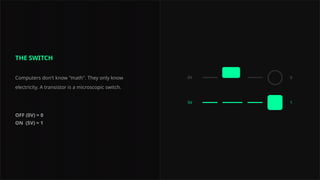
THE SWITCH
Computers don'tknow "math". They only know
electricity. A transistor is a microscopic switch.
OFF (0V) = 0
ON (5V) = 1
0V 0
5V 1
4.
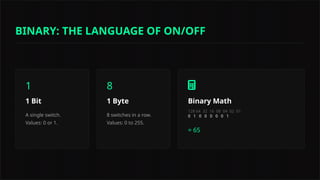
1
1 Bit
A singleswitch.
Values: 0 or 1.
8
1 Byte
8 switches in a row.
Values: 0 to 255.
Binary Math
128 64 32 16 08 04 02 01
0 1 0 0 0 0 0 1
= 65
BINARY: THE LANGUAGE OF ON/OFF
5.
How do westore text? We agree on a map.
char 65
// This number is literally 'A'
DEC
65
BIN CHAR
A
DEC
66
BIN CHAR
B
DEC
33
BIN CHAR
!
ASCII: THE AGREEMENT
6.
pixel[0] = {255,255, 255};
3 Bytes Per Pixel
Every dot on your screen is just three numbers
representing intensity.
•
Red (0-255)
•
Green (0-255)
•
Blue (0-255)
RGB: NUMBERS TO LIGHT
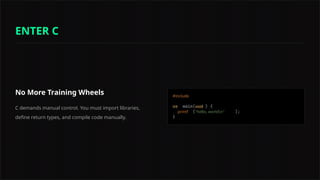
No More TrainingWheels
C demands manual control. You must import libraries,
define return types, and compile code manually.
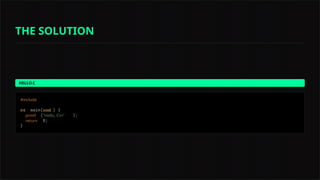
#include
int void
printf "hello, worldn"
ENTER C
9.
// The commandthat does it all
clang -o hello hello.c
Preprocess
#include -> Code
Compile
C -> Assembly
Assemble
Asm -> Object .o
Link
.o + Libraries -> Exe
THE COMPILATION PROCESS
10.
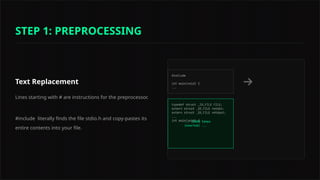
Text Replacement
Lines startingwith # are instructions for the preprocessor.
#include literally finds the file stdio.h and copy-pastes its
entire contents into your file.
STEP 1: PREPROCESSING
11.
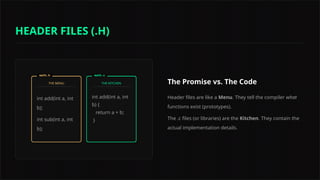
The Promise vs.The Code
Header files are like a Menu. They tell the compiler what
functions exist (prototypes).
The .c files (or libraries) are the Kitchen. They contain the
actual implementation details.
THE MENU
int add(int a, int
b);
int sub(int a, int
b);
THE KITCHEN
int add(int a, int
b) {
return a + b;
}
HEADER FILES (.H)
12.
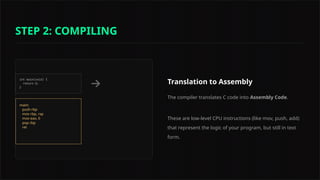
Translation to Assembly
Thecompiler translates C code into Assembly Code.
These are low-level CPU instructions (like mov, push, add)
that represent the logic of your program, but still in text
form.
main:
push rbp
mov rbp, rsp
mov eax, 0
pop rbp
ret
STEP 2: COMPILING
13.
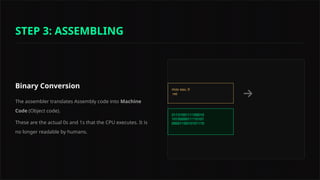
Binary Conversion
The assemblertranslates Assembly code into Machine
Code (Object code).
These are the actual 0s and 1s that the CPU executes. It is
no longer readable by humans.
mov eax, 0
ret
0110100111100010
1010000011110101
0000110010101110
STEP 3: ASSEMBLING
14.
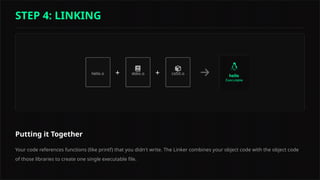
Putting it Together
Yourcode references functions (like printf) that you didn't write. The Linker combines your object code with the object code
of those libraries to create one single executable file.
+ + hello
STEP 4: LINKING
Allocation Matters
In Python,numbers grow forever. In C, you have a fixed
box size.
If you try to fit a long value into an int box, the data
physically won't fit.
THE COST OF DATA
20.
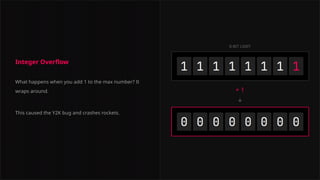
Integer Overflow
What happenswhen you add 1 to the max number? It
wraps around.
This caused the Y2K bug and crashes rockets.
8-BIT LIMIT
+ 1
21.
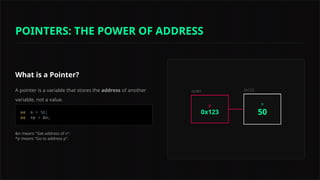
What is aPointer?
A pointer is a variable that stores the address of another
variable, not a value.
&n means "Get address of n".
*p means "Go to address p".
int 50
int
0x981
p
0x123
0x123
n
50
POINTERS: THE POWER OF ADDRESS
22.
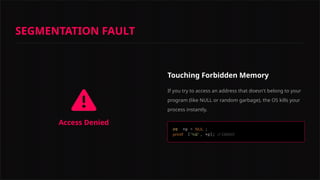
Access Denied
Touching ForbiddenMemory
If you try to access an address that doesn't belong to your
program (like NULL or random garbage), the OS kills your
process instantly.
int NUL
L
printf "%d" // CRASH!
SEGMENTATION FAULT
23.
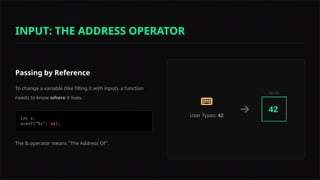
Passing by Reference
Tochange a variable (like filling it with input), a function
needs to know where it lives.
The & operator means "The Address Of".
&
User Types: 42
0x123
42
INPUT: THE ADDRESS OPERATOR
24.
RAM (The Grid)
>Random Access Memory
Every byte has an address. Every variable lives in a numbered box.
25.
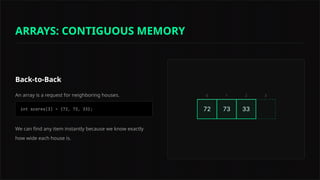
Back-to-Back
An array isa request for neighboring houses.
We can find any item instantly because we know exactly
how wide each house is.
0 1 2 3
ARRAYS: CONTIGUOUS MEMORY
26.
Instant Access
How doesthe computer find scores[100] instantly?
It doesn't "search". It calculates.
0x100 + (3 * 4) = 0x10C
ARRAY ACCESS: THE SECRET FORMULA
27.
No String Type
Chas no "string". It only has
char[] (arrays of characters).
The Sentinel (0)
How does the computer know
where the text ends? We put a
secret 0 byte (NUL) at the end.
Buffer Overflow
If you forget the 0, the
computer keeps reading
memory. This is how hackers
steal data (like Heartbleed).
<-- Vital!
STRINGS: THE ILLUSION
28.
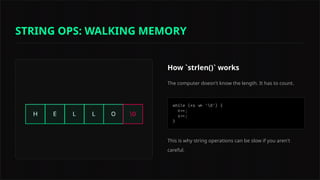
How `strlen()` works
Thecomputer doesn't know the length. It has to count.
This is why string operations can be slow if you aren't
careful.
STRING OPS: WALKING MEMORY
29.
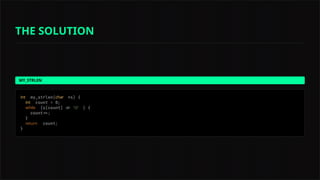
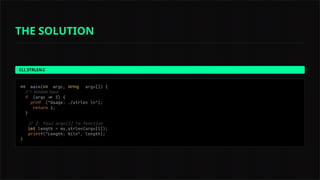
LET'S WRITE CODE
Re-createthe function `int my_strlen(string s)`.
Hint: Use a loop and stop when you hit 0.
What are they?
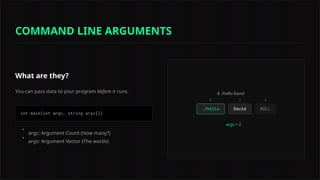
Youcan pass data to your program before it runs.
•
argc: Argument Count (How many?)
•
argv: Argument Vector (The words)
$ ./hello David
argc = 2
0 1 2
COMMAND LINE ARGUMENTS
32.
Talking to Main
Youcan pass data to your program before it runs. argv is an
array of strings sent by the shell.
•
argv[0]: The program name (e.g. ./hello).
•
argv[1]: The first word typed after the command
(e.g., David).
•
argv[argc]: Always NULL (End of list).
// Check if user gave a name
$ ./hello David
argc = 2
0 1 2
COMMAND LINE ARGUMENTS
33.
LET'S WRITE CODE
Addfunctionality to existing program to accept command line arg inputs
Hint: Use argv with right index to get the name.




![pixel[0] = {255, 255, 255};
3 Bytes Per Pixel
Every dot on your screen is just three numbers
representing intensity.
•
Red (0-255)
•
Green (0-255)
•
Blue (0-255)
RGB: NUMBERS TO LIGHT](https://image.slidesharecdn.com/cs-251205091815-db1e2c38/85/GDGC-IARE-Computer-Science-101-event-slides-6-320.jpg)







![Instant Access
How does the computer find scores[100] instantly?
It doesn't "search". It calculates.
0x100 + (3 * 4) = 0x10C
ARRAY ACCESS: THE SECRET FORMULA](https://image.slidesharecdn.com/cs-251205091815-db1e2c38/85/GDGC-IARE-Computer-Science-101-event-slides-26-320.jpg)
![No String Type
C has no "string". It only has
char[] (arrays of characters).
The Sentinel (0)
How does the computer know
where the text ends? We put a
secret 0 byte (NUL) at the end.
Buffer Overflow
If you forget the 0, the
computer keeps reading
memory. This is how hackers
steal data (like Heartbleed).
<-- Vital!
STRINGS: THE ILLUSION](https://image.slidesharecdn.com/cs-251205091815-db1e2c38/85/GDGC-IARE-Computer-Science-101-event-slides-27-320.jpg)

![Talking to Main
You can pass data to your program before it runs. argv is an
array of strings sent by the shell.
•
argv[0]: The program name (e.g. ./hello).
•
argv[1]: The first word typed after the command
(e.g., David).
•
argv[argc]: Always NULL (End of list).
// Check if user gave a name
$ ./hello David
argc = 2
0 1 2
COMMAND LINE ARGUMENTS](https://image.slidesharecdn.com/cs-251205091815-db1e2c38/85/GDGC-IARE-Computer-Science-101-event-slides-32-320.jpg)




![Oh Crap, I Forgot (Or Never Learned) C! [CodeMash 2010]](https://cdn.slidesharecdn.com/ss_thumbnails/oh-crap-i-never-learned-c-codemash-2010-100115163750-phpapp01-thumbnail.jpg?width=640&height=640&fit=bounds)


