Dr. Ajam Shaikh
Assistant Professor, Alliance University
Evaluation for Chemical Reaction
Efficiency: METRICS
1. Why do we need metrics in green chemistry?
2. Established Metrics in Green Chemistry
• Atom Economy
• Environmental (E) Factor
• Atom Utilization
• Reaction Mass Efficiency
3. Additional Metrics Used in Green Chemistry
• Process Mass Intensity
• Life Cycle Assessment
• Ecological Indicator/Ecological Footprint
Topics To Be
Covered
Percent yield: % yield = (actual yield/theoretical yield) x 100
What is missing?
 What co-products are made?
 How much waste is generated?
 Is the waste benign waste?
 How much energy is required?
 Are purification steps needed?
 What solvents are used? (are they benign and/or reusable?)
 Is the “catalyst” truly a catalyst? (stoichiometric vs. catalytic)
CONVENTIONAL METRICS:
PERCENT YIELD
1. Atom economy (atom efficiency)
Atom Economy =
Mass of desired product∗
Mass of all reactants∗
*including the stoichiometric coefficient
2. Environmental (E) factor
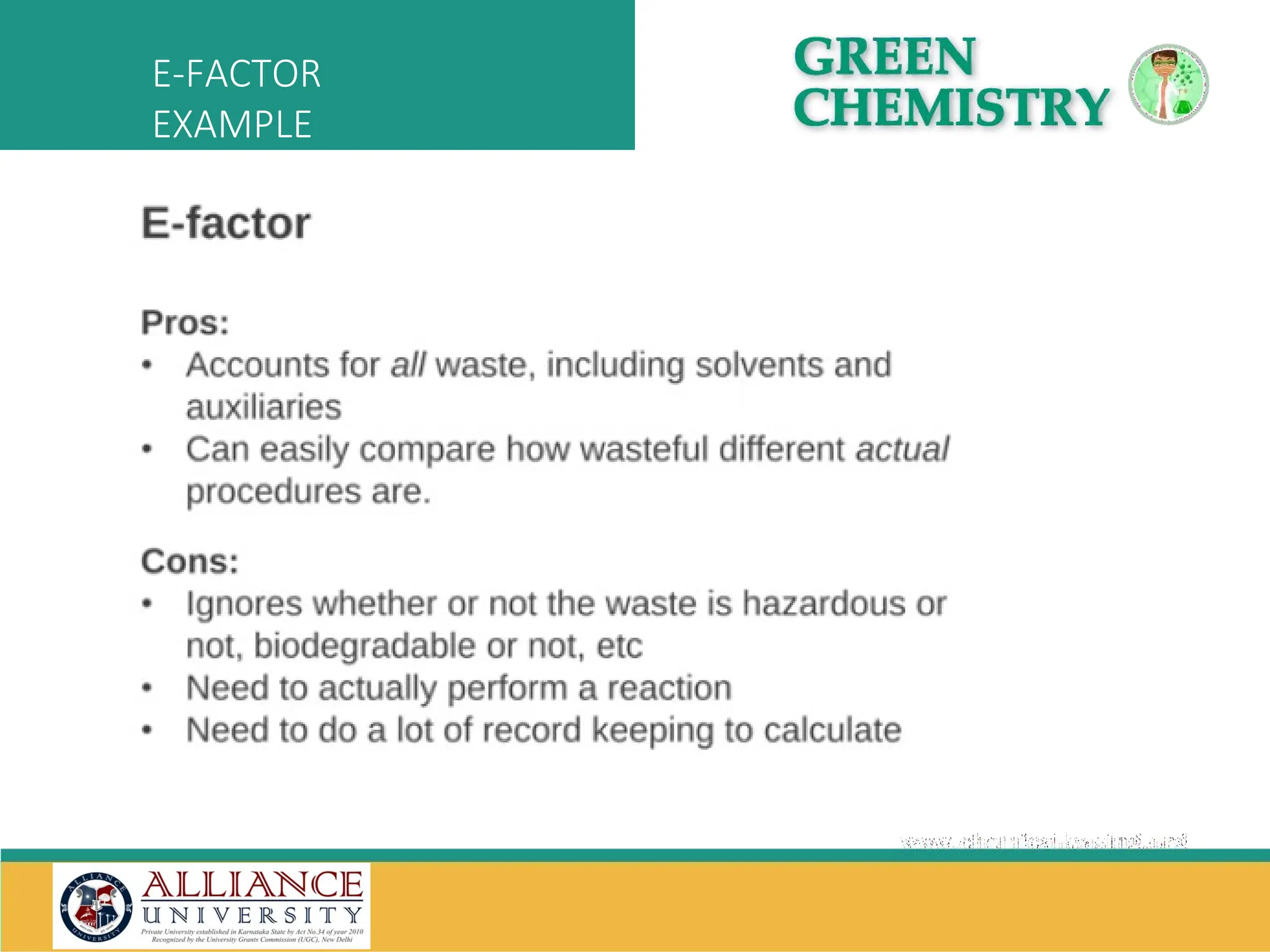
E-factor = total waste (g) / product (g)
3. Atom utilization (variation of atom economy)
% Atom Utilization = (MW of desired product/MW of all products) X 100
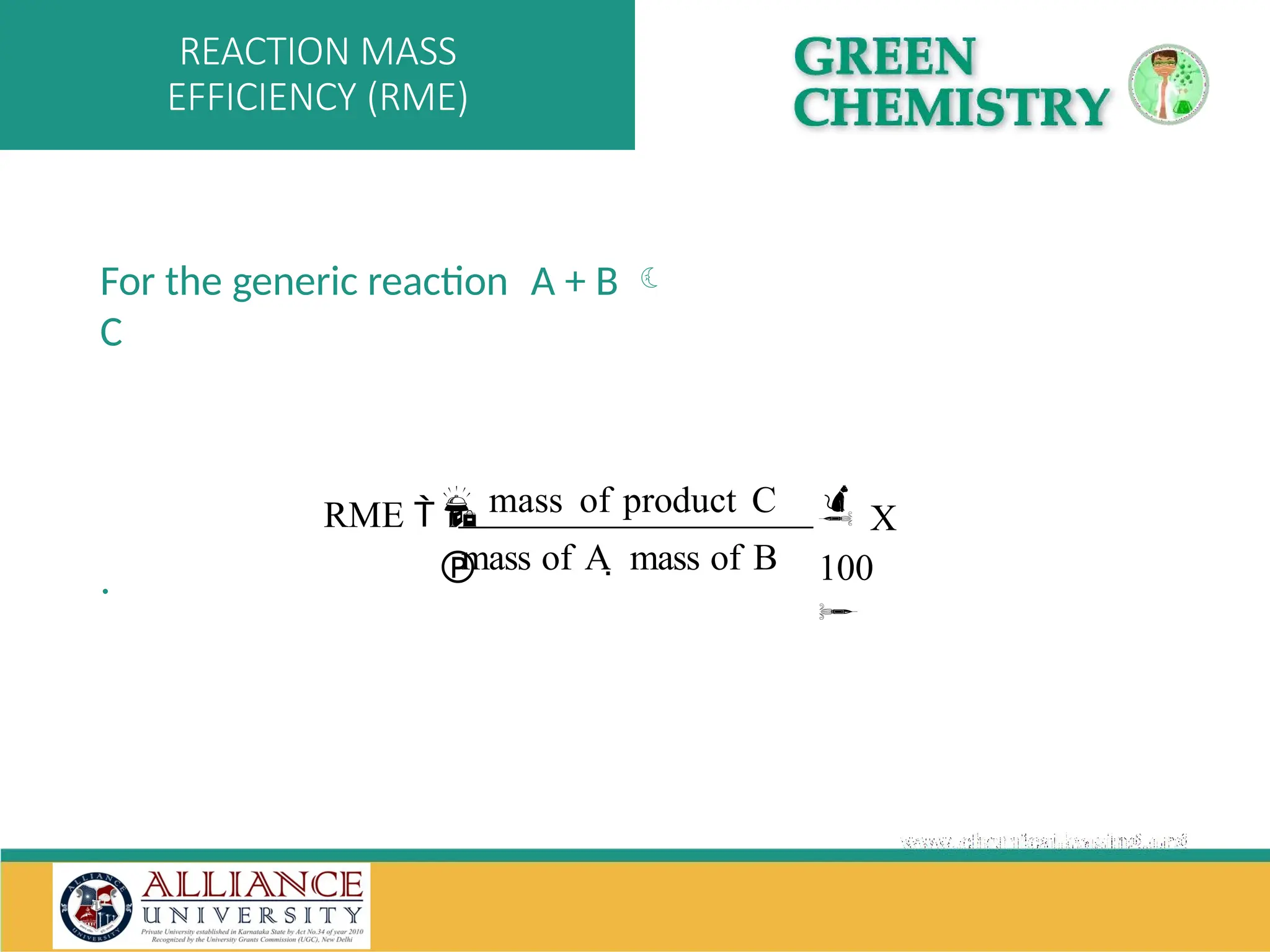
4. Reaction mass efficiency (RME)
(mass of product C/(mass of A + mass of B)) X 100
ESTABLISHED
GREEN CHEMISTRY
METRICS
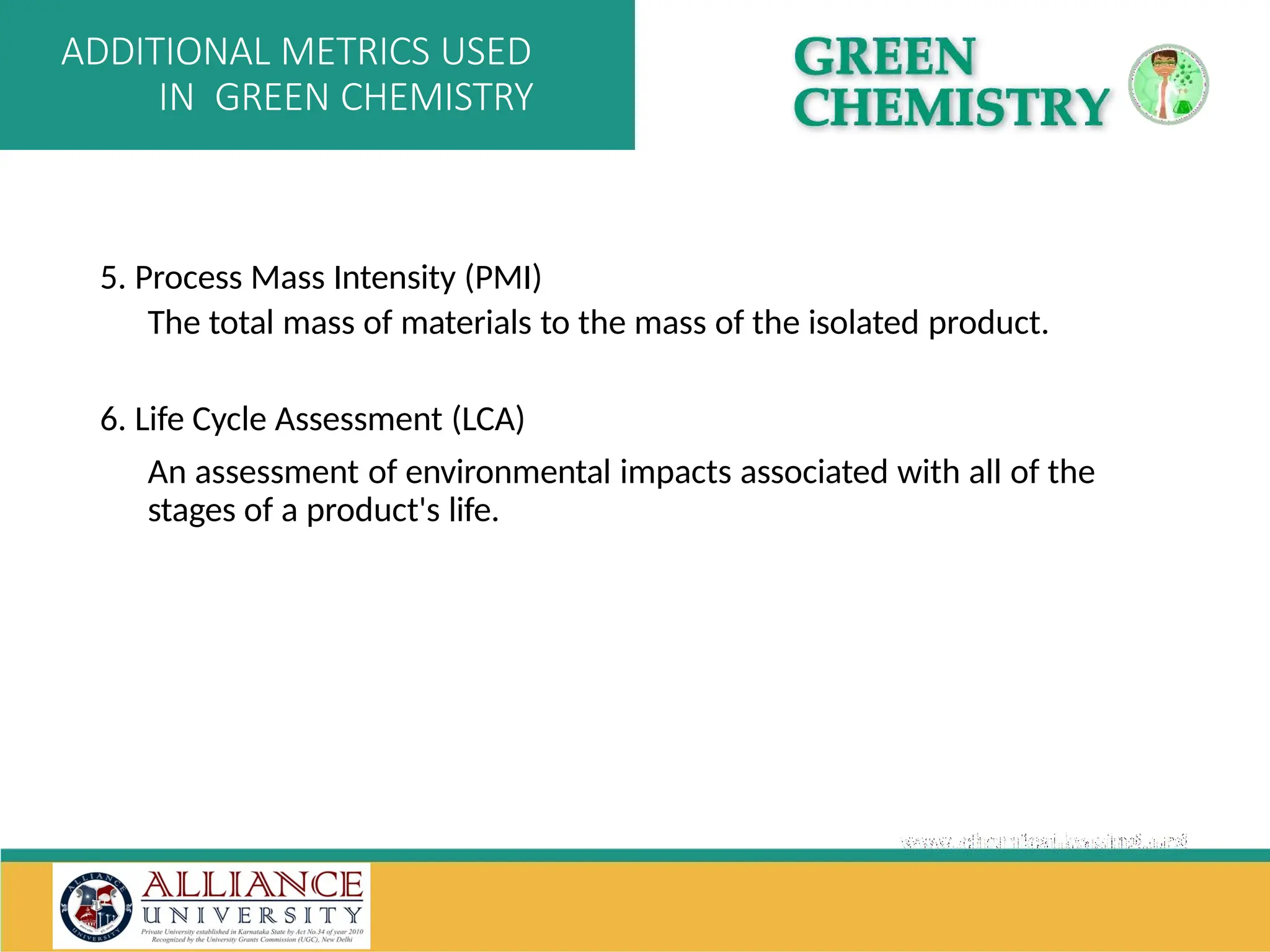
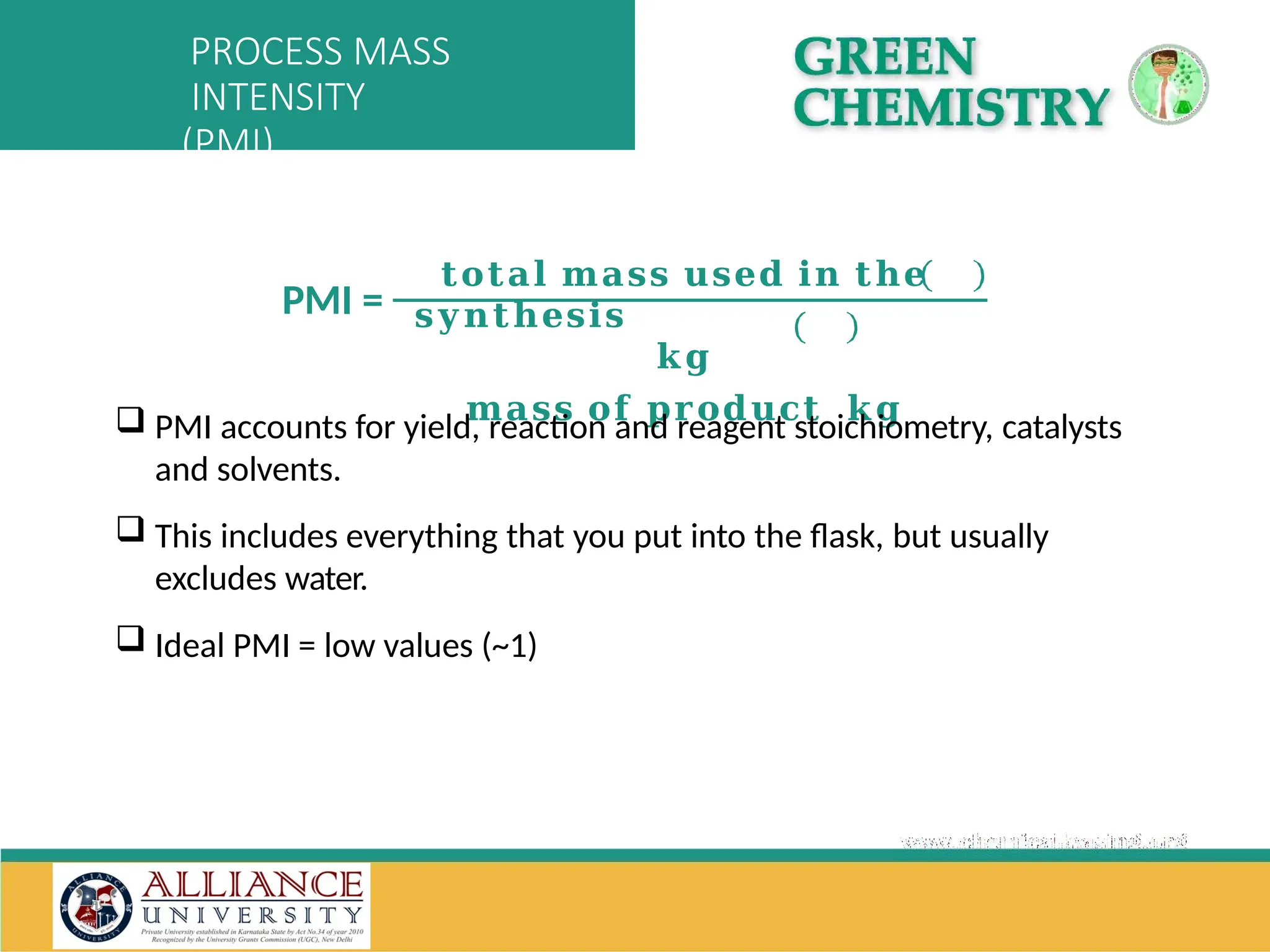
5. Process Mass Intensity (PMI)
The total mass of materials to the mass of the isolated product.
6. Life Cycle Assessment (LCA)
An assessment of environmental impacts associated with all of the
stages of a product's life.
ADDITIONAL METRICS USED
IN GREEN CHEMISTRY
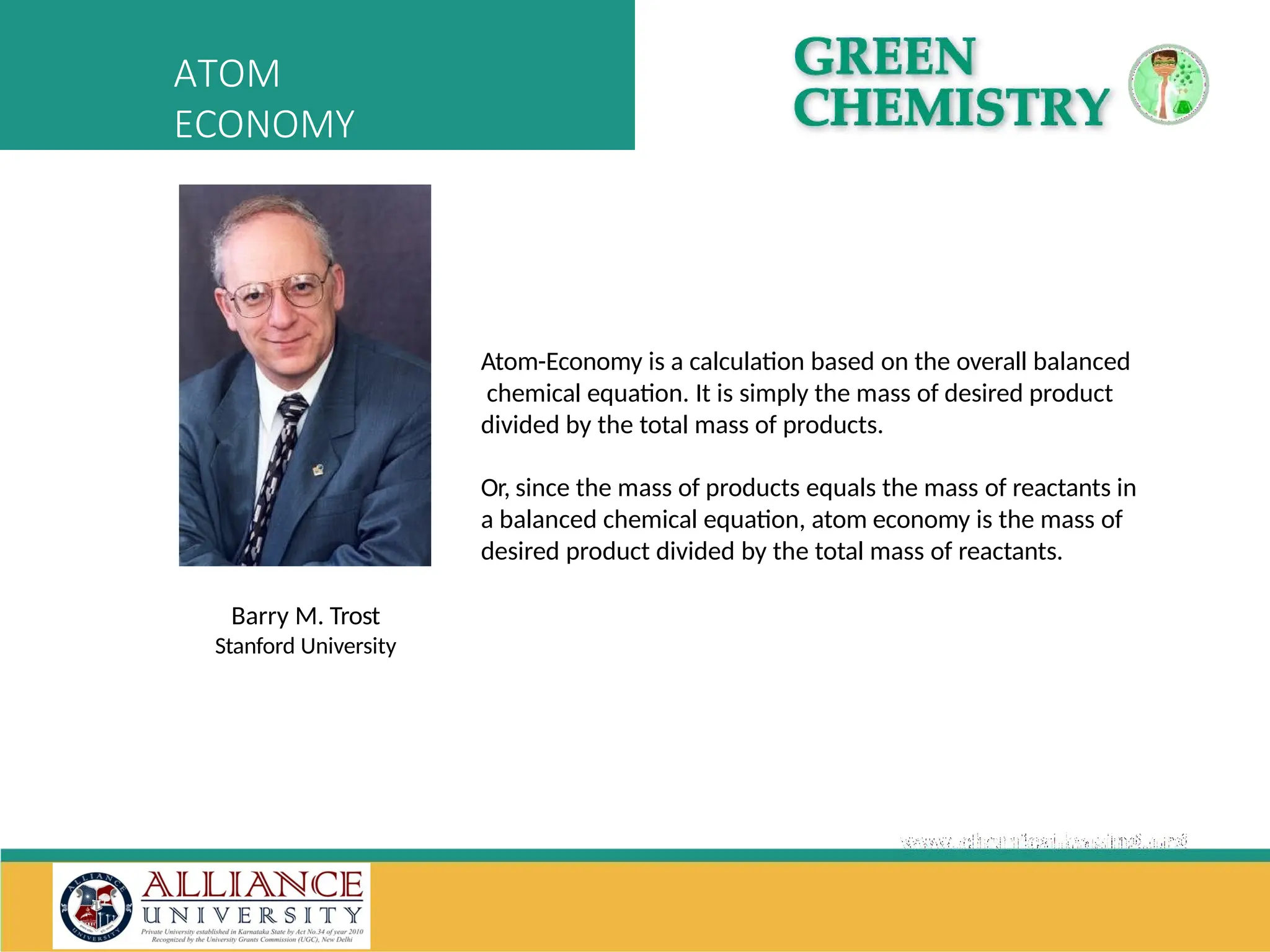
Atom-Economy is a calculation based on the overall balanced
chemical equation. It is simply the mass of desired product
divided by the total mass of products.
Or, since the mass of products equals the mass of reactants in
a balanced chemical equation, atom economy is the mass of
desired product divided by the total mass of reactants.
Barry M. Trost
Stanford University
ATOM
ECONOMY
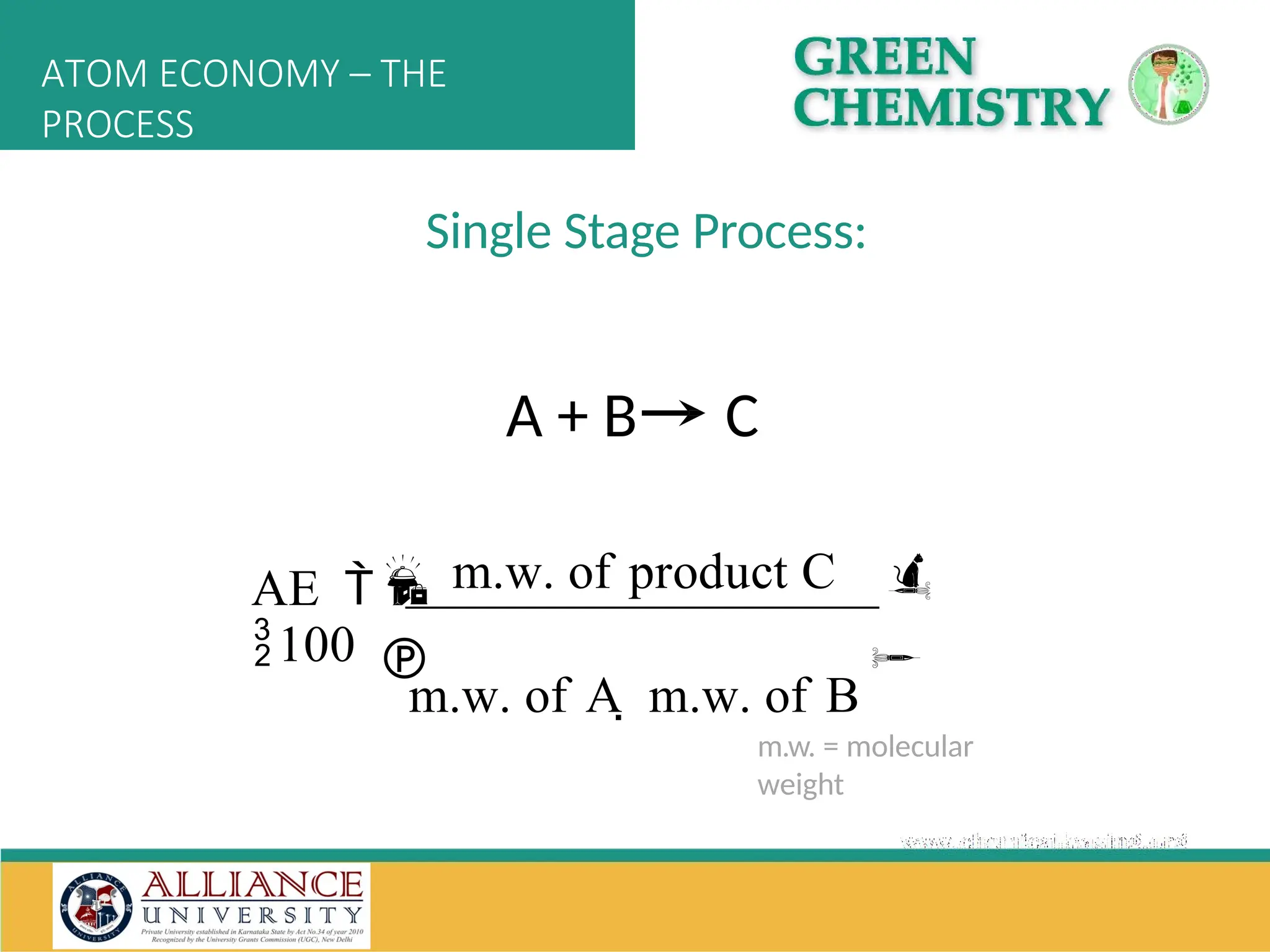
Single Stage Process:
m.w. of product C 


AE   
100
m.w. of A  m.w. of B
A + B C
ATOM ECONOMY – THE
PROCESS

m.w. = molecular
weight
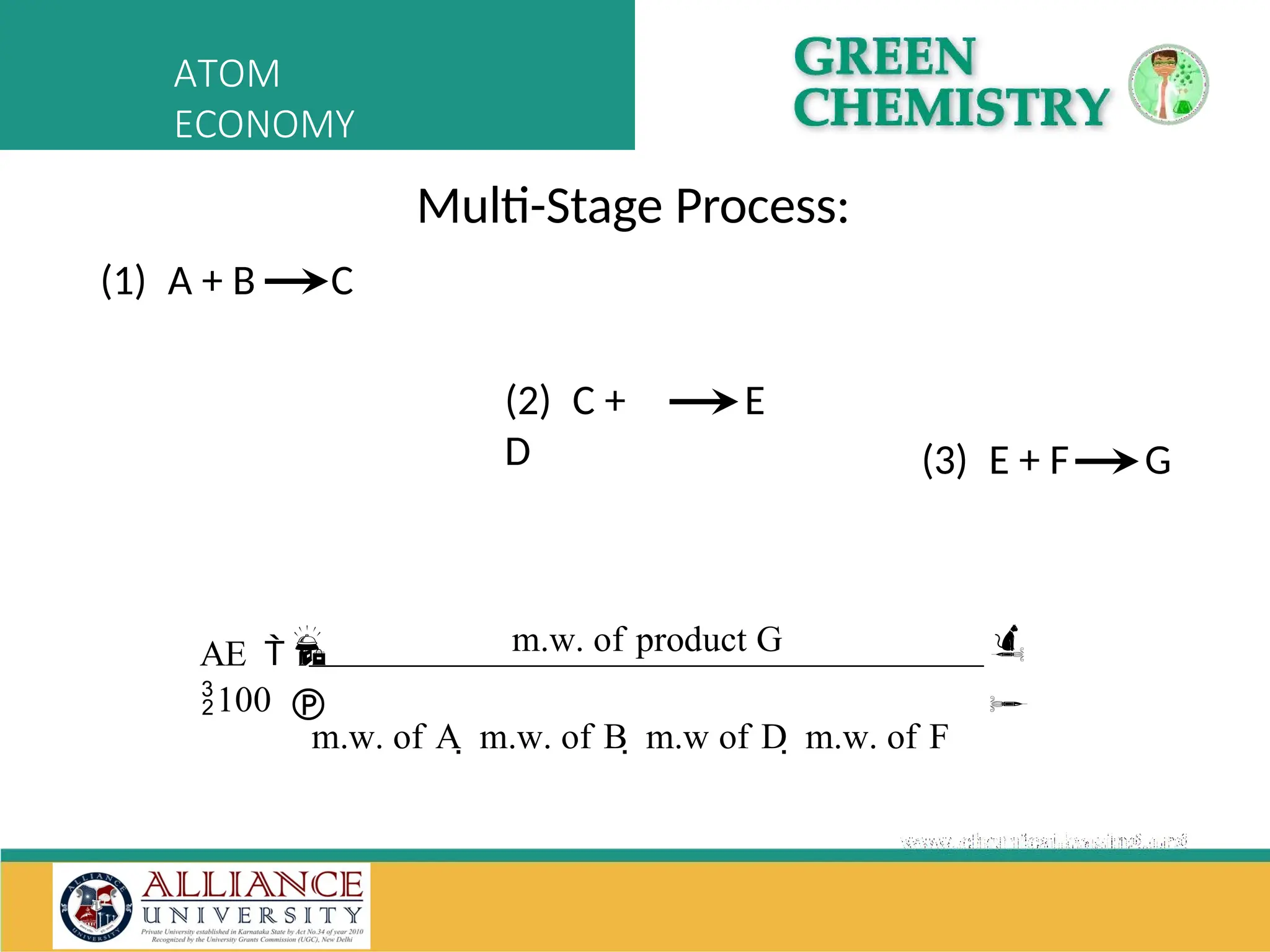
(2) C +
D
E
(3) E + F G
m.w. of product G


AE   
100
m.w. of A  m.w. of B  m.w of D  m.w. of F


Multi-Stage Process:
(1) A + B C
ATOM
ECONOMY
Reagent MW (g mol-1)
1 (Reactant) 74.12
2 (Reactant) 102.91
3 (Reactant) 98.08
4 (Desired
Product)
137
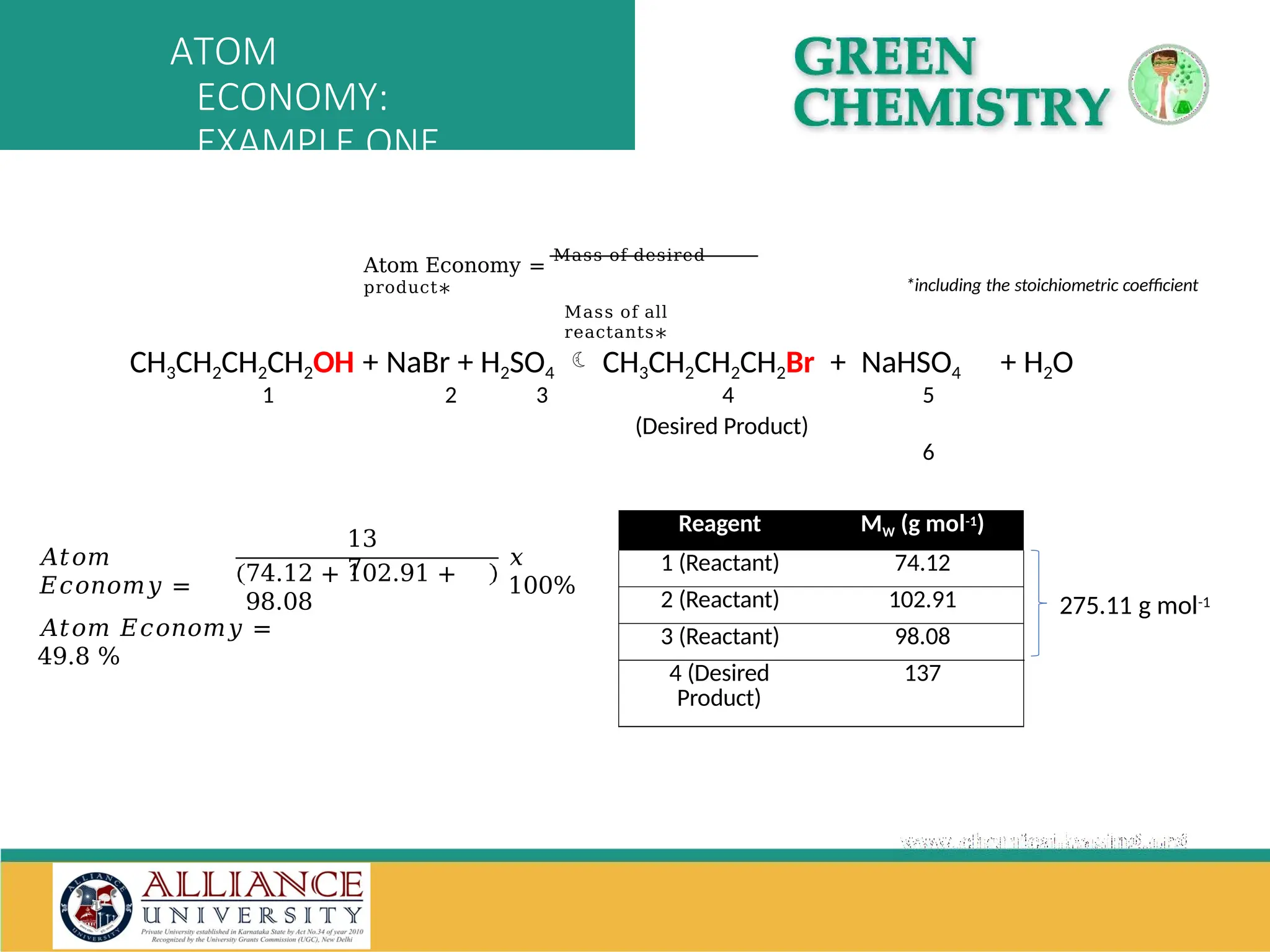
CH3CH2CH2CH2OH + NaBr + H2SO4  CH3CH2CH2CH2Br + NaHSO4 + H2O
1 2 3 4
(Desired Product)
5
6
275.11 g mol-1
𝐴𝑡𝑜𝑚
𝐸𝑐𝑜𝑛𝑜𝑚𝑦 =
13
7
74.12 + 102.91 +
98.08
𝑥
100%
𝐴𝑡𝑜𝑚 𝐸𝑐𝑜𝑛𝑜𝑚𝑦 =
49.8 %
*including the stoichiometric coefficient
Atom Economy =
Mass of desired
product∗
Mass of all
reactants∗
ATOM
ECONOMY:
EXAMPLE ONE
- from Cann, M.C.; and Connelly, M.E. Real World Cases in Green Chemistry, American Chemical Society: Washington, DC, 2000
The Problem:
The traditional industrial synthesis of ibuprofen
was developed and patented by the Boots
Company of England in the 1960s (U.S. Patent
3,385,886). This synthesis is a six-step process
and results in large quantities of unwanted
waste chemical byproducts that must be
disposed of or otherwise managed. Much of the
waste that is generated is a result of many of the
atoms of the reactants not being incorporated
into the desired product (ibuprofen) but into
unwanted byproducts (poor atom
economy/atom utilization). The process also
uses a variety of solvents, and catalysts (if any)
are not used in stoichiometric amounts.
The Solution:
The BHC Company has developed and
implemented a new greener industrial synthesis
of ibuprofen that is only three steps (U.S.
Patents 4,981,995 and 5,068,448, both issued in
1991). In this process, most of the atoms of the
reactants are incorporated into the desired
product (ibuprofen). This results in only small
amounts of unwanted byproducts (very good
atom economy/atom utilization) thus lessening
the need for disposal and mediation of waste
products. There are other environmental
advantages to the green synthesis versus the
brown synthesis, including solvents and catalyst.
ATOM ECONOMY EXAMPLE
TWO: IBUPROFEN
SYNTHESIS
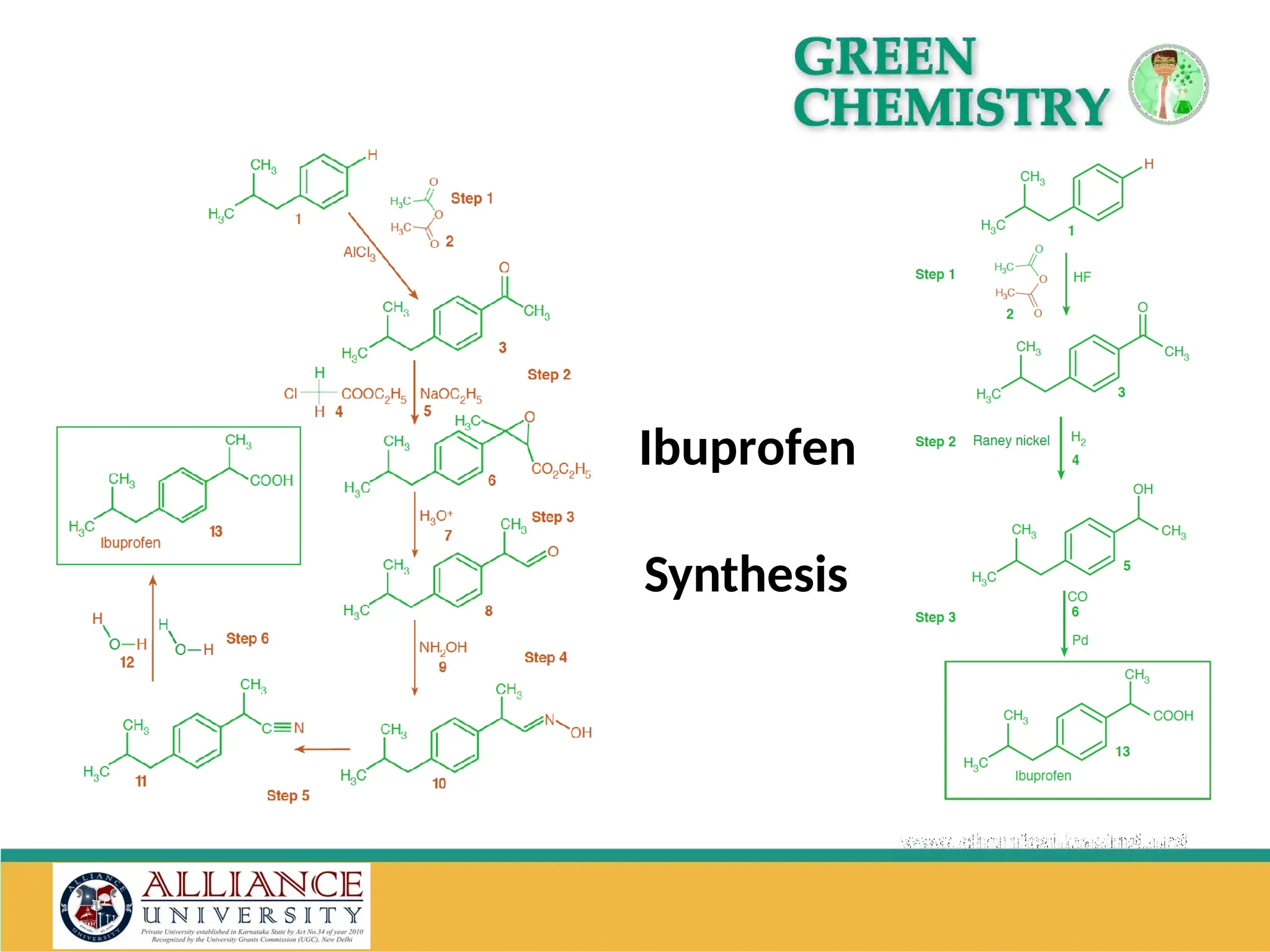
Ibuprofen
Synthesis
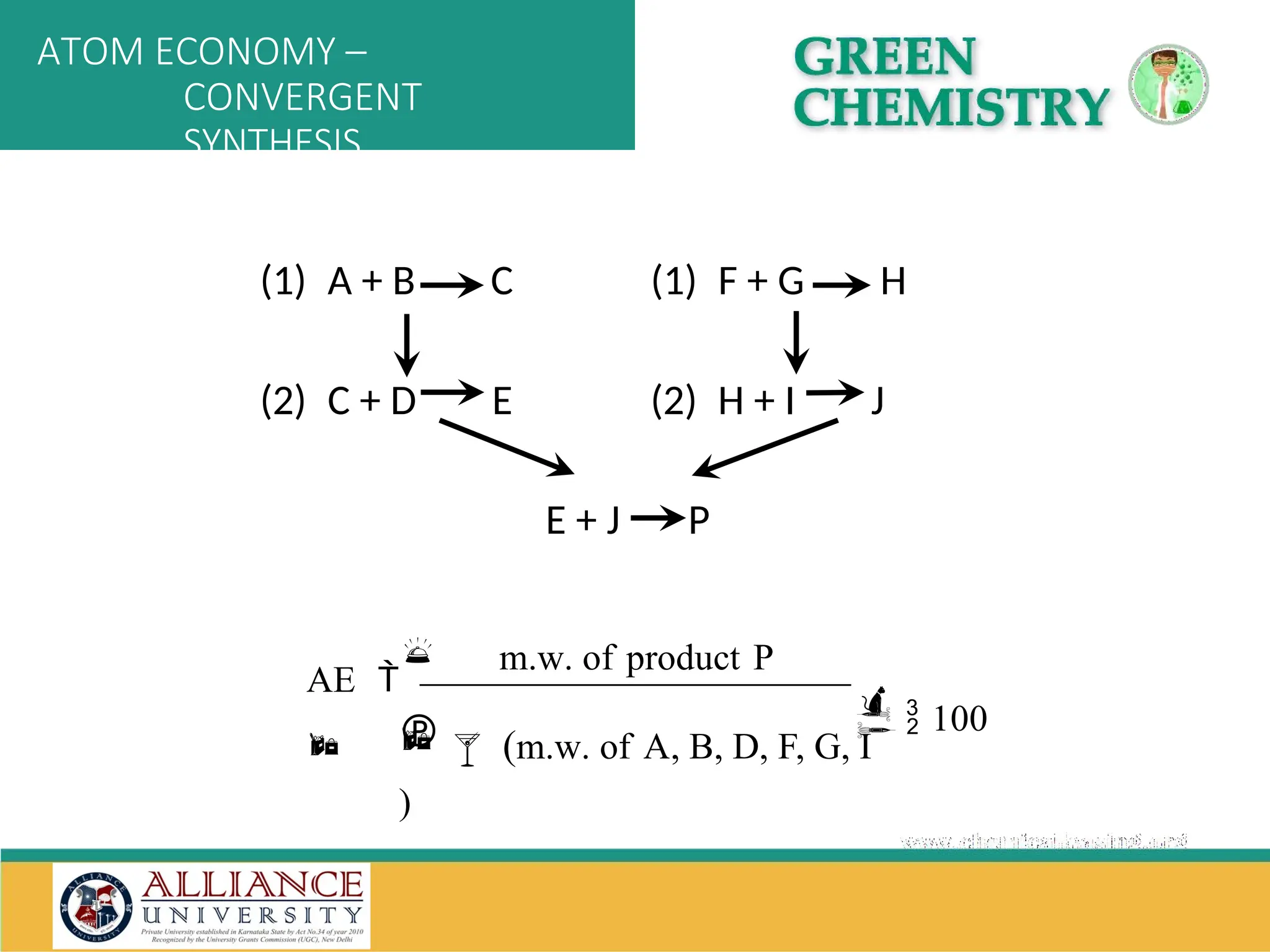
(1) A + B C (1) F + G H
(2) C + D E (2) H + I J
E + J P
m.w. of product P
  100


AE 
 

 (m.w. of A, B, D, F, G, I
)
ATOM ECONOMY –
CONVERGENT
SYNTHESIS
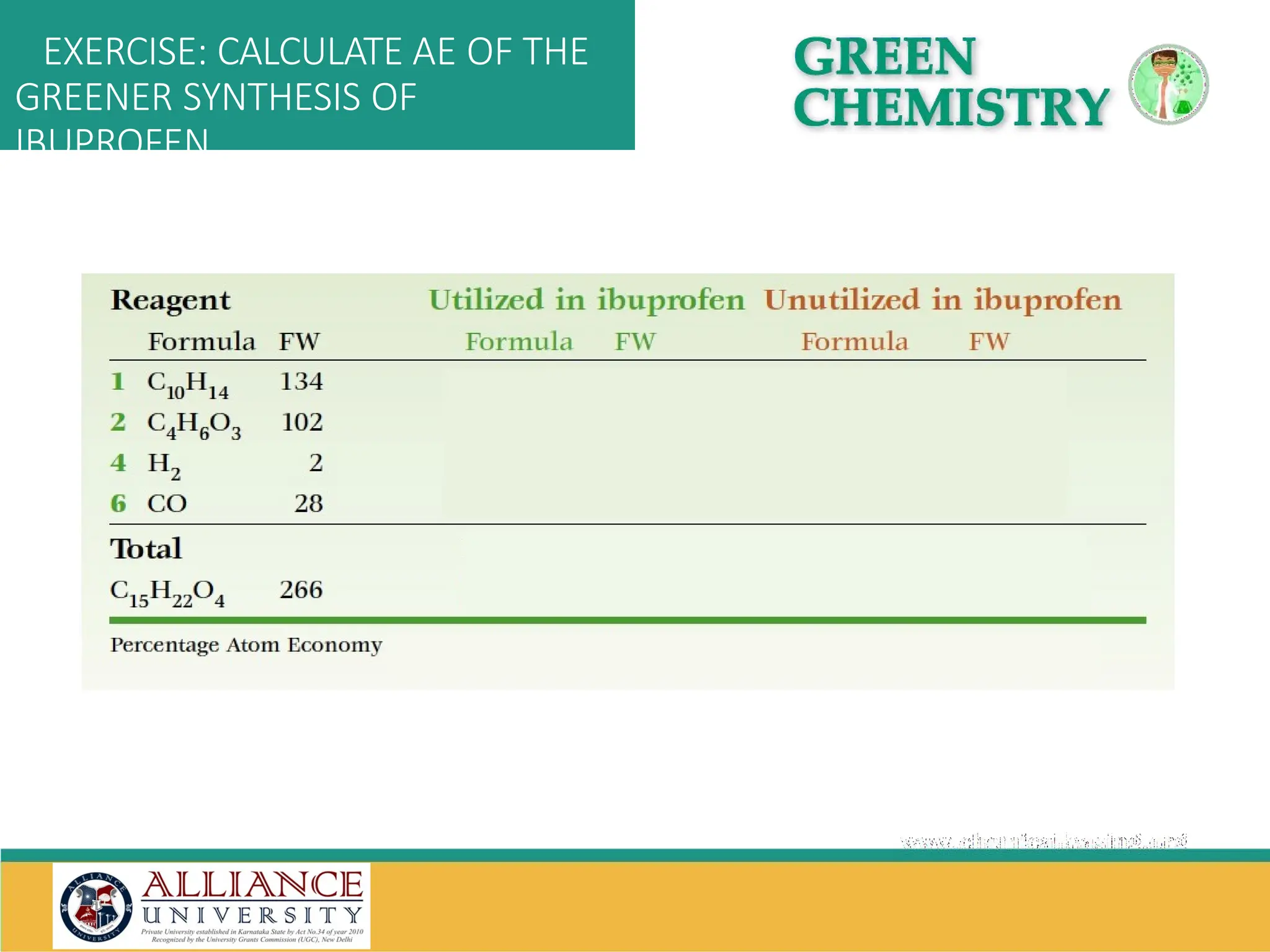
EXERCISE: CALCULATE AE OF THE
GREENER SYNTHESIS OF
IBUPROFEN
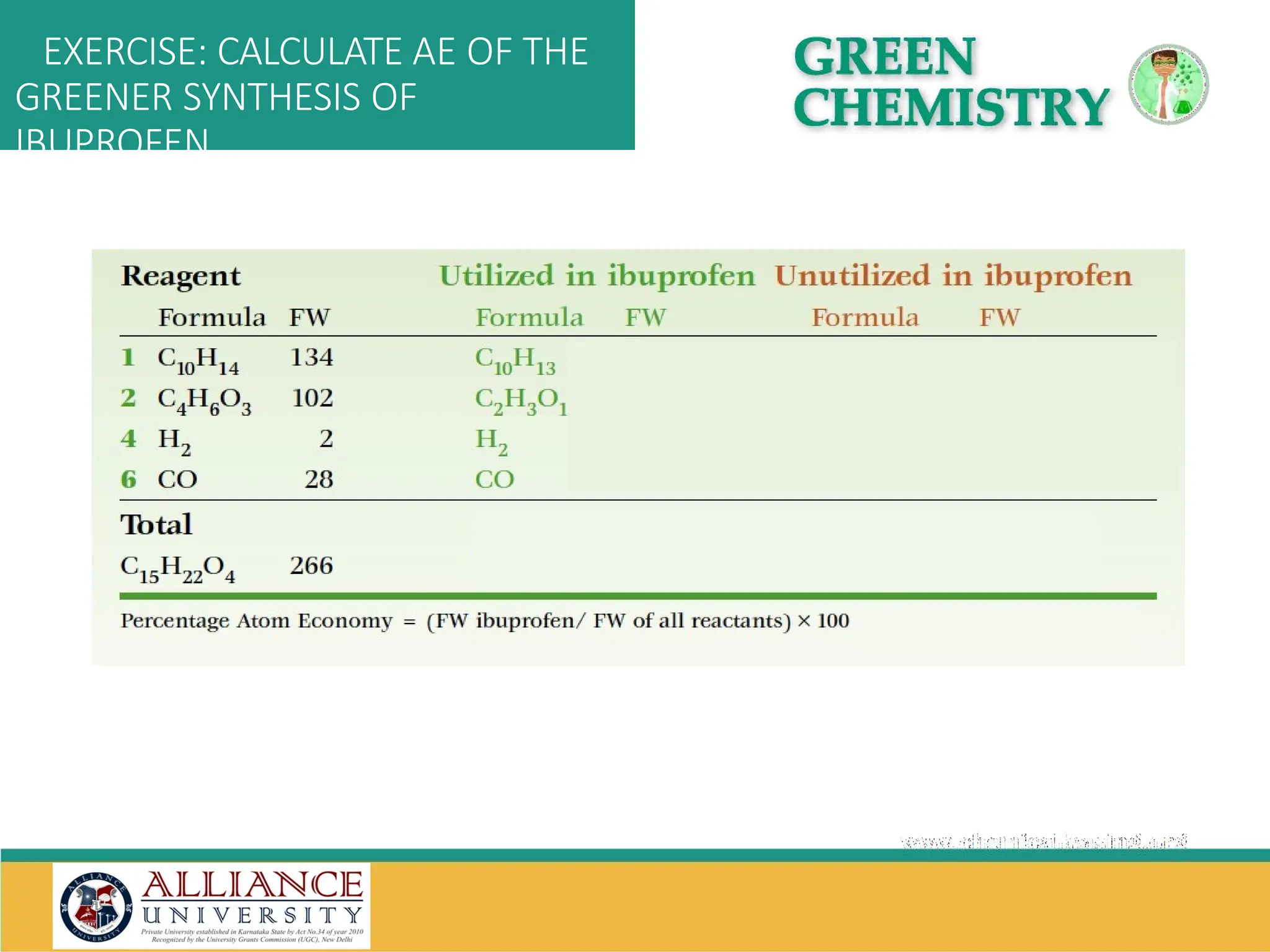
EXERCISE: CALCULATE AE OF THE
GREENER SYNTHESIS OF
IBUPROFEN
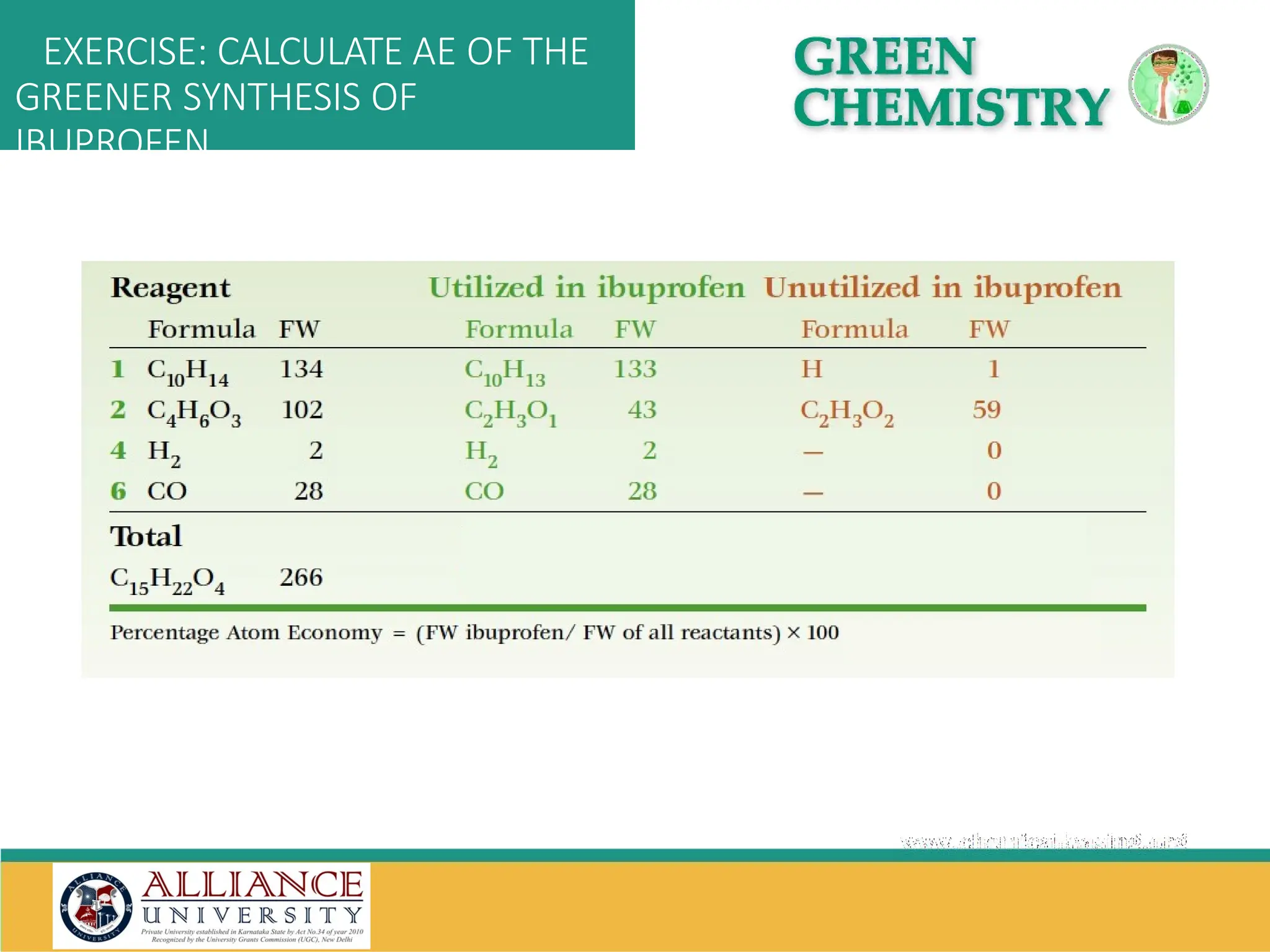
EXERCISE: CALCULATE AE OF THE
GREENER SYNTHESIS OF
IBUPROFEN
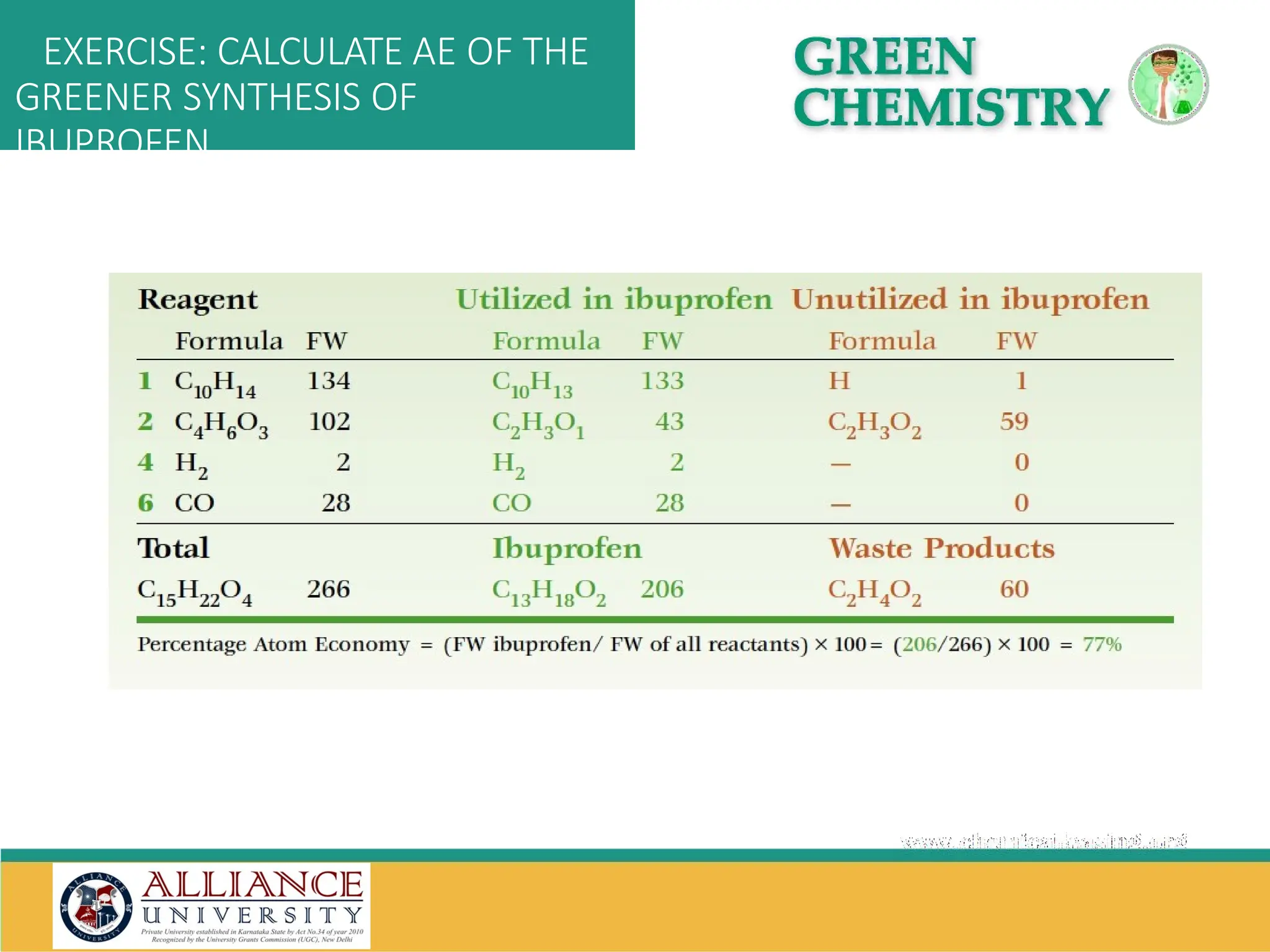
EXERCISE: CALCULATE AE OF THE
GREENER SYNTHESIS OF
IBUPROFEN
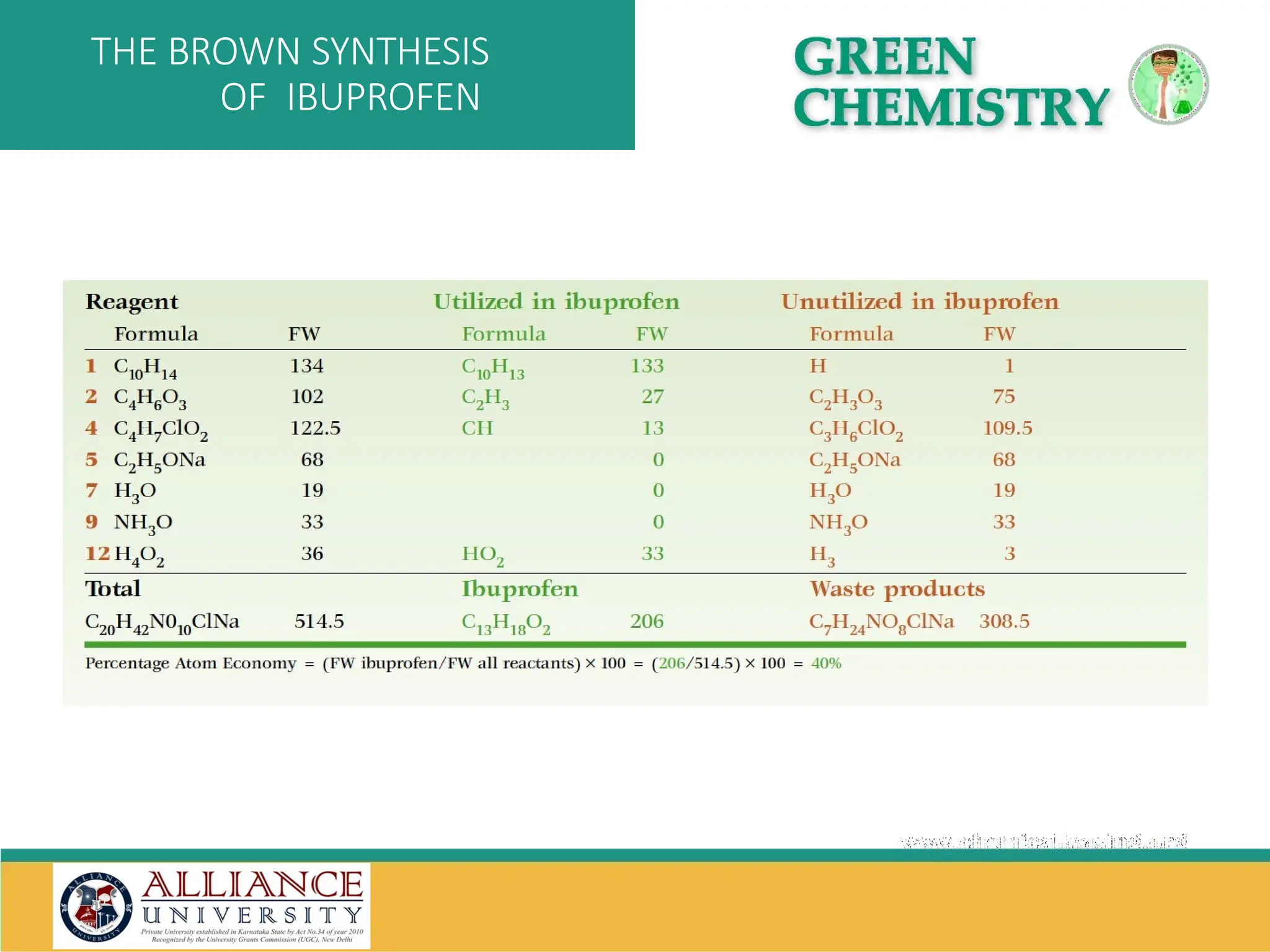
THE BROWN SYNTHESIS
OF IBUPROFEN
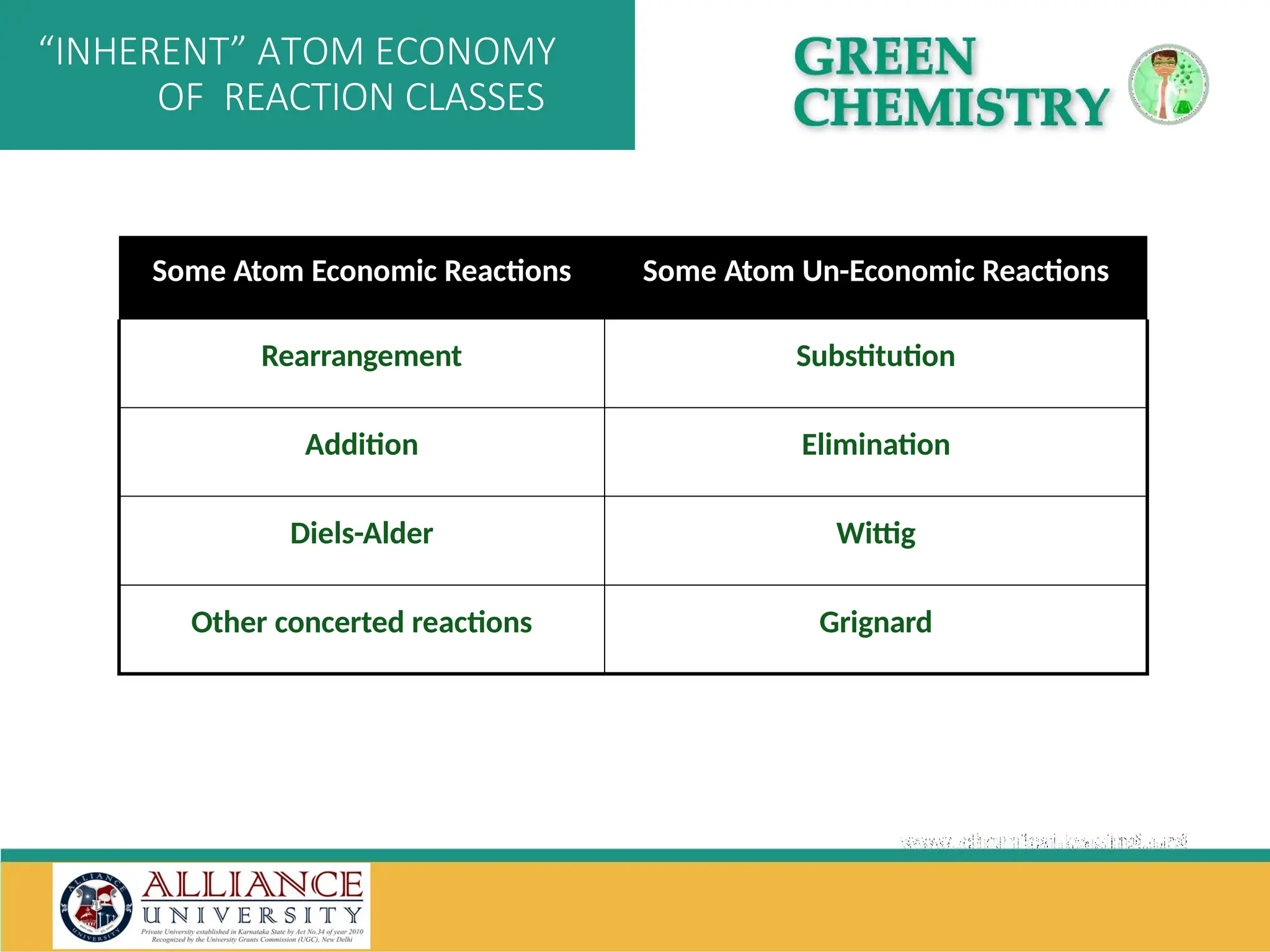
Some Atom Economic Reactions Some Atom Un-Economic Reactions
Rearrangement Substitution
Addition Elimination
Diels-Alder Wittig
Other concerted reactions Grignard
“INHERENT” ATOM ECONOMY
OF REACTION CLASSES
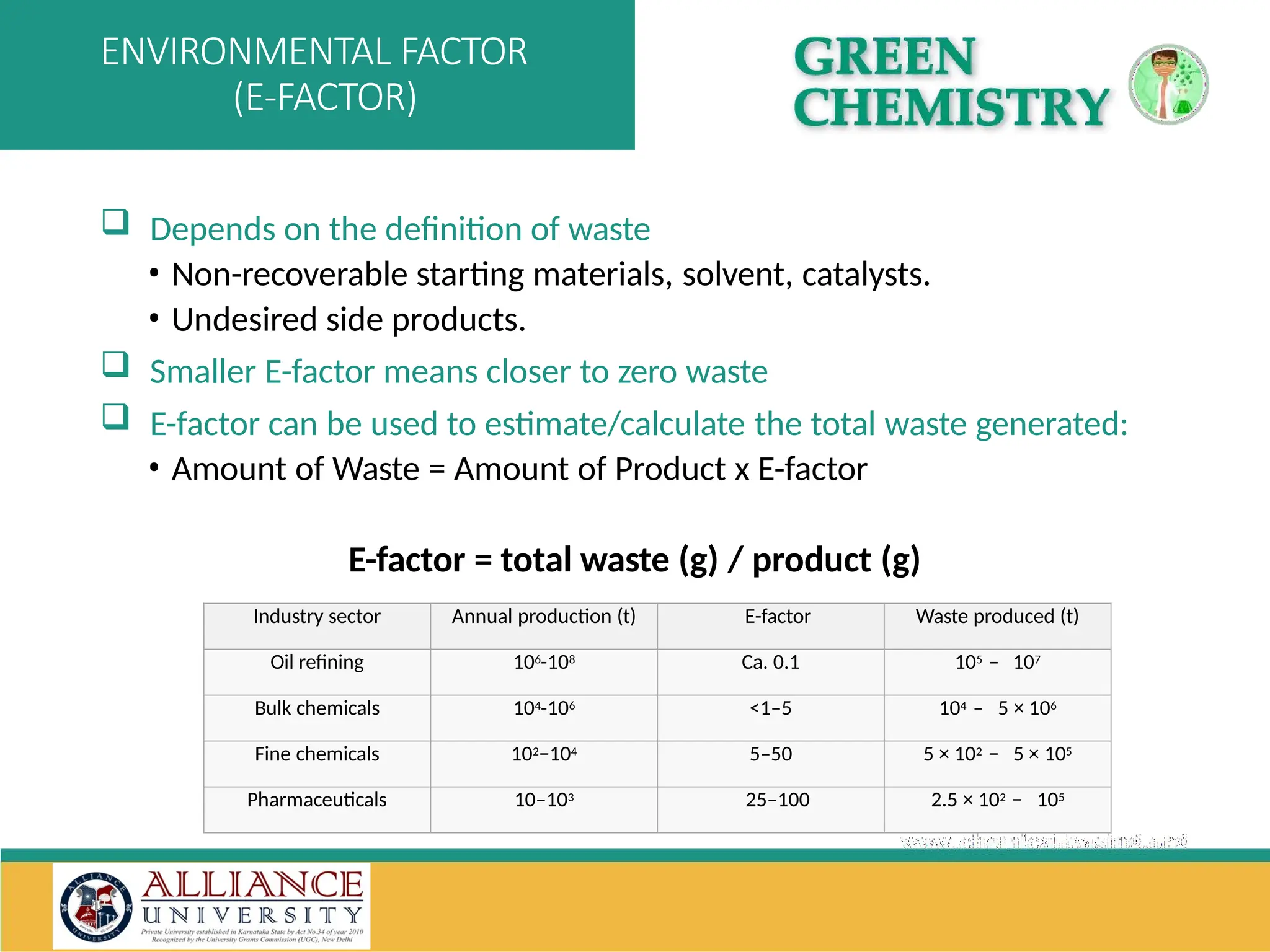
Industry sector Annual production (t) E-factor Waste produced (t)
Oil refining 106-108 Ca. 0.1 105 – 107
Bulk chemicals 104-106 <1–5 104 – 5 × 10⁶
Fine chemicals 102−104 5–50 5 × 10² − 5 × 10⁵
Pharmaceuticals 10–103 25–100 2.5 × 10² − 105
 Depends on the definition of waste
• Non-recoverable starting materials, solvent, catalysts.
• Undesired side products.
 Smaller E-factor means closer to zero waste
 E-factor can be used to estimate/calculate the total waste generated:
• Amount of Waste = Amount of Product x E-factor
E-factor = total waste (g) / product (g)
ENVIRONMENTAL FACTOR
(E-FACTOR)
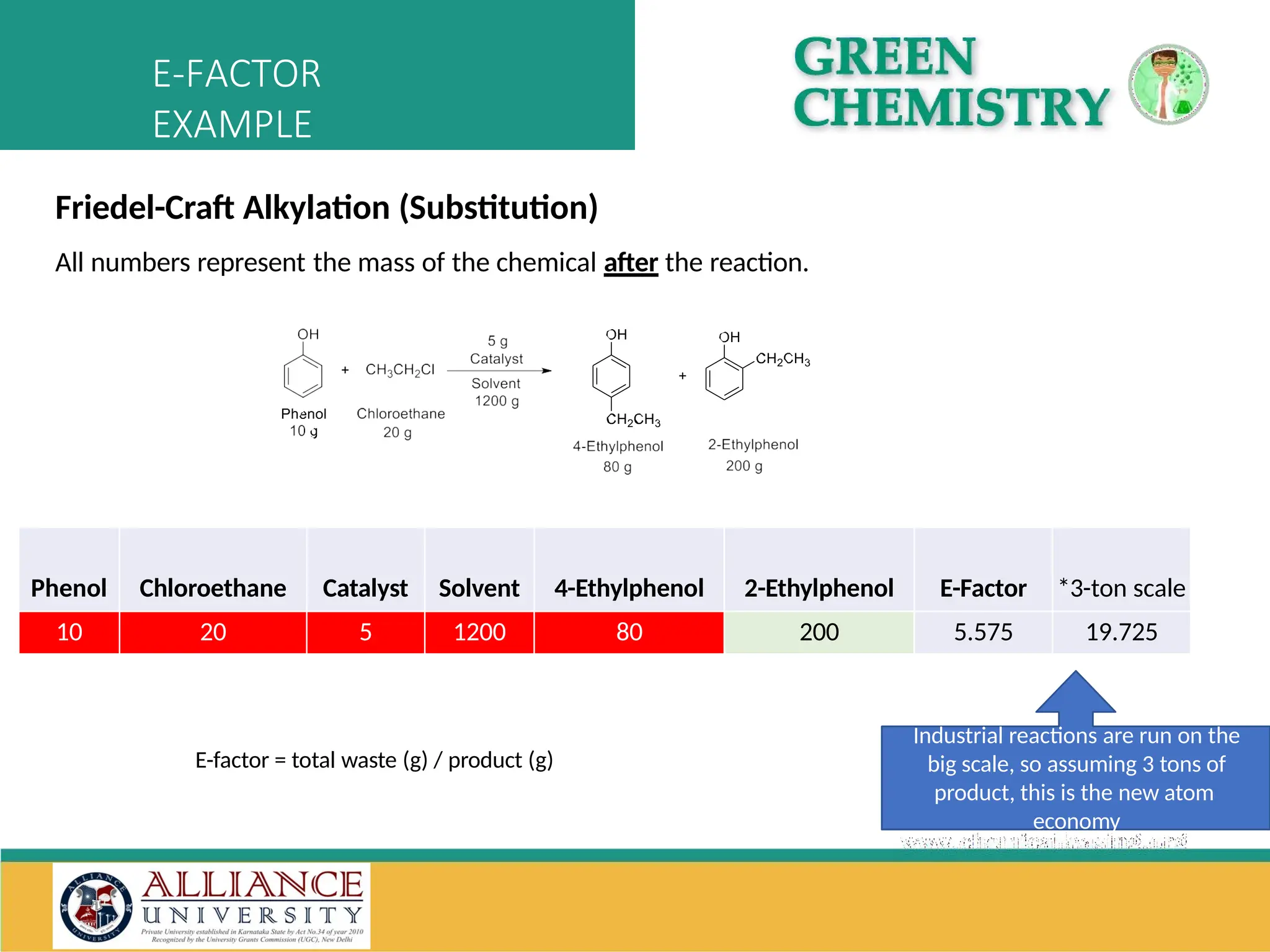
Phenol Chloroethane Catalyst Solvent 4-Ethylphenol 2-Ethylphenol E-Factor *3-ton scale
10 20 5 1200 80 200 5.575 19.725
E-factor = total waste (g) / product (g)
Industrial reactions are run on the
big scale, so assuming 3 tons of
product, this is the new atom
economy
E-FACTOR
EXAMPLE
Friedel-Craft Alkylation (Substitution)
All numbers represent the mass of the chemical after the reaction.
E-FACTOR
EXAMPLE
For the generic reaction A + B 
C
.
mass of product C  X
100




RME  
mass of A  mass of B
REACTION MASS
EFFICIENCY (RME)
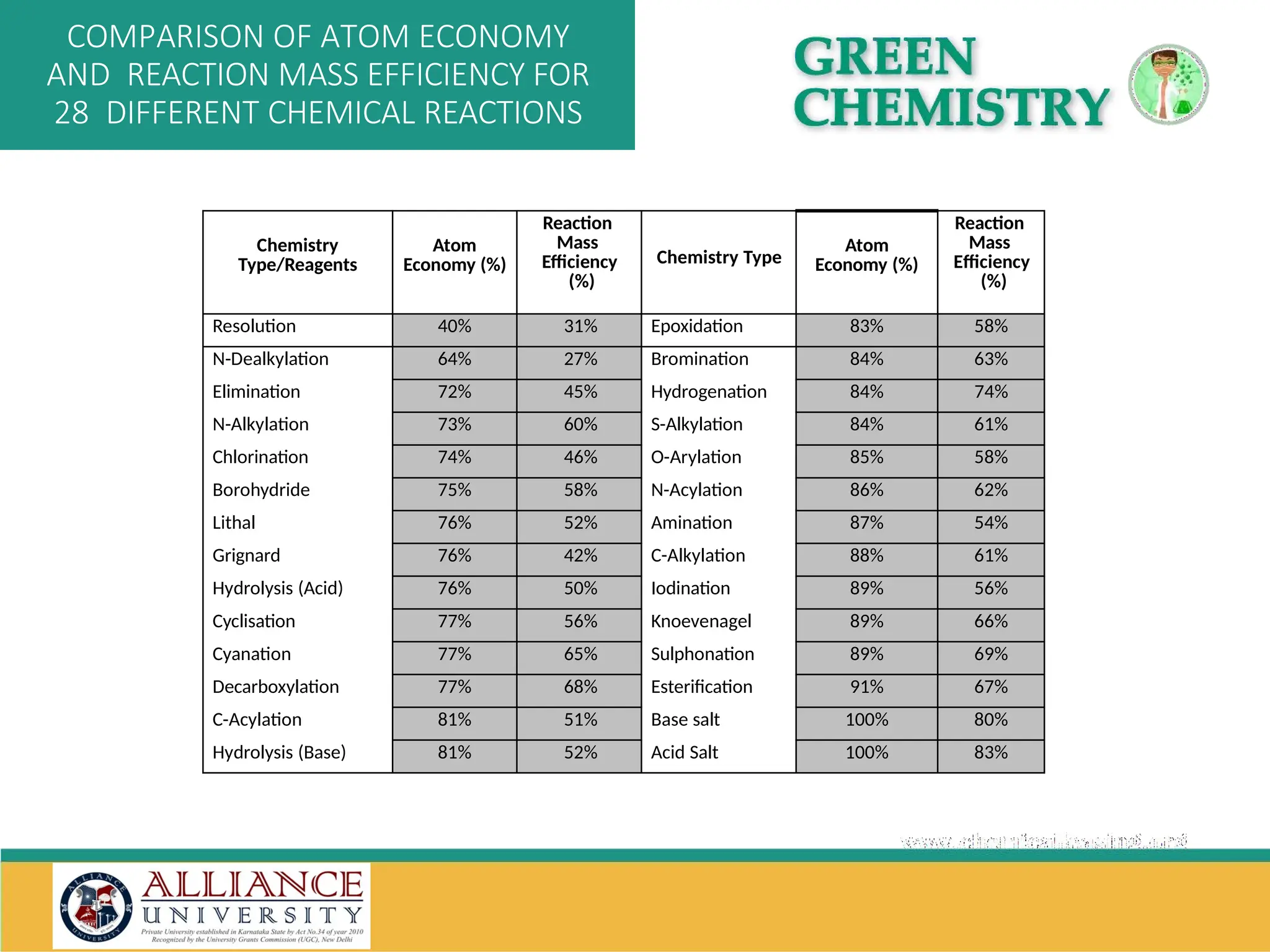
Chemistry
Type/Reagents
Atom
Economy (%)
Reaction
Mass
Efficiency
(%)
Chemistry Type
Atom
Economy (%)
Reaction
Mass
Efficiency
(%)
Resolution 40% 31% Epoxidation 83% 58%
N-Dealkylation 64% 27% Bromination 84% 63%
Elimination 72% 45% Hydrogenation 84% 74%
N-Alkylation 73% 60% S-Alkylation 84% 61%
Chlorination 74% 46% O-Arylation 85% 58%
Borohydride 75% 58% N-Acylation 86% 62%
Lithal 76% 52% Amination 87% 54%
Grignard 76% 42% C-Alkylation 88% 61%
Hydrolysis (Acid) 76% 50% Iodination 89% 56%
Cyclisation 77% 56% Knoevenagel 89% 66%
Cyanation 77% 65% Sulphonation 89% 69%
Decarboxylation 77% 68% Esterification 91% 67%
C-Acylation 81% 51% Base salt 100% 80%
Hydrolysis (Base) 81% 52% Acid Salt 100% 83%
COMPARISON OF ATOM ECONOMY
AND REACTION MASS EFFICIENCY FOR
28 DIFFERENT CHEMICAL REACTIONS
PMI =
𝐭𝐨𝐭𝐚𝐥 𝐦𝐚𝐬𝐬 𝐮𝐬𝐞𝐝 𝐢𝐧 𝐭𝐡𝐞
𝐬𝐲𝐧𝐭𝐡𝐞𝐬𝐢𝐬
𝐤𝐠
𝐦𝐚𝐬𝐬 𝐨𝐟 𝐩𝐫𝐨𝐝𝐮𝐜𝐭 𝐤𝐠
 PMI accounts for yield, reaction and reagent stoichiometry, catalysts
and solvents.
 This includes everything that you put into the flask, but usually
excludes water.
 Ideal PMI = low values (~1)
PROCESS MASS
INTENSITY
(PMI)
Chemical manufacturer responses (n = 18) to the 2012 Roundtable survey question “What green chemistry and
engineering related metrics does your company use? Select all that apply.”
Percentage of respondents indicating one or more metrics surveyed in use computed as the ratio of [total responses –
(not sure + none)]/(total responses). PMI = process mass intensity = (mass of raw materials)/(mass of final product).E-
factor = (mass of waste)/mass of final product).LCA = life cycle assessment.
Implementing Green Chemistry in Chemical Manufacturing: A Survey Report Robert J. Giraud, Paul A. Williams, Amit Sehgal, Ettigounder
Ponnusamy, Alan K. Phillips, and Julie B. Manley
ACS Sustainable Chemistry & Engineering 2014 2 (10), 2237-2242
GREEN CHEMISTRY-RELATED
METRICS USED IN
CHEMICAL
MANUFACTURING
1. Why do we need metrics in green chemistry?
2. Established Metrics in Green Chemistry
• Atom Economy
• Environmental (E) Factor
• Atom Utilization
• Reaction Mass Efficiency
3. Additional Metrics Used in Green Chemistry
• Process Mass Intensity
• Life Cycle Assessment
• Ecological Indicator/Ecological Footprint
TOPICS COVERED
Atom Economic Reactions
The “Good”
Addition
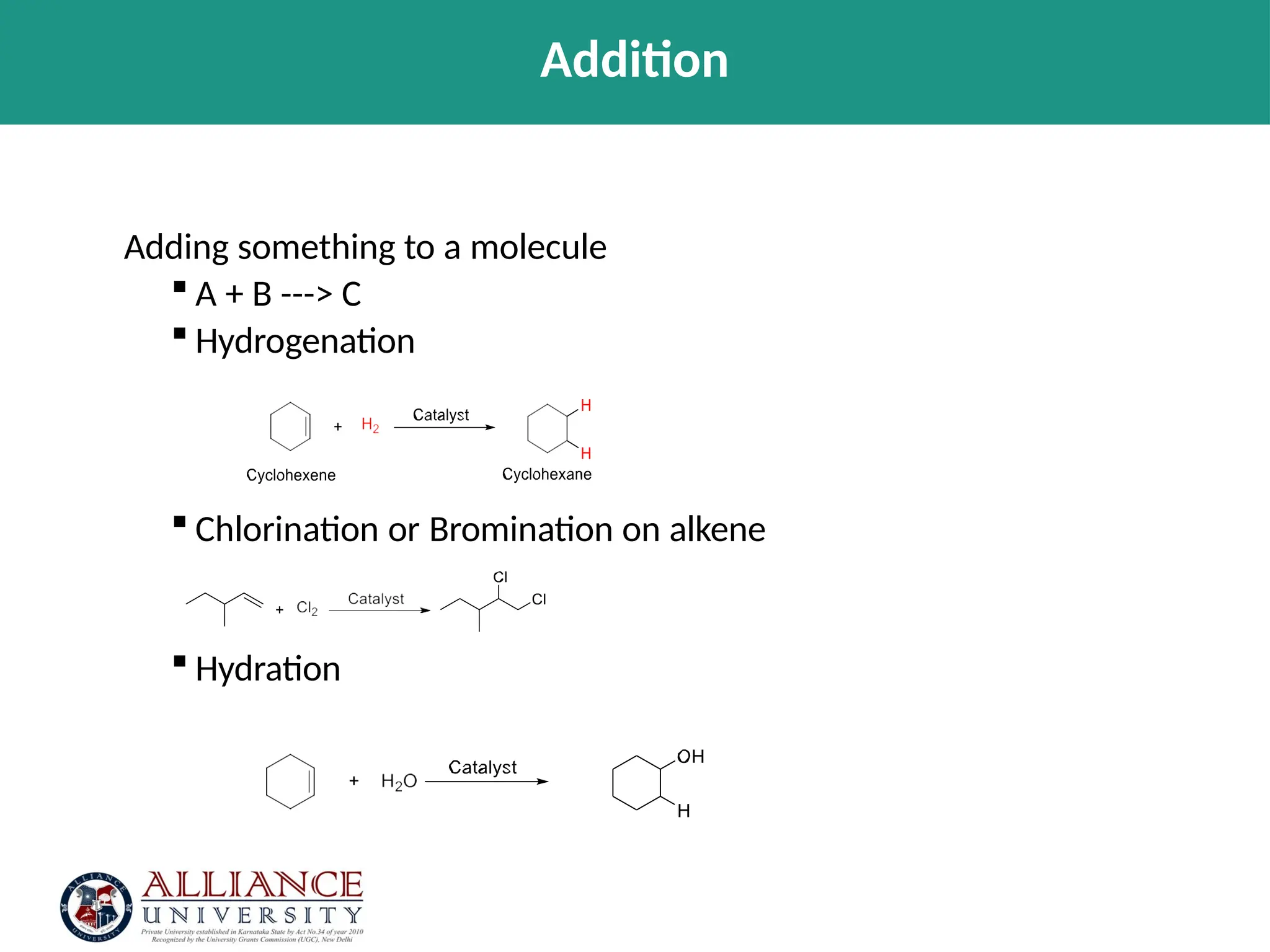
Adding something to a molecule
 A + B ---> C
 Hydrogenation
 Chlorination or Bromination on alkene
 Hydration
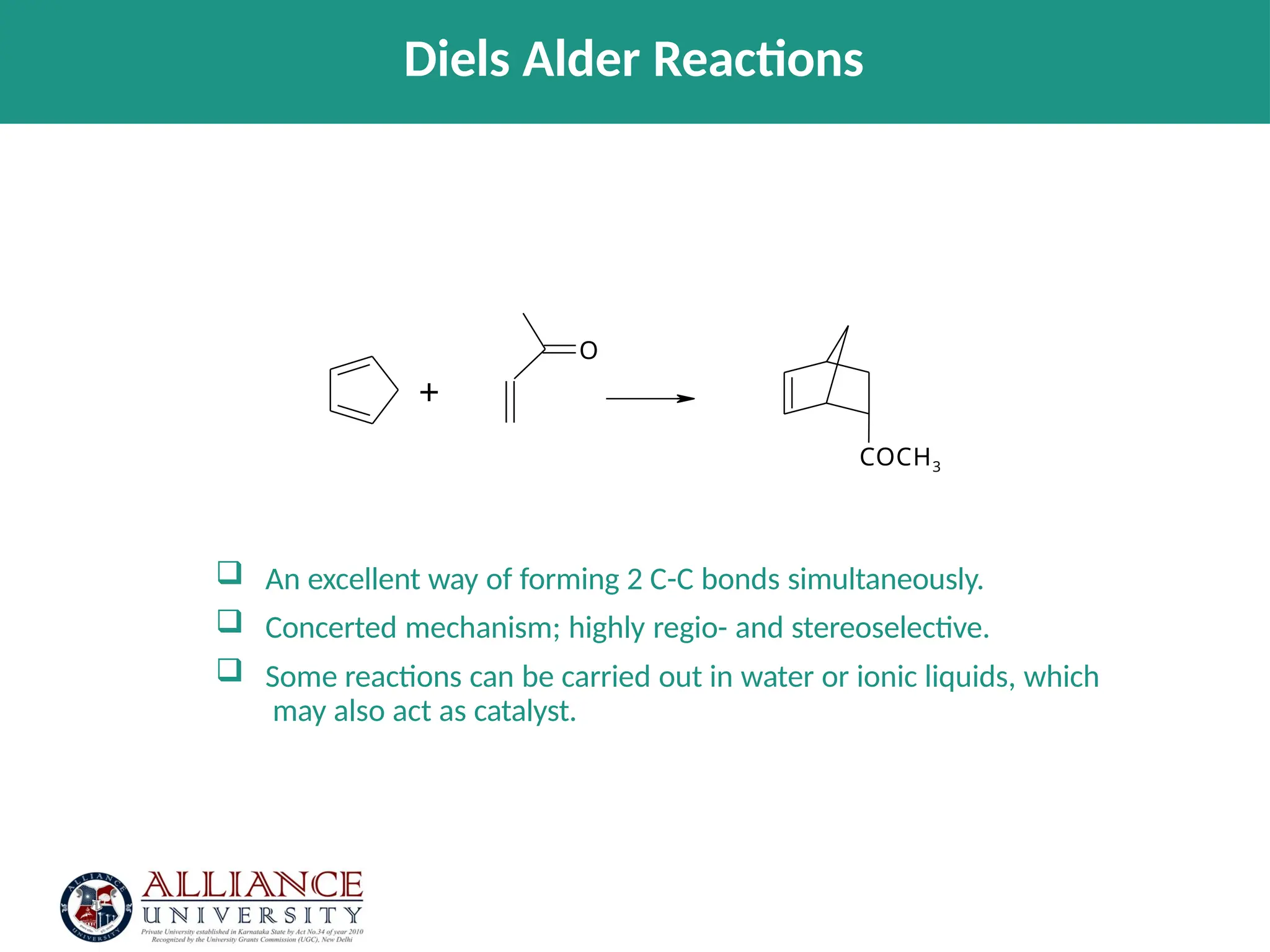
 An excellent way of forming 2 C-C bonds simultaneously.
 Concerted mechanism; highly regio- and stereoselective.
 Some reactions can be carried out in water or ionic liquids, which
may also act as catalyst.
+
O
COCH3
Diels Alder Reactions
Low atom economy reactions
The “Bad”
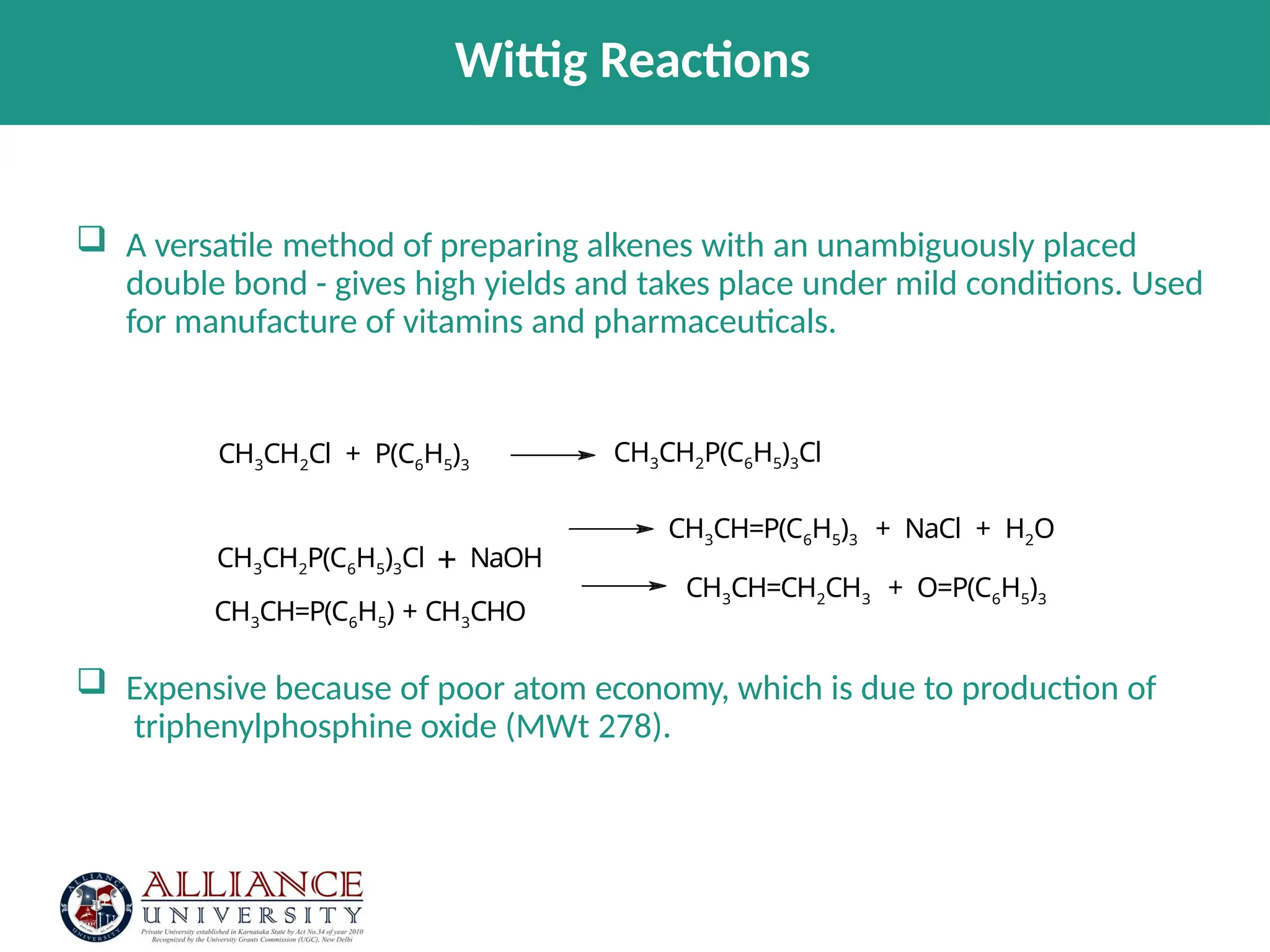
 A versatile method of preparing alkenes with an unambiguously placed
double bond - gives high yields and takes place under mild conditions. Used
for manufacture of vitamins and pharmaceuticals.
 Expensive because of poor atom economy, which is due to production of
triphenylphosphine oxide (MWt 278).
CH3CH2Cl + P(C6H5)3
CH3CH2P(C6H5)3Cl
CH3CH2P(C6H5)3Cl + NaOH
CH3CH=P(C6H5) + CH3CHO
CH3CH=P(C6H5)3 + NaCl + H2O
CH3CH=CH2CH3 + O=P(C6H5)3
Wittig Reactions
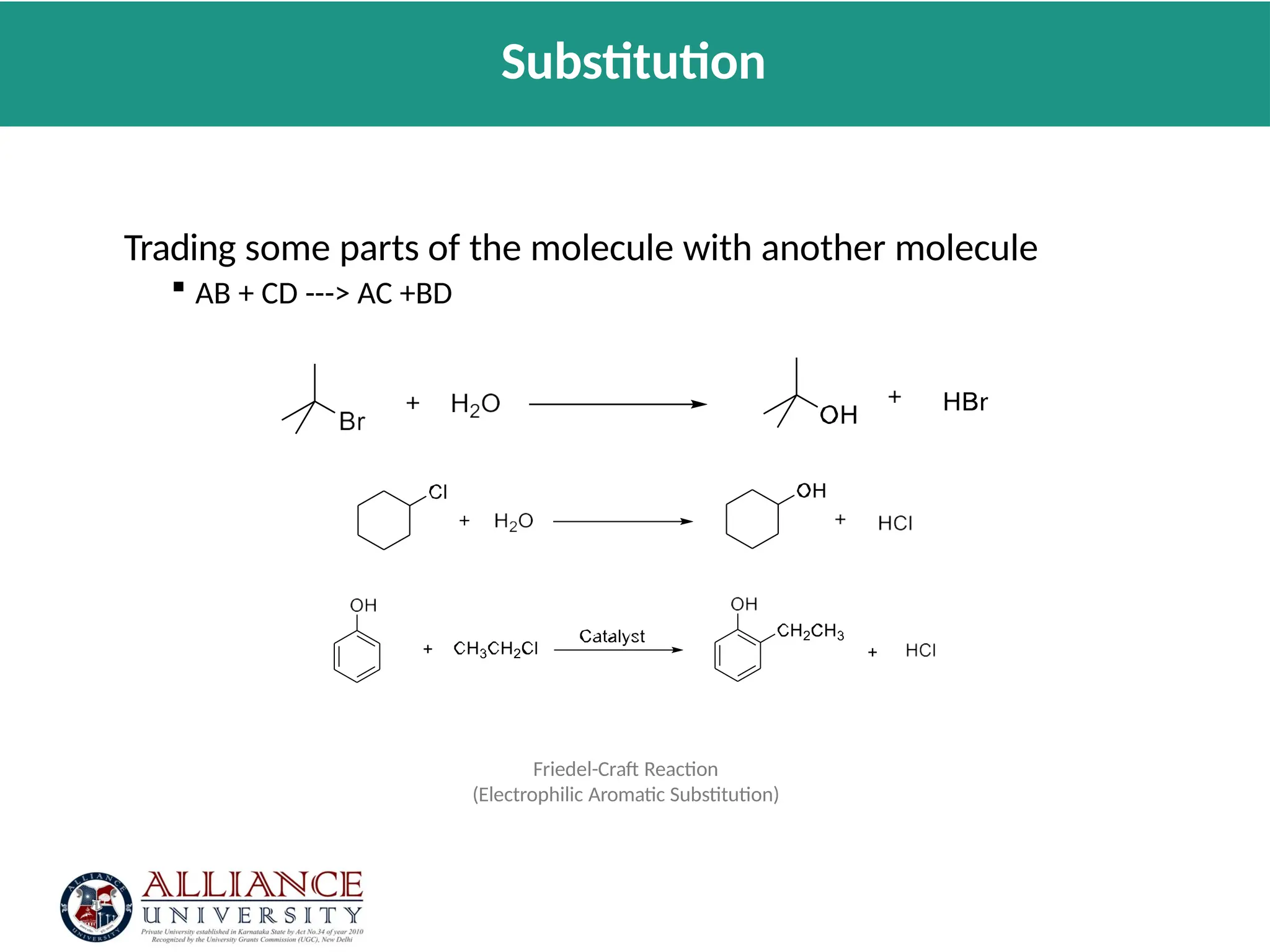
Trading some parts of the molecule with another molecule
 AB + CD ---> AC +BD
Friedel-Craft Reaction
(Electrophilic Aromatic Substitution)
Substitution
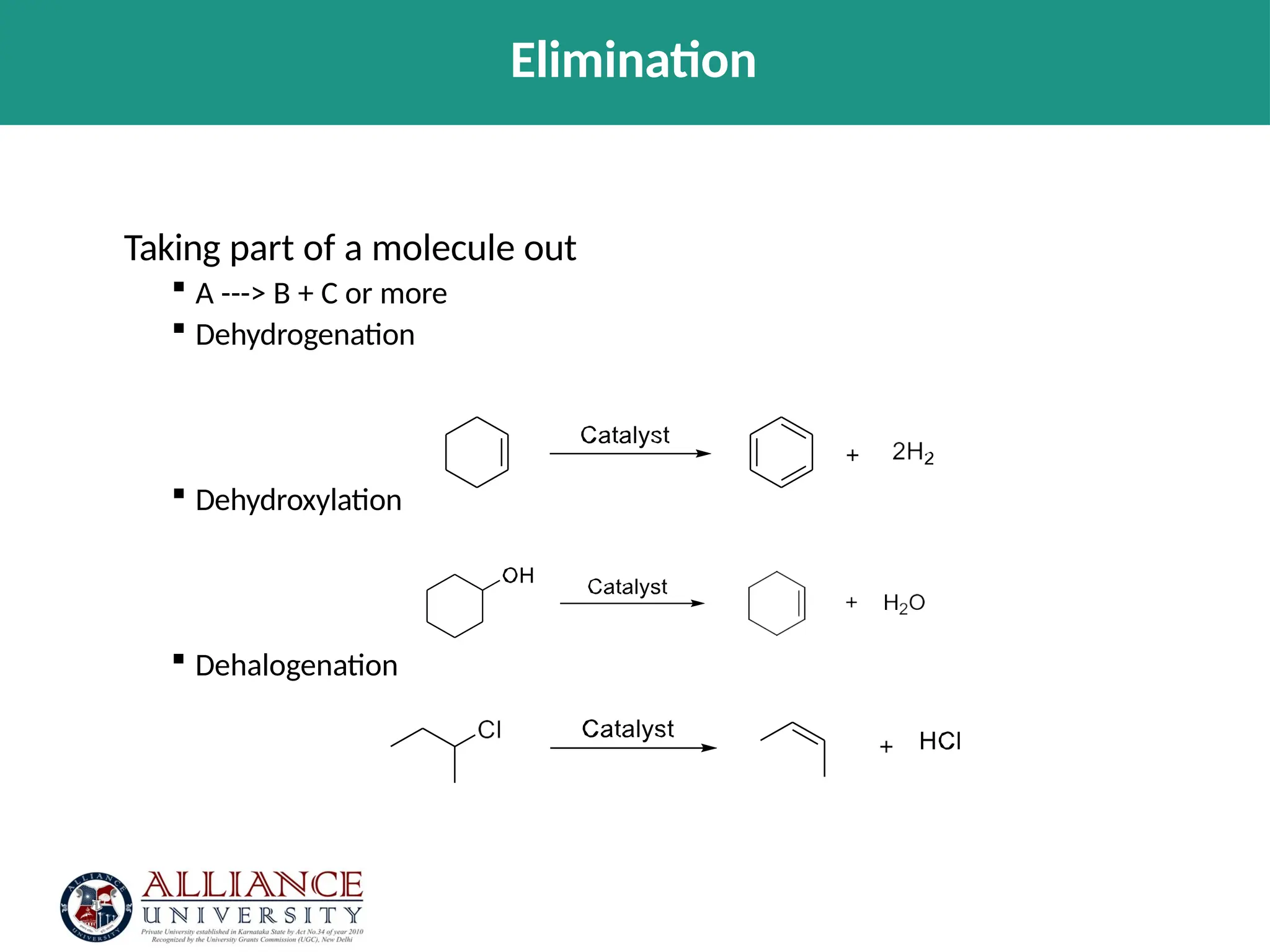
Elimination
Taking part of a molecule out
 A ---> B + C or more
 Dehydrogenation
 Dehydroxylation
 Dehalogenation

GC-4-Day_Training-Day-3-04-Metrics_Presentation.pptx

  • 1.
    Dr. Ajam Shaikh AssistantProfessor, Alliance University Evaluation for Chemical Reaction Efficiency: METRICS
  • 2.
    1. Why dowe need metrics in green chemistry? 2. Established Metrics in Green Chemistry • Atom Economy • Environmental (E) Factor • Atom Utilization • Reaction Mass Efficiency 3. Additional Metrics Used in Green Chemistry • Process Mass Intensity • Life Cycle Assessment • Ecological Indicator/Ecological Footprint Topics To Be Covered
  • 3.
    Percent yield: %yield = (actual yield/theoretical yield) x 100 What is missing?  What co-products are made?  How much waste is generated?  Is the waste benign waste?  How much energy is required?  Are purification steps needed?  What solvents are used? (are they benign and/or reusable?)  Is the “catalyst” truly a catalyst? (stoichiometric vs. catalytic) CONVENTIONAL METRICS: PERCENT YIELD
  • 4.
    1. Atom economy(atom efficiency) Atom Economy = Mass of desired product∗ Mass of all reactants∗ *including the stoichiometric coefficient 2. Environmental (E) factor E-factor = total waste (g) / product (g) 3. Atom utilization (variation of atom economy) % Atom Utilization = (MW of desired product/MW of all products) X 100 4. Reaction mass efficiency (RME) (mass of product C/(mass of A + mass of B)) X 100 ESTABLISHED GREEN CHEMISTRY METRICS
  • 5.
    5. Process MassIntensity (PMI) The total mass of materials to the mass of the isolated product. 6. Life Cycle Assessment (LCA) An assessment of environmental impacts associated with all of the stages of a product's life. ADDITIONAL METRICS USED IN GREEN CHEMISTRY
  • 6.
    Atom-Economy is acalculation based on the overall balanced chemical equation. It is simply the mass of desired product divided by the total mass of products. Or, since the mass of products equals the mass of reactants in a balanced chemical equation, atom economy is the mass of desired product divided by the total mass of reactants. Barry M. Trost Stanford University ATOM ECONOMY
  • 7.
    Single Stage Process: m.w.of product C    AE    100 m.w. of A  m.w. of B A + B C ATOM ECONOMY – THE PROCESS  m.w. = molecular weight
  • 8.
    (2) C + D E (3)E + F G m.w. of product G   AE    100 m.w. of A  m.w. of B  m.w of D  m.w. of F   Multi-Stage Process: (1) A + B C ATOM ECONOMY
  • 9.
    Reagent MW (gmol-1) 1 (Reactant) 74.12 2 (Reactant) 102.91 3 (Reactant) 98.08 4 (Desired Product) 137 CH3CH2CH2CH2OH + NaBr + H2SO4  CH3CH2CH2CH2Br + NaHSO4 + H2O 1 2 3 4 (Desired Product) 5 6 275.11 g mol-1 𝐴𝑡𝑜𝑚 𝐸𝑐𝑜𝑛𝑜𝑚𝑦 = 13 7 74.12 + 102.91 + 98.08 𝑥 100% 𝐴𝑡𝑜𝑚 𝐸𝑐𝑜𝑛𝑜𝑚𝑦 = 49.8 % *including the stoichiometric coefficient Atom Economy = Mass of desired product∗ Mass of all reactants∗ ATOM ECONOMY: EXAMPLE ONE
  • 10.
    - from Cann,M.C.; and Connelly, M.E. Real World Cases in Green Chemistry, American Chemical Society: Washington, DC, 2000 The Problem: The traditional industrial synthesis of ibuprofen was developed and patented by the Boots Company of England in the 1960s (U.S. Patent 3,385,886). This synthesis is a six-step process and results in large quantities of unwanted waste chemical byproducts that must be disposed of or otherwise managed. Much of the waste that is generated is a result of many of the atoms of the reactants not being incorporated into the desired product (ibuprofen) but into unwanted byproducts (poor atom economy/atom utilization). The process also uses a variety of solvents, and catalysts (if any) are not used in stoichiometric amounts. The Solution: The BHC Company has developed and implemented a new greener industrial synthesis of ibuprofen that is only three steps (U.S. Patents 4,981,995 and 5,068,448, both issued in 1991). In this process, most of the atoms of the reactants are incorporated into the desired product (ibuprofen). This results in only small amounts of unwanted byproducts (very good atom economy/atom utilization) thus lessening the need for disposal and mediation of waste products. There are other environmental advantages to the green synthesis versus the brown synthesis, including solvents and catalyst. ATOM ECONOMY EXAMPLE TWO: IBUPROFEN SYNTHESIS
  • 11.
  • 12.
    (1) A +B C (1) F + G H (2) C + D E (2) H + I J E + J P m.w. of product P   100   AE      (m.w. of A, B, D, F, G, I ) ATOM ECONOMY – CONVERGENT SYNTHESIS
  • 13.
    EXERCISE: CALCULATE AEOF THE GREENER SYNTHESIS OF IBUPROFEN
  • 14.
    EXERCISE: CALCULATE AEOF THE GREENER SYNTHESIS OF IBUPROFEN
  • 15.
    EXERCISE: CALCULATE AEOF THE GREENER SYNTHESIS OF IBUPROFEN
  • 16.
    EXERCISE: CALCULATE AEOF THE GREENER SYNTHESIS OF IBUPROFEN
  • 17.
  • 18.
    Some Atom EconomicReactions Some Atom Un-Economic Reactions Rearrangement Substitution Addition Elimination Diels-Alder Wittig Other concerted reactions Grignard “INHERENT” ATOM ECONOMY OF REACTION CLASSES
  • 19.
    Industry sector Annualproduction (t) E-factor Waste produced (t) Oil refining 106-108 Ca. 0.1 105 – 107 Bulk chemicals 104-106 <1–5 104 – 5 × 10⁶ Fine chemicals 102−104 5–50 5 × 10² − 5 × 10⁵ Pharmaceuticals 10–103 25–100 2.5 × 10² − 105  Depends on the definition of waste • Non-recoverable starting materials, solvent, catalysts. • Undesired side products.  Smaller E-factor means closer to zero waste  E-factor can be used to estimate/calculate the total waste generated: • Amount of Waste = Amount of Product x E-factor E-factor = total waste (g) / product (g) ENVIRONMENTAL FACTOR (E-FACTOR)
  • 20.
    Phenol Chloroethane CatalystSolvent 4-Ethylphenol 2-Ethylphenol E-Factor *3-ton scale 10 20 5 1200 80 200 5.575 19.725 E-factor = total waste (g) / product (g) Industrial reactions are run on the big scale, so assuming 3 tons of product, this is the new atom economy E-FACTOR EXAMPLE Friedel-Craft Alkylation (Substitution) All numbers represent the mass of the chemical after the reaction.
  • 21.
  • 22.
    For the genericreaction A + B  C . mass of product C  X 100     RME   mass of A  mass of B REACTION MASS EFFICIENCY (RME)
  • 23.
    Chemistry Type/Reagents Atom Economy (%) Reaction Mass Efficiency (%) Chemistry Type Atom Economy(%) Reaction Mass Efficiency (%) Resolution 40% 31% Epoxidation 83% 58% N-Dealkylation 64% 27% Bromination 84% 63% Elimination 72% 45% Hydrogenation 84% 74% N-Alkylation 73% 60% S-Alkylation 84% 61% Chlorination 74% 46% O-Arylation 85% 58% Borohydride 75% 58% N-Acylation 86% 62% Lithal 76% 52% Amination 87% 54% Grignard 76% 42% C-Alkylation 88% 61% Hydrolysis (Acid) 76% 50% Iodination 89% 56% Cyclisation 77% 56% Knoevenagel 89% 66% Cyanation 77% 65% Sulphonation 89% 69% Decarboxylation 77% 68% Esterification 91% 67% C-Acylation 81% 51% Base salt 100% 80% Hydrolysis (Base) 81% 52% Acid Salt 100% 83% COMPARISON OF ATOM ECONOMY AND REACTION MASS EFFICIENCY FOR 28 DIFFERENT CHEMICAL REACTIONS
  • 24.
    PMI = 𝐭𝐨𝐭𝐚𝐥 𝐦𝐚𝐬𝐬𝐮𝐬𝐞𝐝 𝐢𝐧 𝐭𝐡𝐞 𝐬𝐲𝐧𝐭𝐡𝐞𝐬𝐢𝐬 𝐤𝐠 𝐦𝐚𝐬𝐬 𝐨𝐟 𝐩𝐫𝐨𝐝𝐮𝐜𝐭 𝐤𝐠  PMI accounts for yield, reaction and reagent stoichiometry, catalysts and solvents.  This includes everything that you put into the flask, but usually excludes water.  Ideal PMI = low values (~1) PROCESS MASS INTENSITY (PMI)
  • 25.
    Chemical manufacturer responses(n = 18) to the 2012 Roundtable survey question “What green chemistry and engineering related metrics does your company use? Select all that apply.” Percentage of respondents indicating one or more metrics surveyed in use computed as the ratio of [total responses – (not sure + none)]/(total responses). PMI = process mass intensity = (mass of raw materials)/(mass of final product).E- factor = (mass of waste)/mass of final product).LCA = life cycle assessment. Implementing Green Chemistry in Chemical Manufacturing: A Survey Report Robert J. Giraud, Paul A. Williams, Amit Sehgal, Ettigounder Ponnusamy, Alan K. Phillips, and Julie B. Manley ACS Sustainable Chemistry & Engineering 2014 2 (10), 2237-2242 GREEN CHEMISTRY-RELATED METRICS USED IN CHEMICAL MANUFACTURING
  • 26.
    1. Why dowe need metrics in green chemistry? 2. Established Metrics in Green Chemistry • Atom Economy • Environmental (E) Factor • Atom Utilization • Reaction Mass Efficiency 3. Additional Metrics Used in Green Chemistry • Process Mass Intensity • Life Cycle Assessment • Ecological Indicator/Ecological Footprint TOPICS COVERED
  • 27.
  • 28.
    Addition Adding something toa molecule  A + B ---> C  Hydrogenation  Chlorination or Bromination on alkene  Hydration
  • 29.
     An excellentway of forming 2 C-C bonds simultaneously.  Concerted mechanism; highly regio- and stereoselective.  Some reactions can be carried out in water or ionic liquids, which may also act as catalyst. + O COCH3 Diels Alder Reactions
  • 30.
    Low atom economyreactions The “Bad”
  • 31.
     A versatilemethod of preparing alkenes with an unambiguously placed double bond - gives high yields and takes place under mild conditions. Used for manufacture of vitamins and pharmaceuticals.  Expensive because of poor atom economy, which is due to production of triphenylphosphine oxide (MWt 278). CH3CH2Cl + P(C6H5)3 CH3CH2P(C6H5)3Cl CH3CH2P(C6H5)3Cl + NaOH CH3CH=P(C6H5) + CH3CHO CH3CH=P(C6H5)3 + NaCl + H2O CH3CH=CH2CH3 + O=P(C6H5)3 Wittig Reactions
  • 32.
    Trading some partsof the molecule with another molecule  AB + CD ---> AC +BD Friedel-Craft Reaction (Electrophilic Aromatic Substitution) Substitution
  • 33.
    Elimination Taking part ofa molecule out  A ---> B + C or more  Dehydrogenation  Dehydroxylation  Dehalogenation