The Future of Sales
Gartner for Sales
© 2020 Gartner, Inc. and/or its affiliates. All rights reserved. CM_GBS_1021228
Transformational Strategies for B2B
Sales Organizations
The Future of Sales
2
Introduction
B2B buying behavior has grown even more unpredictable with COVID-19 and market volatility.
One client told us their quarterly deal pipeline shrank to nearly zero in March 2020 when their
prospects suspended all nonessential expenditures. Others report that without in-person
meetings, their sellers don’t achieve the level of engagement required to validate their
pipeline predictions.
And these trends occurred on top of buying changes that were already disrupting B2B sales,
and have since been compounded by the pandemic.
B2B buyers increasingly want to engage with suppliers through digital and self-service
channels. To support this shift to multiexperience buying, and the associated growth in
the number of touchpoints and interactions between buyers and suppliers, sellers will need
additional skills and technology capabilities.
Our research suggests the future of sales will see a permanent transformation in strategy,
processes and resource allocation that moves the sales organization from seller-centric to
buyer-centric and from analog to hyperautomated, digital-first engagement with customers.
The opportunity is enormous — but only for progressive chief sales officers (CSOs) who act
promptly to build adaptive systems to engage the “everywhere customer.”
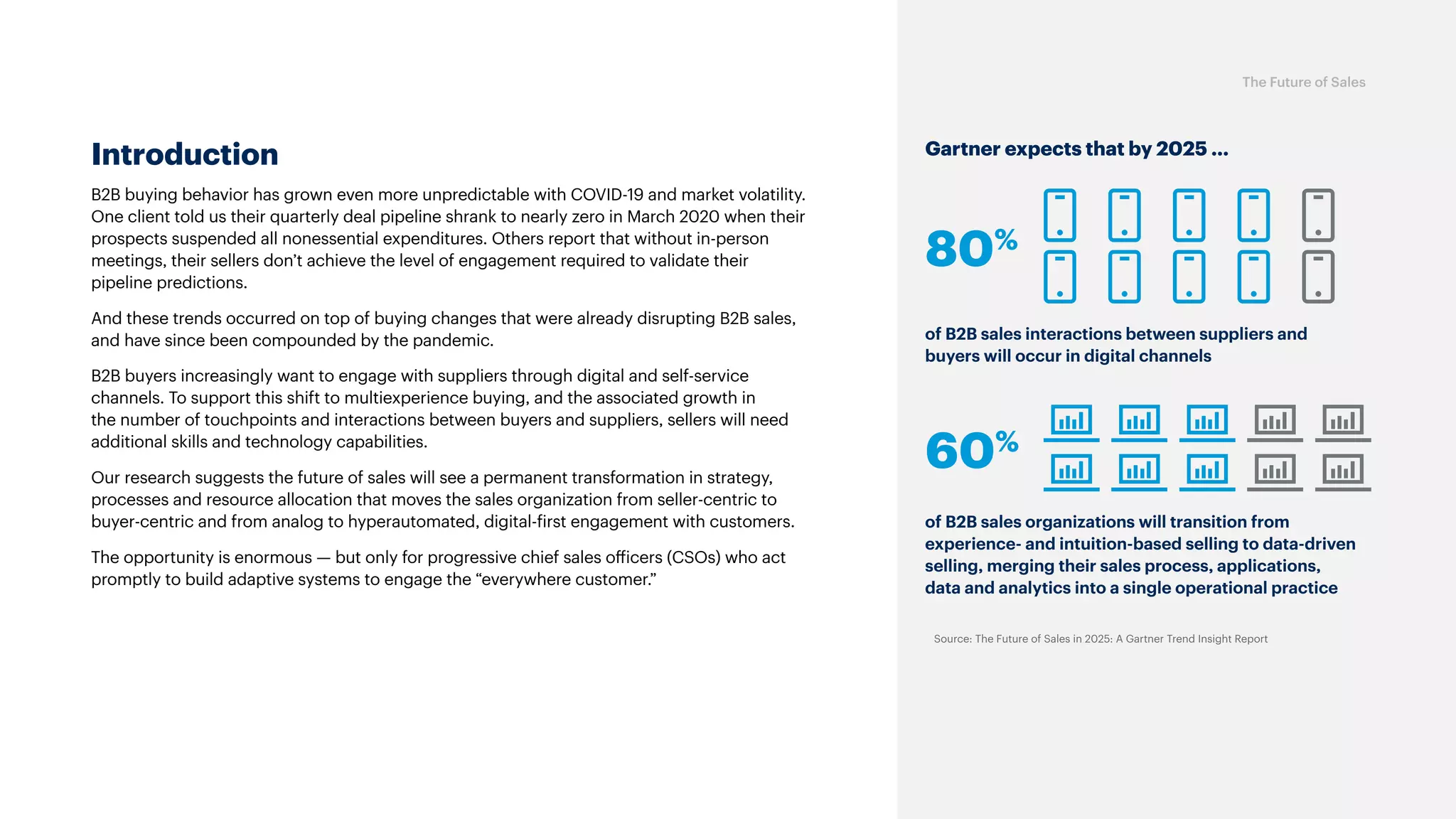
Gartner expects that by 2025 …
of B2B sales interactions between suppliers and
buyers will occur in digital channels
of B2B sales organizations will transition from
experience- and intuition-based selling to data-driven
selling, merging their sales process, applications,
data and analytics into a single operational practice
80%
60%
Source: The Future of Sales in 2025: A Gartner Trend Insight Report
The Future of Sales
The Future of Sales
3
Digital sales channels accelerate
n = 809 B2B buyers
Source: 2018 Gartner B2B Buying Survey
Indexed percentage of customers, by generation,
who report high skepticism of sales rep claims
Baby Boomers
1x
Gen Xers
1.4x
Millennials
2.2x
44%
of millennials prefer
no sales rep interaction in
a B2B purchase setting
Over the next five years, the number of digital interactions between buyers and
suppliers will skyrocket. And this explosive growth will break traditional sales
models. Already, CSOs face three lasting trends they can’t afford to ignore:
B2B customers radically discount the perceived value of sellers.
Gartner research shows that customers perceive little distinct value
(beyond their own learning) from sales reps. Generational preferences
are compounding the trend. Millennials, the first digital natives, are
now decision makers and are far more skeptical of sales reps than
their predecessors.
Customers reward rich virtual buying experiences. B2B organizations
have fallen behind the seamless, easy and informative standard of B2C
digital platforms. As business customers learn and buy more online,
unflattering comparisons to advanced digital retail and media companies
are unavoidable.
Increased digital buying means more data. Increased digital activity
and information storage systems means more, and more detailed, data
on customer behavior and product usage patterns. However, few sales
organizations can yet capture, organize, clean and query that data
systematically — or use it to deploy even rudimentary machine learning
or artificial intelligence (AI).
1
2
3
The Future of Sales
4
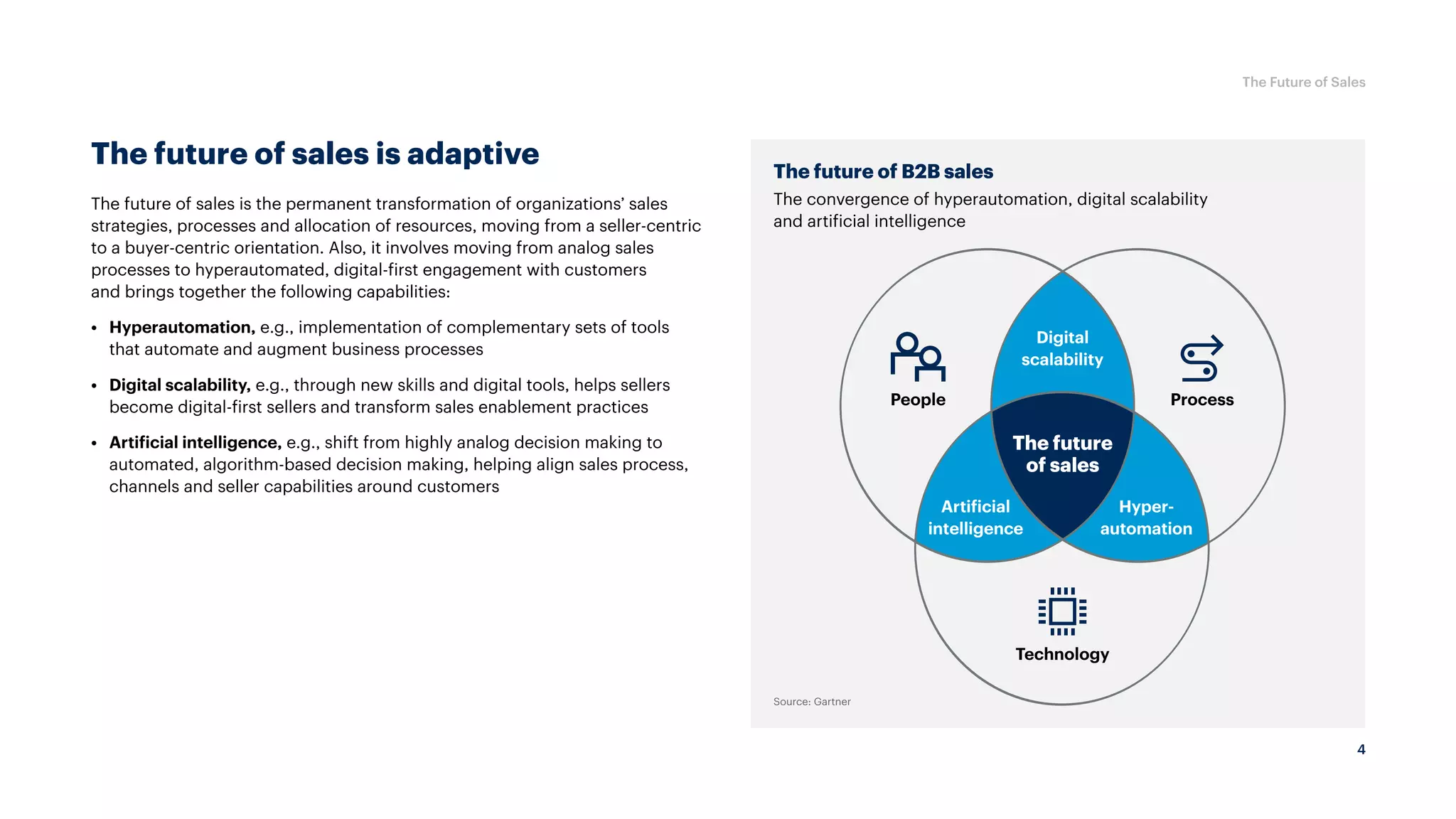
The future of sales is adaptive
The future of sales is the permanent transformation of organizations’ sales
strategies, processes and allocation of resources, moving from a seller-centric
to a buyer-centric orientation. Also, it involves moving from analog sales
processes to hyperautomated, digital-first engagement with customers
and brings together the following capabilities:
• Hyperautomation, e.g., implementation of complementary sets of tools
that automate and augment business processes
• Digital scalability, e.g., through new skills and digital tools, helps sellers
become digital-first sellers and transform sales enablement practices
• Artificial intelligence, e.g., shift from highly analog decision making to
automated, algorithm-based decision making, helping align sales process,
channels and seller capabilities around customers
The future of B2B sales
The convergence of hyperautomation, digital scalability
and artificial intelligence
Process
People
Technology
Artificial
intelligence
Digital
scalability
The future
of sales
Hyper-
automation
Source: Gartner
The Future of Sales
5
The future of CSOs: Leaders of selling, not sellers
01 03
02 04
Leading CSOs must become leaders of selling — wherever and whenever it happens — rather than leaders of sellers.
That requires a shift in the focus of the sales organization, away from sales professionals as the primary commercial channel
and toward digital sales channels. In that digital paradigm, sellers’ decision making is based on data, analytics and AI,
not on intuition and experience.
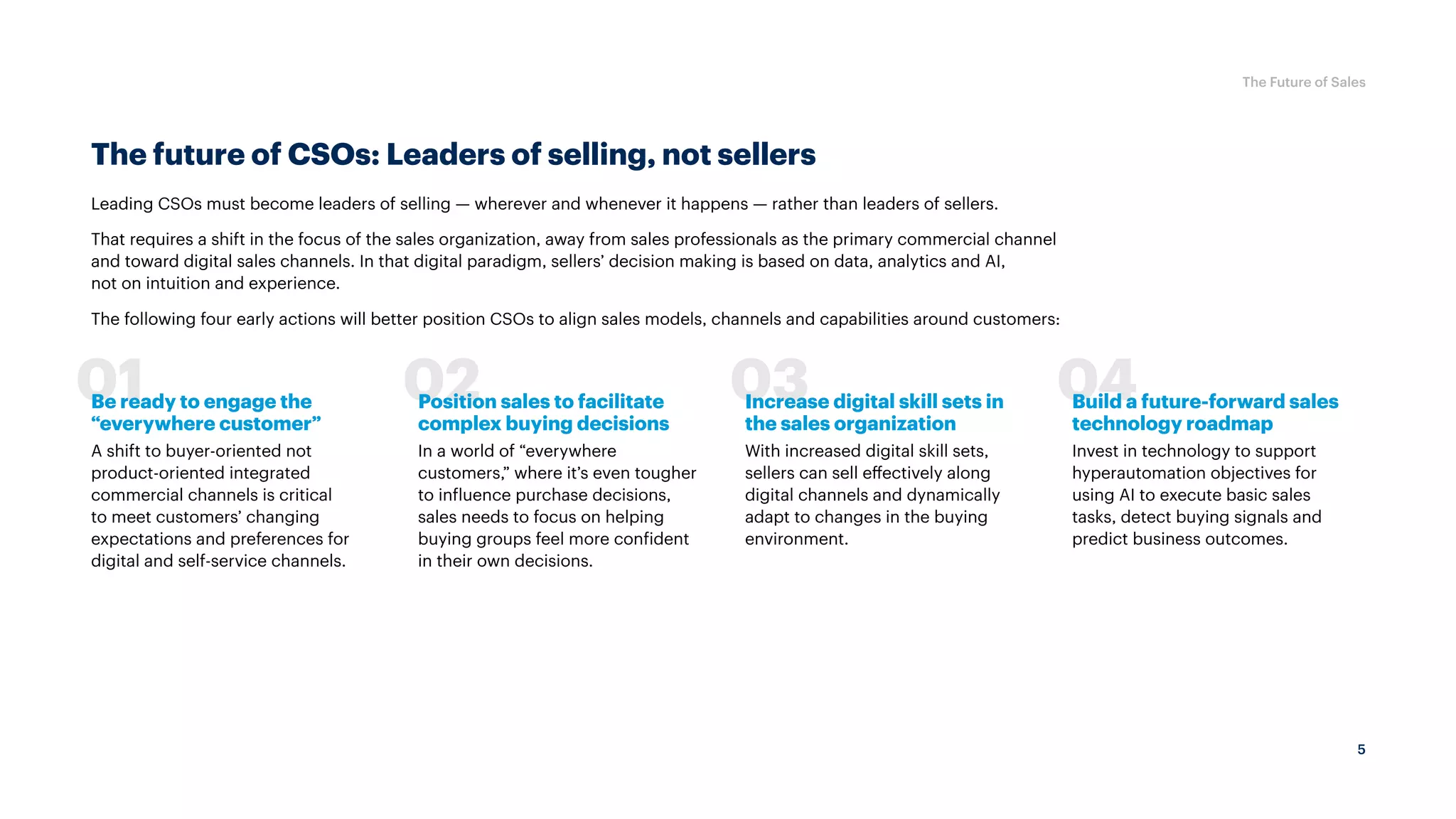
The following four early actions will better position CSOs to align sales models, channels and capabilities around customers:
Be ready to engage the
“everywhere customer”
A shift to buyer-oriented not
product-oriented integrated
commercial channels is critical
to meet customers’ changing
expectations and preferences for
digital and self-service channels.
Position sales to facilitate
complex buying decisions
In a world of “everywhere
customers,” where it’s even tougher
to influence purchase decisions,
sales needs to focus on helping
buying groups feel more confident
in their own decisions.
Increase digital skill sets in
the sales organization
With increased digital skill sets,
sellers can sell effectively along
digital channels and dynamically
adapt to changes in the buying
environment.
Build a future-forward sales
technology roadmap
Invest in technology to support
hyperautomation objectives for
using AI to execute basic sales
tasks, detect buying signals and
predict business outcomes.
The Future of Sales
6
01
Be ready to engage the “everywhere customer”
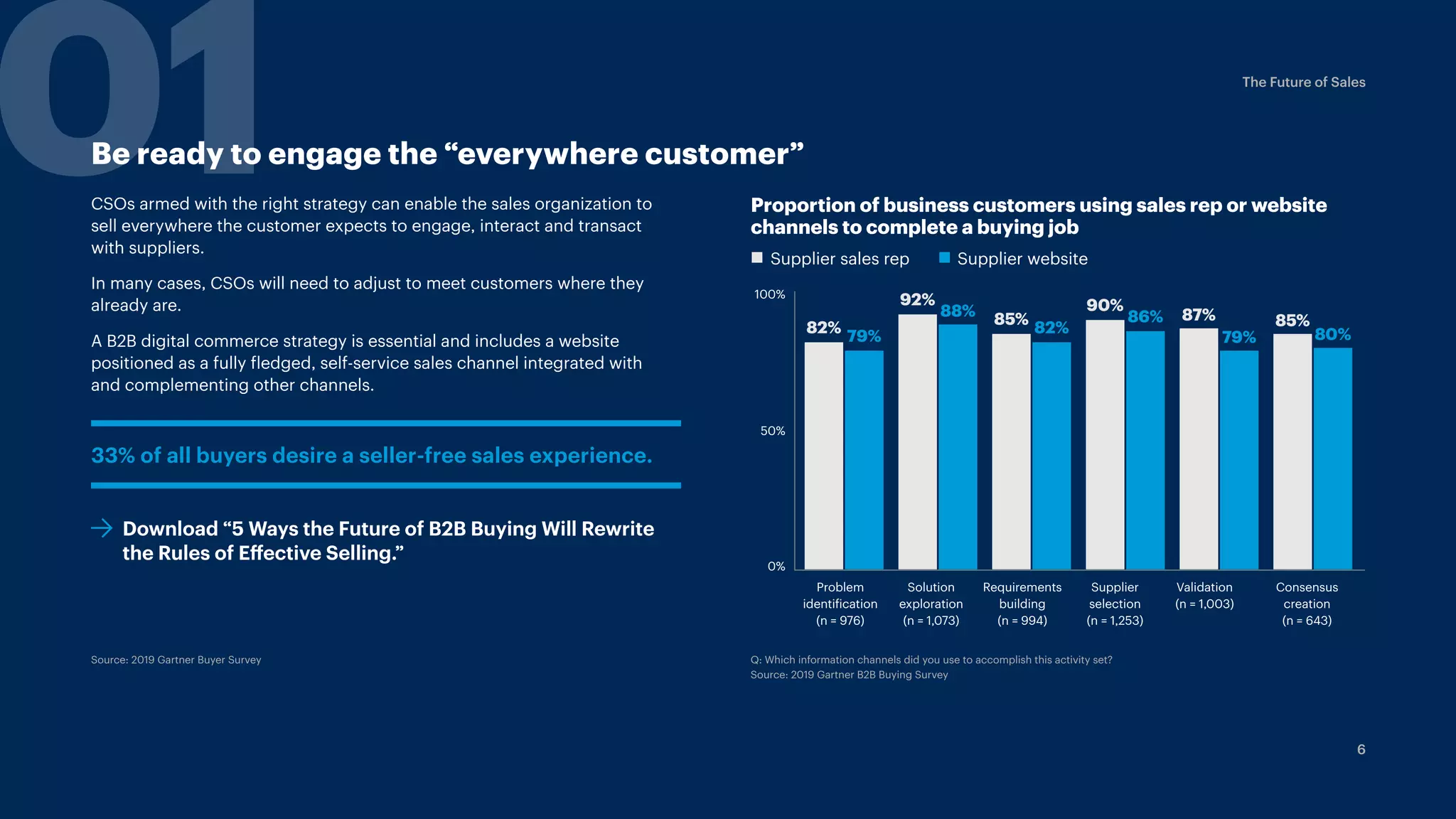
CSOs armed with the right strategy can enable the sales organization to
sell everywhere the customer expects to engage, interact and transact
with suppliers.
In many cases, CSOs will need to adjust to meet customers where they
already are.
A B2B digital commerce strategy is essential and includes a website
positioned as a fully fledged, self-service sales channel integrated with
and complementing other channels.
33% of all buyers desire a seller-free sales experience.
 
Download “5 Ways the Future of B2B Buying Will Rewrite
the Rules of Effective Selling.”
82%
92%
85%
90%
87%
79%
88%
82%
86%
79%
Problem
identification
(n = 976)
Solution
exploration
(n = 1,073)
Requirements
building
(n = 994)
Supplier
selection
(n = 1,253)
Validation
(n = 1,003)
Supplier website
Supplier sales rep
Proportion of business customers using sales rep or website
channels to complete a buying job
100%
50%
0%
Consensus
creation
(n = 643)
Q: Which information channels did you use to accomplish this activity set?
Source: 2019 Gartner B2B Buying Survey
Source: 2019 Gartner Buyer Survey
85%
80%
The Future of Sales
7
02
Position sales to facilitate complex buying decisions
As face-to-face interactions with customers decline, suppliers still need
to find ways to influence buying decisions. A good place to start is by
understanding the reasons buyers make purchase decisions.
Gartner research shows it’s critical to boost a buyer’s confidence in their
purchase decision. Otherwise, uncertainty pervades the purchase decision
process — and uncertainty makes it less likely the customer will complete
the purchase at all, let alone enter a high-quality deal (i.e., buying a
premium offering).
To increase buyer confidence, don’t position sellers as the source of
information. Rather, position sellers as “sense makers” who help
customers make sense of everything they’re learning, irrespective
of source or channel.
 
Learn more about the Sense Making seller.
B2B buyers’ environmental uncertainty and purchase outcomes
n = 1,049 B2B buyers; 517 B2B buyers
Source: 2019 Gartner B2B Buying Survey
Likelihood of a high-quality deal
By degree of buyer uncertainty (indexed)
Likelihood of purchase completion
By degree of buyer uncertainty (indexed)
Low
uncertainty
1x
Moderate to
high uncertainty
0.70x
Low
uncertainty
1x
Moderate to
high uncertainty
0.58x
B2B buyers with moderate to high uncertainty are 30% less likely to complete
a purchase at all and 42% less likely to complete a high-quality deal.
The Future of Sales
8
03
Increase digital skill sets in the sales organization
CSOs can rapidly increase the ability of sellers to master the digital-first
selling behaviors required to succeed today and in the future.
Start by building two key capabilities:
1. Virtual customer engagement. This includes tactics for presales
call planning and preparation and in-meeting practices for ensuring
a productive and engaging dialogue with customers during virtual
sales interactions.
2. Virtual seller enablement. This includes actions for sales enablement
in areas such as sales skills, training delivery and onboarding to support
sellers in a virtual sales environment and equip them to effectively sell
in a remote setting.
Sales organizations will need to adjust their existing investments and
reallocate resources among people, processes and technology to
support digital and virtual selling.
 
Download “Framework to Enable Effective Virtual Selling.”
Key sales technology enabling virtual selling
Source: 2019 Gartner Buyer Survey
Sales
enablement
Collaboration
Microsites
Content sharing/
engagement
analysis
Video-
conferencing
Digital
sales room
Emotional
analysis
An average of 11 individual
stakeholders are involved in a
B2B purchase; that number can
occasionally flex up to nearly 20.
The Future of Sales
9
04
Build a future-forward sales technology roadmap
CSOs’ technology investments should aim to maximize the potential of
AI-based solutions for the sales organization.
First, sales leaders must identify parts of the sales value chain where AI
offers improvement potential for processes. For example, replacing sellers’
educated guesses around what to do next on a complex B2B deal with AI
solutions that can reliably detect buyer signals and actions.
CSOs must also invest in digital technology that improves the buyer
experience. For example, equipping sellers with high-quality audio and
video hardware and reliable remote meeting platforms to enable productive
customer interactions.
Installing future-forward technology also helps CSOs attract top Gen Z
talent — a demographic that values remote work opportunities and digital
collaboration.
Gartner expects that within five years, there will be no separation between
sales process, applications, data and analytics. Instead there will be one
single concept: AI for sales.
 
Learn how to use AI to improve B2B sales revenue and
optimize costs.
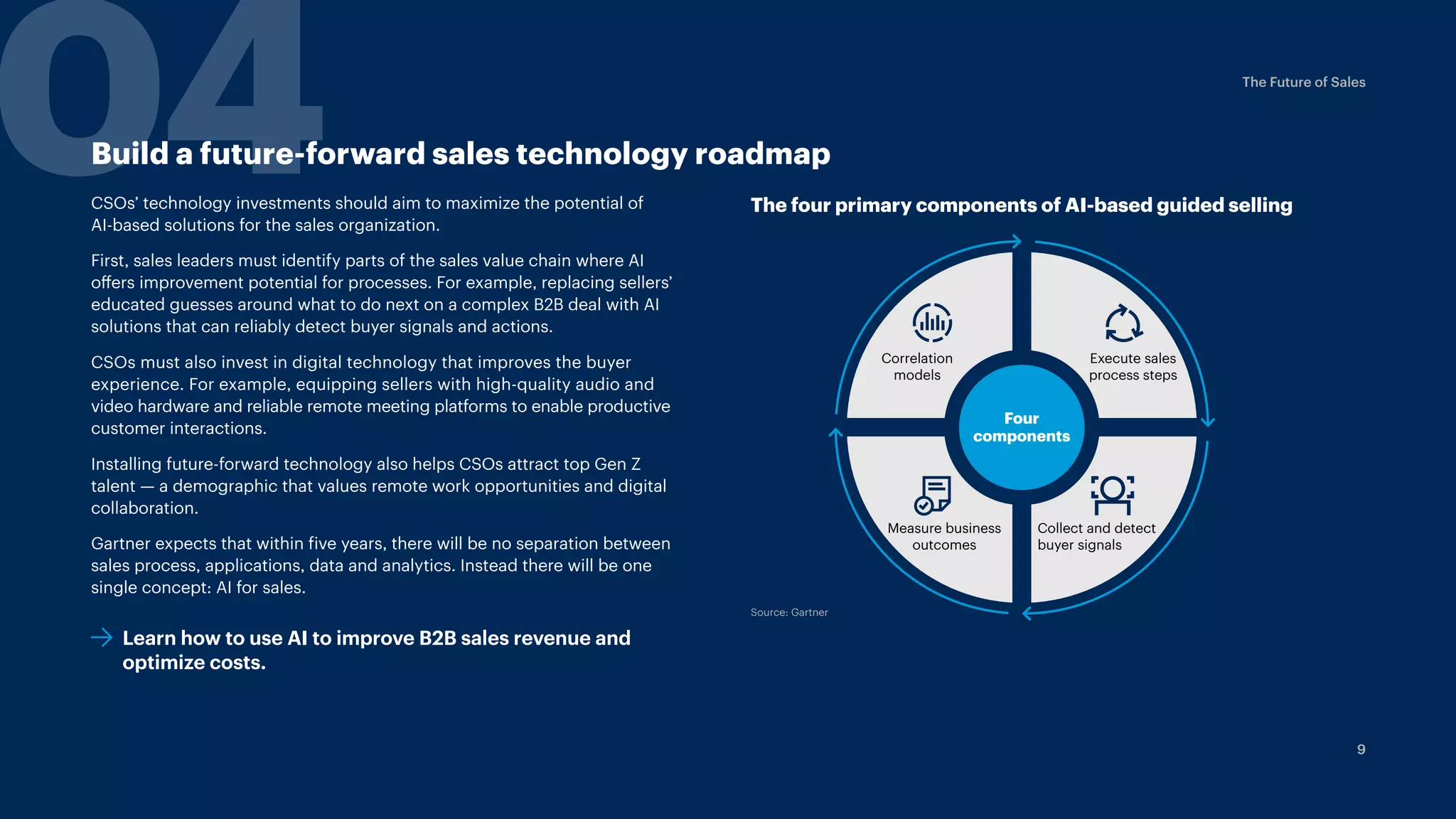
The four primary components of AI-based guided selling
Source: Gartner
Four
components
Correlation
models
Measure business
outcomes
Execute sales
process steps
Collect and detect
buyer signals
The Future of Sales
10
Diagnostics and
benchmarks
Guides and
toolkits
Expert
inquiry
Expert
research
Case studies
and best
practices
Peer
connections
Live events Live webinars
and online
learning events
Document
reviews
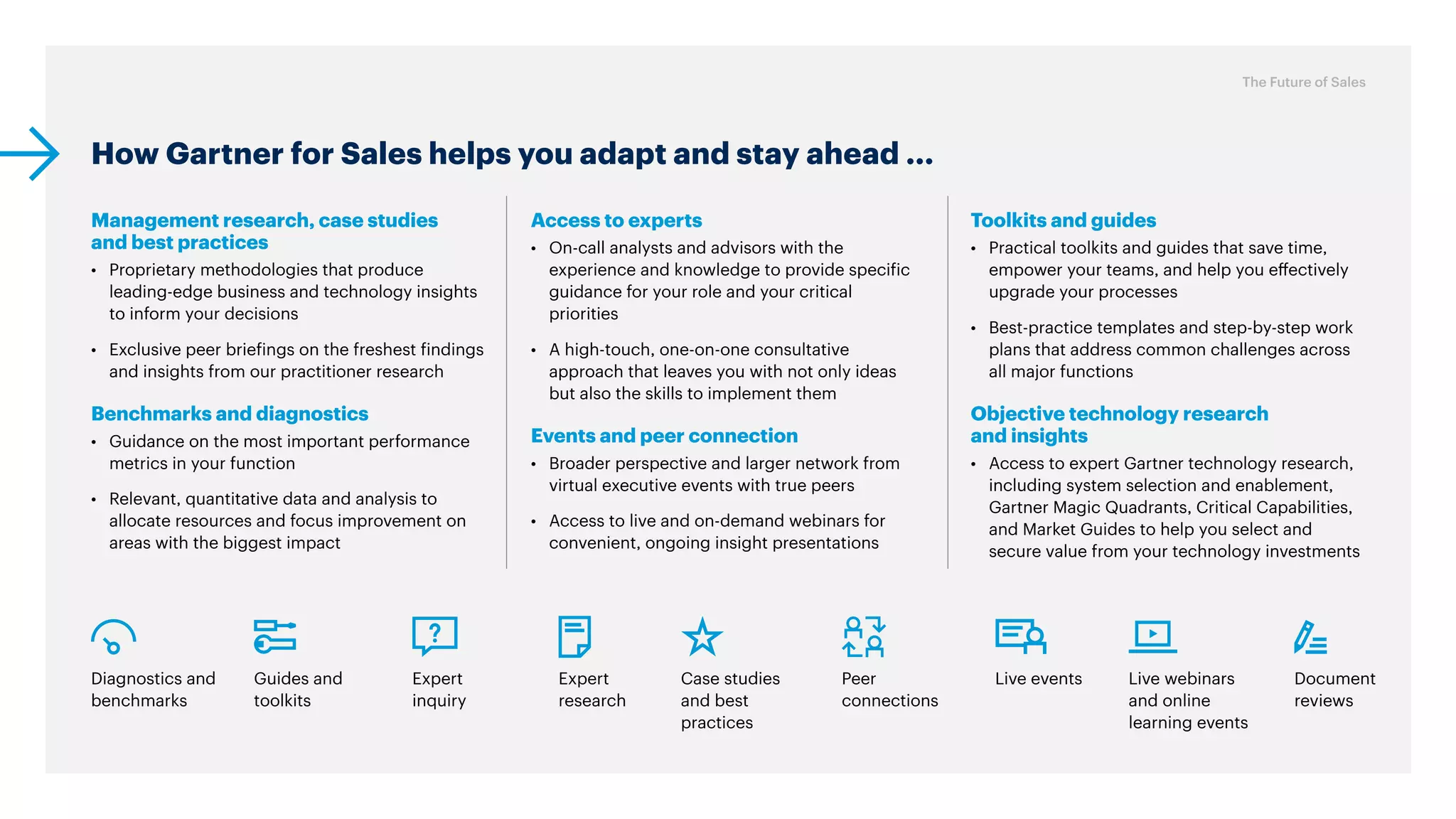
How Gartner for Sales helps you adapt and stay ahead ...
Management research, case studies
and best practices
• Proprietary methodologies that produce
leading-edge business and technology insights
to inform your decisions
• Exclusive peer briefings on the freshest findings
and insights from our practitioner research
Benchmarks and diagnostics
• Guidance on the most important performance
metrics in your function
• Relevant, quantitative data and analysis to
allocate resources and focus improvement on
areas with the biggest impact
Access to experts
• On-call analysts and advisors with the
experience and knowledge to provide specific
guidance for your role and your critical
priorities
• A high-touch, one-on-one consultative
approach that leaves you with not only ideas
but also the skills to implement them
Events and peer connection
• Broader perspective and larger network from
virtual executive events with true peers
• Access to live and on-demand webinars for
convenient, ongoing insight presentations
Toolkits and guides
• Practical toolkits and guides that save time,
empower your teams, and help you effectively
upgrade your processes
• Best-practice templates and step-by-step work
plans that address common challenges across
all major functions
Objective technology research
and insights
• Access to expert Gartner technology research,
including system selection and enablement,
Gartner Magic Quadrants, Critical Capabilities,
and Market Guides to help you select and
secure value from your technology investments
The Future of Sales
The Future of Sales
11
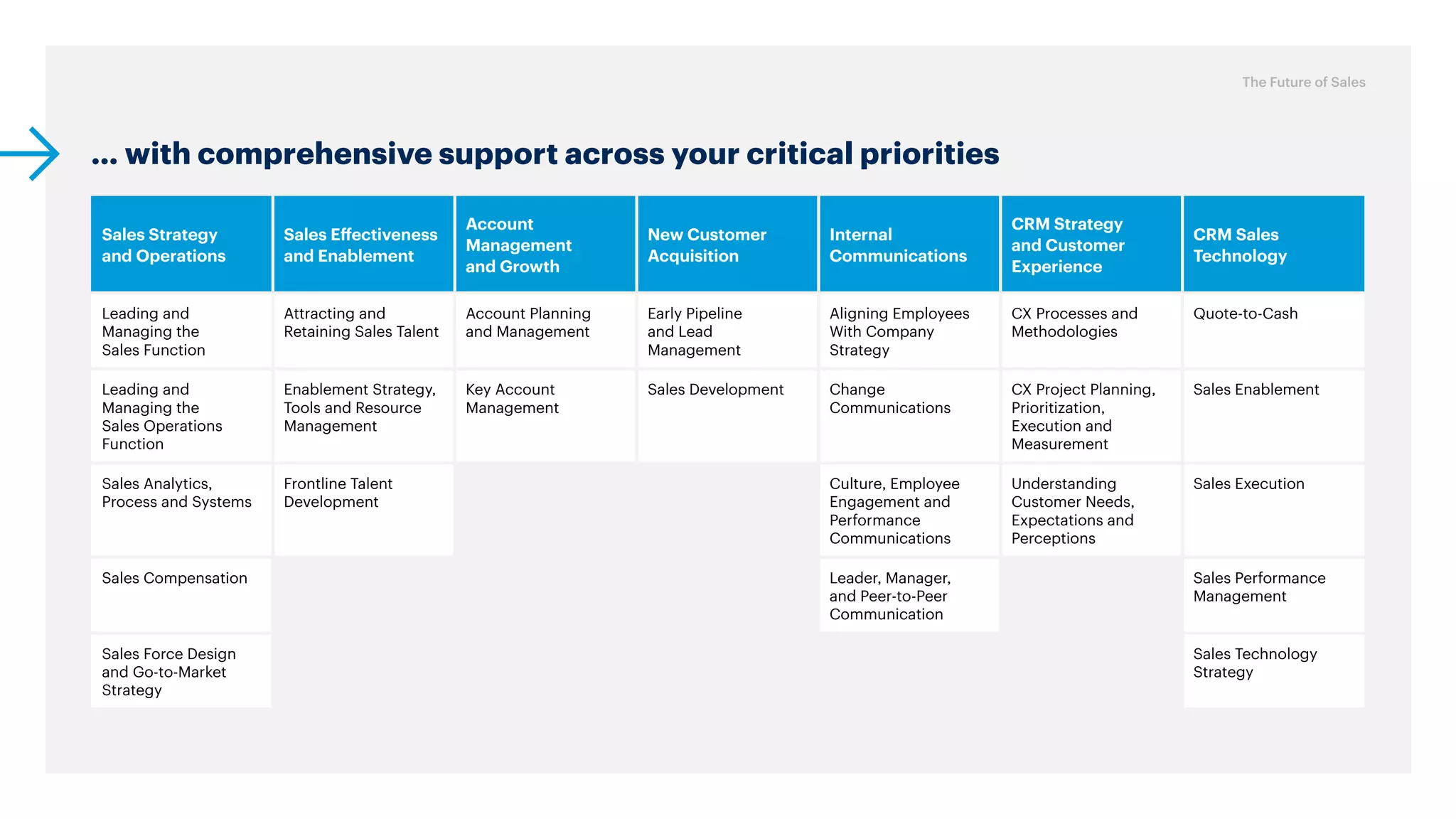
Sales Strategy
and Operations
Sales Effectiveness
and Enablement
Account
Management
and Growth
New Customer
Acquisition
Internal
Communications
CRM Strategy
and Customer
Experience
CRM Sales
Technology
Leading and
Managing the
Sales Function
Attracting and
Retaining Sales Talent
Account Planning
and Management
Early Pipeline
and Lead
Management
Aligning Employees
With Company
Strategy
CX Processes and
Methodologies
Quote-to-Cash
Leading and
Managing the
Sales Operations
Function
Enablement Strategy,
Tools and Resource
Management
Key Account
Management
Sales Development Change
Communications
CX Project Planning,
Prioritization,
Execution and
Measurement
Sales Enablement
Sales Analytics,
Process and Systems
Frontline Talent
Development
Culture, Employee
Engagement and
Performance
Communications
Understanding
Customer Needs,
Expectations and
Perceptions
Sales Execution
Sales Compensation Leader, Manager,
and Peer-to-Peer
Communication
Sales Performance
Management
Sales Force Design
and Go-to-Market
Strategy
Sales Technology
Strategy
… with comprehensive support across your critical priorities
The Future of Sales
The Future of Sales
12
Gartner experts support you and your team
Maria Boulden | VP, Executive Partner
• Sales Strategy
• Sales Leadership
Steve Herz | Senior Director Analyst
• Sales Compensation
• Sales Analytics
• Sales Operations and Strategy
Doug Bushee | Senior Director Analyst
• Sales Effectiveness and Enablement
• 
Sales Enablement Design, Sales
Communication
• Digital Pitchbooks, Virtual Demos
Brent Adamson | Distinguished VP, Advisory
• Sales Strategy
• Challenger
• Buyer Enablement
Steve Rietberg | Senior Director Analyst
• Sales Operations
• Sales Strategy and Design
Shayne Jackson | Senior Director Analyst
• Sales Enablement
• Sales Messaging, Sales Communication
• Sales Skills
• Sales Coaching
Nick Toman | Distinguished VP, Research
• Sales Effectiveness
• Value Proposition
• Sales Service and Talent Management
Dave Egloff | VP Analyst
• Sales Operations
• Sales Force Design and Deployment
• Sales Performance Optimization
Tad Travis | VP Analyst
• CRM Sales Technology
• CRM Strategy and Customer Experience
• Application Leaders
Rick Karlton | Managing Vice President
• Account Management and Growth
• Sales Effectiveness and Enablement
Craig Riley | Senior Principal Analyst
• Sales Operations
• New Customer Acquisition
Michele Buckley | VP Analyst
• Planning and Segmentation
• Sales Effectiveness and Enablement
Cristina Gomez | Managing Vice President
• Sales Talent Management
• Sales Effectiveness and Enablement
• Buyer Enablement
Melissa Hilbert | Senior Director Analyst
• Sales Performance Management
• 
Quota and Territory Management,
Sales Incentives
Scott Collins | VP, Team Manager
• Sales Talent Management
• Sales Strategy and Design
• Sales Effectiveness and Enablement
CSO and Sales Leaders Sales Operations Sales Enablement
The Future of Sales
13
© 2020 Gartner, Inc. and/or its affiliates. All rights reserved. CM_GBS_1021228
Learn more.
Dig deep.
Stay ahead.
Follow us on LinkedIn | Gartner for Sales
Learn more about Gartner for Sales
at gartner.com/en/sales
Get started on planning
for the future.

Gartner - future_of_sales_ebook.pdf

  • 1.
    The Future ofSales Gartner for Sales © 2020 Gartner, Inc. and/or its affiliates. All rights reserved. CM_GBS_1021228 Transformational Strategies for B2B Sales Organizations
  • 2.
    The Future ofSales 2 Introduction B2B buying behavior has grown even more unpredictable with COVID-19 and market volatility. One client told us their quarterly deal pipeline shrank to nearly zero in March 2020 when their prospects suspended all nonessential expenditures. Others report that without in-person meetings, their sellers don’t achieve the level of engagement required to validate their pipeline predictions. And these trends occurred on top of buying changes that were already disrupting B2B sales, and have since been compounded by the pandemic. B2B buyers increasingly want to engage with suppliers through digital and self-service channels. To support this shift to multiexperience buying, and the associated growth in the number of touchpoints and interactions between buyers and suppliers, sellers will need additional skills and technology capabilities. Our research suggests the future of sales will see a permanent transformation in strategy, processes and resource allocation that moves the sales organization from seller-centric to buyer-centric and from analog to hyperautomated, digital-first engagement with customers. The opportunity is enormous — but only for progressive chief sales officers (CSOs) who act promptly to build adaptive systems to engage the “everywhere customer.” Gartner expects that by 2025 … of B2B sales interactions between suppliers and buyers will occur in digital channels of B2B sales organizations will transition from experience- and intuition-based selling to data-driven selling, merging their sales process, applications, data and analytics into a single operational practice 80% 60% Source: The Future of Sales in 2025: A Gartner Trend Insight Report The Future of Sales
  • 3.
    The Future ofSales 3 Digital sales channels accelerate n = 809 B2B buyers Source: 2018 Gartner B2B Buying Survey Indexed percentage of customers, by generation, who report high skepticism of sales rep claims Baby Boomers 1x Gen Xers 1.4x Millennials 2.2x 44% of millennials prefer no sales rep interaction in a B2B purchase setting Over the next five years, the number of digital interactions between buyers and suppliers will skyrocket. And this explosive growth will break traditional sales models. Already, CSOs face three lasting trends they can’t afford to ignore: B2B customers radically discount the perceived value of sellers. Gartner research shows that customers perceive little distinct value (beyond their own learning) from sales reps. Generational preferences are compounding the trend. Millennials, the first digital natives, are now decision makers and are far more skeptical of sales reps than their predecessors. Customers reward rich virtual buying experiences. B2B organizations have fallen behind the seamless, easy and informative standard of B2C digital platforms. As business customers learn and buy more online, unflattering comparisons to advanced digital retail and media companies are unavoidable. Increased digital buying means more data. Increased digital activity and information storage systems means more, and more detailed, data on customer behavior and product usage patterns. However, few sales organizations can yet capture, organize, clean and query that data systematically — or use it to deploy even rudimentary machine learning or artificial intelligence (AI). 1 2 3
  • 4.
    The Future ofSales 4 The future of sales is adaptive The future of sales is the permanent transformation of organizations’ sales strategies, processes and allocation of resources, moving from a seller-centric to a buyer-centric orientation. Also, it involves moving from analog sales processes to hyperautomated, digital-first engagement with customers and brings together the following capabilities: • Hyperautomation, e.g., implementation of complementary sets of tools that automate and augment business processes • Digital scalability, e.g., through new skills and digital tools, helps sellers become digital-first sellers and transform sales enablement practices • Artificial intelligence, e.g., shift from highly analog decision making to automated, algorithm-based decision making, helping align sales process, channels and seller capabilities around customers The future of B2B sales The convergence of hyperautomation, digital scalability and artificial intelligence Process People Technology Artificial intelligence Digital scalability The future of sales Hyper- automation Source: Gartner
  • 5.
    The Future ofSales 5 The future of CSOs: Leaders of selling, not sellers 01 03 02 04 Leading CSOs must become leaders of selling — wherever and whenever it happens — rather than leaders of sellers. That requires a shift in the focus of the sales organization, away from sales professionals as the primary commercial channel and toward digital sales channels. In that digital paradigm, sellers’ decision making is based on data, analytics and AI, not on intuition and experience. The following four early actions will better position CSOs to align sales models, channels and capabilities around customers: Be ready to engage the “everywhere customer” A shift to buyer-oriented not product-oriented integrated commercial channels is critical to meet customers’ changing expectations and preferences for digital and self-service channels. Position sales to facilitate complex buying decisions In a world of “everywhere customers,” where it’s even tougher to influence purchase decisions, sales needs to focus on helping buying groups feel more confident in their own decisions. Increase digital skill sets in the sales organization With increased digital skill sets, sellers can sell effectively along digital channels and dynamically adapt to changes in the buying environment. Build a future-forward sales technology roadmap Invest in technology to support hyperautomation objectives for using AI to execute basic sales tasks, detect buying signals and predict business outcomes.
  • 6.
    The Future ofSales 6 01 Be ready to engage the “everywhere customer” CSOs armed with the right strategy can enable the sales organization to sell everywhere the customer expects to engage, interact and transact with suppliers. In many cases, CSOs will need to adjust to meet customers where they already are. A B2B digital commerce strategy is essential and includes a website positioned as a fully fledged, self-service sales channel integrated with and complementing other channels. 33% of all buyers desire a seller-free sales experience.   Download “5 Ways the Future of B2B Buying Will Rewrite the Rules of Effective Selling.” 82% 92% 85% 90% 87% 79% 88% 82% 86% 79% Problem identification (n = 976) Solution exploration (n = 1,073) Requirements building (n = 994) Supplier selection (n = 1,253) Validation (n = 1,003) Supplier website Supplier sales rep Proportion of business customers using sales rep or website channels to complete a buying job 100% 50% 0% Consensus creation (n = 643) Q: Which information channels did you use to accomplish this activity set? Source: 2019 Gartner B2B Buying Survey Source: 2019 Gartner Buyer Survey 85% 80%
  • 7.
    The Future ofSales 7 02 Position sales to facilitate complex buying decisions As face-to-face interactions with customers decline, suppliers still need to find ways to influence buying decisions. A good place to start is by understanding the reasons buyers make purchase decisions. Gartner research shows it’s critical to boost a buyer’s confidence in their purchase decision. Otherwise, uncertainty pervades the purchase decision process — and uncertainty makes it less likely the customer will complete the purchase at all, let alone enter a high-quality deal (i.e., buying a premium offering). To increase buyer confidence, don’t position sellers as the source of information. Rather, position sellers as “sense makers” who help customers make sense of everything they’re learning, irrespective of source or channel.   Learn more about the Sense Making seller. B2B buyers’ environmental uncertainty and purchase outcomes n = 1,049 B2B buyers; 517 B2B buyers Source: 2019 Gartner B2B Buying Survey Likelihood of a high-quality deal By degree of buyer uncertainty (indexed) Likelihood of purchase completion By degree of buyer uncertainty (indexed) Low uncertainty 1x Moderate to high uncertainty 0.70x Low uncertainty 1x Moderate to high uncertainty 0.58x B2B buyers with moderate to high uncertainty are 30% less likely to complete a purchase at all and 42% less likely to complete a high-quality deal.
  • 8.
    The Future ofSales 8 03 Increase digital skill sets in the sales organization CSOs can rapidly increase the ability of sellers to master the digital-first selling behaviors required to succeed today and in the future. Start by building two key capabilities: 1. Virtual customer engagement. This includes tactics for presales call planning and preparation and in-meeting practices for ensuring a productive and engaging dialogue with customers during virtual sales interactions. 2. Virtual seller enablement. This includes actions for sales enablement in areas such as sales skills, training delivery and onboarding to support sellers in a virtual sales environment and equip them to effectively sell in a remote setting. Sales organizations will need to adjust their existing investments and reallocate resources among people, processes and technology to support digital and virtual selling.   Download “Framework to Enable Effective Virtual Selling.” Key sales technology enabling virtual selling Source: 2019 Gartner Buyer Survey Sales enablement Collaboration Microsites Content sharing/ engagement analysis Video- conferencing Digital sales room Emotional analysis An average of 11 individual stakeholders are involved in a B2B purchase; that number can occasionally flex up to nearly 20.
  • 9.
    The Future ofSales 9 04 Build a future-forward sales technology roadmap CSOs’ technology investments should aim to maximize the potential of AI-based solutions for the sales organization. First, sales leaders must identify parts of the sales value chain where AI offers improvement potential for processes. For example, replacing sellers’ educated guesses around what to do next on a complex B2B deal with AI solutions that can reliably detect buyer signals and actions. CSOs must also invest in digital technology that improves the buyer experience. For example, equipping sellers with high-quality audio and video hardware and reliable remote meeting platforms to enable productive customer interactions. Installing future-forward technology also helps CSOs attract top Gen Z talent — a demographic that values remote work opportunities and digital collaboration. Gartner expects that within five years, there will be no separation between sales process, applications, data and analytics. Instead there will be one single concept: AI for sales.   Learn how to use AI to improve B2B sales revenue and optimize costs. The four primary components of AI-based guided selling Source: Gartner Four components Correlation models Measure business outcomes Execute sales process steps Collect and detect buyer signals
  • 10.
    The Future ofSales 10 Diagnostics and benchmarks Guides and toolkits Expert inquiry Expert research Case studies and best practices Peer connections Live events Live webinars and online learning events Document reviews How Gartner for Sales helps you adapt and stay ahead ... Management research, case studies and best practices • Proprietary methodologies that produce leading-edge business and technology insights to inform your decisions • Exclusive peer briefings on the freshest findings and insights from our practitioner research Benchmarks and diagnostics • Guidance on the most important performance metrics in your function • Relevant, quantitative data and analysis to allocate resources and focus improvement on areas with the biggest impact Access to experts • On-call analysts and advisors with the experience and knowledge to provide specific guidance for your role and your critical priorities • A high-touch, one-on-one consultative approach that leaves you with not only ideas but also the skills to implement them Events and peer connection • Broader perspective and larger network from virtual executive events with true peers • Access to live and on-demand webinars for convenient, ongoing insight presentations Toolkits and guides • Practical toolkits and guides that save time, empower your teams, and help you effectively upgrade your processes • Best-practice templates and step-by-step work plans that address common challenges across all major functions Objective technology research and insights • Access to expert Gartner technology research, including system selection and enablement, Gartner Magic Quadrants, Critical Capabilities, and Market Guides to help you select and secure value from your technology investments The Future of Sales
  • 11.
    The Future ofSales 11 Sales Strategy and Operations Sales Effectiveness and Enablement Account Management and Growth New Customer Acquisition Internal Communications CRM Strategy and Customer Experience CRM Sales Technology Leading and Managing the Sales Function Attracting and Retaining Sales Talent Account Planning and Management Early Pipeline and Lead Management Aligning Employees With Company Strategy CX Processes and Methodologies Quote-to-Cash Leading and Managing the Sales Operations Function Enablement Strategy, Tools and Resource Management Key Account Management Sales Development Change Communications CX Project Planning, Prioritization, Execution and Measurement Sales Enablement Sales Analytics, Process and Systems Frontline Talent Development Culture, Employee Engagement and Performance Communications Understanding Customer Needs, Expectations and Perceptions Sales Execution Sales Compensation Leader, Manager, and Peer-to-Peer Communication Sales Performance Management Sales Force Design and Go-to-Market Strategy Sales Technology Strategy … with comprehensive support across your critical priorities The Future of Sales
  • 12.
    The Future ofSales 12 Gartner experts support you and your team Maria Boulden | VP, Executive Partner • Sales Strategy • Sales Leadership Steve Herz | Senior Director Analyst • Sales Compensation • Sales Analytics • Sales Operations and Strategy Doug Bushee | Senior Director Analyst • Sales Effectiveness and Enablement • Sales Enablement Design, Sales Communication • Digital Pitchbooks, Virtual Demos Brent Adamson | Distinguished VP, Advisory • Sales Strategy • Challenger • Buyer Enablement Steve Rietberg | Senior Director Analyst • Sales Operations • Sales Strategy and Design Shayne Jackson | Senior Director Analyst • Sales Enablement • Sales Messaging, Sales Communication • Sales Skills • Sales Coaching Nick Toman | Distinguished VP, Research • Sales Effectiveness • Value Proposition • Sales Service and Talent Management Dave Egloff | VP Analyst • Sales Operations • Sales Force Design and Deployment • Sales Performance Optimization Tad Travis | VP Analyst • CRM Sales Technology • CRM Strategy and Customer Experience • Application Leaders Rick Karlton | Managing Vice President • Account Management and Growth • Sales Effectiveness and Enablement Craig Riley | Senior Principal Analyst • Sales Operations • New Customer Acquisition Michele Buckley | VP Analyst • Planning and Segmentation • Sales Effectiveness and Enablement Cristina Gomez | Managing Vice President • Sales Talent Management • Sales Effectiveness and Enablement • Buyer Enablement Melissa Hilbert | Senior Director Analyst • Sales Performance Management • Quota and Territory Management, Sales Incentives Scott Collins | VP, Team Manager • Sales Talent Management • Sales Strategy and Design • Sales Effectiveness and Enablement CSO and Sales Leaders Sales Operations Sales Enablement
  • 13.
    The Future ofSales 13 © 2020 Gartner, Inc. and/or its affiliates. All rights reserved. CM_GBS_1021228 Learn more. Dig deep. Stay ahead. Follow us on LinkedIn | Gartner for Sales Learn more about Gartner for Sales at gartner.com/en/sales Get started on planning for the future.