The Northern Ireland Intelligent Energy
Proposition
Beyond the Sustainable Energy Horizon Panel
Report

Energy Storage Solutions for an Intelligent Future
22nd November 2013
Garry Staunton
Matrix mission:
•
•
•
•

To provide advice to NI government on maximising the economic impact of
R&D, science and innovation.
Represent the voice of high tech industry
Champion the role of Science and Technology.
To identify future high tech market opportunities for NI

Backdrop:
•
•
•

Northern Ireland must move to an economy based on new high-tech, high
value-added industries
Develop world class capabilities in high technology and high-level scientific
skills to capture market share
Overcome the perceived disadvantages of a SME based economy

Vision:
•

Supporting NI’s economy based on a Science &
Technology Exploitation System which is:
• Led by business
• Inspired by Academia
• Facilitated by Government
1
Sustainable Energy Horizon Study
Study underpinned by:
•
•
•

Technology Capability Mapping Study
Review/identification of global market opportunities
Identification of barriers

Backdrop highlights NI challenges for sustainable energy:
•
•
•
•
•

40% renewable energy target by 2020 – large.
Most capacity will be from relatively cheap onshore wind.
Existing grid system not designed to handle this.
Resulting in curtailment of wind farms.
Present solution is to spend £100’s m on grid upgrades...
 which adds cost and delay to project development, and increases
electricity bills.

Resultant opportunity for NI:
•

To




make better use of the existing grid system through....
Increased interconnection (N/S and E/W)
Energy Storage
Demand Side Management
…. all working as part of an intelligent energy system......
2
Intelligent Energy Systems are a clear opportunity
Vision: NI as an internationally recognised reference site for the demonstration of
commercially viable integrated energy solutions that have relevance for global
applications and markets
.
HISTORIC SYSTEM

Centralised supply
One -way data flow

Consumers
DG
Storage
DSM

Consumers
DG
Storage
DSM

Large scale
generation

Commercial
DG
Storage

Low voltage distribution

Consumers

Power

• Energy storage – development
and demonstration of efficient
storage systems at medium
and small scales

Commercial
DG
Storage

Transmission

High voltage distribution

• ‘Intelligent’ and grid integrated
renewable generation solutions

INTELLIGENT SYSTEM

Data & controls

Innovative market mechanisms and business models

Consumers
DG
Storage
DSM

• Enabling technologies such as
automated control systems
• ITC – e.g. the development of
‘open source protocols’ for
intelligent control systems
• New business models – that
enable distributed generation
and storage to work cost
effectively.
3
Why NI is well placed

4
The Benefits for Northern Ireland

• Facilitates realisation of renewable electricity,
renewable heat and energy efficiency targets
• Optimise potential for commercial deployment
of regional technology e.g. bioenergy, wind,
micro renewables and energy storage
• Underpins creation of regional supply chains in
key technology areas
• Raises the profile of the region as an
international leader in sustainable energy
• Additional environmental benefits, e.g.
avoidance of waste disposal & nutrient
recycling
• Empower consumers to become participants in
the energy system
• Creates exportable capital in terms of
know-how and IP

Intelligent Energy Systems
2020-2030

2010-2020
0.8 GW

Grid scale
energy storage
in 2020

£400 bn

£600 bn

Forecast global investment

Grid integration of distributed
renewable integration forecast to
grow globally from £2.5 bn in
2012 to £8 bn in 2018 – the
majority associated with energy
storage and micro grids (Pike
Research, 2012)

5
SEHP Recommendations

6
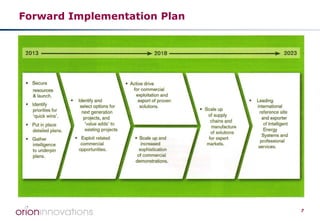
Forward Implementation Plan

7
Key first step
• New Intelligent Energy System Group to be set up under revised
Terms of Reference – overview, guidance and monitoring

1. Immediate Execution
of MATRIX FIP
‘Maintain momentum’

• Drive forward FIP.
• Ministerial level representation
• Recruitment of dynamic and commercially orientated IESNI Delivery
Team for day to day management of FIP – strongly linked to
stakeholders in business, academia and Government

8
The Collaborative Network is a critical interim step
in establishing and resourcing IESNI
IESNI will have to take a visible leadership role in the commercial validation
of IES solutions and accelerate their ‘coming to market’
This entity will:
• Have a visible, dynamic and influential leader with a strong business background.
• Actively leverage the integrated capabilities of NI business and academia
• Specify and develop a ‘reference site’
• Provide a ‘shop window’ and single contact point/voice for NI IES community
• Work with NIE, regulatory bodies and technology companies to develop a common
understanding of the impact of an IES on gas and electricity grids
• Identify the specific components of an IES
• Map this on to what NI companies can provide (products and services)
• Identify the gaps/opportunities for NI companies to respond
• Develop approaches to establishing the costs and benefits of an IES
• Support the integrated development of micro-grid & community energy systems
• Act as a bridge to related activities in other countries
– seek synergies, improvements (made in NI) and market export opportunities

IESNI will need to work closely with a strong and influential counterpart
within Government
9
Questions?
10
Additional Slides

11
Intelligent Energy System
An Intelligent Energy System (IES)
•
•

•
•

Supports the real time monitoring and control required in order to
continuously balance generation and load on the lower voltage grid network
Is a key enabler of grid connected renewables especially those forming part
of a community energy system
• i.e. wind , PV, AD and hydro
Must provide increased robustness and resilience
New products and services will have to be tested at an appropriate scale,
under real operational conditions before scale adoption

In principle NI is ideally suited to be such a test bed
•

From which NI will be able to be exported to (the many) other regions and
countries that face similar grid upgrade challenges

The IES Vision for NI:
•

Within 10 years Northern Ireland will be an internationally recognised
exporter of global solutions forged from the development of the lowest cost,
sustainable energy infrastructure in Europe:
 Created by thriving, indigenous businesses;
 Exploiting the regions natural, intellectual and entrepreneurial capital.
12
Industrial Capacity
Approx 500 companies active in one or more segment; 77 % within wind,
marine, bioenergy and micro renewables.
200

•

Distribution reflects the
general level of maturity of
the segment, and regional
resource potential.

•

In addition, significant no of
companies ‘poised for action’

•

185

Significant diversification
potential from the existing
industrial base.

•

Vast majority micro SMEs
(< 10 employees).

•

Relatively few high profile
corporates, especially OEMs.

•

No activity in large scale solar
PV, fuel cells or hydrogen.

Number of companies

180
160
140
120
100
80
60
40
20
0

119
85
61

55

50
22

17

14

12

6

3

2

0

13
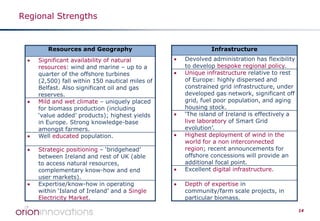
Regional Strengths

Resources and Geography
•

•

•
•

•

Significant availability of natural
resources: wind and marine – up to a
quarter of the offshore turbines
(2,500) fall within 150 nautical miles of
Belfast. Also significant oil and gas
reserves.
Mild and wet climate – uniquely placed
for biomass production (including
‘value added’ products); highest yields
in Europe. Strong knowledge-base
amongst farmers.
Well educated population.
Strategic positioning – ‘bridgehead’
between Ireland and rest of UK (able
to access natural resources,
complementary know-how and end
user markets).
Expertise/know-how in operating
within ‘Island of Ireland’ and a Single
Electricity Market.

Infrastructure
•
•

•
•

•
•

Devolved administration has flexibility
to develop bespoke regional policy.
Unique infrastructure relative to rest
of Europe: highly dispersed and
constrained grid infrastructure, under
developed gas network, significant off
grid, fuel poor population, and aging
housing stock.
‘The island of Ireland is effectively a
live laboratory of Smart Grid
evolution’.
Highest deployment of wind in the
world for a non interconnected
region; recent announcements for
offshore concessions will provide an
additional focal point.
Excellent digital infrastructure.
Depth of expertise in
community/farm scale projects, in
particular biomass.
14
Regional Strengths
Academic Base
•

Academic excellence at QUB and UU
in specific areas of:



Marine – early demo (Seagen is
world’s largest generating tidal
device); impact assessment;



Micro-renewables – adv. heat pumps;



Good international connectivity.
Leading know-how on use of SCR
Willow for biomass at AFBI; and
development of alternative feedstock
for AD at SWC.
Strong applied
research/demonstration and skills
provision via the regional colleges.
Proven successful industrial
collaboration via InnoTech model.

•

Energy infrastructure – power
stabilisation;

•
•

•

Energy Efficiency – adv. glazing;
pcms;



Industrial Capability

•

•

•

•
•

Nascent, and well connected, wind
supply chains with cross over know-how
and expertise of relevance to other
segments such as Marine & Bioenergy.
Proven capability around technology
adaptation, demonstration and system
integration – track record of importing
and adapting technology.
Diversification potential within
manufacturing and engineering base –
precision engineering and metal
fabrication, machining of components,
power take off, prototype manufacture.
Important anchor industrial players
including DONG (big success in
attracting into the region), Bombardier,
Glen Dimplex, Kingspan, Copeland,
McLaughlin & Harvey, FG Wilson & WIS.
Key infrastructure assets.
Can do/will do culture amongst the
rural workforce.
15
Forward Implementation Plan
2018

2013
• Secure
resources &
launch.
• Identify
priorities for
‘quick wins’.
• Put in place
detailed plans.
• Gather
intelligence to
underpin plans.

• Identify and
select options
for next
generation
projects, and
‘value adds’ to
existing
projects
• Exploit related
commercial
opportunities.

• Active drive for
commercial
exploitation and
export of proven
solutions.
• Scale up and
increased
sophistication of
commercial
demonstrations.

2023

• Scale up of
supply chains
and
manufacture
of solutions
for export
markets

• Leading
international
reference site
and exporter
of Intelligent
Energy
Systems and
professional
services.

CORE
Integrated
Sustainable
Energy Reference
Site

Business
Plan

Integrated
Buildings
Reference Site

Feasibility studies
for large scale
integrated projects

Commercial demonstration of fully
integrated and inter connected
network

Scale Up/Next Generation Commercial Reference Sites
Map out potential
prototyping
/manufacturing
capability

Develop related
Service Offerings,
e.g. O&M and Call
Centres

Develop commercial
models for export
markets

Develop logistical capability for volume export markets

ENABLING
Detailed 3 Year
Delivery Plan

Review Delivery
Plan

Develop Market
Intelligence and ‘warm up’
early export markets

Review Delivery
Plan

Review Delivery
Plan

Broaden scope of market intelligence and
relationships with additional export markets

Review and Revise Innovation and Skills Provision (Capacity Building)

Build Global Networks

16

Energy Storage Solutions for an Intelligent Future, Garry Staunton, The Northern Ireland Intelligent Energy Proposition

  • 1.
    The Northern IrelandIntelligent Energy Proposition Beyond the Sustainable Energy Horizon Panel Report Energy Storage Solutions for an Intelligent Future 22nd November 2013 Garry Staunton
  • 2.
    Matrix mission: • • • • To provideadvice to NI government on maximising the economic impact of R&D, science and innovation. Represent the voice of high tech industry Champion the role of Science and Technology. To identify future high tech market opportunities for NI Backdrop: • • • Northern Ireland must move to an economy based on new high-tech, high value-added industries Develop world class capabilities in high technology and high-level scientific skills to capture market share Overcome the perceived disadvantages of a SME based economy Vision: • Supporting NI’s economy based on a Science & Technology Exploitation System which is: • Led by business • Inspired by Academia • Facilitated by Government 1
  • 3.
    Sustainable Energy HorizonStudy Study underpinned by: • • • Technology Capability Mapping Study Review/identification of global market opportunities Identification of barriers Backdrop highlights NI challenges for sustainable energy: • • • • • 40% renewable energy target by 2020 – large. Most capacity will be from relatively cheap onshore wind. Existing grid system not designed to handle this. Resulting in curtailment of wind farms. Present solution is to spend £100’s m on grid upgrades...  which adds cost and delay to project development, and increases electricity bills. Resultant opportunity for NI: • To    make better use of the existing grid system through.... Increased interconnection (N/S and E/W) Energy Storage Demand Side Management …. all working as part of an intelligent energy system...... 2
  • 4.
    Intelligent Energy Systemsare a clear opportunity Vision: NI as an internationally recognised reference site for the demonstration of commercially viable integrated energy solutions that have relevance for global applications and markets . HISTORIC SYSTEM Centralised supply One -way data flow Consumers DG Storage DSM Consumers DG Storage DSM Large scale generation Commercial DG Storage Low voltage distribution Consumers Power • Energy storage – development and demonstration of efficient storage systems at medium and small scales Commercial DG Storage Transmission High voltage distribution • ‘Intelligent’ and grid integrated renewable generation solutions INTELLIGENT SYSTEM Data & controls Innovative market mechanisms and business models Consumers DG Storage DSM • Enabling technologies such as automated control systems • ITC – e.g. the development of ‘open source protocols’ for intelligent control systems • New business models – that enable distributed generation and storage to work cost effectively. 3
  • 5.
    Why NI iswell placed 4
  • 6.
    The Benefits forNorthern Ireland • Facilitates realisation of renewable electricity, renewable heat and energy efficiency targets • Optimise potential for commercial deployment of regional technology e.g. bioenergy, wind, micro renewables and energy storage • Underpins creation of regional supply chains in key technology areas • Raises the profile of the region as an international leader in sustainable energy • Additional environmental benefits, e.g. avoidance of waste disposal & nutrient recycling • Empower consumers to become participants in the energy system • Creates exportable capital in terms of know-how and IP Intelligent Energy Systems 2020-2030 2010-2020 0.8 GW Grid scale energy storage in 2020 £400 bn £600 bn Forecast global investment Grid integration of distributed renewable integration forecast to grow globally from £2.5 bn in 2012 to £8 bn in 2018 – the majority associated with energy storage and micro grids (Pike Research, 2012) 5
  • 7.
  • 8.
  • 9.
    Key first step •New Intelligent Energy System Group to be set up under revised Terms of Reference – overview, guidance and monitoring 1. Immediate Execution of MATRIX FIP ‘Maintain momentum’ • Drive forward FIP. • Ministerial level representation • Recruitment of dynamic and commercially orientated IESNI Delivery Team for day to day management of FIP – strongly linked to stakeholders in business, academia and Government 8
  • 10.
    The Collaborative Networkis a critical interim step in establishing and resourcing IESNI IESNI will have to take a visible leadership role in the commercial validation of IES solutions and accelerate their ‘coming to market’ This entity will: • Have a visible, dynamic and influential leader with a strong business background. • Actively leverage the integrated capabilities of NI business and academia • Specify and develop a ‘reference site’ • Provide a ‘shop window’ and single contact point/voice for NI IES community • Work with NIE, regulatory bodies and technology companies to develop a common understanding of the impact of an IES on gas and electricity grids • Identify the specific components of an IES • Map this on to what NI companies can provide (products and services) • Identify the gaps/opportunities for NI companies to respond • Develop approaches to establishing the costs and benefits of an IES • Support the integrated development of micro-grid & community energy systems • Act as a bridge to related activities in other countries – seek synergies, improvements (made in NI) and market export opportunities IESNI will need to work closely with a strong and influential counterpart within Government 9
  • 11.
  • 12.
  • 13.
    Intelligent Energy System AnIntelligent Energy System (IES) • • • • Supports the real time monitoring and control required in order to continuously balance generation and load on the lower voltage grid network Is a key enabler of grid connected renewables especially those forming part of a community energy system • i.e. wind , PV, AD and hydro Must provide increased robustness and resilience New products and services will have to be tested at an appropriate scale, under real operational conditions before scale adoption In principle NI is ideally suited to be such a test bed • From which NI will be able to be exported to (the many) other regions and countries that face similar grid upgrade challenges The IES Vision for NI: • Within 10 years Northern Ireland will be an internationally recognised exporter of global solutions forged from the development of the lowest cost, sustainable energy infrastructure in Europe:  Created by thriving, indigenous businesses;  Exploiting the regions natural, intellectual and entrepreneurial capital. 12
  • 14.
    Industrial Capacity Approx 500companies active in one or more segment; 77 % within wind, marine, bioenergy and micro renewables. 200 • Distribution reflects the general level of maturity of the segment, and regional resource potential. • In addition, significant no of companies ‘poised for action’ • 185 Significant diversification potential from the existing industrial base. • Vast majority micro SMEs (< 10 employees). • Relatively few high profile corporates, especially OEMs. • No activity in large scale solar PV, fuel cells or hydrogen. Number of companies 180 160 140 120 100 80 60 40 20 0 119 85 61 55 50 22 17 14 12 6 3 2 0 13
  • 15.
    Regional Strengths Resources andGeography • • • • • Significant availability of natural resources: wind and marine – up to a quarter of the offshore turbines (2,500) fall within 150 nautical miles of Belfast. Also significant oil and gas reserves. Mild and wet climate – uniquely placed for biomass production (including ‘value added’ products); highest yields in Europe. Strong knowledge-base amongst farmers. Well educated population. Strategic positioning – ‘bridgehead’ between Ireland and rest of UK (able to access natural resources, complementary know-how and end user markets). Expertise/know-how in operating within ‘Island of Ireland’ and a Single Electricity Market. Infrastructure • • • • • • Devolved administration has flexibility to develop bespoke regional policy. Unique infrastructure relative to rest of Europe: highly dispersed and constrained grid infrastructure, under developed gas network, significant off grid, fuel poor population, and aging housing stock. ‘The island of Ireland is effectively a live laboratory of Smart Grid evolution’. Highest deployment of wind in the world for a non interconnected region; recent announcements for offshore concessions will provide an additional focal point. Excellent digital infrastructure. Depth of expertise in community/farm scale projects, in particular biomass. 14
  • 16.
    Regional Strengths Academic Base • Academicexcellence at QUB and UU in specific areas of:  Marine – early demo (Seagen is world’s largest generating tidal device); impact assessment;  Micro-renewables – adv. heat pumps;  Good international connectivity. Leading know-how on use of SCR Willow for biomass at AFBI; and development of alternative feedstock for AD at SWC. Strong applied research/demonstration and skills provision via the regional colleges. Proven successful industrial collaboration via InnoTech model. • Energy infrastructure – power stabilisation; • • • Energy Efficiency – adv. glazing; pcms;  Industrial Capability • • • • • Nascent, and well connected, wind supply chains with cross over know-how and expertise of relevance to other segments such as Marine & Bioenergy. Proven capability around technology adaptation, demonstration and system integration – track record of importing and adapting technology. Diversification potential within manufacturing and engineering base – precision engineering and metal fabrication, machining of components, power take off, prototype manufacture. Important anchor industrial players including DONG (big success in attracting into the region), Bombardier, Glen Dimplex, Kingspan, Copeland, McLaughlin & Harvey, FG Wilson & WIS. Key infrastructure assets. Can do/will do culture amongst the rural workforce. 15
  • 17.
    Forward Implementation Plan 2018 2013 •Secure resources & launch. • Identify priorities for ‘quick wins’. • Put in place detailed plans. • Gather intelligence to underpin plans. • Identify and select options for next generation projects, and ‘value adds’ to existing projects • Exploit related commercial opportunities. • Active drive for commercial exploitation and export of proven solutions. • Scale up and increased sophistication of commercial demonstrations. 2023 • Scale up of supply chains and manufacture of solutions for export markets • Leading international reference site and exporter of Intelligent Energy Systems and professional services. CORE Integrated Sustainable Energy Reference Site Business Plan Integrated Buildings Reference Site Feasibility studies for large scale integrated projects Commercial demonstration of fully integrated and inter connected network Scale Up/Next Generation Commercial Reference Sites Map out potential prototyping /manufacturing capability Develop related Service Offerings, e.g. O&M and Call Centres Develop commercial models for export markets Develop logistical capability for volume export markets ENABLING Detailed 3 Year Delivery Plan Review Delivery Plan Develop Market Intelligence and ‘warm up’ early export markets Review Delivery Plan Review Delivery Plan Broaden scope of market intelligence and relationships with additional export markets Review and Revise Innovation and Skills Provision (Capacity Building) Build Global Networks 16